Diagramming sentences provides a way of picturing the structure of a sentence. By placing the various parts of a sentence in relation to the basic subject-verb relationship, we can see how the parts fit together and how the meaning of a sentence branches out, just as the branches of a plant ramify from the stem in space and time. Most students who work at diagramming sentences derive a clearer understanding of how sentences work — as well as satisfaction in the pictorial rendering of sentence structure. This presentation touches upon only the basics of diagramming. Use the hyperlinks back to the Guide to Grammar and Writing (this color) for additional information.
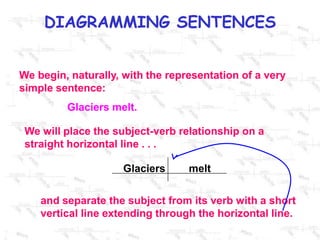
We begin, naturally, with the representation of a very simple sentence:Glaciers melt.We will place the subject-verb relationship on a straight horizontal line . . . Glaciers        meltand separate the subject from its verb with a short vertical line extending through the horizontal line.
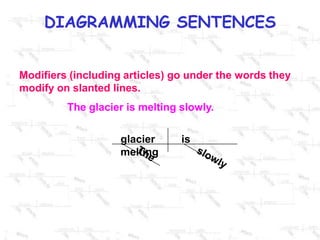
Modifiers (including articles) go under the words they modify on slanted lines.The glacier is melting slowly.glacier         is meltingTheslowly
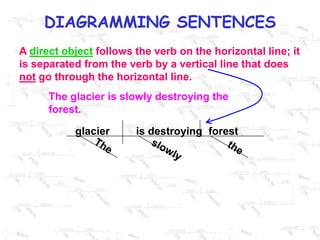
A direct object follows the verb on the horizontal line; it is separated from the verb by a vertical line that does not go through the horizontal line.The glacier is slowly destroying the forest.glacier         is destroyingforestThetheslowly
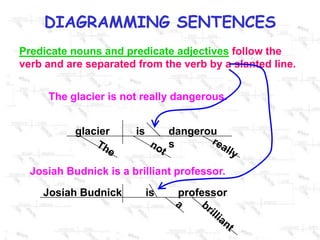
Predicate nouns and predicate adjectives follow the verb and are separated from the verb by a slanted line.The glacier is not really dangerous.glacier         isdangerousThenotreallyJosiah Budnick is a brilliant professor.Josiah Budnick        is        professorabrilliant
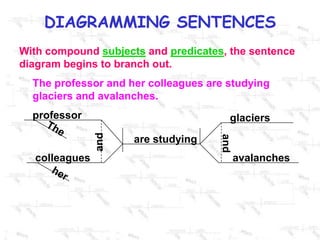
With compound subjects and predicates, the sentence diagram begins to branch out.The professor and her colleagues are studying glaciers and avalanches.professorglaciersTheandare studyingandcolleaguesavalanchesher
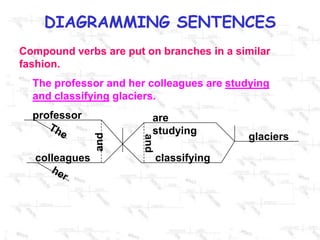
Compound verbs are put on branches in a similar fashion.The professor and her colleagues are studying and classifying glaciers.professorare studyingTheandglaciersandcolleaguesclassifyingher
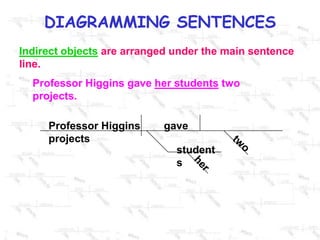
Indirect objects are arranged under the main sentence line.Professor Higgins gave her students two projects.Professor Higgins        gave               projectstwostudentsher
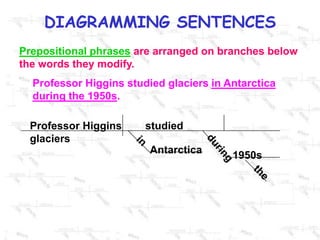
Prepositional phrases are arranged on branches below the words they modify.Professor Higgins studied glaciers in Antarcticaduring the 1950s.Professor Higgins        studied                          glaciersinAntarctica1950sduringthe
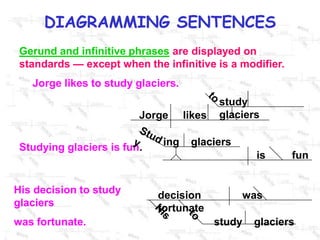
Gerund and infinitive phrases are displayed on standards — except when the infinitive is a modifier.Jorge likes to study glaciers.tostudy   glaciersJorge     likesStudying    glaciersStudying glaciers is fun.is         funHis decision to study glacierswas fortunate.decision              was       fortunateHistostudy    glaciers
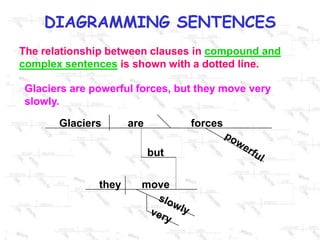
The relationship between clauses in compound and complex sentences is shown with a dotted line.Glaciers are powerful forces, but they move very slowly.Glaciers         are                forcespowerfulbutthey       moveslowlyvery
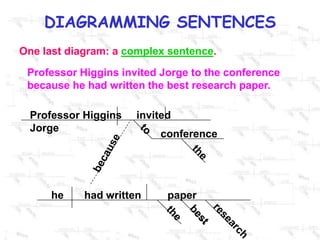
One last diagram: a complex sentence.Professor Higgins invited Jorge to the conference because he had written the best research paper.Professor Higgins     invited       Jorgetoconferencebecausethehe       had written         paperbesttheresearch
Congratulations!

Diagramming sentences

  • 1.
    Diagramming sentences providesa way of picturing the structure of a sentence. By placing the various parts of a sentence in relation to the basic subject-verb relationship, we can see how the parts fit together and how the meaning of a sentence branches out, just as the branches of a plant ramify from the stem in space and time. Most students who work at diagramming sentences derive a clearer understanding of how sentences work — as well as satisfaction in the pictorial rendering of sentence structure. This presentation touches upon only the basics of diagramming. Use the hyperlinks back to the Guide to Grammar and Writing (this color) for additional information.
  • 2.
    We begin, naturally,with the representation of a very simple sentence:Glaciers melt.We will place the subject-verb relationship on a straight horizontal line . . . Glaciers meltand separate the subject from its verb with a short vertical line extending through the horizontal line.
  • 3.
    Modifiers (including articles)go under the words they modify on slanted lines.The glacier is melting slowly.glacier is meltingTheslowly
  • 4.
    A direct objectfollows the verb on the horizontal line; it is separated from the verb by a vertical line that does not go through the horizontal line.The glacier is slowly destroying the forest.glacier is destroyingforestThetheslowly
  • 5.
    Predicate nouns andpredicate adjectives follow the verb and are separated from the verb by a slanted line.The glacier is not really dangerous.glacier isdangerousThenotreallyJosiah Budnick is a brilliant professor.Josiah Budnick is professorabrilliant
  • 6.
    With compound subjectsand predicates, the sentence diagram begins to branch out.The professor and her colleagues are studying glaciers and avalanches.professorglaciersTheandare studyingandcolleaguesavalanchesher
  • 7.
    Compound verbs areput on branches in a similar fashion.The professor and her colleagues are studying and classifying glaciers.professorare studyingTheandglaciersandcolleaguesclassifyingher
  • 8.
    Indirect objects arearranged under the main sentence line.Professor Higgins gave her students two projects.Professor Higgins gave projectstwostudentsher
  • 9.
    Prepositional phrases arearranged on branches below the words they modify.Professor Higgins studied glaciers in Antarcticaduring the 1950s.Professor Higgins studied glaciersinAntarctica1950sduringthe
  • 10.
    Gerund and infinitivephrases are displayed on standards — except when the infinitive is a modifier.Jorge likes to study glaciers.tostudy glaciersJorge likesStudying glaciersStudying glaciers is fun.is funHis decision to study glacierswas fortunate.decision was fortunateHistostudy glaciers
  • 11.
    The relationship betweenclauses in compound and complex sentences is shown with a dotted line.Glaciers are powerful forces, but they move very slowly.Glaciers are forcespowerfulbutthey moveslowlyvery
  • 12.
    One last diagram:a complex sentence.Professor Higgins invited Jorge to the conference because he had written the best research paper.Professor Higgins invited Jorgetoconferencebecausethehe had written paperbesttheresearch
  • 13.