













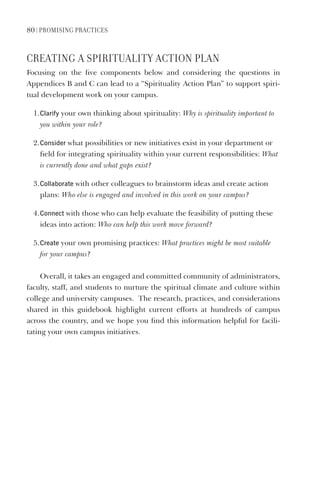







00_PP_cover_1f.indd 1 5/12/11 4:55 PM
A Guidebook of
Promising
Practices
Facilitating College Students’
Spiritual Development
Jennifer A. Lindholm • Melissa L. Millora
Leslie M. Schwartz • Hanna Song Spinosa
A Guidebook of
Promising
Practices
Facilitating College Students’
Spiritual Development
A Guidebook of Promising Practices: Facilitating College Students’ Spiritual Development
Copyright © 2011 by the Regents of the University of California. All rights reserved.
Except for use in any review, the reproduction or utilization of this work in whole or in part in any form
by electronic, mechanical, or other means, now known or hereafter invented, including a retrieval system is
forbidden without the permission of the Regents of the University of California.
ISBN-13: 978-1456456856
ISBN-10: 1456456857
BISAC: Education / Students & Student Life
Printed in the United States of America
first edition
v
Foreword
The idea for this guidebook grew out of a national study of students’ spiritual
development, which was initiated at UCLA’s Higher Education Research Insti-
tute in 2003 under a grant from the John Templeton Foundation. The major
findings from that study, which are reported in the recently released book,
Cultivating the Spirit: How College Can Enhance Students’ Inner Lives (authored by
the two of us and our colleague Jennifer Lindholm), convinced us that it was
time for higher education to increase its efforts to promote students’ spiritual
development. We believe that assisting more students to grow spiritually will
help to create a new generation of young adults who are more caring, more
globally aware, and more committed to social justice than previous genera-
tions. At the same time, it will enable them to respond with greater equanimity
to the many stresses and tensions of our rapidly changing technological society.
This conclusion was supported by a number of our study’s specific
findings: that a large majority of contemporary students are actively engaged
in a spiritual quest; that many expect their colleges to assist them in this
quest; and that our colleges and universities have demonstrated the capacity
to facilitate students’ spiritual development in many of their curricular and
co-curricular programs. Our study also shows that providing students with
more opportunities to touch base with their “inner selves” will facilitate
growth in their academic and leadership skills, contribute to their intellec-
tual self-confidence and psychological well-being, and enhance their satisfac-
tion with the college experience.
If a college or university wishes to undertake new initiatives that will foster
students’ spiritual growth, it is useful to know something about what other insti-
tutions are doing. We decided to produce this guidebook in order to provide
faculty and staff with a broad sampling of current programs and practices that
are designed to encourage students to explore their inner lives and to facilitate
students’ spiritual development.
In this search to learn from the field, we have been impressed with the
energy, creativity, and commitment already being shown by many higher
vi | Promising Practices
education colleagues who have created courses, co-curricular programs, and
other strategies to assist students in their spiritual journeys.
More than 400 institutions responded to our call for examples of promising
practices. What they have reported back to us ranges from undergraduate
degree programs, majors, and minors to specialized courses and seminars
dealing with many of the “big questions,” which touch on issues of morality,
love, suffering, social justice, and social transformation. They incorporate
practices ranging from meditation and yoga to stress management. They
involve diverse subjects such as interfaith relations or depression, as well as
practical issues such as mindful living in residence halls and the development
of life skills. Some institutions have established centers devoted to activities
that facilitate spiritual development; others have created physical spaces for
meditation or reflection. A number of institutions also provide opportunities
for the spiritual development of faculty and staff, assisting personnel who may
wish to undertake this important work.
Major responsibility for producing this guidebook has been assumed by
our Cultivating the Spirit coauthor, Jennifer Lindholm, together with three
current and former members of our project team: Melissa (“Lisa”) Millora,
Leslie Schwartz, and Hanna Spinosa.
1
These colleagues have done a superb
job in canvassing colleges and universities across the country to determine
promising practices that are already in place, and especially in organizing
the considerable amount of information that they received in user-friendly
fashion. We all owe a debt of gratitude to them and the hundreds of people on
campuses who provided us with information about their programs.
We were pleased to learn that so many institutions of virtually every type
are already involved in a wide variety of innovative programs and practices to
enhance and enrich the inner lives of their students. It is our hope that the
publication of this guidebook will encourage many other colleges and univer-
sities to undertake similar efforts.
Helen S. Astin
Alexander W. Astin
Co-Principal Investigators
1
The authors of the guidebook are listed alphabetically.
vii
Preface
Throughout the course of the Spirituality in Higher Education project, higher
education professionals have expressed to our research team their desire to
learn how to facilitate students’ spiritual development via campus initiatives.
They ask: “As a professor, for example, how might I create a course that explores
spirituality within the context of my particular subject matter?”; “as a student
leader, how can I work with my peers to bring awareness and attention to the
different ways in which people experience spirituality in order to promote
cross-cultural understanding?”; or, “as an administrator, what would be an
effective approach for engaging different segments of the campus community
in developing a strategic plan focused on students’ spiritual development?”
In response, we have conceptualized Promising Practices as a resource for
those within higher education who are interested in attending to issues of
spirituality, meaning, and purpose as part of the undergraduate experience.
This guidebook includes descriptions of some of the practices, programs, and
syllabi that campus personnel have shared with us. We hope that these descrip-
tions serve as models and spark new ideas for promoting spiritual develop-
ment on campus.
Content and organization of this guidebook
Part I, “Spirituality in Higher Education,” describes briefly the background
of the research project and explains how the research team conceptualized
spirituality.
Part II, “Spirituality on Campus Today,” offers an overview of contem-
porary trends, discusses spirituality in the context of today’s students and
campuses, and provides examples of how various campus groups (adminis-
trators, faculty and academic affairs personnel, student affairs professionals,
and student leaders) can engage students in spiritual development work.
Part III, “Promising Practices,” highlights some of the specific practices
and programs that colleagues from across the country have shared with us.
These resources are grouped into the following main headings: Curricular
viii | Promising Practices
Initiatives and Teaching Strategies, Co-Curricular Programs and Services,
and Campus-wide Efforts. While you may anticipate that one of these
categories is most directly relevant to your particular role on campus, we
encourage you to explore each section. For additional details about selected
programs and practices contained within this guidebook, we encourage you
to contact colleagues at those institutions (see Contributors, p. 101).
aCknowledgments
Numerous individuals and groups have contributed to this guidebook. We
thank the John Templeton Foundation for its generous support, which made
this work possible, as well as the research our team conducted through the
Spirituality in Higher Education project. We are also grateful to all those who
responded to our requests for information about their campuses’ innovative
practices. (A list of those individuals can be found at the back of this book.) We
also thank the UCLA Graduate School of Education & Information Studies and
the Higher Education Research Institute for their support of the Spirituality in
Higher Education project over the last decade. Finally, we are tremendously
appreciative of the roles that Helen (“Lena”) Astin and Alexander (“Sandy”)
Astin have played in our lives as teachers, mentors, colleagues, and friends.
ix
contents
i. spirituality in higher eduCation.................................................. 1
Project Background ................................................................................... 3
Conceptualizing Spirituality...................................................................... 4
Spirituality Measures ................................................................................. 5
Practice Informed by Research.................................................................. 7
ii. spirituality on Campus today...................................................... 11
Supporting Students’ Spiritual Development ......................................... 14
The Role of Campus Personnel in Facilitating Students’ Spiritual
Development........................................................................................... 15
Administrators ..................................................................................... 15
Faculty and Academic Personnel............................................................ 16
Student Affairs Professionals ................................................................. 16
Student Leaders................................................................................... 17
iii. promising praCtiCes....................................................................... 21
Participating Institutions......................................................................... 24
Curricular Initiatives and Teaching Strategies........................................ 25
Academic Degree Programs ................................................................... 25
Courses and Other Curricular Innovations ............................................ 26
• Big Questions or Spiritual Exploration
• Spirituality and Wellness
• Religious Studies Courses and Departments
Teaching Methods ................................................................................ 31
Co-Curricular Programs and Services..................................................... 33
Awareness Weeks and Events................................................................. 34
Spiritual Mentoring............................................................................. 36
Caring and Compassion for Others........................................................ 37
Service and Immersion Programs .......................................................... 38
Encouraging a Search for Vocation........................................................ 40
x | Promising Practices
Co-Curricular Programs and Services (continued from the previous page)
Dialogues About Spirituality and Religion ............................................. 41
• Dialogues About Spirituality
• Religious Dialogues
• Interfaith Dialogues
Meditation, Reflection, and Retreats...................................................... 50
General Wellness.................................................................................. 51
Student Leadership Training and Governance........................................ 53
Campus-wide Efforts ............................................................................... 56
Leadership and Strategic Planning ....................................................... 56
• Administrative Positions, Committees, and Councils
• Mission Statements and Strategic Plans
Campus Centers and Organizational Units ............................................ 59
Residence Life Initiatives...................................................................... 61
First-year Experience............................................................................ 62
University-wide Initiatives.................................................................... 63
Faculty and Staff Development.............................................................. 65
• Orientation and Professional Development
• Opportunities for Faculty and Staff to Explore Spirituality
Recognition and Rewards..................................................................... 69
Designated Physical Spaces................................................................... 70
Financial Support for Initiatives Relating to Spiritual Development ............. 72
iV. ConCluding thoughts.................................................................... 75
appendiCes
Appendix A: Summer 2010 Campus Survey........................................... 83
Appendix B: Considerations for Campus Groups .................................. 86
Appendix C: Personal Action Plan.......................................................... 88
referenCes.............................................................................................. 89
indiCes
Index A: Key Concepts............................................................................ 90
Index B: Participating Institutions.......................................................... 94
Contributors .......................................................................................... 101
3
Part I
Spirituality in
Higher Education
PrOJECt BaCKGrOUND
In early 2003, a UCLA research team led by Alexander Astin, Helen Astin,
and Jennifer Lindholm embarked on a seven-year journey to examine how
students’ spiritual qualities change during their undergraduate years, and
what role the college experience plays in facilitating their spiritual develop-
ment. Titled Spirituality in Higher Education: A National Study of College Students’
Search for Meaning and Purpose, the project was funded by the John Templeton
Foundation. It was the first national longitudinal study of college students’
spiritual growth and also focused on how college and university faculty view
the intersections between spirituality and higher education.
The primary reason for undertaking the study was a shared belief among
the lead researchers that spirituality is fundamental to students’ lives. The “big
questions” that preoccupy students are essentially spiritual questions: Who am
I? What is my purpose? What is the meaning of life? What kind of person do
I want to become? What sort of world do I want to help to create? When we
speak of students’ “spiritual quest,” we are essentially speaking of their efforts
to seek answers to such questions.
How students deal with these questions has important implications for
many practical decisions they will have to make, including their choices of
courses, majors, and careers, not to mention whether they opt to stay in
college or drop out and whether they decide to pursue postgraduate study.
Seeking answers to these questions is also directly relevant to the develop-
ment of personal qualities, such as self-understanding, empathy, caring, and
social responsibility.
Another compelling motivation for engaging in this work was a collec-
tive sentiment of the researchers that, over time, the relative amount of atten-
4 | PrOmISING PraCtICES
tion that colleges and universities devote to the “inner” and “outer” aspects
of students’ lives has become significantly imbalanced. That sentiment, along
with growing unease about our institutions and our society, has led some of us
to start talking much more openly about the importance of cultivating “inner,”
or spiritual, qualities.
Envisioning campus communities in which the life of the mind and the
life of the spirit are mutually celebrated, supported, and sustained necessitates
that our higher education community must reconsider our traditional ways
of being and doing. We must be open to broadening our existing frames of
reference and willing to look closely not just at what we do (or do not do) on a
daily basis, but why, considering the motivations behind our thoughts, beliefs,
and actions.
To support those efforts, we developed Promising Practices, a guidebook for
those within higher education who are interested in incorporating elements
of spirituality, meaning, and purpose into campus life. In this guidebook, we
highlight both campus-wide initiatives and specifically tailored institutional
practices, aiming to supplement existing programs and courses with teaching
methods and practices that facilitate spiritual development. We envision that
others can potentially adapt these practices to support their own institutional
interests and needs. As educators, researchers, practitioners, and students
who are committed to supporting students’ spiritual development, we are
hopeful that work to facilitate students’ spiritual development may continue
to expand and flourish.
CONCEPtUaLIZING SPIrItUaLItY
From the project’s outset, the Spirituality in Higher Education research team
has conceptualized spirituality as pointing to our inner, subjective life, as
contrasted to the objective domain of observable behavior and material objects.
Spirituality involves our affective experiences at least as much as it does our
reasoning and logic. It is reflected in the values and ideals that we hold most
dear, our sense of who we are and where we come from, our beliefs about why
we are here—the meaning and purpose we see in our lives—and our connect-
edness to each other and to the world around us. Spirituality also captures
SPIrItUaLItY IN HIGHEr EDUCatION | 5
those aspects of our experience that are not easy to define or talk about, such
as intuition, inspiration, the mysterious, and the mystical.
We acknowledge that each individual will view his or her spirituality in a
unique way. For some, traditional religious beliefs compose the core of their
spirituality; for others, such beliefs or traditions may play little or no part.
For those of us who conducted the Spirituality in Higher Education study, the
focal point of the research project was to discern the level and intensity of
spiritual experience among college students and to understand how colleges
can support students in their growth through this experience; it was not to
determine how students define their spirituality or what particular meaning
they make of their lives.
Framed by five of the measures created during the longitudinal study, members
of the research team developed the following definition:
Spirituality is a multifaceted quality that involves an active quest for
answers to life’s “big questions” (Spiritual Quest), a global worldview that
transcends ethnocentrism and egocentrism (Ecumenical Worldview), a
sense of caring and compassion for others (Ethic of Caring) coupled with
a lifestyle that includes service to others (Charitable Involvement), and a
capacity to maintain one’s sense of calm and centeredness, especially in
times of stress (Equanimity).
In the next section, we define and describe each of these measures in
greater depth.
SPIrItUaLItY mEaSUrES
One of the goals in conducting the Spirituality in Higher Education study
was to develop measures that address various dimensions of spirituality and
religiousness. Toward that end, the team searched for clusters of survey-
questionnaire items that formed coherent patterns reflective of underlying
traits. Through this process, we identified five spiritual measures: Spiritual Quest,
Equanimity, Ethic of Caring, Charitable Involvement, and Ecumenical Worldview.
6 | PrOmISING PraCtICES
SpIrItual QuESt
Spiritual Quest is at the heart of students’ spiritual development. It captures the
degree to which an individual is actively searching for meaning and purpose,
desiring to find wisdom, and seeking answers to life’s mysteries and “big
questions.” Each of the individual items that compose this heavily process-
oriented measure includes words such as “finding,” “attaining,” “seeking,”
“developing,” “searching,” or “becoming.”
EQuanImIty
Equanimity may well be the prototypic quality of a spiritual person. It
measures the extent to which the student is able to find meaning in times
of hardship, feels at peace or centered, sees each day as a gift, and feels
good about the direction of his or her life. Equanimity plays an important
role in the quality of undergraduate students’ lives because it helps shape
how they respond to their experiences, particularly those that are poten-
tially stressful.
EthIC of CarIng
Ethic of Caring reflects our sense of caring and concern about the welfare of
others and the world around us. These feelings are expressed in wanting to
help those who are troubled and to alleviate suffering. It includes a concern
about social justice issues and an interest in the welfare of one’s community
and the environment, as well as a commitment to political activism.
CharItablE InvolvEmEnt
In contrast to Ethic of Caring, which emphasizes “caring about,” Charitable
Involvement emphasizes “caring for.” This behavioral measure includes activi-
ties such as participating in community service, donating money to charity,
and helping friends with personal problems.
ECumEnICal WorldvIEW
Ecumenical Worldview reflects a global worldview that transcends ethnocentrism
and egocentrism. It indicates the extent to which the student is interested in
different religious traditions, seeks to understand other countries and cultures,
feels a strong connection to all humanity, believes in the goodness of all people,
SPIrItUaLItY IN HIGHEr EDUCatION | 7
accepts others as they are, and believes that all life is interconnected and that
love is at the root of all the great religions.
These five spiritual measures, which help to articulate various aspects of
individuals’ experiences, are critical aspects of college student develop-
ment. By researching how these measures interface with students’ college
experience, the Spirituality in Higher Education research team has gained a
deeper understanding of the impact that higher education has on students’
spiritual development. Selected study findings are discussed in the next
section along with implications for supporting and fostering students’
spiritual growth in college.
PraCtICE INFOrmED BY rESEarCH
The 2004-07 longitudinal College Students’ Beliefs and Values (CSBV) Survey
entailed analysis of extensive data collected from 14,527 students attending 136
colleges and universities nationwide. To support that work, the research team
conducted individual and focus-group interviews with students, and surveyed
and interviewed faculty.
2
The findings provide a powerful argument in support
of the proposition that higher education should attend more purposefully to
students’ spiritual development.
In the book Cultivating the Spirit: How College Can Enhance Students’ Inner
Lives (Astin, Astin, & Lindholm, 2011), the Spirituality in Higher Education
project’s lead researchers detail how students change during college on each
of the five spiritual measures described earlier: Spiritual Quest, Equanimity,
Ethic of Caring, Charitable Involvement, and Ecumenical Worldview. Changes
over time on five religious measures—religious Commitment, religious Engage-
ment, religious/Social Conservatism, religious Skepticism, and religious Struggle—
are also examined. Ultimately considered are how student change on each
measure affects traditional undergraduate education outcomes (e.g. academic
skills, satisfaction with college), and how different college experiences tend to
impact students’ spiritual development.
2
Survey questionnaires and interview protocols are available on the project website: www.spirituality.ucla.edu.
8 | PrOmISING PraCtICES
Findings from the longitudinal study show that when they enter college as
freshmen:
• Students have very high levels of spiritual interest and involvement.
Many are actively engaged in a spiritual quest and are exploring
meaning and purpose in life. They also display high levels of religious
commitment and involvement.
• Students also have high expectations for the role their educational
institutions will play in their emotional and spiritual development. They
place great value on their colleges enhancing their self-understanding,
helping them develop personal values, and encouraging their expression
of spirituality.
Additionally, during college:
• religious Engagement declines somewhat, yet students’ spiritual qualities
grow substantially.
• Students show the greatest degree of growth in the five spiritual quali-
ties if they are actively engaged in “inner work” through self-reflection,
contemplation, and/or meditation.
• Students also show substantial increases in Spiritual Quest when their
faculty encourage them to explore questions of meaning and purpose or
otherwise show support for their spiritual development.
• Engagement in most forms of Charitable Involvement—community service
work, helping friends with personal problems, donating money to
charity—promotes the development of other spiritual qualities.
• Growth in Equanimity enhances students’ grade-point average, leadership
skills, psychological well-being, self-rated ability to get along with other
races and cultures, and satisfaction with college.
• Growth in Ethic of Caring and Ecumenical Worldview enhances students’
interest in postgraduate study, self-rated ability to get along with other
races and cultures, and commitment to promoting racial understanding.
SPIrItUaLItY IN HIGHEr EDUCatION | 9
• Educational experiences and practices that promote spiritual devel-
opment—especially service learning, interdisciplinary courses, study
abroad, self-reflection, and meditation—have uniformly positive effects
on traditional college outcomes.
• Providing students with more opportunities to connect with their “inner
selves” facilitates growth in students’ academic and leadership skills,
contributes to their intellectual self-confidence and psychological well-
being, and enhances their satisfaction with college.
These findings paint a picture of how specific college experiences can influ-
ence the spiritual growth and development of traditionally aged students
during the undergraduate years. For those interested in more detail about the
development and utilization of these measures in our research, please see the
project website (www.spirituality.ucla.edu) or Cultivating the Spirit. In Part II, we
discuss the current context of spirituality on campus, and general strategies for
integrating spirituality into higher education.
13
Part II
Spirituality on
Campus today
As detailed in Cultivating the Spirit, America’s higher education system
currently is being challenged to focus more purposely on students’ holistic
development, including nurturing the spiritual identities of students, faculty,
and staff. Holistic student learning and development include “vocational,
professional, intellectual, cognitive, social, civic, political, moral, ethical,
spiritual, and religious dimensions, and focus on values clarification and
character development” (Trautvetter, 2007, pp. 238-239).
While the philosophy that colleges and universities should educate the
whole student—mind, body, and spirit—is not new, institutions’ approaches
to this work have varied over the more than 300 years since the first American
college was established. At many of the earliest colleges, attention to the
spirit once took the form of character development through training in moral
philosophy and ethics. Over time, however, this focus has waned (Cohen,
1998; Reuben, 1996).
Today, particularly in secular institutions, many campus personnel tend
to conceptualize spirituality as linked inextricably with religion. By exten-
sion, they believe that apart from the work of their religious life colleagues,
attending to spiritual aspects of students’ lives has no legitimate place within
the academy. As elaborated in Cultivating the Spirit, however, secular institu-
tions can provide a rich environment for students to explore the spiritual
dimension of their lives. Indeed, the broad formative roles that colleges and
universities of all types continue to play in our society, combined with their
long-standing commitment to liberal learning, position them to attend to
the development of both mind and spirit.
14 | PromISIng PraCtICeS
SUPPortIng StUDentS’ SPIrItUaL DeVeLoPment
When they enter college as new freshmen, many students express high expecta-
tions for their own spiritual development. More than eight in 10, for example,
report that “to find my purpose in life” is at least a “somewhat” important
reason for attending college. Fully half say it’s a “very important” reason.
Two-thirds of new freshmen also say that it is either “very important” or “essen-
tial” that college “helps you develop your personal values” and “enhances
your self-understanding” (Astin, Astin, & Lindholm, 2011). Findings from the
Spirituality in Higher Education project support the notion that many students
come to college today seeking spaces where their contributions and self-worth
matter beyond salaries, GPAs, or the prestige of future careers (see e.g. Howe
& Strauss, 2007).
The undergraduate experience offers students numerous opportunities to
explore issues of meaning, purpose, and faith as they engage with peers, faculty,
and staff who embody various backgrounds, beliefs, and practices. Exposure to
new and diverse perspectives is valuable in challenging students to compare,
examine, and clarify their own personal beliefs and values in a communal
setting (see e.g. Palmer, 1990). Our project findings, as detailed in Cultivating
the Spirit, support the notion that exposure to diverse people, cultures, and
ideas—through study abroad, interdisciplinary coursework, leadership educa-
tion, service learning, and other forms of civic engagement—helps students
better understand, and value, multiple perspectives. These capacities are
especially critical given the complex social, economic, and political challenges
of our time.
As students encounter difference in college, they are challenged to grow
and change. For many, college may be the first time they have questioned
“truth” and “reality.” Indeed, the college experience can be critical in helping
students explore and clarify their faith, beliefs, and values. Experiencing
“disequilibrium” or spiritual struggle provides students with opportunities
to analyze their life circumstances and the deeper meaning and purpose
that they are seeking as they strive to live more connected, integrated lives
(Fowler, 1981; Parks, 2000). The challenge for campus personnel, then,
becomes how to effectively address issues related to the spiritual dimension
of students’ lives.
SPIrItUaLIty on CamPUS toDay | 15
tHe roLe oF CamPUS PerSonneL In FaCILItatIng
StUDentS’ SPIrItUaL DeVeLoPment
Findings from the Spirituality in Higher Education longitudinal study and those
reported in Cultivating the Spirit indicate that many students are eager to
explore their own spiritual identities and come to a deeper understanding
of meaning, purpose, and faith in their lives. These findings echo the call of
other scholars to: 1) amplify the importance they place on spiritual growth,
authenticity, purpose, and meaning and 2) view spiritual issues and consid-
erations as legitimate concerns within our campus communities (Braskamp,
Trautvetter, & Ward, 2006; Chickering, Dalton, & Stamm, 2006).
Within each campus, there are multiple ways for campus personnel
to support students’ spiritual development. Appreciating that many effec-
tive institutional practices are the products of collaborative efforts, below we
provide suggestions for how individual members of a campus community can
promote students’ spiritual development.
AdministrAtors
We consider administrators to be members of the campus whose student
interactions are more functional in nature. Campus administrators may be
admissions officers, financial aid counselors, directors of campus ministry,
deans of religious life, deans of students, vice presidents, provosts, and senior
campus executives. Within these positions, administrators can both directly
and indirectly support students’ spiritual development by:
• Considering how mission and vision statements, along with strategic
plans, can communicate an institution’s commitment or openness to
supporting students’ spiritual development;
• Fostering a campus climate that supports open conversations about spiritual
development by modeling these dialogues with colleagues and students;
• Creating and designating physical spaces for reflective practice; and
• Developing organizational structures to coordinate, implement, and
maintain practices and programs that encourage spiritual development
and facilitate campus-wide collaboration.
16 | PromISIng PraCtICeS
FAculty And AcAdemic Personnel
The realm of Academic Affairs refers to faculty members along with lecturers,
teaching assistants, researchers, and other academic members of the campus
community. The amount of time that faculty and other academic personnel
spend on research, teaching, and service varies by campus, but faculty may
find ways to incorporate spiritual development work into any of their areas of
responsibility. Strategies include:
• Encouraging spiritually related discussions within the classroom (e.g.
including course content about the “Big Questions” or spiritual practices);
• Exposing students to various values, belief systems, and ways of living to
build respect for differences across various disciplinary settings;
• Sharing personal experiences of spiritual struggle or quest for meaning,
purpose, and truth with colleagues and students when appropriate;
• Providing emotional support for students in crisis and making appro-
priate referrals to student affairs professionals;
• Recognizing that students have lives beyond the walls of the classroom
and exercising compassion where these issues come into play; and
• Challenging students to search for ways to find meaning and purpose
within their field of study and related career choices.
student AFFAirs ProFessionAls
For the purposes of this guidebook, we consider student affairs professional
to be practitioners whose primary roles involve educating, supporting, and
challenging students outside the classroom. These practitioners often work
in academic advising, career services, health and wellness centers, residen-
tial life, diversity and multicultural education, campus recreation, cultural
centers, and student activities and leadership offices. Student affairs profes-
sionals can help facilitate students’ spiritual development by:
• Learning more about spiritual development and the role it plays in
students’ lives;
SPIrItUaLIty on CamPUS toDay | 17
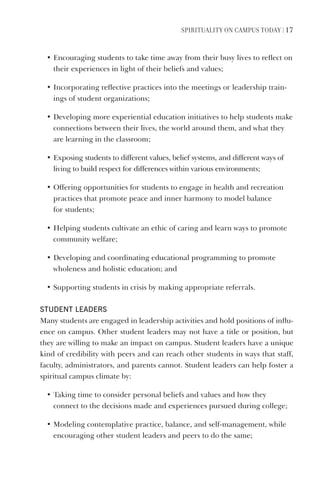
• Encouraging students to take time away from their busy lives to reflect on
their experiences in light of their beliefs and values;
• Incorporating reflective practices into the meetings or leadership train-
ings of student organizations;
• Developing more experiential education initiatives to help students make
connections between their lives, the world around them, and what they
are learning in the classroom;
• Exposing students to different values, belief systems, and different ways of
living to build respect for differences within various environments;
• Offering opportunities for students to engage in health and recreation
practices that promote peace and inner harmony to model balance
for students;
• Helping students cultivate an ethic of caring and learn ways to promote
community welfare;
• Developing and coordinating educational programming to promote
wholeness and holistic education; and
• Supporting students in crisis by making appropriate referrals.
student leAders
Many students are engaged in leadership activities and hold positions of influ-
ence on campus. Other student leaders may not have a title or position, but
they are willing to make an impact on campus. Student leaders have a unique
kind of credibility with peers and can reach other students in ways that staff,
faculty, administrators, and parents cannot. Student leaders can help foster a
spiritual campus climate by:
• Taking time to consider personal beliefs and values and how they
connect to the decisions made and experiences pursued during college;
• Modeling contemplative practice, balance, and self-management, while
encouraging other student leaders and peers to do the same;
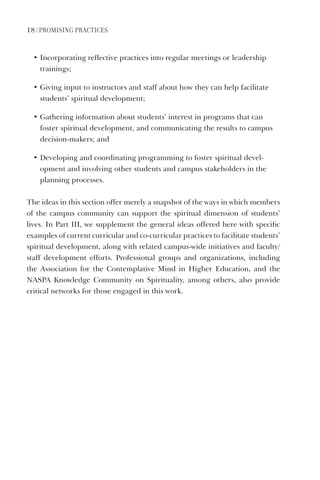
18 | PromISIng PraCtICeS
• Incorporating reflective practices into regular meetings or leadership
trainings;
• Giving input to instructors and staff about how they can help facilitate
students’ spiritual development;
• Gathering information about students’ interest in programs that can
foster spiritual development, and communicating the results to campus
decision-makers; and
• Developing and coordinating programming to foster spiritual devel-
opment and involving other students and campus stakeholders in the
planning processes.
The ideas in this section offer merely a snapshot of the ways in which members
of the campus community can support the spiritual dimension of students’
lives. In Part III, we supplement the general ideas offered here with specific
examples of current curricular and co-curricular practices to facilitate students’
spiritual development, along with related campus-wide initiatives and faculty/
staff development efforts. Professional groups and organizations, including
the Association for the Contemplative Mind in Higher Education, and the
NASPA Knowledge Community on Spirituality, among others, also provide
critical networks for those engaged in this work.
23
Part III:
Promising Practices
Since the very beginning of the Spirituality in Higher Education project,
higher education practitioners have approached us with enthusiasm about
this research and its applications on campuses. In response, our initial
effort to collect information about existing campus practices in spring 2005
centered around collecting syllabi from courses in which faculty incorpo-
rated assignments and other activities to facilitate undergraduate students’
spiritual inquiry and awareness.
1
In 2006, our UCLA-based research team
hosted a National Institute on Spirituality in Higher Education which
brought together teams from 10 diverse campuses to discuss possibilities for
integrating spirituality into the curriculum and co-curriculum. Later, after a
call put forth by our research team in 2007, faculty and administrators from
40 campuses across the country sent us information on their campus’ curric-
ular and co-curricular practices designed to support the spiritual develop-
ment of undergraduate students.
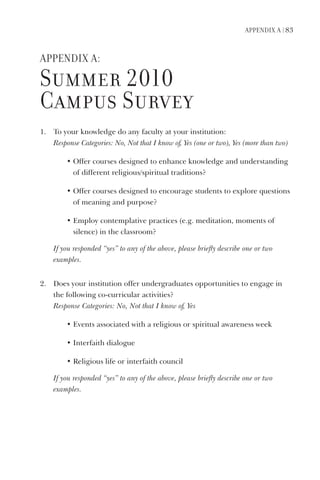
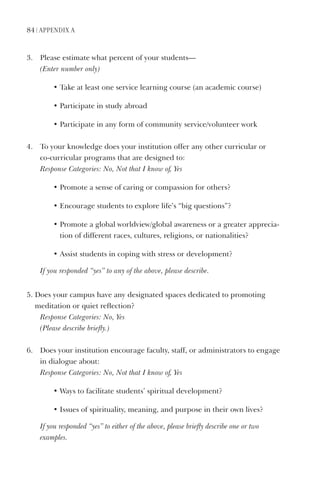
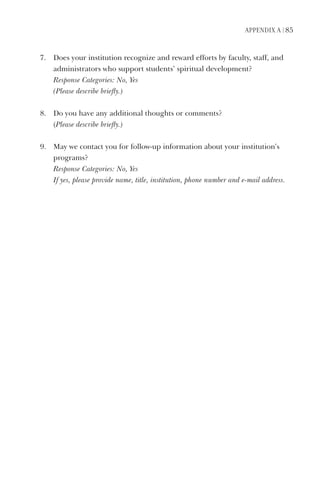
In summer 2010, we expanded the pool of information by surveying
vice presidents for student affairs, vice presidents for academic affairs, and
campus ministry directors or chaplains at 1,580 four-year colleges nation-
wide. The intent of e-mailing the questionnaire to three specific officials at
each institution was to capture the range of perspectives held by different
campus groups. The online questionnaire covered a variety of topics from
specific practices and programs that promote student spiritual development
to faculty spiritual development.
2
1
Syllabi are available at http://spirituality.ucla.edu/publications/newsletters/2/syllabi.php
2
For a copy of the survey questionnaire, please see Appendix A.
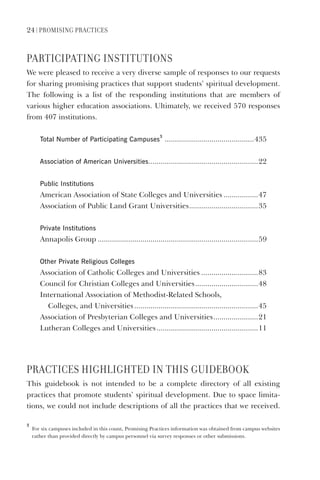
24 | PromIsIng PractIces
PartIcIPatIng InstItUtIons
We were pleased to receive a very diverse sample of responses to our requests
for sharing promising practices that support students’ spiritual development.
The following is a list of the responding institutions that are members of
various higher education associations. Ultimately, we received 570 responses
from 407 institutions.
Total Number of Participating Campuses
3
............................................435
Association of American Universities......................................................22
Public Institutions
American Association of State Colleges and Universities .................47
Association of Public Land Grant Universities..................................35
Private Institutions
Annapolis Group ...............................................................................59
Other Private Religious Colleges
Association of Catholic Colleges and Universities ............................83
Council for Christian Colleges and Universities...............................48
International Association of Methodist-Related Schools,
Colleges, and Universities.............................................................45
Association of Presbyterian Colleges and Universities......................21
Lutheran Colleges and Universities..................................................11
PractIces HIgHLIgHteD In tHIs gUIDeBooK
This guidebook is not intended to be a complete directory of all existing
practices that promote students’ spiritual development. Due to space limita-
tions, we could not include descriptions of all the practices that we received.
3
For six campuses included in this count, Promising Practices information was obtained from campus websites
rather than provided directly by campus personnel via survey responses or other submissions.
PromIsIng PractIces | 25
Instead, we have sought to provide readers with a broad survey of practices
from a diversity of institutions.
Our goal is to promote information-sharing and spark discussion for all
who are interested in the spiritual development of college students. Whether
you desire to implement a campus-wide initiative or provide resources for
students who want to start an organization centered on spiritual issues, this
guidebook can serve as a starting point for identifying other campuses where
similar and successful initiatives have been implemented. The practices that
follow are divided into curricular, co-curricular, and campus-wide efforts.
cUrrIcULar InItIatIVes anD
teacHIng strategIes
This section highlights examples of the many ways that an institution’s
curricular initiatives may facilitate students’ spiritual development. Examples
include: Academic Degree Programs, Courses and Curricular Innovations, and
Teaching Methods.
ACAdemIC degRee PROgRAms
At many campuses, students can pursue courses of study that encourage explo-
ration of spirituality or religion. One venue is through traditional baccalau-
reate degree-granting programs housed in religious studies departments.
Another possibility is to offer specially-designed concentrations or interdisci-
plinary majors and minors. Below are some examples:
• At Boston College, elective academic programs that explore spirituality and
religion include a Faith, Peace, and Justice minor, Jewish studies minor, and
Islamic and middle eastern studies minor. Core philosophy courses explore
ultimate questions of meaning and purpose. Some students fulfill these
core requirements through the PULSE program, which links theology and
philosophy coursework to 10 hours of community service per week.
• University of michigan offers a Program in Creativity and Consciousness, funded
by the Office of the Provost with support from the School of Music,
26 | PromIsIng PractIces
Theatre, and Dance. The traditional course load is supplemented by
opportunities to participate in: a monthly gathering to explore improvi-
sation across a wide variety of disciplines; a think-tank called the “deep
inquiry group” that focuses on big questions of consciousness, human
development, and current events; faculty study groups that explore issues
of creativity and consciousness inter-disciplinarily; and lecture series that
invite a wide range of speakers. Currently, the program offers a B.A. of
Fine Arts in Jazz and Contemplative studies.
Other academic programs:
• Brown University: Scholarly Concentration in Contemplative Studies, a
branch of the Contemplative Studies Initiative
• george Fox University: Peace and Justice minor
• george mason University: 16-credit academic minor that includes courses
in mindfulness, consciousness, and meaning, based in the Center for
Consciousness and Transformation
COURses ANd OTheR CURRICUlAR INNOvATIONs ThAT PROmOTe
sPIRITUAl QUAlITIes
Faculty across the country from a variety of disciplines have developed a multi-
tude of courses to incorporate spirituality into the curriculum. Topics that are
related to spirituality and lend themselves to this strategy include death and
dying, ethics, the meaning of life, stress and health, values, and moral philos-
ophy, among others. Faculty from around the country also shared with the
team 39 sample syllabi, which are available online at http://spirituality.ucla.
edu/publications/newsletters/2/syllabi.php.
Instructors responsible for the professional preparation of teachers,
counselors, or business leaders have opportunities to engage students in
curricular activities that will help prepare them to incorporate spiritual
practices into their future work. Below are selected examples of courses, and
other curricular ideas that have been shared with us, which are categorized
here by their focus on “big questions” (spiritual exploration), spirituality and
wellness, or religious studies courses.
PromIsIng PractIces | 27
Courses Focused on the “Big Questions” or Spiritual Exploration
Faculty are well positioned to challenge students to think about the “big
questions” such as: Who am I? Why am I here? What is my purpose in life? Examples
of these types of courses include the following:
• Carnegie mellon developed a “Big Questions Initiative” with the goal of
engaging faculty and students in conversations about personal values,
morals, and responsibility. Eventual plans involve expanding the
program into the entire first-year residence hall system.
• Franklin W. Olin College of engineering offers the “What Is I?” course that
encourages students to explore their psychological development, person-
alities, purpose in life, and so forth. This course is one of several Arts,
Humanities, and Social Sciences courses in a curriculum otherwise
entirely devoted to engineering.
• salem College has a signature Program that is designed to lead students
along a path of self-knowledge, community service and career prepara-
tion. Each student is required to take courses within the program that
address service learning, global perspective, cross-cultural awareness, and
the “big questions.”
• stanford University offers a class called The meaning of life: moral and spiri-
tual Inquiry Through literature, which combines traditional classroom work,
field trips, weekend activities, and a living-learning experience in an
intense three-week course. Stanford also offers a class called spirituality
and Nonviolent Urban and social Transformation, based on the notion that a
life of engagement in social transformation is often built on a foundation
of spiritual and religious commitments. The class incorporates film, texts,
and service, and utilizes case studies of nonviolent social change agents
to examine the theory and principles of nonviolence as well as religious
and spiritual issues.
• The Semester Within at the University of Redlands is a documentary film about
students’ curricular experiences in which they talk about the challenges
and benefits of interior learning and meditation. Students study moral
28 | PromIsIng PractIces
exemplars such as Mother Teresa, the Dalai Lama, Gandhi, and Nelson
Mandela. They are also encouraged to use meditation techniques in their
service learning endeavors.
Other campuses with similar courses:
• Bellarmine University: “Ultimate Questions”
• Brooklyn College: “Workplace Values and Happiness”
• Ithaca College: “Communication and the Human Spirit” (Communica-
tions/Media Studies) and “Cultivating Meditative Awareness” (Theatre)
• Kansas state University: “Spirituality  Leadership” (Leadership Studies)
• mississippi state University: “Spirituality in Counseling” (Education)
• montreat College: “Spiritual Formation and Faith Development” course
which culminates in a retreat experience
• mount Aloysius College: “The Self and Beyond: Psychology and Spiritu-
ality” (Psychology)
• North Park University: “Dialogue” (General Education/Writing Program)
• Peace College: “Adventures in Life and Learning”
• University of Arizona: “Values, Consciousness, and Higher Education”
• University of California at Berkeley: “Why Are We Here: Great Writing on
the Meaning of Life”
• University of Iowa: “Mindfulness: Being Here With It All”
Spirituality and Wellness
Some faculty-led courses include practices that promote spirituality within
the context of wellness. Often these courses engage students in contemplative
practices. Examples include:
PromIsIng PractIces | 29
• American University presents a course on the practice of yoga and medita-
tion. It is taught as a seminar and includes opportunities for hiking
through neighboring parks and other field experiences. American
University also offers a social justice and religion course that involves
probing the deeper meaning of spirituality and spiritual practice.
• southern Arkansas University offers a course called “Personal  Community
health,” in which students are expected to “demonstrate knowledge of
growth and development characteristics as they affect the physical, social,
mental, intellectual, and spiritual aspects of holistic health.”
• UClA developed “life skills for College Women and men,” sponsored by
Student Development and Health Education and based in the Depart-
ment of Community Health Sciences. The course engages students on
topics in three general areas: (1) stress, relaxation, and cognitive theory;
(2) identity development; and (3) communication and relationships.
Students fill out a weekly experience log that allows them to reflect,
journal, and make meaning of the classroom exercises and conversations.
Other courses related to spirituality and wellness:
• University of louisiana, lafayette: “Exploring the Spiritual Experience in
the Twelve Step Program of Alcoholics”
• Utica College: “Care of the Human Spirit” (Health Studies)
• Warner University: “Spiritual Practices” a class that deals with classic spiri-
tual disciplines and ancient practices
Religious Studies Courses and Departments
Many campuses have Religious Studies Departments that offer baccalaureate
degrees. Many also provide opportunities for students to take courses in
theology, religious studies, or philosophy. Some examples:
• Brescia University offers a course called Faith and Justice in which students
examine how a concern for social, economic, and political justice is
rooted in the Gospel and mission of the Christian church. The course
30 | PromIsIng PractIces
presents the problem of structural injustice and strategies for alterna-
tives. Issues studied include human rights, abortion, poverty, hunger,
racism, sexism, pollution, and war.
• At University of Oklahoma–Norman Campus, the Religious studies Program
brings in speakers each semester for the entire community. Speakers
who have participated include: Dr. Phillip Jenkins of Pennsylvania
State University (The Next Christendom: The Coming of global Christianity);
Dr. Akbar Ahmed, Britain’s Ambassador to Pakistan and Ibn Khaldun
Professor of Islamic Studies at American University (Islam Under siege:
An Invitation to Interfaith dialogue); Rabbi Bradley Hirschfield of the Jewish
Center for Learning and Leadership (CLAL) (When god goes to War);
and Dr. Charles Kimball, Chair of the Department of Religious Studies
at Wake Forest University (and author of When Religion Becomes Evil).
The Outreach Program within the Religious Studies Program partici-
pates in interfaith dialogue within the region and finally, students can
participate in interfaith dialogue within the region through Religious
Studies’ Outreach Program.
• University of Wisconsin-eau Claire offers a major or minor in religious studies
along with general courses in the discipline to help fulfill their liberal
arts, general education requirements. One sophomore-level course is
titled “sacred earth: Religion  Nature,” which “explores the historical,
cultural, religious, and spiritual concerns of humanity’s relationship
with ‘Nature’ and environments, converging varieties or cultural expres-
sions of the “sacred earth” in religious traditions, contemporary society,
environmentalism, and science.”
• Whittier College has a Buddhism class that is taught in a classroom
setting during the semester and at a local monastery during an inten-
sive winter session. The “immersion” at the monastery is usually 10
days, with Buddhist monks leading meditation and preparing meals.
The professor offers insight and instruction related to the history and
practices of Buddhism, and support for students who are struggling
with the experience.
PromIsIng PractIces | 31
Other similar campus courses or departments:
• Bethany College: “Peer Ministry” class
• Fayetteville state University: courses in religious traditions and sociology
of religion
• georgetown College: “Religion and Politics,” “Religion and Popular
Culture,” “Religions of the Modern World,” “Advanced Topics in World
Religions,” and “Religion and Violence”
• guilford College: “Sacred Images, Altars and Rituals” (Art)
• Prescott College: “World Religions,” “Mysticism,” “Studies in Buddhism,”
“Religious Ethics and Environmental Activism,” “Gender, Sexuality, and
Religion,” “Religion and Science,” “Globalization, Religion and Social
Change,” and “Life Centering and Yoga: Philosophy and Practice.”
Contemplative practices are used throughout these courses.
• University of Kentucky: classes on spiritual differences and compara-
tive religions (Anthropology), classes that explore life’s meaning and
purpose (Philosophy, Anthropology, Sociology, Psychology, History, and
Geography). The University has Hebrew and Judaic Studies as well as a
Catholic Studies Program.
TeAChINg meThOds: sTRATegIes FOR FACIlITATINg sPIRITUAl
develOPmeNT
Inadditiontoformalacademicprogramsandcourses,thereareavarietyofteaching
methods that faculty can employ to facilitate students’ spiritual development.
Collaboration between faculty from different disciplines to incorporate different
approaches to teaching and learning, or to make cross-disciplinary connections
between material, can encourage students to develop more integrated worldviews.
Faculty at many campuses such as evergreen state College and Queens University of
Charlotte make links between philosophy, ethics, arts, religion, and related topics.
Faculty shared a variety of approaches to incorporating reflective writing
or journaling exercises into undergraduate courses. Reflection facilitates
deeper thinking about what students are learning, how their actions reflect
32 | PromIsIng PractIces
their values, and so forth. Contemplative practices, such as moments of
silence before or during class, can also help students take a step back from
their busy lives. Faculty shared various teaching strategies, such as reflec-
tive writing, journaling, and related contemplative practices, including:
• Many faculty at Biola University assign “soul projects” where students are
asked to examine how the material illuminates their own journey of
spiritual and character development. These projects also allow for times
of extended prayer and reflection, sometimes in solitude, other times in
small groups.
• lesley University’s “spirituality: Psychological Resource for Individual and social
Well-Being” includes a significant amount of self-reflective learning for
students, through which they explore questions of meaning and purpose,
employ contemplative practices, and learn about world religions.
• monmouth College has a junior year general education requirement, Reflec-
tions, in which questions of ultimate meaning are explored from a variety
of interdisciplinary perspectives. Reflections faculty have found that course
assignments that foster contemplation, whether they be periods of silence
or technology-free periods, are very effective and well-received by students.
• The chaplain and director of religious life community at simpson College
encourages moments of silence before teaching courses to encourage
students to become fully present for the class. Students use this time to
meditate, be still, and pray in their own faith traditions.
Other examples of contemplative practices in the classroom:
• Incorporating meditation, mindfulness or other contemplative
practices into classes (Antioch University of New england, Cornell College–
Iowa, hamline University).
• Beginning classes with a moment of silent reflection (Alvernia University,
louisiana Tech University). Faculty at some religious campuses begin class
with a prayer (molloy College).
PromIsIng PractIces | 33
• Offering a “meaning of life” course developed by a professor of philos-
ophy and religion and the campus chaplain, which requires a great deal
of writing about how others have defined a meaningful life as well as how
the students see life (lincoln memorial University).
• Beginning class with a bow. The bow symbolizes three parts: first, “sit
up,” to be aware of one’s surroundings and become present; second,
“feel,” noticing one’s inner experience and feeling one’s body and
heartbeat; and third, “give,” bowing to honor others in the room and
commit to being awake and present to what transpires during class
(Naropa University).
co-cUrrIcULar Programs anD serVIces
In addition to academic initiatives, academic affairs personnel and student
affairs professionals have developed co-curricular programs and services
designed to support students’ spiritual growth. These practices encourage
students to explore their spiritual identities and can help them gain insights
about themselves that may be important to their search for meaning and
purpose—what we refer to as spiritual Quest. Initiatives that broaden students’
experiences or expose students to the challenges that fellow human beings
face can help students increase their levels of ecumenical Worldview and ethic
of Caring. Efforts to support students through personal crises can help them
learn to find appropriate mechanisms for dealing with emotional struggles
and perhaps increase their long-term ability to achieve equanimity.
In this section, rather than providing a comprehensive listing, we
have selected examples to illustrate the range of programs and services
we received. Co-curricular programs and services are grouped into the
following sub-sections: Awareness Weeks and Events; Spiritual Mentoring; Caring
and Compassion for Others; Service and Immersion Programs; Encouraging a Search
for Vocation; Dialogues About Spirituality and Religion; Meditation, Reflection, and
Retreats; General Wellness; Student Leadership Training and Governance.
34 | PromIsIng PractIces
AWAReNess WeeKs ANd eveNTs
Some campuses hold special theme weeks or days to engage students in
conversations about varied conceptions of spirituality and faith-based beliefs.
At religious campuses, these weeks may frame spirituality in terms of the
religious affiliation of the institution. Some examples include:
• Franklin College hosts a religious emphasis week each year, challenging
students to focus on different faith issues and experiences. Franklin
provides students with a labyrinth workshop each year, a way of teaching
students to meditate and pray by utilizing the tools of pilgrimage,
breathing, and walking. The campus provides continual programming
that addresses the sense of caring and compassion for others, begin-
ning the first day after students arrive on campus with a program called
“Focus.” The morning after new students arrive, they are led by two
upper-class student peers, a faculty member, and a staff member to
engage in some form of community service.
• lawrence Technological University holds campus-wide celebrations for
Eid, Diwali, Chinese New Year, Holy Thursday, and so forth. Events
include reflective teaching with a spiritual leader, a dinner, and
celebration.
• montclair state University has experienced an increasing interest in spiri-
tual life and, in response, different campus groups have collaborated to
develop related programming. The university’s Bonner students create
a yearly (U.S.) Constitution Day, when freedom of speech and religious
expression are discussed. They also have discussion and support groups
for LGBTQ students, such as their Acceptance in Christ group, and
LGBT discussion panels such as “For the Bible Tells Me So.” Muslim
students have a Jesus Awareness Day that is hosted with several Chris-
tian groups. Montclair also has Jewish-feminist seders during Passover.
During Geek Week, there is “Bible geek” programming, which explores
spiritual passion and curiosity. Finally, the campus teaches stress
management, guided imagery, and meditation on an ongoing basis,
and holds “Mind, Body, and Soul” fairs at the Recreation Center.
PromIsIng PractIces | 35
• At vassar College, with the support of the Tanenbaum Inter-Religious
Fellow at the College, the Office of Religious and Spiritual Life sponsors
both a fall “coffee house” and a spring day to consider and celebrate
“the role of religious and spiritual life” in a secular liberal arts education.
Interfaith dialogue is sponsored through leadership development for
student religious leaders, and the inter-religious council.
Other approaches to hosting awareness weeks or events:
• Many campuses devote one or more days or weeks to spirituality as
a theme, each framing the purpose of the week differently. Some
indicate a goal is spiritual emphasis, while others focus on “aware-
ness,” “development,” “deepening,” or “enrichment.” Others seek to
promote caring and compassion while still others may provide oppor-
tunities for spiritual direction with vocation directors. (Asbury University,
Calvin College, god’s Bible school and College, Johnson Bible College, malone
University, mid-Atlantic Christian University, moody Bible Institute, mount mary
College, Palm Beach Atlantic University, shepherd University, Trevecca Nazarene
University). hannibal-lagrange College even hosts a spiritual life conference
every semester.
• Other campuses promote interfaith dialogue or provide students with
opportunities to learn about different religions through belief fairs, “inter-
faith expos,” or religious emphasis weeks and other events (The College of
saint Rose, Colorado College, grambling state University, grand valley state University,
haverford College, huston-Tillotson University, maryville University, Paine College,
Rosemont College, saint Xavier University, Tennessee Tech University, University of
Rhode Island, villanova University). California state University, san Bernardino facili-
tates interfaith dialogues through community service projects.
• Finally, some campuses offer programming that examines the intersec-
tions of spirituality, religion, or faith with culture (King College’s Buechner
Institute, geneva College’s Faith and Culture Week), race (martin methodist
College’s Convocation on Religion and Race), or other contemporary
concerns (hastings College’s Religion in Life Week; sUNY geneseo’s
Cultural Harmony Week).
36 | PromIsIng PractIces
sPIRITUAl meNTORINg
At many campuses, educators have developed mechanisms for mentoring
students’ spiritually. Role-modeling the importance that many individuals
place on their spiritual lives can facilitate students’ own searches for meaning
and purpose. For example:
• Tuesday Talks at hendrix College are organized by the Miller Center and
the Chaplain’s Office, and have become a way for individuals from
across all segments of the community—faculty, staff, administrators, and
students—to explore spirituality, meaning, and purpose. Each Tuesday,
a faculty or staff member is invited to speak at the noon hour on the
question, “What is my calling and how do I know?”
• Cardinal stritch University holds mystic Pizza, an ecumenical gathering
that is offered the first Wednesday evening of each month. Faculty
and staff are invited to share stories with students of someone who has
inspired them on their faith journey in life. The talk is followed by
time for questions, conversation, and pizza.
• monmouth College began a monthly series called “Why Am I here? The
Unfolding of life,” where faculty and staff talk about their personal lives
and tell stories that help students understand that life does not always go
in the direction one may expect.
• Nyack College has a Campus mentor Team consisting of 10 faculty and staff
families that live on campus. One goal is for these families to engage with
students in their homes to discuss meaning, purpose, and issues related
to students’ spiritual development.
• Texas Christian University has a program called What matters to me and Why.
According to TCU’s website, the program is a monthly luncheon series
where participants get a deeper, more personal look into the lives of
faculty and staff members, specifically what they believe, why they believe
it, and what motivates them.
• At William Jessup University, faculty and staff serve as leaders of small
groups focused on students’ spiritual formation.
PromIsIng PractIces | 37
CARINg ANd COmPAssION FOR OTheRs
Many campuses already offer students opportunities to engage with their local
and global communities through direct service, service learning, or immersion
programs. Some campuses such as Alma College and gannon University include the
campus community in their efforts to promote caring and compassion. Both
institutions hold random-acts-of-kindness campaigns. Other campuses host
programs and discussions such as “soup and substance” that encourage students
to deeply explore issues, such as homelessness, which may only be solved when
communities work together (Cal Poly state University, san luis Obispo; saint Peter’s
College). Still others develop innovative ways to encourage and support students’
sense of caring toward others. Below are some examples of these practices:
• hendrix College has an engaged learning requirement under a program called
“Your hendrix Odyssey.” The faculty have recognized six categories of engaged
learning: Service to the World, Professional and Leadership Development,
Global Awareness, Artistic Creativity, Undergraduate Research, and Special
Projects. Students must complete three projects from three different catego-
ries. Faculty or staff work with the student to design a service project with
particular learning goals. These goals can be disciplinary-specific or oriented
toward the “big questions.” The student completes written- and oral-
reflection components through which he or she connects the service work to
ethical, intellectual, and personal-development questions.
• mercer University offers mercer on mission (MOM), an international
program that blends service and study, and aims to create a dynamic,
life-changing synergism for students. MOM has elements of both a
traditional study abroad program and a traditional service trip. The
combination of study and service is designed to produce an increased
understanding of a place and an increased investment in its people.
To maximize the spiritual impact of this program, students keep a
daily journal and respond to prompts that invite spiritual reflection.
• West Texas Am University hosts shack A Thon, a student-initated project.
Hundreds of students build shacks and live in them. The initiative raises
about $25,000 annually. All proceeds go to an entity that provides goats to
refugees in Africa.
38 | PromIsIng PractIces
seRvICe ANd ImmeRsION PROgRAms
Creating opportunities for students to engage in meaningful local, regional,
national, and international service projects or to gain first-hand experience
of other people’s daily lives can facilitate spiritual development. Service
experiences may promote spiritual qualities such as Charitable Involvement,
ethic of Caring, and ecumenical Worldview. Service learning opportunities—
which combine service with academic and reflective components and are so
widespread that we did not discuss them in this guidebook—can promote
spiritual Quest in addition to the aforementioned qualities. Finally, immer-
sion experiences, which are distinct from service experiences, are designed to
broaden students’ sense of community, thereby promoting a sense of solidarity
with others. All of these experiences also serve to promote spiritual develop-
ment. Examples include the following:
• Some campuses provide opportunities for students to voluntarily
engage with local and international communities (Chowan University’s
Chowan Cares; davidson College’s Engage for Change; dallas Christian
College’s Day of Service; eastern michigan University’s alternative spring
break opportunities and Volunteers in Service to Their Neighborhoods
(VISION); daemen College’s food and clothing drives throughout the year
and fundraising for Hospice Buffalo; leTourneau University’s S.T.U.D.S.
(STUdents Devoted to Serve) and S.H.A.R.E (Students Helping Area
Residents Excel). Other campuses require students to engage in commu-
nity service (gallaudet University, southwestern Christian University). Finally,
some campuses require student groups or athletic teams to fulfill service
requirements (dakota Wesleyan University).
• Alternative spring break service programs, where students engage in direct
service to a community and participate in a reflective component to help
process their experiences, may promote caring and compassion for others.
Some campuses devote a great deal of time to preparing students for such
week-long service trips that can be either local or international. King’s
College focuses its service trips on one theme, such as immigration or rural
poverty. Students meet for six weeks in preparation for the experience,
reflect daily, and participate in a follow-up meeting after the trip.
PromIsIng PractIces | 39
• Other institutionally sponsored experiences focus on helping students
learn about another community (domestic or international) and come to
an understanding of how that community lives. Such so-called immersion
programs are hosted at many campuses including saint Joseph’s Univer-
sity (programs in Appalachia, the Gulf Coast, a Navajo reservation in
New Mexico, Guatemala, Ecuador, and El Salvador). santa Clara Univer-
sity’s Kolvenbach solidarity Program is primarily a co-curricular program,
although some experiences are more curricular in nature. The program
provides students with opportunities to learn with and from communities
throughout the United States and Latin America. Through immersion,
students come to understand what it means to live in solidarity with local
and global communities. The program is founded on the principles of
justice, community, spirituality, and simplicity. Groups of 10 -14 students
meet weekly for five weeks of preparation, followed by several post-
immersion gatherings, which integrate structured and non-structured
opportunities for reflection.
• Through seattle University’s social Justice ministry, many opportunities
abound for students to gain a sense of caring or compassion. Ministry
service immersion opportunities challenge students to exercise compas-
sion, social analysis, and faith reflection in experiencing developing-
world conditions, while part of a community of learners. These experi-
ences require an active commitment to faith, service, social justice, and
building community. Participants pursue global issues of faith and justice
in a community.
Other examples of service or immersion experiences:
• Atlanta Christian College: academic programs are closed once each
semester and students are encouraged to participate in a ministry day.
• Bloomsburg University of Pennsylvania: The SOLVE office coordinates
student volunteers with needs in the community.
• CalArts sends a group of students and faculty to work on the genocide
project in Rwanda each summer.
40 | PromIsIng PractIces
• Cal Poly state University, san luis Obispo has an “I Respect” program
as part of its Student Community Services area. The campus also runs
a program called “soup and substance,” which has several topics each
quarter dealing with global issues as well as local concerns such
as homelessness.
• gannon University hosts a program called “Pizza with a Purpose,” a series of
discussion groups led by the Social Concern Office. Previous topics have
included: “American Politics and the Need for Civility “ and “ Cultural
Responses to 9/11.”
eNCOURAgINg A seARCh FOR vOCATION
Student affairs professionals and faculty can help students make connections
between their personal values and their career choices. Career counselors are well
versed in the many professional paths students can pursue based on their interests,
skills, strengths, and personal calling. Faculty can facilitate class discussions about
ways to use knowledge within their field to help their communities. By initiating
conversations about students’ life plans, student affairs professionals and faculty can
challenge and support students’ searches for meaning and purpose. Examples are:
• Bellarmine University’s Career Development Center works with the Office
of Campus Ministry to sponsor regular programs that ask, “What is God
calling me to do?”—an approach to vocational discernment using spiri-
tual practices and psychological inventories.
• goshen College has a three-month summer offering called Inquiry Program
through which students receive a summer stipend and tuition scholarship
to explore “big questions” related to faith and vocation. Before, during,
and after the summer session, students write reflection papers and
participate in topically pertinent discussions.
• John Carroll University’s “senior Conversations” is a three-part conversation series
that engages seniors in meaningful, small-group discussions co-hosted by
a senior student and a faculty member. Each session focuses on one of the
“Three Key Questions:” What brings you joy? What are you good at? Who
needs you to do these things? The program offers a relaxed and social
PromIsIng PractIces | 41
environment where seniors develop the tools necessary to engage in the
process of discernment as well as a space where they can share their fears
and anxieties about the uncertainty of life after graduation.
• smith College houses a Center for Work and life that promotes habits of
reflection and integration of work preparation, wellness, leadership, and
academics. Emphasis is placed on being thoughtful about one’s “good life,”
or life well-lived. The Center’s signature program is the Women’s Narra-
tives Project which brings students together to think about the meanings of
success and a good life.
• Trinity lutheran College’s first-year experience offers a two-semester course
called vocation and Formation, in which students explore multiple spiritual
practices and experiment with these in the classroom. The course weaves
together journaling about spiritual practices, along with exercises and
readings designed to uncover each student’s sense of vocation.
• University of san diego offers a senior get-Away Retreat, which encourages
students to consider the issues of meaning, purpose, and spirituality.
Initially a joint effort between Student Affairs, Career Services, and
University Ministry, the retreat was designed to help seniors reflect
on what they learned during college, where they found meaning and
purpose, and how they could build futures that align with who they are
and what they most deeply want.
Other practices that encourage vocational discernment include:
• georgetown College: Philosophy course called “discovering vocation”
• greensboro College: The First-Year seminar Course explores the meaning
and purposes of vocation and life, which also includes contemplative and
discernment practices.
• grove City College: An annual three-day missions Conference gives students
an opportunity to talk with more than 20 missions agencies about
ministry opportunities.
42 | PromIsIng PractIces
• loyola University of Chicago: The Personal growth/spiritual development Program is
designed to assist students in their ongoing personal growth and spiritual
development along with their professional and vocational pursuits.
• Nebraska methodist College: The college presents a seminar titled “Uncov-
ering and discovering Your spiritual Path.”
• seton hall University: Christian employment Outreach, which is part of the
Institute for Christian Spirituality, offers workshops that focus on discov-
ering the spiritual dimension of work. The main focus is to help under-
graduates understand and discover a religious and spiritual dimension to
their everyday lives.
dIAlOgUes ABOUT sPIRITUAlITY ANd RelIgION
Many campuses provide opportunities for students to engage in dialogue about
spirituality and religion. Some programs focus solely on spirituality or religion,
others address the intersection of the two, and still others are concerned
primarily with interfaith understanding. Ultimately, many programs have the
potential to build bridges across differences and cultivate an appreciation for
a rich diversity of beliefs and perspectives.
Dialogues About Spirituality
Many campuses host a variety of forums that encourage dialogue about the
intersections between spirituality and contemporary issues. Examples:
• Bates College supports students who consider themselves “Spiritual but
not Religious,” or even thoroughly secular, but who are looking for a
place to talk about deep questions of meaning and purpose. The college
holds biweekly dinners at the chaplain’s home to discuss such questions
and gather for casual conversation. Bates also has hosted a series of
lectures called “spirituali-Tea,” which has prompted monthly conversations
about the intersections of religion, spirituality, ethics, and politics.
• saint Peter’s College offers numerous opportunities for spiritual growth.
The college hosts a program called “soup and substance,” a brown-bag
short presentation and conversation about spirituality and life, personally
PromIsIng PractIces | 43
directed or weekend retreats designed around various spiritual themes,
and spiritual direction for members of the campus community.
• University of Illinois (Urbana-Champaign) offers a Program on Intergroup
Relations (PIR), sponsored by the Office on Inclusion and Intercultural
Relations within student affairs. The program engages students in
small-group classroom dialogues and reflective practices around issues
of faith, belief, values, morality, and society in light of religious tradi-
tions and spiritual practices. As one of many PIR courses, this dialogue
stimulates critical conversations around spiritual issues in the context
of various other social-identity factors. It seeks to prepare students to
explore and reflect on their own and others’ perspectives in order to
work and live in a diverse society and global marketplace.
• University of southern California has a lecture series called “What matters to
me and Why.” The entire USC community is invited to engage as a way to
pursue questions of meaning, purpose, and identity. The series encour-
ages reflection about values, beliefs, and motivations, and helps students
better understand the lives and inspirations of prominent figures within
the university.
• University of Tampa has a “spiritual life through Film” series, screening
movies that relate to character-building, spiritual development, and
greater understanding of world cultures and religions. After the film
presentation, a faculty panel discusses these themes and analyzes the film
with the students.
• University of virginia offers “sustained dialogue,” a student-run group
that conducts dialogue on issues of prejudice and bias within the
community. Organizers form small groups at the beginning of the year
that meet weekly and use teaching methods developed at Princeton
to address conflict in the Middle East. In addition, the University’s
religiously affiliated groups (more than 50) discuss “big questions.”
The discussions take many forms, such as Bible study and close reading
of the Torah and the Koran, and are held at various places, including
Hillel and the Tibetan cultural center.
44 | PromIsIng PractIces
Examples of dialogue-based spirituality programming at other campuses:
• Beloit College has a weekly small-group experience called “live the
Questions.”
• Fairfield University has adopted the residential college model for sopho-
more year, designed to have students ask life’s larger questions and
embrace taking responsibility for the broader community.
• Fisher College hosts a weekly “spiritual explorations” workshop.
• lubbock Christian University: The Student Involvement Office works with
other campus groups to create co-curricular programming around Chris-
tian higher education to address various student needs. Programs, such
as the “Sex, Singleness, and Spirituality” forum, ask students: “How does
my faith speak to this particular issue or problem?”
• southern vermont College is not a faith-based college, but together with
Bennington’s Interfaith Council clergy the college sets up a “roving
clergy” series that addresses spirituality topics, and provides opportuni-
ties for spiritual counseling.
• stetson University’s “Fridays at 4” is a model for students to gather and
discuss in an open, welcoming, and inclusive environment, issues that are
timely and/or provocative.
• Wilson College: Chaplaincy-run program called “Big Questions” that brings
in community members to present and discuss what gives meaning to
their lives
• Universidad del este (Puerto Rico) offers moment of Reflection, a short
dialogue about topics related to spiritual practice and how to apply it in
daily life.
• University of North Texas: The Dean of Students and Equity and Diversity
Offices collaborate on opportunities for students to explore their spiri-
tual development.
PromIsIng PractIces | 45
Religious Dialogues
Religious and non-religious campuses alike provide students with a range of
opportunities to learn more about various religious traditions or to enhance
their religious lives. For instance, Bethel University, provides multiple opportu-
nities for religious and spiritual life enhancement through the residence halls,
campus ministries, and leadership in Christian ministries. Regular chapel
services are also available at Bethel and many other campuses (e.g., Cincin-
nati Christian University, College of mount st. Joseph, heritage Christian University,
maranatha Baptist Bible College, midAmerica Nazarene University, Taylor University,
Wittenberg University).
Other campuses merge conversations about faith with discussions about
contemporaryissues.“Theology on Tap” isapopularprogramthatvariesbycampus.
At loyola marymount University, for example, invited speakers with an expertise in a
specific area of theology or spirituality give a short talk followed by a conversation
about the topic. At Bucknell University, students talk about current issues at a local
pub. At Pennsylvania state University-mont Alto, participants have the opportunity to
explore a variety of religions, faiths, spiritualities, and celebrations.
Other practices designed to facilitate religious dialogues or help students enhance their
religious lives:
• Princeton University’s Religious life Council (RlC) brings dialogue about
religious pluralism to the core of campus conversations. Made up of a
dynamic group of undergraduate and graduate students from more than
10 different faith traditions as well as religiously unaffiliated members, the
RLC is committed to fostering conversation between all religious faiths
at Princeton as well as at the national and international level. Weekly
roundtable discussions include topics such as religion and art, conver-
sion, modesty, and the death penalty. The RLC also collaborates with the
residential colleges and other centers and academic offices on campus to
encourage student participation in discussion about religion at Princeton.
• Rochester College has a student-led initiative called the “house of god”
series. It brings sensitive or controversial issues into open dialogue
between known interfaith or non-faith proponents who are active around
46 | PromIsIng PractIces
the greater-Detroit metropolitan area. This dialogue, which is open
to the whole campus and the surrounding community, is reported to
provide a wonderful exploration of faiths and culture.
• University of missouri’s Muslim Student Organization and Jewish Student
Organization have sponsored dialogues on the Gaza settlements. They
also have an association of Campus Religious Advisors that meets monthly.
The association consists of staff from the student ministry programs that
are sponsored by various community churches.
• Yale University has a multi-Faith Council of self-selected students from
different faith traditions who meet weekly for dinner and discussion. This
Council sponsors campus-wide religious awareness activities. An Interreli-
gious leadership Council of student leaders from different religious organi-
zations also meets biweekly.
Student religious groups at both religious and non-religious campuses often
provide settings for students to dialogue about religion. For instance, Rowan
University hosts several religious student groups: Chi Alpha, Fellowship of
Christian Athletes, Hillel, New Life Ministry, Catholic Campus Ministry and
Rowan Christian Fellowship. Another example is southern Illinois University–
Carbondale, which has 12 faith-based student organizations and an active
campus ministry. At campuses such as Indiana University–Purdue University
Fort Wayne, the many faith-based student organizations also convene as an
interfaith council.
At religious and non-religious campuses alike, Campus Ministry depart-
ments, often with the help of student boards, frequently take responsibility for
coordinating various religious activities. The College of Notre dame of maryland
has a student board within Campus Ministry that hosts co-curricular religious
activities, including prayer groups, trips to various churches and mosques,
annual Jewish seders, Christian songfests, Tenebrae service, and interfaith
Advent prayer services. Similarly, silver lake College of the holy Family focuses
on religious and spiritual aspects of students’ education, and has program-
ming that addresses life’s ”big questions” through small faith-sharing groups.
Campus Ministry departments frequently offer programming specifically
designed to promote interfaith dialogue (see next sub-section).
PromIsIng PractIces | 47
Additional examples of practices that promote religious dialogue and provide students
with ways to enhance their religious lives:
• Centre College hosts CentreFaith, which presents films on campus, and is
co-sponsored by the Jewish Student Organization or the Muslim Student
Association. The college also organizes special events centered around
the religious holidays of various traditions.
• Olivet Nazarene University offers prayer groups, “Party with Jesus” (a
student-led worship service), ministry groups that travel, and partner-
ships with community organizations.
• Roberts Wesleyan College offers “Faith Integration Fridays,” which are not
worship services, but rather dialogue-oriented. Examples include: a
dramatic play addressing a theme, followed by break-out groups for
discussion; a video of an organization helping AIDS victims, followed by
physically packing AIDS Workers’ health kits; an ecological topic followed
by an outdoor activity; or visits to senior communities for life-sharing
during a coffee break.
• University of dayton presents Perspectives on Faith and life series, which
consists of dinner, discussion, and speakers who facilitate dialogue among
students, faculty, and staff about religious beliefs as they relate to various
academic disciplines.
• Wiley College has a weekly religious service that is mandatory for all
students except seniors. Worship is led by ministers of various Christian
denominations. Dialogues are conducted with students and faculty of
non-Christian religions.
Interfaith Dialogues
Like the dialogues about spirituality and religion discussed above, interfaith
dialogues have the potential to promote students’ understanding and respect
for other spiritual and religious traditions.
• Allegheny College hosts an Interfaith Fellowship (IFF) that coordinates
interfaith dialogues and events such as Faith Week, which explores
48 | PromIsIng PractIces
religion and social change, spiritual health, and religion as a motivation
for community service. With the campus becoming more diverse, the
chaplain works with the wellness committee, environmental groups, and
various student affairs groups to provide opportunities for student reflec-
tion on the spiritual dimension of vocational, economic, and political
choices, and ethical issues that arise.
• Fisk University’s leaders of the Interfaith Fellowship Team (L.I.F.T.) seek to: 1)
provide a forum for dialogue among students who are both leaders and
representatives of religious denominations or organizations, 2) enhance
the religious life of all students, 3) promote tolerance and acceptance of
the variety of different religious perspectives, and 4) promote interfaith
activities (e.g., worship services and panel discussions) that stimulate both
critical and analytical discussions about issues affecting humanity (e.g.,
poverty, violence, and world hunger). L.I.F.T. includes the Fisk Memorial
Chapel Assistants, The Wesley Foundation at Fisk University, the Mount
Zion College Ministry, Young Excited and Saved (Y.E.S.) Ministries, Every
Nation Campus Ministries, and the Fellowship of Christian Athletes.
• Florida state University (FsU) has an active campus ministry council that
coordinates and publicizes the individual and collaborative events of 30
religious and spiritual campus groups. The activities include Engage Your
World Interfaith Dialogue, Middle East Center speaker series, and the
FSU Spiritual Life Project workshops and roundtables. The FsU spiritual
life Project has embarked on a journey of encouraging and discovering
ways to facilitate students’ spiritual development with faculty, staff, and
other students across campus.
Many campuses have multi-faith groups, interfaith alliances, inter-religious
councils, or similar variations. The purpose of some groups is to provide
a venue for interfaith discussion and faith sharing. Other groups, which
may consist of student leaders from various student religious organizations,
develop programming to enrich campus opportunities for fellowship. Still
others may sponsor interfaith dialogues to educate students about different
faiths or to promote interfaith discussions. Campuses vary in the degree to
PromIsIng PractIces | 49
which they provide administrative and financial support for these groups.
Examples of campuses that have these types of groups include Alma College,
Avila University, Berry College, Campbell University, 12 campuses in the Cleve-
land area that are served by the Cleveland hillel Foundation, Cheyney University
of Pennsylvania, eastern Connecticut state University, gettysburg College, and st.
Bonaventure University.
Finally, many colleges and universities provide opportunities for
interfaith spiritual practices (e.g. sUNY maritime College) or have formal,
organized interfaith discussions and prayer services (e.g. susquehanna
University, vaughn College).
Additional examples of interfaith dialogue include:
• College of mount saint vincent: “Faith” discussions always include a panel
composed of students from various faith traditions.
• lebanon valley College: “sustained dialogues” include interfaith topics. Each
semester, the college hosts an interfaith banquet introducing students
to traditions, music, dance, and food of a different faith tradition.
• massachusetts Institute of Technology: The Addir Fellows program brings
together more than 30 students each year to learn about the religious
traditions of their classmates.
• miles College: Sponsors an annual Interfaith Prayer Service, “The Commu-
nity in Prayer,” in which persons of different faith traditions share prayers
and readings from their tradition.
• mills College: The college presents Interfaith Youth Core Workshops for
students and faculty.
• Oklahoma City University: A non-denominational chapel is held weekly,
and interfaith dialogues with both Jewish- and Muslim-community faith
representatives are presented several times each semester.
• Piedmont College: The college offers Religion 101 field trips to worship
settings for various faith traditions, facilitating interfaith dialogue.
50 | PromIsIng PractIces
• Tufts University: The university supports CAFe (Conversations, Action, Faith
and education), a student group that works at fostering dialogue among
all believers and non-believers
• University of houston-downtown: The university engages students in Inter-
Religious dialogue focused on understanding others through stories of
various faith’s teachings.
• University of massachusetts lowell: The university employs several ministers
on campus who provide both regular and “special” opportunities for
interfaith dialogue.
medITATION, ReFleCTION, ANd ReTReATs
Numerous campuses offer students opportunities to experience formal retreats
and other structured opportunites for students to engage in contemplative
practices (e.g. Cabrini College, Carroll College). Campus Ministry departments also
often house a variety of religious and non-religious retreats for students (e.g.
Canisius College).
• Bryn Athyn College has “sacred space” time every day from 10:30-11 a.m.,
when everything shuts down, except for spiritual activities. No classes are
scheduled during this time.
• During the summer, a psychology professor at Cedar Crest College gives
talks outdoors on issues of meaning and purpose in people’s lives.
The series, called “Reflections Under the Trees,” is open to the entire
campus community.
• At Conception seminary College, students have a number of days of Recol-
lection (silent retreats for one day) during which they hear short presen-
tations by retreat masters, are silent for that day, and refrain from any
internet use. The days (about one per month) are set aside for quiet
reflection and private prayer.
• Each term, dominican University of California offers a Busy Person’s Retreat,
providing faculty, staff, and students the opportunity to meet daily with
a spiritual advisor to discuss a reading from Christian scripture or other
PromIsIng PractIces | 51
book. Felician College also offers “busy person” retreats twice a year to
faculty, staff, and students.
• george mason University created a living-learning community called
“mindful living” in one of the residential halls.
• The Office of the Dean of the Chapel at Indiana Wesleyan University
hosts a “still” event. “Stations” are set up around the chapel-audito-
rium, with each station asking participants to reflect on different
issues. During the second week of the semester, the office hosts a week
of special services called “summit.” These services are meant to spiri-
tually renew the campus community. Invited speakers discuss different
world religions and how Christians should be relating to them.
• Iona College holds a Kairos weekend, a popular retreat program that
many campuses across the country offer. The weekend retreat is
student-led, and engages students in reflection on and affirmation
of their relationships with God, others, and themselves. Student
leaders and professional staff “witness” talks and small-group break-
out sessions designed to help promote personal insight, build a
supportive community, and inspire active involvement and service.
Monthly follow-up meetings, called “Fourth Day” sessions, foster
on-going faith development and discovery.
• Pacific lutheran University organizes the eXPlORe! retreat for first-year
students, aimed at asking students to consider big questions around “the
vocation of learning.”
geNeRAl WellNess
Spiritual development includes the development of internal mechanisms
to be calm or centered during times of stress. Some campuses offer program-
ming to help students learn to manage stress. These practices include:
• Nebraska Wesleyan University has several programs on campus designed to
help students deal with stress, especially around finals times, with what
they call “revival stations.” Some are more spiritually oriented (prayer
52 | PromIsIng PractIces
beads, yoga, etc.) and others are simply stress relief (good food, pet
therapy, etc.).
• Purchase College state University of New York has a Wellness Center and
a campus- wide Wellness Committee. One of the sub-committees is a
spiritual Wellness Alliance. They also offer yoga every day of the week and
meditation twice a week.
• virginia Commonwealth University holds stress-management workshops and
curriculum-infusion workshops, and discusses the purpose and impact
of prayer with students to present prayer as one strategy for health and
stress management.
Many campuses already support students’ general well-being by offering
classes and workshops in meditation, yoga, and stress management (loyola
College maryland), pastoral counseling (College of mount saint vincent), or
other formal counseling services (Coastal Carolina University, Oregon Institute of
Technology). Additionally, many counseling centers conduct outreach programs,
such as “Check up from the Neck Up,” a depression screening held at Pace Univer-
sity in New York. Concordia University Wisconsin’s counseling services holds “Faces
of depression,” a program that encourages students to share, through a number
of creative ways, how they deal with pain or stress in life and how the arts and
the campus community is helpful.
Other campus practices geared toward facilitating students’ general wellness:
• earlham College distributes weekly announcements about stress and
coping skills in “Around the heart,” the college’s electronic newsletter.
• At Ferrum College, the chaplain’s office, the counseling center, and Resident
Educators are trained to assist students to better cope with stress.
• missouri southern state University offers a wide variety of stress-reduction
activities, such as time-managment workshops, study-habit workshops,
test-taking tips, free massage appointments during finals, and social
activities for students to take a break during mid-terms and finals.
PromIsIng PractIces | 53
• At Rivier College, the Nursing Department, Counseling Center, and
Campus Ministry co-sponsor “stress Relief Weeks” three times a year.
• Roosevelt University’s stress management and Relaxation Training (smART), a
series of four group sessions, provides knowledge and stress manage-
ment skills to improve success in students’ personal life, college career,
and beyond.
• savannah state University offers grief counseling, along with wellness and
healthy-living programs.
• The University of California at santa Barbara has a Stress Management Peer
Advisor program in the Stress Management Program Office (SMPO) of
Counseling Services.
sTUdeNT leAdeRshIP TRAININg ANd gOveRNANCe
Some campuses have developed creative ways to integrate spiritual devel-
opment into existing student activities. One approach is to develop student
leadership programs that focus on training students to become spiritual leaders
who can minister to their peers. Another is to encourage existing associated
student bodies or student governments to establish sub-committees or councils
to focus on spiritual development. Or, campus committees or councils might
invite students to represent the views of their peers on spiritual or religious
matters. There are numerous ways for campuses to incorporate spiritual devel-
opment into student leadership activities, including the following:
• dePaul University’s student Interfaith scholars program develops a cohort of
eight student leaders annually. They receive training and direct experi-
ence in interfaith learning and service, and then educate and engage
their peers in similar opportunities.
• Kenyon College has developed a spiritual Advisors Program, which encour-
ages students to reexamine the moral, religious, and spiritual values
they have held all of their lives. Spiritual Advisors aim to provide an ear
and feedback to students struggling with spiritual questions of meaning
and purpose. Advisors come from a diversity of faith backgrounds; some
54 | PromIsIng PractIces
define themselves as seekers with no particular faith and are trained in
listening skills, religious diversity, and active avoidance of anything that
could be interpreted as proselytizing.
• University of st. Thomas’s student spirituality Committee reflects a collabo-
ration between Campus Ministry and the Undergraduate Student
Government (USG). The purpose and intent of the committee (which
is made up of students) is to engage all students in the exploration of
and dialogue about spirituality. Events have included an evening of
journaling, where the group, over dinner, explored best practices for
spiritual journaling and reflection, and dialogue events with leaders of
the major religious and spiritual traditions (Christianity, Islam, Judaism,
Buddhism, and Hinduism). USG, in collaboration with the Campus
Ministry, also developed the “Mind, Body, Spirit” campaign, designed to
invite students to consider holistic development through engagement in
suggested activities (service, prayer, meditation, etc.).
Additional examples of student leadership training and student organizations:
• Asbury University’s student government has a branch dedicated to spiri-
tual life that operates like a student activities board.
• Austin College has a service station, through which much of the student
body participates in community service every year. The campus also has
the Activators Program, engaging students in planning and leading youth
ministry events connected to the Presbyterian Church.
• At Bentley University, student leadership training related to spiritual
development takes many forms. Resident Assistant training sessions
include workshops on inter-religious dialogue. The spiritual life Center has
an Advisory Board that includes students, faculty, and staff. The Diver-
sity Student Council includes representatives from the faith-based clubs:
Catholic, Protestant, Jewish, and Muslim.
• In Bridgewater College’s student Peer ministry Program, trained students
offer caring and compassion to their peers.
PromIsIng PractIces | 55
• visionQuest at dillard University encourages students to explore life’s big
questions through The leadership Institute, a series of three, seven-hour
workshops that present life questions and allow students to direct their
responses to each other.
• Jackson state University has more than 10 active religious organizations on
campus, most of which are student-led and student-initiated. The univer-
sity has an open policy on campus that permits any student, of any faith
conviction, the freedom to start an organization for like-minded individ-
uals on campus.
• All Neumann University student-athletes participate in an evening of
reflection on a particular aspect of the values depicted on the five
pillars in the atrium of the mirenda Center for sport spirituality and
Character development: beauty, reflection, balance, play, and respect.
• Our lady of the lake University has a Providence leadership Program that
engages students in learning more about “call” and response,” as well as
the sponsoring congregation that started the university. The campus also
has several core groups of students who serve as peer ministers for other
students experiencing stress.
• sam houston state University has a student-led group called “One,” which
is sponsored and advised by the Dean of Students Office. The group’s
motto is “One key aspect of leadership is your spiritual walk. Great
Leaders are servant leaders.”
• southern Oregon University’s student-athletes participate in a Champions of
Character Initiative.
• sUNY Potsdam’s leadership programs invite student leaders to explore
the “big questions” and to understand their own values, motivations, and
ways of creating meaning.
• University of southern maine offers a course called “ethical and spiritual
dimensions of leadership.”
56 | PromIsIng PractIces
camPUs-WIDe eFForts
Effective promotion of campus efforts to facilitate students’ spiritual develop-
ment, as with many initiatives that prompt mixed reactions, requires leader-
ship and collaboration. Administrators can provide critical leadership by
communicating the institution’s commitment to supporting students’ spiri-
tual development. The climate around spirituality will likely vary by campus,
and clear communication can help faculty, student affairs professionals, and
student leaders determine how best to engage in this work. The way in which
administrators provide leadership in spiritual development can take many
forms. Although space limitations prevent us from describing all the practices
shared with us, we present a limited number of examples under the following
headings: Leadership and Strategic Planning; Campus Centers and Organizational
Units; Residence Life Initiatives; First-Year Experience; University-Wide Initiatives;
Faculty and Staff Development; Recognition and Rewards; Designated Physical Spaces;
and Financial Support for Initiatives Relating to Spiritual Development.
leAdeRshIP ANd sTRATegIC PlANNINg
Senior administrators may have the greatest influence over the direction a campus
pursues in relation to its overall mission, but successful initiatives typically require
the involvement of a broader range of individuals. Designating full-time positions
or appointing committees and councils to focus specifically on issues of spirituality
related to the entire campus can be effective in advancing this work. These groups
can develop strategic plans for achieving any campus-wide spirituality goals.
Administrative Positions, Committees, and Councils
Campus leaders who are interested in developing or improving efforts to facilitate
students’ spiritual development can designate one or more positions to focus on
spirituality; or they can appoint a small group of individuals to look at how spiritu-
ality can fit into campus life. These individuals might create a planning document
that outlines concrete initiatives with specified measures of success.
• Bard College has formed a Commission on Religion that seeks to address
the increasing influence of religion in world affairs, and the challenge
this resurgence poses to the tradition and practice of a liberal arts
education.
PromIsIng PractIces | 57
• Belmont University designates campus leaders to focus on spiritual develop-
ment, including a vice president for spiritual development, a university
minister, and two associate university ministers. They work with faculty,
staff, and students in promoting ways to help students develop spiritually.
• middlebury College has a Religious life Council that meets monthly with
representatives of 12 religious groups, including Intervarsity Chris-
tian Fellowship (Christian), Hillel (Jewish), Islamic Society, Unitarian
Universalists, Christian Science, Prajna Meditation Society, and
Newman Catholic Student Organization, among others. The college
has held several religious life awareness weeks over the years, and
twice has expanded to month-long awareness periods.
• On the first day of each month, the president of Ouachita Baptist University
sends out to students, faculty, and staff, “First Thoughts,” a brief campus
update that often includes reflections on topics related to spiritual devel-
opment, such as gratitude, faith, growth, and so forth.
Other examples of campuses creating administrative positions focused on
spiritual issues include Cedarville University’s 14 full-time staff in the Christian
Ministries Division; Ohio dominican University’s vice president for mission and
identity; skidmore College’s director of spiritual life; and The University of san
Francisco’s full-time minister, whose responsibility is to further spiritual devel-
opment and faith formation for people of all faith traditions.
Other examples of councils and committees with similar purposes include
College of the holy Cross’s College Committee on Mission and Identity; east Texas
Baptist University’s Chapel Advisory Committee and Committee for the Integra-
tion of Faith and Learning; elon University’s academic standing committee for
Religious and Spiritual Life; Florida Am University’s Campus Ministry Board;
North greenville University’s Faith, Race, and Culture Committee; and southern
Adventist University’s spiritual life committee.
Mission Statements and Strategic Plans
Endorsing the notion that supporting students’ spiritual development is within
the purview of colleges and universities might encourage involvement of a
58 | PromIsIng PractIces
broader range of constituents than normally might be involved in such work.
Campus leaders could publicly signal their support for spiritual development
work in mission statements; at campus events such as convocations; and in
publications and media documents that inform and shape public perceptions
of the institution, such as presidential and admissions websites. Examples of
these approaches follow.
• Centenary College of New Jersey incorporates “questions of meaning and
purpose” into institution-wide expected learning outcomes. Similarly,
the division of Student Engagement and Development at Immaculata
University adopted goals for learning outcomes that include objectives
for encouraging students to explore their spiritual development.
• eastern University’s mission encompasses faith, reason, and justice, and
these themes are interwoven throughout students’ experiences both
inside and outside the classroom.
• The University of Richmond Office of the Chaplaincy recently completed
a new strategic plan called “Inspiring generous Faith; engaging the heart of
the University.” Two of the plan’s five strategic objectives are to create
opportunities for students to explore their own spiritual experiences
and those of others, and to animate “conversations of meaning” that
bring together people across many lines of difference, including
sacred and secular differences.
• Western Connecticut state University’s strategic plan focuses on student
engagement. One of the sub-goals stresses the importance of spiritual
development as part of overall “wellness.” The University has also estab-
lished a wellness initiative that will include elements of spirituality in all
of its dimensions.
Other examples of campuses with mission statements or plans that endorse the idea of
supporting students’ spiritual development:
• Notre dame College is engaged in major efforts to encourage dialogue
about student’s spirituality as part of its strategic plan. They have begun
PromIsIng PractIces | 59
to do this by offering the Freshman Seminar, which explores questions of
meaning and purpose.
• Nyack College: The Office of spiritual Formation has a mission statement for
spiritual formation and program goals.
• Regent University: A quality-enhancement plan is titled “developing globally
Competent Christian leaders.”
• Wartburg College: The mission statement expresses the institution’s dedica-
tion “to challenging and nurturing students for lives of leadership and
service as a spirited expression of their faith and learning. “
• William Jewell College: Its mission statement includes “spiritual growth.”
CAmPUs CeNTeRs ANd ORgANIzATIONAl UNITs
Campus leaders may support centralized efforts to promote interfaith
dialogue, spirituality, service, and related intersections by demonstrating the
value an institution places on spiritual development, thus indirectly facilitating
students’ spiritual development. For example:
• hampshire College has both a spiritual life Office and a Center for spiri-
tual life. The college’s website explains that the Spiritual Life program
“provides the space and support for spiritual exploration, development,
and appreciation.” Furthermore, these two units encourage: “healthy
community life, interaction, and reconciliation across boundaries of
ideas, possibilities, and faiths,” and “offer support so that students, staff,
and faculty can flourish and experience the connections between mind,
body, and spirit, and a place where we can become fully ourselves even as
we lift up and celebrate our diverse community.”
• maryville College’s Center for Calling and Career has been developed to
help students reflect on their own sense of meaning and purpose, and
discover their talents in order to find their “calling” for the future. In
addition, the capstone ethics class and the first-year seminar include a
vocation unit, so students begin and end their time at the college consid-
ering questions of meaning, purpose, and value.
60 | PromIsIng PractIces
• Oberlin College and Conservatory of music’s Office of Religious and spiritual
life is involved in a variety of programming, including: offering courses
to encourage students’ exploration of life’s big questions; promoting
global worldview and awareness weeks; prioritizing caring and compas-
sion through justice projects; hosting a Friendship Day Festival that draws
upon Islamic concepts of friendship and global peacemaking; offering
lectures on atheism and the apocalypse; and hosting a variety of other
events like Multi-faith Awareness Week.
• Occidental College has an Office for Religious and spiritual life, which
provides leadership and resources for programs that explore spiri-
tuality, religion, ethics, moral development, social justice, religious
diversity, and the pursuit of meaningful work. Funded through the
Lilly Endowment, the office encourages students to engage with
the big questions concerning truth, morality, religious beliefs, and
meaning. Students can apply for Values and Vocations Fellowships
to explore these types of spiritual questions. Values and Vocations
retreats, service opportunities, and a variety of other projects focus on
spiritual development.
• spelman College’s WIsdOm Center provides guided meditation as a
co-curricular activity, offered during the academic year by two faculty
members. Interfaith dialogue also occurs within the center. And, the
center has three student learning and development programs that focus
on vocation, purpose, meaning, and faith. The Sisters Chapel has a
prayer room used for multi-faith convening, prayer, quiet reflection,
and meditation.
• University of California, san diego houses a Center for ethics and spirituality
that provides counseling, discussion, and education programs related
to spiritual, moral, and ethical issues. The center also hosts quarterly
lectures on issues related to ethics, spirituality, norms, and morality, as
well as workshops that provide strategies for recognizing and avoiding
cults and high-pressure recruitment.
PromIsIng PractIces | 61
Other campus centers:
• Ashland University: Center of Religious Life
• Barton College: Center for Faith and Spirituality
• Boston College: University Mission and Ministry
• Cardinal stritch University: Center for Calling and Engagement
• Franklin Pierce University: Office of Interfaith Campus Ministries
• gonzaga University: University Ministry Department
• grinnell College: Center for Religion, Spirituality and Social Justice
• lehigh University: Center for Dialogue, Ethics, and Spirituality
• Nazareth College: Center for Interfaith Study and Dialogue
• springfield College: Spiritual Life Center
• University of New hampshire: The Chaplains Association and the Waysmeet
Center
• William Woods University: Office of Faith and Service
• Xavier University of louisiana: Office of Campus Ministry
ResIdeNCe lIFe INITIATIves
Living-learning communities in campus housing can provide unique struc-
tures to support students’ spiritual development. Examples include:
• messiah College’s Reconciliation house, a live-in residence for students,
hosts a program called “Let Me Explain,” which allows for discussion of
differences in a safe and confidential environment.
• Regis University’s Romero house consists of six students and one coordi-
nator who live in “intentional community” for one academic year, and are
dedicated to principles of simplicity, social justice, and spirituality.
62 | PromIsIng PractIces
• Rollins College’s interfaith residential option is found in one of the
residence halls.
• Westmont College’s faculty members volunteer to host reading groups and
forums in the residence halls that address themes of spiritual and intel-
lectual development.
FIRsT-YeAR eXPeRIeNCe
Many colleges already have an office or department that focuses on the
well-being and success of first-year students. Although these units may
not have a mission that is directly spiritual in nature, first-year experi-
ence programs have the potential to offer programming that encourages
students to consider life’s big questions from the very beginning of their
college career.
Some first-year experience programs provide opportunities for spiri-
tual development by introducing the Big Questions into their orientation
programs (Cornerstone University’s Terra Firma program; eastern Oregon Univer-
sity’s first-year program; elmhurst College’s Big Questions: What Will You Stand
For?). Others promote caring and compassion (University of the Pacific’s course,
“What is a Good Society?”), or challenge students with the Big Questions in
their first-year experience seminars (hope College; mississippi College).
Other first-year experience practices:
• desales University’s Freshmen Character program helps student participants
and leaders to deal with issues of stress and maturity.
• The Institute of American Indian Arts’ freshman orientation includes a ropes
course and specific team-building activities to promote community, caring,
and mutual support. A weekly “Talking Circle” and potluck dinners continue
this caring student community of mutual support.
• Juniata College’s Church search program is offered to incoming students, who
are invited to gather on Sunday mornings during the first month of the fall
semester to visit local churches. Each week they visit several churches and then
reconvene after the visits for group reflection on the experience. The program
PromIsIng PractIces | 63
encourages students to find a church home during college, and to meet and
interact with students of other denominations early in their first year.
• Through the University of great Falls’s Corps of discovery first-year experien-
tial program, the university expects students to develop creeds; an under-
standing of personal commitment, interest and vocation; and an awareness
of their responsibilities as members of communities.
UNIveRsITY-WIde INITIATIves
In addition to department and division-wide practices, many campuses are
engaged in university-wide efforts to promote spiritual development:
• miami University offered a year-long program on religion and community
led by the Center for American and World Cultures. Campus initiatives aim
to engage faculty and staff in conversations about how to address religious
issues that may arise with students, develop residential learning communities
focused on the themes of religion and spirituality, and create a multi-purpose
space for reflection-meditation-prayer. Plans also include hosting a summer
conference with educators at similar institutions. Conference participants
would discuss ways to address tensions related to religious pluralism, and
develop seminars about managing difficult classroom dialogues, such as
when students present religious justifications for their beliefs.
• hartwick College offers a month-long programming series called “searching
for spirituality” through the Office of Interfaith and Spirituality. The series
involves an Interfaith Fair, movie, and discussions with student organiza-
tions. It also includes panel discussions led by both faculty and community
faith-based leaders on topics such as: “What it Means to Be Faithful,” “Love
 Marriage and Everything in Between,” “What it Means to Be Christian,”
“Doubters vs. Non-Doubters,” “What it Means to Be Atheist and Agnostic,”
“The Difference between Spirituality and Religion,” and “Beyond the
Afterlife: What Happens After Death.”
• The Schuylkill campus of Pennsylvania state University has run a lecture
series for 24 years on various philosophical and religious topics, guided
by an annually selected theme. Themes have included Great Philosophers
64 | PromIsIng PractIces
on Religion, Spirituality and Health, Great Figures in Christianity, the
Presence of Religious Faith in America, and Religious Faith in Contemporary
American Society. A faculty member is responsible for the lecture series and
is assisted by student officers of the Religious and Philosophical Forum.
• University of Pittsburgh sponsors an Outside the Classroom Curriculum, a
University-wide initiative designed to educate the whole student through
completion of a series of programs, activities, and experiences that comple-
ment each student’s academic studies. The curriculum engages students as
they grow in nine key areas: leadership development, sense of self, career
preparation, university participation, communication skills, respect for
diversity, healthy lifestyles, service to others, and appreciation for the arts.
• Wilberforce University hosts an annual campus colloquium called “People
of the Book,” a dialogue between Judaism, Christianity and Islam. Other
campus events include Men’s Spiritual Empowerment Week; Women’s
Spiritual Empowerment Week; Bible studies, Meet the Chaplain Days;
and Prayer Vigils.
Other campus efforts that involve broad-scale collaborations:
• Florida southern College’s Faith and life Convocation series brings in speakers
to explore topics that address life’s “big questions.”
• marquette University’s manresa Project uses elements of Ignatian Spirituality
in curricular and co-curricular settings to provide students with oppor-
tunities to think more seriously about the big questions of meaning and
purpose, and their interrelationships with the global community. Faculty
have reported that this experience transformed their teaching and helped
them better connect academic content to students’ life paths and overall
development in college.
• Providence College’s Office of the Chaplain/Campus Ministry and Center
for Catholic and Dominican Studies offer extensive programs, lectures,
and discussions. Recent topics include Jewish and Catholic perspectives on
priesthood, the sexual-abuse crisis in the church, images of the feminine
PromIsIng PractIces | 65
in Catholicism, perspectives on hell, chastity, and sexuality, and a series on
various forms of prayer.
• Trinity College’s “The mindfulness Project” provides introductions for faculty,
staff, and students to practices and traditions that foster personal centered-
ness and the integration of mind, body, and spirit.
FACUlTY ANd sTAFF develOPmeNT
Campus administrators can indirectly support students’ spiritual development
through faculty and staff development activities. These activities can provide
a venue for faculty and staff to develop their skills in working with students,
or generate creative ideas for incorporating spiritual development into their
work. Efforts might also involve support for faculty and staff spiritual develop-
ment. Examples are below.
Orientation and Professional Development
During new faculty and staff orientations, campus administrators can commu-
nicate any campus-wide commitment to facilitating students’ spiritual develop-
ment. At religious campuses, like st. John’s University in New York, for example,
performance appraisals may take into account employees’ efforts to pursue
the institution’s mission. Beyond orientation, follow-up programs can provide
additional training for those faculty and staff interested in aligning their work
with the campus’ spiritual development goals.
• At Butler University, faculty and staff can learn to tune into the spiritual
and religious questions and concerns of students, and their longing for
purpose and meaning, through the Center for Faith and Vocation’s annual
Workshop on Faith and the vocation of education. Professors and staff can
participate in the year-long workshop in which they reflect on their own
sense of vocation, or calling, to work in education. Participants also learn
how to enhance academic and other forms of student advising, as well as
mentoring, to include questions and reflection on matters of faith and
spirituality (where appropriate), and on discerning one’s calling. They also
learn about the reality of religious diversity on campus and hear first-hand
from students about the place of religion in their lives. New faculty partici-
66 | PromIsIng PractIces
pate in a workshop offered by the Center for Faith and Vocation as part
of the comprehensive new faculty development initiative of the associate
provost for faculty and interdisciplinary programs.
• edgewood College provides student affairs and faculty development by using
a student affairs division retreat to promote the importance of student
spiritual development.
• University of detroit mercy has a “mission and Identity” office that engages staff
and faculty from a variety of programs to help them assimilate and incor-
porate the university’s mission and values into their work. These programs
involve discussion and self-reflection about the participant’s own spiritual
development.
• virginia Wesleyan College provides professional development support for
faculty whose interests include research and teaching on spirituality.
Other practices:
• Berea College occasionally supports opportunities for professional development by
covering travel to conferences, seminars, or workshops that enhance professional
competence to support students’ spiritual development.
• The Office of Spiritual Life at California Baptist University offers opportuni-
ties for staff and faculty to participate in spiritual activities together. Faculty
are encouraged to share their stories of faith in the classroom.
• emmaus Bible College has held professional development days related
specifically to spiritual formation and the spiritual lives of American
teenagers.
• Fontbonne University sends two faculty members a year to Collegium, a
program in which members who work at Catholic institutions of higher
education talk about how their work is a work of faith. Those who have
attended over the years now organize a mini-Collegium meeting on
campus once a year.
PromIsIng PractIces | 67
• gordon College: The 2009 Fall Faculty Workshop was devoted to the theme of spiri-
tual formation, as faculty discussed strategies for addressing spiritual develop-
ment through the blending of curriculum and co-curriculum. The workshop
focused especially on issues of teaching methods for spiritual development,
and examined advising and mentoring outside of the classroom. Faculty also
have prayer groups and hold semi-monthly Faculty Forums, which allow them
to present their scholarly work, and often touch on issues of personal and spiri-
tual development in their own lives and careers.
• harding University provides funding to faculty members who lead “religious
campaigns” during the summer.
• Presbyterian College discusses students’ spiritual development in new faculty
orientation.
• Rockhurst University has a number of opportunities for faculty and staff to
engage in reflection. The campus offers lunch sessions that encourage
reflection on some aspect of religious identity. The vice president for
mission and ministry and director of human resources facilitate conversa-
tions in academic departments and administrative units about the mission
and purpose of the university. The university offers overnight retreats for
faculty and staff with focused reflection on the university’s mission in light
of their own values and purposes.
• Faculty conversations, presidential seminars, and new employee orientation
at sacred heart University all address issues of spirituality.
• The question of faith integration at southern Wesleyan University shows up
in the new faculty orientation course called “Faculty Cornerstone.” It is also a
frequent topic of faculty development workshops.
• Staff members at Toccoa Falls College are allowed to take regular work time
to meet with students in Barnabas groups, which are the college’s primary
venue for helping students address life questions, cope with stress, and
learn to care. These groups of six to 10 students are facilitated by faculty,
staff, and upperclassmen. They meet weekly, and they focus on interaction,
transformation, and life application.
68 | PromIsIng PractIces
• The Chaplain’s Office at Trinity Christian College assists in the orienta-
tion of new staff and leads sections on the faith tradition and religious
commitments of the college. Staff and faculty are required to submit faith
statements in their application materials, which are updated at every
re-appointment.
• At Union College, encouraging dialogue about students’ spirituality is a
topic integral to all faculty training. It is woven into both their training and
dialogue, and demonstrated in their interactions with students.
Opportunities for Faculty and Staff to Explore Spirituality
Campuses can find creative ways to encourage faculty and administrators
to explore their own spiritual journeys. Faculty and staff who are actively
engaged in advancing their own spiritual development might have opportu-
nities to share with colleagues lessons they have learned, or challenge faculty
who are skeptical of such work. Senior colleagues who see the value of partic-
ipating in efforts to support students’ spiritual development can mentor and
encourage junior colleagues to find ways to do so in their own work.
• georgetown College has a Faculty Center that sponsors “vocation lunches”
twice a semester, which allow faculty members to give a presentation on
issues of spirituality, meaning, and purpose in their lives.
• Pepperdine University offers new faculty members a week-long faculty retreat
to Italy or Argentina to discuss vocation, calling, and spiritual develop-
ment. The university also provides a spiritual mentorship program that
connects staff and faculty to students. Faculty and staff may also apply for
paid leave for spiritual development.
• University of denver has a program called “soul and Role” which is designed
to provide a safe space for faculty, staff, and administrators to reflect on the
intersection between their inner lives and professional activities.
• University of Indianapolis houses a Faculty development Center and an
ecumenical and Interfaith Programs Office that sponsors book discussions for
faculty, staff, and administrators. Participants read a common resource,
PromIsIng PractIces | 69
then discuss the content and application of the main ideas within campus
contexts. The institution also offers discussion groups that enable campus
personnel to reflect on their own spirituality, meaning, and purpose.
Other practices:
• College of st. Benedict/st. John’s University has Lilly Foundation-sponsored programs
that empower faculty, staff, and students to explore their spiritual journeys.
• lee University offers a seminar every summer where faculty and staff
explore the integration of faith and learning. At this retreat, faculty
work on ways of engaging students in dialogues about faith and
spiritual development.
• minot state University started a spiritual wellness series for faculty and staff.
• At Oakland City University, faculty and staff are given time off for partici-
pating in spiritual development activities.
• At Reinhardt University, faculty and staff are nominated for “This I Believe,” a
30-minute talk on their deeply held beliefs.
• saint louis University has a chaplain for faculty and staff, and offers a wide
array of programs designed to support them in their spiritual lives. These
vary from short one- to three-hour programs to twilight retreats and
weekend retreats. Faculty and staff also have the opportunity to participate
in the Spiritual Exercises of St. Ignatius of Loyola in both their 30-day and
nine-month formats.
ReCOgNITION ANd ReWARds
Campus leaders can communicate an institution’s commitment to supporting
students’ spiritual development by recognizing students, staff, campus leaders,
and faculty who exemplify spiritual qualities. Recognition can take various
forms, ranging from awards presented at large-scale campus events such as
convocations and commencements to highlighting the work of community
members in campus magazines. For example:
70 | PromIsIng PractIces
• Bates College gives out the William stringfellow Award to recognize students
and other campus community members who work for peace and justice.
• lagrange College offers the Inspiring the soul Award for professors who inspire
their students in the classroom.
• mercyhurst College features an annual “Romero Award” and lecture for recipients
who have made significant contributions to living their faith through justice.
• The University of the Incarnate Word annually honors one student and one
faculty member, staff member or administrator with the CCvI spirit Ward
for exemplifying core values of the campus mission: faith, service, innova-
tion, education, and truth. For each of the core values, an additional faculty
member is recognized.
Many other institutions also support and recognize their outstanding commu-
nity members for contributions to promoting spirituality (Alaska Pacific Univer-
sity, Andrews University, John Brown University, Oklahoma Baptist University, Troy
University, University of st. Francis (Illinois), and West virginia Wesleyan College).
desIgNATed PhYsICAl sPACes
It is common for campuses to offer space to reflect, deliberate, or simply be quiet.
Consideration of how the physical plant can foster spiritual development may
convince campus leaders to dedicate some indoor or outdoor space for campus
members to engage in ecumenical or interfaith worship, reflection, or meditation.
There are several ways to describe the spaces that campuses set aside.
Many campuses today have meditation rooms or spaces. Others have prayer
rooms, chapels, and sanctuaries. Some campuses with outdoor spaces have
provided gardens, grottoes, labyrinths, prayer circles, and even simple
sitting areas in less-trafficked parts of campus.
These spaces might vary in a number of dimensions. Campuses can deter-
mine where the indoor spaces will be housed: residence halls, student unions,
campus centers. They can determine whether the décor and furniture are fixed
or moveable, whether the space will be available at all hours, and whether it can
be reserved. Campuses can also set guidelines for how the space may be used by
individuals or by groups for meetings or religious services.
PromIsIng PractIces | 71
• Albright College
• Bard College at Simon’s Rock
• Barry University
• Belmont Abbey College
• Bethel College
• California Lutheran University
• Calvin College
• Campbellsville University
• College of New Rochelle
• Converse College
• Crossroads College
• Culver-Stockton College
• Curry College
• DePauw University
• Eastern Mennonite University
• Embry-Riddle Aeronautical University
(Daytona Beach and Prescott)
• Emory  Henry College
• Endicott College
• Eureka College
• Florida State University
• Hiram College
• Hope International University
• Houghton College
• Howard Payne University
• Iowa State University
• Jewish Theological Seminary
• Kentucky Christian University
• Lancaster Bible College
• Limestone College
• Lycoming College
• Lynchburg College
• Lyon College
• Manchester College
• Manhattan College
• Martin Luther College
• Marymount Manhattan College
• Marywood University
• Menlo College
• Military College of South Carolina
• Misericordia University
• Moravian College and Moravian
Theological Seminary
• Mount St. Mary’s University
• Muhlenberg College
• Nebraska Christian College
• Oakwood University
• Oral Roberts University
• Our Lady of Holy Cross College
• Pace University in Pleasantville
• Philander Smith College
• Pontifical College Josephinum
• Portland State University
• Prairie View AM University
• Ramapo College of New Jersey
• Rocky Mountain College
• Salve Regina University
• Southwestern Adventist University
• Southwestern College
• Spring Hill College
• St. Ambrose University
• St. John Fisher College
• St. Joseph Seminary College
• Stillman College
• Sweet Briar College
• Texas Lutheran University
• The Wesley Center at Ohio Northern
University
• University of Dubuque
• University of Portland
• University of Saint Francis (Indiana)
• University of the Ozarks
• Vanguard University
• Wake Forest University
• Wheeling Jesuit University
• Winthrop University
• Wisconsin Lutheran College
The many campuses that have designated physical spaces for reflection include:
72 | PromIsIng PractIces
FINANCIAl sUPPORT FOR INITIATIves RelATINg TO sPIRITUAl
develOPmeNT
Campus leaders can facilitate students’ spiritual development by establishing
scholarships or fellowships to support individuals who show potential for living
lives of charitable involvement or have exhibited behaviors that demonstrate
an ethic of caring.
• Keuka College has a spiritual exploration Field Period scholarship, which is
available to students who can demonstrate that their field period will
help them grow spiritually. The selection committee is composed of
faculty, staff, and representatives from the alumni association. Students
submit applications, complete an interview process and, if selected,
make themselves available to talk about their field experiences with
campus groups.
• University of California at Irvine has established a dalai lama endowed scholar-
ship for students who have worked to advance compassion, peace, and
ethics. In addition, an ethics Fellow is chosen to help develop ethical
guidelines for undergraduates, giving special attention to how students
can develop tolerance of diverse lifestyles and values.
• Westfield state College Foundation (WSCF) recognizes and rewards the
efforts of faculty, staff, and students who support students’ spiritual
development. Annual funding is provided by the WSCF to operate the
Albert and Amelia Ferst Interfaith Center and compensate the staff. The
WSCF also provides the Interfaith Programming Committee with an
allocation to seek program proposals from the College community
annually, and to award faculty, staff, and students with program grants for
accepted program proposals.
• At Wesleyan College, the chaplain manages the Wesleyan disciples program,
a dozen or so students selected each year for scholarships, which require
spiritual discipline and Bible study.
As we share these examples of promising practices from across the country,
we also want to acknowledge the many practices that could not be included
PromIsIng PractIces | 73
in this guidebook. We hope that the curricular, co-curricular, and campus-
wide practices cited here will serve as examples for campuses to engage in
similar practices and institutional efforts. In Part IV, we offer suggestions
for considering how your institution might incorporate spirituality into your
campus community.
77
Part IV:
Concluding thoughts
In developing this guidebook, our purpose was to present a selection of
practices designed to facilitate students’ spiritual development, which we
gathered over the years. Reflecting upon the volume and variety of practices
in which campuses are engaged, we arrived at a number of conclusions, two
of which are worth noting here. First, interest and support for students’ spiri-
tual development are more widespread than we originally thought, and they
are present at all types of campuses—religious and non-religious, public and
private, research-oriented and liberal arts. This realization was both reassuring
and encouraging to us, given our belief in attending to the education and
development of the whole student.
Not surprisingly, we also observed that at campuses engaged in compre-
hensive practices, there was a clear sense of collaboration. At many of these
campuses, multiple people from different campus units were involved in
responding to our various invitations to share promising practices. Sometimes
they submitted one response on behalf of many, other times they submitted
multiple responses. This brings us full circle to a point we made earlier: initia-
tives are most successful and effective when campus units work in collaboration
toward a common goal. Although supporting efforts to facilitate students’ spiri-
tual development may have a ripple effect on a campus’ spiritual climate, the
opposite may also be true. Efforts to make a campus’ climate more amenable
to spirituality may help the growth of nascent efforts to support students’ spiri-
tual development, and may also encourage the type of collaboration that is
necessary for all effective initiatives.
In the previous sections, we provided background information on the Spiri-
tuality in Higher Education research project and longitudinal findings, presented a
snapshot of spirituality on campus today, and shared samples of current promising
practices. From here, we highlight briefly some institutional considerations that
are important to take into account when considering approaches to incorporating
spirituality into higher education. These include the impact of institutional culture,
78 | PromIsIng PraCtICes
structure, and type, as well as considerations related to institutional mission and
physical space. We conclude by sharing steps for creating a spiritual action plan to
begin this work on your own campus.
InstItUtIonaL ConsIDeratIons
InstItutIonal Culture, struCture, and type
Current efforts to move collectively toward integrating issues of meaning and
purpose into higher education are often impeded. This is because existing
campus cultures and structures do not encourage or support spiritual explora-
tion or expression. Both explicit and implicit values shape the overall spiri-
tual climate of an institution, which can also create and reinforce barriers to
integrating spiritual dimensions into the campus culture. Resistance from
administrators, faculty, staff, and even certain student populations can also
inhibit this work. Through our research and interactions with various groups,
we discovered that one of the largest barriers exists because of the uncertainty
around what “spirituality” refers to and how it impacts a campus culture.
Institutional structure, including how departments and units collaborate
and share resources, is another factor to consider when creating and instituting
spiritual practices. Understanding how different offices can come together
around a common goal to foster a healthy spiritual campus climate is a crucial
step, making it possible to create strong practices that do not remain compart-
mentalized within selected institutional units.
Additionally, institutional type can either hinder or promote the integra-
tion of spirituality within the curricula and co-curricula on campuses. For
example, conversations during the National Institute on Spirituality in
Higher Education in 2006 and interviews with faculty in 2008-09 reflected a
sense that at public institutions it tends to be much harder to agree whether
colleges should be responsible for facilitating students’ spiritual development.
Narrowly defined conceptions of spirituality and concerns about maintaining
the separation of church and state served as significant barriers to initiating
and sustaining spirituality work. By comparison, it seemed more common to
find established offices and individuals with clearly defined roles to support
ConCLUDIng thoUghts | 79
students’ spiritual exploration at private institutions—even those that were
nonsectarian—which signaled the institution’s support for taking on this work.
InstItutIonal MIssIon
Mission and core values statements, or strategic plans are key documents to
consider when establishing a foundation upon which to base efforts to promote
spiritual development. Incorporation of words and phrases like holistic, meaning
and purpose, transformative, and student-centered all suggest a connection to the
larger work of integrating spirituality in higher education, providing implicit
space and support for these ideas and associated practices.
Opportunities for administrators, faculty, staff, students, alumni, parents,
and community members to reflect together on key institutional purposes,
values, and practices are also important. Such programs and initiatives
can facilitate creative thinking about how to most appropriately, and effec-
tively, address spiritual considerations within specific campus communities.
These dialogues can also encourage individual and collective investment in
supporting students’ spiritual development.
physICal spaCe
The physical environment and space on a campus impact students’ ability to
engage in spiritual exploration and dialogue and are also important factors
in establishing a culture that is supportive of spiritual development work.
Creating quiet and tranquil places indoors and outdoors, where individual
reflection and contemplative practice naturally occurs, is one way to facilitate
spiritual exploration on campus.
Additionally, for many students, spirituality is closely connected with
their religious faith. Consequently, creating safe spaces where students
of various faith traditions can freely practice is critical when promoting
interfaith cooperation and religious pluralism on campus. While many
campuses have churches, chapels, and other places of worship, these spaces
are often tied to particular faith or belief systems. Non-denominational
spaces—where students of widely different faiths or those who would
simply like to learn more about certain faiths and religious traditions are
actively welcomed—may also indicate an institution’s support for students’
spiritual development.
80 | PromIsIng PraCtICes
CreatIng a sPIrItUaLItY aCtIon PLan
Focusing on the five components below and considering the questions in
Appendices B and C can lead to a “Spirituality Action Plan” to support spiri-
tual development work on your campus.
1.Clarify your own thinking about spirituality: Why is spirituality important to
you within your role?
2.Consider what possibilities or new initiatives exist in your department or
field for integrating spirituality within your current responsibilities: What
is currently done and what gaps exist?
3.Collaborate with other colleagues to brainstorm ideas and create action
plans: Who else is engaged and involved in this work on your campus?
4.Connect with those who can help evaluate the feasibility of putting these
ideas into action: Who can help this work move forward?
5.Create your own promising practices: What practices might be most suitable
for your campus?
Overall, it takes an engaged and committed community of administrators,
faculty, staff, and students to nurture the spiritual climate and culture within
college and university campuses. The research, practices, and considerations
shared in this guidebook highlight current efforts at hundreds of campus
across the country, and we hope you find this information helpful for facili-
tating your own campus initiatives.
APPendix A | 83
APPendix A:
Summer 2010
Campus Survey
1.	 To your knowledge do any faculty at your institution:
Response Categories: No, Not that I know of, Yes (one or two), Yes (more than two)
	 • Offer courses designed to enhance knowledge and understanding
of different religious/spiritual traditions?
	 • Offer courses designed to encourage students to explore questions
of meaning and purpose?
	 • Employ contemplative practices (e.g. meditation, moments of
silence) in the classroom?
	 	If	you	responded	“yes”	to	any	of	the	above,	please	briefly	describe	one	or	two	
examples.
2.	 Does your institution offer undergraduates opportunities to engage in
the following co-curricular activities?
	 Response Categories: No, Not that I know of, Yes
	 • Events associated with a religious or spiritual awareness week
	 • Interfaith dialogue
	 • Religious life or interfaith council
	 	If	you	responded	“yes”	to	any	of	the	above,	please	briefly	describe	one	or	two	
examples.
84 | APPendix A
3.	 	Please	estimate	what	percent	of	your	students—
	 (Enter	number	only)
	 •		Take	at	least	one	service	learning	course	(an	academic	course)
	 •		Participate	in	study	abroad	
	 •		Participate	in	any	form	of	community	service/volunteer	work
4.	 To	your	knowledge	does	your	institution	offer	any	other	curricular	or	
co-curricular	programs	that	are	designed	to:
	 Response	Categories:	No,	Not	that	I	know	of,	Yes
	 •		Promote	a	sense	of	caring	or	compassion	for	others?
	 •		Encourage	students	to	explore	life’s	“big	questions”?
	 •		Promote	a	global	worldview/global	awareness	or	a	greater	apprecia-
tion	of	different	races,	cultures,	religions,	or	nationalities?
	 •		Assist	students	in	coping	with	stress	or	development?
	 If	you	responded	“yes”	to	any	of	the	above,	please	describe.
5.			Does	your	campus	have	any	designated	spaces	dedicated	to	promoting	
meditation	or	quiet	reflection?	
	 Response	Categories:	No,	Yes	
	 (Please	describe	briefly.)
6.	 	Does	your	institution	encourage	faculty,	staff,	or	administrators	to	engage	
in	dialogue	about:
	 Response	Categories:	No,	Not	that	I	know	of,	Yes
	 •	Ways	to	facilitate	students’	spiritual	development?
	 •	Issues	of	spirituality,	meaning,	and	purpose	in	their	own	lives?
	 	If	you	responded	“yes”	to	either	of	the	above,	please	briefly	describe	one	or	two	
examples.
APPendix A | 85
7.	 	Does	your	institution	recognize	and	reward	efforts	by	faculty,	staff,	and	
administrators	who	support	students’	spiritual	development?
	 Response	Categories:	No,	Yes	
	 (Please	describe	briefly.)
8.		 	Do	you	have	any	additional	thoughts	or	comments?
	 (Please	describe	briefly.)
9.	 	May	we	contact	you	for	follow-up	information	about	your	institution’s	
programs?
	 Response	Categories:	No,	Yes	
	 If	yes,	please	provide	name,	title,	institution,	phone	number	and	e-mail	address.
86 | APPendix B
APPendix B:
Considerations for
Campus Groups
AdministrAtors
Questions	to	Ask	Yourself:
• How do the values of your institution’s mission align with the spiritual
qualities described in this guidebook?
• To what extent does your institutional culture support the idea of spiri-
tual development?
• What existing campus relationships might help you encourage spiritual
development on your campus?
• What is your institution currently doing to promote spiritual explora-
tion on campus?
• What opportunities do you have within your institutional role/position
to foster students’ search for meaning and purpose?
Practices	to	Consider:
•		Creating	structure	and	support	for	other	members	of	the	campus	
to	engage	in	promising	practices
• Creating space for reflective practices
FAculty
Questions	to	Ask	Yourself:
• How does exploring spirituality, meaning, and purpose connect to
undergraduate student development?
• What are your personal values and how do they intersect with your
work as a faculty member?
APPendix B | 87
Practices	to	Consider:
•		Promoting	interdisciplinary	perspectives,	critical	thinking,	problem	
solving,	reflective	judgment,	synthesis	of	knowledge,	and	under-
standing	of	multiple	perspectives
•		Introducing	reflective	practices	in	the	classroom
student AFFAirs ProFessionAls
Questions	to	Ask	Yourself:
•		How	does	exploring	spirituality,	meaning,	and	purpose	connect	to	
undergraduate	student	development?
•		What	opportunities	do	you	have	to	encourage	students’	spiritual		
development?
•		What	informal	opportunities	do	you	have	to	engage	students	in	conver-
sations	about	meaning	and	purpose?
Practices	to	Consider:
•		Utilizing	activities	and	programs	that	encourage	students	to	question	
authority,	and	clarify	values,	knowledge,	goals
•		Employing	self-reflection,	journaling,	meditation,	and	other	reflective	
practices	in	your	work	with	students
student leAders
Questions	to	Ask	Yourself:
•		How	do	your	peers	define	spirituality?
•		How	important	is	it	for	you	and	your	peers	to	develop	spiritually?
•		In	your	work	with	student	clubs	and	organizations,	where	do	you	see	
opportunities	to	enhance	spiritual	development?
These	questions	can	be	downloaded	as	a	handout	at	www.spirituality.ucla.edu.
88 | APPendix C
APPendix C:
Personal Action Plan
After reading through the suggestions and practices in this guidebook, use the
questions below to develop your own personal action plan to begin moving
this work forward at your institution.
1. Do any of the ideas presented seem realistic to implement at your
institution? Describe how you can modify or adapt them to meet your
institution’s needs.
2. Are there colleagues here or on your campus with whom you can
collaborate to get this work started? Consider who you will need to
connect with and when you can do this.
3. What obstacles, challenges, or barriers currently exist in your campus
climate to prevent new initiatives from starting? Brainstorm strategies
for overcoming these issues given your available resources.
4. What is a realistic time frame for implementation?
…next 6 months?
…next year?
…next five years?
5. What is one thing you can do today to get this work started?
This worksheet can be downloaded from our website at www.spirituality.ucla.edu.
referenCeS | 89
references
Astin,	A.	W.,	Astin,	H.	S.,		Lindholm,	J.	A.	(2011).	Cultivating	the	spirit:	How	
college	can	enhance	students’	inner	lives.	San	Francisco:	Jossey-Bass.
Braskamp, L.A., Trautvetter, L. C.,  Ward, K. (2006). Putting students first:
How colleges develop students purposefully. Bolton, MA: Anker.
Publishing	Chickering,	A.	W.,	Dalton,	J.	C.,		Stamm,	L.	(2006).	Encouraging	
authenticity		spirituality	in	higher	education.	San	Francisco:	Jossey-Bass.
Cohen, A. M. (1998). The shaping of American higher education: Emergence and
growth of the contemporary system. San Francisco: Jossey-Bass.
Fowler,	J.	W.	(1981).	Stages	of	faith:	The	psychology	of	human	development	and	the	
quest	for	meaning.	San	Francisco:	Harper	Collins.
Howe, N.  Strauss, W. (2007). Millennials go to college: Strategies for a new gen-
eration on campus (2nd Edition). Great Falls, VA: LifeCourse Associates.
Palmer,	P.	J.	(1990).	The	active	life:	A	spirituality	of	work,	creativity,	and	caring.	
San	Francisco:	Jossey-Bass.	
Parks, S. D. (2000). Big questions, worthy dreams: Mentoring young adults in their
search for meaning, purpose, and faith. San Francisco: Jossey-Bass.
Reuben,	J.	A.	(1996).	The	making	of	the	modern	university:	Intellectual	transforma-
tion	and	the	marginalization	of	morality.	Chicago	and	London:	University	of	
Chicago	Press.
Trautvetter, L. C. (2007). Developing students’ search for meaning and pur-
pose. In G.L. Kramer and Associates (Eds.), Fostering student success in the
campus community (pp. 236-261). San Francisco, CA: Jossey-Bass.
90 | index
A
Academic	Affairs,	16,	23,	33
Academic	Degree	Programs,	3,	25-26,	30,	
54,	58
Action	Plan,	78,	80
Administrators,	15,	17,	23,	36,	49,	56-57,	
65,	67-68,	70,	78-80,	
Alternative	Spring	Break,	38
Association,	18,	24,	46,	61,	72
Award,	70,	72
Awareness,	23,	27-28,	33-35,	37,	46,	57,	
60,	63
B
Belief	System,	16-17,	79
Big	Questions,	3,	5-6,	16,	26-27,	37,	40,	
43-44,	47,	51,	55,	60,	62,	64
Buddhism,	30-31,	54
c
Campus	Center,	33,	38,	56,	59,	61,	70
Campus	Climate,	15,	17,	77-78
Campus	Events/Programming,	17-18,	26,	
33-35,	44,	46-48,	51,	54,	58,	60,	62-64,	
69,	72
Campus	Leadership,	25,	56-57,		
66-67
Campus	Ministry,	15,	23,	40,	45,	47-48,	51,	
53-54,	57,	61,	64
Campus-Wide,	4,	15,	18,	25,	34,	46,	56,	
65,	73
Career	Planning,	3,	14,	16,	27,	40-41,	53,	
59,	62,	64,	67
Catholic,	24,	31,	47,	54,	57,	64,	66
Center	For	Spiritual	Life,	59
Chaplain,	23,	32-33,	36,	42,	48,	52,	58,	61,	
64,	68-69,	72
Charitable	Involvement,	5-8,	38,	72
Christian,	24,	29,	34-36,	38-39,	42,	44-45,	
47-48,	50,	57,	59,	63,	68,	71
Class,	27,	29-33,	40,	59
Classroom,	16-17,	27,	29-30,	32,	41,	43,	
58,	63-64,	66-67,	70
Climate,	15,	17,	56,	77-78,	80
Co-Curricular,	18,	23,	25,	33,	39,	44,	47,	
60,	64,	73
Co-Curricular	Programming,	44
College	Students	Beliefs	And	Values,	7
Committee,	48,	52-54,	56-57,	72
Community,	4,	6,	8,	15-18,	25,	27,	29-30,	
32,	34-40,	43-44,	46,	48-52,	54,	59,		
61-64,	69-70,	72-73,	79-80
Community	Service,	6,	8,	25,	27,	34-35,	
38,	48,	54
Compassion,	5,	16,	33-35,	37-39,	54,	60,	62
Conference,	35,	41,	60,	63
Consciousness,	25-26,	28
Contemplative	Practices,	17,	28,	31-32,	50,	79
Contemplative	Studies,	26
Conversations,	15,	27,	29,	34,	36,	40,		
42-43,	45,	50,	58,	63,	67,	78
Counseling,	28,	44,	52-53,	60
Counselor,	52-53
Course,	16,	26-30,	32-33,	41,	55,	62,	67
Cultivating	The	Spirit,	7,	9,	13-15
Curricular	Initiatives,	25
d
Definition	Of	Spirituality,	5
Degree	Programs,	25
index A:
Key Concepts
index | 91
Dialogue,	28,	30,	35,	42-50,	54,	58-61,	64,	
68,	79
Diversity,	16,	25,	42,	44,	53-54,	60,	64-65
e
Ecumenical	Worldview,	5-8,	33,	38
Equanimity,	5-8,	33
Ethic	Of	Caring,	5-8,	17,	33,	38,	72
Ethical,	13,	37,	48,	55,	60,	72
Ethics,	13,	26,	31,	42,	59-61,	72
F
Facilities,	15,	56,	70-71
Faculty	Development,	66-68
Faculty	Involvement,	3,	7-8,	13-14,	16-18,	
23,	26-27,	30-34,	36-37,	39-40,	43,	47-
50,	54,	56-57,	59-60,	62-70,	72,	78-80
Faith,	14-15,	25,	28-29,	32,	34-36,	39-40,	
43-51,	53-55,	57-61,	64-70,	79
Fellowship,	47-48,	57
First-Year	Experience,	41,	56,	62
Forum,	44,	48,	64
Freshman,	59,	62
G
Global	Citizenship,	33,	38
Global	Worldview,	5-6,	60
God,	30,	35,	40,	45,	51
Grade-Point	Average,	8
i
Identity,	29,	43,	57,	66-67
Immersion	Experiences,	38-39
Immersion	Programs,	33,	37-39
Initiatives,	4,	17-18,	25,	33,	56,	61,	63,	72,	
77,	79-80
Inner	Lives,	7,	68
Institutional	Culture,	77-78
Institutional	Mission,	78-79
Institutional	Structure,	78
Institutional	Type,	78
Interfaith	Council,	35,	44,	46-47
Interdisciplinary,	9,	14,	25-26,	32,	66
Interfaith,	30,	35,	42,	44-45,	47-50,	53,	59-
63,	68,	70,	72,	79
Interfaith	Dialogue,	30,	35,	47-50,	59-60
Interfaith	Worship	Facilities,	49,	70,	79
Internet	Use,	50
Islam,	30,	54,	64
J
Junior,	32,	68
Justice,	6,	25-26,	29,	39,	58,	60-61,	70
l
Labyrinths,	70
Leadership	Skills,	8-9,	33,	53-54
Learning	Outcomes,	7,	9,	58
Lectures,	26,	42-43,	60,	63-64,	70
LGBTQ,	34
Life	Skills,	29
m
Majors,	3,	25,	30,	54,	58
Meaning,	3-6,	8,	14-16,	25-29,	31-33,	36,	
40-44,	50,	53,	55,	58-60,	64-65,	68-69,	
78-79
Meaning	Of	Life,	3,	26-28,	33
Meaning	And	Purpose,	3-4,	6,	8,	14,	16,	
25,	31-33,	36,	40-42,	50,	53,	58-59,	64,	
68-69,	78-79
Meditation,	8-9,	27-30,	32-34,	50-52,	54,	
57,	60,	70
Mentor,	36,	68
Mind,	Body,	And	Spirit,	13,	59,	65
Mindfulness,	26,	28,	32,	65
Ministry,	15,	23,	31,	39-41,	45-48,	51,	53-
54,	57,	61,	64,	67
Mission,	15,	29,	37,	56-59,	61-62,	65-67,	
70,	78-79
Moral,	13,	26-27,	53,	60
Morality,	43,	60
92 | index
Multi-Faith,	46,	48,	60
Muslim,	34,	46,	54
o
Orientation,	62,	65,	67-68
P
Physical	Plant,	70
Physical	Space,	78-79
Pluralism,	45,	63,	79
Prayer,	32,	46-47,	49-50,	52,	54,	60,	64-65,	
67,	70
Professional	Development,	65-66
Psychological	Well-Being,	8-9,	32,	52,	62
Purpose,	3-4,	6,	8,	14-16,	25,	27,	31-33,	
35-36,	40-43,	48,	50,	52-54,	58-60,		
64-65,	67-69,	77-79
r
Racial	Understanding,	8
Random	Acts	Of	Kindness,	37
Reading	Groups,	62
Recognition,	56,	69
Reflection,	5,	15,	17-18,	31-34,	37-41,	
43-44,	48,	50-51,	54-55,	60,	62,	65,	67,	
70-71,	79
Religion,	13,	25,	29-31,	33,	35,	42,	45,	47-
49,	57,	60-61,	63-65
Religious	Identity,	67
Religious	Life	Council,	45,	57
Religious	Pluralism,	45,	63,	79
Religious	Studies	Courses,	26,	29
Religiousness,	5
Residential	Life,	16
Retreat,	28,	33,	41,	43,	50-51,	60,	66-69
Rewards,	56,	69,	72
s
Sacred,	30-31,	51,	58,	67
Scholarships,	40,	72
Self-Awareness,	3,	8,	14,	27,	64
Senior	Programming	40-41,	47
Service,	5-6,	8-9,	14,	16,	25,	27-28,	33-35,	
37-39,	46-49,	51,	53-54,	59-61,	64,	70
Service	Learning,	9,	14,	27-28,	37-38
Social	Change,	27,	31,	48
Social	Justice,	6,	29,	39,	60-61
Sophomore,	44
Soul	Projects,	32
Spiritual	Advisor,	50
Spiritual	Development,	3-4,	6-9,	14-16,	18,	
23-25,	31,	36,	38,	42-44,	48,	51,	53-54,	
56-63,	65-70,	72,	77-80
Spiritual	Dimension,	13-14,	18,	42,	48
Spiritual	Growth,	3,	7,	9,	15,	33,	42,	59
Spiritual	Journeys,	68-69
Spiritual	Life	Office,	59
Spiritual	Qualities,	3-4,	8,	26,	38,	69
Spiritual	Quest,	3,	5-8,	33,	38
Spiritual	Lives,	66,	69
Spirituality,	1,	3-5,	7-9,	11,	13-15,	18,	23,	
25-29,	32-36,	39,	41-42,	44-45,	47,	
54-56,	58-61,	63-70,	73,	77-80
Spirituality	Measures,	5
Strategic	Planning,	56
Strategic	Plan,	58
Stress,	5,	26,	29,	34,	51-53,	55,	62,	67
Student-Athletes,	55
Student	Leadership,	33,	53-54
Student	Organization,	46,	57
Study	Abroad,	9,	14,	37
t
Teaching,	4,	16,	25,	31-32,	34,	43,	64,	66-67
Theology,	25,	29,	45
Training,	13,	33,	53-54,	65,	68
V
Values,	4,	7-8,	13-14,	16-17,	26-28,	32,	40,	
43,	53,	55,	59-60,	66-68,	70,	72,	78-79
Vocation,	33,	35,	40-41,	51,	59-60,	63,	
65-66,	68
index | 93
W
Wellness,	16,	26,	28-29,	33,	41,	48,	51-53,	
58,	69
y
Yoga,	29,	31,	52
94 | index
index B:
Participating
institutions
A
Alaska	Pacific	University,	70
Albright	College,	71
Allegheny	College,	47
Alma	College,	37,	49
Alvernia	University,	32
American	University,	29-30
Andrews	University,	70
Antioch	University	of	New	England,	32
Asbury	University,	35,	54
Ashland	University,	61
Atlanta	Christian	College,	39
Austin	College,	54
Avila	University,	49
B
Babson	College,	not	cited
Bard	College	at	Simon’s	Rock,	71
Bard	College,	56
Barry	University,	71
Barton	College,	61
Bates	College,	42,	70
Bellarmine	University,	28,	40
Belmont	Abbey	College,	71
Belmont	University,	57
Beloit	College,	44
Bentley	University,	54
Berea	College,	66
Berry	College,	49
Bethany	College,	31
Bethel	College,	71
Bethel	University,	45
Biola	University,	32
Bloomsburg	University	of	Pennsylvania,	39
Boston	College,	25,	61
Brescia	University,	29
Bridgewater	College,	54
Brooklyn	College,	28
Brown	University,	26,	70
Bryn	Athyn	College,	51
Bucknell	University,	45
Butler	University,	65
c
Cabrini	College,	51
CalArts,	39
California	Baptist	University,	66
California	Institute	of	Integral	Studies,	not	cited
California	Lutheran	University,	71
California	Poly	State	University,	San	Luis	
Obispo,	37
California	State	University,		
San	Bernardino,	35
Calvin	College,	35,	71
Campbell	University,	49
Campbellsville	University,	71
Canisius	College,	51
Cardinal	Stritch	University,	36,	61
Carleton	College	not	cited
Carnegie	Mellon	University,	27
Carroll	College,	51
Cedar	Crest	College,	50
Cedarville	University,	57
Centenary	College	of	New	Jersey,	58
Centre	College,	46
Cheyney	University	of	Pennsylvania,	49
index | 95
Chowan	University,	38
Cincinnati	Christian	University,	45
Claremont	Graduate	University,		
not	cited
Cleveland	Hillel	Foundation,	49
Coastal	Carolina	University,	52
College	of	Mount	Saint	Vincent,	49,	52
College	of	Mount	St.	Joseph,	45
College	of	New	Rochelle,	The,	71
College	of	Notre	Dame	of	Maryland,	47
College	of	Saint	Rose,	The,	35
College	of	St.	Benedict/St.	John’s
University,	69
College	of	the	Holy	Cross,	57
Colorado	College,	35
Conception	Seminary	College,	50
Concordia	University	Wisconsin,	52
Converse	College,	71
Corban	University,	not	cited
Cornell	College	(Iowa),	32
Cornerstone	University,	62
Creighton	University,	not	cited
Crossroads	College,	71
Culver-Stockton	College,	71
Curry	College,	71
d
Daemen	College,	38
Dakota	Wesleyan	University,	38
Dallas	Christian	College,	38
Davidson	College,	38
DePaul	University,	53
DePauw	University,	71
DeSales	University,	62
Dillard	University,	55
Dominican	University	of	California,	50
e
Earlham	College,	52
East	Texas	Baptist	University,	57
Eastern	Connecticut	State	University,	49
Eastern	Mennonite	University,	71
Eastern	Michigan	University,	38
Eastern	Oregon	University,	62
Eastern	University,	58
Edgewood	College,	66
Elmhurst	College,	62
Elon	University,	57
Embry-Riddle	Aeronautical	University,	
Daytona	Beach,	71
Embry-Riddle	Aeronautical	University,	71
Emmaus	Bible	College,	66
Emory		Henry	College,	71
Endicott	College,	71
Eureka	College,	71
Evangel	University,	not	cited
Evergreen	State	College,	31
F
Fairfield	University,	44
Fayetteville	State	University,	31
Felician	College,	50
Ferrum	College,	52
Fisher	College,	44,	71
Fisk	University,	48
Florida	AM	University,	57
Florida	Southern	College,	64
Florida	State	University,	48,	71
Fontbonne	University,	66
Franklin	College,	34
Franklin	Pierce	University,	61
Franklin	W.	Olin	College	of		
Engineering,	27
Furman	University,	not	cited
G
Gallaudet	University,	38
Gannon	University,	37,	40
Geneva	College,	35
George	Fox	University,	26
George	Mason	University,	26,	51
Georgetown	College,	31,	41,	68
96 | index
Georgia	College	and	State		
University,	not	cited
Gettysburg	College,	49
God’s	Bible	School	and	College,	35
Gonzaga	University,	61
Gordon	College,	67
Goshen	College,	40
Grambling	State	University,	35
Grand	Valley	State	University,	35
Greensboro	College,	41
Grinnell	College,	61
Grove	City	College,	41
Guilford	College,	31
H
Hamline	University,	32
Hampshire	College,	59
Hannibal-LaGrange	College,	35
Harding	University,	67
Hartwick	College,	63
Hastings	College,	35
Haverford	College,	35
Hendrix	College,	36-37
Heritage	Christian	University,	45
Hiram	College,	71
Hope	College,	62
Hope	International	University,	71
Houghton	College,	71
Howard	Payne	University,	71
Huston-Tillotson	University,	35
i
Illinois	College	of	Optometry,	not	cited
Immaculata	University,	58
Indiana	University–Purdue	University		
Fort	Wayne,	47
Indiana	Wesleyan	University,	50
Institute	of	American	Indian	Arts,	62
Iona	College,	51
Iowa	State	University,	71
Ithaca	College,	28
J
Jackson	State	University,	55
Jewish	Theological	Seminary,	71
John	Brown	University,	70
John	Carroll	University,	40
Johnson		Wales	University		
(Charlotte),	not	cited
Johnson	Bible	College,	35
Juniata	College,	62
K
Kansas	State	University,	28
Kentucky	Christian	University,	71
Kenyon	College,	53
Kettering	College	of	Medical	Arts,		
not	cited
Keuka	College,	72
King	College,	35
King’s	College,	38
l
LaGrange	College,	70
Lancaster	Bible	College,	71
Lawrence	Technological		
University,	34
Lawrence	University,	not	cited
Lebanon	Valley	College,	49
Lee	University,	69
Lehigh	University,	61
Lesley	University,	32
LeTourneau	University,	38
Limestone	College,	71
Lincoln	Memorial	University,	33
Louisiana	Tech	University,	32
Loyola	College	Maryland,	52
Loyola	Marymount	University,	45
Loyola	University	of	Chicago,	42
Lubbock	Christian	University,	44
Lycoming	College,	71
Lynchburg	College,	71
Lyon	College,	71
index | 97
m
Maharishi	University	of	Management,		
not	cited
Malone	University,	35
Manchester	College,	71
Manhattan	College,	71
Maranatha	Baptist	Bible	College,	45
Marquette	University,	64
Martin	Luther	College,	71
Martin	Methodist	College,	35
Marymount	Manhattan	College,	71
Maryville	College,	59
Maryville	University,	35
Marywood	University,	71
Massachusetts	Institute	of	Technology,	49
McNeese	State	University,	not	cited
Menlo	College,	71
Mercer	University,	37
Mercyhurst	College,	70
Messiah	College,	61
Miami	University,	63
Mid	Atlantic	Christian	University,	35,	99
MidAmerica	Nazarene	University,	45
Middlebury	College,	57
Miles	College,	49
Military	College	of	South	Carolina		
(The	Citadel),	71
Mills	College,	49
Minot	State	University,	69
Misericordia	University,	71
Mississippi	College,	62
Mississippi	State	University,	28
Missouri	Southern	State	University,	52
Molloy	College,	32
Monmouth	College,	32,	36
Montclair	State	University,	34
Montreat	College,	28
Moody	Bible	Institute,,	35
Moravian	College	and	Moravian		
Theological	Seminary,	71
Mount	Aloysius	College,	28
Mount	Mary	College,	35
Mount	St.	Mary’s	University,	71
Muhlenberg	College,	71
n
Naropa	University,	33
Nazareth	College,	61
Nebraska	Christian	College,	71
Nebraska	Methodist	College,	42
Nebraska	Wesleyan	University,	51
Neumann	University,	55
North	Greenville	University,	57
North	Park	University,	28
Notre	Dame	College,	58
Nyack	College,	36,	59
o
Oakland	City	University,	69	
Oakwood	University,	71
Oberlin	College	and		
Conservatory	of	Music,	60
Occidental	College,	60	
Ohio	Dominican	University,	57
Ohio	Northern	University,	71
Oklahoma	Baptist	University,	70
Oklahoma	City	University,	49
Olivet	Nazarene	University,	46
Oral	Roberts	University,	71
Oregon	Institute	of	Technology,	52
Ouachita	Baptist	University,	57
Our	Lady	of	Holy	Cross	College,	71
Our	Lady	of	the	Lake		
University,	55
P
Pace	University	in	Pleasantville,	71
Pace	University	in	New	York,	52
Pacific	Lutheran	University,	51
Paine	College,	35
Palm	Beach	Atlantic	University,	35
Peace	College,	28
98 | index
Pennsylvania	State	University-Mont		
Alto,	The,	45
Pennsylvania	State	University-Schuylkill,	
The,	63
Pepperdine	University,	68
Pfeiffer	University,	not	cited
Philander	Smith	College,	71
Piedmont	College,	49
Pontifical	College	Josephinum,	71
Portland	State	University,	71
Prairie	View	AM	University,	71
Presbyterian	College,	67
Prescott	College,	31
Princeton	Thological	Seminary,	not	cited
Princeton	University,	45
Providence	College,	64
Purchase	College	State	University	of		
New	York,	52
Q
Queens	University	of	Charlotte,	31
r
Ramapo	College	of	New	Jersey,	71
Regent	University,	59
Regis	University,	61
Reinhardt	University,	69
Rhodes	College,	not	cited
Rivier	College,	53
Roberts	Wesleyan	College,	46
Rochester	College,	45
Rockhurst	University,	67
Rocky	Mountain	College,	71
Rollins	College,	62
Roosevelt	University,	53
Rosemont	College,	35
Rowan	University,	47
s
Sacred	Heart	University,	67
Saint	Joseph’s	University,	39
Saint	Louis	University,	69
Saint	Peter’s	College,	37,	42
Saint	Xavier	University,	35
Salem	College,	27
Salve	Regina	University,	71
Sam	Houston	State	University,	55
Santa	Clara	University,	39
Savannah	State	University,	53
Schreiner	University,	not	cited
Seattle	University,	39
Seton	Hall	University,	42
Sewanee:	The	University	of	the	South,	
not	cited
Shepherd	University,	35
Silver	Lake	College	of	the	Holy	Family,	47
Simpson	College,	32
Skidmore	College,	57
Smith	College,	41,	71
Southern	Adventist	University,	57
Southern	Arkansas	University,	29
Southern	Illinois	University	Carbondale,	47
Southern	Oregon	University,	55
Southern	Vermont	College,	44
Southern	Wesleyan	University,	67
Southwestern	Adventist	University,	71
Southwestern	Christian	University,	38
Southwestern	College,	71
Spelman	College,	60
Spring	Hill	College,	71
Springfield	College,	61
St.	Ambrose	University,	71
St.	Bonaventure	University,	49
St.	John	Fisher	College,	71
St.	John’s	University	(Minnesota),	not	cited
St.	John’s	University	(New	York),	65
St.	Joseph	Seminary	College,	71
Stanford	University,	27
Stetson	University,	44
Stillman	College,	71
SUNY	Geneseo,	35
SUNY	Maritime	College,	49
index | 99
SUNY	Potsdam,	55
Susquehanna	University,	49
Sweet	Briar	College,	71
t
Taylor	University,	45
Tennessee	Tech	University,	35
Texas	Christian	University,	36
Texas	Lutheran	University,	71
Toccoa	Falls	College,	67
Trevecca	Nazarene	University,	35
Trinity	Christian	College,	68
Trinity	College,	65
Trinity	Lutheran	College,	41
Troy	University,	70
Tufts	University,	50
u
Union	College	(Nebraska),	68
Universidad	del	Este,	44
University	of	Arizona,	28
University	of	California,	Berkeley,	28
University	of	California,	Irvine,	72
University	of	California,	Los	Angeles,	29
University	of	California,	San	Diego,	60
University	of	California,	Santa		
Barbara,	53
University	of	California,	Santa	Cruz,		
not	cited
University	of	Dayton,	46
University	of	Denver,	68
University	of	Detroit	Mercy,	66
University	of	Dubuque,	71
University	of	Great	Falls,	63
University	of	Houston–Downtown,	50
University	of	Illinois,	Urbana-	
Champaign,	43
University	of	Indianapolis,	68
University	of	Iowa,	28
University	of	Kentucky,	31
University	of	Louisiana	(Lafayette),	29
University	of	Massachusetts	Amherst,		
not	cited
University	of	Massachusetts	Lowell,	50
University	of	Mary	Hardin-Baylor,		
not	cited
University	of	Michigan,	25
University	of	Missouri,	46
University	of	New	Hampshire,	61
University	of	North	Texas,	44
University	of	Oklahoma–Norman		
Campus,	30
University	of	Pittsburgh,	64
University	of	Portland,	71
University	of	Redlands,	27
University	of	Rhode	Island,	35
University	of	Richmond,	58
University	of	Saint	Francis	(Indiana),	71
University	of	San	Diego,	41
University	of	San	Francisco,	The,	57
University	of	Southern	California,	43
University	of	Southern	Maine,	55
University	of	St.	Francis	(Illinois),	70
University	of	St.	Thomas,	54
University	of	Tampa,	43
University	of	the	Incarnate	Word,	70
University	of	the	Ozarks,	71
University	of	the	Pacific,	62
University	of	Toronto,	not	cited
University	of	Turin	Italy,	not	cited
University	of	Virginia,	43
University	of	Wisconsin–Eau	Claire,	30
Utica	College,	29
V
Vanderbilt	University,	not	cited
Vanguard	University,	71
Vassar	College,	35
Vaughn	College,	49
Villanova	University,	35
Virginia	Commonwealth	University,	52
Virginia	Wesleyan	College,	66,	70
100 | index
W
Wake	Forest	University,	30,	71
Walla	Walla	University,	not	cited
Warner	University,	29
Wartburg	College,	59
Webster	University,	not	cited
Wesleyan	College,	not	cited
West	Texas	AM	University,	37
West	Virginia	Wesleyan	College,	70
Western	Connecticut	State	University,	58
Westfield	State	College,	72
Westmont	College,	62
Wheeling	Jesuit	University,	71
Whittier	College,	30
Wilberforce	University,	64
Wiley	College,	47
Willamette	University,	not	cited
William	Jessup	University,	36
William	Jewell	College,	59
William	Woods	University,	61
Wilson	College,	44
Winthrop	University,	71
Wisconsin	Lutheran	College,	71
Wittenberg	University,	45
X
Xavier	University	of	Louisiana,	61
y
Yale	University,	46
York	College	of	Pennsylvania,	not	cited
ContriButorS | 101
A
Alaska	Pacific	University,	Douglas	Lindsay
Albright	College,	Paul	E.	Clark
Allegheny	College,	Jane	Ellen	Nickell
Alma	College,	Carol	Gregg
Alvernia	University,	Dr.	Joseph	J.	Cicala
Alvernia	University,	Rev.	Kevin	Queally,	TOR
American	University,	Joe	Eldridge
Andrews	University,	Berrien	Springs,	MI.,	
Frances	Faehner
Andrews	University,	Berrien	Springs,	MI.,	
Timothy	P.	Nixon
Antioch	University	New	England,	
Katherine	Clarke
Asbury	University,	Rev.	Greg	Haseloff
Ashland	University,	Dan	Lawson
Atlanta	Christian	College,		
Samuel	W.	Huxford
Austin	College,	John	Williams
Avila	University,	Dave	Armstrong
B
Babson	College,	Denning	Aaris
Bard	College	at	Simon’s	Rock,	Mary	Marcy
Bard	College,	Bruce	Chilton
Barry	University,	Rev.	Scott	O’Brien,	OP
Barton	College,	George	Solan
Bates	College,	Emily	Wright-Timko
Bellarmine	University,		
Melanie-Prejean	Sullivan
Belmont	Abbey	College,	Tricia	Stevenson
Belmont	University,	Todd	Lake
Beloit	College,	William	Conover
Bentley	University,	
Rev.	Claude	Grenache,	A.A.
Berea	College,	Jeff	B.	Pool,	Ph.D.
Berry	College,	Debbie	Heida
Bethany	College,	Noni	Strand
Bethel	College,	Dale	R.	Schrag
Bethel	University,	Edee	Schulze
Biola	University,	Todd	Pickett
Bloomsburg	University	of	Pennsylvania,	
Maggie	Gillespie
Boston	College,	Jennie	Purnell
Brescia	University,	Pam	Mueller
Bridgewater	College,	Robert	R.	Miller
Brooklyn	College,	Hershey	H.	Friedman
Bryn	Athyn	College,	Ray	Silverman
Bucknell	University,	Chris	J.	Boyatzis
Bucknell	University,	Rev.	Thomasina	A.	Yuille
Butler	University,	Judith	Cebula
c
Cabrini	College,	Christa	Grzeskowiak
CalArts,	Yvonne	Guy
California	Baptist	University,	John	Montgomery
California	Institute	of	Integral	Studies,	
Mariana	Caplan
California	Institute	of	Integral	Studies,	
Jorge	N.	Ferrer
California	Lutheran	University,	
Leanne	Neilson
California	Poly	State	University	San	Luis	
Obispo,	Ken	Barclay
Contributors
We wish to thank all those who submitted examples of the promising practices
occurring at their campuses. Please note that some individuals may have left
campuses since this guidebook went to print.
102 | ContriButorS
California	State	University,	San	Bernardino,	
Luz	Lara
Calvin	College,	Claudia	Beversluis
Calvin	College,	Mary	Hulst
Calvin	College,	Shirley	J.	Roels
Campbell	University,	Dr.	Dennis	N.	Bazemore
Campbellsville	University,	Ed	Pavy
Canisius	College,	Dr.	Scott	Chadwick
Canisius	College,	Sandra	Estanek
Cardinal	Stritch	University,	Jim	Gannon,	ofm
Carleton	College,	
Carolyn	Fure-Slocum		Bev	Nagel
Carnegie	Mellon	University,	Amy	Burkert
Carnegie	Mellon	University,	Indira	Nair
Carroll	College,	Helena,	MT,	
Dr.	Jim	Hardwick
Carroll	College,	Paula	McNutt
Catawba	College,	Kenneth	W.	Clapp
Cedar	Crest	College,	Carol	Pulham
Cedarville	University,	Robert	K.	Rohm
Centenary	College	of	New	Jersey,	Dave	Jones
Center	for	Contemplative	Mind	in	Society,		
Beth	Wadham	
Centre	College,	Rick	Axtell
Cheyney	University	of	Pennsylvania,	
Etta	G.	Baldwin
Chowan	University,	Mari	Wiles
Cincinnati	Christian	University,	Jon	Weatherly
Claremont	Graduate	University	and	California	
State	Polytechnic	University,	Carol	Bliss
Claremont	Graduate	University,		
Peter	Drucker	School	of	Management,		
Jeremy	P.	Hunter
Cleveland	Hillel	Foundation,	Gary	Coleman
Coastal	Carolina	University,	Haven	Hart
College	of	Mount	Saint	Vincent,	Dianna	Dale
College	of	Mount	Saint	Vincent,	
Cecilia	Harriendorf,	SC
College	of	Mount	St.	Joseph,	
Alan	deCourcy		Andrea	Stiles
College	of	New	Rochelle,	The,	Dorothy	Escribano
College	of	Notre	Dame	of	Maryland,	
Melissa	Lees
College	of	St.	Benedict/St.	John’s	University,	
Rita	Knuesel
College	of	the	Holy	Cross,	Paul	F.	Harman,	S.J.
College	of	Saint	Rose,	The,	Joan	Horgan
College	of	Saint	Rose,	The,		
Rev.	Christopher	DeGiovine
Colorado	College,	Kate	Holbrook
Conception	Seminary	College,	
Elizabeth	McGrath
Concordia	University	Wisconsin,	Steve	Smith
Converse	College,	Jeffrey	H.	Barker
Corban	University,	Matt	Lucas
Corban	University,	Nancy	Hedberg
Cornell	College	(Iowa),	
Rev.	Catherine	Quehl-Engel
Cornerstone	University,	Gerald	Longjohn,	Jr.
Creighton	University,	Patrick	J.	Borchers
Crossroads	College,	Rick	D.	Walston
Culver-Stockton	College,	Brent	Reynolds
Curry	College,	Terry	Hofmann
d
Daemen	College,	Rev.	Cassandra	L.	Salter-Smith
Dakota	Wesleyan	University,	
Rev.	Brandon	Vetter
Dallas	Christian	College,	Mark	C.	Worley
Davidson	College,	Robert	C.	Spach
DePaul	University,	Mark	Laboe
DePauw	University,	Rev.	Kate	Smanik
DeSales	University,	Fr.	John	Hanley,	OSFS
Dillard	University,	Gail	E.	Bowman
Dominican	University	of	California,	
Rev.	Robert	Haberman
Dominican	University,	Rosary	College	of	Arts	
and	Sciences,	MaDonna	Thelen
e
Earlham	College,	Kelly	Burk
East	Texas	Baptist	University,	Alan	Huesing
ContriButorS | 103
Eastern	Connecticut	State	University,	Rhona	Free
Eastern	Mennonite	University,	
Brian	Martin	Burkholder
Eastern	Mennonite	University,	Fred	Kniss
Eastern	Michigan	University,	
Glenna	Frank	Miller
Eastern	Oregon	University,	Camille	Consolvo
Eastern	University,	Bettie	Ann	Brigham
Edgewood	College,	Mary	Klink
Elmhurst	College,	Eileen	G.	Sullivan,	Ph.D.
Elon	University,	Steven	House
Embry-Riddle	Aeronautical	University,		
Daytona	Beach,	Richard	H.	Heist
Embry-Riddle	Aeronautical	University,	Prescott,	
Jack	Clevenger
Emmaus	Bible	College,	Lisa	Beatty
Emory		Henry	College,	Mary	K.	Briggs
Endicott	College,	
The	Rev.	Dr.	Stephen	Butler	Murray
Eureka	College,	Ken	Baxter
Evangel	University,	John	Plake
Evergreen	State	College,	The,	Art	Costantino
F
Fairfield	University,	Ann	Stehney
Fairfield	University,	Fairfield,	CT,	
Michael	J.	Doody,	SJ
Fairfield	University,	Ignatian	Residential	College,	
Elizabeth	Dreyer
Fayetteville	State	University,	Jon	Young
Felician	College,	Sister	Mary	Rosita	Brennan
Ferrum	College,	Wes	Astin
Fisher	College,	Ann	S.	Clarke
Fisk	University,	
Reverend	Dr.	Jason	Richard	Curry
Florida	AM	University,	Henry	Kirby
Florida	Southern	College,	Tim	Wright
Florida	State	University,	Mary	Coburn
Fontbonne	University,	Sarah	Boul
Franklin	College,	David	Weatherspoon
Franklin	Pierce	University,	Rev.	Bill	Beardslee
Franklin	W.	Olin	College	of	Engineering,		
Rod	Crafts
Furman	University,	Connie	Carson
Furman	University,	John	S.	Beckford
Furman	University,	Linda	Bartlett
Furman	University,	Vaughn	Crowe-Tipton
G
Gallaudet	University,	Stephen	F.	Weiner
Gannon	University,	Deacon	Stephen	Washek
Gannon	University,	Ward	McCracken
Geneva	College,	Keith	Martel
Geneva	College,	Mike	Loomis
George	Fox	University,	Patrick	Allen
George	Mason	University,	Rose	Pascarell
Georgetown	College,	Rosemary	Allen
Georgia	College	and	State	University,	
Jennifer	Graham
Gettysburg	College,	Christopher	J.	Zappe
Gettysburg	College,	Julie	Ramsey
God’s	Bible	School	and	College,	Richard	Miles
God’s	Bible	School	and	College,	Aaron	Profitt
Gonzaga	University,	C.	Hightower,	S.J.
Gordon	College,	Mark	Sargent
Goshen	College,	Bob	Yoder
Grambling	State	University,	
Rev.	Connie	Breaux
Grand	Valley	State	University,	
Aaron	Klein	Haight
Greensboro	College,	Robert	Brewer
Grinnell	College,	Brad	Bateman
Grove	City	College,	Devi	Wintrode
Guilford	College,	Adele	Wayman
H
Hamline	University,	Nancy	Victorin-Vangerud
Hampshire	College,	Liza	M.	Neal
Hannibal-LaGrange	College,	David	J.	Pelletier
Harding	University,	Bruce	D.	McLarty
Harding	University,	Larry	R.	Long
Hartwick	College,	Taralyn	Loewenguth
104 | ContriButorS
Hastings	College,	David	McCarthy
Haverford	College,	Jason	McGraw
Hendrix	College,	Dr.	Peg	Falls-Corbitt
Heritage	Christian	University,	Bill	Bagents
Hiram	College,	Cheryl	B.	Torsney
Hope	College,	Richard	Ray
Hope	International	University,	J.J.	Peterson
Houghton	College,	John	Brittain
Howard	Payne	University,	W.	Mark	Tew
Huston-Tillotson	University,	Donald	Brewington
i
Illinois	College	of	Optometry,	
Kelly	A.	Frantz
Immaculata	University,	Erin	Ebersole
Indiana	University-Purdue	University	Fort	
Wayne,	George	McClellan
Indiana	Wesleyan	University,	
Rev.	Dr.	Jim	“Umfundisi”	Lo
Institute	of	American	Indian	Arts,	
Dr.	Ann	Fielmyr
Iona	College,	Warren	Rosenberg
Iowa	State	University,	Arne	Hallam
Iowa	State	University,	Dan	Black
Iowa	State	University,	Jacinto	F.	Fabiosa
Iowa	State	University,	Shari	Reilly
Ithaca	College,	Michael	Faber
Ithaca	College,	John	Hochheimer
J
Jackson	State	University,		
Rev.	Elbert	McGowan
Jewish	Theological	Seminary,		
Stephen	Garfinkel
John	Brown	University,	Rod	Reed
John	Carroll	University,	John	B	Scarano
John	Carroll	University,	Mark	McCarthy
Johnson		Wales	University,	Charlotte,		
Tarun	Malik
Johnson	Bible	College,	Mark	F.	Pierce
Juniata	College,	David	Witkovsky
K
Kansas	State	University,	Matthew	Cobb
Kentucky	Christian	University,	Ronald	W	Arnett
Kenyon	College,	Rev.	Karl	Stevens
Kettering	College	of	Medical	Arts,	Beverly	Cobb
Kettering	College	of	Medical	Arts,	Clive	Wilson
Kettering	College	of	Medical	Arts,		
David	VanDenburgh
Keuka	College,	Eric	Detar
King	College,	Matt	Peltier
King’s	College,	Richard	Hockman,	C.S.C.
l
LaGrange	College,	Dr.	Quincy	Brown
Lancaster	Bible	College,	Bob	McMichael
Lawrence	Technological	University,	Kevin	
Finn
Lawrence	University,	David	Burrows
Lebanon	Valley	College,		
Rev.	Paul	M.	Fullmer,	Ph.D.
Lee	University,	Carolyn	Dirksen
Lehigh	University,	Lloyd	Steffen
Lesley	University,	Dr.	Jared	Kass
LeTourneau	University,	Harold	Carl
Limestone	College,	Ron	Singleton
Lincoln	Memorial	University,	Dr.	Ray	Penn
Louisiana	Tech	University,	Dr.	Barry	J.	Morales
Loyola	College	Maryland,	John	Dennis,	S.J.
Loyola	Marymount	University,		
Elena	M.	Bove,	Ed.	D.
Loyola	University	of	Chicago,		
Jennifer	G.	Haworth
Lubbock	Christian	University,	Randal	Dement
Lycoming	College,	
Sr.	Catherine	Ann	Gilvary,	IHM
Lynchburg	College,	Stephanie	McLemore
Lyon	College,	Nancy	McSpadden
m
Maharishi	University	of	Management,		
Evan	Finkelstein
ContriButorS | 105
Malone	University,	Will	Friesen
Manchester	College,	Glenn	Sharfman
Manhattan	College,	Lois	Harr
Maranatha	Baptist	Bible	College,	Brian	Trainer
Marquette	University,	Susan	Mountin
Martin	Luther	College,	Jeffrey	Schone
Martin	Methodist	College,	Rev.	Laura	Kirkpatrick
Marymount	Manhattan	College,		
Carol	L.	Jackson
Maryville	College,	Anne	D.	McKee
Maryville	College,	Jeff	Fager
Maryville	University,	Stephen	DiSalvo
Marywood	University,	Dr.	Ray	Heath
Marywood	University,		
Sr	Catherine	Luxner,	IHM
Massachusetts	Institute	of	Technology,		
Robert	M.	Randolph
McNeese	State	University,	Toby	Osburn,	Ed.D.
Menlo	College,	Yasmin	Lambie-Simpson
Mercer	University,	Craig	McMahan
Mercyhurst	College,	Gerard	Tobin,	PhD
Messiah	College,	Eldon	Fry
Miami	University,	Richard	Nault	
Mid	Atlantic	Christian	University,	Nicole	Jones
Mid	Atlantic	Christian	University,	Chris	Stanley
MidAmerica	Nazarene	University,		
Randy	Beckum
MidAmerica	Nazarene	University,	Steve	Ragan
Middlebury	College,	Laurel	Jordan
Miles	College,	Dollie	Howell	Pankey
Military	College	of	South	Carolina,	Tara	McNealy
Mills	College,	Dr.	Angela	Batista
Minot	State	University,	Kari	Williamson
Misericordia	University,	Christine	Somers
Misericordia	University,	Mary	Hinton
Mississippi	College,	Eric	Pratt
Mississippi	State	University,	J.	Scott	Young
Missouri	Southern	State	University,		
Darren	Fullerton
Molloy	College,	Scott	Salvato
Monmouth	College,	Jane	Jakoubek
Monmouth	College,	Rev.	Dr.	B.	Kathleen	Fannin
Montclair	State	University,	Esmilda	Abreu
Montreat	College,	Becky	Frawley
Moody	Bible	Institute,	Tim	Arens
Moravian	College	and	Moravian	Theological	
Seminary,	Hopeton	Clennon
Mount	Aloysius	College,	Brad	Hastings
Mount	Mary	College,	Pam	Schoessling
Mount	St.	Mary’s	University,	David	Rehm
Muhlenberg	College,	Peter	Bredlau
n
Naropa	University,	Sherry	Ellms
Nazareth	College,	Sara	Varhus
Nebraska	Christian	College,	David	Huskey
Nebraska	Methodist	College,	Daniel	Johnston
Nebraska	Wesleyan	University,	Mara	Bailey
Neumann	University,	Melissa	Hickey
Neumann	University,	
Sr.	Marguerite	O’Beirne,	OSF
North	Greenville	University,	Dr.	Steve	Crouse
North	Park	University,	Rich	Johnson
Notre	Dame	College,	Anthony	Camino
Notre	Dame	College,	Carol	Ziegler,	SND
Nyack	College,	Wanda	Walborn
o
Oakland	City	University,	Dr.	James	Pratt
Oakwood	University,	Rupert	Bushner,	Jr
Oberlin	College	and	Conservatory	of	Music,	
Rev.	Greg	McGonigle
Occidental	College,	Rev.	Susan	E.	Young
Ohio	Dominican	University,	Fr.	John	J.	Boll,	O.P.
Ohio	Northern	University,	Vernon	F.	LaSala
Oklahoma	Baptist	University,	M.	Dale	Griffin
Oklahoma	City	University,	Richard	Hall
Olivet	Nazarene	University,	Gregg	Chenoweth
Olivet	Nazarene	University,	Mark	Holcomb
Oral	Roberts	University,	Dr.	Clarence	V.	Boyd,	Jr.
Oregon	Institute	of	Technology,	Erin	Foley
Ouachita	Baptist	University,	Stan	Poole
106 | ContriButorS
Our	Lady	of	Holy	Cross	College,	Mary	Pat	Barth
Our	Lady	of	the	Lake	University,		
Gloria	Urrabazo
P
Pace	University	in	New	York,		
Lisa	Bardill	Moscaritolo
Pace	University	in	New	York,	Marijo	O’Grady
Pacific	Lutheran	University,	Eva	Johnson
Paine	College,	Curtis	Martin
Paine	College,	Dr.	Luther	B.	Felder
Palm	Beach	Atlantic	University,	Bernie	A.	Cueto
Palm	Beach	Atlantic	University,	Mark	Kaprive
Peace	College,	Ashley	Griffith
Pennsylvania	State	University-Mont	Alto,	The,	
Kimberly	Hoover
Pennsylvania	State	University–Schuylkill,	The	
Donald	C.	Lindenmuth
Pepperdine	University,	Christopher	Collins
Pfeiffer	University,	Doug	Hume
Philander	Smith	College,	Juliana	Mosley
Piedmont	College,	Ashley	Cleere
Pontifical	College	Josephinum,	Dr.	Michael	Ross
Portland	State	University,	Jackie	Balzer
Prairie	View	AM	University,		
Charles	H.	Lewter,	IV
Presbyterian	College,	Anita	Gustafson
Presbyterian	College,	Bill	McDonald
Prescott	College,	Laurie	Silver
Princeton	Theological	Seminary,	Ellen	Charry
Providence	College,	Fr.	Joseph	J.	Guido,	O.P.
Purchase	College	State	University	of	New	York,	
Regina	Abdou
Q
Queens	University	of	Charlotte,	J.	Diane	Mowrey
Queens	University	of	Charlotte,	Norris	Frederick
r
Ramapo	College	of	New	Jersey,	Patrick	P.	Chang
Regent	University,	Alfred	P.	Rovai
Regis	University,	Steve	Jacobs
Regis	University,	Peter	Rogers
Reinhardt	University,	Leigh	Martin
Rhodes	College,	Michael	R.	Drompp
Rivier	College,	Mary	Jane	Silvia
Roberts	Wesleyan	College,	Rev.	Jonathan	Bratt
Rochester	College,	Adam	Hill
Rochester	College,	Brian	Cole
Rockhurst	University,	Rev.	Kevin	Cullen
Rockhurst	University,	William	Haefele
Rocky	Mountain	College,	Rev	Kristi	Foster
Rollins	College,	Patrick	J	Powers
Roosevelt	University,	Eric	Tammes
Rosemont	College,	Elizabeth	Small
Rowan	University,	James	O.	Anderson
s
Sacred	Heart	University,	Rev.	Gerald	Ryle
Saint	Joseph’s	University,	Thomas	Sheibley
Saint	Louis	University,	Fr.	Joe	Fortier,	S.J.
Saint	Louis	University,	Lisa	Reiter
Saint	Peter’s	College,	Mary	Sue	Callan-Farley
Saint	Peter’s	College,	Michael	L.	Braden,	S.J.
Saint	Xavier	University,	Esther	Sanborn
Salem	College,	Rev.	Dr.	Amy	Rio-Anderson
Salve	Regina	University,	Dean	de	la	Motte
Salve	Regina	University,	John	Rok
Sam	Houston	State	University,	David	Payne
Sam	Houston	State	University,	John	Yarabeck
Santa	Clara	University,	Diane	Jonte-Pace
Santa	Clara	University,	Thomas	Plante	
Santa	Clara	University,	Valerie	Sarma	
Santa	Clara	University,	Jack	Treacy,	SJ
Santa	Clara	University,		
Br.	Keith	Douglass	Warner	
Savannah	State	University,	Dr.	Mary	C.	Wyatt
Schreiner	University,	Rev.	Gini	Norris-Lane
Seattle	Universitiy,	Mike	Bayard,	SJ
Seton	Hall	University,	Greg	Burton
Sewanee:	The	University	of	the	South,		
Eric	Hartman
ContriButorS | 107
Shepherd	University,	Sharon	Kipetz
Silver	Lake	College	of	the	Holy	Family,		
Deacon	Paul	Gleichner
Simpson	College,	Angela	Gafford
Skidmore	College,	Muriel	Poston
Smith	College,	Frédérique	Apffel-Marglin
Smith	College,	Jennifer	L	Walters
Southern	Adventist	University,	Robert	Young
Southern	Arkansas	University,	Donna	Y.	Allen
Southern	Illinois	University	Carbondale,	
Larry	Dietz
Southern	Oregon	University,	Jonathan	Eldridge
Southern	Vermont	College,	Al	DeCiccio
Southern	Wesleyan	University,	Keith	Iddings
Southwestern	Adventist	University,	Bill	Kilgore
Southwestern	Christian	University,		
Dr.	Reggies	Wenyika
Southwestern	College,	Rev.	Ashlee	Alley
Spelman	College,	Beletia	Marvray	Diamond	
and	Frank	T.	Martin
Spelman	College,	Lisa	Rhodes
Spring	Hill	College,	George	Sims
Springfield	College,	David	Braverman
Springfield	College,	Springfield,	MA,		
David	L.	C.	McMahon
St.	Ambrose	University,	Rev.	Charles	Adam
St.	Bonaventure	University,	Robert	M.	Donius
St.	John	Fisher	College,	Rick	DeJesus-Rueff
St.	John’s	University	(Minnesota),		
Doug	Mullin,	OSB
St.	John’s	University,	Pamela	Shea-	Byrnes
St.	Joseph	Seminary	College,	Jude	Lupinetti
Stanford	University,	Ronald	Barrett
Stanford	University,	William	(Scotty)	McLennan
Stanford	University,	Abigail	Nathanson
Stanford	University,		
Rabbi	Patricia	Karlin-Neumann
Stanford	University,	Joanne	Sanders
Stetson	University,	Michael	Fronk
Stillman	College,	Dr.	Sharon	E.	Whittaker
SUNY	Geneseo,	Carol	S.	Long
SUNY	Maritime	College,		
The	Rev.	John	T.	Farrell,	Ph.D.
SUNY	Potsdam,	Christine	Strong
SUNY	Potsdam,	Harvey	A.	Smith
SUNY	Potsdam,	Margaret	Madden
Susquehanna	University,	Mark	Radecke
Sweet	Briar	College,	Jonathan	D.	Green
t
Taylor	University,	Skip	Trudeau
Tennessee	Tech	University,	Marc	L.	Burnett
Texas	Christian	University,		
Rev.	Angela	Kaufman
Texas	Lutheran	University,	Greg	Ronning
Toccoa	Falls	College,	Jeff	Gangel
Trevecca	Nazarene	University,	Brent	Tallman
Trinity	Christian	College,	Willis	Van	Groningen
Trinity	College,	Allison	Read
Trinity	Lutheran	College,	Jeffrey	Mallinson
Troy	University,	Barbara	Patterson
Tufts	University,	David	O’Leary
u
Union	College	(Nebraska),	Rich	Carlson
Universidad	del	Este-	Puerto	Rico,		
Carmen	Socomo	Rodriguez	Mercado
University	of	Arizona,	Jenny	Lee
University	of	California,	Berkeley,		
Michael	Nagler	and	Doug	Oman	
University	of	California,	Irvine,		
Manuel	Gomez
University	of	California,	Irvine,	Nancy	Minear
University	of	California,	Los	Angeles,	Pam	Viele
University	of	California,	San	Diego,		
Gary	Anderson
University	of	California,	San	Diego,		
Barbara	Sawrey
University	of	California,	Santa	Barbara,		
Katya	Armistead
University	of	California,	Santa	Cruz,		
Alma	Sifuentes
108 | ContriButorS
University	of	Dayton,	Crystal	Caruana	Sullivan
University	of	Denver,	Gary	Brower
University	of	Detroit	Mercy,	Gary	Wright,	SJ
University	of	Dubuque,	Rev.	Jim	Gunn
University	of	Great	Falls,	Richard	L.	McDowell
University	of	Houston-Downtown,		
Tommy	Thomason
University	of	Indianapolis,		
Rev.	Dr.	L.	Lang	Brownlee
University	of	Iowa,	Beth	Ingram
University	of	Kentucky,	Betsy	Mahoney
University	of	Louisiana	(Lafayette),		
Jeff	Sandoz
University	of	Mary	Hardin-Baylor,		
James	Cohagan
University	of	Massachusetts	Amherst,		
Mary	Anne	Bright
University	of	Massachusetts	Lowell,		
Charlotte	Mandell
University	of	Michigan,	Malinda	Matney
University	of	Missouri,	Cathy	Scroggs
University	of	New	Hampshire,		
The	Waysmeet	Center	@	UNH,	Rev.	Larry	
Brickner-Wood
University	of	North	Texas,	Paul	F.	Goebel
University	of	Oklahoma	–	Norman	Campus,	
Nancy	L.	Mergler
University	of	Pittsburgh,	Shawn	E.	Brooks
University	of	Portland,	
Br.	Donald	J.	Stabrowski,	C.S.C.,	Ph.D.
University	of	Redlands,	Fran	Grace
University	of	Rhode	Island,	Tom	Dougan
University	of	Richmond,	Craig	Kocher
University	of	Saint	Francis	(Indiana),	
Janet	Patterson
University	of	San	Diego,	Michael	Lovette-Colyer	
University	of	San	Diego,	Mark	Peters
University	of	San	Francisco,	The,		
Donal	Godfrey
University	of	Southern	California,	Varun	Soni
University	of	Southern	Maine,	Betty	Robinson
University	of	St.	Francis	(Illinois),		
Sharon	Frederick,	OSF
University	of	St.	Thomas,	Don	Beyers
University	of	St.	Thomas,	Erich	Rutten
University	of	St.	Thomas,	John	Malone
University	of	Tampa,	Stephanie	Russell	Holz
University	of	the	Incarnate	Word,	Beth	Villarreal
University	of	the	Incarnate	Word,		
Sister	Walter	Maher
University	of	the	Ozarks,	Daniel	Taddie
University	of	the	Pacific,		
Rev.	Dr.	Donna	McNiel
University	of	Toronto,	Ontario	Institute	for	
Studies	in	Education,	Jack	Miller	
University	of	Turin,	Italy,	Enzo	Giorgino
University	of	Virginia,	Julie	Caruccio
University	of	Wisconsin-Eau	Claire,		
Marc	Goulet
Utica	College,	Annette	L.	Becker
V
Vanderbilt	University,	John	Tarpley
Vanguard	University,	Vince	Beresford
Vassar	College,	Samuel	Speers
Vaughn	College,	Sharon	DeVivo
Villanova	University,	Kail	C.	Ellis
Virginia	Commonwealth	University,		
Linda	Hancock
Virginia	Wesleyan	College,	Timothy	G.	O’Rourke
W
Wake	Forest	Divinity	School,	Katherine	Amos,	
Samuel	F.	Weber,		Sam	Stevenson
Wake	Forest	University,	Timothy	L.	Auman
Walla	Walla	University,		
Ginger	Ketting-Weller
Warner	University,	Michael	Sanders
Warner	University,	William	M.	Rigel
Wartburg	College,	Ramona	S.	Bouzard
Webster	University,	Anastasia	(Stacy)	Henning	
Wesleyan	College,	Vivia	Fowler
ContriButorS | 109
West	Texas	AM	University,	James	Hallmark
West	Virginia	Wesleyan	College,		
Angela	Gay	Kinkead
West	Virginia	Wesleyan	College,	Larry	R.	Parson
Western	Connecticut	State	University,		
Dr.	Walter	B.	Bernstein
Westfield	State	College,	Mr.	Daryl	Hendery
Westmont	College,	Dr.	Bill	Wright
Wheeling	Jesuit	University,		
Christine	Ohl-Gigliotti
Wheeling	Jesuit	University,	James	Brogan
Whittier	College,	Joy	Hoffman
Wilberforce	University,	Richard	Allen	Williams
Wiley	College,	Ernest	J.	Plaata
Wiley	College,	Joseph	L.	Morale
Willamette	University,	Charles	Wallace`
William	Jessup	University,	Kay	Llovio
William	Jewell	College,	Andrew	Pratt
William	Woods	University,	Travis	Tamerius
Wilson	College,	Rev.	Rosie	Magee
Winthrop	University,	Frank	Ardaiolo
Wisconsin	Lutheran	College,	Nathan	J.	Strobel
Wittenberg	University,		
Rev.	Rachel	Sandum	Tune
X
Xavier	University	of	Louisiana,		
Loren	Blanchard
y
Yale	University,	Sharon	Kugler
York	College	of	Pennsylvania,	Louise	Worley
00_PP_cover_1f.indd 1 5/12/11 4:55 PM

A Guidebook of Promising Practices