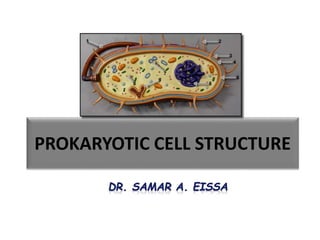
PROKARYOTIC CELL STRUCTURE
CYTOPLASM
A homogeneous soft gel mass inside the cell that
contains:
• Nuclear body
• Ribosomes.
• Storage granules
• Enzymes.
• Extrachromosomal DNA pieces e.g. plasmids.
The cytoplasm of prokaryotes has no mitochondria
and no endoplasmic reticulum.
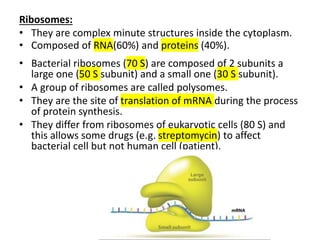
Ribosomes:
• They are complex minute structures inside the cytoplasm.
• Composed of RNA(60%) and proteins (40%).
• Bacterial ribosomes (70 S) are composed of 2 subunits a
large one (50 S subunit) and a small one (30 S subunit).
• A group of ribosomes are called polysomes.
• They are the site of translation of mRNA during the process
of protein synthesis.
• They differ from ribosomes of eukaryotic cells (80 S) and
this allows some drugs (e.g. streptomycin) to affect
bacterial cell but not human cell (patient).
Nuclear body
• A mass of DNA molecule coiled to form single
chromosome (double stranded DNA molecule).
• There is no nuclear membrane and no
nucleolus.
• It carries all the genetic information of the
cell.
• It duplicates before cell division.
Plasmids:
• Plasmids are small circular, extra-chromosomal DNA
molecules that code variable number of genes.
• Bacteria may have none or several plasmids.
• They contain supplemental genetic information as
mating capabilities, antibiotic resistance or toxic
metal tolerance.
• They permit survival of a bacterium under
unfavorable conditions.
• They can be used in genetic engineering because
they are easy to manipulate and can have genetic
information from other sources.
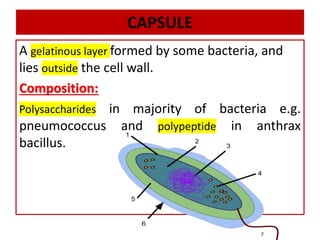
CAPSULE
A gelatinous layer formed by some bacteria, and
lies outside the cell wall.
Composition:
Polysaccharides in majority of bacteria e.g.
pneumococcus and polypeptide in anthrax
bacillus.
Function:
1. Virulence factor = antiphagocytic factor protect
pathogenic bacteria against phagocytosis.
2. Protect bacterial cells against bacteriophage,
complement, lysozymes etc.
3. Antigenic : help in identification and typing of
bacteria e.g. pneumococci.
4. Vaccine preparation.
5. May help pathogenic bacteria in adherence to
human tissues.
GLYCOCALYX (Slime layer)
Definition:
It is a thin coat ,that covers the surface of bacteria
like a film.
Composition:
Polysaccharide.
Function:
It facilitates bacterial adhesion and colonization to
various structures e.g. skin , heart valves , catheters
and teeth (e.g. Strept. mutans that form plaque ,
the precursor of dental caries).
FLAGELLA
Definition:
• These are long, hollow, filamentous appendages used
as organ of motility.
Structure:
• Formed of protein called flagellin.
• Arise form basal bodies in the cytoplasm.
Function:
• Responsible for motility  pathogenesis.
• Antigenic (H antigen)  Identification of bacteria.
Types:
• Monotrichous.
• Amphitrichate
• Lophotrichous.
• Peritrichate.
FIMBRIAE = PILI
Definition:
Short, hair – like filaments found mainly
on surface of Gram – ve organisms.
Structure :
Formed of protein called (pilin).
Arise from the cytoplasmic membrane.
Function:
• Organ of adhesion.
• Transfer of genetic material
(conjugation).
• Antigenic.
Types:
1. Ordinary pili = organ of adhesion.
2. Sex pili = conjugation.
SPORES
Spores are highly resistant resting forms of some
bacteria, formed on exposure to unfavorable conditions
e.g. dryness, heat and depletion of nutrients.
Sporulation (sporogenesis): the process of formation of
spores from vegetative cells.. It occurs usually in vitro.
Germination: opposite to sporulation i.e. formation of
vegetative cells from spores in favorable conditions.
Examples of sporulating bacteria:
a) Bacillus group e.g. B. anthracis.
b) Clostridium group e.g. Cl. tetani.
Structure:
a) Nuclear material.
b) Cytoplasm with little water
and enzyme.
c) Inner membrane formed
from cytoplasmic
membrane = spore wall.
d) Spore cortex formed of
thick peptidoglycan layer.
e) Spore coat formed of
tough keratin – like
protein.
Description:
Site : Central, terminal, subterminal.
Shape: Rounded, oval.
Size : Smaller than, equal to, or larger than
(bulging) bacterial cell.
Position: Still in the cell remnant or free.
Resistance:
Spores are more resistant than bacterial cell due to:
• Very low content of water and enzymes.
• Rigid impermeable wall, rich in calcium dipicolinate.
• No or little metabolic activity.
• The large amount of calcium dipicolonate which is
found only in the core of spores.
Medical importance:
• Resistance to heat and chemicals (bad environmental
conditions).
• Help identification of bacteria. e.g. spore of cl. tetani is
terminal, rounded, bulging (drum stick appearance).
BACTERIAL GROWTH AND
METABOLISM
Bacterial Metabolism
Many bacteria secrete enzymes e.g. lipases,
nucleases, proteinases and other hydrolytic
enzymes.
These breakdown extracellular nutritive material into
simple molecules that are actively transported
across the cytoplasmic membrane into bacterial
cell.
These are oxidized by bacteria to yield energy; and the
degradation products are used to build up structural
components and essential macromolecules for cell
metabolism (anabolism).
The oxidation process:
• It involves a series of reactions in which electrons
(hydrogen) are released in reaction and
transferred to an electron acceptor.
• The electron acceptor is molecular oxygen in
aerobic respiration or an inorganic compound, (e.g.
nitrate) in anaerobic respiration.
• The whole process is catalyzed by a set of
enzymes and coenzymes similar to cytochrome
system.
• The energy that results from these reactions is
stored as high energy bonds e.g. ATP to be used in
anabolic process.
Fermentation
• Fermentation is a type of e metabolism in
which the substrate is metabolized without
the involvement of an exogenous oxidizing
agent.
• This is the process by which facultative
bacteria generate ATP in absence of oxygen.
Bacterial Nutrition
Autotrophic bacteria
• These are bacteria which can
utilize simple inorganic
substances e.g. CO2 as a
source of carbon, and
ammonium salts as a source
of nitrogen, from which they
synthesize organic substances
e.g. proteins and
carbohydrates.
• These are free living, non-
parasitic (saprophytic)
organisms of no medical
importance.
• There are bacteria which
require complex preformed
organic substances e.g.
sugars, protein which are
derived from plant or
animal sources.
• All bacteria of medical
importance are
heterotrophs.
Heterotrophic bacteria
Prokaryotic cell structure.pptx

Prokaryotic cell structure.pptx

  • 1.
  • 2.
    CYTOPLASM A homogeneous softgel mass inside the cell that contains: • Nuclear body • Ribosomes. • Storage granules • Enzymes. • Extrachromosomal DNA pieces e.g. plasmids. The cytoplasm of prokaryotes has no mitochondria and no endoplasmic reticulum.
  • 3.
    Ribosomes: • They arecomplex minute structures inside the cytoplasm. • Composed of RNA(60%) and proteins (40%). • Bacterial ribosomes (70 S) are composed of 2 subunits a large one (50 S subunit) and a small one (30 S subunit). • A group of ribosomes are called polysomes. • They are the site of translation of mRNA during the process of protein synthesis. • They differ from ribosomes of eukaryotic cells (80 S) and this allows some drugs (e.g. streptomycin) to affect bacterial cell but not human cell (patient).
  • 4.
    Nuclear body • Amass of DNA molecule coiled to form single chromosome (double stranded DNA molecule). • There is no nuclear membrane and no nucleolus. • It carries all the genetic information of the cell. • It duplicates before cell division.
  • 5.
    Plasmids: • Plasmids aresmall circular, extra-chromosomal DNA molecules that code variable number of genes. • Bacteria may have none or several plasmids. • They contain supplemental genetic information as mating capabilities, antibiotic resistance or toxic metal tolerance. • They permit survival of a bacterium under unfavorable conditions. • They can be used in genetic engineering because they are easy to manipulate and can have genetic information from other sources.
  • 7.
    CAPSULE A gelatinous layerformed by some bacteria, and lies outside the cell wall. Composition: Polysaccharides in majority of bacteria e.g. pneumococcus and polypeptide in anthrax bacillus.
  • 8.
    Function: 1. Virulence factor= antiphagocytic factor protect pathogenic bacteria against phagocytosis. 2. Protect bacterial cells against bacteriophage, complement, lysozymes etc. 3. Antigenic : help in identification and typing of bacteria e.g. pneumococci. 4. Vaccine preparation. 5. May help pathogenic bacteria in adherence to human tissues.
  • 10.
    GLYCOCALYX (Slime layer) Definition: Itis a thin coat ,that covers the surface of bacteria like a film. Composition: Polysaccharide. Function: It facilitates bacterial adhesion and colonization to various structures e.g. skin , heart valves , catheters and teeth (e.g. Strept. mutans that form plaque , the precursor of dental caries).
  • 12.
    FLAGELLA Definition: • These arelong, hollow, filamentous appendages used as organ of motility. Structure: • Formed of protein called flagellin. • Arise form basal bodies in the cytoplasm. Function: • Responsible for motility  pathogenesis. • Antigenic (H antigen)  Identification of bacteria.
  • 13.
    Types: • Monotrichous. • Amphitrichate •Lophotrichous. • Peritrichate.
  • 14.
    FIMBRIAE = PILI Definition: Short,hair – like filaments found mainly on surface of Gram – ve organisms. Structure : Formed of protein called (pilin). Arise from the cytoplasmic membrane. Function: • Organ of adhesion. • Transfer of genetic material (conjugation). • Antigenic. Types: 1. Ordinary pili = organ of adhesion. 2. Sex pili = conjugation.
  • 15.
    SPORES Spores are highlyresistant resting forms of some bacteria, formed on exposure to unfavorable conditions e.g. dryness, heat and depletion of nutrients. Sporulation (sporogenesis): the process of formation of spores from vegetative cells.. It occurs usually in vitro. Germination: opposite to sporulation i.e. formation of vegetative cells from spores in favorable conditions. Examples of sporulating bacteria: a) Bacillus group e.g. B. anthracis. b) Clostridium group e.g. Cl. tetani.
  • 17.
    Structure: a) Nuclear material. b)Cytoplasm with little water and enzyme. c) Inner membrane formed from cytoplasmic membrane = spore wall. d) Spore cortex formed of thick peptidoglycan layer. e) Spore coat formed of tough keratin – like protein.
  • 18.
    Description: Site : Central,terminal, subterminal. Shape: Rounded, oval. Size : Smaller than, equal to, or larger than (bulging) bacterial cell. Position: Still in the cell remnant or free.
  • 19.
    Resistance: Spores are moreresistant than bacterial cell due to: • Very low content of water and enzymes. • Rigid impermeable wall, rich in calcium dipicolinate. • No or little metabolic activity. • The large amount of calcium dipicolonate which is found only in the core of spores. Medical importance: • Resistance to heat and chemicals (bad environmental conditions). • Help identification of bacteria. e.g. spore of cl. tetani is terminal, rounded, bulging (drum stick appearance).
  • 20.
  • 21.
    Bacterial Metabolism Many bacteriasecrete enzymes e.g. lipases, nucleases, proteinases and other hydrolytic enzymes. These breakdown extracellular nutritive material into simple molecules that are actively transported across the cytoplasmic membrane into bacterial cell. These are oxidized by bacteria to yield energy; and the degradation products are used to build up structural components and essential macromolecules for cell metabolism (anabolism).
  • 22.
    The oxidation process: •It involves a series of reactions in which electrons (hydrogen) are released in reaction and transferred to an electron acceptor. • The electron acceptor is molecular oxygen in aerobic respiration or an inorganic compound, (e.g. nitrate) in anaerobic respiration. • The whole process is catalyzed by a set of enzymes and coenzymes similar to cytochrome system. • The energy that results from these reactions is stored as high energy bonds e.g. ATP to be used in anabolic process.
  • 23.
    Fermentation • Fermentation isa type of e metabolism in which the substrate is metabolized without the involvement of an exogenous oxidizing agent. • This is the process by which facultative bacteria generate ATP in absence of oxygen.
  • 24.
    Bacterial Nutrition Autotrophic bacteria •These are bacteria which can utilize simple inorganic substances e.g. CO2 as a source of carbon, and ammonium salts as a source of nitrogen, from which they synthesize organic substances e.g. proteins and carbohydrates. • These are free living, non- parasitic (saprophytic) organisms of no medical importance. • There are bacteria which require complex preformed organic substances e.g. sugars, protein which are derived from plant or animal sources. • All bacteria of medical importance are heterotrophs. Heterotrophic bacteria