Activating Prior Knowledge
Whatdo you think makes someone a good digital
citizen in the context of social media interactions,
online gaming, email communication, online
learning platforms and sharing content online?
3.
Lesson Purpose
Enumerate the
elementsof Digital
Citizenship.
Present a role-play
scenario with
analyzation on
what digital
citizenship
elements were
ignored.
Assess scenarios how
it could have been
handled better.
1 2 3
4.
Unlocking Content Vocabulary
Inyour own words, how do you define the
following?
-Digital Access
-Digital Commerce
-Digital Communication
-Digital Literacy
-Digital Etiquette
-Digital Law
-Digital Rights and Responsibilities
-Digital Health and Wellness
5.
ELEMENTS OF DIGITALCITIZENSHIP
-Digital Access
-Digital Commerce
-Digital Communication
-Digital Literacy
-Digital Etiquette
-Digital Law
-Digital Rights and Responsibilities
-Digital Health and Wellness
-Digital Security (Self-protection)
Developing and Deepening Understanding
6.
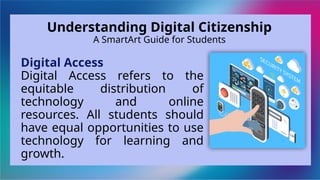
Digital Access
Digital Accessrefers to the
equitable distribution of
technology and online
resources. All students should
have equal opportunities to use
technology for learning and
growth.
Understanding Digital Citizenship
A SmartArt Guide for Students
7.
Digital Commerce
Digital Commerceinvolves
buying and selling goods
and services online. It
includes understanding
safe buying practices and
recognizing the
importance of secure
transactions.
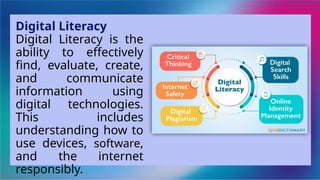
Digital Literacy
Digital Literacyis the
ability to effectively
find, evaluate, create,
and communicate
information using
digital technologies.
This includes
understanding how to
use devices, software,
and the internet
responsibly.
10.
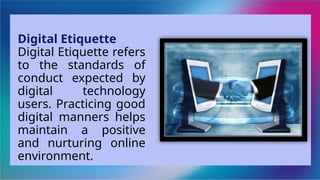
Digital Etiquette
Digital Etiquetterefers
to the standards of
conduct expected by
digital technology
users. Practicing good
digital manners helps
maintain a positive
and nurturing online
environment.
11.
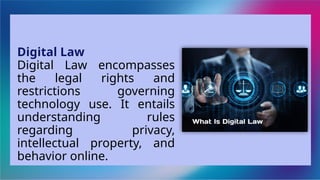
Digital Law
Digital Lawencompasses
the legal rights and
restrictions governing
technology use. It entails
understanding rules
regarding privacy,
intellectual property, and
behavior online.
12.
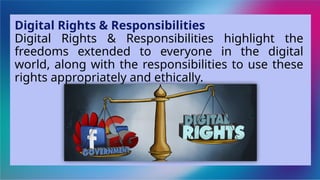
Digital Rights &Responsibilities
Digital Rights & Responsibilities highlight the
freedoms extended to everyone in the digital
world, along with the responsibilities to use these
rights appropriately and ethically.
13.
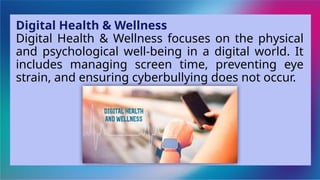
Digital Health &Wellness
Digital Health & Wellness focuses on the physical
and psychological well-being in a digital world. It
includes managing screen time, preventing eye
strain, and ensuring cyberbullying does not occur.
14.
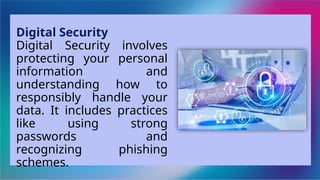
Digital Security
Digital Securityinvolves
protecting your personal
information and
understanding how to
responsibly handle your
data. It includes practices
like using strong
passwords and
recognizing phishing
schemes.
15.
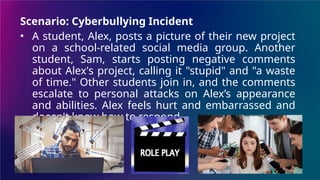
Scenario: Cyberbullying Incident
•A student, Alex, posts a picture of their new project
on a school-related social media group. Another
student, Sam, starts posting negative comments
about Alex's project, calling it "stupid" and "a waste
of time." Other students join in, and the comments
escalate to personal attacks on Alex’s appearance
and abilities. Alex feels hurt and embarrassed and
doesn't know how to respond.
16.
Guided Analysis
Discussion Points
IdentifyIgnored Digital Citizenship Elements
1. Digital Etiquette - Sam and the other students
ignored the norms of respectful and kind
communication online.
2. Digital Rights and Responsibilities - The bullies
ignored Alex's right to a safe and respectful online
environment.
3. Digital Security - The situation could escalate to a
point where Alex's personal information might be at
risk if the bullying continues.
17.
Analyze the Situation
1.How did Alex feel? Discuss the emotional impact of
cyberbullying on Alex.
2. Why did Sam and the other students behave this
way? Explore the reasons behind cyberbullying
behavior.
3. What role did the bystanders play? Discuss the
impact of bystanders either joining in or staying
silent.
18.
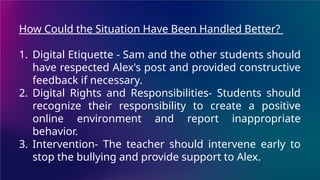
How Could theSituation Have Been Handled Better?
1. Digital Etiquette - Sam and the other students should
have respected Alex's post and provided constructive
feedback if necessary.
2. Digital Rights and Responsibilities- Students should
recognize their responsibility to create a positive
online environment and report inappropriate
behavior.
3. Intervention- The teacher should intervene early to
stop the bullying and provide support to Alex.
19.
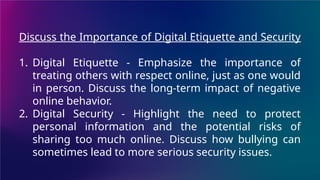
Discuss the Importanceof Digital Etiquette and Security
1. Digital Etiquette - Emphasize the importance of
treating others with respect online, just as one would
in person. Discuss the long-term impact of negative
online behavior.
2. Digital Security - Highlight the need to protect
personal information and the potential risks of
sharing too much online. Discuss how bullying can
sometimes lead to more serious security issues.
21.
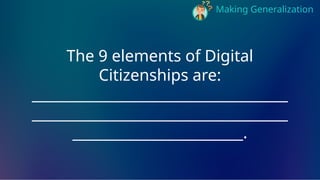
Making Generalization
The 9elements of Digital
Citizenships are:
____________________________________
____________________________________
________________________.
Evaluation
1. What doesDigital Access ensure for
students?
a. Equal opportunities to use technology for
learning and growth
b. Limited access to technology for selected
students
c. Exclusive digital tools for advanced learners
only
d. Restriction of technology use in education
24.
Evaluation
2. Which ofthe following best describes
Digital Communication?
a. Exchanging information using digital tools
while being respectful and clear
b. Using only emails for formal
communication
c. Avoiding all forms of communication online
d. Sharing information without concern for
accuracy or tone
25.
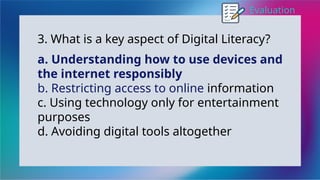
Evaluation
3. What isa key aspect of Digital Literacy?
a. Understanding how to use devices and the
internet responsibly
b. Restricting access to online information
c. Using technology only for entertainment
purposes
d. Avoiding digital tools altogether
26.
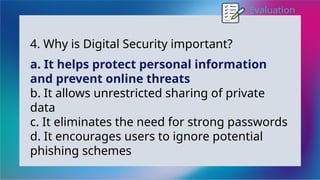
Evaluation
4. Why isDigital Security important?
a. It helps protect personal information and
prevent online threats
b. It allows unrestricted sharing of private
data
c. It eliminates the need for strong passwords
d. It encourages users to ignore potential
phishing schemes
27.
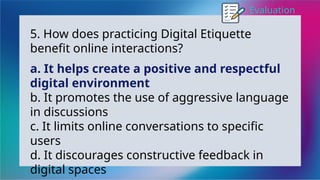
Evaluation
5. How doespracticing Digital Etiquette
benefit online interactions?
a. It helps create a positive and respectful
digital environment
b. It promotes the use of aggressive language
in discussions
c. It limits online conversations to specific
users
d. It discourages constructive feedback in
digital spaces
28.
Evaluation
1. What doesDigital Access ensure for
students?
a. Equal opportunities to use technology
for learning and growth
b. Limited access to technology for selected
students
c. Exclusive digital tools for advanced learners
only
d. Restriction of technology use in education
29.
Evaluation
2. Which ofthe following best describes
Digital Communication?
a. Exchanging information using digital
tools while being respectful and clear
b. Using only emails for formal
communication
c. Avoiding all forms of communication online
d. Sharing information without concern for
accuracy or tone
30.
Evaluation
3. What isa key aspect of Digital Literacy?
a. Understanding how to use devices and
the internet responsibly
b. Restricting access to online information
c. Using technology only for entertainment
purposes
d. Avoiding digital tools altogether
31.
Evaluation
4. Why isDigital Security important?
a. It helps protect personal information
and prevent online threats
b. It allows unrestricted sharing of private
data
c. It eliminates the need for strong passwords
d. It encourages users to ignore potential
phishing schemes
32.
Evaluation
5. How doespracticing Digital Etiquette
benefit online interactions?
a. It helps create a positive and respectful
digital environment
b. It promotes the use of aggressive language
in discussions
c. It limits online conversations to specific
users
d. It discourages constructive feedback in
digital spaces