

Project-based Collaborative Learning of Software Patterns Zoran Jeremi ć Military academy, Belgrade
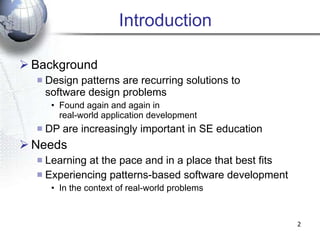
Introduction Background Design patterns are recurring solutions to  software design problems Found again and again in  real-world application development DP are increasingly important in SE education Needs Learning at the pace and in a place that best fits Experiencing patterns-based software development In the context of real-world problems
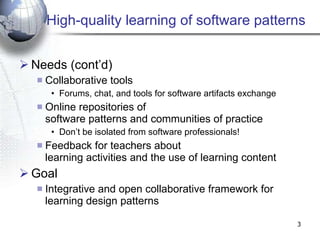
High-quality learning of software patterns Needs (cont’d) Collaborative tools  Forums, chat, and tools for software artifacts exchange Online repositories of  software patterns and communities of practice Don’t be isolated from software professionals! Feedback for teachers about  learning activities and the use of learning content Goal Integrative and open collaborative framework for learning design patterns
Current State Current learning support  Individual use of tools Lack of means for enabling the exchange of  data about the activities between tools Poor support for Context-aware learning services Inter-tool personalized learning
Proposal: DEPTHS  DEsign Patterns Teaching Help System Semantic-rich framework: Sharing knowledge
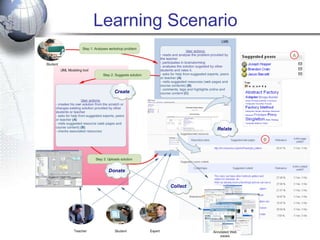
Learning Scenario
LOCO-Cite Ontology Learning Object Context Ontology (LOCO)
Domain Ontology
DEPTHS Architecture
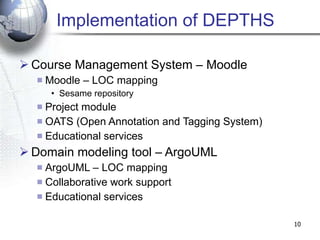
Implementation of DEPTHS Course Management System – Moodle Moodle – LOC mapping Sesame repository  Project module OATS (Open Annotation and Tagging System) Educational services Domain modeling tool – ArgoUML ArgoUML – LOC mapping Collaborative work support Educational services
Implementation of DEPTHS Feedback provision tools for educators LOCO-Analyst  Online repositories Wikipedia, Yahoo! Design Pattern, Library,  Portland Pattern Repository,Hillside.net Pattern Catalog… KIM framework – semantic annotation platform
Conclusion Benefits  Students’ learning effectiveness and efficiency Recommending resources from  online repositories related to the learning goal Integration of knowledge about all related learning activities  Performed by any student with any tool Knowledge reuse Teachers spent less time developing online lessons Evaluation has been done at Military academy
Project-based Collaborative Learning of Software Patterns Zoran Jeremi ć Military academy, Belgrade

Project-based Collaborative Learning of Software Patterns

  • 1.
    Project-based Collaborative Learningof Software Patterns Zoran Jeremi ć Military academy, Belgrade
  • 2.
    Introduction Background Designpatterns are recurring solutions to software design problems Found again and again in real-world application development DP are increasingly important in SE education Needs Learning at the pace and in a place that best fits Experiencing patterns-based software development In the context of real-world problems
  • 3.
    High-quality learning ofsoftware patterns Needs (cont’d) Collaborative tools Forums, chat, and tools for software artifacts exchange Online repositories of software patterns and communities of practice Don’t be isolated from software professionals! Feedback for teachers about learning activities and the use of learning content Goal Integrative and open collaborative framework for learning design patterns
  • 4.
    Current State Currentlearning support Individual use of tools Lack of means for enabling the exchange of data about the activities between tools Poor support for Context-aware learning services Inter-tool personalized learning
  • 5.
    Proposal: DEPTHS DEsign Patterns Teaching Help System Semantic-rich framework: Sharing knowledge
  • 6.
  • 7.
    LOCO-Cite Ontology LearningObject Context Ontology (LOCO)
  • 8.
  • 9.
  • 10.
    Implementation of DEPTHSCourse Management System – Moodle Moodle – LOC mapping Sesame repository Project module OATS (Open Annotation and Tagging System) Educational services Domain modeling tool – ArgoUML ArgoUML – LOC mapping Collaborative work support Educational services
  • 11.
    Implementation of DEPTHSFeedback provision tools for educators LOCO-Analyst Online repositories Wikipedia, Yahoo! Design Pattern, Library, Portland Pattern Repository,Hillside.net Pattern Catalog… KIM framework – semantic annotation platform
  • 12.
    Conclusion Benefits Students’ learning effectiveness and efficiency Recommending resources from online repositories related to the learning goal Integration of knowledge about all related learning activities Performed by any student with any tool Knowledge reuse Teachers spent less time developing online lessons Evaluation has been done at Military academy
  • 13.
    Project-based Collaborative Learningof Software Patterns Zoran Jeremi ć Military academy, Belgrade