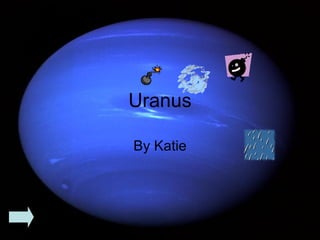
Uranus By Katie
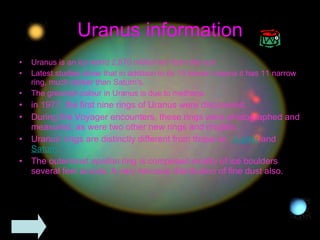
Uranus information Uranus is an icy world 2,870 million km from the sun.  Latest studies show that in addition to its 15 known moons it has 11 narrow ring, much darker than Saturn's. The greenish colour in Uranus is due to methane . in 1977, the first nine rings of Uranus were discovered.  During the Voyager encounters, these rings were photographed and measured, as were two other new rings and ringlets.  Uranus' rings are distinctly different from those on   Jupiter  and  Saturn .  The outermost  epsilon  ring is composed mostly of ice boulders several feet across. A very tenuous distribution of fine dust also.
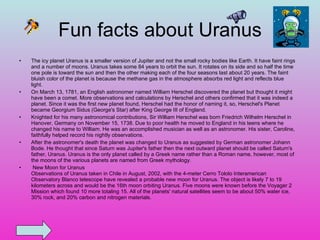
Fun facts about Uranus The icy planet Uranus is a smaller version of Jupiter and not the small rocky bodies like Earth. It have faint rings and a number of moons. Uranus takes some 84 years to orbit the sun. It rotates on its side and so half the time one pole is toward the sun and then the other making each of the four seasons last about 20 years. The faint bluish color of the planet is because the methane gas in the atmosphere absorbs red light and reflects blue light. On March 13, 1781, an English astronomer named William Herschel discovered the planet but thought it might have been a comet. More observations and calculations by Herschel and others confirmed that it was indeed a planet. Since it was the first new planet found, Herschel had the honor of naming it, so, Herschel's Planet became Georgium Sidus (George's Star) after King George III of England.  Knighted for his many astronomical contributions, Sir William Herschel was born Friedrich Wilhelm Herschel in Hanover, Germany on November 15, 1738. Due to poor health he moved to England in his teens where he changed his name to William. He was an accomplished musician as well as an astronomer. His sister, Caroline, faithfully helped record his nightly observations.  After the astronomer's death the planet was changed to Uranus as suggested by German astronomer Johann Bode. He thought that since Saturn was Jupiter's father then the next outward planet should be called Saturn's father, Uranus. Uranus is the only planet called by a Greek name rather than a Roman name, however, most of the moons of the various planets are named from Greek mythology. New Moon for Uranus Observations of Uranus taken in Chile in August, 2002, with the 4-meter Cerro Tololo Interamerican Observatory Blanco telescope have revealed a probable new moon for Uranus. The object is likely 7 to 19 kilometers across and would be the 16th moon orbiting Uranus. Five moons were known before the Voyager 2 Mission which found 10 more totaling 15. All of the planets' natural satellites seem to be about 50% water ice, 30% rock, and 20% carbon and nitrogen materials.
Uranus moons Uranus has 27 moons which are all names from Shakespeare plays here are the moons. 1.  Cordelia   2. Ophelia   3. Bianca   4. Cressida   5. Desdemona   6. Juliet   7. Portia   8. Rosalind   9.  Mab   10. Belinda   11.  Perdita   12. Puck   13. Cupid   14. Miranda   15. Francisco   16. Ariel   17. Umbriel   18. Titania   19. Oberon   20. Caliban   21. Stephano   22. Trinculo   23. Sycorax   24. Margaret   25. Prospero   26. Setebos   27. Ferdinand
My Alien The alien that I have chosen lives on Uranus.  It has nine faint  rings around it.

facts about the planet uranus

  • 1.
  • 2.
    Uranus information Uranusis an icy world 2,870 million km from the sun. Latest studies show that in addition to its 15 known moons it has 11 narrow ring, much darker than Saturn's. The greenish colour in Uranus is due to methane . in 1977, the first nine rings of Uranus were discovered. During the Voyager encounters, these rings were photographed and measured, as were two other new rings and ringlets. Uranus' rings are distinctly different from those on   Jupiter  and  Saturn . The outermost  epsilon  ring is composed mostly of ice boulders several feet across. A very tenuous distribution of fine dust also.
  • 3.
    Fun facts aboutUranus The icy planet Uranus is a smaller version of Jupiter and not the small rocky bodies like Earth. It have faint rings and a number of moons. Uranus takes some 84 years to orbit the sun. It rotates on its side and so half the time one pole is toward the sun and then the other making each of the four seasons last about 20 years. The faint bluish color of the planet is because the methane gas in the atmosphere absorbs red light and reflects blue light. On March 13, 1781, an English astronomer named William Herschel discovered the planet but thought it might have been a comet. More observations and calculations by Herschel and others confirmed that it was indeed a planet. Since it was the first new planet found, Herschel had the honor of naming it, so, Herschel's Planet became Georgium Sidus (George's Star) after King George III of England. Knighted for his many astronomical contributions, Sir William Herschel was born Friedrich Wilhelm Herschel in Hanover, Germany on November 15, 1738. Due to poor health he moved to England in his teens where he changed his name to William. He was an accomplished musician as well as an astronomer. His sister, Caroline, faithfully helped record his nightly observations. After the astronomer's death the planet was changed to Uranus as suggested by German astronomer Johann Bode. He thought that since Saturn was Jupiter's father then the next outward planet should be called Saturn's father, Uranus. Uranus is the only planet called by a Greek name rather than a Roman name, however, most of the moons of the various planets are named from Greek mythology. New Moon for Uranus Observations of Uranus taken in Chile in August, 2002, with the 4-meter Cerro Tololo Interamerican Observatory Blanco telescope have revealed a probable new moon for Uranus. The object is likely 7 to 19 kilometers across and would be the 16th moon orbiting Uranus. Five moons were known before the Voyager 2 Mission which found 10 more totaling 15. All of the planets' natural satellites seem to be about 50% water ice, 30% rock, and 20% carbon and nitrogen materials.
  • 4.
    Uranus moons Uranushas 27 moons which are all names from Shakespeare plays here are the moons. 1. Cordelia 2. Ophelia 3. Bianca 4. Cressida 5. Desdemona 6. Juliet 7. Portia 8. Rosalind 9. Mab 10. Belinda 11. Perdita 12. Puck 13. Cupid 14. Miranda 15. Francisco 16. Ariel 17. Umbriel 18. Titania 19. Oberon 20. Caliban 21. Stephano 22. Trinculo 23. Sycorax 24. Margaret 25. Prospero 26. Setebos 27. Ferdinand
  • 5.
    My Alien Thealien that I have chosen lives on Uranus. It has nine faint rings around it.