Gap Inc.Filling The Gap: Building a Bridge to Future ProsperityPM Cluster 107Professor CarterProfessor CoombsProfessor MattaProfessor WrightMay 1, 2009Team 7GJoseph BurnsMax FeldmanPatrick FogtJustine HoltkampJustin Schiff
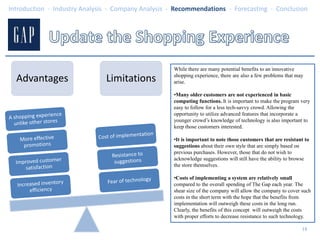
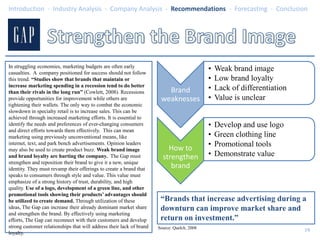
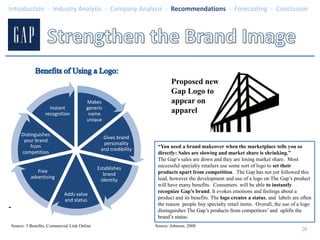
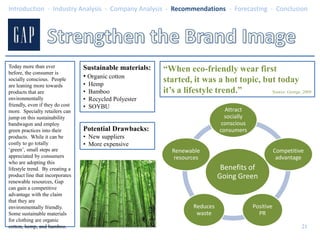
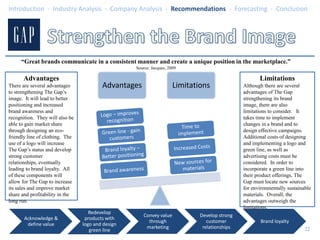
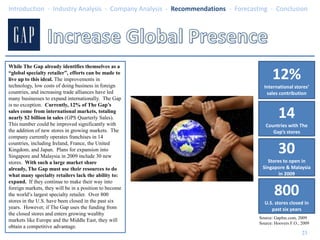
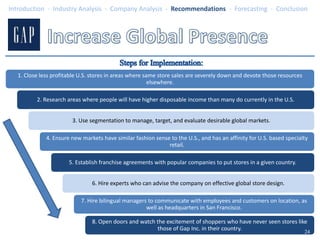
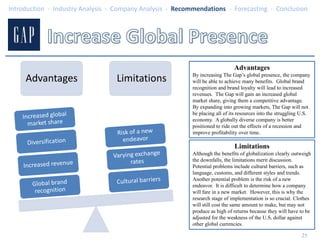
Executive SummaryRecent Economic DownturnThe current economic downfall has caused consumers to drastically change their spending habits.  This reduction in spending has severely impacted businesses from every industry, and the specialty retail industry is no exception.  A majority of specialty retailers have seen a dramatic slowdown in growth and sales.  The Gap must continue to grow by taking advantage of their market share. With so many resources available, The Gap has the unique ability to take risks in order to combat the limitations of their weaknesses.Several efforts must be made to ensure the company’s ability to continue dominance in producing revenue and conveying value:Update the Shopping Experience: Innovative Customer Relationships Management Systems give companies ample opportunities to better serve their customers through greater personalization. Application of Data Mining techniques will allow The Gap to analyze their market basket and increase customer acquisition, retention and loyalty.Strengthen the Brand Image: A lack of brand identity has recently plagued The Gap’s ability to differentiate themselves amongst the growing threat of a highly competitive retail clothing market. Implementing and using an identifiable logo on apparel will increase brand recognition. As an industry leader, The Gap must use their resources to increase their recognition as an innovator amongst environmentally friendly stores.Increase Global Presence: With such a volatile U.S. market, it is important to combat downturns through global diversification. With a redefined and focused brand image, The Gap will have the capabilities and resources to regain their status as the largest retailer in the world. Proper research into advantageous markets, as well as hiring employees that understand cultural differences, are the most important of many vital steps to achieving international prominence.Financial StatusSuccessful and effective implementation of these strategies will  greatly effect the financial status of The Gap versus its competition. The effect of these changes, as well as the current status of these financials in terms of liquidity, efficiency, profitability, leverage, and market value will be highlighted. While The Gap is an industry leader in some of these categories, there is also room for improvement. Steps of effective implementation of the provided  strategies are designed to improve The Gap in these areas.2
Table of Contents3
IntroductionThe United States based specialty retail clothing industry has suffered due to the recent economic recession. As the largest retailer in the United States, The Gap must continue to advance in order to maintain their market share.  In a world of constantly changing technology and business strategies, many efforts must be made to stay ahead of the endless amount of relentless competitors. A powerhouse like The Gap must use their size and influence to emphasize their strengths and alleviate the pressures of their weaknesses. The structure of the typical shopping experience is changing and retailers are forced to comply to the ever increasing  and specialized demands of their customers.The purpose of this report is to: Analyzethe performance of the industry
Assessthe current condition of the company
Benchmarkthe company against key competitors
Provide strategic direction to tackle company and industry issues
Discusshow to effectively implement these strategies
Evaluate the impact of recommendations on the company’s financial position and performance4
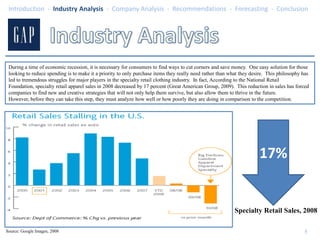
Industry AnalysisDuring a time of economic recession, it is necessary for consumers to find ways to cut corners and save money.  One easy solution for those looking to reduce spending is to make it a priority to only purchase items they really need rather than what they desire.  This philosophy has led to tremendous struggles for major players in the specialty retail clothing industry.  In fact, According to the National Retail Foundation, specialty retail apparel sales in 2008 decreased by 17 percent (Great American Group, 2009).  This reduction in sales has forced companies to find new and creative strategies that will not only help them survive, but also allow them to thrive in the future.  However, before they can take this step, they must analyze how well or how poorly they are doing in comparison to the competition.  17%Specialty Retail Sales, 2008Source: Google Images, 20085
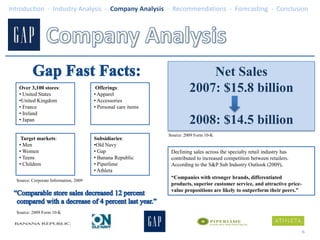
Company AnalysisGap Fast Facts:Net Sales2007: $15.8 billion2008: $14.5 billionOver 3,100 stores: United States
United Kingdom
 France
 Ireland
 Japan Offerings:  Apparel
 Accessories
 Personal care itemsSource: 2009 Form 10-KTarget markets:  Men
 Women
 Teens
 ChildrenSubsidiaries:Old Navy
 Gap
 Banana Republic
Piperlime
AthletaDeclining sales across the specialty retail industry has contributed to increased competition between retailers.  According to the S&P Sub Industry Outlook (2009), “Companies with stronger brands, differentiated products, superior customer service, and attractive price-value propositions are likely to outperform their peers.”Source: Corporate Information, 2009“Comparable store sales decreased 12 percent compared with a decrease of 4 percent last year.”Source: 2009 Form 10-K6
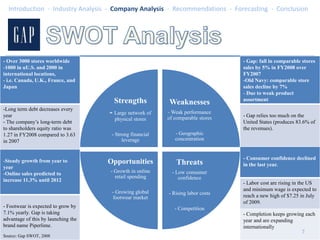
SWOT Analysis7Source: Gap SWOT, 2008
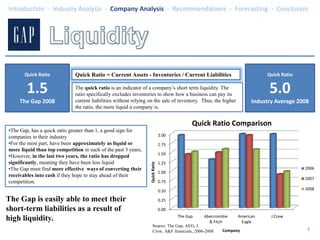
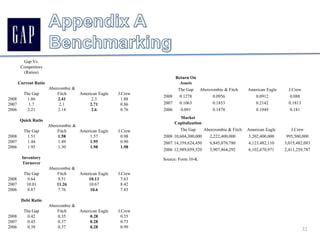
LiquidityQuick Ratio1.5The Gap 2008Quick Ratio5.0Industry Average 2008Quick Ratio = Current Assets - Inventories / Current Liabilities The quick ratio is an indicator of a company’s short term liquidity. The ratio specifically excludes inventories to show how a business can pay its current liabilities without relying on the sale of inventory.  Thus, the higher the ratio, the more liquid a company is.The Gap, has a quick ratio greater than 1, a good sign for companies in their industry
For the most part, have been approximately as liquid or more liquid than top competition in each of the past 3 years,
However, in the last two years, the ratio has dropped significantly, meaning they have been less liquid
The Gap must find more effective  ways of converting their receivables into cash if they hope to stay ahead of their competition.The Gap is easily able to meet their short-term liabilities as a result of high liquidity.Source: The Gap, AEO, J. Crew, A&F financials, 2006-2008
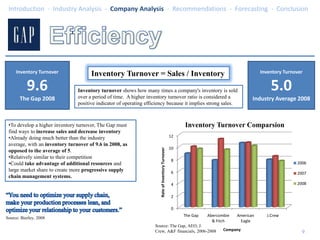
EfficiencyInventory Turnover5.0Industry Average 2008Inventory Turnover9.6The Gap 2008Inventory Turnover = Sales / InventoryInventory turnover shows how many times a company's inventory is sold over a period of time.  A higher inventory turnover ratio is considered a positive indicator of operating efficiency because it implies strong sales. To develop a higher inventory turnover, The Gap must find ways to increase sales and decrease inventory
Already doing much better than the industry average, with an inventory turnover of 9.6 in 2008, as opposed to the average of 5.
Relatively similar to their competition
Could take advantage of additional resources and large market share to create more progressive supply chain management systems.“You need to optimize your supply chain, make your production processes lean, and optimize your relationship to your customers.”Source: Bierley, 2008Source: The Gap, AEO, J. Crew, A&F financials, 2006-20089
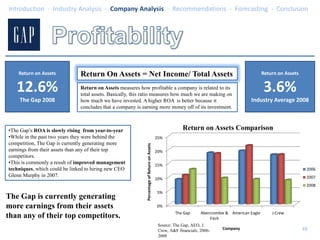
ProfitabilityReturn on Assets3.6%Industry Average 2008Return on Assets12.6%The Gap 2008Return On Assets = Net Income/ Total AssetsReturn on Assets measures how profitable a company is related to its total assets. Basically, this ratio measures how much we are making on how much we have invested. A higher ROA  is better because it concludes that a company is earning more money off of its investment. The Gap’s ROA is slowly rising  from year-to-year
While in the past two years they were behind the competition, The Gap is currently generating more earnings from their assets than any of their top competitors.
This is commonly a result of improved management techniques, which could be linked to hiring new CEO Glenn Murphy in 2007.The Gap is currently generating more earnings from their assets than any of their top competitors.Source: The Gap, AEO, J. Crew, A&F financials, 2006-2008
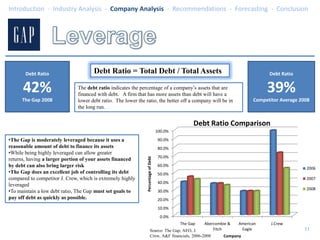
LeverageDebt Ratio42%The Gap 2008Debt Ratio 39%Competitor Average 2008Debt Ratio = Total Debt / Total AssetsThe debt ratio indicates the percentage of a company’s assets that are financed with debt.   A firm that has more assets than debt will have a lower debt ratio.  The lower the ratio, the better off a company will be in the long run. The Gap is moderately leveraged because it uses a reasonable amount of debt to finance its assets
While being highly leveraged can allow greater returns, having a larger portion of your assets financed by debt can also bring larger risk
The Gap does an excellent job of controlling its debt compared to competitor J. Crew, which is extremely highly leveraged
To maintain a low debt ratio, The Gap must set goals to pay off debt as quickly as possible. Source: The Gap, AEO, J. Crew, A&F financials, 2006-2008

Business Cluster Project

  • 1.
    Gap Inc.Filling TheGap: Building a Bridge to Future ProsperityPM Cluster 107Professor CarterProfessor CoombsProfessor MattaProfessor WrightMay 1, 2009Team 7GJoseph BurnsMax FeldmanPatrick FogtJustine HoltkampJustin Schiff
  • 2.
    Executive SummaryRecent EconomicDownturnThe current economic downfall has caused consumers to drastically change their spending habits. This reduction in spending has severely impacted businesses from every industry, and the specialty retail industry is no exception. A majority of specialty retailers have seen a dramatic slowdown in growth and sales. The Gap must continue to grow by taking advantage of their market share. With so many resources available, The Gap has the unique ability to take risks in order to combat the limitations of their weaknesses.Several efforts must be made to ensure the company’s ability to continue dominance in producing revenue and conveying value:Update the Shopping Experience: Innovative Customer Relationships Management Systems give companies ample opportunities to better serve their customers through greater personalization. Application of Data Mining techniques will allow The Gap to analyze their market basket and increase customer acquisition, retention and loyalty.Strengthen the Brand Image: A lack of brand identity has recently plagued The Gap’s ability to differentiate themselves amongst the growing threat of a highly competitive retail clothing market. Implementing and using an identifiable logo on apparel will increase brand recognition. As an industry leader, The Gap must use their resources to increase their recognition as an innovator amongst environmentally friendly stores.Increase Global Presence: With such a volatile U.S. market, it is important to combat downturns through global diversification. With a redefined and focused brand image, The Gap will have the capabilities and resources to regain their status as the largest retailer in the world. Proper research into advantageous markets, as well as hiring employees that understand cultural differences, are the most important of many vital steps to achieving international prominence.Financial StatusSuccessful and effective implementation of these strategies will greatly effect the financial status of The Gap versus its competition. The effect of these changes, as well as the current status of these financials in terms of liquidity, efficiency, profitability, leverage, and market value will be highlighted. While The Gap is an industry leader in some of these categories, there is also room for improvement. Steps of effective implementation of the provided strategies are designed to improve The Gap in these areas.2
  • 3.
  • 4.
    IntroductionThe United Statesbased specialty retail clothing industry has suffered due to the recent economic recession. As the largest retailer in the United States, The Gap must continue to advance in order to maintain their market share. In a world of constantly changing technology and business strategies, many efforts must be made to stay ahead of the endless amount of relentless competitors. A powerhouse like The Gap must use their size and influence to emphasize their strengths and alleviate the pressures of their weaknesses. The structure of the typical shopping experience is changing and retailers are forced to comply to the ever increasing and specialized demands of their customers.The purpose of this report is to: Analyzethe performance of the industry
  • 5.
  • 6.
  • 7.
    Provide strategic directionto tackle company and industry issues
  • 8.
    Discusshow to effectivelyimplement these strategies
  • 9.
    Evaluate the impactof recommendations on the company’s financial position and performance4
  • 10.
    Industry AnalysisDuring atime of economic recession, it is necessary for consumers to find ways to cut corners and save money. One easy solution for those looking to reduce spending is to make it a priority to only purchase items they really need rather than what they desire. This philosophy has led to tremendous struggles for major players in the specialty retail clothing industry. In fact, According to the National Retail Foundation, specialty retail apparel sales in 2008 decreased by 17 percent (Great American Group, 2009). This reduction in sales has forced companies to find new and creative strategies that will not only help them survive, but also allow them to thrive in the future. However, before they can take this step, they must analyze how well or how poorly they are doing in comparison to the competition. 17%Specialty Retail Sales, 2008Source: Google Images, 20085
  • 11.
    Company AnalysisGap FastFacts:Net Sales2007: $15.8 billion2008: $14.5 billionOver 3,100 stores: United States
  • 12.
  • 13.
  • 14.
  • 15.
  • 16.
  • 17.
    Personal careitemsSource: 2009 Form 10-KTarget markets: Men
  • 18.
  • 19.
  • 20.
  • 21.
  • 22.
  • 23.
  • 24.
    AthletaDeclining sales acrossthe specialty retail industry has contributed to increased competition between retailers. According to the S&P Sub Industry Outlook (2009), “Companies with stronger brands, differentiated products, superior customer service, and attractive price-value propositions are likely to outperform their peers.”Source: Corporate Information, 2009“Comparable store sales decreased 12 percent compared with a decrease of 4 percent last year.”Source: 2009 Form 10-K6
  • 25.
  • 26.
    LiquidityQuick Ratio1.5The Gap2008Quick Ratio5.0Industry Average 2008Quick Ratio = Current Assets - Inventories / Current Liabilities The quick ratio is an indicator of a company’s short term liquidity. The ratio specifically excludes inventories to show how a business can pay its current liabilities without relying on the sale of inventory. Thus, the higher the ratio, the more liquid a company is.The Gap, has a quick ratio greater than 1, a good sign for companies in their industry
  • 27.
    For the mostpart, have been approximately as liquid or more liquid than top competition in each of the past 3 years,
  • 28.
    However, in thelast two years, the ratio has dropped significantly, meaning they have been less liquid
  • 29.
    The Gap mustfind more effective ways of converting their receivables into cash if they hope to stay ahead of their competition.The Gap is easily able to meet their short-term liabilities as a result of high liquidity.Source: The Gap, AEO, J. Crew, A&F financials, 2006-2008
  • 30.
    EfficiencyInventory Turnover5.0Industry Average2008Inventory Turnover9.6The Gap 2008Inventory Turnover = Sales / InventoryInventory turnover shows how many times a company's inventory is sold over a period of time. A higher inventory turnover ratio is considered a positive indicator of operating efficiency because it implies strong sales. To develop a higher inventory turnover, The Gap must find ways to increase sales and decrease inventory
  • 31.
    Already doing muchbetter than the industry average, with an inventory turnover of 9.6 in 2008, as opposed to the average of 5.
  • 32.
    Relatively similar totheir competition
  • 33.
    Could take advantageof additional resources and large market share to create more progressive supply chain management systems.“You need to optimize your supply chain, make your production processes lean, and optimize your relationship to your customers.”Source: Bierley, 2008Source: The Gap, AEO, J. Crew, A&F financials, 2006-20089
  • 34.
    ProfitabilityReturn on Assets3.6%IndustryAverage 2008Return on Assets12.6%The Gap 2008Return On Assets = Net Income/ Total AssetsReturn on Assets measures how profitable a company is related to its total assets. Basically, this ratio measures how much we are making on how much we have invested. A higher ROA is better because it concludes that a company is earning more money off of its investment. The Gap’s ROA is slowly rising from year-to-year
  • 35.
    While in thepast two years they were behind the competition, The Gap is currently generating more earnings from their assets than any of their top competitors.
  • 36.
    This is commonlya result of improved management techniques, which could be linked to hiring new CEO Glenn Murphy in 2007.The Gap is currently generating more earnings from their assets than any of their top competitors.Source: The Gap, AEO, J. Crew, A&F financials, 2006-2008
  • 37.
    LeverageDebt Ratio42%The Gap2008Debt Ratio 39%Competitor Average 2008Debt Ratio = Total Debt / Total AssetsThe debt ratio indicates the percentage of a company’s assets that are financed with debt. A firm that has more assets than debt will have a lower debt ratio. The lower the ratio, the better off a company will be in the long run. The Gap is moderately leveraged because it uses a reasonable amount of debt to finance its assets
  • 38.
    While being highlyleveraged can allow greater returns, having a larger portion of your assets financed by debt can also bring larger risk
  • 39.
    The Gap doesan excellent job of controlling its debt compared to competitor J. Crew, which is extremely highly leveraged
  • 40.
    To maintain alow debt ratio, The Gap must set goals to pay off debt as quickly as possible. Source: The Gap, AEO, J. Crew, A&F financials, 2006-2008