Recognising And Recording
Progress and Achievement:
The development of an electronic
Individual Learning Plan (eILP)
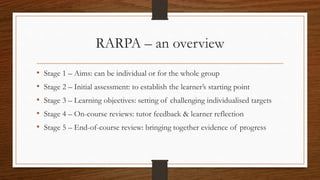
RARPA – an overview
• Stage 1 – Aims: can be individual or for the whole group
• Stage 2 – Initial assessment: to establish the learner’s starting point
• Stage 3 – Learning objectives: setting of challenging individualised targets
• Stage 4 – On-course reviews: tutor feedback & learner reflection
• Stage 5 – End-of-course review: bringing together evidence of progress
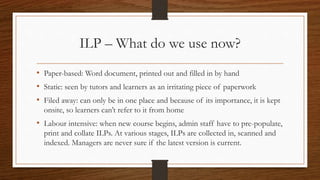
ILP – What do we use now?
• Paper-based: Word document, printed out and filled in by hand
• Static: seen by tutors and learners as an irritating piece of paperwork
• Filed away: can only be in one place and because of its importance, it is kept
onsite, so learners can’t refer to it from home
• Labour intensive: when new course begins, admin staff have to pre-populate,
print and collate ILPs. At various stages, ILPs are collected in, scanned and
indexed. Managers are never sure if the latest version is current.
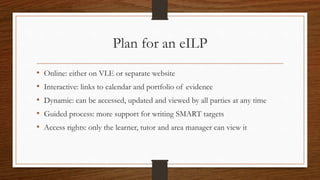
Plan for an eILP
• Online: either on VLE or separate website
• Interactive: links to calendar and portfolio of evidence
• Dynamic: can be accessed, updated and viewed by all parties at any time
• Guided process: more support for writing SMART targets
• Access rights: only the learner, tutor and area manager can view it
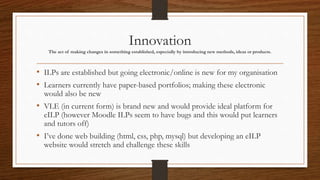
Innovation
The act of making changes in something established, especially by introducing new methods, ideas or products.
• ILPs are established but going electronic/online is new for my organisation
• Learners currently have paper-based portfolios; making these electronic
would also be new
• VLE (in current form) is brand new and would provide ideal platform for
eILP (however Moodle ILPs seem to have bugs and this would put learners
and tutors off)
• I’ve done web building (html, css, php, mysql) but developing an eILP
website would stretch and challenge these skills
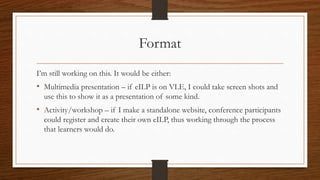
Format
I’m still working on this. It would be either:
• Multimedia presentation – if eILP is on VLE, I could take screen shots and
use this to show it as a presentation of some kind.
• Activity/workshop – if I make a standalone website, conference participants
could register and create their own eILP, thus working through the process
that learners would do.
Feedback
Please give me some feedback. I am particularly doubtful (at the moment)
about:
• The title
• The format

Project plan

  • 1.
    Recognising And Recording Progressand Achievement: The development of an electronic Individual Learning Plan (eILP)
  • 2.
    RARPA – anoverview • Stage 1 – Aims: can be individual or for the whole group • Stage 2 – Initial assessment: to establish the learner’s starting point • Stage 3 – Learning objectives: setting of challenging individualised targets • Stage 4 – On-course reviews: tutor feedback & learner reflection • Stage 5 – End-of-course review: bringing together evidence of progress
  • 3.
    ILP – Whatdo we use now? • Paper-based: Word document, printed out and filled in by hand • Static: seen by tutors and learners as an irritating piece of paperwork • Filed away: can only be in one place and because of its importance, it is kept onsite, so learners can’t refer to it from home • Labour intensive: when new course begins, admin staff have to pre-populate, print and collate ILPs. At various stages, ILPs are collected in, scanned and indexed. Managers are never sure if the latest version is current.
  • 4.
    Plan for aneILP • Online: either on VLE or separate website • Interactive: links to calendar and portfolio of evidence • Dynamic: can be accessed, updated and viewed by all parties at any time • Guided process: more support for writing SMART targets • Access rights: only the learner, tutor and area manager can view it
  • 5.
    Innovation The act ofmaking changes in something established, especially by introducing new methods, ideas or products. • ILPs are established but going electronic/online is new for my organisation • Learners currently have paper-based portfolios; making these electronic would also be new • VLE (in current form) is brand new and would provide ideal platform for eILP (however Moodle ILPs seem to have bugs and this would put learners and tutors off) • I’ve done web building (html, css, php, mysql) but developing an eILP website would stretch and challenge these skills
  • 6.
    Format I’m still workingon this. It would be either: • Multimedia presentation – if eILP is on VLE, I could take screen shots and use this to show it as a presentation of some kind. • Activity/workshop – if I make a standalone website, conference participants could register and create their own eILP, thus working through the process that learners would do.
  • 7.
    Feedback Please give mesome feedback. I am particularly doubtful (at the moment) about: • The title • The format