Achieving Optimum Team
Effectiveness
in Project Management
Cheryl May, Partner
Tammy Johnson, Vice President
Learning Objectives
• Networks: Understand A New Tool for Analyzing
Organizations
• A New Method for Analyzing Your Projects and
Organizations
• Best Practices of High Performing Teams
Agenda
• Setting the Stage for Network Analysis
• Why Social Networks
• Case Study
• Best Practices
• How to Get Started
Network Analysis:
Enhancing Project Delivery
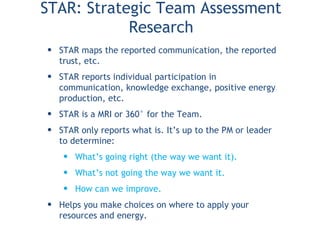
STAR: Strategic Team Assessment
Research
• STAR maps the reported communication, the reported
trust, etc.
• STAR reports individual participation in
communication, knowledge exchange, positive energy
production, etc.
• STAR is a MRI or 360° for the Team.
• STAR only reports what is. It’s up to the PM or leader
to determine:
• What’s going right (the way we want it).
• What’s not going the way we want it.
• How can we improve.
• Helps you make choices on where to apply your
resources and energy.
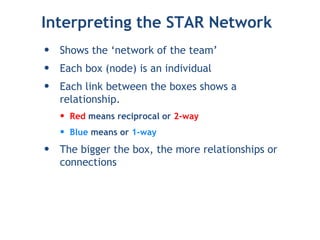
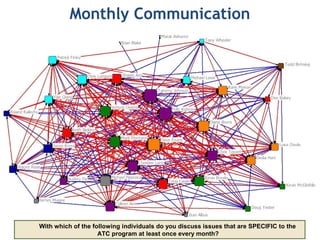
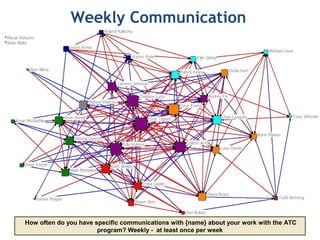
Interpreting the STAR Network
• Shows the ‘network of the team’
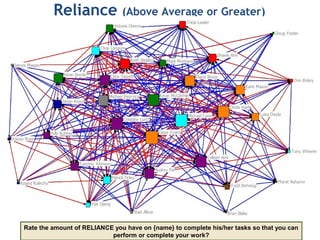
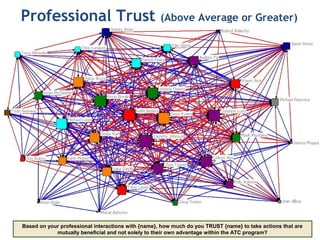
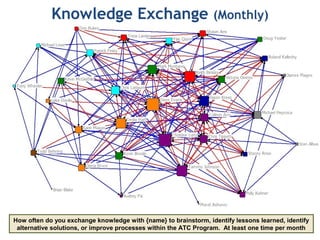
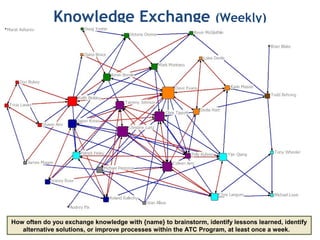
• Each box (node) is an individual
• Each link between the boxes shows a
relationship.
• Red means reciprocal or 2-way
• Blue means or 1-way
• The bigger the box, the more relationships or
connections
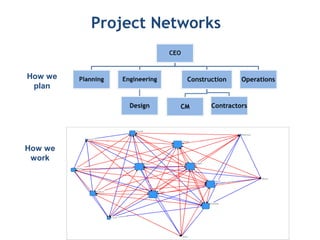
Project Networks
How we
plan
How we
work
Case Study: Lackland Air Force Base,
Airmen Training Complex, Texas
35 team members representing:
– Project Manager
– Assistant PMs + Assistant Technical Managers
– Lead Architect + Architects
– Lead Structural + Structural Engineers + Structural Designers
– Lead Mechanical + Mechanical Engineers
– Lead Electrical + Electrical Engineers
– Construction Management PEs – on site
– IT
– Subcontractors: Civil + Electrical + Landscape Architect
Case Study: ATC Program
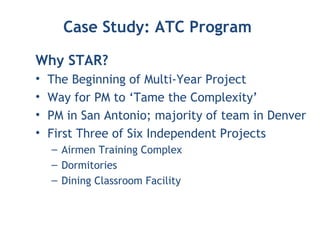
Why STAR?
• The Beginning of Multi-Year Project
• Way for PM to ‘Tame the Complexity’
• PM in San Antonio; majority of team in Denver
• First Three of Six Independent Projects
– Airmen Training Complex
– Dormitories
– Dining Classroom Facility
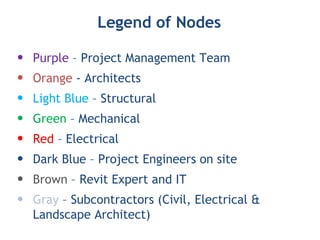
Legend of Nodes
• Purple – Project Management Team
• Orange - Architects
• Light Blue – Structural
• Green – Mechanical
• Red – Electrical
• Dark Blue – Project Engineers on site
• Brown – Revit Expert and IT
• Gray – Subcontractors (Civil, Electrical &
Landscape Architect)
Monthly Communication
With which of the following individuals do you discuss issues that are SPECIFIC to the
ATC program at least once every month?  
Weekly Communication
How often do you have specific communications with {name} about your work with the ATC
program? Weekly - at least once per week
Reliance (Above Average or Greater)
Rate the amount of RELIANCE you have on {name} to complete his/her tasks so that you can
perform or complete your work?
Professional Trust (Above Average or Greater)
Based on your professional interactions with {name}, how much do you TRUST {name} to take actions that are
mutually beneficial and not solely to their own advantage within the ATC program?
Knowledge Exchange (Monthly)
15
How often do you exchange knowledge with {name} to brainstorm, identify lessons learned, identify
alternative solutions, or improve processes within the ATC Program. At least one time per month
Knowledge Exchange (Weekly)
16
How often do you exchange knowledge with {name} to brainstorm, identify lessons learned, identify
alternative solutions, or improve processes within the ATC Program, at least once a week.
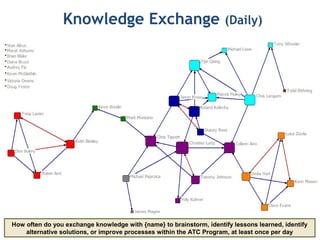
Knowledge Exchange (Daily)
17
How often do you exchange knowledge with {name} to brainstorm, identify lessons learned, identify
alternative solutions, or improve processes within the ATC Program, at least once per day
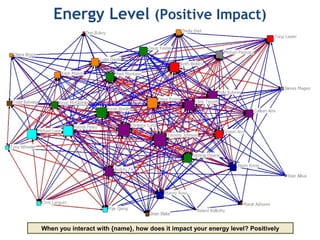
Energy Level (Positive Impact)
When you interact with {name}, how does it impact your energy level? Positively
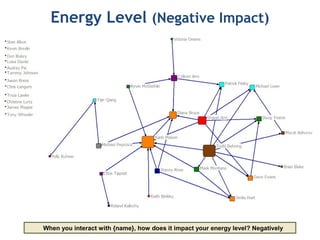
Energy Level (Negative Impact)
When you interact with {name}, how does it impact your energy level? Negatively
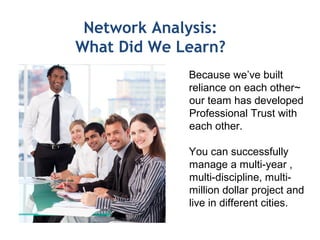
Network Analysis:
What Did We Learn?
Because we’ve built
reliance on each other~
our team has developed
Professional Trust with
each other.
You can successfully
manage a multi-year ,
multi-discipline, multi-
million dollar project and
live in different cities.

Project Network Analysis as a Key Project Management Tool

  • 1.
    Achieving Optimum Team Effectiveness inProject Management Cheryl May, Partner Tammy Johnson, Vice President
  • 2.
    Learning Objectives • Networks:Understand A New Tool for Analyzing Organizations • A New Method for Analyzing Your Projects and Organizations • Best Practices of High Performing Teams
  • 3.
    Agenda • Setting theStage for Network Analysis • Why Social Networks • Case Study • Best Practices • How to Get Started
  • 4.
  • 5.
    STAR: Strategic TeamAssessment Research • STAR maps the reported communication, the reported trust, etc. • STAR reports individual participation in communication, knowledge exchange, positive energy production, etc. • STAR is a MRI or 360° for the Team. • STAR only reports what is. It’s up to the PM or leader to determine: • What’s going right (the way we want it). • What’s not going the way we want it. • How can we improve. • Helps you make choices on where to apply your resources and energy.
  • 6.
    Interpreting the STARNetwork • Shows the ‘network of the team’ • Each box (node) is an individual • Each link between the boxes shows a relationship. • Red means reciprocal or 2-way • Blue means or 1-way • The bigger the box, the more relationships or connections
  • 7.
  • 8.
    Case Study: LacklandAir Force Base, Airmen Training Complex, Texas 35 team members representing: – Project Manager – Assistant PMs + Assistant Technical Managers – Lead Architect + Architects – Lead Structural + Structural Engineers + Structural Designers – Lead Mechanical + Mechanical Engineers – Lead Electrical + Electrical Engineers – Construction Management PEs – on site – IT – Subcontractors: Civil + Electrical + Landscape Architect
  • 9.
    Case Study: ATCProgram Why STAR? • The Beginning of Multi-Year Project • Way for PM to ‘Tame the Complexity’ • PM in San Antonio; majority of team in Denver • First Three of Six Independent Projects – Airmen Training Complex – Dormitories – Dining Classroom Facility
  • 10.
    Legend of Nodes •Purple – Project Management Team • Orange - Architects • Light Blue – Structural • Green – Mechanical • Red – Electrical • Dark Blue – Project Engineers on site • Brown – Revit Expert and IT • Gray – Subcontractors (Civil, Electrical & Landscape Architect)
  • 11.
    Monthly Communication With whichof the following individuals do you discuss issues that are SPECIFIC to the ATC program at least once every month?  
  • 12.
    Weekly Communication How oftendo you have specific communications with {name} about your work with the ATC program? Weekly - at least once per week
  • 13.
    Reliance (Above Averageor Greater) Rate the amount of RELIANCE you have on {name} to complete his/her tasks so that you can perform or complete your work?
  • 14.
    Professional Trust (AboveAverage or Greater) Based on your professional interactions with {name}, how much do you TRUST {name} to take actions that are mutually beneficial and not solely to their own advantage within the ATC program?
  • 15.
    Knowledge Exchange (Monthly) 15 Howoften do you exchange knowledge with {name} to brainstorm, identify lessons learned, identify alternative solutions, or improve processes within the ATC Program. At least one time per month
  • 16.
    Knowledge Exchange (Weekly) 16 Howoften do you exchange knowledge with {name} to brainstorm, identify lessons learned, identify alternative solutions, or improve processes within the ATC Program, at least once a week.
  • 17.
    Knowledge Exchange (Daily) 17 Howoften do you exchange knowledge with {name} to brainstorm, identify lessons learned, identify alternative solutions, or improve processes within the ATC Program, at least once per day
  • 18.
    Energy Level (PositiveImpact) When you interact with {name}, how does it impact your energy level? Positively
  • 19.
    Energy Level (NegativeImpact) When you interact with {name}, how does it impact your energy level? Negatively
  • 20.
    Network Analysis: What DidWe Learn? Because we’ve built reliance on each other~ our team has developed Professional Trust with each other. You can successfully manage a multi-year , multi-discipline, multi- million dollar project and live in different cities.