Project
Management
Case
Analysis
[Type the document subtitle]
Contents
Executive summary.......................................................................................................................................2
Introduction...................................................................................................................................................3
Project Background...................................................................................................................................3
Desirable Outcomes..................................................................................................................................3
Project Scope ............................................................................................................................................4
Project Deliverables..................................................................................................................................4
Project Exclusions.....................................................................................................................................5
Project Constraints....................................................................................................................................5
Work Breakdown structure...........................................................................................................................6
First Milestone- Planning Phase ...............................................................................................................7
Second Milestone- Analysis Phase ...........................................................................................................7
Third Milestone- Designing Phase............................................................................................................9
Fourth Milestone- Implementation Phase...............................................................................................10
Fifth Milestone- Testing & Evaluation...................................................................................................11
Scheduling, Timelines and Linkage............................................................................................................11
CPM method to Schedule Project...........................................................................................................12
Gantt chart...........................................................................................................................................13
Critical Path ........................................................................................................................................15
PERT Method- Scheduling.....................................................................................................................16
Quality control Management ......................................................................................................................17
Quality Planning &Management ............................................................................................................17
Risk Management ...................................................................................................................................18
References...................................................................................................................................................19
Executive summary
CN*NOW (CNW) is one of the largest manufacturer of outdoor manufacturer of furniture for
domestic and commercial use. It records huge turnover but is not able to reflect it in the bottom-
line. It is because of this reason in this report we proposed the introduction of ERP so as to
improve the profitability of the company. Besides these ERP solutions’ objective is to ensure that
the data streams amongst each internal trade while managing affiliations, or "touch focuses", to
the partners. ERP solutions works on a blended bag of computer gear’s and network
arrangements, Regardless of the course of action, generally ERP solutions use a simple database
to hold information from various trades and which can be used by different customers utilizing
some means.
It also discusses that the project scope is to integrate all aspects of business with different tools to
improve the operational framework of the company. It explains that entire project is divided into
5 major milestones as per project life cycle guidelines. The primary phase is the planning stage
in which one ought to understand the requirement of creating the enterprise resource planning
system and rundown the functional necessities of the framework whereas in designing analysis
phase blueprint will be prepared which in turn helps in entering the real stage called execution &
Implementation phase which incorporates the actions to begin manufacturing and addition of the
blueprint. Finally in the final phase, preparation and testing of the software code is the major
tasks. All bugs ought to be rectified. While doing the rectification it must be kept in mind all
these must be as per planning and design phase and at the last it is essential to examine the
practical functionality of the framework keeping in mind its objective.
This report also discusses the quality management as it plays an important role in ensuring the
quality of deliverables i.e. it must be as per project specifications and customers’ requirement. It
also discusses that project quality will be managed and ensured through detailed testing which
will be done in two steps to ensure the accuracy and correctness of the ERP systems. Alpha
testing will ensure all major bugs get fixed whereas beta testing will ensure the smooth and
seamless run of the system. Apart from these it also discusses that risks management is used to
ensure the deliverable in time.
Introduction
Project Background
CN*NOW (CNW) is one of the largest manufacturer of outdoor manufacturer of furniture for
domestic and commercial use. It records huge turnover but is not able to reflect it in the bottom-
line. It is because of this reason we proposed the introduction of ERP so as to improve the
profitability of the company. The proposed ERP (Enterprise resource planning) will help to
integrate all aspects of business which in turn improves and streamline the operations and thus
reducing the costs and increasing the profitability of the company.
Desirable Outcomes
The major aims and objectives of the project for CNW are as follows:-
a) To revamp entire IT infrastructure
b) To improve and streamline entire operational process
c) To decrease costs & Improve profitability
Besides ERP solutions’ objective is to ensure that the data streams amongst each internal trade
while managing affiliations, or "touch focuses", to the partners. ERP solutions works on a
blended bag of computer gear’s and network arrangements, Regardless of the course of action,
generally ERP solutions use a simple database to hold information from various trades and which
can be used by different customers utilizing some means.
Project Scope
The scope of a project (commonly referred to as the Scope of venture) is a justifiable, specific
statement in context to what has been consulted to achieve/perform in a certain venture. Cost or
Resources is the second part of the Triple Constraint. Resources are dependent on cost/cash, so
the two of them are interchangeable among themselves in various ways. When we explain the
total cost of a project, we are talking about that what ought to be joined or relegated to the
project as far as money and effort with a certain final aim to get things working. This will
include resources such as manpower or can be substances needed for the task or resources for
risk evaluation and management or any foreign party sources which might need to be saved and
hence acts as major source of dangers. In this case the project scope is to integrate the all aspects
of business with different tools to improve the operational framework of the company. Therefore
the project scopes consist of following things:-
a) To implement ERP by integrating all aspects of business
b) Tools like inventory management system, supply chain management system, customer
relationship management will integrate with ERP in this project
c) Project must be completed within 6 months i.e. from January 1st
to 30th
June 2016.
Project Deliverables
The major project deliverables to meet all the objectives of the projects are as follows:-
 Revamping of entire IT infrastructure supporting quick flow of information and
connectivity
 Support smooth and seamless flow of information
 Efficient and quick generation of reports
 Helps in gaining important consumer insights
 Decreases error and reduces the time in completing a process
 Helps in improving customer satisfaction and thus customers loyalty
 Helps in creating and making back up of all important data
 Fast and quick communication with all suppliers and vendors
 Quick and efficient response from finance and purchase department
Project Exclusions
The major project exclusions for this project are as follows:-
a) Project must be completed within given timelines of 6 Months
b) Project must be completed within allocated budget of 1 Million USD
c) Separate team will be created without disturbing existing operational team
Project Constraints
The major constraints in completing this project are as follows:-
a) Tight Budget
b) Strict timelines
c) Lack of skilled labors and workers
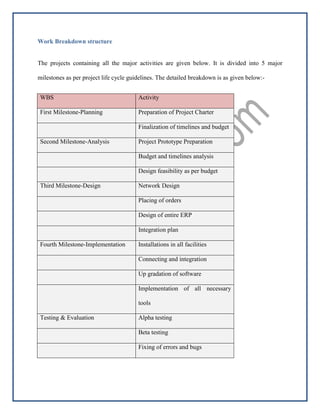
Work Breakdown structure
The projects containing all the major activities are given below. It is divided into 5 major
milestones as per project life cycle guidelines. The detailed breakdown is as given below:-
WBS Activity
First Milestone-Planning Preparation of Project Charter
Finalization of timelines and budget
Second Milestone-Analysis Project Prototype Preparation
Budget and timelines analysis
Design feasibility as per budget
Third Milestone-Design Network Design
Placing of orders
Design of entire ERP
Integration plan
Fourth Milestone-Implementation Installations in all facilities
Connecting and integration
Up gradation of software
Implementation of all necessary
tools
Testing & Evaluation Alpha testing
Beta testing
Fixing of errors and bugs
The most important and practical aspects of WBS for CNW is to help from planning to
implementation phase by acting as yard stick for development during various phases. The
detailed WBS as per five phases and its descriptions are given below:-
First Milestone- Planning Phase
The primary phase is the planning stage in which one ought to understand the requirement of
creating the enterprise resource planning system and rundown the functional necessities of the
framework. In this one can discover what issues will be confronted amid its advancement and its
possibility in the surrounding and thus developing a venture plan. The major activities of this
stage are as follows:-
 Preparation of Project Charter
 Finalization of timelines and budget
Second Milestone- Analysis Phase
It includes proper examinations as per the present situation and in addition estimation of future
issues. Additionally higher administration individual plus market exhortation ought to be taken
and an appropriate blend of all of the above ought to be arranged. As appeared in the
prerequisite analysis, organization requires central framework with worldwide connectivity. This
is conceivable by associating all gadgets with web with assistance of Ethernet and router. The
whole hardware necessity to grow such framework is mentioned below:-
Bridge
A bridge is a device that channels data traffic at the limit of a system. Scaffolds partition the
movement present on a LAN (Local Area Network) and consequently reduce its sum on a
system. These work at the second information connection layer of an OSI model. They audit the
drawing movement and pick whether it ought to be sent or discarded off.
Router
A router connects two or more systems and has programming which is utilized to forward
bundles amongst them on the premise of data given by directing tables and parcel headers.
Routers are in this manner the foundation of complex network frameworks (for e.g.- enterprise
wide systems) and fundamental to Internet’s operation. A simple network has two or more PCs
joined, alongside some other regular devices (e.g. printers, external hard drives etc.), such that it
permits them to convey and share records amongst each other.
DSL Modem
Another service named as DSL broadband is utilizing a Digital Subscriber Line (DSL) modem,
and is used to connect a router or a PC with a telephone line which provides Internet network to
the PC. In technical terms, a DSL modem is the one which connects with a single PC, via
Ethernet Port or USB Port or is connected in a PC’s PCI slot.
Switch
A system switch (also called switching hub, bridging hub, officially MAC bridge) is a PC
networking gadget that joins gadgets together on a PC network, by utilizing packet switching to
retrieve, process and pass on the data to the destination gadget. It is unlike other system hubs
since it propels data just to one or different gadgets that require it.
Network Interface Card (NIC)
Network Interface Card (NIC) is another gadget utilized by PCs to connect with a system. It
screens both wired as well as wireless connections of PC sharing information with Internet and
with various PCs.
HUB
When depicting a network structure, Hub is the most basic networking gadget joining numerous
computers and other devices with each other. It has just solitary job, to pass on all data it gets
from each of its connections. Consequently, it differs from routers or switches. But they can
differentiate basic collision problems, having all information sent to various ports and contains
security dangers and might produce bottlenecks.
The major activities other than establishment of entire hardware frameworks are given below:-
 Project Prototype Preparation
 Budget and timelines analysis
 Design feasibility as per budget
Third Milestone- Designing Phase
From this stage we will receive output as a document file consisting limitations, requirements
and essential notes. From these notes, the necessities of staffs in the hardware and software part
and additionally other materialistic requirement can be evaluated. In brief, this document will
work as a basis for future venture and support us in estimating problems which can be confronted
in later stage of the venture. But it is important that this configuration meets the expectations and
requirements of the company. The important steps included in configuration steps are total
hardware and software design in execution of whole system. The major activities of this stage are
as follows:-
 Network Design
 Placing of orders
 Design of entire ERP
 Integration plan
 Installations in all facilities
 Connection and integration
 Up gradation of software
 Implementation of all necessary tools
Fourth Milestone- Implementation Phase
After the completion of blueprint, we enter the real stage called execution & Implementation
phase which incorporates the actions to begin manufacturing and addition of the blueprint.
Preparation and testing of the software code is the major work of this stage. All bugs ought to be
rectified. While doing the rectification it must be kept in mind all these must be as per planning
and design phase and at the last it is essential to examine the practical functionality of the
framework keeping in mind its objective. The major activities of this stage are as follows:-
 Installations in all facilities
 Connection and integration
 Up gradation of software
 Implementation of all necessary tools
Fifth Milestone- Testing & Evaluation
This is the final phase in which all the testing will be done to check whether the system is
generating output as required by the company or not. Besides in this phase feedback will be
gathered so as to improve the system further. The major activities related to this stage are as
follows:-
 Alpha testing
 Beta testing
 Fixing of errors and bugs
Scheduling, Timelines and Linkage
The scheduling is essential in this venture as the examination of every venture is to fulfill its trail
and be profitable within the Triple Constraint; the Triple Constraint being resources (cost), time
(schedule) and scope (quality). The three constraints of a task are regarded to co-ordinate while
performing with each other. They coordinate in such a manner that if any of the three
components is restricted or extended, the other out two constraints will then also be required to
either be extended/expanded in specific manner or restricted/educed in specific way.
In venture management, time is estimated to its smallest detail. The estimation of time required
to complete all venture constraints is evaluated. When the estimation is completed, those basics
are distributed further more into the time period required to do the various parts of the job.
Clearly from the most part of this we have the capability to gauge the venture’s time period and
additionally how and what much/many resources need to be given to that project and any delay
due to resources like absence of any two will work as major constraint. The two scheduling
methodologies are explained in the below parts.
CPM method to Schedule Project
In this method, we use critical path to schedule and control the entire project. The various
activities code, their relationships and durations are given below:-
Activity
Activity
Code
Preceding
Activity
Duration in
Weeks
Preparation of Project Charter A None 5
Finalization of timelines and budget B None 5
Project Prototype Preparation C None 5
Budget and timelines analysis D C 5
Design feasibility as per budget E C 5
Network Design F E 10
Placing of orders G E 10
Design of entire ERP H E 10
Integration plan I E 10
Installations in all facilities J I 5
Connecting and integration K I 5
Up gradation of software L I 5
Implementation of all necessary
tools
M I
5
Alpha testing N M 5
Beta testing O M 5
Fixing of errors and bugs P M 5
Gantt chart
The Gantt Chart showing the completion of project in 30 weeks i.e. 6 Months are given below:-
Gantt Chart Time in Weeks
Activity 5 10 15 20 25 30
Preparation of Project Charter
Finalization of timelines and budget
Project Prototype Preparation
Budget and timelines analysis
Design feasibility as per budget
Network Design
Placing of orders
Design of entire ERP
Integration plan
Installations in all facilities
Connecting and integration
Up gradation of software
Implementation of all necessary
tools
Alpha testing
Beta testing
Fixing of errors and bugs
From this method we found that critical path is 2-3-5-9-13-16 and the entire duration to complete
it is 30 weeks. The scheduling utilizing this technique is created on the point that extent for the
greater part leads to crucial changes to the job processes and functions of the ventures as
described above. Commonly, three types of methods are applied to help in implementing such
corrections— customization, support and counseling. Execution time depends on size of the
trade, amount of tasks, customization, the scope of modification in procedure, and availability of
the customer to take venture’s possession. Measured upgraded systems can be implemented in
various stages. A general venture for a growing enterprise takes up to 30 weeks and support of
around 150 consultants. Small actions might require months for finishing; multinational and
different other important executions might take years.
Customization can impressively fabricate utilization times. Aside that, processing data sways
diverse business limits e.g. some huge organizations viz. KFC utilizes a just-in-time stock
framework. This reduces the capacity in the stock and extends movement effectiveness, and
requires up-to-date-info. Hence, this framework will not just aid in managing the inventory in a
better way, Customer focus glitches but additionally incorporated the system for the
organization.
The method to design this framework is to a large extent, includes managing the method the
association requires the system to execute with the process with which it was expected to work.
ERP systems commonly include various settings that change system operations. For example, an
organization can select the sort of stock accounting—either FIFO or LIFO—to use; whether to
see income regarding geographical section, dissemination channel or product offering; and to
pay for conveyance costs on customer return or not.
Critical Path
The critical path is shown as given below. It is important since importance must be given to these
activities to control the project. The critical path is shown in red.
Gantt Chart Time in Weeks
Activity 5 10 15 20 25 30
Preparation of Project Charter
Finalization of timelines and budget
Project Prototype Preparation
Budget and timelines analysis
Design feasibility as per budget
Network Design
Placing of orders
Design of entire ERP
Integration plan
Installations in all facilities
Connecting and integration
Up gradation of software
Implementation of all necessary tools
Alpha testing
Beta testing
Fixing of errors and bugs
PERT Method- Scheduling
This method uses three time frames to calculate the schedule to complete the project. It is more
accurate but bit complex and is calculating the time as per three scenarios i.e. optimistic,
pessimistic and most probably using formula (O+M+4P)/6 as given below:-
Times in Weeks
Activity
Code
Pessimistic
(P)Scenario
Best
Scenario(B)
Optimistic
scenario(O)
PERT
Estimate
A 8 5 3 5.17
B 8 5 3 5.17
C 9 5 3 5.33
D 9 5 2 5.17
E 9 5 2 5.17
F 16 10 7 10.50
G 16 10 7 10.50
H 16 10 7 10.50
I 16 10 7 10.50
J 9 5 3 5.33
K 9 5 3 5.33
L 9 5 3 5.33
M 9 5 3 5.33
N 8 5 2 5.00
O 8 5 2 5.00
P 1 5 -1 3.33
Quality control Management
Quality Control will be done in two steps so as to ensure that highest quality products will get
delivered using two methodologies:-
a) Quality management to ensure highest quality of products as per objectives and
requirements
b) Risk management to improve quality of project deliverable by ensuring its completion in
time.
The detailed about both steps are explained in proceeding sections:-
Quality Planning &Management
Quality planning and management plays an important role in ensuring the quality of deliverables
i.e. it must be as per project specifications and customers’ requirement. In this project quality
will be managed and ensured through detailed testing as explained in the testing phase. In this
phase detailed testing will be done in two steps to ensure the accuracy and correctness of the
ERP systems. Alpha testing will ensure all major bugs get fixed whereas beta testing will ensure
the smooth and seamless run of the system. Apart from these precautions will be taken in every
steps to ensure that hardware and software installed are licensed and are purchased from branded
vendors.
Risk Management
Risk management is essentials in this venture as the examination of every venture is to fulfill its
trail and be profitable within the Triple Constraint; the Triple Constraint being resources (cost),
time (schedule) and scope (quality). The three constraints of a task are regarded to co-ordinate
while performing with each other. They coordinate in such a manner that if any of the three
components is restricted or extended, the other out two constraints will then also be required to
either be extended/expanded in specific manner or restricted/educed in specific way. It can be
done using the risk registers and various techniques mentioned in scheduling. Besides these the
danger of loss occurring due to lacking or fizzled internal processes, persons and systems or from
exterior situations is referred as Operational risk.
The depiction includes legitimate danger however does not include danger related to reputation
and strategy. Legitimate danger includes, even if is not restricted to, punishments, fines, or
reformatory losses occurring because of supervisory actions, and also private settlements. It can
be constituted by a diverse amount of various external occasions starting from power failures due
to floods or earthquakes to terrorist attacks. Hence, operational danger can originate due to
internal happenings, for e.g., the capacity for failures or insufficiencies in any of the various
processes and systems linked to company (like, IT or its risk management, human resources
management processes and systems), or variety of these of its outscored service providers. In
order to manage those dangers, a dangers register will be managed shown in the basis given
beneath:-
Risk Description Date Impact
Action
Taken
References
Kendall, K.E. & Kendall,J.E. (2006). Systems Analysis and Design 8th
ed. Pearson
Education, Inc. Upper Saddle River, NJ.
Marchewka, Jack T. (2012). Information Technology Project Management w/ CD 4th
ed. John
Wiley & Sons, Inc. Hoboke
The Definitive Guide to Project Management. Nokes, Sebastian. 2nd Ed.n. London (Financial
Times / Prentice Hall): 2007. ISBN 978-0-273-71097-4
"What is Project Management? | Project Management Institute". Pmi.org. Retrieved2014-06-04.
Paul C. Dinsmore et al (2005) The right projects done right! John Wiley and Sons, 2005.ISBN 0-
7879-7113-8. p.35 and further.
Cattani, G., Ferriani, S., Frederiksen, L. and Florian, T. (2011) Project-Based Organizing and
Strategic Management, Advances in Strategic Management, Vol 28, Emerald, ISBN
1780521936.[1]
Lewis R. Ireland (2006) Project Management. McGraw-Hill Professional, 2006. ISBN 0-07-
147160-X. p.110
Joseph Phillips (2003). PMP Project Management Professional Study Guide. McGraw-Hill
Professional, 2003. ISBN 0-07-223062-2 p.354.
PMI (2010). A Guide to the Project Management Body of Knowledge p.27-35
Dennis Lock (2007) Project Management (9th ed.) Gower Publishing, Ltd., 2007.
Young-Hoon Kwak (2005). "A brief History of Project Management". In: The story of
managing projects. Elias G. Carayannis et al. (9 eds), Greenwood Publishing Group, 2005.ISBN
1-56720-506-2
David I. Cleland, Roland Gareis (2006). Global Project Management Handbook. "Chapter 1:
"The evolution of project management". McGraw-Hill Professional, 2006. ISBN 0-07-146045-4
Martin Stevens (2002). Project Management Pathways. Association for Project Management.
APM Publishing Limited, 2002 ISBN 1-903494-01-X p.xxii
Wailgum, T. (2008, January 29). CIO.com-business technology leadership. In Why ERP systems
are more important than ever. Retrieved Dec15.,2015,
fromhttp://www.cio.com/article/177300/Why_ERP_Systems_Are_More_Important_Than_Ever
Schroeder, D., CPA, CITP, CISA. (2006). IT Governance. In AICPA information technology
center. Retrieved Dec 16, 2015,
What is cloud computing? (2009).Salesforce.com. Retrieved Dec 15, 2015,
fromhttp://www.salesforce.com/cloudcomputing/
Laudon, K. C., & Laudon, J. P. (2006). In B. Horan (Ed.), Management information systems (pp.
16, 56-57, 59, 62, 180, 276-277, 339-340, G12). Upper Saddle River, NJ: Pearson Prentice Hall.
Web sites, e-sources Accountants and auditors. (n.d.). United States department of labor (bureau
of labor statistics) [Occupational Outlook Handbook, 2008-09 Edition].
Project management case analysis

Project management case analysis

  • 1.
  • 2.
    Contents Executive summary.......................................................................................................................................2 Introduction...................................................................................................................................................3 Project Background...................................................................................................................................3 DesirableOutcomes..................................................................................................................................3 Project Scope ............................................................................................................................................4 Project Deliverables..................................................................................................................................4 Project Exclusions.....................................................................................................................................5 Project Constraints....................................................................................................................................5 Work Breakdown structure...........................................................................................................................6 First Milestone- Planning Phase ...............................................................................................................7 Second Milestone- Analysis Phase ...........................................................................................................7 Third Milestone- Designing Phase............................................................................................................9 Fourth Milestone- Implementation Phase...............................................................................................10 Fifth Milestone- Testing & Evaluation...................................................................................................11 Scheduling, Timelines and Linkage............................................................................................................11 CPM method to Schedule Project...........................................................................................................12 Gantt chart...........................................................................................................................................13 Critical Path ........................................................................................................................................15 PERT Method- Scheduling.....................................................................................................................16 Quality control Management ......................................................................................................................17 Quality Planning &Management ............................................................................................................17 Risk Management ...................................................................................................................................18 References...................................................................................................................................................19
  • 3.
    Executive summary CN*NOW (CNW)is one of the largest manufacturer of outdoor manufacturer of furniture for domestic and commercial use. It records huge turnover but is not able to reflect it in the bottom- line. It is because of this reason in this report we proposed the introduction of ERP so as to improve the profitability of the company. Besides these ERP solutions’ objective is to ensure that the data streams amongst each internal trade while managing affiliations, or "touch focuses", to the partners. ERP solutions works on a blended bag of computer gear’s and network arrangements, Regardless of the course of action, generally ERP solutions use a simple database to hold information from various trades and which can be used by different customers utilizing some means. It also discusses that the project scope is to integrate all aspects of business with different tools to improve the operational framework of the company. It explains that entire project is divided into 5 major milestones as per project life cycle guidelines. The primary phase is the planning stage in which one ought to understand the requirement of creating the enterprise resource planning system and rundown the functional necessities of the framework whereas in designing analysis phase blueprint will be prepared which in turn helps in entering the real stage called execution & Implementation phase which incorporates the actions to begin manufacturing and addition of the blueprint. Finally in the final phase, preparation and testing of the software code is the major tasks. All bugs ought to be rectified. While doing the rectification it must be kept in mind all these must be as per planning and design phase and at the last it is essential to examine the practical functionality of the framework keeping in mind its objective. This report also discusses the quality management as it plays an important role in ensuring the quality of deliverables i.e. it must be as per project specifications and customers’ requirement. It also discusses that project quality will be managed and ensured through detailed testing which will be done in two steps to ensure the accuracy and correctness of the ERP systems. Alpha testing will ensure all major bugs get fixed whereas beta testing will ensure the smooth and seamless run of the system. Apart from these it also discusses that risks management is used to ensure the deliverable in time.
  • 4.
    Introduction Project Background CN*NOW (CNW)is one of the largest manufacturer of outdoor manufacturer of furniture for domestic and commercial use. It records huge turnover but is not able to reflect it in the bottom- line. It is because of this reason we proposed the introduction of ERP so as to improve the profitability of the company. The proposed ERP (Enterprise resource planning) will help to integrate all aspects of business which in turn improves and streamline the operations and thus reducing the costs and increasing the profitability of the company. Desirable Outcomes The major aims and objectives of the project for CNW are as follows:- a) To revamp entire IT infrastructure b) To improve and streamline entire operational process c) To decrease costs & Improve profitability Besides ERP solutions’ objective is to ensure that the data streams amongst each internal trade while managing affiliations, or "touch focuses", to the partners. ERP solutions works on a blended bag of computer gear’s and network arrangements, Regardless of the course of action, generally ERP solutions use a simple database to hold information from various trades and which can be used by different customers utilizing some means.
  • 5.
    Project Scope The scopeof a project (commonly referred to as the Scope of venture) is a justifiable, specific statement in context to what has been consulted to achieve/perform in a certain venture. Cost or Resources is the second part of the Triple Constraint. Resources are dependent on cost/cash, so the two of them are interchangeable among themselves in various ways. When we explain the total cost of a project, we are talking about that what ought to be joined or relegated to the project as far as money and effort with a certain final aim to get things working. This will include resources such as manpower or can be substances needed for the task or resources for risk evaluation and management or any foreign party sources which might need to be saved and hence acts as major source of dangers. In this case the project scope is to integrate the all aspects of business with different tools to improve the operational framework of the company. Therefore the project scopes consist of following things:- a) To implement ERP by integrating all aspects of business b) Tools like inventory management system, supply chain management system, customer relationship management will integrate with ERP in this project c) Project must be completed within 6 months i.e. from January 1st to 30th June 2016. Project Deliverables The major project deliverables to meet all the objectives of the projects are as follows:-
  • 6.
     Revamping ofentire IT infrastructure supporting quick flow of information and connectivity  Support smooth and seamless flow of information  Efficient and quick generation of reports  Helps in gaining important consumer insights  Decreases error and reduces the time in completing a process  Helps in improving customer satisfaction and thus customers loyalty  Helps in creating and making back up of all important data  Fast and quick communication with all suppliers and vendors  Quick and efficient response from finance and purchase department Project Exclusions The major project exclusions for this project are as follows:- a) Project must be completed within given timelines of 6 Months b) Project must be completed within allocated budget of 1 Million USD c) Separate team will be created without disturbing existing operational team Project Constraints The major constraints in completing this project are as follows:- a) Tight Budget b) Strict timelines c) Lack of skilled labors and workers
  • 7.
    Work Breakdown structure Theprojects containing all the major activities are given below. It is divided into 5 major milestones as per project life cycle guidelines. The detailed breakdown is as given below:- WBS Activity First Milestone-Planning Preparation of Project Charter Finalization of timelines and budget Second Milestone-Analysis Project Prototype Preparation Budget and timelines analysis Design feasibility as per budget Third Milestone-Design Network Design Placing of orders Design of entire ERP Integration plan Fourth Milestone-Implementation Installations in all facilities Connecting and integration Up gradation of software Implementation of all necessary tools Testing & Evaluation Alpha testing Beta testing Fixing of errors and bugs
  • 8.
    The most importantand practical aspects of WBS for CNW is to help from planning to implementation phase by acting as yard stick for development during various phases. The detailed WBS as per five phases and its descriptions are given below:- First Milestone- Planning Phase The primary phase is the planning stage in which one ought to understand the requirement of creating the enterprise resource planning system and rundown the functional necessities of the framework. In this one can discover what issues will be confronted amid its advancement and its possibility in the surrounding and thus developing a venture plan. The major activities of this stage are as follows:-  Preparation of Project Charter  Finalization of timelines and budget Second Milestone- Analysis Phase It includes proper examinations as per the present situation and in addition estimation of future issues. Additionally higher administration individual plus market exhortation ought to be taken and an appropriate blend of all of the above ought to be arranged. As appeared in the prerequisite analysis, organization requires central framework with worldwide connectivity. This is conceivable by associating all gadgets with web with assistance of Ethernet and router. The whole hardware necessity to grow such framework is mentioned below:- Bridge A bridge is a device that channels data traffic at the limit of a system. Scaffolds partition the movement present on a LAN (Local Area Network) and consequently reduce its sum on a
  • 9.
    system. These workat the second information connection layer of an OSI model. They audit the drawing movement and pick whether it ought to be sent or discarded off. Router A router connects two or more systems and has programming which is utilized to forward bundles amongst them on the premise of data given by directing tables and parcel headers. Routers are in this manner the foundation of complex network frameworks (for e.g.- enterprise wide systems) and fundamental to Internet’s operation. A simple network has two or more PCs joined, alongside some other regular devices (e.g. printers, external hard drives etc.), such that it permits them to convey and share records amongst each other. DSL Modem Another service named as DSL broadband is utilizing a Digital Subscriber Line (DSL) modem, and is used to connect a router or a PC with a telephone line which provides Internet network to the PC. In technical terms, a DSL modem is the one which connects with a single PC, via Ethernet Port or USB Port or is connected in a PC’s PCI slot. Switch A system switch (also called switching hub, bridging hub, officially MAC bridge) is a PC networking gadget that joins gadgets together on a PC network, by utilizing packet switching to retrieve, process and pass on the data to the destination gadget. It is unlike other system hubs since it propels data just to one or different gadgets that require it. Network Interface Card (NIC)
  • 10.
    Network Interface Card(NIC) is another gadget utilized by PCs to connect with a system. It screens both wired as well as wireless connections of PC sharing information with Internet and with various PCs. HUB When depicting a network structure, Hub is the most basic networking gadget joining numerous computers and other devices with each other. It has just solitary job, to pass on all data it gets from each of its connections. Consequently, it differs from routers or switches. But they can differentiate basic collision problems, having all information sent to various ports and contains security dangers and might produce bottlenecks. The major activities other than establishment of entire hardware frameworks are given below:-  Project Prototype Preparation  Budget and timelines analysis  Design feasibility as per budget Third Milestone- Designing Phase From this stage we will receive output as a document file consisting limitations, requirements and essential notes. From these notes, the necessities of staffs in the hardware and software part and additionally other materialistic requirement can be evaluated. In brief, this document will work as a basis for future venture and support us in estimating problems which can be confronted in later stage of the venture. But it is important that this configuration meets the expectations and requirements of the company. The important steps included in configuration steps are total
  • 11.
    hardware and softwaredesign in execution of whole system. The major activities of this stage are as follows:-  Network Design  Placing of orders  Design of entire ERP  Integration plan  Installations in all facilities  Connection and integration  Up gradation of software  Implementation of all necessary tools Fourth Milestone- Implementation Phase After the completion of blueprint, we enter the real stage called execution & Implementation phase which incorporates the actions to begin manufacturing and addition of the blueprint. Preparation and testing of the software code is the major work of this stage. All bugs ought to be rectified. While doing the rectification it must be kept in mind all these must be as per planning and design phase and at the last it is essential to examine the practical functionality of the framework keeping in mind its objective. The major activities of this stage are as follows:-  Installations in all facilities  Connection and integration  Up gradation of software
  • 12.
     Implementation ofall necessary tools Fifth Milestone- Testing & Evaluation This is the final phase in which all the testing will be done to check whether the system is generating output as required by the company or not. Besides in this phase feedback will be gathered so as to improve the system further. The major activities related to this stage are as follows:-  Alpha testing  Beta testing  Fixing of errors and bugs Scheduling, Timelines and Linkage The scheduling is essential in this venture as the examination of every venture is to fulfill its trail and be profitable within the Triple Constraint; the Triple Constraint being resources (cost), time (schedule) and scope (quality). The three constraints of a task are regarded to co-ordinate while performing with each other. They coordinate in such a manner that if any of the three components is restricted or extended, the other out two constraints will then also be required to either be extended/expanded in specific manner or restricted/educed in specific way. In venture management, time is estimated to its smallest detail. The estimation of time required to complete all venture constraints is evaluated. When the estimation is completed, those basics are distributed further more into the time period required to do the various parts of the job. Clearly from the most part of this we have the capability to gauge the venture’s time period and additionally how and what much/many resources need to be given to that project and any delay
  • 13.
    due to resourceslike absence of any two will work as major constraint. The two scheduling methodologies are explained in the below parts. CPM method to Schedule Project In this method, we use critical path to schedule and control the entire project. The various activities code, their relationships and durations are given below:- Activity Activity Code Preceding Activity Duration in Weeks Preparation of Project Charter A None 5 Finalization of timelines and budget B None 5 Project Prototype Preparation C None 5 Budget and timelines analysis D C 5 Design feasibility as per budget E C 5 Network Design F E 10 Placing of orders G E 10 Design of entire ERP H E 10 Integration plan I E 10 Installations in all facilities J I 5 Connecting and integration K I 5
  • 14.
    Up gradation ofsoftware L I 5 Implementation of all necessary tools M I 5 Alpha testing N M 5 Beta testing O M 5 Fixing of errors and bugs P M 5 Gantt chart The Gantt Chart showing the completion of project in 30 weeks i.e. 6 Months are given below:- Gantt Chart Time in Weeks Activity 5 10 15 20 25 30 Preparation of Project Charter Finalization of timelines and budget Project Prototype Preparation Budget and timelines analysis Design feasibility as per budget Network Design Placing of orders Design of entire ERP
  • 15.
    Integration plan Installations inall facilities Connecting and integration Up gradation of software Implementation of all necessary tools Alpha testing Beta testing Fixing of errors and bugs From this method we found that critical path is 2-3-5-9-13-16 and the entire duration to complete it is 30 weeks. The scheduling utilizing this technique is created on the point that extent for the greater part leads to crucial changes to the job processes and functions of the ventures as described above. Commonly, three types of methods are applied to help in implementing such corrections— customization, support and counseling. Execution time depends on size of the trade, amount of tasks, customization, the scope of modification in procedure, and availability of the customer to take venture’s possession. Measured upgraded systems can be implemented in various stages. A general venture for a growing enterprise takes up to 30 weeks and support of around 150 consultants. Small actions might require months for finishing; multinational and different other important executions might take years. Customization can impressively fabricate utilization times. Aside that, processing data sways diverse business limits e.g. some huge organizations viz. KFC utilizes a just-in-time stock framework. This reduces the capacity in the stock and extends movement effectiveness, and
  • 16.
    requires up-to-date-info. Hence,this framework will not just aid in managing the inventory in a better way, Customer focus glitches but additionally incorporated the system for the organization. The method to design this framework is to a large extent, includes managing the method the association requires the system to execute with the process with which it was expected to work. ERP systems commonly include various settings that change system operations. For example, an organization can select the sort of stock accounting—either FIFO or LIFO—to use; whether to see income regarding geographical section, dissemination channel or product offering; and to pay for conveyance costs on customer return or not. Critical Path The critical path is shown as given below. It is important since importance must be given to these activities to control the project. The critical path is shown in red. Gantt Chart Time in Weeks Activity 5 10 15 20 25 30 Preparation of Project Charter Finalization of timelines and budget Project Prototype Preparation Budget and timelines analysis Design feasibility as per budget Network Design Placing of orders Design of entire ERP
  • 17.
    Integration plan Installations inall facilities Connecting and integration Up gradation of software Implementation of all necessary tools Alpha testing Beta testing Fixing of errors and bugs PERT Method- Scheduling This method uses three time frames to calculate the schedule to complete the project. It is more accurate but bit complex and is calculating the time as per three scenarios i.e. optimistic, pessimistic and most probably using formula (O+M+4P)/6 as given below:- Times in Weeks Activity Code Pessimistic (P)Scenario Best Scenario(B) Optimistic scenario(O) PERT Estimate A 8 5 3 5.17 B 8 5 3 5.17 C 9 5 3 5.33 D 9 5 2 5.17 E 9 5 2 5.17 F 16 10 7 10.50
  • 18.
    G 16 107 10.50 H 16 10 7 10.50 I 16 10 7 10.50 J 9 5 3 5.33 K 9 5 3 5.33 L 9 5 3 5.33 M 9 5 3 5.33 N 8 5 2 5.00 O 8 5 2 5.00 P 1 5 -1 3.33 Quality control Management Quality Control will be done in two steps so as to ensure that highest quality products will get delivered using two methodologies:- a) Quality management to ensure highest quality of products as per objectives and requirements b) Risk management to improve quality of project deliverable by ensuring its completion in time. The detailed about both steps are explained in proceeding sections:- Quality Planning &Management
  • 19.
    Quality planning andmanagement plays an important role in ensuring the quality of deliverables i.e. it must be as per project specifications and customers’ requirement. In this project quality will be managed and ensured through detailed testing as explained in the testing phase. In this phase detailed testing will be done in two steps to ensure the accuracy and correctness of the ERP systems. Alpha testing will ensure all major bugs get fixed whereas beta testing will ensure the smooth and seamless run of the system. Apart from these precautions will be taken in every steps to ensure that hardware and software installed are licensed and are purchased from branded vendors. Risk Management Risk management is essentials in this venture as the examination of every venture is to fulfill its trail and be profitable within the Triple Constraint; the Triple Constraint being resources (cost), time (schedule) and scope (quality). The three constraints of a task are regarded to co-ordinate while performing with each other. They coordinate in such a manner that if any of the three components is restricted or extended, the other out two constraints will then also be required to either be extended/expanded in specific manner or restricted/educed in specific way. It can be done using the risk registers and various techniques mentioned in scheduling. Besides these the danger of loss occurring due to lacking or fizzled internal processes, persons and systems or from exterior situations is referred as Operational risk. The depiction includes legitimate danger however does not include danger related to reputation and strategy. Legitimate danger includes, even if is not restricted to, punishments, fines, or reformatory losses occurring because of supervisory actions, and also private settlements. It can be constituted by a diverse amount of various external occasions starting from power failures due to floods or earthquakes to terrorist attacks. Hence, operational danger can originate due to
  • 20.
    internal happenings, fore.g., the capacity for failures or insufficiencies in any of the various processes and systems linked to company (like, IT or its risk management, human resources management processes and systems), or variety of these of its outscored service providers. In order to manage those dangers, a dangers register will be managed shown in the basis given beneath:- Risk Description Date Impact Action Taken References Kendall, K.E. & Kendall,J.E. (2006). Systems Analysis and Design 8th ed. Pearson Education, Inc. Upper Saddle River, NJ. Marchewka, Jack T. (2012). Information Technology Project Management w/ CD 4th ed. John Wiley & Sons, Inc. Hoboke The Definitive Guide to Project Management. Nokes, Sebastian. 2nd Ed.n. London (Financial Times / Prentice Hall): 2007. ISBN 978-0-273-71097-4 "What is Project Management? | Project Management Institute". Pmi.org. Retrieved2014-06-04. Paul C. Dinsmore et al (2005) The right projects done right! John Wiley and Sons, 2005.ISBN 0- 7879-7113-8. p.35 and further. Cattani, G., Ferriani, S., Frederiksen, L. and Florian, T. (2011) Project-Based Organizing and Strategic Management, Advances in Strategic Management, Vol 28, Emerald, ISBN 1780521936.[1] Lewis R. Ireland (2006) Project Management. McGraw-Hill Professional, 2006. ISBN 0-07- 147160-X. p.110
  • 21.
    Joseph Phillips (2003).PMP Project Management Professional Study Guide. McGraw-Hill Professional, 2003. ISBN 0-07-223062-2 p.354. PMI (2010). A Guide to the Project Management Body of Knowledge p.27-35 Dennis Lock (2007) Project Management (9th ed.) Gower Publishing, Ltd., 2007. Young-Hoon Kwak (2005). "A brief History of Project Management". In: The story of managing projects. Elias G. Carayannis et al. (9 eds), Greenwood Publishing Group, 2005.ISBN 1-56720-506-2 David I. Cleland, Roland Gareis (2006). Global Project Management Handbook. "Chapter 1: "The evolution of project management". McGraw-Hill Professional, 2006. ISBN 0-07-146045-4 Martin Stevens (2002). Project Management Pathways. Association for Project Management. APM Publishing Limited, 2002 ISBN 1-903494-01-X p.xxii Wailgum, T. (2008, January 29). CIO.com-business technology leadership. In Why ERP systems are more important than ever. Retrieved Dec15.,2015, fromhttp://www.cio.com/article/177300/Why_ERP_Systems_Are_More_Important_Than_Ever Schroeder, D., CPA, CITP, CISA. (2006). IT Governance. In AICPA information technology center. Retrieved Dec 16, 2015, What is cloud computing? (2009).Salesforce.com. Retrieved Dec 15, 2015, fromhttp://www.salesforce.com/cloudcomputing/ Laudon, K. C., & Laudon, J. P. (2006). In B. Horan (Ed.), Management information systems (pp. 16, 56-57, 59, 62, 180, 276-277, 339-340, G12). Upper Saddle River, NJ: Pearson Prentice Hall. Web sites, e-sources Accountants and auditors. (n.d.). United States department of labor (bureau of labor statistics) [Occupational Outlook Handbook, 2008-09 Edition].