SCHOOL OF ARCHITECTURE,
BUILDING AND DESIGN
PROJECT MANAGEMENT (MGT60704)
DEFINING AND
DOCUMENTING A
PROJECT
Ar. Edwin Chan
0326938 Lim Jesson
0326465 Lissa Lai Jing Ying
0327780 Ahmad Nabil B. Jimi
0327161 Aidiel Syazrie B. Azhar
0332172 Kohei Watanabe
0904Y72861 Ng Jiji
TABLE OF CONTENTS
1.0 INTRODUCTION
1.1 Project Information
1.2 Site Location
2.0 PROJECT TEAM
2.1 Project Manager
2.2 Architect
2.3 Civil & Structural Consultant
2.4 Mechanical & Electrical Consultant
2.5 Quantity Surveyor Consultant
2.6 Landscape Architect
2.7 Main Contractor
3.0 ORGANIZATION STRUCTURE
4.0 STAKEHOLDERS
5.0 PROJECT INFORMATION
5.1 Project Objectives & Goals
5.2 Implementation Phase
5.2.1 Schematic Design
5.2.2 Design Development
5.2.3 Contract Documentation
5.2.4 Contract Implementation
5.2.5 Final Completion
5.3 Implementation Tools
5.4 Monitoring Tools & Strategies
5.5 Risks & Mitigation
5.6 Procurement
5.7 Success Criteria
6.0 CONCLUSION
7.0 REFERENCES
8.0 APPENDIX
03
04
06
07
10
10
11
13
14
16
17
18
21
23
24
25
38
39
41
43
44
45
47
49
2
1.01.0
⬥
⬦
⬥
⬦
⬥
⬦
INTRODUCTION
3
1.1 Project Information
Client
Project : O’Hako Residence @ Puchong Jaya
Project Site : Jalan Pipit 1, Bukit Tandang, Pekan Puchong Jaya, Daerah Petaling,
Selangor Darul Ehsan
Architect : Verge Architects
Client : Marimo Land SDN. BHD.
Final Completion Date : September 2019
Marimo Land Sdn. Bhd. is the Malaysian subsidiary for Marimo Co., Ltd. from Hiroshima of Southern Japan.
Marimo Co., Ltd. began as an architectural firm with expertise in providing affordable condominium designs to
suit the burgeoning demand set by Japan’s rapid urbanisation. Building on the experience and techniques in
residential planning and design, they transitioned into condominium development and set a goal to become
leaders in the local market. Marimo Land Sdn. Bhd. made its debut in Malaysia with the O’Hako Residence.
Project Scope
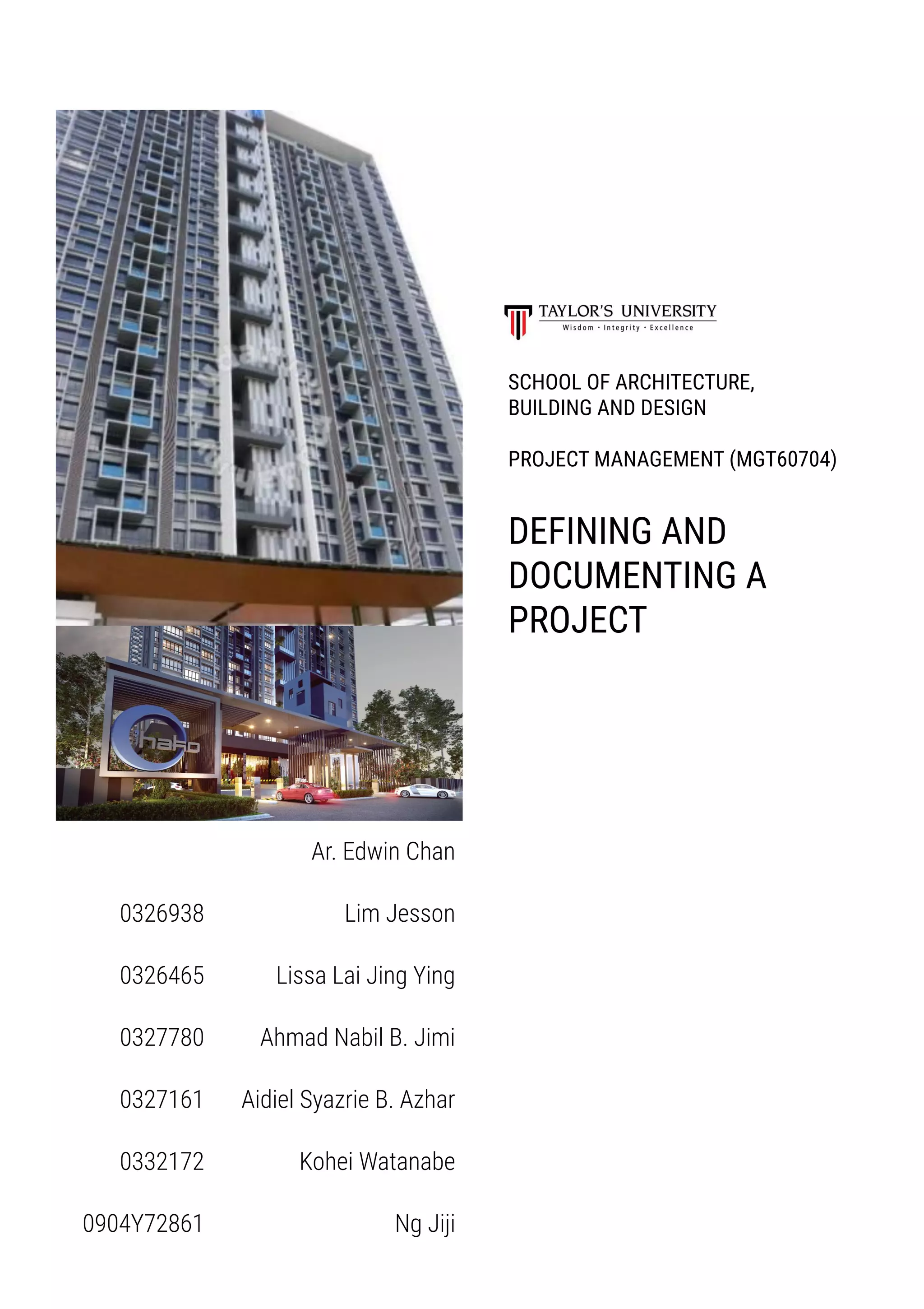
Renderings of O’Hako Residence
O’Hako Residences in Puchong Jaya the first service apartment project done by a Japanese company in
Kuala Lumpur suburb of Puchong. The project is situated near the Klang River and surrounded near the
existing residential area at site. Their concept, ‘O’Hako (十八番)’, which means a box is their drive in
designing this prestigious apartment. The project has been designed to provide the most luxurious and
attractive common areas in Puchong.
4
Specifications of the project includes:-
Total Land Area of O’Hako: 4.375 acres
Total Land Area of Facilities: 1.5acres
2 blocks with 358 units each
Tower A
- Residential units
- 2 FLOORS of facilities provided
- Kindergarten
- Multipurpose Hall
- Gymnasium
- Swimming Pool
- 4 units of retail outlets
- Surau (LVL 1)
- Management Offices
- Basement Car Park
- Guard House
Tower B
- Housing Units
- Basement Car Park
5
1.2 Site Location
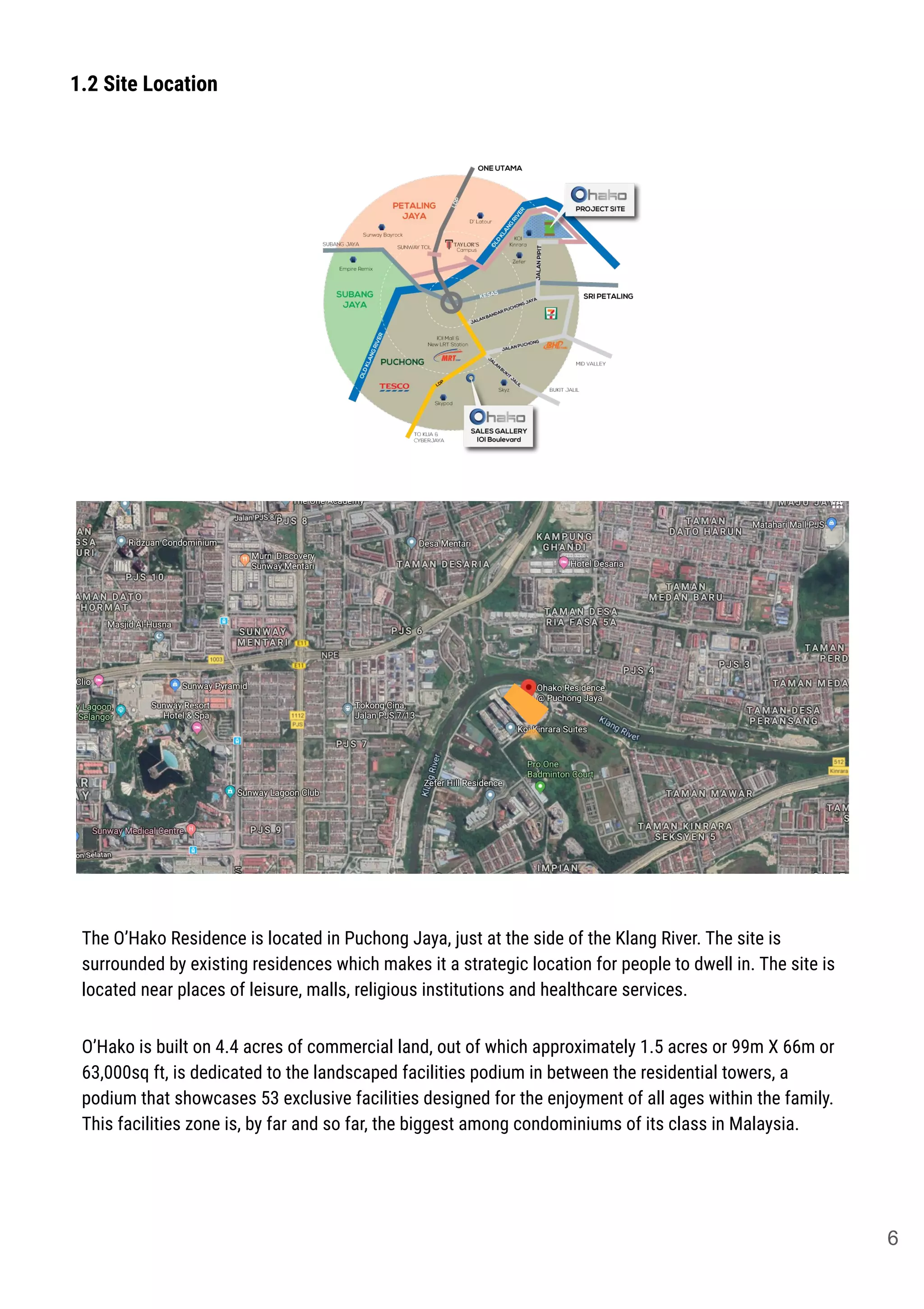
The O’Hako Residence is located in Puchong Jaya, just at the side of the Klang River. The site is
surrounded by existing residences which makes it a strategic location for people to dwell in. The site is
located near places of leisure, malls, religious institutions and healthcare services.
O’Hako is built on 4.4 acres of commercial land, out of which approximately 1.5 acres or 99m X 66m or
63,000sq ft, is dedicated to the landscaped facilities podium in between the residential towers, a
podium that showcases 53 exclusive facilities designed for the enjoyment of all ages within the family.
This facilities zone is, by far and so far, the biggest among condominiums of its class in Malaysia.
6
2.02.0
⬥
⬦
⬥
⬦
⬥
⬦
PROJECT TEAM
7
2.0 Project Team
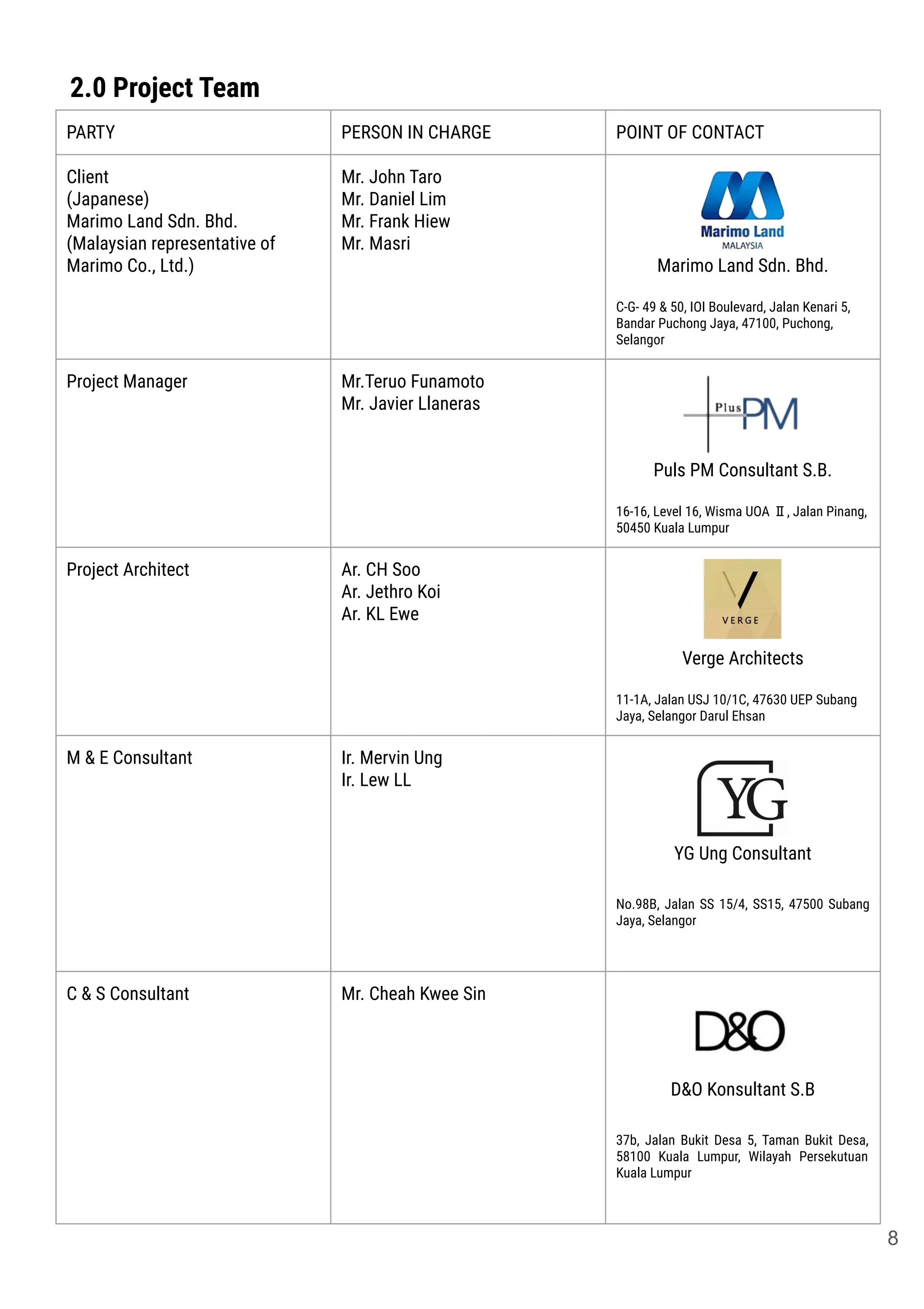
PARTY PERSON IN CHARGE POINT OF CONTACT
Client
(Japanese)
Marimo Land Sdn. Bhd.
(Malaysian representative of
Marimo Co., Ltd.)
Mr. John Taro
Mr. Daniel Lim
Mr. Frank Hiew
Mr. Masri
Marimo Land Sdn. Bhd.
C-G- 49 & 50, IOI Boulevard, Jalan Kenari 5,
Bandar Puchong Jaya, 47100, Puchong,
Selangor
Project Manager Mr.Teruo Funamoto
Mr. Javier Llaneras
Puls PM Consultant S.B.
16-16, Level 16, Wisma UOA Ⅱ, Jalan Pinang,
50450 Kuala Lumpur
Project Architect Ar. CH Soo
Ar. Jethro Koi
Ar. KL Ewe
Verge Architects
11-1A, Jalan USJ 10/1C, 47630 UEP Subang
Jaya, Selangor Darul Ehsan
M & E Consultant Ir. Mervin Ung
Ir. Lew LL
YG Ung Consultant
No.98B, Jalan SS 15/4, SS15, 47500 Subang
Jaya, Selangor
C & S Consultant Mr. Cheah Kwee Sin
D&O Konsultant S.B
37b, Jalan Bukit Desa 5, Taman Bukit Desa,
58100 Kuala Lumpur, Wilayah Persekutuan
Kuala Lumpur
8
PARTY PERSON IN CHARGE POINT OF CONTACT
C & S Consultant
(Initial stage only - Terminated)
Mr. Samson Lee
Perunding Reka Cekap S.B
9, Jalan Kenari 2, andar Puchong Jaya, 7100
Puchong, Selangor Darul Ehsan
Quantity Surveyor Consultant Sr. C.S. Chlu
Ms. C.K Chla
DK-QS Sdn.Bhd
38-2, Jalan Sierra 10/2, Bandar 16 Sierra,
47110 Puchong, Selangor
Quantity Surveyor Consultant
(Initial stage only - Terminated)
Mr. Mohd Razif
Ms. CL Wong
Perunding PQS 10-3,
Jalan 13/48a, Sentul Raya Boulevard, 51000
Kuala Lumpur, Wilayah Persekutuan Kuala
Lumpur
Landscape Architect Mr. Khoo Eng Kee
Ms. Helen Hui
Engky Design S.B
No. 249, Jln BK 2/7, Bandar Kinrara,47180,
Puchong, Selangor
Main Contractor Mr. Michael Ong
Mr. Jason Pang
Mr. Dennis Tan
PEMBINAAN INFRA E&J S.B
No. 15, 1, Jalan Damai Raya 1, Alam Damai,
56000 Kuala Lumpur, Wilayah Persekutuan
9
CONSULTANT SCOPE OF WORK
This chapter covers the roles and responsibilities of the consultants involved in the project. The respective
roles constantly work together in the project, which can be observed through an example of the project's site
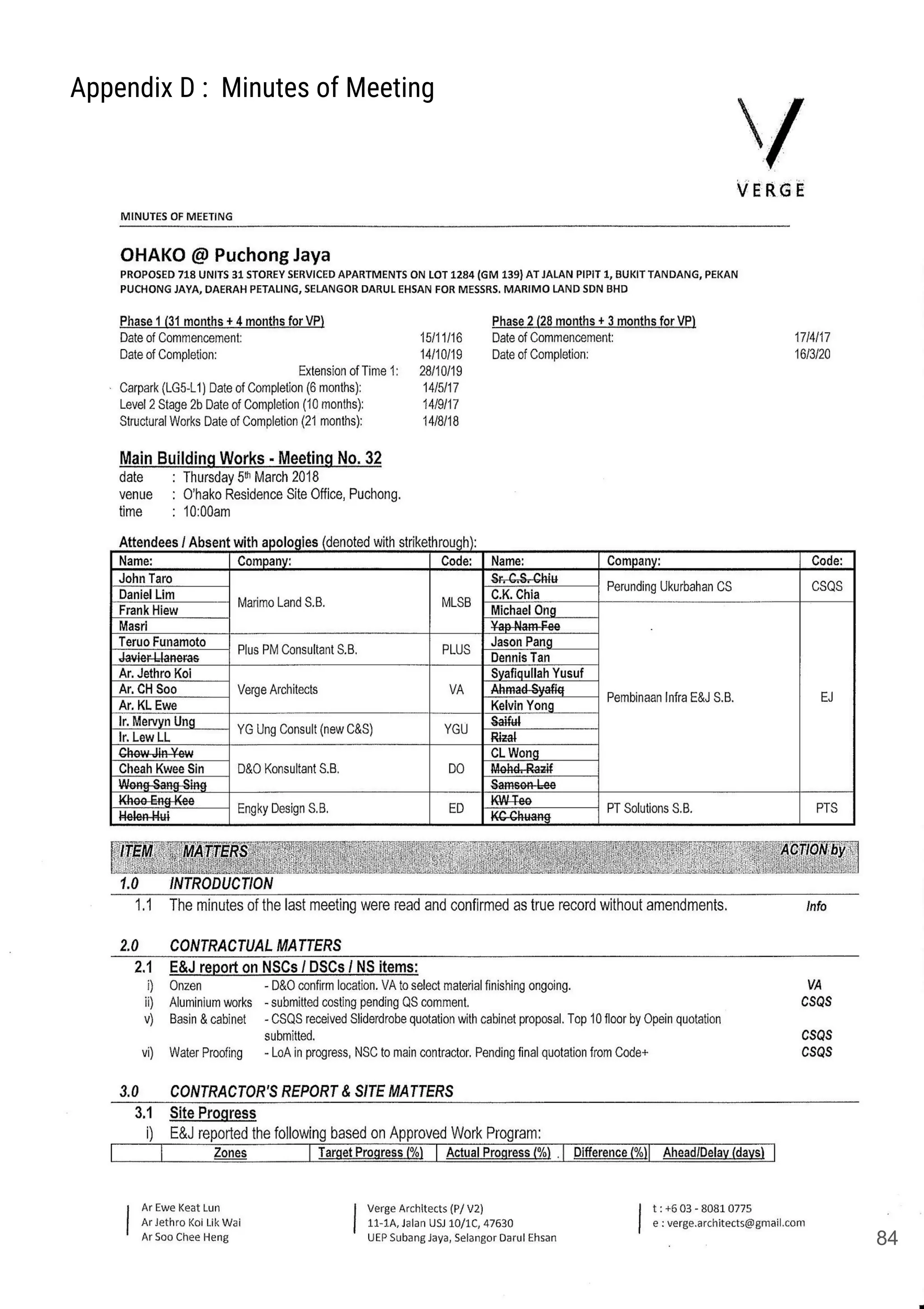
meeting minutes(in Appendix C) and client-consultant meeting minutes attached (in Appendix D).
2.1 PROJECT MANAGER
2.1.1 RESPONSIBILITIES
A professional in the field of project management. He/She is responsible to plan, procurement and execute a
project, undertaking that has a defined scope, defied start and defined finish. Project manager is the first
point person when there are discrepancies or issues. This individual aims to maintain the progress, mutual
interaction and tasks in order to reduces the risk of overall failure, maximize benefits and minimise costs.
2.1.2 COMPANY BACKGROUND: Plus PM Consultant S.B.
Plus PM Consultant S.B. is a leading project and construction management company established by
Japanese company to support investors that expand their business in ASEAN. "Our role is to bring the
construction project built in line with your business strategy. Significantly different from Japan, overseas
construction projects often encounter risks such as over construction budget, delay completion etc. Our
mission is to ensure project completion on schedule, assurance of required quality and construction
investment within budget in an environment away from Japan".
2.2 ARCHITECT
2.2.1 RESPONSIBILITIES
As lead consultant of the project, the architect carries one of the heaviest role in the team. The architect gets
involved in every phase from the start of the project till the end. coordinating with other consultants and
contractor along the way while constantly providing updates and progress to the project manager and client.
2.2.2 COMPANY BACKGROUND: Verge Architects
Verge Architects was established in Malaysia in 2009. In the ensuing 10 years, the firm has grown to serve an
increasingly diverse and extensive clientele in both private and public sectors. "We believe that
Architecture is one of the compelling forces that shape the lifestyles of society, behaviourial trends
and the intrinsic emotions of each individuals in perpectual relation to the genus loci". (refer to
Appendix H for letter of release by old architect)
10
2.2.3 TASK AT DIFFERENT STAGES
Before Construction
Architect and project manager are responsible to design the buildings according to the requirements of
authority. Drawings submission to the authority and amend changes commented by authority. There are
mainly three stages to coordinate all the drawings and documents; Schematic Design Phase, Design
Development Phase and Contract Documentation Phase.
During Construction
Once the construction starts, they need to ensure efficient quality control on all projects. They need to ensure
the resources availability and allocation. Having site inspection and site meetings to keep tracking the
progress of the construction and having quick response to resolve any problem during construction.
After Construction
They will conduct a final site inspection. Ensure close-out documentation and project archives are completed.
2.3 CIVIL AND STRUCTURAL CONSULTANT
2.3.1 RESPONSIBILITIES
A Civil & Structural Consultant is a construction industry professional with expert knowledge on create,
improve and protect the environment in which we live. They plan and design the construction and maintenance
of building structures and infrastructure. They also design and build tall buildings and large structures that
can withstand all weather conditions.
Civil engineers are divided into two types, which are consulting engineers and contracting engineers.
Consultants are responsible for the design work of projects and work predominantly in an office. Contractors
then take the designs and implement them during construction. Contractors work on site, managing the
construction of the structure.
11
2.3.2 COMPANY BACKGROUND:
YG Ung Consultant
YG Ung Consultant majors in knowledge of construction methods and construction sequences in civil
structural construction above or below the ground. Mr.James Ung has been praised by his high career growth
thought a continuous process of a successful professional and leading to best opportunity.
Perunding Reka Cekap S.B ( Initial stage only - Terminated )
Perunding Reka Cekap S.B was incorporated in 1994 by Dato’ Ir. Tee Chai Seng to provide professional civil
and structural engineering consultancy services in Malaysia and abroad.
They are an established multi-disciplined engineering consulting firm with expertise in the design and
supervision of mixed developments, corporate buildings, commercial complexes, infrastructural projects such
as jetties, bridges and highways.
2.3.3 TASK AT DIFFERENT STAGES
Before Construction
Civil and Structural Engineer help with feasibility studies for a project. They are involved in the investigation
and survey of build sites to determine the suitability of the earth for the requirements of the upcoming project.
They also need to assist the design team to design a safety building and according to the spaces that clients
needs. They needed to consider about the strength of various of construction materials too.
During Construction
Once the construction starts, they need to ensure efficient quality control on all projects and provide support
to engineering team at all times to maintain work schedule. Having inspection to keep tracking the quality of
the construction.
After Construction
The Civil and Structural Consultant will conduct series of test to examine the structures quality and ensure it
is structurally sound.
12
2.4 MECHANICAL AND ELECTRICAL CONSULTANT
2.4.1 RESPONSIBILITIES
Mechanical and Electrical Consultants are responsible for the mechanical or electrical components of
different services in the building such as elevators, air-conditioning, gas and water supply. From installation
to testing, operation, maintenance and repair, they help to ensure that buildings are equipped with the
relevant services and are able to operate safely.
2.4.2 COMPANY BACKGROUND: D&O Konsultant S.B
D&O Konsultant was established in 1984, with more than 30 years of experience , they are leading the way in
value driven, sustainable, energy efficient design solution. D&O Konsultant is positioned to efficiently
respond to the rapid growth within the region and deliver solutions that meet the needs of their clients.
2.4.3 TASK AT DIFFERENT STAGES
Before Construction
Mechanical & Electrical Engineer discuss concept, requirements and thoughts with the other consultants
regarding construction and implement the systems. Once mutual agreement have been achieve, M&E start to
produce tender drawings and submit it to fire department to get the approval.
During Construction
After getting the green light from local authority, M&E will conduct site inspection to make sure the
contractors do according to plan. During a period of time, meeting will held frequently to check the progress
and coordinate with other building teams such as C&S engineer.
After Construction
Once the construction was completed, M&E will test the system and the installation every 2-3 days to ensure
works are built according to requirements. Lift and other mechanisms usually will takes about one month
due to its complexity.
13
2.5 QUANTITY SURVEYOR CONSULTANT
2.5.1 RESPONSIBILITIES
A Quantity Surveyor(QS) is a construction industry professional with expert knowledge on construction costs
and contracts. They are responsible for managing all aspects of the contractual and financial side of
construction projects. Quantity surveying about managing costs, ensuring that high-quality structures are
built as economically as possible. A quantity surveyor could be involved in every stage of the project,
depending on whether they work for a consultant or for a contractor.
A Quantity Surveyor manages all costs relating to building and civil engineering projects, from the initial
calculations to the financial figures. They seek to minimise the costs of a project and enhance value for
money, while still achieving the required standards and quality. This includes ensuring statutory building
regulations are met. Quantity surveyor work for either the client or the contractor, in an office or on site. They
will be involved in a project from the start, preparing estimates and cost of the work. When the project is in
progress, they will keep track of any variations to the contract that may affect costs and create reports to
show profitability. Their alternative job titles include construction cost consultant and commercial manager.
2.5.2 COMPANY BACKGROUND:
DK-QS Sdn.Bhd
DK-QS is a firm of Quantity Surveyors and Construction Economists with it's headquarters office at Puchong
Jaya. They have established, implemented and maintained a documented Quality Management
System(QMS), which meets the requirements of the Standard ISO9001 :2008 Quality Management System.
"We act as cost advisor, technical accountant and specialist on contractual matters, providing the link between
the designer and the producer, and is concerned with building projects from its inception to its ultimate
financial completion".
Perunding PQS (Initial stage only - Terminated)
PERUNDING PQS was formed in 1989 as a wholly owned Malaysian firm registered with the Registar of
Companies, Malaysia and the partners of the firm are: Lu Ping Liang and Low Kok Keong.
both being profesional Chartered Surveyors and registered with the Lembaga Juruukur Bahan Malaysia
(Board of Quantity Surveyors Malaysia) and The Royal Institution of Chartered Surveyors (RICS). (refer to
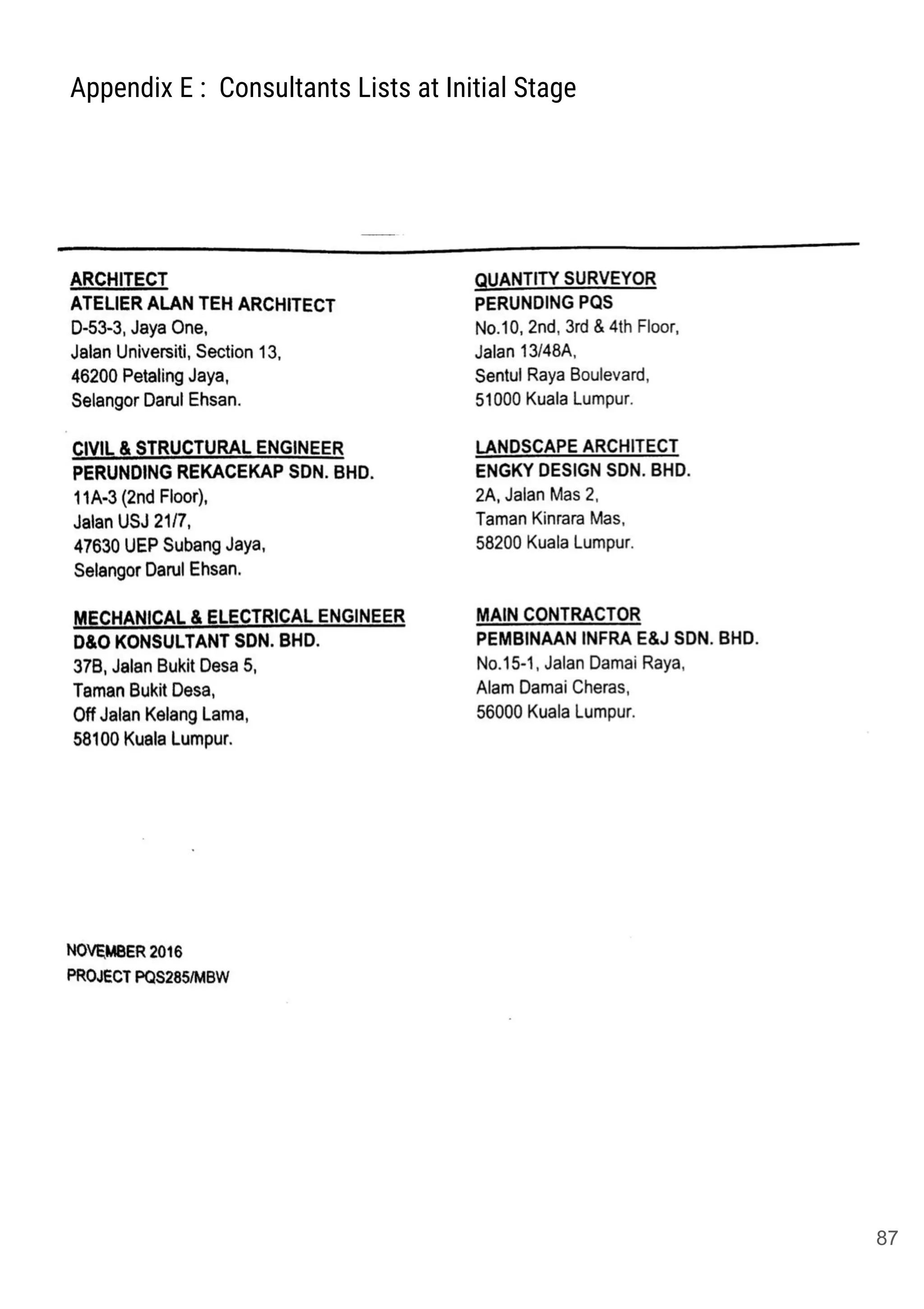
Appendix E for old list of consultants)
14
2.5.3 TASK AT DIFFERENT STAGES
Before Construction
Quantity Surveyors help with feasibility studies for a project. They studies the architects' and engineers' plans,
identifies the costs involved, and then sets an overall estimated budget for the project. The QS can then plan
costs to help the design team stay within the project budget using practical solutions. This is called value
engineering.
The final detailed estimate is prepared by the QS, together with a project architect. This is the basis for
evaluating tenders.
During Construction
Once the construction starts, the QS keeps costs on track. They provide cash flow data so the client can
arrange the finances needed for cash stage of the project. The QS also assess cost effects when changes to
the project occur, such as delays, and agree on 'variation' with contractors.
They provide a bank with a project report and help a client by preparing to draw down certificates for money to
be loaned by the bank. Resolving disputes between clients, designers and building contractors is another role
in some projects.
After Construction
The QS can prepare a statement of final account, which records the actual costs for all sections of the job.
The client shall pay the QS for the provision of the services required.
15
2.6 LANDSCAPE ARCHITECT
2.6.1 RESPONSIBILITIES
Landscape Architect is incharge in creating aesthetic layout of outdoor spaces that provide environmental
benefits, focusing on master planning, site planning, landscape design to project management and
implementation. The projects range that a landscape architect involve are vary, it can be minor projects like
residential environment, parks, sport courses to regional recreation. In additional case, Landscape Architects
will also be working with ecologist and geologist to investigate and reserve the environment follow by the
requirement of clients and UBBL.
2.6.2 COMPANY BACKGROUND: Engky Design S.B
Engky Design is a professional landscape consulting firm who believes in balance of forms, function,
architecture and the environment. It is the aspiration of two landscape designers with more than 10 years of
design experience in the market. They express their work through art and blend their art with the environment.
"We aims to create meaningful and unique landscape design to each site according to the essence of their
context and brief history".
2.6.3 TASK AT DIFFERENT STAGES
Before Construction
Before construction, landscape architects will provide preliminary services which are inception and feasibility.
During this period, the landscape architects with start analysing site and prepare site plans, specifications,
materials, vegetations and cost estimates. They will propose the land features and structure and as well
coordinate the arrangement of existing structure and vegetations. There will be meetings with consultants
until everyone agreed with the final design and call tender.
During Construction
Once the construction starts, the landscape architect will attend site meeting along with engineers, architects
and other consultants. During the period, the landscape architects will also monitor and understand the
outdoor spaces and help to give advice on solving on site issues.
After Construction
After the project is completed, the landscape architects will pay a visit to the site and inspect the quality of
work with the team, then prepare the schedule of defects and cerity completion.
16
2.7 MAIN CONTRACTOR
2.7.1 RESPONSIBILITIES
A main contractor is responsible for providing all of the material, labor, equipment (such as engineering
vehicles and tools) and services necessary for the construction of the project. A general contractor often hires
specialized subcontractors to perform all or portions of the construction work. When using subcontractors,
the general contractor is responsible for the quality of all work performed by any and all of the hires. The
contractor's number one priority is safety on the job site.
A main contractor's responsibilities may include applying for building permits, advising the person they are
hired by, securing the property, providing temporary utilities on site, managing personnel on site, providing site
surveying and engineering, disposing or recycling of construction waste, monitoring schedules and cash
flows, and maintaining accurate records.
2.7.2 COMPANY BACKGROUND: PEMBINAAN INFRA E&J SDN BHD
E&J established in year 1998, where the E&J group is an established company with a main focus in building
and infrastructure. It has come a long way from a humble sewerage treatment plant sub contractor to being a
sizeable contractor and developer companies. The group has grown from strength-to-strength, expanding its
scope and expertise that today cuts across the whole spectrum of the construction industry. It moved away
from doing just sewerage treatment plant to infrastructure and building construction, and in year 2010,
property development.
Currently, E&J group has a total contract value of RM150 million on both building, sewerage and infrastructure
projects. In its pipeline development, the group will be launching its warehouse and residential work in the
Klang Valley in year 2012.
17
3.03.0
⬥
⬦
⬥
⬦
⬥
⬦
ORGANIZATION STRUCTURE
18
3.1 ORGANIZATION CHART
Project Delivery : Since the client is a Japanese developer, they hired a "client side" project management
consultant which is established in Japan. The consultant keeps in check the architect and other consultants
then represents to the client. The second project manager,Verge Architect, is a local architectural firm.
Basically all the on-site process were managed by the architect. They leads other local consultants then
arrange several meetings with other stakeholders. This linear process is well understood and is suitable for
international projects. Moreover, the project delivery method could provide the client with an unbiased third
party ensuring successful completion of the project.
CLIENT
Marimo Land S.B
PROJECT MANAGER PROJECT MANAGER / ARCHITECT
Plus PM Consultant Verge Architect
CIVIL & STRUCTURAL
YG Ung Consultant
MECHANICAL &
ELECTRICAL
D&O Konsultant
QUANTITY SURVEYOR
DK-QS
LANDSCAPE
ARCHITECT
Engky Design
CONSULTANTS
Figure 3.1 Organization Structure
19
1.1 Project Information
Client
Marimo Land Sdn.
Bhd.
Architect
Verge Architects
Quantity Surveyor
DK-QS Sdn. Bhd.
Architect
Atelier Alan Teh Architects
(Terminated)
Contractor
Pembinaan Infra E & J
Sdn. Bhd.
Quantity Surveyor
Perunding PQS
(Terminated)
20
4.04.0
⬥
⬦
⬥
⬦
⬥
⬦
STAKEHOLDERS
21
4.0 Stakeholders
STAKEHOLDERS
PROJECT TEAM REGULATORY BODIES END USER
Concept Architect
Verge Architect
Contractor
Pembinaan Infra E & J Sdn.
Bhd.
Quantity Surveyor
DK-QS Sdn. Bhd.
M&E Engineer
D&O Konsultant
C&S Engineer
YG Ung Consultant
Landscape Architect
Engky Design
MPSJ
Jabatan Kejuruteraan
Jabatan Bangunan
Jabatan Kesihatan
Jabatan Perancangan
OSC
POS Malaysia
Jabatan Kerja Raya
Indah Water Konsortium
Syarikat Bekalan Air
Selangor
Tenaga Nasional Berhad
Telekom Malaysia
Lembaga Arkitek Malaysia
Unit owners
Shop owners
BOMBA
External Shareholders
Internal Shareholders
Project Manager
Plus PM Consultant
22
5.05.0
⬥
⬦
⬥
⬦
⬥
⬦
PROJECT INFORMATION
23
5.1 Project Objectives & Goals
5.1.1 Project Objectives
● Create a special residency with a unique concept and identity known as O’Hako (十八番), to provide
the luxurious and attractive place for the users
● Improve the quality of life for the residences in the area
● To be the leading market in providing affordable and quality residential developments
● Create a good asset that will be attractive to current and potential residents.
5.1.2 Project Goals
● Mark the first successful condominium development for the parent company in Malaysia
● Set a path for more future condominium or residential developments
● Create its own identity with unique concept to build an image in the public
● Find a proper land that has great value for the development
● Budget and completion time is met, and all other requirements to be approved on time
24
5.2.1 Schematic Design
In this process, analysing the project brief, design concept, cost indication and submissions for Planning
Approval are the main components. The client appoints all responsibility of a main consultant to the
architect, in which the architect is then in charge of gathering all information of the site for the initial design
stage. In determining a project brief, Client Consultant Meetings (CCM) are conducted.
Analysis of Project Brief
The client, Marimo Land S. B., approaches the architect regarding their proposal to build a service apartment
in the suburban area of Puchong. However, there was no set of requirements given by the client except for
the concept which was O’Hako. The architect, working together with the client, will come up with a proper
brief with programmes. Once an agreement is achieved, the planner will brief on the site requirements and
the authority guidelines. Site requirements include, density that can be built on site. During this process, the
client was in the midst of procuring the land for the project from an agent. The agent will provide the land
grant and the land surveyor would record the land size and bearings, as well as the soil condition.
Preparation of Preliminary Conceptual Sketches Proposal
The concept introduced by client is the O’Hako, box of surprises. The team started to design by using boxes
as their main point of attraction. The architect aimed to create a special and well-designed residential
building.
Development of Sketch Designs
The boxes were design from every single direction, including the guard house and tower itself. The concept
of Ohako continued to be developed into complete sketch designs to be made for development order
approval.
5.2 Implementation Phase
The 5 phases of a project cycle starts with schematic design, then followed by design development, contract
documentation, contract implementation & management and completion phase.
25
Figure of Appendix B: Sketch design showing the site plan of Ohako Residence.
Figure of Appendix A: Development Order Approval
26
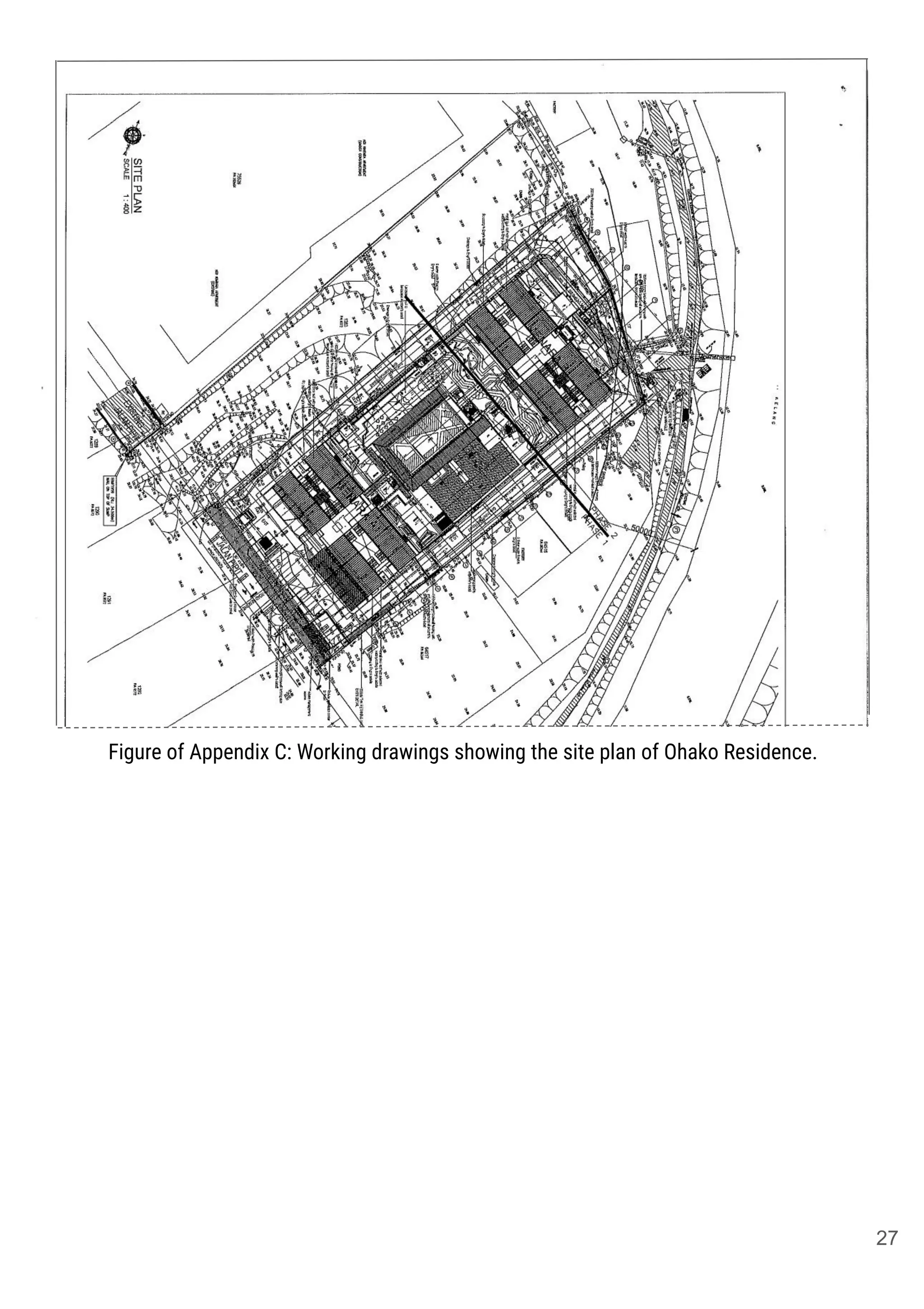
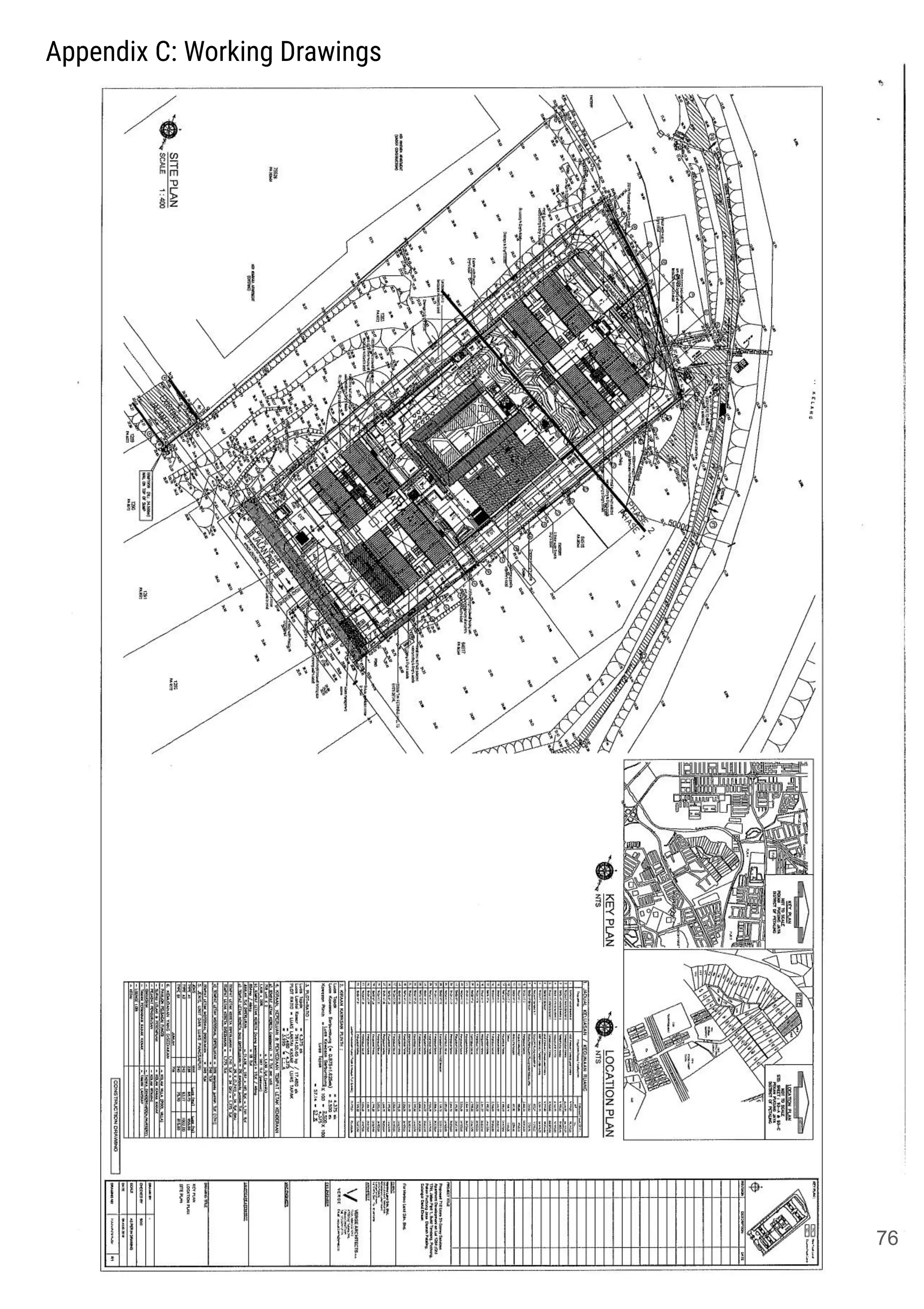
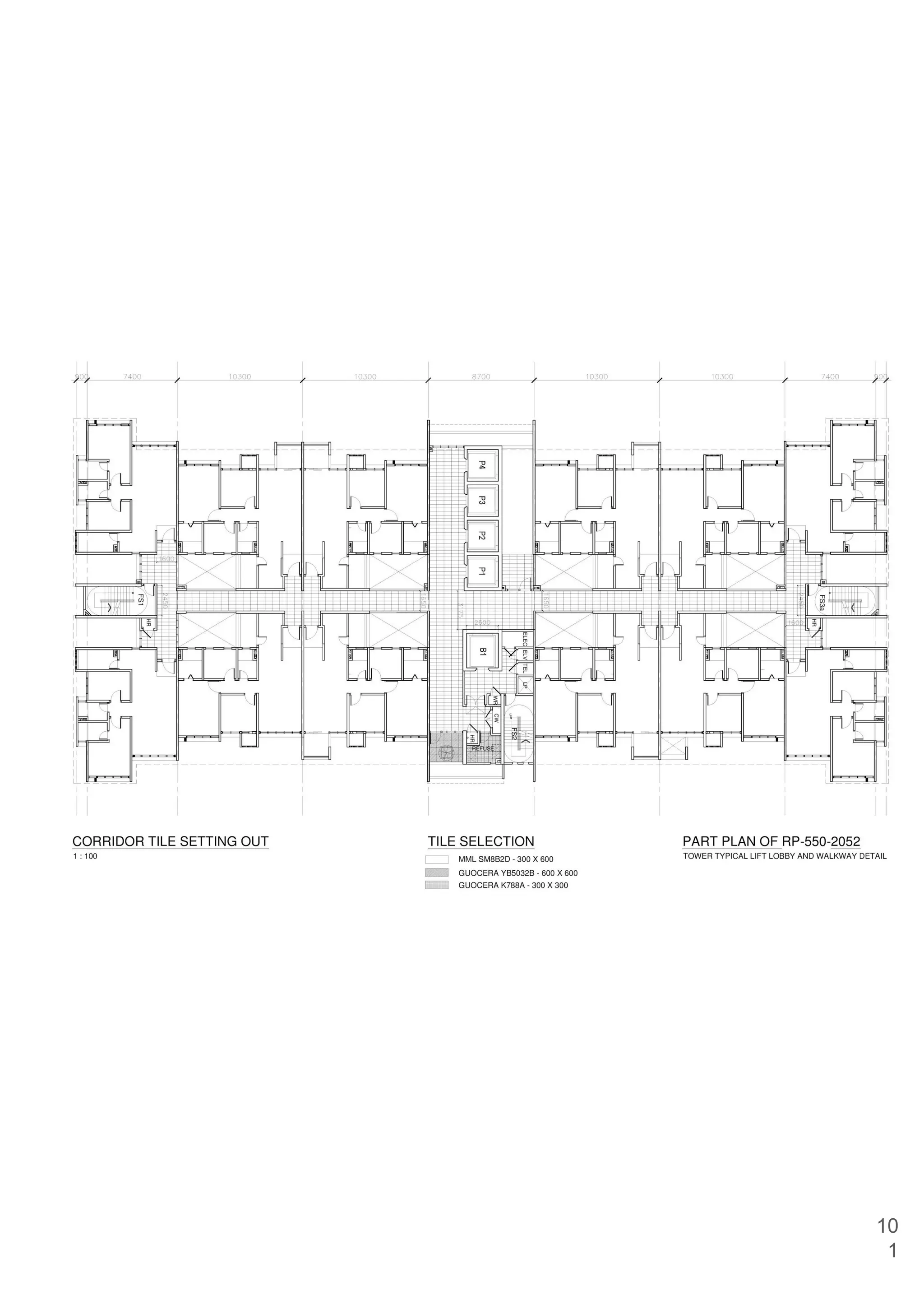
Figure of Appendix C: Working drawings showing the site plan of Ohako Residence.
27
5.2.2 Design Development
Once approval of project development of the project is given by the authorities, the schematic design is then
further developed alongside other relevant consultants. This consists of Preliminary Cost Estimation, and
Submissions for Building Approval. The project is then divided with other consultants to begin with detailed
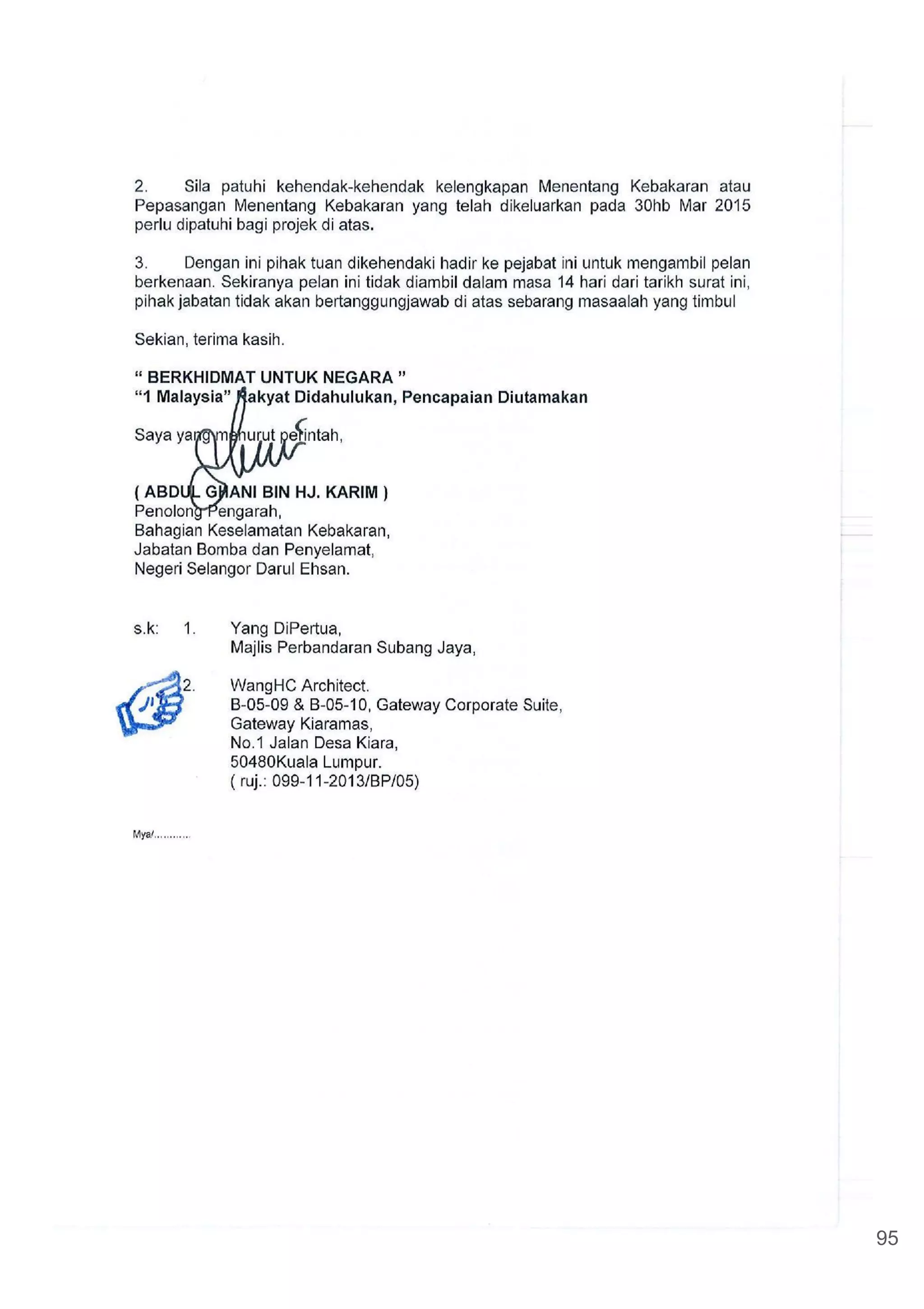
drawings such as the architect, C & S Engineer and M & E Engineer. (refer to Appendix G for BOMBA
APPROVAL)
Detailed Design Work
The design is to be developed and completed upon client’s agreement on the proposal.
The architect decided to provide efficient facilities for the residence in second floor such as swimming pool,
hall and gym. The facilities included the five-level basement which is concealed from front entrance. Some
facilities also changed from shop lots to kindergarten as the residents are intended to run the educational
facilities and caters for Ohako residence. The residence is made for family concept, so the architect
incorporated as much open space as possible for the children’s playing area. He also included disabled
facilities such as wheelchair-friendly staircases and shower rooms for disabled.
The amount of bedrooms were designed according to market trend. The client has his marketing team to
conduct the market survey. The architect proposed the standard residence with two bedrooms and two
bathrooms. However, the client decided two types of accommodation: two bedrooms and three bedrooms.
Three bedrooms is considered as average amount for architect’s design.
After that, the client started to engage with the architect for civil and structural proposal to decide for the
structural design of the residence.
Relevant consultants will come in by this phase to produce technical drawings to ensure the project is
feasible.
Preparation and Submission of Working Drawings
The architect was preparing for submission to obtain building approval. So, the civil and structural engineer,
as well as quantity surveyor were involved. Civil and structural engineers played the major role in this phase.
The drawings are developed along with the client’s approval before being sent to the authorities.
The drawings must abide by local authorities regulations and requirements in order to be approved. In our
case study, the authorities involved were MBSJ and Bomba.
28
5.2.3 Contract Documentation
Building Permit Application
Preparation of documents for build permit application for the owner’s signature as applicant and assist with
the submission of the application.
1. Zoning Land Use Amendment
2. Variance from UBBL
3. Site Plan Approval
Submission of Construction Documents
The construction documents are submitted to the clients and approval preparation of the bidding
information, bidding forms and condition of the construction contract.
Contract Documentation
The architect, Ar.Soo provides accurate and detailed tender documentation for the clients, which provides a
reliable baseline on which to tender for proposed construction works. Clients were also advised on the
preparation of bidding information, bidding forms, drawings, specifications, timeline, costs and the
conditions of the construction contract and the form of construction between the client and contractor.
Selective Tendering
Consists of a short-list of contractors that are known to have the appropriate qualifications to carry out the
work satisfactorily. For this project, the client recommended 4 contractors while the architects, 3.
Tender Documentation
The Quantity Surveyor is first in charge of the compilation of documents which are then sent to the tenderers.
From here, there are open quotations and comparisons are made by the Quantity Surveyor between the
accepted tenders and the final cost plan.
Evaluation Criteria
Several evaluation criterias were set such as the overall costs and total costs, background and financialities.
To further shortlist the selection, the would remove the contractor with the highest and lowest proposal and
select the few in the middle range.
29
Evaluation Result
Once all the criteria has been met, the contract will be made. The architect would then prepare and collate
the necessary contract documentations and incorporate any agreed alterations that may have been made
post-tender.
Award of Contract
Standard or bespoke Forms of Contract would be completed and would be arranged for the contract to be
signed by the client and the successful contractor.
The contractor was chosen among a group of many and all were categorised in terms of cost, a lower range,
a mid range and a higher range. The contractor that was chosen was in the mid range category. In the end,
the contractor recommended by the client was chosen.
Resource Planning and Timeline
A duration and resource types schedule which are detailed for the information and the types of resources in
each task. Duration refers to the timeframe or timeline in which the tasks will be performed. Resource type is
the skill set required to accomplish the task and identify the level of effort (LOE), both prepared by the
contractor.
Budget and Cost Control
The quantity surveyor controls the estimation of costs, the setting of an agreed budget, and management of
actual and forecast costs against the budget.
Project Baseline
Once a detailed budget is developed and approved with the clients, the architect publishes a baseline and
seit it as a point of comparison or reference for actual performance and progress.
Project Planning and Schedule Implementation
Project plans and schedules are prepared as a summary to support the project. A schedule listing of project
milestones, activities and deliverables, usually with intended start and finish dates are made. This is usually
prepared by the contractors themselves and serve as a reference point of their progress at site.
30
5.2.4 Contract Implementation
The performance of all functions and duties of architectural consultancy practice under the building contract.
In addition, providing advice to the client and site staff that are required for the project. Information and
activities of the construction are provided by the architects to the contractor under the building contract to
allow the contractor to proceed on the construction works. The contractor will then carry on with the
construction works as instructed by the architect.
Progress of construction works are monitored and inspected regularly, with contractor meetings every
fortnight, so that each construction works are executed according to the building contract. Also, quality of
the construction works will be inspected and liaise with the contractor to rectify any errors.
Construction General Review
The examination, evaluation and report upon representative samples of work to keep the client informed of
the progress and quality of work. Any defects or deficiencies in the work observed during site visitations will
be reported.
Site Meetings
Site meetings are held with the contractor, major subcontractor, consultants and client to review progress of
the work and to discuss critical site issues on the project details.
Architect’s Instructions
A set of instructions given by the architects, fortified by a contract for the contractors to comply. If they do
not comply, there are severe consequences. (refer to Appendix I for AI)
Bonds and Insurance Policies
Arranged to receive from contractor as required under the building contract and deliver to client for client’s
bond and insurance advisors to review.
Construction Schedule
Architect and project manager receive construction schedule from contractor which is then reviewed and
forwarded to the client. Examination of the working programme submitted by the contractor and to be
satisfied on the works can be completed within the contract period. In addition, inspection of the work
schedule to ensure the work is being executed in accordance with the building contract.
Construction schedule is prepared and submitted by the contractor in conformity with the contract time. The
construction schedule indicates timing of major construction works including details of critical events.
Construction schedule is updated on a monthly basis based on progress of work. Contractor will advise
client on any revisions to the schedule as a result from request for any extensions.
31
Construction Contract Documentation Interpretation
Request on contractor, consistent with the intent and inferable from the documents, showing partially to the
contractor on claims, disputes and other matters in question relating to the performance of work.
Schedule Value
Project manager received the schedule from the contractor to indicate and adjust. The client is advised and
obtains the agreement from the contractor. Architect, contractor and client then work together to determine
the cost value of each construction works that will be spent on construction of the project.
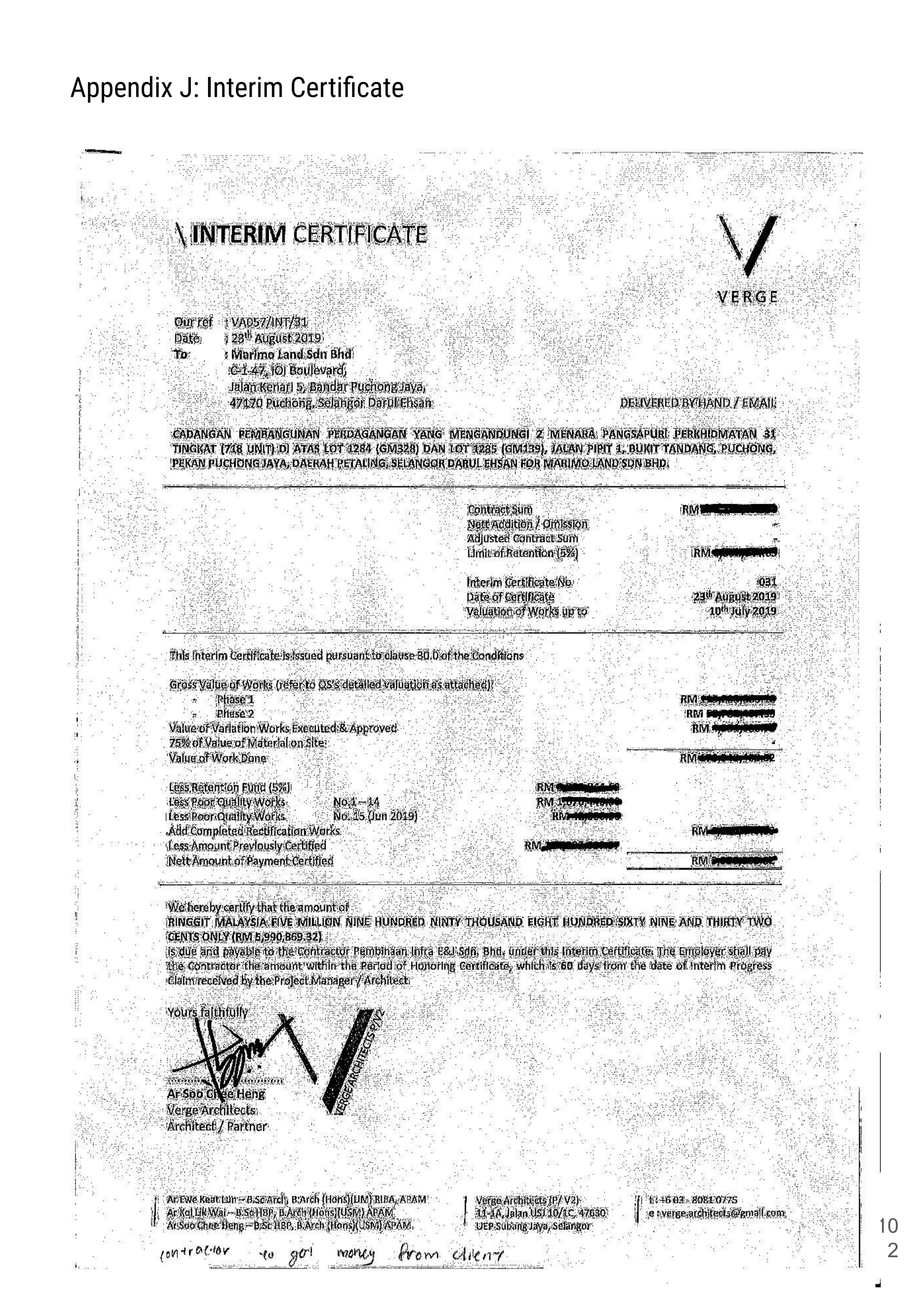
Payment Certification
Architect and project manager are involved to assess contractor’s application for payment. In addition,
project manager determines the amounts owed to the contractor under construction contract based on the
architect’s observations and evaluation of the contractor application of payment having factored in
completeness against the schedule of value and issue certificate of payment to the client. (refer to Appendix
J for Interim Certificate)
Drawings and Submittals
The architect will review the drawings, product data and samples for conformance with the general design
concept of the work as provided in the documents.
Inspections
Architect and contractor provides assistance in having inspection and testing companies perform services
as required by building contract. Project manager then receives and reviews the testing report to the client.
The testing and inspection are required to fulfill the authority approval such as :
- TNB
- JKR
- SYABAS
- BOMBA
- TM (Internet)
- VCAL (Aviation Department)
- TAR (Traffic)
32
5.2.5 Final Completion
Certificate of Practical Completion (CPC)
Contractor is required to give a written notice that the works are practically completed. Within 14 days of this
notice, Certificate of Practical Completion (CPC) will be issued by Verge Architects to the main contractor
when the architect is satisfied with all the physical works being completed. All subcontractors will also be
notified by the architect.
Figure 5.1 Copy of Certificate of Practical Completion (CPC)
33
Certificate of Completion and Compliance (CCC)
The Certificate of Completion and Compliance (CCC) will be issued by a principal submitting person (PSP).
The PSP, namely an architect, engineer and registered draftsman carry responsibilities including submitting
building plans for approval by the MBSJ, supervising erection and completion of the building in conformity
with the approved plans and requirements of the provisions of Acts or By-Laws, Upon satisfactory completion
of works and clearances from the six essential service departments obtained, CCC can be issued to the
owner.
The six essential services :
1. Confirmation of electrical supply (TNB)
2. Confirmation of water supply (SYABAS)
3. Confirmation of connection to sewage treatment plants (JPP)
4. Clearance from lifts and machinery department (JKKP)
5. Clearance for active fire fighting systems (BOMBA)
6. Roads and Drainage
MBSJ may inspect the building at any time on its own initiative or due to any complaints. In the event of
failure to comply with the approved plans, in the erection and construction of the building, MBSJ may issue a
written notice requiring compliance within a period which fits the non-compliance to be rectified. Issuance of
the CCC will also be withheld until such non-compliances are rectified.
34
Figure 5.2 Copy of Certificate of Completion and Compliance (CCC)
35
Client Handling Over
The handover of the building takes place once the contract administrator has confirmed that the works
defined in the contracts are complete. However, it has been planned well in advance, and any special
requirements included in appointment documents and contracts.
During the handover process, there are three parts :
1. The Schedule : Outlines the typical time frame of a project from design phase to the one-year
warranty review stage. This graphic highlights the key stages in the project, along with recommended
starting points for specific tasks.
2. The Checklists : Assists the consultants with planning, coordinating and monitoring the tasks to
ensure a successful transfer. The checklists have columns for responsible parties, due dates and
comments
3. The Companion Document : Provides background information for the checklists and identifies which
consultant is typically responsible for a specific task relating to the building handover.
During the handover, the client should be issued with :
● Keys, fobs and transmitter controls for the development
● The health and safety file
● The draft building owner’s manual
● The building log book
● A building user’s guide
● Up to date testing and commissioning data
● All certificates and warranties in respect of the works
● As-built drawings from consultants and specialist suppliers and contractors (or as manufactured and
installed). Or an as-constructed building information model.
● Copies of statutory approvals, waivers, consents and conditions
● Equipment test certificates for lifts, escalators, lifting equipment, cradle systems, boilers and
pressure vessels
● Licences such as licences to store chemicals and gases to extract groundwater from an artesian wall
36
Defects Liability Period (DLP) & CMGD
Once practical completion has been certified, the defects liability period (DLP) which last six to twelve
months begins. DLP commences based on the date stated on CPC. If no defects are found during the
inspection of contractor and client, Certificate of Making Good Defects (CMGD) will be issued. During this
DLP, any defects reported by the client will be decided by contract administrator whether they are in fact
defects or are merely maintenance issues. If contract administrator considers they are defects, then they
may issue instructions to the contractor to make good with the defects within reasonable time. When the
contract administrator considers that all items on the defect schedule have been made good, CMGD will be
issued.
Final Account Certificate
The final account certificate is made at the end of the defects liability period provided that all patent defects
have been rectified. Preparing the final account is the process of calculating and agreeing any adjustments to
the contract sum (amount originally set out in the contract to be paid to the contractor for completion of the
works) so that the amount of the final payment can be determined. The amount of the final payment is then
set out in the final certificate.
The financial statements prepared by the quantity surveyor will generally serve as the starting point for final
account discussions, In addition, quantity surveyor will also ensure that all the contracts instructions have
been accounted for any potential cost-related items. A draft copy of the final account is signed off by the
contractor as a full and final settlement prior to the issue.
Strata Management Act
The client sets up the MGB and transfer MC. In the period of the first year after completion, the management
cooperation of the building is taken care by the client. However, from there onwards a shift occurs where the
occupants of the building are in-charge
37
5.3 Implementation Tools
5.3.1 Planning and Scheduling
Microsoft Excel
The software aids in creating Gantt Charts which helps in the planning and scheduling phase of the project.
Creating a spreadsheet of all related items and allocating sufficient time periods to create a project timeline.
5.3.2 Drafting and Design
Autodesk AutoCAD
AutoCAD is a 2D aided drafting software used in architecture to assist in preparing drawings. This software is
used as a standardised practice in Verge Architects throughout the whole firm. They use Drawing
Management System (DMS) to track and manage the files digitally in the project.
Sketchup
Sketchup enables the 2D drawings become 3D designs. Via this application, it allows Verge Architects to
convey their ideas to their clients with a better visual and understanding of the potential building. The 3D
model are shown during meetings to the clients for approval.
Method of Collaboration
Various methods of collaboration was used. This allows prevention of misinformation and miscommunication
among the consultants and other parties involved. For a big scale project like, O’Hako, misunderstandings in
the process of construction have serious implications. Platforms used but not limited to are:
- Email
- Documents from authorities
- Formal letters
- Phone communication (Call or Text)
38
5.4 Monitoring Tools & Strategies
Monitoring tools are used to oversee the progress on the tasks at hand throughout the project. This is
necessary to ensure that the project is completed within the timeframe, scope and budget so that it may
proceed with minimal risks. Throughout the project, the process will involve comparing actual performance
with planned performance and taking actions on different outcomes.
Technical Meeting
Technical meetings only include members of the technical team which excludes the clients. The meetings are
short and concise as it is aimed to resolve as many issues as possible within that span of time.
Site Meeting
SIte meetings include the consultants and contractors, and sometimes clients themselves to check on the
current works on site. The meetings usually involves touring the site and check for any mistakes done on the
site works. Site meetings are to make sure that all works on site are appropriate and any confusions are
discussed
Meeting Minutes
Meeting minutes are used to record the important matters discussed on the meetings. The meetings minutes
are also referred when there are confusions or any disagreement on contracts and site works / discussions.
Figure of Appendix D: Minutes of Meeting.
39
Quality Assessment Committee Meeting
This meeting is to make sure that all quality of work is assessed and all defects are dealt with.
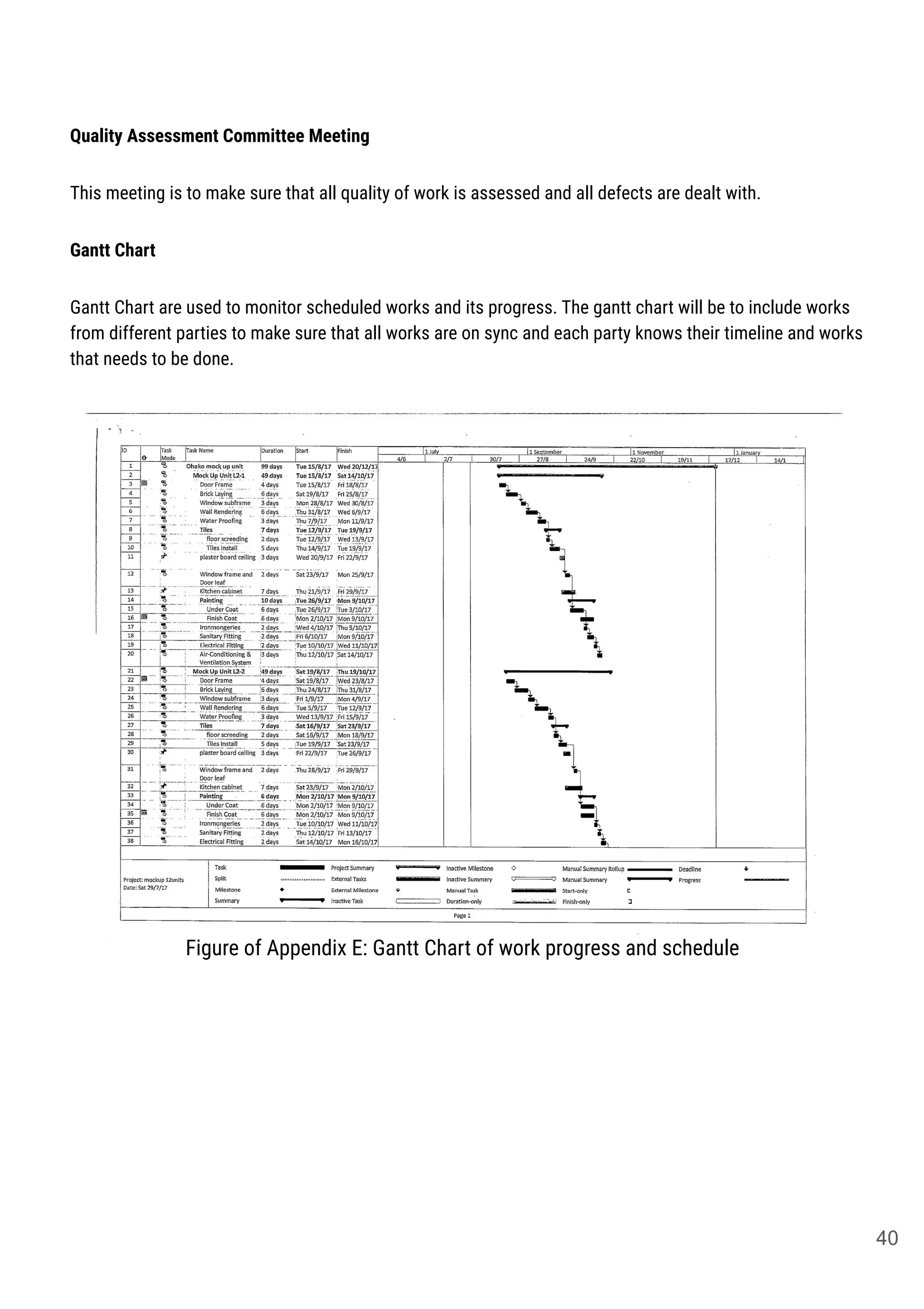
Gantt Chart
Gantt Chart are used to monitor scheduled works and its progress. The gantt chart will be to include works
from different parties to make sure that all works are on sync and each party knows their timeline and works
that needs to be done.
Figure of Appendix E: Gantt Chart of work progress and schedule
40
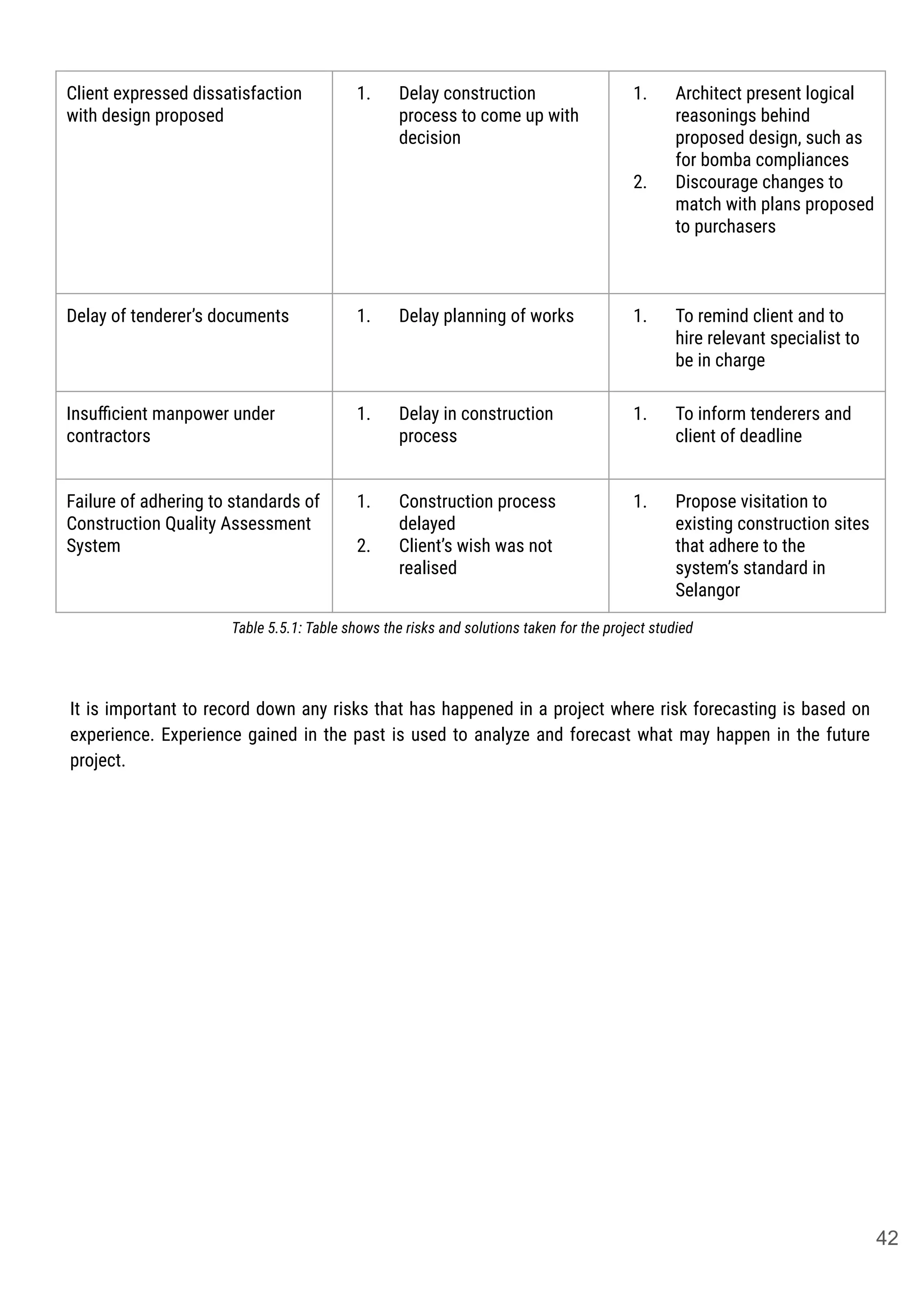
5.5 Risks & Mitigation
Risk management is a systematic process that is done throughout a project to identify, analyze and respond to
certain risks that may present themselves. This allows the probability and consequences of an event
beneficial to the project’s objectives to be maximised.
Risk management includes preparing a list of risk and mitigation plan so that allowances can be made for
uncertain events in the project schedule and budget. These uncertain events include unexpected good events
(beneficial/good risks), as well as unwanted events (negative risks) which can negatively impact project
success. A risk plan can be used to track the status of risks during a project, check for risk events in a daily or
weekly manner ad bring it under control.
RISKS IMPACT ON PROJECT SOLUTION/MITIGATIONS
Main contractor did not fulfill
contract duties on time
1. Delay in construction
process
2. Extension of project
deadline
1. Architect issue warning
letter to relevant party
2. As no suitable actions
were taken,the party was
terminated from further
duties to lighten their
workload
3. New party is hired to take
over
4. non -conformance report is
issued for unacceptable
delays
Structural elements constructed
not up to standard
1. Additional time and costs
is needed to rectify the
mistake
2. Delay in construction
process
1. Architect’s instruction (all)
is issued to ensure that the
mistake is fixed within 7
days,
2. When the consequential
delay is significant, catch
up program is created with
the contractor
Insufficient manpower under
contractors
1. Delay in construction
process
1. Request work schedule of
the contractor to make
sure manpower is
sufficiently delegated to
relevant work
2. Monitor process to ensure
balance f work
41
Client expressed dissatisfaction
with design proposed
1. Delay construction
process to come up with
decision
1. Architect present logical
reasonings behind
proposed design, such as
for bomba compliances
2. Discourage changes to
match with plans proposed
to purchasers
Delay of tenderer’s documents 1. Delay planning of works 1. To remind client and to
hire relevant specialist to
be in charge
Insufficient manpower under
contractors
1. Delay in construction
process
1. To inform tenderers and
client of deadline
Failure of adhering to standards of
Construction Quality Assessment
System
1. Construction process
delayed
2. Client’s wish was not
realised
1. Propose visitation to
existing construction sites
that adhere to the
system’s standard in
Selangor
It is important to record down any risks that has happened in a project where risk forecasting is based on
experience. Experience gained in the past is used to analyze and forecast what may happen in the future
project.
Table 5.5.1: Table shows the risks and solutions taken for the project studied
42
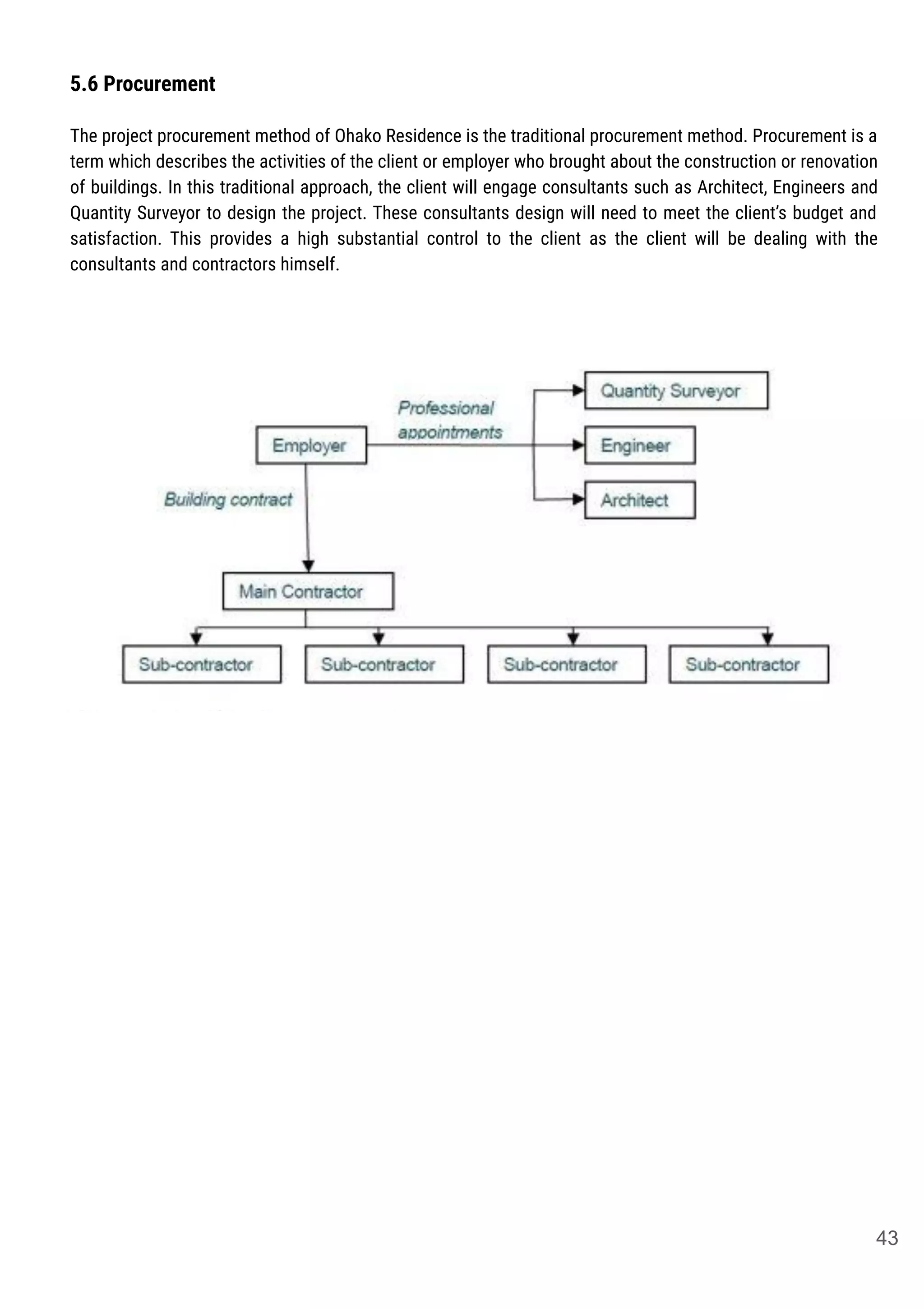
5.6 Procurement
The project procurement method of Ohako Residence is the traditional procurement method. Procurement is a
term which describes the activities of the client or employer who brought about the construction or renovation
of buildings. In this traditional approach, the client will engage consultants such as Architect, Engineers and
Quantity Surveyor to design the project. These consultants design will need to meet the client’s budget and
satisfaction. This provides a high substantial control to the client as the client will be dealing with the
consultants and contractors himself.
43
5.7 Success Criteria
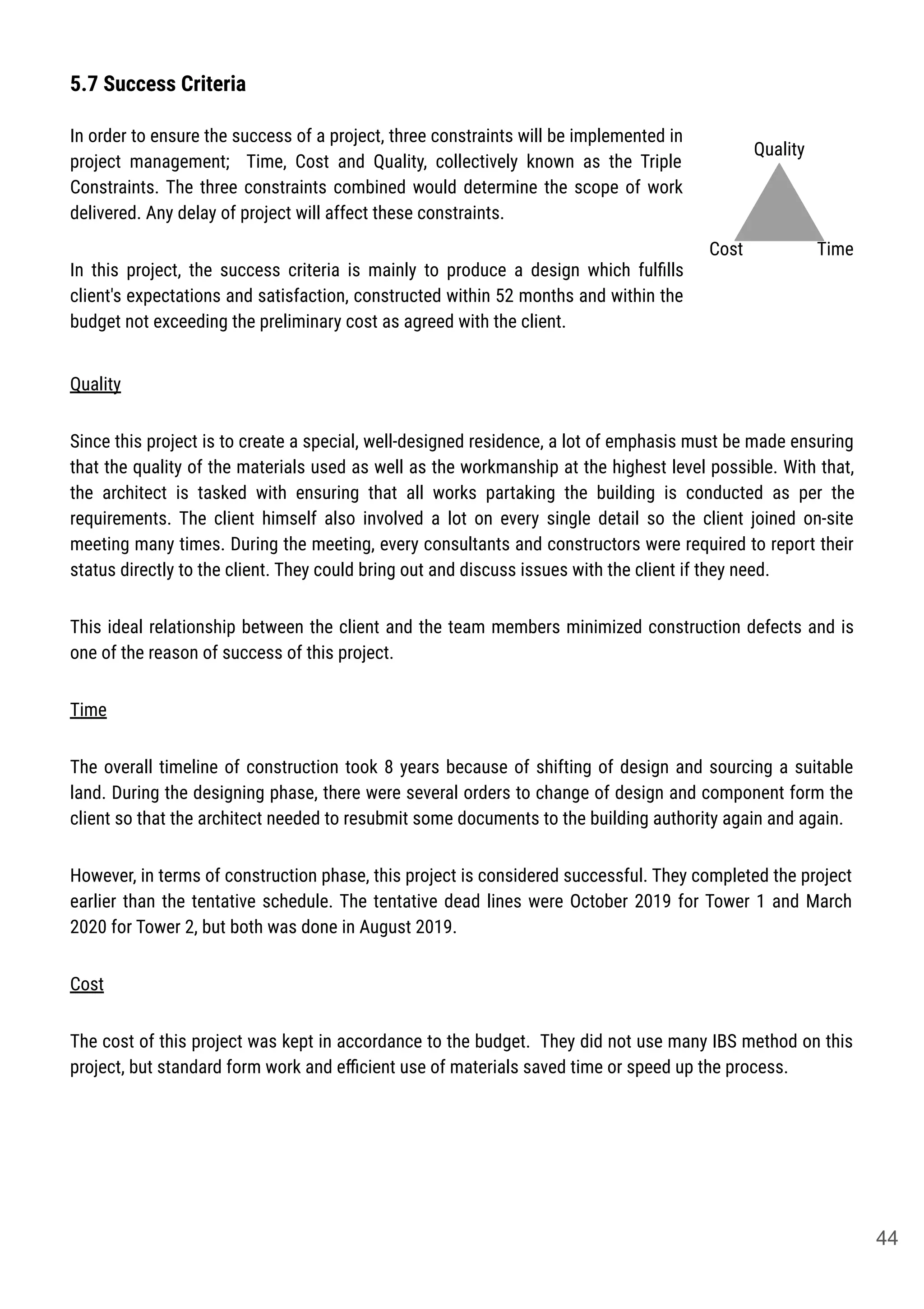
In order to ensure the success of a project, three constraints will be implemented in
project management; Time, Cost and Quality, collectively known as the Triple
Constraints. The three constraints combined would determine the scope of work
delivered. Any delay of project will affect these constraints.
In this project, the success criteria is mainly to produce a design which fulfills
client's expectations and satisfaction, constructed within 52 months and within the
budget not exceeding the preliminary cost as agreed with the client.
Quality
TimeCost
Quality
Since this project is to create a special, well-designed residence, a lot of emphasis must be made ensuring
that the quality of the materials used as well as the workmanship at the highest level possible. With that,
the architect is tasked with ensuring that all works partaking the building is conducted as per the
requirements. The client himself also involved a lot on every single detail so the client joined on-site
meeting many times. During the meeting, every consultants and constructors were required to report their
status directly to the client. They could bring out and discuss issues with the client if they need.
This ideal relationship between the client and the team members minimized construction defects and is
one of the reason of success of this project.
Time
The overall timeline of construction took 8 years because of shifting of design and sourcing a suitable
land. During the designing phase, there were several orders to change of design and component form the
client so that the architect needed to resubmit some documents to the building authority again and again.
However, in terms of construction phase, this project is considered successful. They completed the project
earlier than the tentative schedule. The tentative dead lines were October 2019 for Tower 1 and March
2020 for Tower 2, but both was done in August 2019.
Cost
The cost of this project was kept in accordance to the budget. They did not use many IBS method on this
project, but standard form work and efficient use of materials saved time or speed up the process.
44
6.06.0
⬥
⬦
⬥
⬦
⬥
⬦
CONCLUSION
45
In conclusion, conducting the case study on O’Hako Residences enabled us to gain a better understanding on
the different stages of project management and how important it is to have an organised process of
execution from start to finish of a project. The defining of roles is crucial to allow the frame of work to be
established for each party. This allows accountability in work done in case of mishaps or unfortunate events.
From the project, we can understand in depth the different stages and phases involved, which includes
implementation phases, prior to completion phase. These processes heavily involve back and forth
communication between different parties. Thus, cooperation is necessary to ensure a successful project
completion. Furthermore, it is important the project’s goals and achievements are determined so that there is
a solid direction for the project. Project management allows mediation between different members of the
project to allow a smooth documentation.
Additionally, success criteria of the project is studied to evaluate the quality based on the triple constraints.
There is a consideration that the project may fail but harsh lessons are learned in order to improve on the
next project and raise awareness in practice.
46
7.07.0
⬥
⬦
⬥
⬦
⬥
⬦
REFERENCE
47
-Sdn.Bhd., P. P. M. consultant. (0AD). Overseas construction consulting service to investors in ASEAN Plus
PM Consultant Sdn.Bhd. Retrieved from https://www.plus-pm.com/en/
-VergeArchitects. (0AD). Retrieved from https://www.facebook.com/VergeArchitects/
-QS Sdn. Bhd. (0AD). Retrieved from http://dkqs.com.my/Online.aspx
-EngkyDesign. (2017, May 4). Retrieved from http://engkydesign.com.my/v2/
-E & J Construction. (0AD). General Construction Contractor, Remodeling, and Handyman Services. Retrieved
from https://ejconstructionrgv.com/
-PERUNDING PQS SDN. BHD. - Get More Info at RAMCI. (n.d.). Retrieved from
https://buy.ramcreditinfo.com.my/index.php/search/Malaysia-Company/232045/PERUNDING-PQS-SDN.-BH
D..html.
-ABOUT US. (n.d.). Retrieved from https://www.primareka.com/about-us/.
48
8.08.0
⬥
⬦
⬥
⬦
⬥
⬦
APPENDIX
49
Content
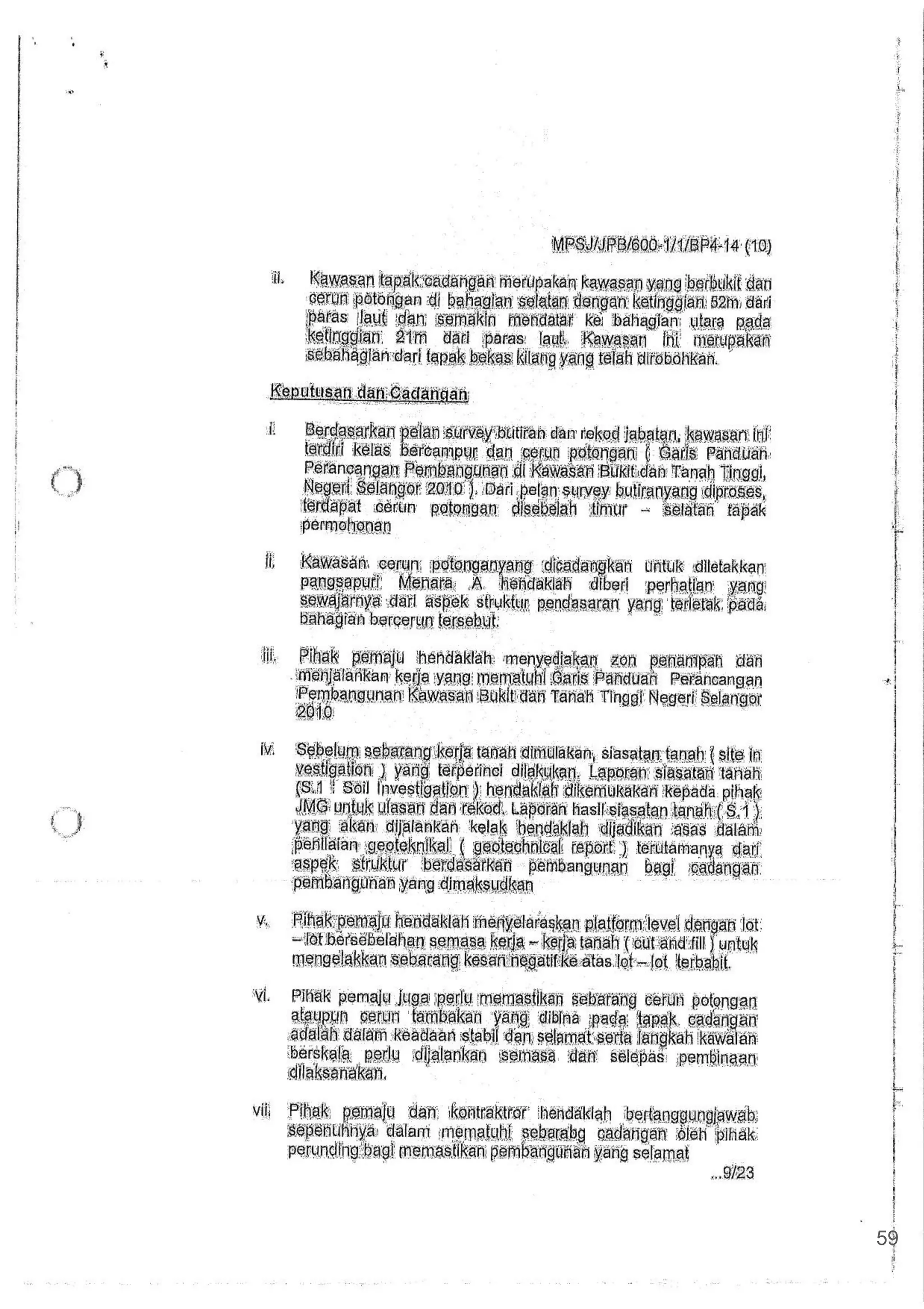
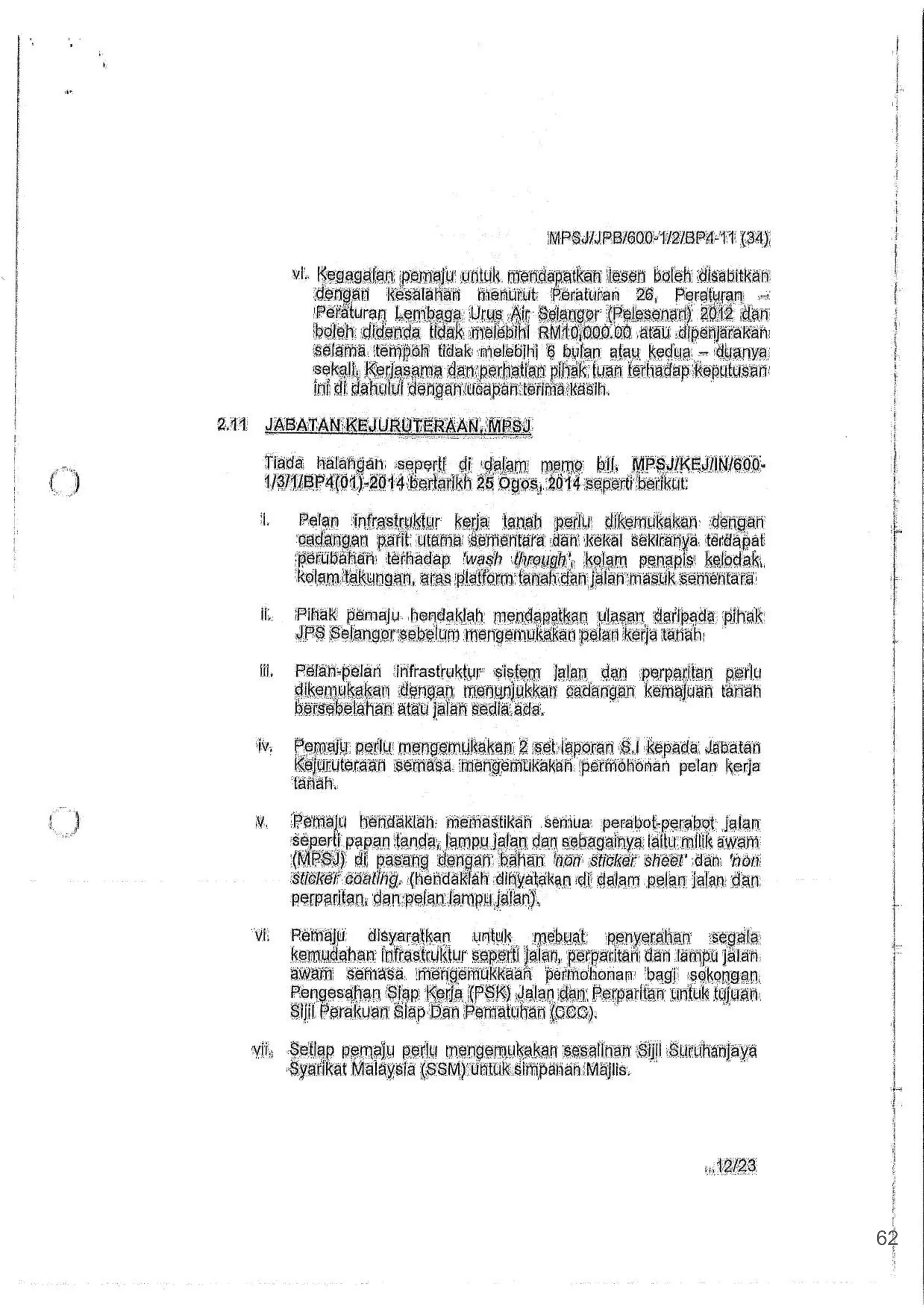
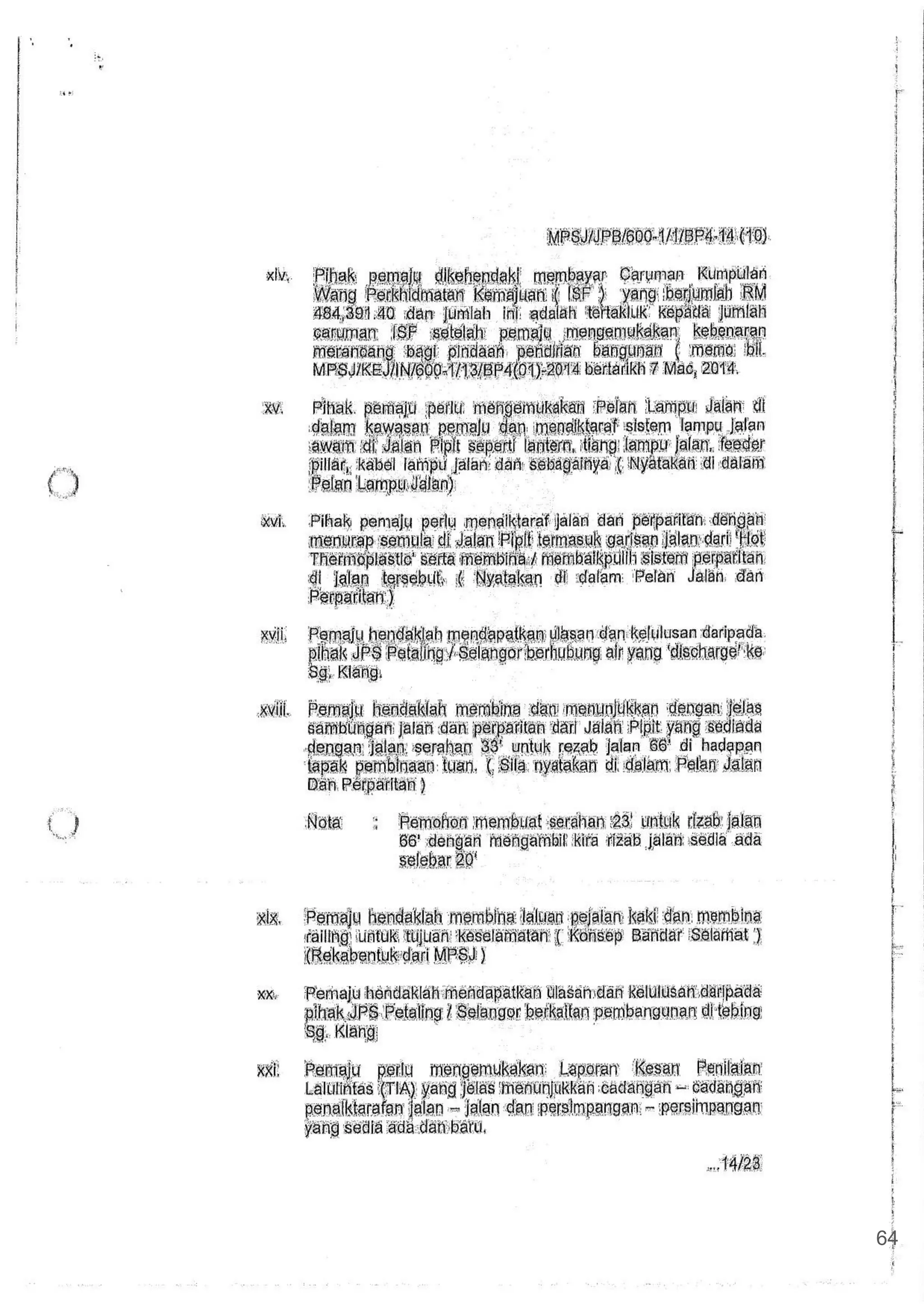
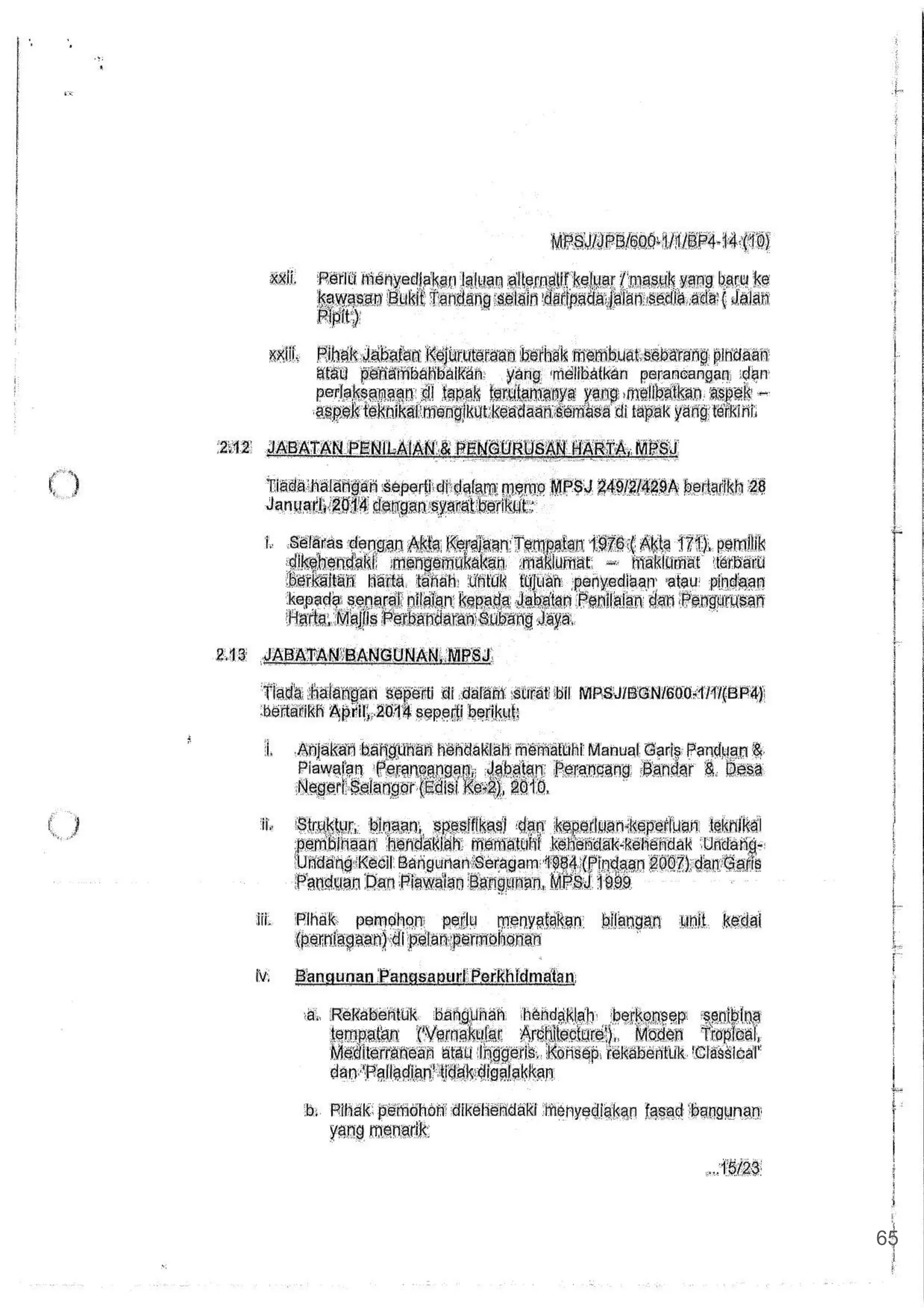
Appendix A: Development Order Approval
Appendix B: Sketch Designs
Appendix C: Working Drawings
Appendix D: Minute of Site meeting
Appendix E: Consultants Lists at Initial Stage
Appendix G: BOMBA Approval
Appendix H: Letter of Release
Appendix I: Architect’s Instructions
Appendix J: Interim Certificate
50
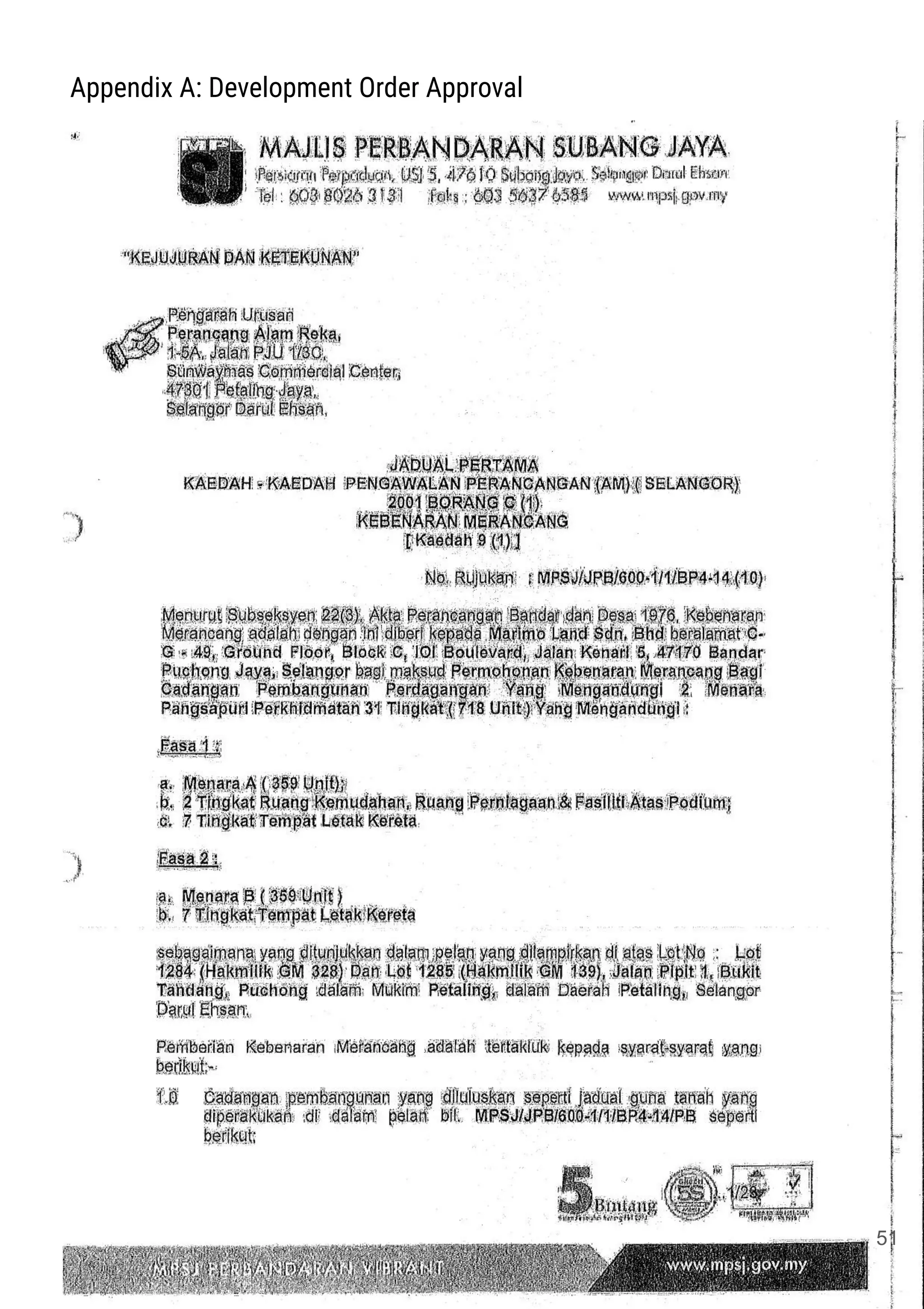
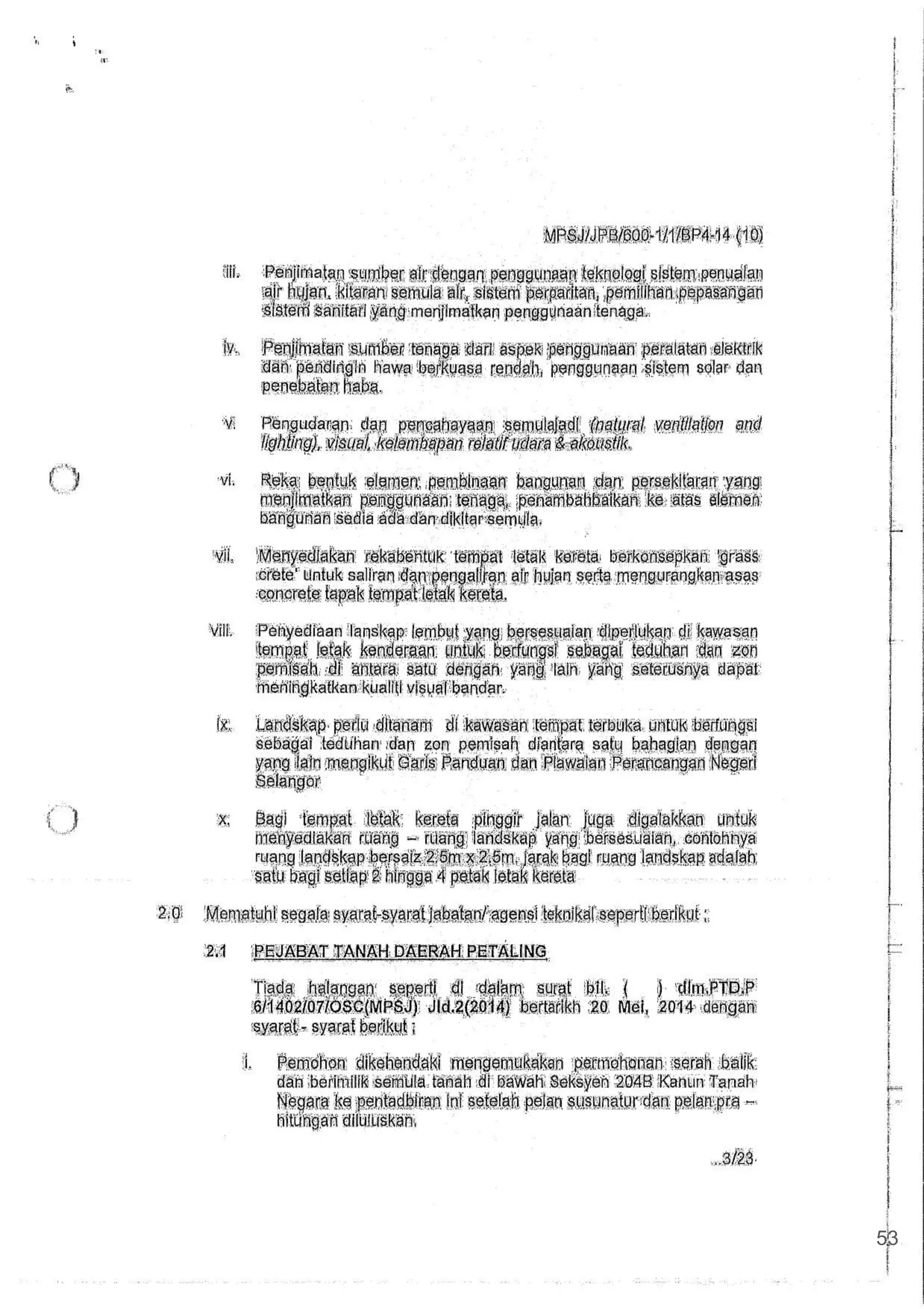
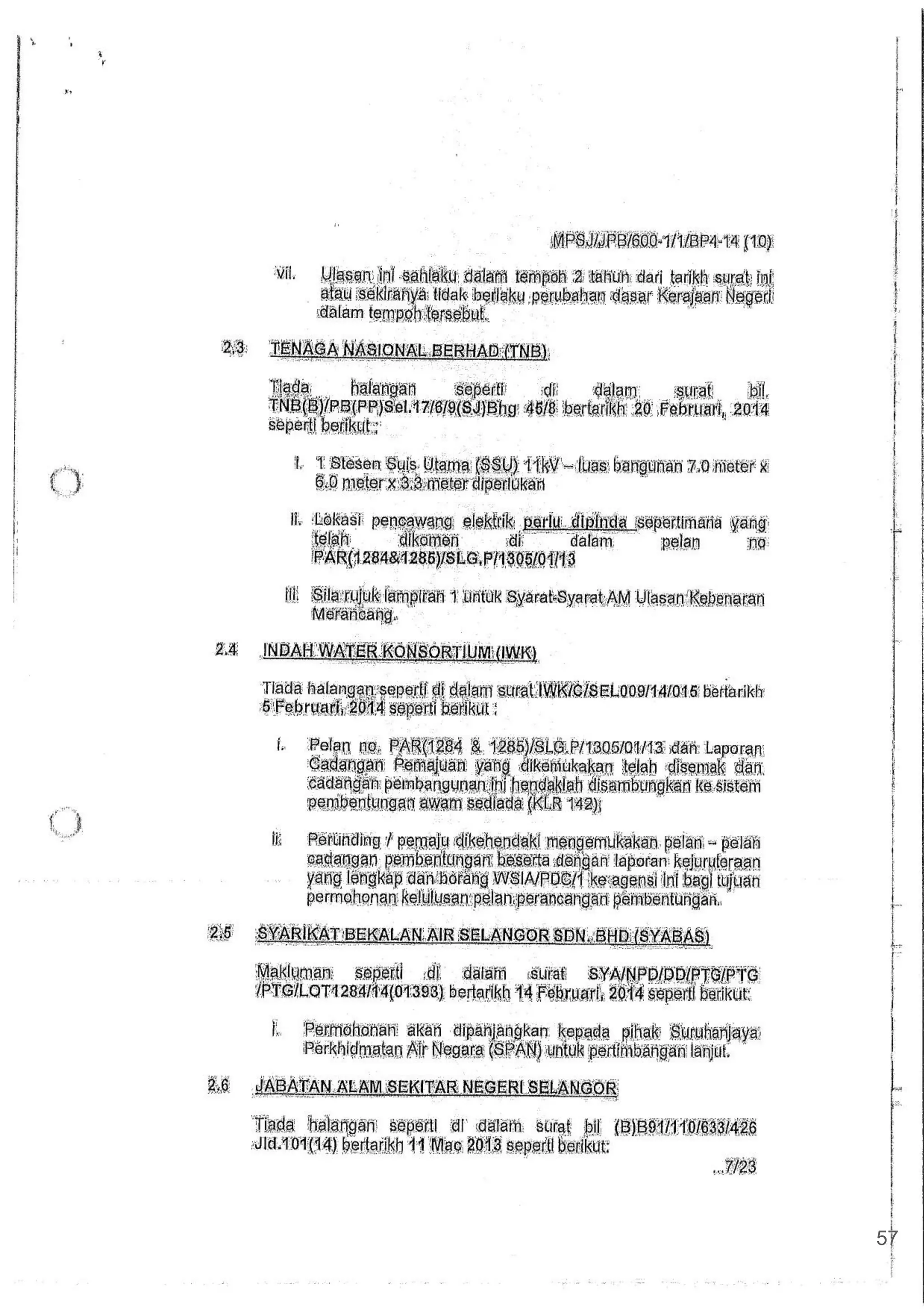
Appendix A: Development Order Approval
51
52
53
54
55
56
57
58
59
60
61
62
63
64
65
66
67
68
69
70
71
72
73
Appendix B: Sketch Designs
74
75
Appendix C: Working Drawings
76
77
78
79
80
81
82
83
Appendix D : Minutes of Meeting
84
85
86
Appendix E : Consultants Lists at Initial Stage
87
Appendix F : Gantt Chart
88
89
90
91
92
93
Appendix G: BOMBA Approval
94
95
Appendix H: Letter of Release
96
97
98
99
Appendix I: Architect’s Instructions
10
0
10
1
Appendix J: Interim Certificate
10
2

Project management

  • 1.
    SCHOOL OF ARCHITECTURE, BUILDINGAND DESIGN PROJECT MANAGEMENT (MGT60704) DEFINING AND DOCUMENTING A PROJECT Ar. Edwin Chan 0326938 Lim Jesson 0326465 Lissa Lai Jing Ying 0327780 Ahmad Nabil B. Jimi 0327161 Aidiel Syazrie B. Azhar 0332172 Kohei Watanabe 0904Y72861 Ng Jiji
  • 2.
    TABLE OF CONTENTS 1.0INTRODUCTION 1.1 Project Information 1.2 Site Location 2.0 PROJECT TEAM 2.1 Project Manager 2.2 Architect 2.3 Civil & Structural Consultant 2.4 Mechanical & Electrical Consultant 2.5 Quantity Surveyor Consultant 2.6 Landscape Architect 2.7 Main Contractor 3.0 ORGANIZATION STRUCTURE 4.0 STAKEHOLDERS 5.0 PROJECT INFORMATION 5.1 Project Objectives & Goals 5.2 Implementation Phase 5.2.1 Schematic Design 5.2.2 Design Development 5.2.3 Contract Documentation 5.2.4 Contract Implementation 5.2.5 Final Completion 5.3 Implementation Tools 5.4 Monitoring Tools & Strategies 5.5 Risks & Mitigation 5.6 Procurement 5.7 Success Criteria 6.0 CONCLUSION 7.0 REFERENCES 8.0 APPENDIX 03 04 06 07 10 10 11 13 14 16 17 18 21 23 24 25 38 39 41 43 44 45 47 49 2
  • 3.
  • 4.
    1.1 Project Information Client Project: O’Hako Residence @ Puchong Jaya Project Site : Jalan Pipit 1, Bukit Tandang, Pekan Puchong Jaya, Daerah Petaling, Selangor Darul Ehsan Architect : Verge Architects Client : Marimo Land SDN. BHD. Final Completion Date : September 2019 Marimo Land Sdn. Bhd. is the Malaysian subsidiary for Marimo Co., Ltd. from Hiroshima of Southern Japan. Marimo Co., Ltd. began as an architectural firm with expertise in providing affordable condominium designs to suit the burgeoning demand set by Japan’s rapid urbanisation. Building on the experience and techniques in residential planning and design, they transitioned into condominium development and set a goal to become leaders in the local market. Marimo Land Sdn. Bhd. made its debut in Malaysia with the O’Hako Residence. Project Scope Renderings of O’Hako Residence O’Hako Residences in Puchong Jaya the first service apartment project done by a Japanese company in Kuala Lumpur suburb of Puchong. The project is situated near the Klang River and surrounded near the existing residential area at site. Their concept, ‘O’Hako (十八番)’, which means a box is their drive in designing this prestigious apartment. The project has been designed to provide the most luxurious and attractive common areas in Puchong. 4
  • 5.
    Specifications of theproject includes:- Total Land Area of O’Hako: 4.375 acres Total Land Area of Facilities: 1.5acres 2 blocks with 358 units each Tower A - Residential units - 2 FLOORS of facilities provided - Kindergarten - Multipurpose Hall - Gymnasium - Swimming Pool - 4 units of retail outlets - Surau (LVL 1) - Management Offices - Basement Car Park - Guard House Tower B - Housing Units - Basement Car Park 5
  • 6.
    1.2 Site Location TheO’Hako Residence is located in Puchong Jaya, just at the side of the Klang River. The site is surrounded by existing residences which makes it a strategic location for people to dwell in. The site is located near places of leisure, malls, religious institutions and healthcare services. O’Hako is built on 4.4 acres of commercial land, out of which approximately 1.5 acres or 99m X 66m or 63,000sq ft, is dedicated to the landscaped facilities podium in between the residential towers, a podium that showcases 53 exclusive facilities designed for the enjoyment of all ages within the family. This facilities zone is, by far and so far, the biggest among condominiums of its class in Malaysia. 6
  • 7.
  • 8.
    2.0 Project Team PARTYPERSON IN CHARGE POINT OF CONTACT Client (Japanese) Marimo Land Sdn. Bhd. (Malaysian representative of Marimo Co., Ltd.) Mr. John Taro Mr. Daniel Lim Mr. Frank Hiew Mr. Masri Marimo Land Sdn. Bhd. C-G- 49 & 50, IOI Boulevard, Jalan Kenari 5, Bandar Puchong Jaya, 47100, Puchong, Selangor Project Manager Mr.Teruo Funamoto Mr. Javier Llaneras Puls PM Consultant S.B. 16-16, Level 16, Wisma UOA Ⅱ, Jalan Pinang, 50450 Kuala Lumpur Project Architect Ar. CH Soo Ar. Jethro Koi Ar. KL Ewe Verge Architects 11-1A, Jalan USJ 10/1C, 47630 UEP Subang Jaya, Selangor Darul Ehsan M & E Consultant Ir. Mervin Ung Ir. Lew LL YG Ung Consultant No.98B, Jalan SS 15/4, SS15, 47500 Subang Jaya, Selangor C & S Consultant Mr. Cheah Kwee Sin D&O Konsultant S.B 37b, Jalan Bukit Desa 5, Taman Bukit Desa, 58100 Kuala Lumpur, Wilayah Persekutuan Kuala Lumpur 8
  • 9.
    PARTY PERSON INCHARGE POINT OF CONTACT C & S Consultant (Initial stage only - Terminated) Mr. Samson Lee Perunding Reka Cekap S.B 9, Jalan Kenari 2, andar Puchong Jaya, 7100 Puchong, Selangor Darul Ehsan Quantity Surveyor Consultant Sr. C.S. Chlu Ms. C.K Chla DK-QS Sdn.Bhd 38-2, Jalan Sierra 10/2, Bandar 16 Sierra, 47110 Puchong, Selangor Quantity Surveyor Consultant (Initial stage only - Terminated) Mr. Mohd Razif Ms. CL Wong Perunding PQS 10-3, Jalan 13/48a, Sentul Raya Boulevard, 51000 Kuala Lumpur, Wilayah Persekutuan Kuala Lumpur Landscape Architect Mr. Khoo Eng Kee Ms. Helen Hui Engky Design S.B No. 249, Jln BK 2/7, Bandar Kinrara,47180, Puchong, Selangor Main Contractor Mr. Michael Ong Mr. Jason Pang Mr. Dennis Tan PEMBINAAN INFRA E&J S.B No. 15, 1, Jalan Damai Raya 1, Alam Damai, 56000 Kuala Lumpur, Wilayah Persekutuan 9
  • 10.
    CONSULTANT SCOPE OFWORK This chapter covers the roles and responsibilities of the consultants involved in the project. The respective roles constantly work together in the project, which can be observed through an example of the project's site meeting minutes(in Appendix C) and client-consultant meeting minutes attached (in Appendix D). 2.1 PROJECT MANAGER 2.1.1 RESPONSIBILITIES A professional in the field of project management. He/She is responsible to plan, procurement and execute a project, undertaking that has a defined scope, defied start and defined finish. Project manager is the first point person when there are discrepancies or issues. This individual aims to maintain the progress, mutual interaction and tasks in order to reduces the risk of overall failure, maximize benefits and minimise costs. 2.1.2 COMPANY BACKGROUND: Plus PM Consultant S.B. Plus PM Consultant S.B. is a leading project and construction management company established by Japanese company to support investors that expand their business in ASEAN. "Our role is to bring the construction project built in line with your business strategy. Significantly different from Japan, overseas construction projects often encounter risks such as over construction budget, delay completion etc. Our mission is to ensure project completion on schedule, assurance of required quality and construction investment within budget in an environment away from Japan". 2.2 ARCHITECT 2.2.1 RESPONSIBILITIES As lead consultant of the project, the architect carries one of the heaviest role in the team. The architect gets involved in every phase from the start of the project till the end. coordinating with other consultants and contractor along the way while constantly providing updates and progress to the project manager and client. 2.2.2 COMPANY BACKGROUND: Verge Architects Verge Architects was established in Malaysia in 2009. In the ensuing 10 years, the firm has grown to serve an increasingly diverse and extensive clientele in both private and public sectors. "We believe that Architecture is one of the compelling forces that shape the lifestyles of society, behaviourial trends and the intrinsic emotions of each individuals in perpectual relation to the genus loci". (refer to Appendix H for letter of release by old architect) 10
  • 11.
    2.2.3 TASK ATDIFFERENT STAGES Before Construction Architect and project manager are responsible to design the buildings according to the requirements of authority. Drawings submission to the authority and amend changes commented by authority. There are mainly three stages to coordinate all the drawings and documents; Schematic Design Phase, Design Development Phase and Contract Documentation Phase. During Construction Once the construction starts, they need to ensure efficient quality control on all projects. They need to ensure the resources availability and allocation. Having site inspection and site meetings to keep tracking the progress of the construction and having quick response to resolve any problem during construction. After Construction They will conduct a final site inspection. Ensure close-out documentation and project archives are completed. 2.3 CIVIL AND STRUCTURAL CONSULTANT 2.3.1 RESPONSIBILITIES A Civil & Structural Consultant is a construction industry professional with expert knowledge on create, improve and protect the environment in which we live. They plan and design the construction and maintenance of building structures and infrastructure. They also design and build tall buildings and large structures that can withstand all weather conditions. Civil engineers are divided into two types, which are consulting engineers and contracting engineers. Consultants are responsible for the design work of projects and work predominantly in an office. Contractors then take the designs and implement them during construction. Contractors work on site, managing the construction of the structure. 11
  • 12.
    2.3.2 COMPANY BACKGROUND: YGUng Consultant YG Ung Consultant majors in knowledge of construction methods and construction sequences in civil structural construction above or below the ground. Mr.James Ung has been praised by his high career growth thought a continuous process of a successful professional and leading to best opportunity. Perunding Reka Cekap S.B ( Initial stage only - Terminated ) Perunding Reka Cekap S.B was incorporated in 1994 by Dato’ Ir. Tee Chai Seng to provide professional civil and structural engineering consultancy services in Malaysia and abroad. They are an established multi-disciplined engineering consulting firm with expertise in the design and supervision of mixed developments, corporate buildings, commercial complexes, infrastructural projects such as jetties, bridges and highways. 2.3.3 TASK AT DIFFERENT STAGES Before Construction Civil and Structural Engineer help with feasibility studies for a project. They are involved in the investigation and survey of build sites to determine the suitability of the earth for the requirements of the upcoming project. They also need to assist the design team to design a safety building and according to the spaces that clients needs. They needed to consider about the strength of various of construction materials too. During Construction Once the construction starts, they need to ensure efficient quality control on all projects and provide support to engineering team at all times to maintain work schedule. Having inspection to keep tracking the quality of the construction. After Construction The Civil and Structural Consultant will conduct series of test to examine the structures quality and ensure it is structurally sound. 12
  • 13.
    2.4 MECHANICAL ANDELECTRICAL CONSULTANT 2.4.1 RESPONSIBILITIES Mechanical and Electrical Consultants are responsible for the mechanical or electrical components of different services in the building such as elevators, air-conditioning, gas and water supply. From installation to testing, operation, maintenance and repair, they help to ensure that buildings are equipped with the relevant services and are able to operate safely. 2.4.2 COMPANY BACKGROUND: D&O Konsultant S.B D&O Konsultant was established in 1984, with more than 30 years of experience , they are leading the way in value driven, sustainable, energy efficient design solution. D&O Konsultant is positioned to efficiently respond to the rapid growth within the region and deliver solutions that meet the needs of their clients. 2.4.3 TASK AT DIFFERENT STAGES Before Construction Mechanical & Electrical Engineer discuss concept, requirements and thoughts with the other consultants regarding construction and implement the systems. Once mutual agreement have been achieve, M&E start to produce tender drawings and submit it to fire department to get the approval. During Construction After getting the green light from local authority, M&E will conduct site inspection to make sure the contractors do according to plan. During a period of time, meeting will held frequently to check the progress and coordinate with other building teams such as C&S engineer. After Construction Once the construction was completed, M&E will test the system and the installation every 2-3 days to ensure works are built according to requirements. Lift and other mechanisms usually will takes about one month due to its complexity. 13
  • 14.
    2.5 QUANTITY SURVEYORCONSULTANT 2.5.1 RESPONSIBILITIES A Quantity Surveyor(QS) is a construction industry professional with expert knowledge on construction costs and contracts. They are responsible for managing all aspects of the contractual and financial side of construction projects. Quantity surveying about managing costs, ensuring that high-quality structures are built as economically as possible. A quantity surveyor could be involved in every stage of the project, depending on whether they work for a consultant or for a contractor. A Quantity Surveyor manages all costs relating to building and civil engineering projects, from the initial calculations to the financial figures. They seek to minimise the costs of a project and enhance value for money, while still achieving the required standards and quality. This includes ensuring statutory building regulations are met. Quantity surveyor work for either the client or the contractor, in an office or on site. They will be involved in a project from the start, preparing estimates and cost of the work. When the project is in progress, they will keep track of any variations to the contract that may affect costs and create reports to show profitability. Their alternative job titles include construction cost consultant and commercial manager. 2.5.2 COMPANY BACKGROUND: DK-QS Sdn.Bhd DK-QS is a firm of Quantity Surveyors and Construction Economists with it's headquarters office at Puchong Jaya. They have established, implemented and maintained a documented Quality Management System(QMS), which meets the requirements of the Standard ISO9001 :2008 Quality Management System. "We act as cost advisor, technical accountant and specialist on contractual matters, providing the link between the designer and the producer, and is concerned with building projects from its inception to its ultimate financial completion". Perunding PQS (Initial stage only - Terminated) PERUNDING PQS was formed in 1989 as a wholly owned Malaysian firm registered with the Registar of Companies, Malaysia and the partners of the firm are: Lu Ping Liang and Low Kok Keong. both being profesional Chartered Surveyors and registered with the Lembaga Juruukur Bahan Malaysia (Board of Quantity Surveyors Malaysia) and The Royal Institution of Chartered Surveyors (RICS). (refer to Appendix E for old list of consultants) 14
  • 15.
    2.5.3 TASK ATDIFFERENT STAGES Before Construction Quantity Surveyors help with feasibility studies for a project. They studies the architects' and engineers' plans, identifies the costs involved, and then sets an overall estimated budget for the project. The QS can then plan costs to help the design team stay within the project budget using practical solutions. This is called value engineering. The final detailed estimate is prepared by the QS, together with a project architect. This is the basis for evaluating tenders. During Construction Once the construction starts, the QS keeps costs on track. They provide cash flow data so the client can arrange the finances needed for cash stage of the project. The QS also assess cost effects when changes to the project occur, such as delays, and agree on 'variation' with contractors. They provide a bank with a project report and help a client by preparing to draw down certificates for money to be loaned by the bank. Resolving disputes between clients, designers and building contractors is another role in some projects. After Construction The QS can prepare a statement of final account, which records the actual costs for all sections of the job. The client shall pay the QS for the provision of the services required. 15
  • 16.
    2.6 LANDSCAPE ARCHITECT 2.6.1RESPONSIBILITIES Landscape Architect is incharge in creating aesthetic layout of outdoor spaces that provide environmental benefits, focusing on master planning, site planning, landscape design to project management and implementation. The projects range that a landscape architect involve are vary, it can be minor projects like residential environment, parks, sport courses to regional recreation. In additional case, Landscape Architects will also be working with ecologist and geologist to investigate and reserve the environment follow by the requirement of clients and UBBL. 2.6.2 COMPANY BACKGROUND: Engky Design S.B Engky Design is a professional landscape consulting firm who believes in balance of forms, function, architecture and the environment. It is the aspiration of two landscape designers with more than 10 years of design experience in the market. They express their work through art and blend their art with the environment. "We aims to create meaningful and unique landscape design to each site according to the essence of their context and brief history". 2.6.3 TASK AT DIFFERENT STAGES Before Construction Before construction, landscape architects will provide preliminary services which are inception and feasibility. During this period, the landscape architects with start analysing site and prepare site plans, specifications, materials, vegetations and cost estimates. They will propose the land features and structure and as well coordinate the arrangement of existing structure and vegetations. There will be meetings with consultants until everyone agreed with the final design and call tender. During Construction Once the construction starts, the landscape architect will attend site meeting along with engineers, architects and other consultants. During the period, the landscape architects will also monitor and understand the outdoor spaces and help to give advice on solving on site issues. After Construction After the project is completed, the landscape architects will pay a visit to the site and inspect the quality of work with the team, then prepare the schedule of defects and cerity completion. 16
  • 17.
    2.7 MAIN CONTRACTOR 2.7.1RESPONSIBILITIES A main contractor is responsible for providing all of the material, labor, equipment (such as engineering vehicles and tools) and services necessary for the construction of the project. A general contractor often hires specialized subcontractors to perform all or portions of the construction work. When using subcontractors, the general contractor is responsible for the quality of all work performed by any and all of the hires. The contractor's number one priority is safety on the job site. A main contractor's responsibilities may include applying for building permits, advising the person they are hired by, securing the property, providing temporary utilities on site, managing personnel on site, providing site surveying and engineering, disposing or recycling of construction waste, monitoring schedules and cash flows, and maintaining accurate records. 2.7.2 COMPANY BACKGROUND: PEMBINAAN INFRA E&J SDN BHD E&J established in year 1998, where the E&J group is an established company with a main focus in building and infrastructure. It has come a long way from a humble sewerage treatment plant sub contractor to being a sizeable contractor and developer companies. The group has grown from strength-to-strength, expanding its scope and expertise that today cuts across the whole spectrum of the construction industry. It moved away from doing just sewerage treatment plant to infrastructure and building construction, and in year 2010, property development. Currently, E&J group has a total contract value of RM150 million on both building, sewerage and infrastructure projects. In its pipeline development, the group will be launching its warehouse and residential work in the Klang Valley in year 2012. 17
  • 18.
  • 19.
    3.1 ORGANIZATION CHART ProjectDelivery : Since the client is a Japanese developer, they hired a "client side" project management consultant which is established in Japan. The consultant keeps in check the architect and other consultants then represents to the client. The second project manager,Verge Architect, is a local architectural firm. Basically all the on-site process were managed by the architect. They leads other local consultants then arrange several meetings with other stakeholders. This linear process is well understood and is suitable for international projects. Moreover, the project delivery method could provide the client with an unbiased third party ensuring successful completion of the project. CLIENT Marimo Land S.B PROJECT MANAGER PROJECT MANAGER / ARCHITECT Plus PM Consultant Verge Architect CIVIL & STRUCTURAL YG Ung Consultant MECHANICAL & ELECTRICAL D&O Konsultant QUANTITY SURVEYOR DK-QS LANDSCAPE ARCHITECT Engky Design CONSULTANTS Figure 3.1 Organization Structure 19
  • 20.
    1.1 Project Information Client MarimoLand Sdn. Bhd. Architect Verge Architects Quantity Surveyor DK-QS Sdn. Bhd. Architect Atelier Alan Teh Architects (Terminated) Contractor Pembinaan Infra E & J Sdn. Bhd. Quantity Surveyor Perunding PQS (Terminated) 20
  • 21.
  • 22.
    4.0 Stakeholders STAKEHOLDERS PROJECT TEAMREGULATORY BODIES END USER Concept Architect Verge Architect Contractor Pembinaan Infra E & J Sdn. Bhd. Quantity Surveyor DK-QS Sdn. Bhd. M&E Engineer D&O Konsultant C&S Engineer YG Ung Consultant Landscape Architect Engky Design MPSJ Jabatan Kejuruteraan Jabatan Bangunan Jabatan Kesihatan Jabatan Perancangan OSC POS Malaysia Jabatan Kerja Raya Indah Water Konsortium Syarikat Bekalan Air Selangor Tenaga Nasional Berhad Telekom Malaysia Lembaga Arkitek Malaysia Unit owners Shop owners BOMBA External Shareholders Internal Shareholders Project Manager Plus PM Consultant 22
  • 23.
  • 24.
    5.1 Project Objectives& Goals 5.1.1 Project Objectives ● Create a special residency with a unique concept and identity known as O’Hako (十八番), to provide the luxurious and attractive place for the users ● Improve the quality of life for the residences in the area ● To be the leading market in providing affordable and quality residential developments ● Create a good asset that will be attractive to current and potential residents. 5.1.2 Project Goals ● Mark the first successful condominium development for the parent company in Malaysia ● Set a path for more future condominium or residential developments ● Create its own identity with unique concept to build an image in the public ● Find a proper land that has great value for the development ● Budget and completion time is met, and all other requirements to be approved on time 24
  • 25.
    5.2.1 Schematic Design Inthis process, analysing the project brief, design concept, cost indication and submissions for Planning Approval are the main components. The client appoints all responsibility of a main consultant to the architect, in which the architect is then in charge of gathering all information of the site for the initial design stage. In determining a project brief, Client Consultant Meetings (CCM) are conducted. Analysis of Project Brief The client, Marimo Land S. B., approaches the architect regarding their proposal to build a service apartment in the suburban area of Puchong. However, there was no set of requirements given by the client except for the concept which was O’Hako. The architect, working together with the client, will come up with a proper brief with programmes. Once an agreement is achieved, the planner will brief on the site requirements and the authority guidelines. Site requirements include, density that can be built on site. During this process, the client was in the midst of procuring the land for the project from an agent. The agent will provide the land grant and the land surveyor would record the land size and bearings, as well as the soil condition. Preparation of Preliminary Conceptual Sketches Proposal The concept introduced by client is the O’Hako, box of surprises. The team started to design by using boxes as their main point of attraction. The architect aimed to create a special and well-designed residential building. Development of Sketch Designs The boxes were design from every single direction, including the guard house and tower itself. The concept of Ohako continued to be developed into complete sketch designs to be made for development order approval. 5.2 Implementation Phase The 5 phases of a project cycle starts with schematic design, then followed by design development, contract documentation, contract implementation & management and completion phase. 25
  • 26.
    Figure of AppendixB: Sketch design showing the site plan of Ohako Residence. Figure of Appendix A: Development Order Approval 26
  • 27.
    Figure of AppendixC: Working drawings showing the site plan of Ohako Residence. 27
  • 28.
    5.2.2 Design Development Onceapproval of project development of the project is given by the authorities, the schematic design is then further developed alongside other relevant consultants. This consists of Preliminary Cost Estimation, and Submissions for Building Approval. The project is then divided with other consultants to begin with detailed drawings such as the architect, C & S Engineer and M & E Engineer. (refer to Appendix G for BOMBA APPROVAL) Detailed Design Work The design is to be developed and completed upon client’s agreement on the proposal. The architect decided to provide efficient facilities for the residence in second floor such as swimming pool, hall and gym. The facilities included the five-level basement which is concealed from front entrance. Some facilities also changed from shop lots to kindergarten as the residents are intended to run the educational facilities and caters for Ohako residence. The residence is made for family concept, so the architect incorporated as much open space as possible for the children’s playing area. He also included disabled facilities such as wheelchair-friendly staircases and shower rooms for disabled. The amount of bedrooms were designed according to market trend. The client has his marketing team to conduct the market survey. The architect proposed the standard residence with two bedrooms and two bathrooms. However, the client decided two types of accommodation: two bedrooms and three bedrooms. Three bedrooms is considered as average amount for architect’s design. After that, the client started to engage with the architect for civil and structural proposal to decide for the structural design of the residence. Relevant consultants will come in by this phase to produce technical drawings to ensure the project is feasible. Preparation and Submission of Working Drawings The architect was preparing for submission to obtain building approval. So, the civil and structural engineer, as well as quantity surveyor were involved. Civil and structural engineers played the major role in this phase. The drawings are developed along with the client’s approval before being sent to the authorities. The drawings must abide by local authorities regulations and requirements in order to be approved. In our case study, the authorities involved were MBSJ and Bomba. 28
  • 29.
    5.2.3 Contract Documentation BuildingPermit Application Preparation of documents for build permit application for the owner’s signature as applicant and assist with the submission of the application. 1. Zoning Land Use Amendment 2. Variance from UBBL 3. Site Plan Approval Submission of Construction Documents The construction documents are submitted to the clients and approval preparation of the bidding information, bidding forms and condition of the construction contract. Contract Documentation The architect, Ar.Soo provides accurate and detailed tender documentation for the clients, which provides a reliable baseline on which to tender for proposed construction works. Clients were also advised on the preparation of bidding information, bidding forms, drawings, specifications, timeline, costs and the conditions of the construction contract and the form of construction between the client and contractor. Selective Tendering Consists of a short-list of contractors that are known to have the appropriate qualifications to carry out the work satisfactorily. For this project, the client recommended 4 contractors while the architects, 3. Tender Documentation The Quantity Surveyor is first in charge of the compilation of documents which are then sent to the tenderers. From here, there are open quotations and comparisons are made by the Quantity Surveyor between the accepted tenders and the final cost plan. Evaluation Criteria Several evaluation criterias were set such as the overall costs and total costs, background and financialities. To further shortlist the selection, the would remove the contractor with the highest and lowest proposal and select the few in the middle range. 29
  • 30.
    Evaluation Result Once allthe criteria has been met, the contract will be made. The architect would then prepare and collate the necessary contract documentations and incorporate any agreed alterations that may have been made post-tender. Award of Contract Standard or bespoke Forms of Contract would be completed and would be arranged for the contract to be signed by the client and the successful contractor. The contractor was chosen among a group of many and all were categorised in terms of cost, a lower range, a mid range and a higher range. The contractor that was chosen was in the mid range category. In the end, the contractor recommended by the client was chosen. Resource Planning and Timeline A duration and resource types schedule which are detailed for the information and the types of resources in each task. Duration refers to the timeframe or timeline in which the tasks will be performed. Resource type is the skill set required to accomplish the task and identify the level of effort (LOE), both prepared by the contractor. Budget and Cost Control The quantity surveyor controls the estimation of costs, the setting of an agreed budget, and management of actual and forecast costs against the budget. Project Baseline Once a detailed budget is developed and approved with the clients, the architect publishes a baseline and seit it as a point of comparison or reference for actual performance and progress. Project Planning and Schedule Implementation Project plans and schedules are prepared as a summary to support the project. A schedule listing of project milestones, activities and deliverables, usually with intended start and finish dates are made. This is usually prepared by the contractors themselves and serve as a reference point of their progress at site. 30
  • 31.
    5.2.4 Contract Implementation Theperformance of all functions and duties of architectural consultancy practice under the building contract. In addition, providing advice to the client and site staff that are required for the project. Information and activities of the construction are provided by the architects to the contractor under the building contract to allow the contractor to proceed on the construction works. The contractor will then carry on with the construction works as instructed by the architect. Progress of construction works are monitored and inspected regularly, with contractor meetings every fortnight, so that each construction works are executed according to the building contract. Also, quality of the construction works will be inspected and liaise with the contractor to rectify any errors. Construction General Review The examination, evaluation and report upon representative samples of work to keep the client informed of the progress and quality of work. Any defects or deficiencies in the work observed during site visitations will be reported. Site Meetings Site meetings are held with the contractor, major subcontractor, consultants and client to review progress of the work and to discuss critical site issues on the project details. Architect’s Instructions A set of instructions given by the architects, fortified by a contract for the contractors to comply. If they do not comply, there are severe consequences. (refer to Appendix I for AI) Bonds and Insurance Policies Arranged to receive from contractor as required under the building contract and deliver to client for client’s bond and insurance advisors to review. Construction Schedule Architect and project manager receive construction schedule from contractor which is then reviewed and forwarded to the client. Examination of the working programme submitted by the contractor and to be satisfied on the works can be completed within the contract period. In addition, inspection of the work schedule to ensure the work is being executed in accordance with the building contract. Construction schedule is prepared and submitted by the contractor in conformity with the contract time. The construction schedule indicates timing of major construction works including details of critical events. Construction schedule is updated on a monthly basis based on progress of work. Contractor will advise client on any revisions to the schedule as a result from request for any extensions. 31
  • 32.
    Construction Contract DocumentationInterpretation Request on contractor, consistent with the intent and inferable from the documents, showing partially to the contractor on claims, disputes and other matters in question relating to the performance of work. Schedule Value Project manager received the schedule from the contractor to indicate and adjust. The client is advised and obtains the agreement from the contractor. Architect, contractor and client then work together to determine the cost value of each construction works that will be spent on construction of the project. Payment Certification Architect and project manager are involved to assess contractor’s application for payment. In addition, project manager determines the amounts owed to the contractor under construction contract based on the architect’s observations and evaluation of the contractor application of payment having factored in completeness against the schedule of value and issue certificate of payment to the client. (refer to Appendix J for Interim Certificate) Drawings and Submittals The architect will review the drawings, product data and samples for conformance with the general design concept of the work as provided in the documents. Inspections Architect and contractor provides assistance in having inspection and testing companies perform services as required by building contract. Project manager then receives and reviews the testing report to the client. The testing and inspection are required to fulfill the authority approval such as : - TNB - JKR - SYABAS - BOMBA - TM (Internet) - VCAL (Aviation Department) - TAR (Traffic) 32
  • 33.
    5.2.5 Final Completion Certificateof Practical Completion (CPC) Contractor is required to give a written notice that the works are practically completed. Within 14 days of this notice, Certificate of Practical Completion (CPC) will be issued by Verge Architects to the main contractor when the architect is satisfied with all the physical works being completed. All subcontractors will also be notified by the architect. Figure 5.1 Copy of Certificate of Practical Completion (CPC) 33
  • 34.
    Certificate of Completionand Compliance (CCC) The Certificate of Completion and Compliance (CCC) will be issued by a principal submitting person (PSP). The PSP, namely an architect, engineer and registered draftsman carry responsibilities including submitting building plans for approval by the MBSJ, supervising erection and completion of the building in conformity with the approved plans and requirements of the provisions of Acts or By-Laws, Upon satisfactory completion of works and clearances from the six essential service departments obtained, CCC can be issued to the owner. The six essential services : 1. Confirmation of electrical supply (TNB) 2. Confirmation of water supply (SYABAS) 3. Confirmation of connection to sewage treatment plants (JPP) 4. Clearance from lifts and machinery department (JKKP) 5. Clearance for active fire fighting systems (BOMBA) 6. Roads and Drainage MBSJ may inspect the building at any time on its own initiative or due to any complaints. In the event of failure to comply with the approved plans, in the erection and construction of the building, MBSJ may issue a written notice requiring compliance within a period which fits the non-compliance to be rectified. Issuance of the CCC will also be withheld until such non-compliances are rectified. 34
  • 35.
    Figure 5.2 Copyof Certificate of Completion and Compliance (CCC) 35
  • 36.
    Client Handling Over Thehandover of the building takes place once the contract administrator has confirmed that the works defined in the contracts are complete. However, it has been planned well in advance, and any special requirements included in appointment documents and contracts. During the handover process, there are three parts : 1. The Schedule : Outlines the typical time frame of a project from design phase to the one-year warranty review stage. This graphic highlights the key stages in the project, along with recommended starting points for specific tasks. 2. The Checklists : Assists the consultants with planning, coordinating and monitoring the tasks to ensure a successful transfer. The checklists have columns for responsible parties, due dates and comments 3. The Companion Document : Provides background information for the checklists and identifies which consultant is typically responsible for a specific task relating to the building handover. During the handover, the client should be issued with : ● Keys, fobs and transmitter controls for the development ● The health and safety file ● The draft building owner’s manual ● The building log book ● A building user’s guide ● Up to date testing and commissioning data ● All certificates and warranties in respect of the works ● As-built drawings from consultants and specialist suppliers and contractors (or as manufactured and installed). Or an as-constructed building information model. ● Copies of statutory approvals, waivers, consents and conditions ● Equipment test certificates for lifts, escalators, lifting equipment, cradle systems, boilers and pressure vessels ● Licences such as licences to store chemicals and gases to extract groundwater from an artesian wall 36
  • 37.
    Defects Liability Period(DLP) & CMGD Once practical completion has been certified, the defects liability period (DLP) which last six to twelve months begins. DLP commences based on the date stated on CPC. If no defects are found during the inspection of contractor and client, Certificate of Making Good Defects (CMGD) will be issued. During this DLP, any defects reported by the client will be decided by contract administrator whether they are in fact defects or are merely maintenance issues. If contract administrator considers they are defects, then they may issue instructions to the contractor to make good with the defects within reasonable time. When the contract administrator considers that all items on the defect schedule have been made good, CMGD will be issued. Final Account Certificate The final account certificate is made at the end of the defects liability period provided that all patent defects have been rectified. Preparing the final account is the process of calculating and agreeing any adjustments to the contract sum (amount originally set out in the contract to be paid to the contractor for completion of the works) so that the amount of the final payment can be determined. The amount of the final payment is then set out in the final certificate. The financial statements prepared by the quantity surveyor will generally serve as the starting point for final account discussions, In addition, quantity surveyor will also ensure that all the contracts instructions have been accounted for any potential cost-related items. A draft copy of the final account is signed off by the contractor as a full and final settlement prior to the issue. Strata Management Act The client sets up the MGB and transfer MC. In the period of the first year after completion, the management cooperation of the building is taken care by the client. However, from there onwards a shift occurs where the occupants of the building are in-charge 37
  • 38.
    5.3 Implementation Tools 5.3.1Planning and Scheduling Microsoft Excel The software aids in creating Gantt Charts which helps in the planning and scheduling phase of the project. Creating a spreadsheet of all related items and allocating sufficient time periods to create a project timeline. 5.3.2 Drafting and Design Autodesk AutoCAD AutoCAD is a 2D aided drafting software used in architecture to assist in preparing drawings. This software is used as a standardised practice in Verge Architects throughout the whole firm. They use Drawing Management System (DMS) to track and manage the files digitally in the project. Sketchup Sketchup enables the 2D drawings become 3D designs. Via this application, it allows Verge Architects to convey their ideas to their clients with a better visual and understanding of the potential building. The 3D model are shown during meetings to the clients for approval. Method of Collaboration Various methods of collaboration was used. This allows prevention of misinformation and miscommunication among the consultants and other parties involved. For a big scale project like, O’Hako, misunderstandings in the process of construction have serious implications. Platforms used but not limited to are: - Email - Documents from authorities - Formal letters - Phone communication (Call or Text) 38
  • 39.
    5.4 Monitoring Tools& Strategies Monitoring tools are used to oversee the progress on the tasks at hand throughout the project. This is necessary to ensure that the project is completed within the timeframe, scope and budget so that it may proceed with minimal risks. Throughout the project, the process will involve comparing actual performance with planned performance and taking actions on different outcomes. Technical Meeting Technical meetings only include members of the technical team which excludes the clients. The meetings are short and concise as it is aimed to resolve as many issues as possible within that span of time. Site Meeting SIte meetings include the consultants and contractors, and sometimes clients themselves to check on the current works on site. The meetings usually involves touring the site and check for any mistakes done on the site works. Site meetings are to make sure that all works on site are appropriate and any confusions are discussed Meeting Minutes Meeting minutes are used to record the important matters discussed on the meetings. The meetings minutes are also referred when there are confusions or any disagreement on contracts and site works / discussions. Figure of Appendix D: Minutes of Meeting. 39
  • 40.
    Quality Assessment CommitteeMeeting This meeting is to make sure that all quality of work is assessed and all defects are dealt with. Gantt Chart Gantt Chart are used to monitor scheduled works and its progress. The gantt chart will be to include works from different parties to make sure that all works are on sync and each party knows their timeline and works that needs to be done. Figure of Appendix E: Gantt Chart of work progress and schedule 40
  • 41.
    5.5 Risks &Mitigation Risk management is a systematic process that is done throughout a project to identify, analyze and respond to certain risks that may present themselves. This allows the probability and consequences of an event beneficial to the project’s objectives to be maximised. Risk management includes preparing a list of risk and mitigation plan so that allowances can be made for uncertain events in the project schedule and budget. These uncertain events include unexpected good events (beneficial/good risks), as well as unwanted events (negative risks) which can negatively impact project success. A risk plan can be used to track the status of risks during a project, check for risk events in a daily or weekly manner ad bring it under control. RISKS IMPACT ON PROJECT SOLUTION/MITIGATIONS Main contractor did not fulfill contract duties on time 1. Delay in construction process 2. Extension of project deadline 1. Architect issue warning letter to relevant party 2. As no suitable actions were taken,the party was terminated from further duties to lighten their workload 3. New party is hired to take over 4. non -conformance report is issued for unacceptable delays Structural elements constructed not up to standard 1. Additional time and costs is needed to rectify the mistake 2. Delay in construction process 1. Architect’s instruction (all) is issued to ensure that the mistake is fixed within 7 days, 2. When the consequential delay is significant, catch up program is created with the contractor Insufficient manpower under contractors 1. Delay in construction process 1. Request work schedule of the contractor to make sure manpower is sufficiently delegated to relevant work 2. Monitor process to ensure balance f work 41
  • 42.
    Client expressed dissatisfaction withdesign proposed 1. Delay construction process to come up with decision 1. Architect present logical reasonings behind proposed design, such as for bomba compliances 2. Discourage changes to match with plans proposed to purchasers Delay of tenderer’s documents 1. Delay planning of works 1. To remind client and to hire relevant specialist to be in charge Insufficient manpower under contractors 1. Delay in construction process 1. To inform tenderers and client of deadline Failure of adhering to standards of Construction Quality Assessment System 1. Construction process delayed 2. Client’s wish was not realised 1. Propose visitation to existing construction sites that adhere to the system’s standard in Selangor It is important to record down any risks that has happened in a project where risk forecasting is based on experience. Experience gained in the past is used to analyze and forecast what may happen in the future project. Table 5.5.1: Table shows the risks and solutions taken for the project studied 42
  • 43.
    5.6 Procurement The projectprocurement method of Ohako Residence is the traditional procurement method. Procurement is a term which describes the activities of the client or employer who brought about the construction or renovation of buildings. In this traditional approach, the client will engage consultants such as Architect, Engineers and Quantity Surveyor to design the project. These consultants design will need to meet the client’s budget and satisfaction. This provides a high substantial control to the client as the client will be dealing with the consultants and contractors himself. 43
  • 44.
    5.7 Success Criteria Inorder to ensure the success of a project, three constraints will be implemented in project management; Time, Cost and Quality, collectively known as the Triple Constraints. The three constraints combined would determine the scope of work delivered. Any delay of project will affect these constraints. In this project, the success criteria is mainly to produce a design which fulfills client's expectations and satisfaction, constructed within 52 months and within the budget not exceeding the preliminary cost as agreed with the client. Quality TimeCost Quality Since this project is to create a special, well-designed residence, a lot of emphasis must be made ensuring that the quality of the materials used as well as the workmanship at the highest level possible. With that, the architect is tasked with ensuring that all works partaking the building is conducted as per the requirements. The client himself also involved a lot on every single detail so the client joined on-site meeting many times. During the meeting, every consultants and constructors were required to report their status directly to the client. They could bring out and discuss issues with the client if they need. This ideal relationship between the client and the team members minimized construction defects and is one of the reason of success of this project. Time The overall timeline of construction took 8 years because of shifting of design and sourcing a suitable land. During the designing phase, there were several orders to change of design and component form the client so that the architect needed to resubmit some documents to the building authority again and again. However, in terms of construction phase, this project is considered successful. They completed the project earlier than the tentative schedule. The tentative dead lines were October 2019 for Tower 1 and March 2020 for Tower 2, but both was done in August 2019. Cost The cost of this project was kept in accordance to the budget. They did not use many IBS method on this project, but standard form work and efficient use of materials saved time or speed up the process. 44
  • 45.
  • 46.
    In conclusion, conductingthe case study on O’Hako Residences enabled us to gain a better understanding on the different stages of project management and how important it is to have an organised process of execution from start to finish of a project. The defining of roles is crucial to allow the frame of work to be established for each party. This allows accountability in work done in case of mishaps or unfortunate events. From the project, we can understand in depth the different stages and phases involved, which includes implementation phases, prior to completion phase. These processes heavily involve back and forth communication between different parties. Thus, cooperation is necessary to ensure a successful project completion. Furthermore, it is important the project’s goals and achievements are determined so that there is a solid direction for the project. Project management allows mediation between different members of the project to allow a smooth documentation. Additionally, success criteria of the project is studied to evaluate the quality based on the triple constraints. There is a consideration that the project may fail but harsh lessons are learned in order to improve on the next project and raise awareness in practice. 46
  • 47.
  • 48.
    -Sdn.Bhd., P. P.M. consultant. (0AD). Overseas construction consulting service to investors in ASEAN Plus PM Consultant Sdn.Bhd. Retrieved from https://www.plus-pm.com/en/ -VergeArchitects. (0AD). Retrieved from https://www.facebook.com/VergeArchitects/ -QS Sdn. Bhd. (0AD). Retrieved from http://dkqs.com.my/Online.aspx -EngkyDesign. (2017, May 4). Retrieved from http://engkydesign.com.my/v2/ -E & J Construction. (0AD). General Construction Contractor, Remodeling, and Handyman Services. Retrieved from https://ejconstructionrgv.com/ -PERUNDING PQS SDN. BHD. - Get More Info at RAMCI. (n.d.). Retrieved from https://buy.ramcreditinfo.com.my/index.php/search/Malaysia-Company/232045/PERUNDING-PQS-SDN.-BH D..html. -ABOUT US. (n.d.). Retrieved from https://www.primareka.com/about-us/. 48
  • 49.
  • 50.
    Content Appendix A: DevelopmentOrder Approval Appendix B: Sketch Designs Appendix C: Working Drawings Appendix D: Minute of Site meeting Appendix E: Consultants Lists at Initial Stage Appendix G: BOMBA Approval Appendix H: Letter of Release Appendix I: Architect’s Instructions Appendix J: Interim Certificate 50
  • 51.
    Appendix A: DevelopmentOrder Approval 51
  • 52.
  • 53.
  • 54.
  • 55.
  • 56.
  • 57.
  • 58.
  • 59.
  • 60.
  • 61.
  • 62.
  • 63.
  • 64.
  • 65.
  • 66.
  • 67.
  • 68.
  • 69.
  • 70.
  • 71.
  • 72.
  • 73.
  • 74.
  • 75.
  • 76.
  • 77.
  • 78.
  • 79.
  • 80.
  • 81.
  • 82.
  • 83.
  • 84.
    Appendix D :Minutes of Meeting 84
  • 85.
  • 86.
  • 87.
    Appendix E :Consultants Lists at Initial Stage 87
  • 88.
    Appendix F :Gantt Chart 88
  • 89.
  • 90.
  • 91.
  • 92.
  • 93.
  • 94.
    Appendix G: BOMBAApproval 94
  • 95.
  • 96.
    Appendix H: Letterof Release 96
  • 97.
  • 98.
  • 99.
  • 100.
    Appendix I: Architect’sInstructions 10 0
  • 101.
  • 102.
    Appendix J: InterimCertificate 10 2