AIDIEL SYAZRIE BIN AZHAR | 0327161 | AR EMMANUEL CANLAS
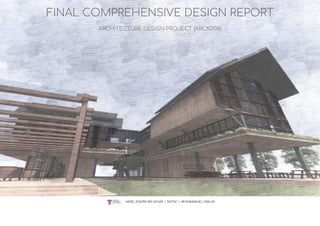
FINAL COMPREHENSIVE DESIGN REPORT
ARCHITECTURE DESIGN PROJECT (ARC60108)
CONTENTS
1.0 PROJECT BACKGROUND 1
- 1.1 Introduction
- 1.2 Project Aims
2.0 SITE INTRODUCTION & CONTEXTUAL STUDIES 2
- 2.1 Site Introduction
- 2.2 Historical Background
- 2.3 Macro Site Analysis
3.0 DESIGN INTENTIONS & STRATEGIES 12
- 3.1 Micro Site Analysis
- 3.2 Design Intentions
- 3.3 Proposed Programmes
- 3.4 Design Strategy
- 3.5 Site Response
- 3.6 Spatial Programming
- 3.7 Form Development
4.0 ENVIRONMENTAL & TECHNOLOGICAL STUDIES 24
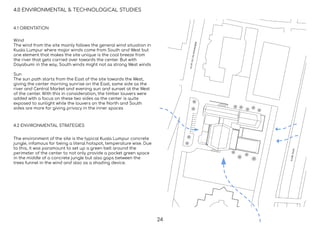
- 4.1 Orientation
- 4.2 Environmental Strategies
- 4.3 Sustainability Concepts
- 4.4 Structural Concepts
5.0 COMPILATION OF PRESENTATION BOARDS 27
6.0 REFLECTIVE JOURNAL 28
7.0 REFERENCES 29
1
1.0 PROJECT BACKGROUND
1.1 INTRODUCTION
The project brief calls for the proposal of a Cultural Centre at the heart of Malaysia, Kuala Lumpur, more specifically, along Jalan Sultan
Hishamuddin. The Cultural Centre would become a landmark which caters to the public and local community in addition to being a space
centered towards the cultural aspects of Kuala Lumpur. Around the site are scattered several historical landmarks and even modern
landmarks, from the big, bold and touristy to the humble, local hubs which presents one of the main features of the site, a duality of local
and tourist, historical and modern.
1.2 PROJECT AIMS
1. Establish a central cultural hub in Kuala Lumpur for locals and foreigners alike.
2. Create a green space to provide a haven in amongst the concrete jungle.
3. To establish a space for public use which can be utilised throughout the day.
4. To create a space to reconnect locals and tourists to the historical landmarks on site.
1
2.0 SITE INTRODUCTION & CONTEXTUAL STUDIES
2.1 SITE INTRODUCTION
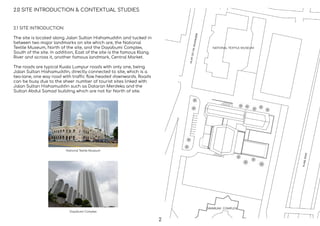
The site is located along Jalan Sultan Hishamuddin and tucked in
between two major landmarks on site which are, the National
Textile Museum, North of the site, and the Dayabumi Complex,
South of the site. In addition, East of the site is the famous Klang
River and across it, another famous landmark, Central Market.
The roads are typical Kuala Lumpur roads with only one, being
Jalan Sultan Hishamuddin, directly connected to site, which is a
two-lane, one way road with traffic flow headed downwards. Roads
can be busy due to the sheer number of tourist sites linked with
Jalan Sultan Hishamuddin such as Dataran Merdeka and the
Sultan Abdul Samad building which are not far North of site.
National Textile Museum
Dayabumi Complex
NATIONAL TEXTILE MUSEUM
DAYABUMI COMPLEX
2
2.2 HISTORICAL BACKGROUND
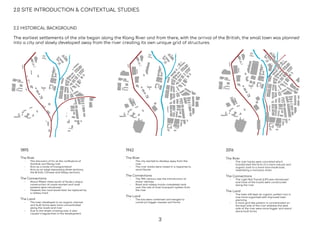
The earliest settlements of the site began along the Klang River and from there, with the arrival of the British, the small town was planned
into a city and slowly developed away from the river creating its own unique grid of structures.
1895
The River
- The discovery of tin at the confluence of
Gombak and Klang river
- Acts as a mode of transportation
- Acts as an edge separating three sections,
the British, Chinese and Malay sections.
The Connections
- About fifteen miles south of Kuala Lumpur
construction of roads started and road
systems were introduced
- However, the road would later be replaced by
a railway track
The Land
- The town developed in an organic manner
and built forms were more concentrated
along the roads and river
- Due to the street crossing over, it also
caused irregularities in the development.
1962
The River
- The city started to develop away from the
river
- The river banks were raised in a response to
avoid floods
The Connections
- The 19th century saw the introduction of
motor vehicles
- Road and railway tracks completely took
over the role of main transport system from
the river
The Land
- The lots were combined and merged to
construct bigger masses and forms
2016
The River
- The river banks were concreted which
transformed the form of a more natural and
organic look to a more man-made look,
resembling a monsoon drain
The Connections
- The Light Rail Transit (LRT) was introduced
and most of the tracks were constructed
along the river
The Land
- The town still kept an organic pattern but is
now more organised with improved town
planning
- A more grid like pattern is concentrated on
the east side of the river whereas the west
side of the river were more bigger and stand
alone built forms
2.0 SITE INTRODUCTION & CONTEXTUAL STUDIES
3
2.3 MACRO SITE ANALYSIS - Land Use
2.0 SITE INTRODUCTION & CONTEXTUAL STUDIES
SITE
KLANG RIVER
COMMERCIAL
TRANSPORTATION
INSTITUTIONAL
RECREATIONAL
LEGEND
SITE
KLANG RIVER
COURSE GRAIN
FINE GRAIN
LEGEND
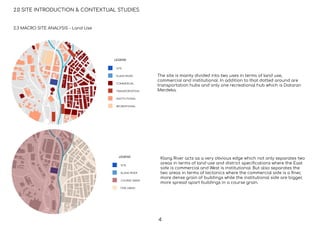
The site is mainly divided into two uses in terms of land use,
commercial and institutional. In addition to that dotted around are
transportation hubs and only one recreational hub which is Dataran
Merdeka.
Klang River acts as a very obvious edge which not only separates two
areas in terms of land use and district specifications where the East
side is commercial and West is institutional. But also separates the
two areas in terms of tectonics where the commercial side is a finer,
more dense grain of buildings while the institutional side are bigger,
more spread apart buildings in a course grain.
4
2.0 SITE INTRODUCTION & CONTEXTUAL STUDIES
Medan Pasar Clock Tower
400m
Petaling Street
550m
Central Market
250m
Dataran Merdeka
400m
Dayabumi Complex
100m
Masjid Negara
850m
2.3 MACRO SITE ANALYSIS - Landmarks to Site
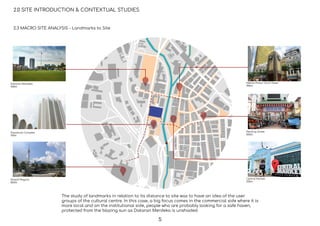
The study of landmarks in relation to its distance to site was to have an idea of the user
groups of the cultural centre. In this case, a big focus comes in the commercial side where it is
more local and on the institutional side, people who are probably looking for a safe haven,
protected from the blazing sun as Dataran Merdeka is unshaded.
5
2.0 SITE INTRODUCTION & CONTEXTUAL STUDIES
SITE
KLANG RIVER
MAIN ROADS
PUBLIC TRANSPORTATION
SECONDARY ROADS
CAR PARKING
LEGEND
PEDESTRIAN WALKWAY
2.3 MACRO SITE ANALYSIS - Paths
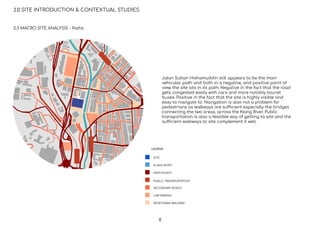
Jalan Sultan Hishamuddin still appears to be the main
vehicular path and both in a negative, and positive point of
view, the site sits in its path. Negative in the fact that the road
gets congested easily with cars and more notably tourist
buses. Positive in the fact that the site is highly visible and
easy to navigate to. Navigation is also not a problem for
pedestrians as walkways are sufficient especially the bridges
connecting the two areas, across the Klang River. Public
transportation is also a feasible way of getting to site and the
sufficient walkways to site complement it well.
6
9am - 12pm
12pm - 3pm
3pm - 6pm
6pm - 9pm
2.0 SITE INTRODUCTION & CONTEXTUAL STUDIES
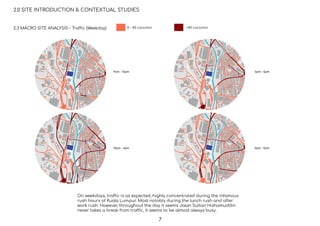
2.3 MACRO SITE ANALYSIS - Traffic (Weekday)
On weekdays, traffic is as expected, highly concentrated during the infamous
rush hours of Kuala Lumpur. Most notably during the lunch rush and after
work rush. However, throughout the day it seems Jalan Sultan Hishamuddin
never takes a break from traffic, it seems to be almost always busy.
0 - 40 cars/min >40 cars/min
7
9am - 12pm
12pm - 3pm
3pm - 6pm
6pm - 9pm
2.0 SITE INTRODUCTION & CONTEXTUAL STUDIES
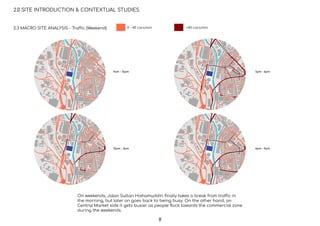
2.3 MACRO SITE ANALYSIS - Traffic (Weekend) 0 - 40 cars/min >40 cars/min
On weekends, Jalan Sultan Hishamuddin finally takes a break from traffic in
the morning, but later on goes back to being busy. On the other hand, on
Central Market side it gets busier as people flock towards the commercial zone
during the weekends.
8
Sultan Abdul Samad Building
Dataran Merdeka
Kuala Lumpur City Gallery
Masjid Jamek
Textile Museum
Central Market
Sri Mahamariamman Temple
2.0 SITE INTRODUCTION & CONTEXTUAL STUDIES
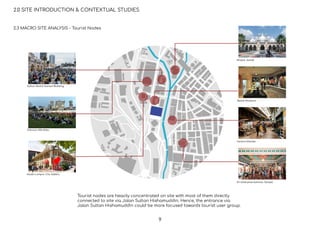
2.3 MACRO SITE ANALYSIS - Tourist Nodes
Tourist nodes are heavily concentrated on site with most of them directly
connected to site via Jalan Sultan Hishamuddin. Hence, the entrance via
Jalan Sultan Hishamuddin could be more focused towards tourist user group.
9
Dataran Merdeka
Kuala Lumpur Library
Medan Pasar
Pos Laju Kuala Lumpur
2.0 SITE INTRODUCTION & CONTEXTUAL STUDIES
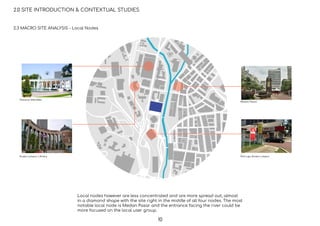
2.3 MACRO SITE ANALYSIS - Local Nodes
Local nodes however are less concentrated and are more spread out, almost
in a diamond shape with the site right in the middle of all four nodes. The most
notable local node is Medan Pasar and the entrance facing the river could be
more focused on the local user group.
10
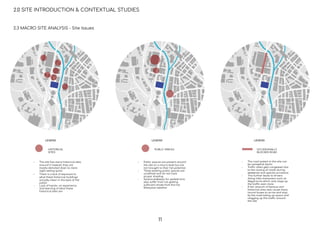
HISTORICAL
SITES
LEGEND
PUBLIC SPACES
LEGEND
OCCASIONALLY
BLOCKED ROAD
LEGEND
2.0 SITE INTRODUCTION & CONTEXTUAL STUDIES
2.3 MACRO SITE ANALYSIS - Site Issues
- The site has many historical sites
around it however, they are
mostly demoted down to mere
sight-seeing spots
- There is a lack of exposure to
what these historical buildings
actually mean in the eyes of the
public
- Lack of hands- on experience
and learning of what these
historical sites are
- Public spaces are present around
the site on a macro level but are
not brought to their full potential
- These existing public spaces are
unrefined and do not have
proper shading
- Several walkways for pedestrians
also suffer from not getting
sufficient shade from the hot
Malaysian weather
- The road system in the site can
be somewhat hectic
- Traffic often gets congested due
to the closing of roads during
weekends and special occasions
- This further leads to drivers
doing risky maneuvers such as
illegal turns which only clogs up
the traffic even more
- A fair amount of famous and
historical sites also cause many
tourist buses to arrive and stop
by the road taking up space and
clogging up the traffic around
the site
11
3.0 DESIGN INTENTION & STRATEGIES
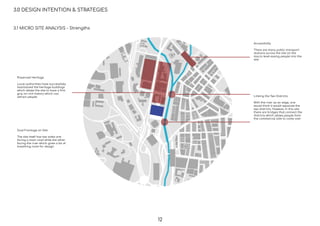
Preserved Heritage
Local authorities have successfully
maintained the heritage buildings
which allows the site to have a firm
grip on rich history which can
attract people Linking the Two Districts
With the river as an edge, one
would think it would separate the
two districts. However, in this site
there are bridges that connect the
districts which allows people from
the commercial side to come over
Accessibility
There are many public transport
stations across the site on the
macro level easing people into the
site
Dual Frontage on Site
The site itself has two sides one
facing a main road while the other
facing the river which gives a lot of
breathing room for design
3.1 MICRO SITE ANALYSIS - Strengths
12
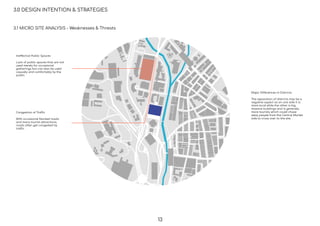
Ineffective Public Spaces
Lack of public spaces that are not
used merely for occasional
gatherings but can also be used
casually and comfortably by the
public
Congestion of Traffic
With occasional blocked roads
and many tourist attractions,
roads often get congested by
traffic
Major Differences in Districts
The separation of districts may be a
negative aspect as on one side it is
more local while the other is big
massive buildings and is generally
more touristy which could chase
away people from the Central Market
side to cross over to the site
3.0 DESIGN INTENTION & STRATEGIES
3.1 MICRO SITE ANALYSIS - Weaknesses & Threats
13
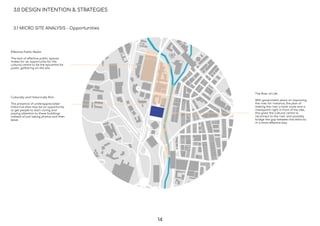
Culturally and Historically Rich
The presence of underappreciated
historical sites may be an opportunity
to get people to start caring and
paying attention to these buildings
instead of just taking photos and then
leave.
The River of Life
With government plans on improving
the river, for instance, the plan of
making the river a boat route and a
checkpoint right in front of the site,
this gives the cultural centre to
reconnect to the river and possibly
bridge the gap between the districts
in a more effective way.
Effective Public Realm
The lack of effective public spaces
makes for an opportunity for the
cultural centre to be the epicentre for
public gathering on the site
3.0 DESIGN INTENTION & STRATEGIES
3.1 MICRO SITE ANALYSIS - Opportunities
14
3.0 DESIGN INTENTION & STRATEGIES
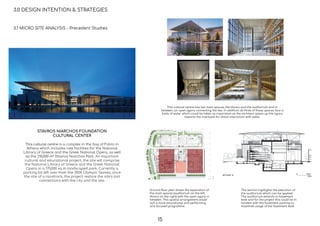
This cultural centre has two main spaces, the library and the auditorium and in
between, an open agora connecting the two. In addition all three of these spaces face a
body of water which could be taken as inspiration as the architect opens up the agora
towards the riverbank for direct interaction with water.
Ground floor plan shows the separation of
the main spaces (auditorium on the left,
library on the right) with the open agora in
between. This spatial arrangement would
suit a more educational and performing
arts focused programme.
The section highlights the execution of
the auditorium which can be applied.
The auditorium extends to basement
level and for the project this could be in
tandem with the basement parking to
maximise usage of the basement level.
3.1 MICRO SITE ANALYSIS - Precedent Studies
STAVROS NIARCHOS FOUNDATION
CULTURAL CENTER
This cultural centre is a complex in the bay of Faliro in
Athens which includes new facilities for the National
Library of Greece and the Greek National Opera, as well
as the 210,000 m² Stavros Niarchos Park. An important
cultural and educational project, the site will comprise
the National Library of Greece and the Greek National
Opera in a 170,000 sq m landscaped park. Currently a
parking lot left over from the 2004 Olympic Games, once
the site of a racetrack, the project restore the site’s lost
connections with the city and the sea.
15
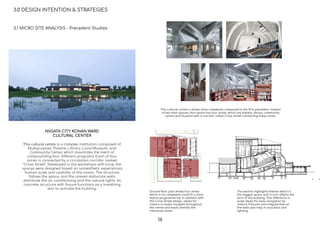
This cultural centre is shows more complexity compared to the first precedent. Instead
of two main spaces, this centre has four zones, which are theatre, library, community
centre and museum with a corridor called Cross Street connecting these zones.
Ground floor plan shows four zones
which in its complexity could fit a more
hybrid programme list. In addition with
the Cross Street design, allows for
visitors to easily navigate throughout
the centre and easily identify the
individual zones.
The section highlights theatre which is
the biggest space and in turn affects the
form of the building. This difference in
scale allows for easy navigation by
visitors. Fissures and irregularities on
the walls also help in acoustics and
lighting.
3.0 DESIGN INTENTION & STRATEGIES
3.1 MICRO SITE ANALYSIS - Precedent Studies
NIIGATA CITY KONAN WARD
CULTURAL CENTER
This cultural centre is a complex institution composed of
Multipurpose Theatre, Library, Local Museum, and
Community Center, which maximizes the merit of
compounding four different programs. Each of four
zones is connected by a circulation corridor named
"Cross Street". Developed in the workshops with local, the
spaces were designed based on somesthetic experiences,
human scale and usability of the rooms. The structure
follows the space, and the uneven elaborate walls
distribute the air conditioning and the natural lights. Its
concrete structure with fissure functions as a breathing
skin to activate the building.
16
3.0 DESIGN INTENTION & STRATEGIES
3.2 DESIGN INTENTION
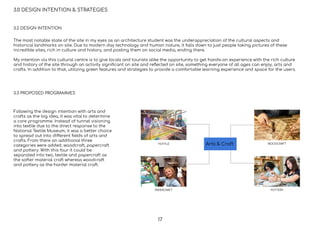
3.3 PROPOSED PROGRAMMES
Arts & CraftTEXTILE
PAPERCRAFT
WOODCRAFT
POTTERY
The most notable state of the site in my eyes as an architecture student was the underappreciation of the cultural aspects and
historical landmarks on site. Due to modern day technology and human nature, it falls down to just people taking pictures of these
incredible sites, rich in culture and history, and posting them on social media, ending there.
My intention via this cultural centre is to give locals and tourists alike the opportunity to get hands-on experience with the rich culture
and history of the site through an activity significant on site and reflected on site, something everyone of all ages can enjoy, arts and
crafts. In addition to that, utilizing green features and strategies to provide a comfortable learning experience and space for the users.
Following the design intention with arts and
crafts as the big idea, it was vital to determine
a core programme. Instead of tunnel visioning
into textile due to the direct response to the
National Textile Museum, it was a better choice
to spread out into different fields of arts and
crafts. From there an additional three
categories were added, woodcraft, papercraft
and pottery. With this four it could be
separated into two, textile and papercraft as
the softer material craft whereas woodcraft
and pottery as the harder material craft.
17
3.0 DESIGN INTENTION & STRATEGIES
3.4 DESIGN STRATEGY
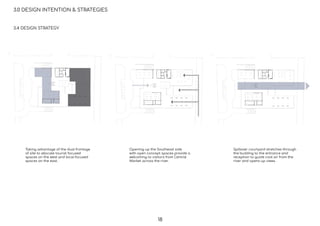
Taking advantage of the dual frontage
of site to allocate tourist focused
spaces on the west and local focused
spaces on the east.
Opening up the Southeast side
with open concept spaces provide a
welcoming to visitors from Central
Market across the river.
Spillover courtyard stretches through
the building to the entrance and
reception to guide cool air from the
river and opens up views.
18
3.0 DESIGN INTENTION & STRATEGIES
3.4 SITE RESPONSE
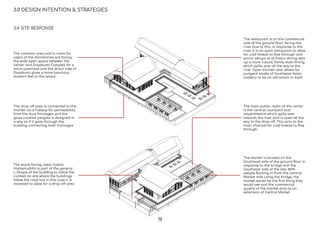
The drop off area is connected to the
market via a hallway for permeability
from the dual frontages and the
glass covered pergola is designed in
a way as if it goes through the
building connecting both frontages
The plane facing Jalan Sultan
Hishamuddin is part of the general
L-Shape of the building to follow the
context on site where the buildings
follow the road but in this case it is
recessed to allow for a drop off area
The common area and tv room for
users of the dormitories are facing
the wide open space between the
center and Dayabumi Complex for a
more openness and the direct view of
Dayabumi gives a more luxurious,
modern feel to the space.
The restaurant is on the commercial
side of the ground floor, facing the
river. Due to this, in response to the
river, it is an open restaurant to allow
for cold breeze to flow through and
picnic setups at al fresco dining sets
up a more casual, family style dining
which spills over all the way to the
river. Open kitchen also allows for
pungent smells of Southeast Asian
cookery to be an attraction in itself
The main public realm of the center
is the central courtyard and
amphitheatre which spills over
towards the river and is open all the
way to the drop off. This acts as the
main channel for cold breeze to flow
through.
The market is located on the
Southeast side of the ground floor in
response to the bridge and the
Southeast side of the site. With
people flocking in from the Central
Market side using the bridge, the
market would be the first thing they
would see and the commercial
quality of the market acts as an
extension of Central Market
19
3.0 DESIGN INTENTION & STRATEGIES
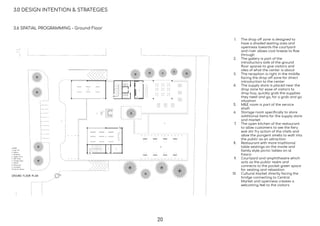
3.6 SPATIAL PROGRAMMING - Ground Floor
1. The drop off zone is designed to
have a shaded waiting area and
openness towards the courtyard
and river allows cool breeze to flow
through
2. The gallery is part of the
introductory side of the ground
floor spaces to give visitors and
idea of what the center is about
3. The reception is right in the middle
facing the drop off zone for direct
introduction to the center
4. The supply store is placed near the
drop zone for ease of visitors to
drop buy, quickly grab the supplies
they need and go, for a grab and go
situation
5. M&E room is part of the service
shaft
6. Storage room specifically to store
additional items for the supply store
and market
7. The open kitchen of the restaurant
to allow customers to see the fiery
wok stir fry action of the chefs and
allow the pungent smells to waft into
the public as an attraction
8. Restaurant with more traditional
table seatings on the inside and
family style picnic tables on al
fresco
9. Courtyard and amphitheatre which
acts as the public realm and
connects to the pocket green space
for seating and relaxation
10. Cultural market directly facing the
bridge connecting to Central
Market and openness creates a
welcoming feel to the visitors
20
3.0 DESIGN INTENTION & STRATEGIES
3.6 SPATIAL PROGRAMMING - First Floor
1. The library located in between the
two wings of workshops to act as
the common space and
information/knowledge hub for the
workshop students
2. Textile workshop, part of the soft
material wing of workshops with
batik weaving machines and sewing
equipment
3. Papercraft workshop, part of the
soft material wing of workshops with
standard working tables and
equipment for more simpler crafts
such as sketches and papier mache
4. Pottery workshop, part of the hard
material wing of workshops with
standard work tables in addition to
pottery turntables
5. Woodcraft workshop, part of the
hard material wing of workshops
with standard work tables but with
attached table clamps and wood
cutting equipment
6. Drying area and balcony for
workshop students to dry their
works and drying crafts themselves
act as an attraction
7. M&E is room part of the service
shaft
8. General storage room for all
workshops to keep extra equipment
and material
21
3.0 DESIGN INTENTION & STRATEGIES
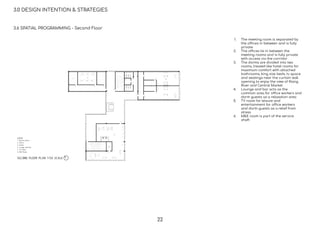
3.6 SPATIAL PROGRAMMING - Second Floor
1. The meeting room is separated by
the offices in between and is fully
private
2. The offices lie in between the
meeting rooms and is fully private
with access via the corridor
3. The dorms are divided into two
rooms, treated like hotel rooms for
maximum comfort with attached
bathrooms, king size beds, tv space
and seatings near the curtain wall
opening to enjoy the view of Klang
River and Central Market
4. Lounge and bar acts as the
common area for office workers and
dorm guests as a relaxation area
5. TV room for leisure and
entertainment for office workers
and dorm guests as a relief from
stress
6. M&E room is part of the service
shaft
22
3.0 DESIGN INTENTION & STRATEGIES
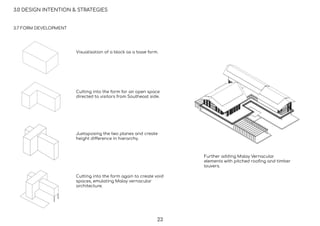
3.7 FORM DEVELOPMENT
Visualisation of a block as a base form.
Cutting into the form for an open space
directed to visitors from Southeast side.
Juxtaposing the two planes and create
height difference in hierarchy.
Cutting into the form again to create void
spaces, emulating Malay vernacular
architecture.
Further adding Malay Vernacular
elements with pitched roofing and timber
louvers.
23
4.0 ENVIRONMENTAL & TECHNOLOGICAL STUDIES
4.1 ORIENTATION
4.2 ENVIRONMENTAL STRATEGIES
Wind
The wind from the site mainly follows the general wind situation in
Kuala Lumpur where major winds come from South and West but
one element that makes the site unique is the cool breeze from
the river that gets carried over towards the center. But with
Dayabumi in the way, South winds might not as strong West winds
Sun
The sun path starts from the East of the site towards the West,
giving the center morning sunrise on the East, same side as the
river and Central Market and evening sun and sunset at the West
of the center. With this in consideration, the timber louvers were
added with a focus on these two sides as the center is quite
exposed to sunlight while the louvers on the North and South
sides are more for giving privacy in the inner spaces
The environment of the site is the typical Kuala Lumpur concrete
jungle, infamous for being a literal hotspot, temperature wise. Due
to this, it was paramount to set up a green belt around the
perimeter of the center to not only provide a pocket green space
in the middle of a concrete jungle but also gaps between the
trees funnel in the wind and also as a shading device.
24
4.0 ENVIRONMENTAL & TECHNOLOGICAL STUDIES
4.3 SUSTAINABILITY CONCEPTS
Wind
One of the concepts in the center is leaving the middle axis of the
center open, most notably on the Ground Floor where the
courtyard opens up all the way to the drop off zone. This creates
a channel for wind to flow through. Openness of the market also
allows wind from the South to flow into that channel. Trees further
enhances this effect, channeling wind between their gaps.
Sun
The sun is mostly utilised as a natural lighting mechanism. With
floor to ceiling curtain walls, it allows for sufficient lighting in the
inner spaces. However, sunlight can be harsh and heat coming off
of the glass of the curtain walls can heat up inner spaces. Hence,
timber louvers are added to control the amount of sunlight that
enters the spaces and mullions help as well. In addition, timber
louvers add to the overall Malay Vernacular architecture elements
the center possesses.
Greenery
The primary concept for greenery is the utilisation of a green belt
surrounding the center. However due to the road and design of
the center, a complete green belt of trees could not be feasible.
Due to that, to continue the green belt even on the roads, the
roads have green elements in which grass are planted in between
the stone to continue the green belt.
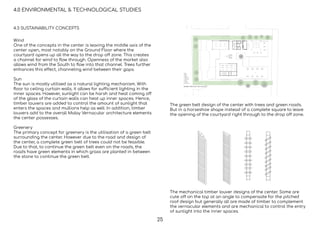
The green belt design of the center with trees and green roads.
But in a horseshoe shape instead of a complete square to leave
the opening of the courtyard right through to the drop off zone.
The mechanical timber louver designs of the center. Some are
cute off on the top at an angle to compensate for the pitched
roof design but generally all are made of timber to complement
the vernacular elements and are mechanical to control the entry
of sunlight into the inner spaces.
25
4.0 ENVIRONMENTAL & TECHNOLOGICAL STUDIES
4.4 STRUCTURAL CONCEPTS
The main structure or skeleton of the center is made or
reinforced concrete, so columns and beams and
foundations are concrete based. The walls however are
of masonry and are cladded with recycled timber to
give a more crafty feel to the arts and crafts cultural
center but also repurposing timber in a step to reduce
usage of timber in response to deforestation.
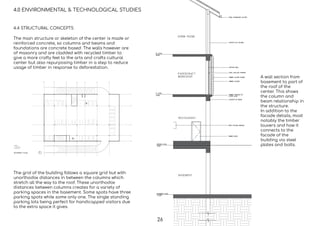
A wall section from
basement to part of
the roof of the
center. This shows
the column and
beam relationship in
the structure.
In addition to the
facade details, most
notably the timber
louvers and how it
connects to the
facade of the
building via steel
plates and bolts.
The grid of the building follows a square grid but with
unorthodox distances in between the columns which
stretch all the way to the roof. These unorthodox
distances between columns creates for a variety of
parking spaces in the basement. Some spots have three
parking spots while some only one. The single standing
parking lots being perfect for handicapped visitors due
to the extra space it gives.
26
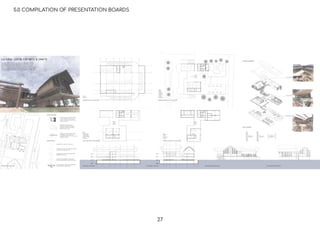
5.0 COMPILATION OF PRESENTATION BOARDS
27
6.0 REFLECTIVE JOURNAL
WEEK 1
Week 1 was the start of a new and different semester with the
initiation of the MCO due to the Covid-19 pandemic. Online
briefings, lectures and tutorials were something to get used to.
WEEK 2
Week 2 was when the work for project 1a site analysis really
started to kick off and I realised an architect really needs to go
out and actually stand on the site itself instead of relying on
online information to get more of a feel of the site itself instead
of just raw data.
WEEK 3
This week was submission week for project 1a and the biggest
thing I learned was to never underestimate diagrams, especially
site related diagrams with many details as they take up alot of
time.
WEEK 4
The start of project 1b was more of an exploratory phase and
eventhough I had a general idea of what I wanted to do, it was
vital to still really study precedents to help me along the way.
WEEK 5
This week was an extension of the exploratory phase and
instead of going too far ahead, i learned to go back a few steps
and look back at the site and determine the core programme
from there, and ask myself, what do the people need.
WEEK 6 & WEEK 7
These two weeks were basically one single long stretch of
figuring out bubble diagrams and line diagrams after
determining the core programme. The big thing I learned here
was from what AR Manny told me which was if you have
something in mind, put it on paper and dont let it fade away in
your mind.
WEEK 8
Week 8 was the submission week and learned alot from Mr. Liu’s
feedback and helped me show more expression in the massing
and form as my form at that stage was “nice, but predictable
and looks too commercial”.
WEEK 9 & WEEK 10
These two weeks were still a personal struggle to massage the
spaces from my floor plans and trying to figure out the final
form of the center. It was filled with struggles and stress from
shuffling spaces and rearranging spaces which eventually
birthed into somewhat satisfactory floor plans at that time.
WEEK 11
This was the week where I started to think about the structure
and technology of the building which I unfortunately realised a
bit too late as it was pivotal in the final design
WEEK 12
Interim week gave me further insight from AR Edward which
improved my floor plans even more, giving me a point of view
different from AR Manny’s. It was also the week of the workshop
which made me consider and learn the importance of
environmental sustainability in design and AR Axxu making me
realise things i have not even considered before in my design.
WEEK 13 & WEEK 14
The final two weeks before the final presentation was mostly
working on the 3D model which again like many other things I
have underestimated as adding details to the model which
definitely takes it to another level can take up alot of time,
WEEK 15 & WEEK 16
The final two weeks of this semester was relaxing for once as I
did not have to think about the stresses of printing. But the
biggest takeaways was definitely from the panelists of the
presentation, AR Vanessa and AR Rebecca really taught me to
go all out with my design and put as many renderings as I can
when the opportunity arises and just SHOW OFF YOUR DESIGN!
28
7.0 REFERENCES
29
Green belt. (n.d.). Retrieved from
https://www.designingbuildings.co.uk/wiki/Green_belt
Building a Clerestory Roof (n.d.). Retrieved from
https://www.homedesignersoftware.com/support/article/KB-00492/building-a-c
lerestory-skillion-roof.html
Ng, P. H. (2017, March 27). Vernacular Architecture – Relating Environmental
Issues to Cultural Conventions. Retrieved from
https://localcode.org/2017/03/vernacular-architecture-relating-environmental-i
ssues-to-cultural-conventions/
Kuala Lumpur, Kuala Lumpur, Malaysia Three Day Weather Forecast. (n.d.).
Retrieved from
https://www.accuweather.com/en/my/kuala-lumpur/233776/weather-forecast/2
33776
Concrete Frame Construction: Concrete Frame Structures. (n.d.). Retrieved from
http://www.understandconstruction.com/concrete-frame-structures.html
Lopez-Besora, J., Coch, H., & Pardal, C. (1970, January 01). Contemporary Roof
Design Concepts: Learning from Vernacular Architecture. Retrieved from
https://link.springer.com/chapter/10.1007/978-3-030-06185-2_16

Adp report Aidiel Azhar

  • 1.
    AIDIEL SYAZRIE BINAZHAR | 0327161 | AR EMMANUEL CANLAS FINAL COMPREHENSIVE DESIGN REPORT ARCHITECTURE DESIGN PROJECT (ARC60108)
  • 2.
    CONTENTS 1.0 PROJECT BACKGROUND1 - 1.1 Introduction - 1.2 Project Aims 2.0 SITE INTRODUCTION & CONTEXTUAL STUDIES 2 - 2.1 Site Introduction - 2.2 Historical Background - 2.3 Macro Site Analysis 3.0 DESIGN INTENTIONS & STRATEGIES 12 - 3.1 Micro Site Analysis - 3.2 Design Intentions - 3.3 Proposed Programmes - 3.4 Design Strategy - 3.5 Site Response - 3.6 Spatial Programming - 3.7 Form Development 4.0 ENVIRONMENTAL & TECHNOLOGICAL STUDIES 24 - 4.1 Orientation - 4.2 Environmental Strategies - 4.3 Sustainability Concepts - 4.4 Structural Concepts 5.0 COMPILATION OF PRESENTATION BOARDS 27 6.0 REFLECTIVE JOURNAL 28 7.0 REFERENCES 29 1
  • 3.
    1.0 PROJECT BACKGROUND 1.1INTRODUCTION The project brief calls for the proposal of a Cultural Centre at the heart of Malaysia, Kuala Lumpur, more specifically, along Jalan Sultan Hishamuddin. The Cultural Centre would become a landmark which caters to the public and local community in addition to being a space centered towards the cultural aspects of Kuala Lumpur. Around the site are scattered several historical landmarks and even modern landmarks, from the big, bold and touristy to the humble, local hubs which presents one of the main features of the site, a duality of local and tourist, historical and modern. 1.2 PROJECT AIMS 1. Establish a central cultural hub in Kuala Lumpur for locals and foreigners alike. 2. Create a green space to provide a haven in amongst the concrete jungle. 3. To establish a space for public use which can be utilised throughout the day. 4. To create a space to reconnect locals and tourists to the historical landmarks on site. 1
  • 4.
    2.0 SITE INTRODUCTION& CONTEXTUAL STUDIES 2.1 SITE INTRODUCTION The site is located along Jalan Sultan Hishamuddin and tucked in between two major landmarks on site which are, the National Textile Museum, North of the site, and the Dayabumi Complex, South of the site. In addition, East of the site is the famous Klang River and across it, another famous landmark, Central Market. The roads are typical Kuala Lumpur roads with only one, being Jalan Sultan Hishamuddin, directly connected to site, which is a two-lane, one way road with traffic flow headed downwards. Roads can be busy due to the sheer number of tourist sites linked with Jalan Sultan Hishamuddin such as Dataran Merdeka and the Sultan Abdul Samad building which are not far North of site. National Textile Museum Dayabumi Complex NATIONAL TEXTILE MUSEUM DAYABUMI COMPLEX 2
  • 5.
    2.2 HISTORICAL BACKGROUND Theearliest settlements of the site began along the Klang River and from there, with the arrival of the British, the small town was planned into a city and slowly developed away from the river creating its own unique grid of structures. 1895 The River - The discovery of tin at the confluence of Gombak and Klang river - Acts as a mode of transportation - Acts as an edge separating three sections, the British, Chinese and Malay sections. The Connections - About fifteen miles south of Kuala Lumpur construction of roads started and road systems were introduced - However, the road would later be replaced by a railway track The Land - The town developed in an organic manner and built forms were more concentrated along the roads and river - Due to the street crossing over, it also caused irregularities in the development. 1962 The River - The city started to develop away from the river - The river banks were raised in a response to avoid floods The Connections - The 19th century saw the introduction of motor vehicles - Road and railway tracks completely took over the role of main transport system from the river The Land - The lots were combined and merged to construct bigger masses and forms 2016 The River - The river banks were concreted which transformed the form of a more natural and organic look to a more man-made look, resembling a monsoon drain The Connections - The Light Rail Transit (LRT) was introduced and most of the tracks were constructed along the river The Land - The town still kept an organic pattern but is now more organised with improved town planning - A more grid like pattern is concentrated on the east side of the river whereas the west side of the river were more bigger and stand alone built forms 2.0 SITE INTRODUCTION & CONTEXTUAL STUDIES 3
  • 6.
    2.3 MACRO SITEANALYSIS - Land Use 2.0 SITE INTRODUCTION & CONTEXTUAL STUDIES SITE KLANG RIVER COMMERCIAL TRANSPORTATION INSTITUTIONAL RECREATIONAL LEGEND SITE KLANG RIVER COURSE GRAIN FINE GRAIN LEGEND The site is mainly divided into two uses in terms of land use, commercial and institutional. In addition to that dotted around are transportation hubs and only one recreational hub which is Dataran Merdeka. Klang River acts as a very obvious edge which not only separates two areas in terms of land use and district specifications where the East side is commercial and West is institutional. But also separates the two areas in terms of tectonics where the commercial side is a finer, more dense grain of buildings while the institutional side are bigger, more spread apart buildings in a course grain. 4
  • 7.
    2.0 SITE INTRODUCTION& CONTEXTUAL STUDIES Medan Pasar Clock Tower 400m Petaling Street 550m Central Market 250m Dataran Merdeka 400m Dayabumi Complex 100m Masjid Negara 850m 2.3 MACRO SITE ANALYSIS - Landmarks to Site The study of landmarks in relation to its distance to site was to have an idea of the user groups of the cultural centre. In this case, a big focus comes in the commercial side where it is more local and on the institutional side, people who are probably looking for a safe haven, protected from the blazing sun as Dataran Merdeka is unshaded. 5
  • 8.
    2.0 SITE INTRODUCTION& CONTEXTUAL STUDIES SITE KLANG RIVER MAIN ROADS PUBLIC TRANSPORTATION SECONDARY ROADS CAR PARKING LEGEND PEDESTRIAN WALKWAY 2.3 MACRO SITE ANALYSIS - Paths Jalan Sultan Hishamuddin still appears to be the main vehicular path and both in a negative, and positive point of view, the site sits in its path. Negative in the fact that the road gets congested easily with cars and more notably tourist buses. Positive in the fact that the site is highly visible and easy to navigate to. Navigation is also not a problem for pedestrians as walkways are sufficient especially the bridges connecting the two areas, across the Klang River. Public transportation is also a feasible way of getting to site and the sufficient walkways to site complement it well. 6
  • 9.
    9am - 12pm 12pm- 3pm 3pm - 6pm 6pm - 9pm 2.0 SITE INTRODUCTION & CONTEXTUAL STUDIES 2.3 MACRO SITE ANALYSIS - Traffic (Weekday) On weekdays, traffic is as expected, highly concentrated during the infamous rush hours of Kuala Lumpur. Most notably during the lunch rush and after work rush. However, throughout the day it seems Jalan Sultan Hishamuddin never takes a break from traffic, it seems to be almost always busy. 0 - 40 cars/min >40 cars/min 7
  • 10.
    9am - 12pm 12pm- 3pm 3pm - 6pm 6pm - 9pm 2.0 SITE INTRODUCTION & CONTEXTUAL STUDIES 2.3 MACRO SITE ANALYSIS - Traffic (Weekend) 0 - 40 cars/min >40 cars/min On weekends, Jalan Sultan Hishamuddin finally takes a break from traffic in the morning, but later on goes back to being busy. On the other hand, on Central Market side it gets busier as people flock towards the commercial zone during the weekends. 8
  • 11.
    Sultan Abdul SamadBuilding Dataran Merdeka Kuala Lumpur City Gallery Masjid Jamek Textile Museum Central Market Sri Mahamariamman Temple 2.0 SITE INTRODUCTION & CONTEXTUAL STUDIES 2.3 MACRO SITE ANALYSIS - Tourist Nodes Tourist nodes are heavily concentrated on site with most of them directly connected to site via Jalan Sultan Hishamuddin. Hence, the entrance via Jalan Sultan Hishamuddin could be more focused towards tourist user group. 9
  • 12.
    Dataran Merdeka Kuala LumpurLibrary Medan Pasar Pos Laju Kuala Lumpur 2.0 SITE INTRODUCTION & CONTEXTUAL STUDIES 2.3 MACRO SITE ANALYSIS - Local Nodes Local nodes however are less concentrated and are more spread out, almost in a diamond shape with the site right in the middle of all four nodes. The most notable local node is Medan Pasar and the entrance facing the river could be more focused on the local user group. 10
  • 13.
    HISTORICAL SITES LEGEND PUBLIC SPACES LEGEND OCCASIONALLY BLOCKED ROAD LEGEND 2.0SITE INTRODUCTION & CONTEXTUAL STUDIES 2.3 MACRO SITE ANALYSIS - Site Issues - The site has many historical sites around it however, they are mostly demoted down to mere sight-seeing spots - There is a lack of exposure to what these historical buildings actually mean in the eyes of the public - Lack of hands- on experience and learning of what these historical sites are - Public spaces are present around the site on a macro level but are not brought to their full potential - These existing public spaces are unrefined and do not have proper shading - Several walkways for pedestrians also suffer from not getting sufficient shade from the hot Malaysian weather - The road system in the site can be somewhat hectic - Traffic often gets congested due to the closing of roads during weekends and special occasions - This further leads to drivers doing risky maneuvers such as illegal turns which only clogs up the traffic even more - A fair amount of famous and historical sites also cause many tourist buses to arrive and stop by the road taking up space and clogging up the traffic around the site 11
  • 14.
    3.0 DESIGN INTENTION& STRATEGIES Preserved Heritage Local authorities have successfully maintained the heritage buildings which allows the site to have a firm grip on rich history which can attract people Linking the Two Districts With the river as an edge, one would think it would separate the two districts. However, in this site there are bridges that connect the districts which allows people from the commercial side to come over Accessibility There are many public transport stations across the site on the macro level easing people into the site Dual Frontage on Site The site itself has two sides one facing a main road while the other facing the river which gives a lot of breathing room for design 3.1 MICRO SITE ANALYSIS - Strengths 12
  • 15.
    Ineffective Public Spaces Lackof public spaces that are not used merely for occasional gatherings but can also be used casually and comfortably by the public Congestion of Traffic With occasional blocked roads and many tourist attractions, roads often get congested by traffic Major Differences in Districts The separation of districts may be a negative aspect as on one side it is more local while the other is big massive buildings and is generally more touristy which could chase away people from the Central Market side to cross over to the site 3.0 DESIGN INTENTION & STRATEGIES 3.1 MICRO SITE ANALYSIS - Weaknesses & Threats 13
  • 16.
    Culturally and HistoricallyRich The presence of underappreciated historical sites may be an opportunity to get people to start caring and paying attention to these buildings instead of just taking photos and then leave. The River of Life With government plans on improving the river, for instance, the plan of making the river a boat route and a checkpoint right in front of the site, this gives the cultural centre to reconnect to the river and possibly bridge the gap between the districts in a more effective way. Effective Public Realm The lack of effective public spaces makes for an opportunity for the cultural centre to be the epicentre for public gathering on the site 3.0 DESIGN INTENTION & STRATEGIES 3.1 MICRO SITE ANALYSIS - Opportunities 14
  • 17.
    3.0 DESIGN INTENTION& STRATEGIES This cultural centre has two main spaces, the library and the auditorium and in between, an open agora connecting the two. In addition all three of these spaces face a body of water which could be taken as inspiration as the architect opens up the agora towards the riverbank for direct interaction with water. Ground floor plan shows the separation of the main spaces (auditorium on the left, library on the right) with the open agora in between. This spatial arrangement would suit a more educational and performing arts focused programme. The section highlights the execution of the auditorium which can be applied. The auditorium extends to basement level and for the project this could be in tandem with the basement parking to maximise usage of the basement level. 3.1 MICRO SITE ANALYSIS - Precedent Studies STAVROS NIARCHOS FOUNDATION CULTURAL CENTER This cultural centre is a complex in the bay of Faliro in Athens which includes new facilities for the National Library of Greece and the Greek National Opera, as well as the 210,000 m² Stavros Niarchos Park. An important cultural and educational project, the site will comprise the National Library of Greece and the Greek National Opera in a 170,000 sq m landscaped park. Currently a parking lot left over from the 2004 Olympic Games, once the site of a racetrack, the project restore the site’s lost connections with the city and the sea. 15
  • 18.
    This cultural centreis shows more complexity compared to the first precedent. Instead of two main spaces, this centre has four zones, which are theatre, library, community centre and museum with a corridor called Cross Street connecting these zones. Ground floor plan shows four zones which in its complexity could fit a more hybrid programme list. In addition with the Cross Street design, allows for visitors to easily navigate throughout the centre and easily identify the individual zones. The section highlights theatre which is the biggest space and in turn affects the form of the building. This difference in scale allows for easy navigation by visitors. Fissures and irregularities on the walls also help in acoustics and lighting. 3.0 DESIGN INTENTION & STRATEGIES 3.1 MICRO SITE ANALYSIS - Precedent Studies NIIGATA CITY KONAN WARD CULTURAL CENTER This cultural centre is a complex institution composed of Multipurpose Theatre, Library, Local Museum, and Community Center, which maximizes the merit of compounding four different programs. Each of four zones is connected by a circulation corridor named "Cross Street". Developed in the workshops with local, the spaces were designed based on somesthetic experiences, human scale and usability of the rooms. The structure follows the space, and the uneven elaborate walls distribute the air conditioning and the natural lights. Its concrete structure with fissure functions as a breathing skin to activate the building. 16
  • 19.
    3.0 DESIGN INTENTION& STRATEGIES 3.2 DESIGN INTENTION 3.3 PROPOSED PROGRAMMES Arts & CraftTEXTILE PAPERCRAFT WOODCRAFT POTTERY The most notable state of the site in my eyes as an architecture student was the underappreciation of the cultural aspects and historical landmarks on site. Due to modern day technology and human nature, it falls down to just people taking pictures of these incredible sites, rich in culture and history, and posting them on social media, ending there. My intention via this cultural centre is to give locals and tourists alike the opportunity to get hands-on experience with the rich culture and history of the site through an activity significant on site and reflected on site, something everyone of all ages can enjoy, arts and crafts. In addition to that, utilizing green features and strategies to provide a comfortable learning experience and space for the users. Following the design intention with arts and crafts as the big idea, it was vital to determine a core programme. Instead of tunnel visioning into textile due to the direct response to the National Textile Museum, it was a better choice to spread out into different fields of arts and crafts. From there an additional three categories were added, woodcraft, papercraft and pottery. With this four it could be separated into two, textile and papercraft as the softer material craft whereas woodcraft and pottery as the harder material craft. 17
  • 20.
    3.0 DESIGN INTENTION& STRATEGIES 3.4 DESIGN STRATEGY Taking advantage of the dual frontage of site to allocate tourist focused spaces on the west and local focused spaces on the east. Opening up the Southeast side with open concept spaces provide a welcoming to visitors from Central Market across the river. Spillover courtyard stretches through the building to the entrance and reception to guide cool air from the river and opens up views. 18
  • 21.
    3.0 DESIGN INTENTION& STRATEGIES 3.4 SITE RESPONSE The drop off area is connected to the market via a hallway for permeability from the dual frontages and the glass covered pergola is designed in a way as if it goes through the building connecting both frontages The plane facing Jalan Sultan Hishamuddin is part of the general L-Shape of the building to follow the context on site where the buildings follow the road but in this case it is recessed to allow for a drop off area The common area and tv room for users of the dormitories are facing the wide open space between the center and Dayabumi Complex for a more openness and the direct view of Dayabumi gives a more luxurious, modern feel to the space. The restaurant is on the commercial side of the ground floor, facing the river. Due to this, in response to the river, it is an open restaurant to allow for cold breeze to flow through and picnic setups at al fresco dining sets up a more casual, family style dining which spills over all the way to the river. Open kitchen also allows for pungent smells of Southeast Asian cookery to be an attraction in itself The main public realm of the center is the central courtyard and amphitheatre which spills over towards the river and is open all the way to the drop off. This acts as the main channel for cold breeze to flow through. The market is located on the Southeast side of the ground floor in response to the bridge and the Southeast side of the site. With people flocking in from the Central Market side using the bridge, the market would be the first thing they would see and the commercial quality of the market acts as an extension of Central Market 19
  • 22.
    3.0 DESIGN INTENTION& STRATEGIES 3.6 SPATIAL PROGRAMMING - Ground Floor 1. The drop off zone is designed to have a shaded waiting area and openness towards the courtyard and river allows cool breeze to flow through 2. The gallery is part of the introductory side of the ground floor spaces to give visitors and idea of what the center is about 3. The reception is right in the middle facing the drop off zone for direct introduction to the center 4. The supply store is placed near the drop zone for ease of visitors to drop buy, quickly grab the supplies they need and go, for a grab and go situation 5. M&E room is part of the service shaft 6. Storage room specifically to store additional items for the supply store and market 7. The open kitchen of the restaurant to allow customers to see the fiery wok stir fry action of the chefs and allow the pungent smells to waft into the public as an attraction 8. Restaurant with more traditional table seatings on the inside and family style picnic tables on al fresco 9. Courtyard and amphitheatre which acts as the public realm and connects to the pocket green space for seating and relaxation 10. Cultural market directly facing the bridge connecting to Central Market and openness creates a welcoming feel to the visitors 20
  • 23.
    3.0 DESIGN INTENTION& STRATEGIES 3.6 SPATIAL PROGRAMMING - First Floor 1. The library located in between the two wings of workshops to act as the common space and information/knowledge hub for the workshop students 2. Textile workshop, part of the soft material wing of workshops with batik weaving machines and sewing equipment 3. Papercraft workshop, part of the soft material wing of workshops with standard working tables and equipment for more simpler crafts such as sketches and papier mache 4. Pottery workshop, part of the hard material wing of workshops with standard work tables in addition to pottery turntables 5. Woodcraft workshop, part of the hard material wing of workshops with standard work tables but with attached table clamps and wood cutting equipment 6. Drying area and balcony for workshop students to dry their works and drying crafts themselves act as an attraction 7. M&E is room part of the service shaft 8. General storage room for all workshops to keep extra equipment and material 21
  • 24.
    3.0 DESIGN INTENTION& STRATEGIES 3.6 SPATIAL PROGRAMMING - Second Floor 1. The meeting room is separated by the offices in between and is fully private 2. The offices lie in between the meeting rooms and is fully private with access via the corridor 3. The dorms are divided into two rooms, treated like hotel rooms for maximum comfort with attached bathrooms, king size beds, tv space and seatings near the curtain wall opening to enjoy the view of Klang River and Central Market 4. Lounge and bar acts as the common area for office workers and dorm guests as a relaxation area 5. TV room for leisure and entertainment for office workers and dorm guests as a relief from stress 6. M&E room is part of the service shaft 22
  • 25.
    3.0 DESIGN INTENTION& STRATEGIES 3.7 FORM DEVELOPMENT Visualisation of a block as a base form. Cutting into the form for an open space directed to visitors from Southeast side. Juxtaposing the two planes and create height difference in hierarchy. Cutting into the form again to create void spaces, emulating Malay vernacular architecture. Further adding Malay Vernacular elements with pitched roofing and timber louvers. 23
  • 26.
    4.0 ENVIRONMENTAL &TECHNOLOGICAL STUDIES 4.1 ORIENTATION 4.2 ENVIRONMENTAL STRATEGIES Wind The wind from the site mainly follows the general wind situation in Kuala Lumpur where major winds come from South and West but one element that makes the site unique is the cool breeze from the river that gets carried over towards the center. But with Dayabumi in the way, South winds might not as strong West winds Sun The sun path starts from the East of the site towards the West, giving the center morning sunrise on the East, same side as the river and Central Market and evening sun and sunset at the West of the center. With this in consideration, the timber louvers were added with a focus on these two sides as the center is quite exposed to sunlight while the louvers on the North and South sides are more for giving privacy in the inner spaces The environment of the site is the typical Kuala Lumpur concrete jungle, infamous for being a literal hotspot, temperature wise. Due to this, it was paramount to set up a green belt around the perimeter of the center to not only provide a pocket green space in the middle of a concrete jungle but also gaps between the trees funnel in the wind and also as a shading device. 24
  • 27.
    4.0 ENVIRONMENTAL &TECHNOLOGICAL STUDIES 4.3 SUSTAINABILITY CONCEPTS Wind One of the concepts in the center is leaving the middle axis of the center open, most notably on the Ground Floor where the courtyard opens up all the way to the drop off zone. This creates a channel for wind to flow through. Openness of the market also allows wind from the South to flow into that channel. Trees further enhances this effect, channeling wind between their gaps. Sun The sun is mostly utilised as a natural lighting mechanism. With floor to ceiling curtain walls, it allows for sufficient lighting in the inner spaces. However, sunlight can be harsh and heat coming off of the glass of the curtain walls can heat up inner spaces. Hence, timber louvers are added to control the amount of sunlight that enters the spaces and mullions help as well. In addition, timber louvers add to the overall Malay Vernacular architecture elements the center possesses. Greenery The primary concept for greenery is the utilisation of a green belt surrounding the center. However due to the road and design of the center, a complete green belt of trees could not be feasible. Due to that, to continue the green belt even on the roads, the roads have green elements in which grass are planted in between the stone to continue the green belt. The green belt design of the center with trees and green roads. But in a horseshoe shape instead of a complete square to leave the opening of the courtyard right through to the drop off zone. The mechanical timber louver designs of the center. Some are cute off on the top at an angle to compensate for the pitched roof design but generally all are made of timber to complement the vernacular elements and are mechanical to control the entry of sunlight into the inner spaces. 25
  • 28.
    4.0 ENVIRONMENTAL &TECHNOLOGICAL STUDIES 4.4 STRUCTURAL CONCEPTS The main structure or skeleton of the center is made or reinforced concrete, so columns and beams and foundations are concrete based. The walls however are of masonry and are cladded with recycled timber to give a more crafty feel to the arts and crafts cultural center but also repurposing timber in a step to reduce usage of timber in response to deforestation. A wall section from basement to part of the roof of the center. This shows the column and beam relationship in the structure. In addition to the facade details, most notably the timber louvers and how it connects to the facade of the building via steel plates and bolts. The grid of the building follows a square grid but with unorthodox distances in between the columns which stretch all the way to the roof. These unorthodox distances between columns creates for a variety of parking spaces in the basement. Some spots have three parking spots while some only one. The single standing parking lots being perfect for handicapped visitors due to the extra space it gives. 26
  • 29.
    5.0 COMPILATION OFPRESENTATION BOARDS 27
  • 30.
    6.0 REFLECTIVE JOURNAL WEEK1 Week 1 was the start of a new and different semester with the initiation of the MCO due to the Covid-19 pandemic. Online briefings, lectures and tutorials were something to get used to. WEEK 2 Week 2 was when the work for project 1a site analysis really started to kick off and I realised an architect really needs to go out and actually stand on the site itself instead of relying on online information to get more of a feel of the site itself instead of just raw data. WEEK 3 This week was submission week for project 1a and the biggest thing I learned was to never underestimate diagrams, especially site related diagrams with many details as they take up alot of time. WEEK 4 The start of project 1b was more of an exploratory phase and eventhough I had a general idea of what I wanted to do, it was vital to still really study precedents to help me along the way. WEEK 5 This week was an extension of the exploratory phase and instead of going too far ahead, i learned to go back a few steps and look back at the site and determine the core programme from there, and ask myself, what do the people need. WEEK 6 & WEEK 7 These two weeks were basically one single long stretch of figuring out bubble diagrams and line diagrams after determining the core programme. The big thing I learned here was from what AR Manny told me which was if you have something in mind, put it on paper and dont let it fade away in your mind. WEEK 8 Week 8 was the submission week and learned alot from Mr. Liu’s feedback and helped me show more expression in the massing and form as my form at that stage was “nice, but predictable and looks too commercial”. WEEK 9 & WEEK 10 These two weeks were still a personal struggle to massage the spaces from my floor plans and trying to figure out the final form of the center. It was filled with struggles and stress from shuffling spaces and rearranging spaces which eventually birthed into somewhat satisfactory floor plans at that time. WEEK 11 This was the week where I started to think about the structure and technology of the building which I unfortunately realised a bit too late as it was pivotal in the final design WEEK 12 Interim week gave me further insight from AR Edward which improved my floor plans even more, giving me a point of view different from AR Manny’s. It was also the week of the workshop which made me consider and learn the importance of environmental sustainability in design and AR Axxu making me realise things i have not even considered before in my design. WEEK 13 & WEEK 14 The final two weeks before the final presentation was mostly working on the 3D model which again like many other things I have underestimated as adding details to the model which definitely takes it to another level can take up alot of time, WEEK 15 & WEEK 16 The final two weeks of this semester was relaxing for once as I did not have to think about the stresses of printing. But the biggest takeaways was definitely from the panelists of the presentation, AR Vanessa and AR Rebecca really taught me to go all out with my design and put as many renderings as I can when the opportunity arises and just SHOW OFF YOUR DESIGN! 28
  • 31.
    7.0 REFERENCES 29 Green belt.(n.d.). Retrieved from https://www.designingbuildings.co.uk/wiki/Green_belt Building a Clerestory Roof (n.d.). Retrieved from https://www.homedesignersoftware.com/support/article/KB-00492/building-a-c lerestory-skillion-roof.html Ng, P. H. (2017, March 27). Vernacular Architecture – Relating Environmental Issues to Cultural Conventions. Retrieved from https://localcode.org/2017/03/vernacular-architecture-relating-environmental-i ssues-to-cultural-conventions/ Kuala Lumpur, Kuala Lumpur, Malaysia Three Day Weather Forecast. (n.d.). Retrieved from https://www.accuweather.com/en/my/kuala-lumpur/233776/weather-forecast/2 33776 Concrete Frame Construction: Concrete Frame Structures. (n.d.). Retrieved from http://www.understandconstruction.com/concrete-frame-structures.html Lopez-Besora, J., Coch, H., & Pardal, C. (1970, January 01). Contemporary Roof Design Concepts: Learning from Vernacular Architecture. Retrieved from https://link.springer.com/chapter/10.1007/978-3-030-06185-2_16