LAKbAy KaAGaPay:
PROJECT ICARETree cum Project
Proposal, Partnership
Implementation and ICT Integration
ERICK P. CAÑAVERAL
Project Development Officer I - Youth Formation Coordinator
Division YES-O Coordinator
a.Intensify advocacy that will help in shaping the young
generation through the core value - Makakalikasan;
b.Provide simplified Project, Programs, and Activities
(PPA’s);
c.Impart technical knowledge on Project Proposal,
Partnership Implementation, and ICT Integration to
District and Municipal YES-O Coordinators;
d.Craft School Calendar of Proposed Activities and Project
Proposals reflecting Partner Stakeholders, and
Integration of ICT Tools
Objectives:
Launching of
LAKbAy KaAGaPay
LAKbAy – refers to the “Journey” of the organization
in strengthening the advocacies through the
implementation of programs, projects, and activities
KaAGaPay – from the root word “agapay” which
refers to the person who assist us or our partner in
doing things and making our advocacies into reality..
Why LAKbAy KaAGaPay?
LAKbAy KaAGaPay is an acronym for “Leading Actions
for Kabataang Albayano, Kabataang Albayano na may
Gawaing Tagumpay” and a flagship program initiated to
promote SDO Albay’s Youth Formation Programs,
Projects, and Activities (PPA’s) particularly on Youth for
Environment in Schools Organization (YES-O) and
Barkada Kontra Droga (BKD).
What is LAKbAy KaAGaPay?
• Project ICARETree – Simplified and contextualized PPA’s
anchored DepEd Order No. 93, s. 2011
PPA’s under LAKbAy KaAGaPay
• Project GreenThumb – creation of
advocacy materials during election
period
• YES-Online Talakayan! – online
sessions discussing environmental
topics / sharing of best practices about
PPA implementation
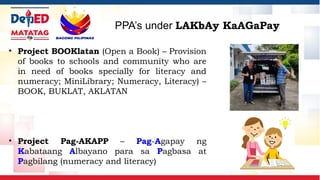
• Project BOOKlatan (Open a Book) – Provision
of books to schools and community who are
in need of books specially for literacy and
numeracy; MiniLibrary; Numeracy, Literacy) –
BOOK, BUKLAT, AKLATAN
• Project Pag-AKAPP – Pag-Agapay ng
Kabataang Albayano para sa Pagbasa at
Pagbilang (numeracy and literacy)
PPA’s under LAKbAy KaAGaPay
• Project CoMBAT – Capacity Building on
Managing Personal and Health Issues
and Battling Addiction and Life
Transformation
• Project HOPE – Humanitarian Act and
Opportunities for PFA Provision and
Training for Education
PPA’s under LAKbAy KaAGaPay
• Project MYFaIth – Ministry of Youth
for Fellowship and Interfaith
Activities towards Trust and Healing
(for consultation)
PPA’s under LAKbAy KaAGaPay
Overview of
Project ICARETree
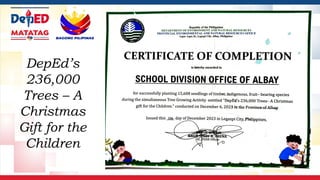
DepEd’s
236,000
Trees – A
Christmas
Gift for the
Children
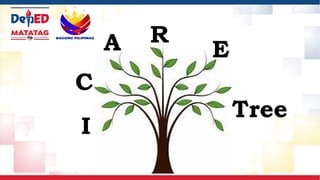
I
C
A R
E
Tree
Project ICARETree is an acronym for the Inventory of
Malunggay and other Trees in School, Clean-up Activity,
Advocacy Campaign, 3R’s (Reduce, Reuse, Recycle /
Establishment of School MRF), Environmental Awareness,
Tree planting, growing, and caring (including establishment
of school nursery).
What is Project ICARETree?
Incorporating these initiatives in a school setting can offer numerous
benefits:
1. Feeding support: Planting and inventory of malunggay can help
ensure a sustainable supply of nutritious food for school feeding
programs. Malunggay is rich in vitamins and minerals and can
contribute to improved nutrition for learners (DepEd Order No. 234, s.
2008).
2. Environmental education: Maintaining an inventory of various trees
on the school grounds provides an opportunity for learners to become
familiar with different tree species and learn about their ecological
significance.
3. Clean-up activities: Involving students in clean-up
activities not only enhances the aesthetics of the school
and local community but also promotes environmental
stewardship and a sense of community responsibility.
4. Waste management: Establishing a material recovery
facility in the school can promote the principles of reduce,
reuse, and recycle. This initiative can help minimize waste
and encourage sustainable practices within the school
community.
5. Environmental awareness training and Advocacy
Campaign: Providing training on environmental awareness
can educate students about the importance of
conservation, waste reduction, and sustainable living
practices.
6. Tree planting and care: Engaging students in tree
planting and caring for existing trees can instill a sense of
environmental responsibility and foster a connection to
nature.
With the adoption of Project ICARETree cum Project
Proposal, Partnership Implementation and ICT Integration,
the schools will be able to come up and implement with no
to minimal cost of projects, programs, and activities and can
contribute to a more environmentally conscious and
engaged student body, as well as promoting sustainable
practices within the school and wider community.
Project Proposal
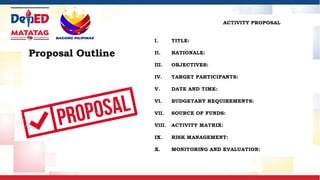
Proposal Outline
1. Rationale: This explains the reason for undertaking the project and
provides a background for the proposed work. It helps to establish the
need for the project and why it is important.
2. Objectives: These are the specific, measurable outcomes that the
project aims to achieve. They provide a clear focus and direction for the
project's activities.
3. Target Participants: Identifying the specific individuals or groups
that the project intends to benefit or serve is crucial for ensuring that
the project design is tailored to the needs of the intended beneficiaries.
In project proposal making, each of these
components serves an important purpose:
4. Budgetary Requirements: This outlines the estimated costs associated
with implementing the project. It helps to ensure that the project is
financially feasible and allows for effective resource allocation.
5. Source of Funds: Understanding where the funding for the project will
come from is essential for ensuring financial sustainability and
determining any potential constraints or requirements associated with the
funding source.
6. Activity Matrix: This lays out the specific tasks and activities that will
be carried out as part of the project. It helps to ensure that all necessary
activities are planned for and carried out in a logical sequence.
In project proposal making, each of these
components serves an important purpose:
7. Risk Management: Identifying and addressing potential risks that
could affect the successful implementation of the project is crucial for
effectively mitigating these risks and ensuring project success.
8. Monitoring and Evaluation: Establishing a plan for monitoring and
evaluating the project's progress allows for ongoing assessment of the
project's effectiveness and the achievement of its objectives.
Each of these components contributes to the overall clarity, feasibility,
and effectiveness of the project proposal.
In project proposal making, each of these
components serves an important purpose:
Signatories
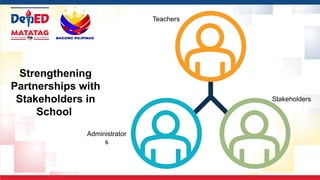
Strengthening
Partnerships with
Stakeholders in School
Strengthening
Partnerships with
Stakeholders in
School
Teachers
Administrator
s
Stakeholders
Stakeholders are the support system to the goals of the Department
of Education in providing quality, equitable, culture-based, and
complete basic education and at the same time inculcating in them
the love of the country. These include families, school administrators,
and communities that bring about the seeds of morality, cultural
values, social responsibilities, human affections, resources, and
opportunities, for our learners. They are the springboards of expertise
in skills and professions, and hobbies, among others. They are the
sources of encouragement, optimism, and resilience.
Strengthening Partnerships with
Stakeholders in School
Consequently, strengthening the bond between the school community
and the stakeholders could create confident and competent learners
in fulfilling their dreams. Several studies revealed that schools that
developed a strong bond with stakeholders have the following:
1. higher number of performing learners on grade level,
2. higher rate of parents’ involvement,
3. better support school reforms,
4. improved student assessment results,
5. higher rate of learners' attendance,
6. more learning opportunities outside of school.
Strengthening Partnerships with
Stakeholders in School
With this, a recent study has found factors that promote strong
partnerships with stakeholders. First, strong school leadership is required
in a school head, for this plays a pivotal role in the formation of
partnerships with the stakeholders. One must be a visionary with respect to
the school and the role of the stakeholders in supporting such partnerships.
Furthermore, the school head must also have the capacity to motivate his or
her subordinates and be one with the stakeholders, having that talent for
nurturing relationships with parents, teachers, government officials,
religious organizations, and the community. Second, a welcoming school
environment is advantageous to strengthening stakeholder partnerships.
This means that stakeholders have always a choice to help the school in any
way they want for the betterment of the learners and the school as a whole.
Strengthening Partnerships with
Stakeholders in School
(By: Lea Viteño Gayawet)
Third, the dedication of teachers to the success of the learners.
Stakeholders become more involved and more willing to supply the needs of
the school and the learners when they see the commitment of teachers to
going the extra mile. Finally, interaction and teamwork. These two are found
to also foster a strong partnership with stakeholders. Activities of the school
that are communicated well are valued by stakeholders and the community
and thus, working together, as a team, could easier way of doing those
activities, projects, or programs of the school.
Having presented all these, for a school to strengthen its partnership with
stakeholders, it must have those qualities and factors mentioned above.
When these are met, then learners can have a better quality of life and
become essential contributors to the economic progress and stability of the
country.
Strengthening Partnerships with
Stakeholders in School
(By: Lea Viteño Gayawet)
Building partnerships and linkages in the implementation of project
programs and activities in a school requires a strategic approach. Here are
some steps that can help in this process:
1. Identify Potential Partners: Begin by identifying potential partners such
as local businesses, community organizations, educational institutions, and
government agencies that align with the goals of the project program and
activities.
2. Establish Clear Goals and Objectives: Clearly define the goals and
objectives of the project program and activities to potential partners. This
will help them understand the purpose and what they can contribute.
Approach in Building Partnerships and
Linkages
3. Communication and Relationship Building: Establish effective
communication channels to engage potential partners and build
relationships. Regular communication and transparency are key in
maintaining strong partnerships.
4. Collaboration and Contribution: Encourage collaboration and input
from partners in the planning and implementation of the project program
and activities. Each partner can bring unique resources, expertise, and
support to the table.
5. Memorandums of Understanding (MOUs) or Agreements: Consider
formalizing partnerships through MOUs or agreements that outline the
roles, responsibilities, and expectations of each partner.
Approach in Building Partnerships and
Linkages
6. Recognition and Appreciation: Recognize and appreciate the
contributions of partners. This can be done through public
acknowledgment, joint events, or other forms of recognition.
7. Continuous Evaluation and Improvement: Regularly evaluate the
effectiveness of partnerships and make adjustments as necessary.
Continuous improvement is essential in maintaining successful
partnerships.
By following these steps, schools can effectively build partnerships and
linkages to support the implementation of project programs and activities.
Approach in Building Partnerships and
Linkages
The Basics of Mail Merge and
Pivot Table: A Productivity
Tool for Data Gathering and
Document Preparation
Mail Merge is a powerful tool for writing and sending a personalized letter or email to
many different people at the same time.
You can also use it to create envelopes or labels with each recipient information.
Mail Merge allow to create new list or imports data from another source as Excel.
You can use it to quickly create personalized messages for hundreds of people at once.
What is Mail Merge?
Source of Data – MS Excel
Output – MS Word (Certificate)
2. Go to mailing Tab and Click on start mail merge &
click on step-by-step mail wizard
3. Selecting recipients for mail merge –
Letters / Envelope / Email Messages /
Labels, etc. and click on next: starting
documents
1. Open a blank word / new /
existing document
4. Select
existing/current
document & click
on next: Select
Recipients
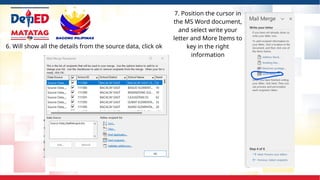
4. Browse the data source and click
4. Browse
the data
source and
click
5. Select specific
worksheet
6. Will show all the details from the source data, click ok
7. Position the cursor in
the MS Word document,
and select write your
letter and More Items to
key in the right
information
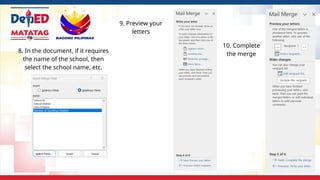
8. In the document, if it requires
the name of the school, then
select the school name, etc.
9. Preview your
letters
10. Complete
the merge
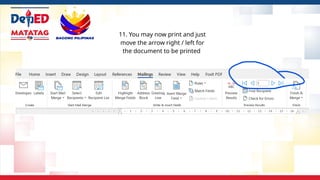
11. You may now print and just
move the arrow right / left for
the document to be printed
An interactive worksheet table
- Provides a powerful tool for summarizing large amounts of tabular data
Similar to a cross-tabulation table
- A pivot table classifies numeric data in a list based on other fields in
the list
General Purpose:
- Quickly summarize data from a worksheet or from an external source
- Calculate totals, average, counts, etc. based on any numeric fields in
your table
- Generate charts from your pivot tables
What is Pivot Table?
Interactive: easily rearrange them by moving, adding or
deleting fields
Dynamic: results are automatically recalculated
whenever fields are added or dropped, or whenever
categories are hidden or displayed
Easy to updated: "refreshable" if the original worksheet
data changes
Pivot Table Advantages?
Data arranged in the list:
- Columns represent fields
- Rows represent a record of related data
First row = column label
Columns contaon one sort of data
- for example, text in one column and numeric values in a
separate column
Remove subtotals
- You can work with subtotals, but use caution
De-normalized database extracts are great for pivoting
Appropriate Data
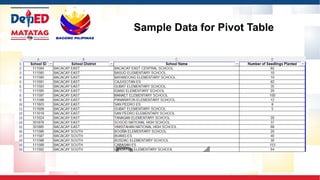
Sample Data for Pivot Table
What to Submit?
Calendar of Annual Proposed Activity
- SY 2023-2024
- Incorporating Project ICARETree
- Approved by School Head
Project Proposals
- Following the template
- Integrate partnerships in your proposals
Cascade the learnings to School YES-O Teacher-Advisers
*Due February 1, 2024
Thank You!

Project-ICARETree-Coordinators-Guide.pptx

  • 1.
    LAKbAy KaAGaPay: PROJECT ICARETreecum Project Proposal, Partnership Implementation and ICT Integration ERICK P. CAÑAVERAL Project Development Officer I - Youth Formation Coordinator Division YES-O Coordinator
  • 2.
    a.Intensify advocacy thatwill help in shaping the young generation through the core value - Makakalikasan; b.Provide simplified Project, Programs, and Activities (PPA’s); c.Impart technical knowledge on Project Proposal, Partnership Implementation, and ICT Integration to District and Municipal YES-O Coordinators; d.Craft School Calendar of Proposed Activities and Project Proposals reflecting Partner Stakeholders, and Integration of ICT Tools Objectives:
  • 3.
  • 4.
    LAKbAy – refersto the “Journey” of the organization in strengthening the advocacies through the implementation of programs, projects, and activities KaAGaPay – from the root word “agapay” which refers to the person who assist us or our partner in doing things and making our advocacies into reality.. Why LAKbAy KaAGaPay?
  • 5.
    LAKbAy KaAGaPay isan acronym for “Leading Actions for Kabataang Albayano, Kabataang Albayano na may Gawaing Tagumpay” and a flagship program initiated to promote SDO Albay’s Youth Formation Programs, Projects, and Activities (PPA’s) particularly on Youth for Environment in Schools Organization (YES-O) and Barkada Kontra Droga (BKD). What is LAKbAy KaAGaPay?
  • 6.
    • Project ICARETree– Simplified and contextualized PPA’s anchored DepEd Order No. 93, s. 2011 PPA’s under LAKbAy KaAGaPay • Project GreenThumb – creation of advocacy materials during election period • YES-Online Talakayan! – online sessions discussing environmental topics / sharing of best practices about PPA implementation
  • 7.
    • Project BOOKlatan(Open a Book) – Provision of books to schools and community who are in need of books specially for literacy and numeracy; MiniLibrary; Numeracy, Literacy) – BOOK, BUKLAT, AKLATAN • Project Pag-AKAPP – Pag-Agapay ng Kabataang Albayano para sa Pagbasa at Pagbilang (numeracy and literacy) PPA’s under LAKbAy KaAGaPay
  • 8.
    • Project CoMBAT– Capacity Building on Managing Personal and Health Issues and Battling Addiction and Life Transformation • Project HOPE – Humanitarian Act and Opportunities for PFA Provision and Training for Education PPA’s under LAKbAy KaAGaPay
  • 9.
    • Project MYFaIth– Ministry of Youth for Fellowship and Interfaith Activities towards Trust and Healing (for consultation) PPA’s under LAKbAy KaAGaPay
  • 10.
  • 11.
  • 12.
  • 13.
    Project ICARETree isan acronym for the Inventory of Malunggay and other Trees in School, Clean-up Activity, Advocacy Campaign, 3R’s (Reduce, Reuse, Recycle / Establishment of School MRF), Environmental Awareness, Tree planting, growing, and caring (including establishment of school nursery). What is Project ICARETree?
  • 14.
    Incorporating these initiativesin a school setting can offer numerous benefits: 1. Feeding support: Planting and inventory of malunggay can help ensure a sustainable supply of nutritious food for school feeding programs. Malunggay is rich in vitamins and minerals and can contribute to improved nutrition for learners (DepEd Order No. 234, s. 2008). 2. Environmental education: Maintaining an inventory of various trees on the school grounds provides an opportunity for learners to become familiar with different tree species and learn about their ecological significance.
  • 15.
    3. Clean-up activities:Involving students in clean-up activities not only enhances the aesthetics of the school and local community but also promotes environmental stewardship and a sense of community responsibility. 4. Waste management: Establishing a material recovery facility in the school can promote the principles of reduce, reuse, and recycle. This initiative can help minimize waste and encourage sustainable practices within the school community.
  • 16.
    5. Environmental awarenesstraining and Advocacy Campaign: Providing training on environmental awareness can educate students about the importance of conservation, waste reduction, and sustainable living practices. 6. Tree planting and care: Engaging students in tree planting and caring for existing trees can instill a sense of environmental responsibility and foster a connection to nature.
  • 17.
    With the adoptionof Project ICARETree cum Project Proposal, Partnership Implementation and ICT Integration, the schools will be able to come up and implement with no to minimal cost of projects, programs, and activities and can contribute to a more environmentally conscious and engaged student body, as well as promoting sustainable practices within the school and wider community.
  • 19.
  • 20.
  • 21.
    1. Rationale: Thisexplains the reason for undertaking the project and provides a background for the proposed work. It helps to establish the need for the project and why it is important. 2. Objectives: These are the specific, measurable outcomes that the project aims to achieve. They provide a clear focus and direction for the project's activities. 3. Target Participants: Identifying the specific individuals or groups that the project intends to benefit or serve is crucial for ensuring that the project design is tailored to the needs of the intended beneficiaries. In project proposal making, each of these components serves an important purpose:
  • 22.
    4. Budgetary Requirements:This outlines the estimated costs associated with implementing the project. It helps to ensure that the project is financially feasible and allows for effective resource allocation. 5. Source of Funds: Understanding where the funding for the project will come from is essential for ensuring financial sustainability and determining any potential constraints or requirements associated with the funding source. 6. Activity Matrix: This lays out the specific tasks and activities that will be carried out as part of the project. It helps to ensure that all necessary activities are planned for and carried out in a logical sequence. In project proposal making, each of these components serves an important purpose:
  • 23.
    7. Risk Management:Identifying and addressing potential risks that could affect the successful implementation of the project is crucial for effectively mitigating these risks and ensuring project success. 8. Monitoring and Evaluation: Establishing a plan for monitoring and evaluating the project's progress allows for ongoing assessment of the project's effectiveness and the achievement of its objectives. Each of these components contributes to the overall clarity, feasibility, and effectiveness of the project proposal. In project proposal making, each of these components serves an important purpose:
  • 24.
  • 25.
  • 26.
  • 27.
    Stakeholders are thesupport system to the goals of the Department of Education in providing quality, equitable, culture-based, and complete basic education and at the same time inculcating in them the love of the country. These include families, school administrators, and communities that bring about the seeds of morality, cultural values, social responsibilities, human affections, resources, and opportunities, for our learners. They are the springboards of expertise in skills and professions, and hobbies, among others. They are the sources of encouragement, optimism, and resilience. Strengthening Partnerships with Stakeholders in School
  • 28.
    Consequently, strengthening thebond between the school community and the stakeholders could create confident and competent learners in fulfilling their dreams. Several studies revealed that schools that developed a strong bond with stakeholders have the following: 1. higher number of performing learners on grade level, 2. higher rate of parents’ involvement, 3. better support school reforms, 4. improved student assessment results, 5. higher rate of learners' attendance, 6. more learning opportunities outside of school. Strengthening Partnerships with Stakeholders in School
  • 29.
    With this, arecent study has found factors that promote strong partnerships with stakeholders. First, strong school leadership is required in a school head, for this plays a pivotal role in the formation of partnerships with the stakeholders. One must be a visionary with respect to the school and the role of the stakeholders in supporting such partnerships. Furthermore, the school head must also have the capacity to motivate his or her subordinates and be one with the stakeholders, having that talent for nurturing relationships with parents, teachers, government officials, religious organizations, and the community. Second, a welcoming school environment is advantageous to strengthening stakeholder partnerships. This means that stakeholders have always a choice to help the school in any way they want for the betterment of the learners and the school as a whole. Strengthening Partnerships with Stakeholders in School (By: Lea Viteño Gayawet)
  • 30.
    Third, the dedicationof teachers to the success of the learners. Stakeholders become more involved and more willing to supply the needs of the school and the learners when they see the commitment of teachers to going the extra mile. Finally, interaction and teamwork. These two are found to also foster a strong partnership with stakeholders. Activities of the school that are communicated well are valued by stakeholders and the community and thus, working together, as a team, could easier way of doing those activities, projects, or programs of the school. Having presented all these, for a school to strengthen its partnership with stakeholders, it must have those qualities and factors mentioned above. When these are met, then learners can have a better quality of life and become essential contributors to the economic progress and stability of the country. Strengthening Partnerships with Stakeholders in School (By: Lea Viteño Gayawet)
  • 31.
    Building partnerships andlinkages in the implementation of project programs and activities in a school requires a strategic approach. Here are some steps that can help in this process: 1. Identify Potential Partners: Begin by identifying potential partners such as local businesses, community organizations, educational institutions, and government agencies that align with the goals of the project program and activities. 2. Establish Clear Goals and Objectives: Clearly define the goals and objectives of the project program and activities to potential partners. This will help them understand the purpose and what they can contribute. Approach in Building Partnerships and Linkages
  • 32.
    3. Communication andRelationship Building: Establish effective communication channels to engage potential partners and build relationships. Regular communication and transparency are key in maintaining strong partnerships. 4. Collaboration and Contribution: Encourage collaboration and input from partners in the planning and implementation of the project program and activities. Each partner can bring unique resources, expertise, and support to the table. 5. Memorandums of Understanding (MOUs) or Agreements: Consider formalizing partnerships through MOUs or agreements that outline the roles, responsibilities, and expectations of each partner. Approach in Building Partnerships and Linkages
  • 33.
    6. Recognition andAppreciation: Recognize and appreciate the contributions of partners. This can be done through public acknowledgment, joint events, or other forms of recognition. 7. Continuous Evaluation and Improvement: Regularly evaluate the effectiveness of partnerships and make adjustments as necessary. Continuous improvement is essential in maintaining successful partnerships. By following these steps, schools can effectively build partnerships and linkages to support the implementation of project programs and activities. Approach in Building Partnerships and Linkages
  • 34.
    The Basics ofMail Merge and Pivot Table: A Productivity Tool for Data Gathering and Document Preparation
  • 35.
    Mail Merge isa powerful tool for writing and sending a personalized letter or email to many different people at the same time. You can also use it to create envelopes or labels with each recipient information. Mail Merge allow to create new list or imports data from another source as Excel. You can use it to quickly create personalized messages for hundreds of people at once. What is Mail Merge?
  • 36.
    Source of Data– MS Excel Output – MS Word (Certificate)
  • 37.
    2. Go tomailing Tab and Click on start mail merge & click on step-by-step mail wizard 3. Selecting recipients for mail merge – Letters / Envelope / Email Messages / Labels, etc. and click on next: starting documents 1. Open a blank word / new / existing document
  • 38.
    4. Select existing/current document &click on next: Select Recipients 4. Browse the data source and click
  • 39.
    4. Browse the data sourceand click 5. Select specific worksheet
  • 40.
    6. Will showall the details from the source data, click ok 7. Position the cursor in the MS Word document, and select write your letter and More Items to key in the right information
  • 41.
    8. In thedocument, if it requires the name of the school, then select the school name, etc. 9. Preview your letters 10. Complete the merge
  • 42.
    11. You maynow print and just move the arrow right / left for the document to be printed
  • 43.
    An interactive worksheettable - Provides a powerful tool for summarizing large amounts of tabular data Similar to a cross-tabulation table - A pivot table classifies numeric data in a list based on other fields in the list General Purpose: - Quickly summarize data from a worksheet or from an external source - Calculate totals, average, counts, etc. based on any numeric fields in your table - Generate charts from your pivot tables What is Pivot Table?
  • 44.
    Interactive: easily rearrangethem by moving, adding or deleting fields Dynamic: results are automatically recalculated whenever fields are added or dropped, or whenever categories are hidden or displayed Easy to updated: "refreshable" if the original worksheet data changes Pivot Table Advantages?
  • 45.
    Data arranged inthe list: - Columns represent fields - Rows represent a record of related data First row = column label Columns contaon one sort of data - for example, text in one column and numeric values in a separate column Remove subtotals - You can work with subtotals, but use caution De-normalized database extracts are great for pivoting Appropriate Data
  • 46.
    Sample Data forPivot Table
  • 47.
    What to Submit? Calendarof Annual Proposed Activity - SY 2023-2024 - Incorporating Project ICARETree - Approved by School Head Project Proposals - Following the template - Integrate partnerships in your proposals Cascade the learnings to School YES-O Teacher-Advisers *Due February 1, 2024
  • 48.

Editor's Notes

  • #19 A project proposal is essential in the implementation of a project as it serves as a roadmap for the entire process. It outlines the objectives, scope, methodology, and resources required for the successful completion of the project. In a school setting, a well-developed project proposal can help to secure necessary funding, gain support from stakeholders, and ensure that everyone involved is on the same page regarding the goals and strategies for the project. Additionally, it can help to identify potential risks and challenges, and establish a framework for monitoring and evaluating the progress of the project. By providing a detailed plan and rationale for the proposed program and activities, the project proposal can ultimately increase the likelihood of a successful implementation and attainment of desired outcomes.
  • #23 Enjoin to submit Project Proposal for Approval of the SDS To Craft Proposal based on but not limited to the PPA’s of Project ICARETree Risk Management Proposal for IGP…. Same, but need to emphasize on the source of funds, amount… must be through GPTA (in consultation, collection) … emphasize on the project or beneficiaries of the IGP…
  • #26 While the main priority of teachers is to continuously provide basic quality education to prepare our learners to become good citizens and abled contributors to the development of our country, these cannot be completely fulfilled without the assistance of the stakeholders in the schools. As such, equal efforts between the teachers, administrators, and stakeholders are expected since the school alone cannot completely instill the desired learning outcomes and social, moral, and ethical values in the learners without the support of the stakeholders.
  • #27 But what exactly are stakeholders and why the need to strengthen partnerships between them and the school?
  • #29 The second question that comes to mind is how to build a strong partnership between the school and the stakeholders. With this, a recent study has found factors that promote strong partnerships with stakeholders.