CHILDREN’S EDUCATIONAL SOCIETY(REGD.)
THE OXFORD COLLEGE OF PHARMACY
6/9,1ST CROSS, BEGUR ROAD, HONGASANDRA, BANGALORE-560068
TO STUDY THE EFFECT OF REDUCED SODIUM INTAKE ON
HYPERTENSIVE PATIENTS – A COMPARITIVE STUDY
27.2.2024 RGUHS UG SHORT-TERM PROJECT REVIEW PRESENTATION 1
TOSTUDYTHEEFFECTOFREDUCEDSODIUM
INTAKEONHYPERTENSIVEPATIENTS:A
COMPARATIVESTUDY
Prepared By: Weizel Pearl
Guided By : Dr. Bindu B N
Assistant Proffesor
Department of Pharmacology
INTRODUCTION
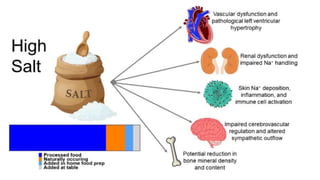
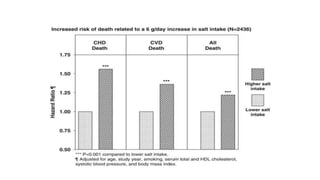
• The close relationship between hypertension and dietary sodium
intake is widely recognized and supported by several studies. [1]
• A reduction in dietary sodium not only decreases the blood
pressure and the incidence of hypertension, but is also associated
with a reduction in morbidity and mortality from cardiovascular
diseases. [1]
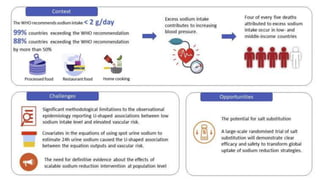
• Excessive sodium consumption (defined by the World Health
Organization as >5 g sodium per day) has been shown to produce
a significant increase in BP and has been linked with onset of
hypertension and its cardiovascular complications. [2]
• Most guidelines suggest a low salt intake, defined as <2-2.3 g
of sodium (equivalent to <5-5.75 g of sodium chloride) per day
to reduce high blood pressure and to improve cardiovascular
outcomes [3,4].
• Globally, the usual sodium intake is between 3.5–5.5 g per day
(equivalent to 9 - 12 g of daily salt). [3]
Current recommendations
• The 2020 International Society of Hypertension Global
Hypertension Practice Guidelines recommend reducing the
quantity of salt added when cooking and at the table, and to
avoid or limit the consumption of high salt containing foods,
such as fast foods, soy sauce and processed food (including
breads and cereals). They also recommend population-based
efforts to reduce salt intake and encourage consumption of
fresh vegetables and fruits [6].
• The 2018 European Society of Cardiology Hypertension
Guidelines [3] and the WHO 2020 statement [4] recommend
that sodium intake should be limited to <2 g per day (equivalent
to <5 g salt per day) in the general population as well as in
NEED FOR THE STUDY
• Hypertension is a major public health problem due to its high
prevalence all around the globe [1–4]. Around 7.5 million deaths
or 12.8% of the total of all annual deaths worldwide occur due to
high blood pressure [5]. It is predicted to be increased to 1.56
billion adults with hypertension in 2025.
• Hypertensive patients are unaware of the Non pharmacological
approaches to manage Hypertension so the study helps in
providing evidence for the reduction in blood pressure by reduced
intake of sodium to <2g/day.
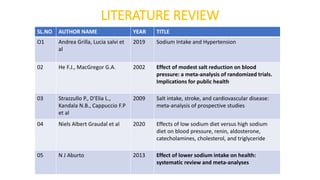
LITERATURE REVIEW
SL.NO AUTHOR NAME YEAR TITLE
O1 Andrea Grilla, Lucia salvi et
al
2019 Sodium Intake and Hypertension
02 He F.J., MacGregor G.A. 2002 Effect of modest salt reduction on blood
pressure: a meta-analysis of randomized trials.
Implications for public health
03 Strazzullo P., D’Elia L.,
Kandala N.B., Cappuccio F.P
et al
2009 Salt intake, stroke, and cardiovascular disease:
meta-analysis of prospective studies
04 Niels Albert Graudal et al 2020 Effects of low sodium diet versus high sodium
diet on blood pressure, renin, aldosterone,
catecholamines, cholesterol, and triglyceride
05 N J Aburto 2013 Effect of lower sodium intake on health:
systematic review and meta-analyses
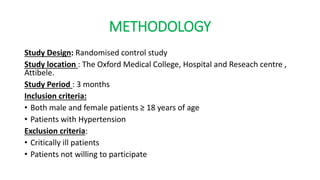
METHODOLOGY
Study Design: Randomised control study
Study location : The Oxford Medical College, Hospital and Reseach centre ,
Attibele.
Study Period : 3 months
Inclusion criteria:
• Both male and female patients ≥ 18 years of age
• Patients with Hypertension
Exclusion criteria:
• Critically ill patients
• Patients not willing to participate
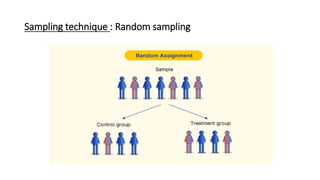
Sampling technique : Random sampling
PLAN OF THE STUDY
• Subjects are randomly allocated into two groups i.e, cases and control.
• Intervention is been assigned to subjects belonging to cases and no
Intervention is been given to control group of subjects.
• Subjects are monitored for their dietary food habits for understanding their
daily sodium intake and Blood pressure levels.
• Intervention of dietary modification counselling on sodium intake is given
to Subjects belonging to cases and Blood pressure levels are monitored.
• After 2 weeks we will compare the Blood pressure readings of Cases and
Control groups
• The effect of Intervention is been assessed using BP readings.
OBJECTIVES
PRIMARY OBJECTIVE
• To study the impact of reduced Na+ intake on Hypertensive patients.
SECONDARY OBJECTIVE
• To help the patient to replace the salt with other substitutes.
• To assess the benefits or adverse effects related to reduce sodium
intake in hypertensive patients.
RESULTS
• Results on effect of reduced sodium intake on hypertensive patients
• Results on effect of increased sodium intake on hypertensive patients
• Results of comparing the above 2 criterias.
CONCLUSION
• High intake of salt is dangerous to every human being. This study
helps the patients to know the exact amount of sodium to be
consumed daily for normal body functioning.
• Many food products contain salt, and thus this study brings
awareness of the salt content in their diet to avoid high consumption.
• Population-based campaigns should increase the public awareness
about the risks of high dietary salt and about the available measures
to replace an unhealthy diet with a healthier one.
REFERENCES
1) Https://www.ncbi.nlm.nih.gov/pmc/articles/PMC6770596/
2) https://pubmed.ncbi.nlm.nih.gov/23658998/
3) Williams B, Mancia G, Spiering W, Agabiti Rosei E, Azizi M, Burnier M,
Clement DL, Coca A, de Simone G, Dominiczak A, Kahan T, Mahfoud F,
Redon J, Ruilope L, Zanchetti A, Kerins M, Kjeldsen SE, Kreutz R,
Laurent S, Lip GYH, McManus R, Narkiewicz K, Ruschitzka F,
Schmieder RE, Shlyakhto E, Tsioufis C, Aboyans V, Desormais I;
Authors/Task Force Members. 2018 ESC/ESH Guidelines for the
management of arterial hypertension: The Task Force for the
management of arterial hypertension of the European Society of
Cardiology and the European Society of Hypertension: The Task Force
for the management of arterial hypertension of the European Society of
Cardiology and the European Society of Hypertension. J Hypertens.
2018;36:1953-2041.
4) World Health Organization. Salt reduction 2020
5) Grillo A, Salvi L, Coruzzi P, Salvi P, Parati G. Sodium Intake
and Hypertension. Nutrients. 2019;11:1970.
6) Unger T, Borghi C, Charchar F, Khan NA, Poulter NR,
Prabhakaran D, Ramirez A, Schlaich M, Stergiou GS,
Tomaszewski M, Wainford RD, Williams B, Schutte AE. 2020
International Society of Hypertension Global Hypertension
Practice Guidelines. Hypertension. 2020;75:1334-57.
7) https://www.heart.org/en/healthy-living/healthy-eating/eat-
smart/sodium/sodium-sources

project final.pptx ffdfdgfhghjfghghghghghgh

  • 1.
    CHILDREN’S EDUCATIONAL SOCIETY(REGD.) THEOXFORD COLLEGE OF PHARMACY 6/9,1ST CROSS, BEGUR ROAD, HONGASANDRA, BANGALORE-560068 TO STUDY THE EFFECT OF REDUCED SODIUM INTAKE ON HYPERTENSIVE PATIENTS – A COMPARITIVE STUDY 27.2.2024 RGUHS UG SHORT-TERM PROJECT REVIEW PRESENTATION 1
  • 2.
    TOSTUDYTHEEFFECTOFREDUCEDSODIUM INTAKEONHYPERTENSIVEPATIENTS:A COMPARATIVESTUDY Prepared By: WeizelPearl Guided By : Dr. Bindu B N Assistant Proffesor Department of Pharmacology
  • 3.
    INTRODUCTION • The closerelationship between hypertension and dietary sodium intake is widely recognized and supported by several studies. [1] • A reduction in dietary sodium not only decreases the blood pressure and the incidence of hypertension, but is also associated with a reduction in morbidity and mortality from cardiovascular diseases. [1] • Excessive sodium consumption (defined by the World Health Organization as >5 g sodium per day) has been shown to produce a significant increase in BP and has been linked with onset of hypertension and its cardiovascular complications. [2]
  • 4.
    • Most guidelinessuggest a low salt intake, defined as <2-2.3 g of sodium (equivalent to <5-5.75 g of sodium chloride) per day to reduce high blood pressure and to improve cardiovascular outcomes [3,4]. • Globally, the usual sodium intake is between 3.5–5.5 g per day (equivalent to 9 - 12 g of daily salt). [3]
  • 7.
    Current recommendations • The2020 International Society of Hypertension Global Hypertension Practice Guidelines recommend reducing the quantity of salt added when cooking and at the table, and to avoid or limit the consumption of high salt containing foods, such as fast foods, soy sauce and processed food (including breads and cereals). They also recommend population-based efforts to reduce salt intake and encourage consumption of fresh vegetables and fruits [6]. • The 2018 European Society of Cardiology Hypertension Guidelines [3] and the WHO 2020 statement [4] recommend that sodium intake should be limited to <2 g per day (equivalent to <5 g salt per day) in the general population as well as in
  • 8.
    NEED FOR THESTUDY • Hypertension is a major public health problem due to its high prevalence all around the globe [1–4]. Around 7.5 million deaths or 12.8% of the total of all annual deaths worldwide occur due to high blood pressure [5]. It is predicted to be increased to 1.56 billion adults with hypertension in 2025. • Hypertensive patients are unaware of the Non pharmacological approaches to manage Hypertension so the study helps in providing evidence for the reduction in blood pressure by reduced intake of sodium to <2g/day.
  • 10.
    LITERATURE REVIEW SL.NO AUTHORNAME YEAR TITLE O1 Andrea Grilla, Lucia salvi et al 2019 Sodium Intake and Hypertension 02 He F.J., MacGregor G.A. 2002 Effect of modest salt reduction on blood pressure: a meta-analysis of randomized trials. Implications for public health 03 Strazzullo P., D’Elia L., Kandala N.B., Cappuccio F.P et al 2009 Salt intake, stroke, and cardiovascular disease: meta-analysis of prospective studies 04 Niels Albert Graudal et al 2020 Effects of low sodium diet versus high sodium diet on blood pressure, renin, aldosterone, catecholamines, cholesterol, and triglyceride 05 N J Aburto 2013 Effect of lower sodium intake on health: systematic review and meta-analyses
  • 11.
    METHODOLOGY Study Design: Randomisedcontrol study Study location : The Oxford Medical College, Hospital and Reseach centre , Attibele. Study Period : 3 months Inclusion criteria: • Both male and female patients ≥ 18 years of age • Patients with Hypertension Exclusion criteria: • Critically ill patients • Patients not willing to participate
  • 12.
    Sampling technique :Random sampling
  • 13.
    PLAN OF THESTUDY • Subjects are randomly allocated into two groups i.e, cases and control. • Intervention is been assigned to subjects belonging to cases and no Intervention is been given to control group of subjects. • Subjects are monitored for their dietary food habits for understanding their daily sodium intake and Blood pressure levels. • Intervention of dietary modification counselling on sodium intake is given to Subjects belonging to cases and Blood pressure levels are monitored. • After 2 weeks we will compare the Blood pressure readings of Cases and Control groups • The effect of Intervention is been assessed using BP readings.
  • 14.
    OBJECTIVES PRIMARY OBJECTIVE • Tostudy the impact of reduced Na+ intake on Hypertensive patients. SECONDARY OBJECTIVE • To help the patient to replace the salt with other substitutes. • To assess the benefits or adverse effects related to reduce sodium intake in hypertensive patients.
  • 15.
    RESULTS • Results oneffect of reduced sodium intake on hypertensive patients • Results on effect of increased sodium intake on hypertensive patients • Results of comparing the above 2 criterias.
  • 16.
    CONCLUSION • High intakeof salt is dangerous to every human being. This study helps the patients to know the exact amount of sodium to be consumed daily for normal body functioning. • Many food products contain salt, and thus this study brings awareness of the salt content in their diet to avoid high consumption. • Population-based campaigns should increase the public awareness about the risks of high dietary salt and about the available measures to replace an unhealthy diet with a healthier one.
  • 17.
    REFERENCES 1) Https://www.ncbi.nlm.nih.gov/pmc/articles/PMC6770596/ 2) https://pubmed.ncbi.nlm.nih.gov/23658998/ 3)Williams B, Mancia G, Spiering W, Agabiti Rosei E, Azizi M, Burnier M, Clement DL, Coca A, de Simone G, Dominiczak A, Kahan T, Mahfoud F, Redon J, Ruilope L, Zanchetti A, Kerins M, Kjeldsen SE, Kreutz R, Laurent S, Lip GYH, McManus R, Narkiewicz K, Ruschitzka F, Schmieder RE, Shlyakhto E, Tsioufis C, Aboyans V, Desormais I; Authors/Task Force Members. 2018 ESC/ESH Guidelines for the management of arterial hypertension: The Task Force for the management of arterial hypertension of the European Society of Cardiology and the European Society of Hypertension: The Task Force for the management of arterial hypertension of the European Society of Cardiology and the European Society of Hypertension. J Hypertens. 2018;36:1953-2041. 4) World Health Organization. Salt reduction 2020
  • 18.
    5) Grillo A,Salvi L, Coruzzi P, Salvi P, Parati G. Sodium Intake and Hypertension. Nutrients. 2019;11:1970. 6) Unger T, Borghi C, Charchar F, Khan NA, Poulter NR, Prabhakaran D, Ramirez A, Schlaich M, Stergiou GS, Tomaszewski M, Wainford RD, Williams B, Schutte AE. 2020 International Society of Hypertension Global Hypertension Practice Guidelines. Hypertension. 2020;75:1334-57. 7) https://www.heart.org/en/healthy-living/healthy-eating/eat- smart/sodium/sodium-sources