Basic
Machine Learning
Capstone Project examples
School of Information and Communication Technology
Hanoi University of Science and Technology
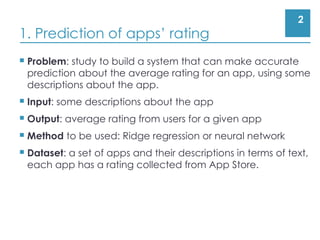
2
1. Prediction of apps’ rating
 Problem: study to build a system that can make accurate
prediction about the average rating for an app, using some
descriptions about the app.
 Input: some descriptions about the app
 Output: average rating from users for a given app
 Method to be used: Ridge regression or neural network
 Dataset: a set of apps and their descriptions in terms of text,
each app has a rating collected from App Store.
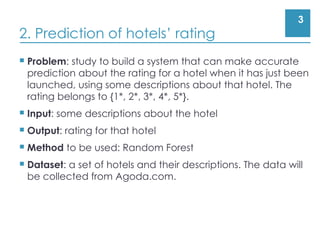
3
2. Prediction of hotels’ rating
 Problem: study to build a system that can make accurate
prediction about the rating for a hotel when it has just been
launched, using some descriptions about that hotel. The
rating belongs to {1*, 2*, 3*, 4*, 5*}.
 Input: some descriptions about the hotel
 Output: rating for that hotel
 Method to be used: Random Forest
 Dataset: a set of hotels and their descriptions. The data will
be collected from Agoda.com.
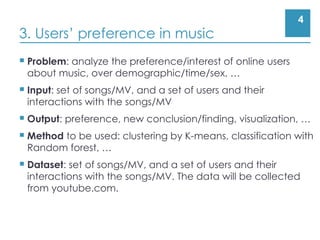
4
3. Users’ preference in music
 Problem: analyze the preference/interest of online users
about music, over demographic/time/sex, …
 Input: set of songs/MV, and a set of users and their
interactions with the songs/MV
 Output: preference, new conclusion/finding, visualization, …
 Method to be used: clustering by K-means, classification with
Random forest, …
 Dataset: set of songs/MV, and a set of users and their
interactions with the songs/MV. The data will be collected
from youtube.com.
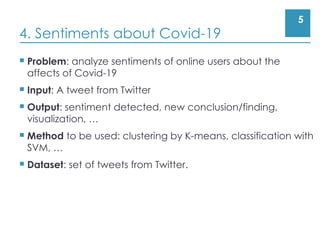
5
4. Sentiments about Covid-19
 Problem: analyze sentiments of online users about the
affects of Covid-19
 Input: A tweet from Twitter
 Output: sentiment detected, new conclusion/finding,
visualization, …
 Method to be used: clustering by K-means, classification with
SVM, …
 Dataset: set of tweets from Twitter.
6
5. Sentiments about products
 Problem: analyze sentiments of online users about some
products
 Input: A sentence/paragraph/document/post
 Output: sentiment detected for each product or each
aspect, …
 Method to be used: SVM, KNN, …
 Dataset: set of sentences/paragraphs/documents/posts,
each has one/some labels.
7
6. Connecting users with products
 Problem: analyze preference of online users about some
products and then suggest a suitable product to a user
 Input: Some interactions (views, buys, clicks) of an user in the
past
 Output: 5 products that the user may be most interested, …
 Method to be used: SVM, KNN, …
 Dataset: set of interactions (views, buys, clicks) of online
users in the past
8
7. Neoplastic characterization in colonoscopy
 Problem: to segment polyp regions and classify them into
two classes: neoplastic or non-neoplastic
 Input: medical images
 Output: semantic segmentation
 Method to be used: encoder-decoder based model,
Transformer
 Dataset: https://bkai.ai/research/bkai-igh-neopolyp-small-a-
dataset-for-fine-grained-polyp-segmentation/
9
8. Domain Adaptation in Object Detection
 Problem: to detect ligaments in liquid sprays and generalize
the model to other domains
 Input: images of the breakup process of liquid sprays
 Output: detected objects
 Method to be used: adversarial learning
 Dataset: deepspray dataset (internal)
10
9. Domain Adaptation for classification of anatomical sites
 Problem: to classify anatomical sites based on images
captured in different color modes
 Input: medical images
 Output: predicted labels
 Method to be used: CNN, adversarial learning
 Dataset: internal
11
10. Visual Question Answering
 Problem: to answer questions about the contents of images
 Input: an image and a question
 Output: answer to the question
 Method to be used: attention, RNN, transformer
 Dataset: https://visualqa.org/
12
11. Traffic flow forecasting
 Problem: to forecast traffic flow
 Input: time series of traffic flow
 Output: predicted values in the future
 Method to be used: Attention, RNN, GCN
 Dataset: PeMSD4 and PeMSD8
13
12. Ventilator Pressure Prediction
 Problem: to predict ventilator pressure
 Input: time series of ventilator pressure
 Output: predicted pressure
 Method to be used: Attention, RNN, GCN...
 Dataset: https://www.kaggle.com/c/ventilator-pressure-
prediction

Project examples machine learning .pptx

  • 1.
    Basic Machine Learning Capstone Projectexamples School of Information and Communication Technology Hanoi University of Science and Technology
  • 2.
    2 1. Prediction ofapps’ rating  Problem: study to build a system that can make accurate prediction about the average rating for an app, using some descriptions about the app.  Input: some descriptions about the app  Output: average rating from users for a given app  Method to be used: Ridge regression or neural network  Dataset: a set of apps and their descriptions in terms of text, each app has a rating collected from App Store.
  • 3.
    3 2. Prediction ofhotels’ rating  Problem: study to build a system that can make accurate prediction about the rating for a hotel when it has just been launched, using some descriptions about that hotel. The rating belongs to {1*, 2*, 3*, 4*, 5*}.  Input: some descriptions about the hotel  Output: rating for that hotel  Method to be used: Random Forest  Dataset: a set of hotels and their descriptions. The data will be collected from Agoda.com.
  • 4.
    4 3. Users’ preferencein music  Problem: analyze the preference/interest of online users about music, over demographic/time/sex, …  Input: set of songs/MV, and a set of users and their interactions with the songs/MV  Output: preference, new conclusion/finding, visualization, …  Method to be used: clustering by K-means, classification with Random forest, …  Dataset: set of songs/MV, and a set of users and their interactions with the songs/MV. The data will be collected from youtube.com.
  • 5.
    5 4. Sentiments aboutCovid-19  Problem: analyze sentiments of online users about the affects of Covid-19  Input: A tweet from Twitter  Output: sentiment detected, new conclusion/finding, visualization, …  Method to be used: clustering by K-means, classification with SVM, …  Dataset: set of tweets from Twitter.
  • 6.
    6 5. Sentiments aboutproducts  Problem: analyze sentiments of online users about some products  Input: A sentence/paragraph/document/post  Output: sentiment detected for each product or each aspect, …  Method to be used: SVM, KNN, …  Dataset: set of sentences/paragraphs/documents/posts, each has one/some labels.
  • 7.
    7 6. Connecting userswith products  Problem: analyze preference of online users about some products and then suggest a suitable product to a user  Input: Some interactions (views, buys, clicks) of an user in the past  Output: 5 products that the user may be most interested, …  Method to be used: SVM, KNN, …  Dataset: set of interactions (views, buys, clicks) of online users in the past
  • 8.
    8 7. Neoplastic characterizationin colonoscopy  Problem: to segment polyp regions and classify them into two classes: neoplastic or non-neoplastic  Input: medical images  Output: semantic segmentation  Method to be used: encoder-decoder based model, Transformer  Dataset: https://bkai.ai/research/bkai-igh-neopolyp-small-a- dataset-for-fine-grained-polyp-segmentation/
  • 9.
    9 8. Domain Adaptationin Object Detection  Problem: to detect ligaments in liquid sprays and generalize the model to other domains  Input: images of the breakup process of liquid sprays  Output: detected objects  Method to be used: adversarial learning  Dataset: deepspray dataset (internal)
  • 10.
    10 9. Domain Adaptationfor classification of anatomical sites  Problem: to classify anatomical sites based on images captured in different color modes  Input: medical images  Output: predicted labels  Method to be used: CNN, adversarial learning  Dataset: internal
  • 11.
    11 10. Visual QuestionAnswering  Problem: to answer questions about the contents of images  Input: an image and a question  Output: answer to the question  Method to be used: attention, RNN, transformer  Dataset: https://visualqa.org/
  • 12.
    12 11. Traffic flowforecasting  Problem: to forecast traffic flow  Input: time series of traffic flow  Output: predicted values in the future  Method to be used: Attention, RNN, GCN  Dataset: PeMSD4 and PeMSD8
  • 13.
    13 12. Ventilator PressurePrediction  Problem: to predict ventilator pressure  Input: time series of ventilator pressure  Output: predicted pressure  Method to be used: Attention, RNN, GCN...  Dataset: https://www.kaggle.com/c/ventilator-pressure- prediction