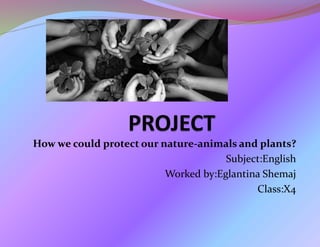
How we could protect our nature-animals and plants?
Subject:English
Worked by:Eglantina Shemaj
Class:X4
Why is it important to protect
endangered plants and animals?
 Every plant and animal is part of the ecosystem of the particular
place where its habitat is. It is also part of the food chain. So
destroying plant or animal beyond natural causes of their death
destroys the ecosystem and creates imbalance in nature in the long
run. It is then when some plants and animals become endangered.
So in simple words endangered species actually indicate
environmental imbalance, food scarcity, environmental(air, water,
soil) pollution, climate change or man made disasters. When we
come forward to protect these endangered species, we actually try to
restore our nature and environment for our welfare. So its important
to protect endangered species to keep this world liveable for human
too.
 Because the plants are responsible for oxygen formation and carbon
dioxide consumption, so they has great role over global warming
endangered plant and animals are like they are supposed to be
extinct within few decades ,and will never appear in the planet...so
they must be saved to save our human race save the animal...save the
world
save plant save the world
 About two hundred years ago
man lived in greater harmony
with his environment because
industry was not much
developed. Today the situation is
quit different, the contradictions
between man and nature are
dramatic.
 People all over the world are
worried about what is happening
to the environment. Newspapers,
magazines write about water
pollution, air pollution, and land
pollution. Now many parts of the
world are crowded, people live in
big cities. Where many people live
together, litter is a problem.
People dont always put garbage
into the garbage can.
 Its easier to drop a paper than to find a
garbage can for it. But litter is ugly. It
makes the city look dirty and spoils the
view.
 Litter is a health problem too. Food,
garbage bring animals, which sometimes
carry disease.
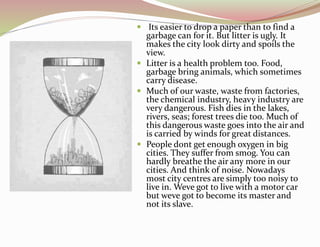
 Much of our waste, waste from factories,
the chemical industry, heavy industry are
very dangerous. Fish dies in the lakes,
rivers, seas; forest trees die too. Much of
this dangerous waste goes into the air and
is carried by winds for great distances.
 People dont get enough oxygen in big
cities. They suffer from smog. You can
hardly breathe the air any more in our
cities. And think of noise. Nowadays
most city centres are simply too noisy to
live in. Weve got to live with a motor car
but weve got to become its master and
not its slave.
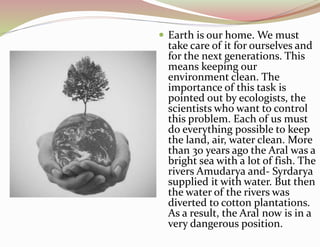
 Earth is our home. We must
take care of it for ourselves and
for the next generations. This
means keeping our
environment clean. The
importance of this task is
pointed out by ecologists, the
scientists who want to control
this problem. Each of us must
do everything possible to keep
the land, air, water clean. More
than 30 years ago the Aral was a
bright sea with a lot of fish. The
rivers Amudarya and- Syrdarya
supplied it with water. But then
the water of the rivers was
diverted to cotton plantations.
As a result, the Aral now is in a
very dangerous position.
 If no immediate measures are taken,
the Aral Sea will disappear by the year
2010.• There are many other places in
our planet that need immediate help.
For example Lake Baikal and its shores
have been declared a specially
protected zone of our country. There
is a hope that one of the most
beautiful and the deepest lakes of the
world will never die.
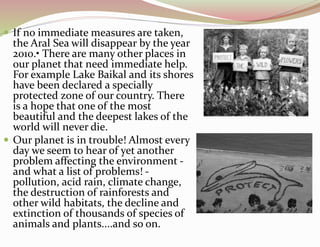
 Our planet is in trouble! Almost every
day we seem to hear of yet another
problem affecting the environment -
and what a list of problems! -
pollution, acid rain, climate change,
the destruction of rainforests and
other wild habitats, the decline and
extinction of thousands of species of
animals and plants....and so on.
How to help:Thinking more about what we waste helps to protect the environment by saving
energy, reducing pollution, cutting costs and preserving our natural resources.
 Sort it out! Not all of our recycling is taken by helpful dustmen. Unwanted or
leftover food such as tea bags and potato peelings can be added straight to a
compost heap. Plenty of minibeasts will be on-hand there to help! Little insects
help break down food and plant matter and make it into scrumptious soil that
plants, trees and other animals love. Many local councils now include compostable
waste in their recycling collections.
 Recycle Bank Some councils don’t collect plastics or cardboard but there is always
somewhere nearby with big recycling banks where you can take them.
 Save trees Save trees by recycling your own paper. Paper with a clean side can be
made into notepads with a simple staple or a hole to tie a piece of string. These are
great for doodles and notes. If you are buying paper, buy recycled paper.
 Fashion Statement Give any unwanted clothes to charity shops or to a Salvation
Army recycling bank. A lot of our unwanted clothes go to the homeless to keep
them warm or alternatively, the clothes are sent to developing countries. There’s
always someone who will want that knitted jumper!
 Would you like a bag? If you can carry your shopping home without a bag then
carry it home. If you can’t why not take a bag you already have with you. Re-using
bags is the cool way to shop!
 Packaging Packaging is a big problem for the environment because once the
product is open you don’t need it and it’s thrown out or, if it’s lucky, recycled. So
avoid buying products that have a lot of paper and plastic around them.
 Shout out - Tell Friends of the Earth what products or companies you think
highlight the problem of our trashed planet.
 Flowers Orchids are popular in florists, but many come from the rainforest. The
UK imports millions of flowers every year and despite checks some orchids may
have been taken from the wild. Check that any orchids have been grown in Britain
or the EU before buying.
 Protected Pet? Some parrots and macaws are unfortunately still being imported
into the country to be sold as pets. If you want a parrot as a pet, make sure it has
been hatched in Britain.
 Nowadays, most of us know that these threats exist and that
humans have caused them. Many of us are very worried
about the future of our planet and unless we can find a way
of solving the problems we have made then the
environment will suffer even more.
 Teach others about the importance
of the environment and how they
can help save rainforests.
 Restore damaged ecosystems by
planting trees on land where forests
have been cut down.
 Encourage people to live in a way
that doesn't hurt the environment
 Establish parks to protect rainforests
and wildlife
 Support companies that operate in
ways that minimize damage to the
environment

Project English

  • 1.
    How we couldprotect our nature-animals and plants? Subject:English Worked by:Eglantina Shemaj Class:X4
  • 2.
    Why is itimportant to protect endangered plants and animals?  Every plant and animal is part of the ecosystem of the particular place where its habitat is. It is also part of the food chain. So destroying plant or animal beyond natural causes of their death destroys the ecosystem and creates imbalance in nature in the long run. It is then when some plants and animals become endangered. So in simple words endangered species actually indicate environmental imbalance, food scarcity, environmental(air, water, soil) pollution, climate change or man made disasters. When we come forward to protect these endangered species, we actually try to restore our nature and environment for our welfare. So its important to protect endangered species to keep this world liveable for human too.  Because the plants are responsible for oxygen formation and carbon dioxide consumption, so they has great role over global warming endangered plant and animals are like they are supposed to be extinct within few decades ,and will never appear in the planet...so they must be saved to save our human race save the animal...save the world save plant save the world
  • 3.
     About twohundred years ago man lived in greater harmony with his environment because industry was not much developed. Today the situation is quit different, the contradictions between man and nature are dramatic.  People all over the world are worried about what is happening to the environment. Newspapers, magazines write about water pollution, air pollution, and land pollution. Now many parts of the world are crowded, people live in big cities. Where many people live together, litter is a problem. People dont always put garbage into the garbage can.
  • 4.
     Its easierto drop a paper than to find a garbage can for it. But litter is ugly. It makes the city look dirty and spoils the view.  Litter is a health problem too. Food, garbage bring animals, which sometimes carry disease.  Much of our waste, waste from factories, the chemical industry, heavy industry are very dangerous. Fish dies in the lakes, rivers, seas; forest trees die too. Much of this dangerous waste goes into the air and is carried by winds for great distances.  People dont get enough oxygen in big cities. They suffer from smog. You can hardly breathe the air any more in our cities. And think of noise. Nowadays most city centres are simply too noisy to live in. Weve got to live with a motor car but weve got to become its master and not its slave.
  • 6.
     Earth isour home. We must take care of it for ourselves and for the next generations. This means keeping our environment clean. The importance of this task is pointed out by ecologists, the scientists who want to control this problem. Each of us must do everything possible to keep the land, air, water clean. More than 30 years ago the Aral was a bright sea with a lot of fish. The rivers Amudarya and- Syrdarya supplied it with water. But then the water of the rivers was diverted to cotton plantations. As a result, the Aral now is in a very dangerous position.
  • 7.
     If noimmediate measures are taken, the Aral Sea will disappear by the year 2010.• There are many other places in our planet that need immediate help. For example Lake Baikal and its shores have been declared a specially protected zone of our country. There is a hope that one of the most beautiful and the deepest lakes of the world will never die.  Our planet is in trouble! Almost every day we seem to hear of yet another problem affecting the environment - and what a list of problems! - pollution, acid rain, climate change, the destruction of rainforests and other wild habitats, the decline and extinction of thousands of species of animals and plants....and so on.
  • 8.
    How to help:Thinkingmore about what we waste helps to protect the environment by saving energy, reducing pollution, cutting costs and preserving our natural resources.  Sort it out! Not all of our recycling is taken by helpful dustmen. Unwanted or leftover food such as tea bags and potato peelings can be added straight to a compost heap. Plenty of minibeasts will be on-hand there to help! Little insects help break down food and plant matter and make it into scrumptious soil that plants, trees and other animals love. Many local councils now include compostable waste in their recycling collections.  Recycle Bank Some councils don’t collect plastics or cardboard but there is always somewhere nearby with big recycling banks where you can take them.  Save trees Save trees by recycling your own paper. Paper with a clean side can be made into notepads with a simple staple or a hole to tie a piece of string. These are great for doodles and notes. If you are buying paper, buy recycled paper.  Fashion Statement Give any unwanted clothes to charity shops or to a Salvation Army recycling bank. A lot of our unwanted clothes go to the homeless to keep them warm or alternatively, the clothes are sent to developing countries. There’s always someone who will want that knitted jumper!  Would you like a bag? If you can carry your shopping home without a bag then carry it home. If you can’t why not take a bag you already have with you. Re-using bags is the cool way to shop!  Packaging Packaging is a big problem for the environment because once the product is open you don’t need it and it’s thrown out or, if it’s lucky, recycled. So avoid buying products that have a lot of paper and plastic around them.  Shout out - Tell Friends of the Earth what products or companies you think highlight the problem of our trashed planet.  Flowers Orchids are popular in florists, but many come from the rainforest. The UK imports millions of flowers every year and despite checks some orchids may have been taken from the wild. Check that any orchids have been grown in Britain or the EU before buying.  Protected Pet? Some parrots and macaws are unfortunately still being imported into the country to be sold as pets. If you want a parrot as a pet, make sure it has been hatched in Britain.
  • 9.
     Nowadays, mostof us know that these threats exist and that humans have caused them. Many of us are very worried about the future of our planet and unless we can find a way of solving the problems we have made then the environment will suffer even more.
  • 10.
     Teach othersabout the importance of the environment and how they can help save rainforests.  Restore damaged ecosystems by planting trees on land where forests have been cut down.  Encourage people to live in a way that doesn't hurt the environment  Establish parks to protect rainforests and wildlife  Support companies that operate in ways that minimize damage to the environment