Project-based approach in subtitler training:
a case study of subtitling pre-WWII films
for the Polish National Film Archive
Agnieszka Szarkowska
University of Warsaw
a.szarkowska@uw.edu.pl
CTER 2016, Kraków
Project-based translator training
 Empowerment of students in their learning process
– Constructing their own knowledge
– Assuming responsibility of their own learning
through collaborative work
 Authentic assignments
– ‘the collaborative undertaking of complete translation
projects for real clients’ (Kiraly 2005)
 Departure from
– ‘Who takes the next sentence’ approach
to more learner-centred, task-based training
– Transmissionist view of competence acquisition
 ‘Providing students with opportunities to work
authentically on the real-world translation market’
(Kiraly 2005: 1109)
Don Kiraly (2000, 2005)
Kiraly – a subtitling project (2005)
 University (a subtitling tutor) was contacted
by a small German film production company
 Translation into English
 The subtitling tutor taught them ‘the mechanics of
Subtitle Workshop’ in two 90-minute sessions
 Divided the film into chunks to be translated
in pairs by 14 students
 Prepare the subtitles, peer-review, full group review
 Completion time: 16 weeks
Kiraly (2005)
 ‘The project developed a life of its own. It became
the group’s raison d’etre; the need for the teacher-
centred transmission of knowledge and sticking
to a lesson plan evaporated against the backdrop of
our real-world responsitibilities: acquiring, creating and
applying the knowledge needed to complete our
project in a timely and competent manner’
 ‘As a sole native speaker informant in the class,
I moved from group to group and provided assistance
resolving difficulties involving vocabulary choice,
idiomatic usage, stylistic infelicities and the like,
and I also provided my constructive criticism
as a translator and fellow novice subtitler’
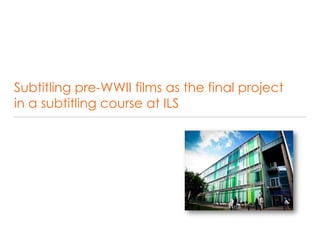
Subtitling pre-WWII films as the final project
in a subtitling course at ILS
Subtitling course
 30 hour (15 meetings) face-to-face elective course
 1st year of the MA programme
 VLE: Moodle platform
 20 students in the class
 Languages
– English – B or C
– Polish – mother tongue
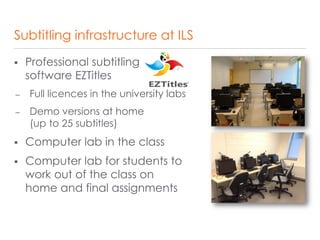
Subtitling infrastructure at ILS
 Professional subtitling
software EZTitles
– Full licences in the university labs
– Demo versions at home
(up to 25 subtitles)
 Computer lab in the class
 Computer lab for students to
work out of the class on
home and final assignments
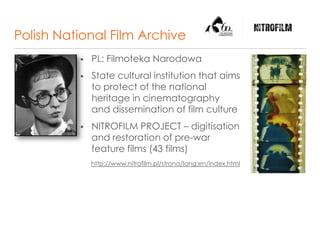
Polish National Film Archive
 PL: Filmoteka Narodowa
 State cultural institution that aims
to protect of the national
heritage in cinematography
and dissemination of film culture
 NITROFILM PROJECT – digitisation
and restoration of pre-war
feature films (43 films)
http://www.nitrofilm.pl/strona/lang:en/index.html
Films subtitled in the project
 ABC miłości (1935)
 Ada, to nie wypada (1936)
 Dwie Joasie (1935)
 Dziewczyna szuka miłości
(1937)
 Przez łzy do szczęścia (1939)
 U kresu drogi (1939)
 Ludzie Wisły (1938)
Course work & the final project
 Introduction to subtitling
 Parallel work on the final project
and the regular course
 Time frame
– November – students get the films and original scripts
– mid-January – deadline for delivering subtitle files
 Group work
– Moodle quiz functionality
– 3 people per group (up to 30 mins per person)
– Peer review within groups
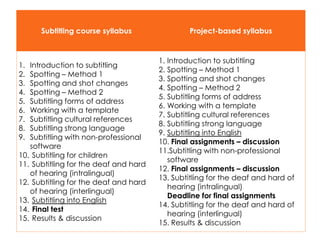
Subtitling course syllabus Project-based syllabus
1. Introduction to subtitling
2. Spotting – Method 1
3. Spotting and shot changes
4. Spotting – Method 2
5. Subtitling forms of address
6. Working with a template
7. Subtitling cultural references
8. Subtitling strong language
9. Subtitling with non-professional
software
10. Subtitling for children
11. Subtitling for the deaf and hard
of hearing (intralingual)
12. Subtitling for the deaf and hard
of hearing (interlingual)
13. Subtitling into English
14. Final test
15. Results & discussion
1. Introduction to subtitling
2. Spotting – Method 1
3. Spotting and shot changes
4. Spotting – Method 2
5. Subtitling forms of address
6. Working with a template
7. Subtitling cultural references
8. Subtitling strong language
9. Subtitling into English
10. Final assignments – discussion
11.Subtitling with non-professional
software
12. Final assignments – discussion
13. Subtitling for the deaf and hard of
hearing (intralingual)
Deadline for final assignments
14. Subtitling for the deaf and hard of
hearing (interlingual)
15. Results & discussion
In-class work on the project (failure?)
 Some students did not manage to watch their films
before coming to class
 Some students did not start translating,
so they couldn’t talk about difficulties
 Moodle discussion forum – not used at all
Division of work within each group of 3 students
(done by students themselves)
Translate and
spot ca. 30 mins
Revise
somebody else’s
subtitles
Submit the
subtitle file
(without verifying
the whole thing!)
Deadline – and then what?
 Subtitle files marked by the tutor
– Less than 2 weeks for 7 films
– Revise the files for them or just indicate problems?
– Comments inserted with requests for revision
 Deadline for grading at the university – subtitle files
not ready to be sent to the National Film Archive
 Students volunteered to revise the files
after the course ended
Student feedback on final assignment
Real-life task
 Very, very good idea. Especially the fact that
we knew that our translations will be used later.
 In my opinion it was quite difficult and demanding,
yet I like the idea of creating something that has
real use and will be helpful to someone.
 I liked it, it was challenging. I’m glad I could take
part in a larger project, out of university and to
gain experience in real subtitling. I really
appreciate that you planned the final assignment
in such an interesting way, though of course it
required a lot of work.
 loved the final assignment!
Translation problems
 It was very interesting, yet very demanding,
but I found translating the songs quite amusing.
 It was difficult, as the people were using outdated
words and collocations that are not meaningful
anymore.
 Dated forms of address
 Technical issues related to film quality
Time
 It was a very very time-consuming, yet very
interesting challenge :)
 Pretty hard and very time-consuming.
 It was great fun, but at the same time very difficult.
It took me ages to translate my part. It was very
demanding, but all in all, I enjoyed it.
Work management
 It was difficult to work on the assignment when ILS
was closed for Christmas, so we didn’t manage to
plan the work optimally.
 Also, coordination for such a large project
necessitates the people to be able to truly rely on
one another.
 It was a very interesting experience. But I think
we didn’t have enough time to complete it.
You had to hunt to be able to find a computer
in the lab to be able to do this.
Technical issues
 Translating it was a very satisfying job, but at the
same time really tiresome. I couldn't stay at ILS after
the classes, so I had to prepare it at home on a
demo version of EZTitles with maximum 25 subs per
file.
 It was a stressful, but generally great experience.
The only thing I didn’t like about it was that I had to
do it on my demo version of the programme and
then merge all files into one using the university
computer.
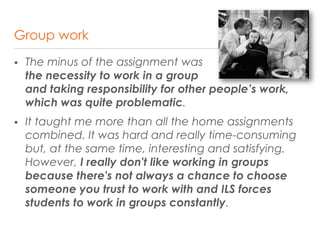
Group work
 The minus of the assignment was
the necessity to work in a group
and taking responsibility for other people’s work,
which was quite problematic.
 It taught me more than all the home assignments
combined. It was hard and really time-consuming
but, at the same time, interesting and satisfying.
However, I really don't like working in groups
because there's not always a chance to choose
someone you trust to work with and ILS forces
students to work in groups constantly.
Other issues
 Ok, though doing stuff useful for someone for free feels
stupid
 It was a great idea. But I wish the final project was a part
of the classes. I mean that it would be helpful if you,
lecturer, was present while our facing problems when
subtitling.
 Really time-consuming and quite stressful at times (when
programme does not work or some unexpected things
occur.) At the end it was rewarding to see the effects, but
I would suggest that people should do shorter translations
as final assignment (up to 10-15min.)
Problems from the tutor’s perspective
 How much of the work should be done in class
and how much as individual/group work?
 Spending the whole course/semester doing one
project – limiting
 Unrepresentative of the market situation
 ‘The market requires that the final product be of
impeccable quality’ (Kiraly 2005: 1109)
– what if it isn’t?
Conclusions
 ‘The ways of accomplishing these goals vary
greatly from group to group, from project to
project and from student to student’
(Kiraly 2005: 1109)
 Students are used to trainer-centred didactic
environment and transmissionist approach
 Payment for work?
 Time-consuming for the tutor
Contact
a.szarkowska@uw.edu.pl
www.avt.ils.uw.edu.pl
www.facebook.com/AVTLab

Project based approach to subtitler training

  • 1.
    Project-based approach insubtitler training: a case study of subtitling pre-WWII films for the Polish National Film Archive Agnieszka Szarkowska University of Warsaw a.szarkowska@uw.edu.pl CTER 2016, Kraków
  • 2.
  • 3.
    Project-based translator training Empowerment of students in their learning process – Constructing their own knowledge – Assuming responsibility of their own learning through collaborative work  Authentic assignments – ‘the collaborative undertaking of complete translation projects for real clients’ (Kiraly 2005)  Departure from – ‘Who takes the next sentence’ approach to more learner-centred, task-based training – Transmissionist view of competence acquisition  ‘Providing students with opportunities to work authentically on the real-world translation market’ (Kiraly 2005: 1109) Don Kiraly (2000, 2005)
  • 4.
    Kiraly – asubtitling project (2005)  University (a subtitling tutor) was contacted by a small German film production company  Translation into English  The subtitling tutor taught them ‘the mechanics of Subtitle Workshop’ in two 90-minute sessions  Divided the film into chunks to be translated in pairs by 14 students  Prepare the subtitles, peer-review, full group review  Completion time: 16 weeks
  • 5.
    Kiraly (2005)  ‘Theproject developed a life of its own. It became the group’s raison d’etre; the need for the teacher- centred transmission of knowledge and sticking to a lesson plan evaporated against the backdrop of our real-world responsitibilities: acquiring, creating and applying the knowledge needed to complete our project in a timely and competent manner’  ‘As a sole native speaker informant in the class, I moved from group to group and provided assistance resolving difficulties involving vocabulary choice, idiomatic usage, stylistic infelicities and the like, and I also provided my constructive criticism as a translator and fellow novice subtitler’
  • 6.
    Subtitling pre-WWII filmsas the final project in a subtitling course at ILS
  • 7.
    Subtitling course  30hour (15 meetings) face-to-face elective course  1st year of the MA programme  VLE: Moodle platform  20 students in the class  Languages – English – B or C – Polish – mother tongue
  • 8.
    Subtitling infrastructure atILS  Professional subtitling software EZTitles – Full licences in the university labs – Demo versions at home (up to 25 subtitles)  Computer lab in the class  Computer lab for students to work out of the class on home and final assignments
  • 9.
    Polish National FilmArchive  PL: Filmoteka Narodowa  State cultural institution that aims to protect of the national heritage in cinematography and dissemination of film culture  NITROFILM PROJECT – digitisation and restoration of pre-war feature films (43 films) http://www.nitrofilm.pl/strona/lang:en/index.html
  • 12.
    Films subtitled inthe project  ABC miłości (1935)  Ada, to nie wypada (1936)  Dwie Joasie (1935)  Dziewczyna szuka miłości (1937)  Przez łzy do szczęścia (1939)  U kresu drogi (1939)  Ludzie Wisły (1938)
  • 13.
    Course work &the final project  Introduction to subtitling  Parallel work on the final project and the regular course  Time frame – November – students get the films and original scripts – mid-January – deadline for delivering subtitle files  Group work – Moodle quiz functionality – 3 people per group (up to 30 mins per person) – Peer review within groups
  • 14.
    Subtitling course syllabusProject-based syllabus 1. Introduction to subtitling 2. Spotting – Method 1 3. Spotting and shot changes 4. Spotting – Method 2 5. Subtitling forms of address 6. Working with a template 7. Subtitling cultural references 8. Subtitling strong language 9. Subtitling with non-professional software 10. Subtitling for children 11. Subtitling for the deaf and hard of hearing (intralingual) 12. Subtitling for the deaf and hard of hearing (interlingual) 13. Subtitling into English 14. Final test 15. Results & discussion 1. Introduction to subtitling 2. Spotting – Method 1 3. Spotting and shot changes 4. Spotting – Method 2 5. Subtitling forms of address 6. Working with a template 7. Subtitling cultural references 8. Subtitling strong language 9. Subtitling into English 10. Final assignments – discussion 11.Subtitling with non-professional software 12. Final assignments – discussion 13. Subtitling for the deaf and hard of hearing (intralingual) Deadline for final assignments 14. Subtitling for the deaf and hard of hearing (interlingual) 15. Results & discussion
  • 15.
    In-class work onthe project (failure?)  Some students did not manage to watch their films before coming to class  Some students did not start translating, so they couldn’t talk about difficulties  Moodle discussion forum – not used at all
  • 16.
    Division of workwithin each group of 3 students (done by students themselves) Translate and spot ca. 30 mins Revise somebody else’s subtitles Submit the subtitle file (without verifying the whole thing!)
  • 17.
    Deadline – andthen what?  Subtitle files marked by the tutor – Less than 2 weeks for 7 films – Revise the files for them or just indicate problems? – Comments inserted with requests for revision  Deadline for grading at the university – subtitle files not ready to be sent to the National Film Archive  Students volunteered to revise the files after the course ended
  • 18.
    Student feedback onfinal assignment
  • 19.
    Real-life task  Very,very good idea. Especially the fact that we knew that our translations will be used later.  In my opinion it was quite difficult and demanding, yet I like the idea of creating something that has real use and will be helpful to someone.  I liked it, it was challenging. I’m glad I could take part in a larger project, out of university and to gain experience in real subtitling. I really appreciate that you planned the final assignment in such an interesting way, though of course it required a lot of work.  loved the final assignment!
  • 20.
    Translation problems  Itwas very interesting, yet very demanding, but I found translating the songs quite amusing.  It was difficult, as the people were using outdated words and collocations that are not meaningful anymore.  Dated forms of address  Technical issues related to film quality
  • 21.
    Time  It wasa very very time-consuming, yet very interesting challenge :)  Pretty hard and very time-consuming.  It was great fun, but at the same time very difficult. It took me ages to translate my part. It was very demanding, but all in all, I enjoyed it.
  • 22.
    Work management  Itwas difficult to work on the assignment when ILS was closed for Christmas, so we didn’t manage to plan the work optimally.  Also, coordination for such a large project necessitates the people to be able to truly rely on one another.  It was a very interesting experience. But I think we didn’t have enough time to complete it. You had to hunt to be able to find a computer in the lab to be able to do this.
  • 23.
    Technical issues  Translatingit was a very satisfying job, but at the same time really tiresome. I couldn't stay at ILS after the classes, so I had to prepare it at home on a demo version of EZTitles with maximum 25 subs per file.  It was a stressful, but generally great experience. The only thing I didn’t like about it was that I had to do it on my demo version of the programme and then merge all files into one using the university computer.
  • 24.
    Group work  Theminus of the assignment was the necessity to work in a group and taking responsibility for other people’s work, which was quite problematic.  It taught me more than all the home assignments combined. It was hard and really time-consuming but, at the same time, interesting and satisfying. However, I really don't like working in groups because there's not always a chance to choose someone you trust to work with and ILS forces students to work in groups constantly.
  • 25.
    Other issues  Ok,though doing stuff useful for someone for free feels stupid  It was a great idea. But I wish the final project was a part of the classes. I mean that it would be helpful if you, lecturer, was present while our facing problems when subtitling.  Really time-consuming and quite stressful at times (when programme does not work or some unexpected things occur.) At the end it was rewarding to see the effects, but I would suggest that people should do shorter translations as final assignment (up to 10-15min.)
  • 26.
    Problems from thetutor’s perspective  How much of the work should be done in class and how much as individual/group work?  Spending the whole course/semester doing one project – limiting  Unrepresentative of the market situation  ‘The market requires that the final product be of impeccable quality’ (Kiraly 2005: 1109) – what if it isn’t?
  • 27.
    Conclusions  ‘The waysof accomplishing these goals vary greatly from group to group, from project to project and from student to student’ (Kiraly 2005: 1109)  Students are used to trainer-centred didactic environment and transmissionist approach  Payment for work?  Time-consuming for the tutor
  • 28.