Programming
Terminology
Including specialized terms from
Java, C++, C#, and Visual Basic.
- Michael Henson -
www.michaeljhenson.info
Algorithm
• A finite sequence of unambiguous
instructions which, when given the
required input, produces the correct
output and then stops.
• A sequence of the correct steps in the
correct order for solving a problem.
- Michael Henson -
www.michaeljhenson.info
Pseudocode
• An algorithm written in plain English
instructions and structured into a
code-like form.
• An intermediate step between natural
language and programming language.
- Michael Henson -
www.michaeljhenson.info
IDE
• Integrated Development Environment
• A set of software tools that work
together for designing, developing,
and troubleshooting programs.
• Usually includes a source code editor,
debugger, compiler, project management
features, and often much more.
- Michael Henson -
www.michaeljhenson.info
Variable
• A value stored in the computer’s
memory.
• All variables have:
– Name (how we reference it in code)
– Type (what type of data it stores)
– Value (what actual data value it has)
– Size (how many bits in memory)
- Michael Henson -
www.michaeljhenson.info
Precedence
• The priority of operators that
determines the order in which they
are evaluated.
• Higher precedence goes first.
• The precedence of operators in Java, C+
+, C#, and Visual Basic follows the same
mathematical rules as standard arithmetic.
- Michael Henson -
www.michaeljhenson.info
Control Structures
• Also called control statements.
• Code statements that determine how
control is transferred from one statement
to another.
• In structured programming, there are three
types:
1. Sequence – the steps go in the given order
2. Selection – branching; conditional “if” statements
3. Repetition – looping
- Michael Henson -
www.michaeljhenson.info
Selection Structures
• Control structures that evaluate a
condition to determine which
statement will be executed next.
• Also called branching statements or
conditional statements.
• Java, C++, C#: if, if/else, switch
• Visual Basic: If-Then, If-Then/Else,
Select Case
- Michael Henson -
www.michaeljhenson.info
Repetition Structures
• Loops -- control structures that evaluate a
condition to determine whether to repeat
a given block of code.
• In Java and C++: while, do/while, for
• In C#: All of the above, plus foreach
• In Visual Basic .NET: While, Do
While/Loop, Do/Loop While, Do
Until/Loop, Do/Loop Until, For/Next,
For Each/Next
- Michael Henson -
www.michaeljhenson.info
GUI
• Graphical User Interface
• An interface to a software program
consisting of visual, graphical
elements with which the user
interacts.
- Michael Henson -
www.michaeljhenson.info
Function
• A subroutine that returns a value
back to the caller.
• In C++, subroutines are sometimes called
functions even when they do not return a
value (void functions).
- Michael Henson -
www.michaeljhenson.info
Sub
• In Visual Basic, a procedure that
does not return a value to the
caller.
• In C++, we call this a void function.
• In Java, we call this a void method.
- Michael Henson -
www.michaeljhenson.info
Method
• A subroutine that is defined as a
member of a class.
• In C++, these are usually called member
functions.
• In Java, every subroutine is called a
method since they all must exist within the
bounds of a class.
- Michael Henson -
www.michaeljhenson.info
Parameters
• Values passed as input into a
procedure from the point where the
procedure is called. (Actual
parameters or arguments.)
• Variables declared in a procedure
header to hold values that are
passed in. (Formal parameters.)
- Michael Henson -
www.michaeljhenson.info
Signature
• The portion of a procedure header
containing the procedure’s name
and parameter list.
• Each procedure must have a unique
signature. That is, they must differ either
in name or in the number, type, or order of
their parameters.
- Michael Henson -
www.michaeljhenson.info
Pass by Value
• A way of passing parameters in
which a copy of the parameter’s
value is passed to the procedure.
• In Java, primitive variables are always
passed by value.
• In C++, this is the default behavior of
parameters unless otherwise specified.
• In VB, this is accomplished using ByVal.
- Michael Henson -
www.michaeljhenson.info
Pass by Reference
• A way of passing parameters in
which a reference to the original
variable is passed to the procedure.
• Objects are always passed by reference.
• In C++, primitive variables can be passed
as reference parameters by using &.
• In VB, this is accomplished using ByRef.
- Michael Henson -
www.michaeljhenson.info
Scope
• The portion of program code where
a particular identifier (variable,
function, etc.) may be referenced.
- Michael Henson -
www.michaeljhenson.info
Overloading
• Creating multiple procedures with
the same name but different
parameter lists.
- Michael Henson -
www.michaeljhenson.info
Data Structure
• A collection of memory locations
under one name that stores multiple
pieces of data.
• May be static (fixed size) or dynamic (can
grow and shrink).
- Michael Henson -
www.michaeljhenson.info
Array
• A static data structure in which the
elements, all of which are the same
data type, are accessed via the
array name and an integer
subscript.
• All elements of an array have the same
name and type.
- Michael Henson -
www.michaeljhenson.info
Sorting
• The process of putting a data
structure’s elements in order.
- Michael Henson -
www.michaeljhenson.info
Searching
• The process of looking through a
data structure to find a given key
value.
- Michael Henson -
www.michaeljhenson.info
Encapsulation
• Encapsulation is the bundling of data
with the program code that operates on it.
• Objects do this by containing data
members and methods in their class
definitions.
• Encapsulation enables information hiding.
- Michael Henson -
www.michaeljhenson.info
Information Hiding
• Information hiding is the ability to hide
implementation details from the outside
world. It enables objects to make things
available on a “need-to-know” basis and
helps to protect data from taking on invalid
values.
• Objects do this by containing data and
methods that are marked public, private,
or some level in between.
- Michael Henson -
www.michaeljhenson.info
Constructor
• A special method that is called
automatically upon the creation of
an object to initialize that object’s
data and prepare it for use.
• In Java, C++, and C#, the constructor
always has the same name as the class it
constructs.
• In VB, the constructor is always Sub New.
- Michael Henson -
www.michaeljhenson.info
Accessor
• A procedure for accessing an
object’s private data.
• Sometimes called getters (for retrieving
values) and setters (for setting values).
• In VB and C#, get and set accessors can
be paired in Property methods.
- Michael Henson -
www.michaeljhenson.info
Class
• The definition of a certain type of object
or group of objects. A class defines what is
required for a certain object to exist.
• Declares the properties that describe an object
and the behaviors of which an object is capable.
• An object-oriented program is made of class
definitions which declare variables that
represent an object’s attributes (data members)
and the functions that determine an object’s
behaviors (methods).
- Michael Henson -
www.michaeljhenson.info
Object
• An object is a “thing” that has attributes
and behaviors. It’s an instance of a
class.
• A common analogy: If a class is the
blueprint for a house, then an object is the
actual house that was built from the
blueprint.
- Michael Henson -
www.michaeljhenson.info
Composition
• A relationship between objects in
which one object is composed of
another object.
• For this reason, composition is sometimes
called “aggregation” or a “has-a”
relationship.
• Classes do this by containing object
variables as data members.
- Michael Henson -
www.michaeljhenson.info
Inheritance
• A relationship between classes in
which one class automatically
absorbs all of the properties and
behaviors of another class.
• Inheritance creates an “is-a”
relationship between the child and
parent classes.
- Michael Henson -
www.michaeljhenson.info
Overriding
• Overriding happens when a class
inherits a method from its parent
and then replaces that method with
an alternate implementation of it.
• Overriding can be thought of as
“redefining”
- Michael Henson -
www.michaeljhenson.info
Access Modifier
• A keyword that specifies which
parts of the code have access to a
particular class member.
• See language-specific modifiers on
following slides.
- Michael Henson -
www.michaeljhenson.info
VB Access Modifiers
Modifier: Allows access to:
Public Anyone who has an
object of the class
Protected Subclasses
Friend Other classes in the
same assembly
Private Code within the same
class only
- Michael Henson -
www.michaeljhenson.info
C# Access Modifiers
Modifier: Allows access to:
public Anyone who has an
object of the class
protected Subclasses
internal Other classes in the
same assembly
private Code within the same
class only
- Michael Henson -
www.michaeljhenson.info
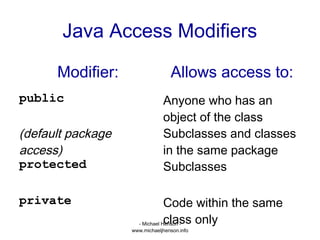
Java Access Modifiers
Modifier: Allows access to:
public Anyone who has an
object of the class
(default package
access)
Subclasses and classes
in the same package
protected Subclasses
private Code within the same
class only- Michael Henson -
www.michaeljhenson.info
C++ Access Modifiers
Modifier: Allows access to:
public Anyone who has an
object of the class
protected Subclasses
private Code within the same
class only
- Michael Henson -
www.michaeljhenson.info
Polymorphism
• The ability of different types of
objects related by inheritance to
respond differently to the same
method call.
• This is made possible by the fact that
classes inherit methods from their parents
and can then override those methods.
- Michael Henson -
www.michaeljhenson.info
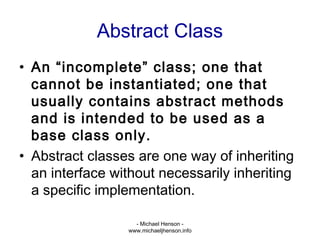
Abstract Class
• An “incomplete” class; one that
cannot be instantiated; one that
usually contains abstract methods
and is intended to be used as a
base class only.
• Abstract classes are one way of inheriting
an interface without necessarily inheriting
a specific implementation.
- Michael Henson -
www.michaeljhenson.info
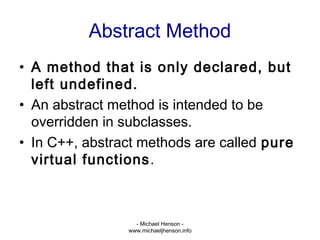
Abstract Method
• A method that is only declared, but
left undefined.
• An abstract method is intended to be
overridden in subclasses.
• In C++, abstract methods are called pure
virtual functions.
- Michael Henson -
www.michaeljhenson.info
To Be Continued…
- Michael Henson -
www.michaeljhenson.info

Programming Terminology

  • 1.
    Programming Terminology Including specialized termsfrom Java, C++, C#, and Visual Basic. - Michael Henson - www.michaeljhenson.info
  • 2.
    Algorithm • A finitesequence of unambiguous instructions which, when given the required input, produces the correct output and then stops. • A sequence of the correct steps in the correct order for solving a problem. - Michael Henson - www.michaeljhenson.info
  • 3.
    Pseudocode • An algorithmwritten in plain English instructions and structured into a code-like form. • An intermediate step between natural language and programming language. - Michael Henson - www.michaeljhenson.info
  • 4.
    IDE • Integrated DevelopmentEnvironment • A set of software tools that work together for designing, developing, and troubleshooting programs. • Usually includes a source code editor, debugger, compiler, project management features, and often much more. - Michael Henson - www.michaeljhenson.info
  • 5.
    Variable • A valuestored in the computer’s memory. • All variables have: – Name (how we reference it in code) – Type (what type of data it stores) – Value (what actual data value it has) – Size (how many bits in memory) - Michael Henson - www.michaeljhenson.info
  • 6.
    Precedence • The priorityof operators that determines the order in which they are evaluated. • Higher precedence goes first. • The precedence of operators in Java, C+ +, C#, and Visual Basic follows the same mathematical rules as standard arithmetic. - Michael Henson - www.michaeljhenson.info
  • 7.
    Control Structures • Alsocalled control statements. • Code statements that determine how control is transferred from one statement to another. • In structured programming, there are three types: 1. Sequence – the steps go in the given order 2. Selection – branching; conditional “if” statements 3. Repetition – looping - Michael Henson - www.michaeljhenson.info
  • 8.
    Selection Structures • Controlstructures that evaluate a condition to determine which statement will be executed next. • Also called branching statements or conditional statements. • Java, C++, C#: if, if/else, switch • Visual Basic: If-Then, If-Then/Else, Select Case - Michael Henson - www.michaeljhenson.info
  • 9.
    Repetition Structures • Loops-- control structures that evaluate a condition to determine whether to repeat a given block of code. • In Java and C++: while, do/while, for • In C#: All of the above, plus foreach • In Visual Basic .NET: While, Do While/Loop, Do/Loop While, Do Until/Loop, Do/Loop Until, For/Next, For Each/Next - Michael Henson - www.michaeljhenson.info
  • 10.
    GUI • Graphical UserInterface • An interface to a software program consisting of visual, graphical elements with which the user interacts. - Michael Henson - www.michaeljhenson.info
  • 11.
    Function • A subroutinethat returns a value back to the caller. • In C++, subroutines are sometimes called functions even when they do not return a value (void functions). - Michael Henson - www.michaeljhenson.info
  • 12.
    Sub • In VisualBasic, a procedure that does not return a value to the caller. • In C++, we call this a void function. • In Java, we call this a void method. - Michael Henson - www.michaeljhenson.info
  • 13.
    Method • A subroutinethat is defined as a member of a class. • In C++, these are usually called member functions. • In Java, every subroutine is called a method since they all must exist within the bounds of a class. - Michael Henson - www.michaeljhenson.info
  • 14.
    Parameters • Values passedas input into a procedure from the point where the procedure is called. (Actual parameters or arguments.) • Variables declared in a procedure header to hold values that are passed in. (Formal parameters.) - Michael Henson - www.michaeljhenson.info
  • 15.
    Signature • The portionof a procedure header containing the procedure’s name and parameter list. • Each procedure must have a unique signature. That is, they must differ either in name or in the number, type, or order of their parameters. - Michael Henson - www.michaeljhenson.info
  • 16.
    Pass by Value •A way of passing parameters in which a copy of the parameter’s value is passed to the procedure. • In Java, primitive variables are always passed by value. • In C++, this is the default behavior of parameters unless otherwise specified. • In VB, this is accomplished using ByVal. - Michael Henson - www.michaeljhenson.info
  • 17.
    Pass by Reference •A way of passing parameters in which a reference to the original variable is passed to the procedure. • Objects are always passed by reference. • In C++, primitive variables can be passed as reference parameters by using &. • In VB, this is accomplished using ByRef. - Michael Henson - www.michaeljhenson.info
  • 18.
    Scope • The portionof program code where a particular identifier (variable, function, etc.) may be referenced. - Michael Henson - www.michaeljhenson.info
  • 19.
    Overloading • Creating multipleprocedures with the same name but different parameter lists. - Michael Henson - www.michaeljhenson.info
  • 20.
    Data Structure • Acollection of memory locations under one name that stores multiple pieces of data. • May be static (fixed size) or dynamic (can grow and shrink). - Michael Henson - www.michaeljhenson.info
  • 21.
    Array • A staticdata structure in which the elements, all of which are the same data type, are accessed via the array name and an integer subscript. • All elements of an array have the same name and type. - Michael Henson - www.michaeljhenson.info
  • 22.
    Sorting • The processof putting a data structure’s elements in order. - Michael Henson - www.michaeljhenson.info
  • 23.
    Searching • The processof looking through a data structure to find a given key value. - Michael Henson - www.michaeljhenson.info
  • 24.
    Encapsulation • Encapsulation isthe bundling of data with the program code that operates on it. • Objects do this by containing data members and methods in their class definitions. • Encapsulation enables information hiding. - Michael Henson - www.michaeljhenson.info
  • 25.
    Information Hiding • Informationhiding is the ability to hide implementation details from the outside world. It enables objects to make things available on a “need-to-know” basis and helps to protect data from taking on invalid values. • Objects do this by containing data and methods that are marked public, private, or some level in between. - Michael Henson - www.michaeljhenson.info
  • 26.
    Constructor • A specialmethod that is called automatically upon the creation of an object to initialize that object’s data and prepare it for use. • In Java, C++, and C#, the constructor always has the same name as the class it constructs. • In VB, the constructor is always Sub New. - Michael Henson - www.michaeljhenson.info
  • 27.
    Accessor • A procedurefor accessing an object’s private data. • Sometimes called getters (for retrieving values) and setters (for setting values). • In VB and C#, get and set accessors can be paired in Property methods. - Michael Henson - www.michaeljhenson.info
  • 28.
    Class • The definitionof a certain type of object or group of objects. A class defines what is required for a certain object to exist. • Declares the properties that describe an object and the behaviors of which an object is capable. • An object-oriented program is made of class definitions which declare variables that represent an object’s attributes (data members) and the functions that determine an object’s behaviors (methods). - Michael Henson - www.michaeljhenson.info
  • 29.
    Object • An objectis a “thing” that has attributes and behaviors. It’s an instance of a class. • A common analogy: If a class is the blueprint for a house, then an object is the actual house that was built from the blueprint. - Michael Henson - www.michaeljhenson.info
  • 30.
    Composition • A relationshipbetween objects in which one object is composed of another object. • For this reason, composition is sometimes called “aggregation” or a “has-a” relationship. • Classes do this by containing object variables as data members. - Michael Henson - www.michaeljhenson.info
  • 31.
    Inheritance • A relationshipbetween classes in which one class automatically absorbs all of the properties and behaviors of another class. • Inheritance creates an “is-a” relationship between the child and parent classes. - Michael Henson - www.michaeljhenson.info
  • 32.
    Overriding • Overriding happenswhen a class inherits a method from its parent and then replaces that method with an alternate implementation of it. • Overriding can be thought of as “redefining” - Michael Henson - www.michaeljhenson.info
  • 33.
    Access Modifier • Akeyword that specifies which parts of the code have access to a particular class member. • See language-specific modifiers on following slides. - Michael Henson - www.michaeljhenson.info
  • 34.
    VB Access Modifiers Modifier:Allows access to: Public Anyone who has an object of the class Protected Subclasses Friend Other classes in the same assembly Private Code within the same class only - Michael Henson - www.michaeljhenson.info
  • 35.
    C# Access Modifiers Modifier:Allows access to: public Anyone who has an object of the class protected Subclasses internal Other classes in the same assembly private Code within the same class only - Michael Henson - www.michaeljhenson.info
  • 36.
    Java Access Modifiers Modifier:Allows access to: public Anyone who has an object of the class (default package access) Subclasses and classes in the same package protected Subclasses private Code within the same class only- Michael Henson - www.michaeljhenson.info
  • 37.
    C++ Access Modifiers Modifier:Allows access to: public Anyone who has an object of the class protected Subclasses private Code within the same class only - Michael Henson - www.michaeljhenson.info
  • 38.
    Polymorphism • The abilityof different types of objects related by inheritance to respond differently to the same method call. • This is made possible by the fact that classes inherit methods from their parents and can then override those methods. - Michael Henson - www.michaeljhenson.info
  • 39.
    Abstract Class • An“incomplete” class; one that cannot be instantiated; one that usually contains abstract methods and is intended to be used as a base class only. • Abstract classes are one way of inheriting an interface without necessarily inheriting a specific implementation. - Michael Henson - www.michaeljhenson.info
  • 40.
    Abstract Method • Amethod that is only declared, but left undefined. • An abstract method is intended to be overridden in subclasses. • In C++, abstract methods are called pure virtual functions. - Michael Henson - www.michaeljhenson.info
  • 41.
    To Be Continued… -Michael Henson - www.michaeljhenson.info