PROGRAMMING PARADIGM
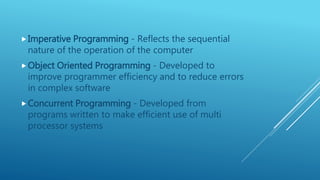
Imperative Programming - Reflects the sequential
nature of the operation of the computer
Object Oriented Programming - Developed to
improve programmer efficiency and to reduce errors
in complex software
Concurrent Programming - Developed from
programs written to make efficient use of multi
processor systems
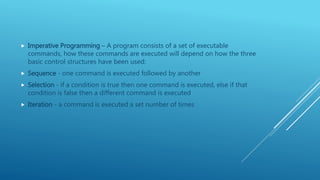
 Imperative Programming – A program consists of a set of executable
commands, how these commands are executed will depend on how the three
basic control structures have been used:
 Sequence - one command is executed followed by another
 Selection - if a condition is true then one command is executed, else if that
condition is false then a different command is executed
 Iteration - a command is executed a set number of times
 Imperative Programming is sometimes referred to as Procedural Programming.
 Being able to combine commands into a single block of self-contained code is referred
to as Modularity.

Programming Paradigm

  • 1.
  • 2.
    Imperative Programming -Reflects the sequential nature of the operation of the computer Object Oriented Programming - Developed to improve programmer efficiency and to reduce errors in complex software Concurrent Programming - Developed from programs written to make efficient use of multi processor systems
  • 3.
     Imperative Programming– A program consists of a set of executable commands, how these commands are executed will depend on how the three basic control structures have been used:  Sequence - one command is executed followed by another  Selection - if a condition is true then one command is executed, else if that condition is false then a different command is executed  Iteration - a command is executed a set number of times
  • 4.
     Imperative Programmingis sometimes referred to as Procedural Programming.  Being able to combine commands into a single block of self-contained code is referred to as Modularity.