Procedural Vs Object Oriented
Programming
Programming Paradigm
Programming paradigm is an approach to
solve problem using some programming
language or also we can say it is a method to
solve a problem using tools and techniques
that are available to us following some
approach.
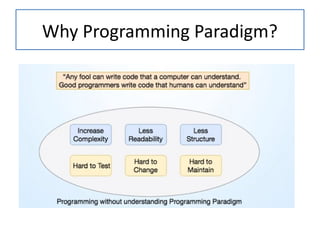
Why Programming Paradigm?
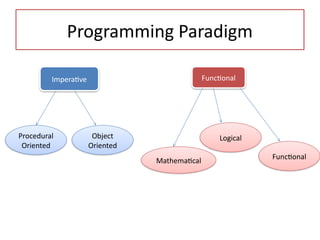
Programming Paradigm
Imperative Functional
Procedural
Oriented
Object
Oriented
Mathematical
Logical
Functional
Imperative Paradigm
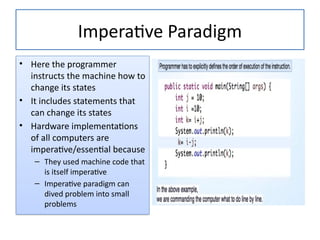
• Here the programmer
instructs the machine how to
change its states
• It includes statements that
can change its states
• Hardware implementations
of all computers are
imperative/essential because
– They used machine code that
is itself imperative
– Imperative paradigm can
dived problem into small
problems
Procedural Paradigm
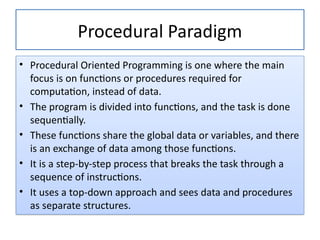
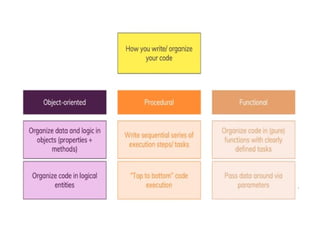
• Procedural Oriented Programming is one where the main
focus is on functions or procedures required for
computation, instead of data.
• The program is divided into functions, and the task is done
sequentially.
• These functions share the global data or variables, and there
is an exchange of data among those functions.
• It is a step-by-step process that breaks the task through a
sequence of instructions.
• It uses a top-down approach and sees data and procedures
as separate structures.
Object Oriented Paradigm
• Object-Oriented Programming (OOP) is a
fundamental programming concept that
developer uses for binding data and functions
together using the concept of object and class.
• It helps the programmer to control and access
the data.
• It also improves the code readability and
reusability.
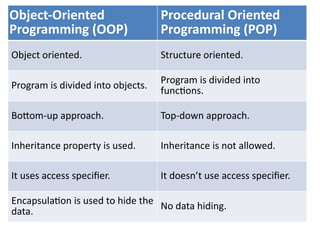
Object-Oriented
Programming (OOP)
Procedural Oriented
Programming (POP)
Object oriented. Structure oriented.
Program is divided into objects. Program is divided into
functions.
Bottom-up approach. Top-down approach.
Inheritance property is used. Inheritance is not allowed.
It uses access specifier. It doesn’t use access specifier.
Encapsulation is used to hide the
data.
No data hiding.
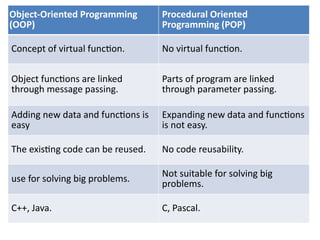
Object-Oriented Programming
(OOP)
Procedural Oriented
Programming (POP)
Concept of virtual function. No virtual function.
Object functions are linked
through message passing.
Parts of program are linked
through parameter passing.
Adding new data and functions is
easy
Expanding new data and functions
is not easy.
The existing code can be reused. No code reusability.
use for solving big problems.
Not suitable for solving big
problems.
C++, Java. C, Pascal.

1.2 Procedural Vs Object Oriented Programming.pptx

  • 1.
    Procedural Vs ObjectOriented Programming
  • 2.
    Programming Paradigm Programming paradigmis an approach to solve problem using some programming language or also we can say it is a method to solve a problem using tools and techniques that are available to us following some approach.
  • 3.
  • 4.
  • 5.
    Imperative Paradigm • Herethe programmer instructs the machine how to change its states • It includes statements that can change its states • Hardware implementations of all computers are imperative/essential because – They used machine code that is itself imperative – Imperative paradigm can dived problem into small problems
  • 6.
    Procedural Paradigm • ProceduralOriented Programming is one where the main focus is on functions or procedures required for computation, instead of data. • The program is divided into functions, and the task is done sequentially. • These functions share the global data or variables, and there is an exchange of data among those functions. • It is a step-by-step process that breaks the task through a sequence of instructions. • It uses a top-down approach and sees data and procedures as separate structures.
  • 7.
    Object Oriented Paradigm •Object-Oriented Programming (OOP) is a fundamental programming concept that developer uses for binding data and functions together using the concept of object and class. • It helps the programmer to control and access the data. • It also improves the code readability and reusability.
  • 9.
    Object-Oriented Programming (OOP) Procedural Oriented Programming(POP) Object oriented. Structure oriented. Program is divided into objects. Program is divided into functions. Bottom-up approach. Top-down approach. Inheritance property is used. Inheritance is not allowed. It uses access specifier. It doesn’t use access specifier. Encapsulation is used to hide the data. No data hiding.
  • 10.
    Object-Oriented Programming (OOP) Procedural Oriented Programming(POP) Concept of virtual function. No virtual function. Object functions are linked through message passing. Parts of program are linked through parameter passing. Adding new data and functions is easy Expanding new data and functions is not easy. The existing code can be reused. No code reusability. use for solving big problems. Not suitable for solving big problems. C++, Java. C, Pascal.