1
Principles of Automatic
Control
Qingpu Hu (胡青璞)
Yellow River Conservancy Technical Institute (YRCTI)
2
l Instructor:
- Chinese name: Qingpu Hu (胡青璞)
- English name: Jaden
l Office: 5# Training building sy5530
l Email: Jaden_yrcti@163.com
l WeChat: qingpupu
Welcome to contact me
3
Ø Lectures: 48 hours
Ø Grading:
- Attendance
- Homework
- Class participation
- Final examination
Ø Objectives:
- Basic understanding of control systems
- Engineering applications
Course Description
4
Ø Slides / Lecture notes
Ø References:
- 胡寿松主编,《自动控制原理》
- 李俨主编,Principles of Automatic Control
- Carlos A. Smith, Principles and Practice of
Automatic Process Control
- H. Bischoff, Process Control System
- Curtis D. Johnson, Process Control
Instrumentation Technology
Course Materials
5
Principles of Automatic Control
CHAPTER 1
Introduction to Control Systems
6
1.1 Introduction
1.2 Development of Automatic Control
1.3 Basic Concepts of Automatic Control
1.4 Control System Composition
1.5 Classification of Automatic Control Systems
1.6 General Requirements for Control Systems
Outline
7
Ø Requirements:
- Open-loop control vs. Closed-loop control
- Feedback control
- Block diagram
- Components distinguishment,
such as, System Input, Output,
Controller, Plant, Sensor
Introduction to control systems
8
- What is “Control” ?
- Development of “ Control Theory”
- Why to study “Automatic Control” ?
- What is “ Automatic Control” ?
- Feedback control structure
- Types of control systems
- Basic requirements on control systems
Introduction to control systems
9
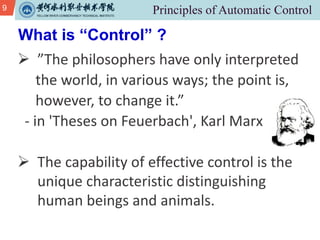
Ø ”The philosophers have only interpreted
the world, in various ways; the point is,
however, to change it.”
- in 'Theses on Feuerbach', Karl Marx
Ø The capability of effective control is the
unique characteristic distinguishing
human beings and animals.
What is “Control” ?
10
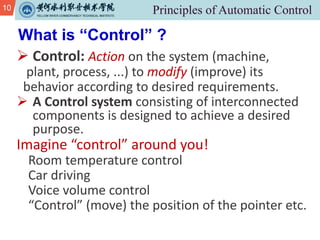
Ø Control: Action on the system (machine,
plant, process, ...) to modify (improve) its
behavior according to desired requirements.
Ø A Control system consisting of interconnected
components is designed to achieve a desired
purpose.
Imagine “control” around you!
Room temperature control
Car driving
Voice volume control
“Control” (move) the position of the pointer etc.
What is “Control” ?
11
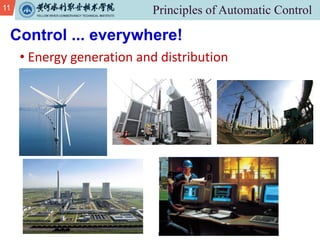
• Energy generation and distribution
Control ... everywhere!
12
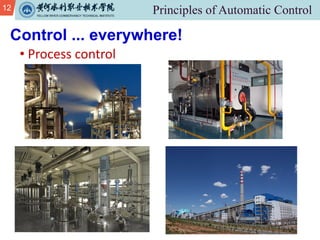
• Process control
Control ... everywhere!
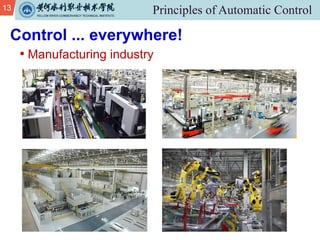
13
• Manufacturing industry
Control ... everywhere!
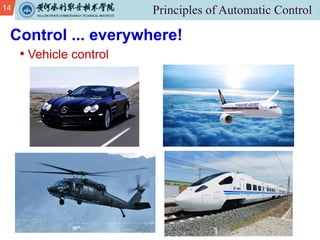
14
• Vehicle control
Control ... everywhere!
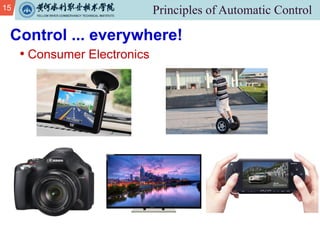
15
• Consumer Electronics
Control ... everywhere!
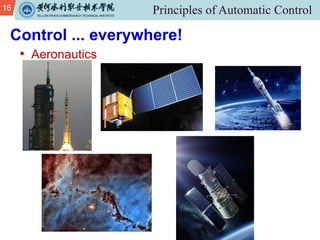
16
• Aeronautics
Control ... everywhere!
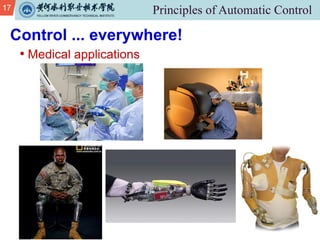
17
• Medical applications
Control ... everywhere!
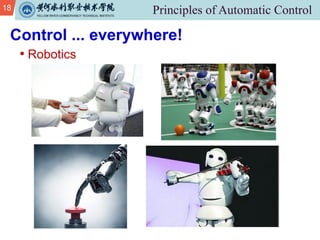
18
• Robotics
Control ... everywhere!
19
Ø Applications of automatic control
include, but not limited to, aircraft,
robots, civil engineering structures,
process control,..., etc.
Ø Automatic control has played a vital
role in the advance of engineering and
science.
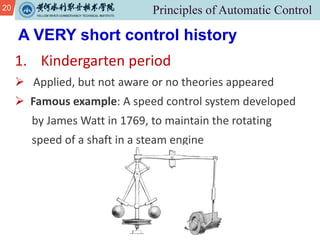
20
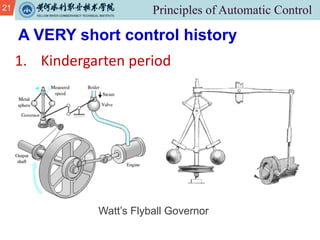
1. Kindergarten period
Ø Applied, but not aware or no theories appeared
Ø Famous example: A speed control system developed
by James Watt in 1769, to maintain the rotating
speed of a shaft in a steam engine
A VERY short control history
21
1. Kindergarten period
A VERY short control history
Watt’s Flyball Governor
22
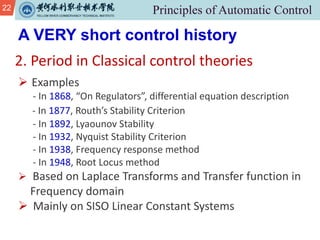
2. Period in Classical control theories
A VERY short control history
Ø Examples
- In 1868, “On Regulators”, differential equation description
- In 1877, Routh’s Stability Criterion
- In 1892, Lyaounov Stability
- In 1932, Nyquist Stability Criterion
- In 1938, Frequency response method
- In 1948, Root Locus method
Ø Based on Laplace Transforms and Transfer function in
Frequency domain
Ø Mainly on SISO Linear Constant Systems
23
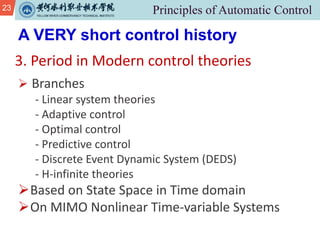
3. Period in Modern control theories
A VERY short control history
Ø Branches
- Linear system theories
- Adaptive control
- Optimal control
- Predictive control
- Discrete Event Dynamic System (DEDS)
- H-infinite theories
ØBased on State Space in Time domain
ØOn MIMO Nonlinear Time-variable Systems
24
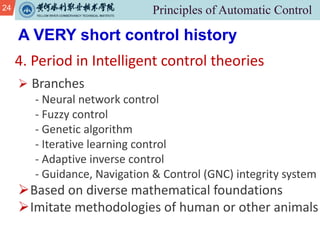
4. Period in Intelligent control theories
A VERY short control history
Ø Branches
- Neural network control
- Fuzzy control
- Genetic algorithm
- Iterative learning control
- Adaptive inverse control
- Guidance, Navigation & Control (GNC) integrity system
ØBased on diverse mathematical foundations
ØImitate methodologies of human or other animals
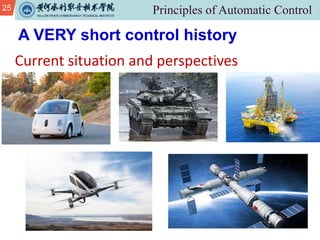
25
Current situation and perspectives
A VERY short control history
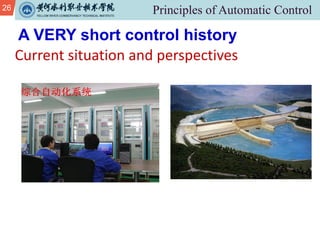
26
Current situation and perspectives
A VERY short control history
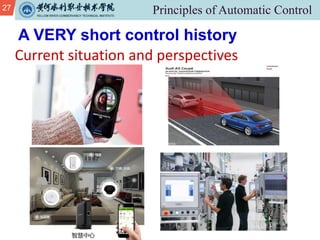
27
Current situation and perspectives
A VERY short control history
28
Other areas of interest:
l Biomedical devices
l Biological systems
l Environment
l Socio-Economic systems
l Financial markets
l Management
l ……
A VERY short control history
29
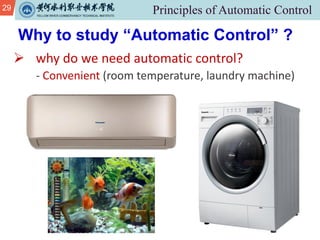
Ø why do we need automatic control?
- Convenient (room temperature, laundry machine)
Why to study “Automatic Control” ?
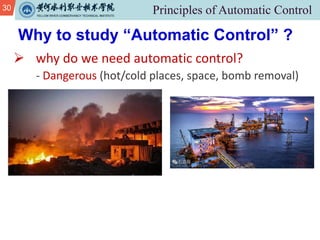
30
Ø why do we need automatic control?
- Dangerous (hot/cold places, space, bomb removal)
Why to study “Automatic Control” ?
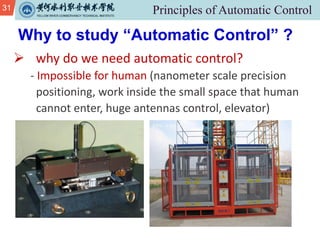
31
Ø why do we need automatic control?
- Impossible for human (nanometer scale precision
positioning, work inside the small space that human
cannot enter, huge antennas control, elevator)
Why to study “Automatic Control” ?
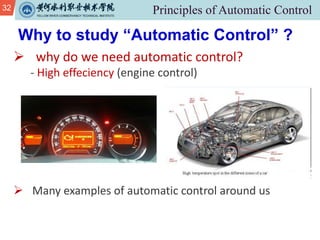
32
Ø why do we need automatic control?
- High effeciency (engine control)
Ø Many examples of automatic control around us
Why to study “Automatic Control” ?
33
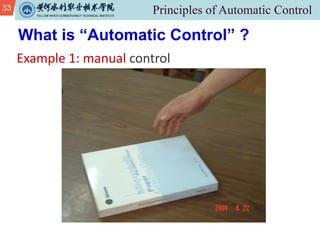
Example 1: manual control
What is “Automatic Control” ?
34
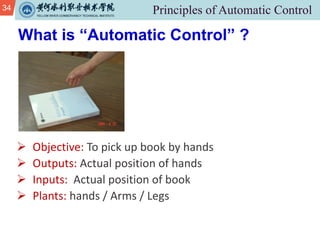
Ø Objective: To pick up book by hands
Ø Outputs: Actual position of hands
Ø Inputs: Actual position of book
Ø Plants: hands / Arms / Legs
What is “Automatic Control” ?
35
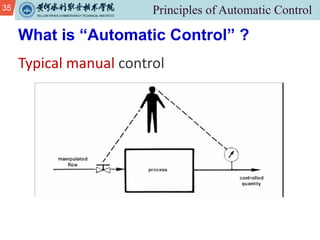
What is “Automatic Control” ?
Typical manual control
36
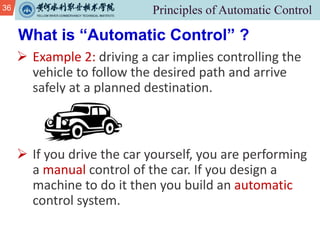
Ø Example 2: driving a car implies controlling the
vehicle to follow the desired path and arrive
safely at a planned destination.
Ø If you drive the car yourself, you are performing
a manual control of the car. If you design a
machine to do it then you build an automatic
control system.
What is “Automatic Control” ?
37
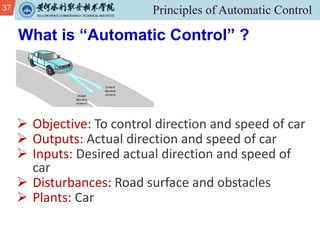
Ø Objective: To control direction and speed of car
Ø Outputs: Actual direction and speed of car
Ø Inputs: Desired actual direction and speed of
car
Ø Disturbances: Road surface and obstacles
Ø Plants: Car
What is “Automatic Control” ?
38
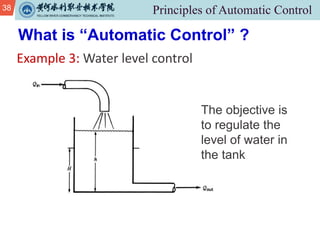
Example 3: Water level control
What is “Automatic Control” ?
The objective is
to regulate the
level of water in
the tank
39
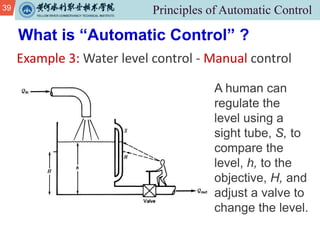
Example 3: Water level control - Manual control
What is “Automatic Control” ?
A human can
regulate the
level using a
sight tube, S, to
compare the
level, h, to the
objective, H, and
adjust a valve to
change the level.
40
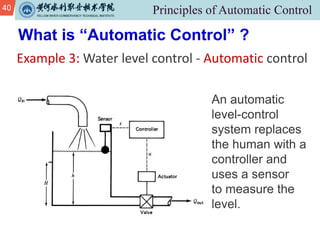
Example 3: Water level control - Automatic control
What is “Automatic Control” ?
An automatic
level-control
system replaces
the human with a
controller and
uses a sensor
to measure the
level.
41
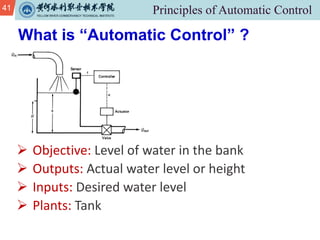
Ø Objective: Level of water in the bank
Ø Outputs: Actual water level or height
Ø Inputs: Desired water level
Ø Plants: Tank
What is “Automatic Control” ?
42
What is “Automatic Control” ?
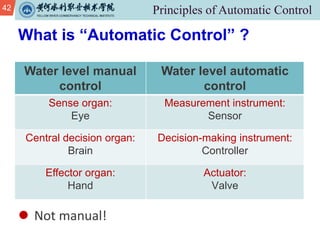
Water level manual
control
Water level automatic
control
Sense organ:
Eye
Measurement instrument:
Sensor
Central decision organ:
Brain
Decision-making instrument:
Controller
Effector organ:
Hand
Actuator:
Valve
l Not manual!
43
definitions
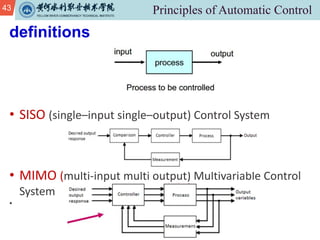
• SISO (single–input single–output) Control System
• MIMO (multi-input multi output) Multivariable Control
System
•
44
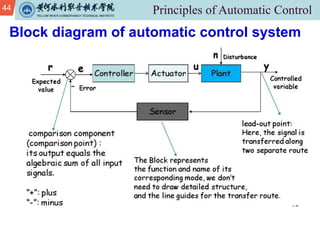
Block diagram of automatic control system
45
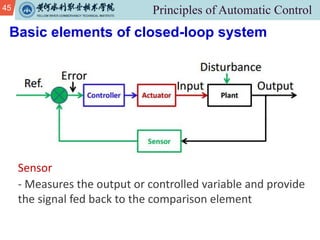
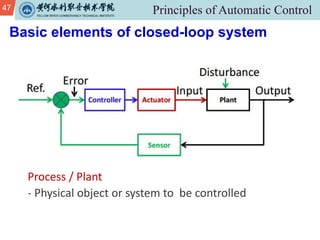
Basic elements of closed-loop system
Sensor
- Measures the output or controlled variable and provide
the signal fed back to the comparison element
46
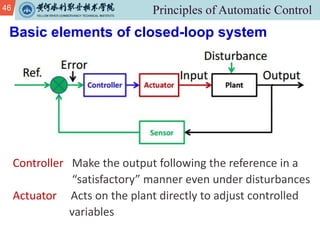
Basic elements of closed-loop system
Controller Make the output following the reference in a
“satisfactory” manner even under disturbances
Actuator Acts on the plant directly to adjust controlled
variables
47
Basic elements of closed-loop system
Process / Plant
- Physical object or system to be controlled
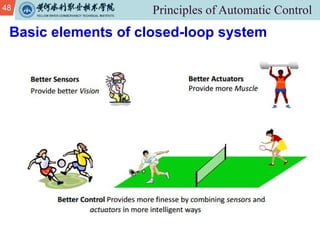
48
Basic elements of closed-loop system
49
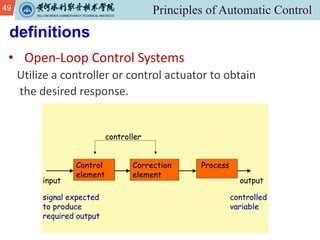
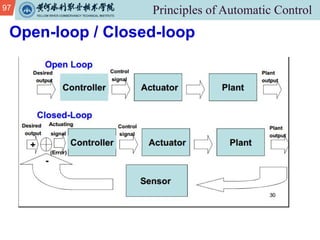
• Open-Loop Control Systems
Utilize a controller or control actuator to obtain
the desired response.
definitions
50
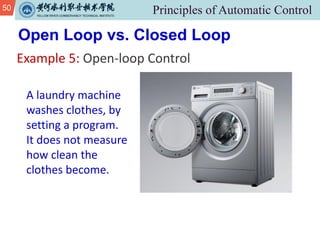
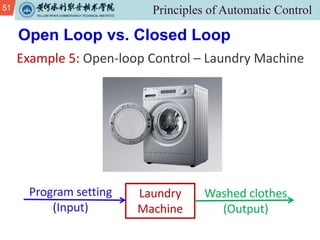
Example 5: Open-loop Control
Open Loop vs. Closed Loop
A laundry machine
washes clothes, by
setting a program.
It does not measure
how clean the
clothes become.
51
Example 5: Open-loop Control – Laundry Machine
Open Loop vs. Closed Loop
52
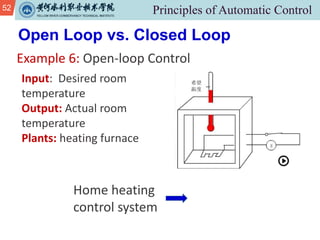
Example 6: Open-loop Control
Open Loop vs. Closed Loop
Input: Desired room
temperature
Output: Actual room
temperature
Plants: heating furnace
Home heating
control system
53
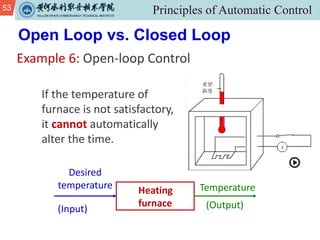
Example 6: Open-loop Control
Open Loop vs. Closed Loop
Heating
furnace
Desired
temperature
(Input)
Temperature
(Output)
If the temperature of
furnace is not satisfactory,
it cannot automatically
alter the time.
54
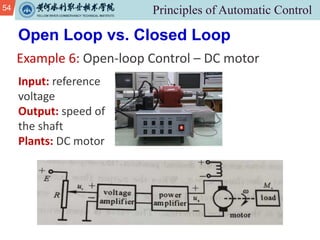
Example 6: Open-loop Control – DC motor
Open Loop vs. Closed Loop
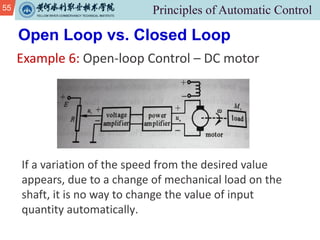
Input: reference
voltage
Output: speed of
the shaft
Plants: DC motor
55
Example 6: Open-loop Control – DC motor
Open Loop vs. Closed Loop
If a variation of the speed from the desired value
appears, due to a change of mechanical load on the
shaft, it is no way to change the value of input
quantity automatically.
56
Example 6: Open-loop Control – DC motor
Open Loop vs. Closed Loop
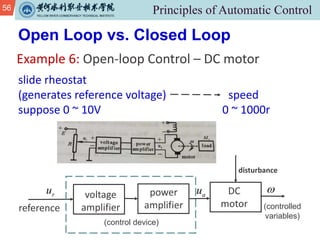
slide rheostat
(generates reference voltage) speed
suppose 0 ~ 10V 0 ~ 1000r
voltage
amplifier
power
amplifier
r
u
reference
a
u
(control device)
DC
motor
disturbance

(controlled
variables)
57
Example 6: Open Loop Control – DC motor
Open-loop control systems
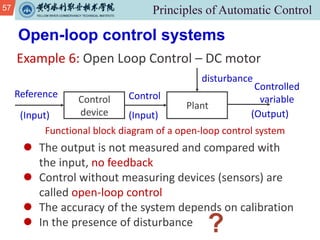
l The output is not measured and compared with
the input, no feedback
l Control without measuring devices (sensors) are
called open-loop control
l The accuracy of the system depends on calibration
l In the presence of disturbance
Control
device
Plant
Reference
(Input)
Control
(Input)
Controlled
variable
(Output)
disturbance
Functional block diagram of a open-loop control system
58
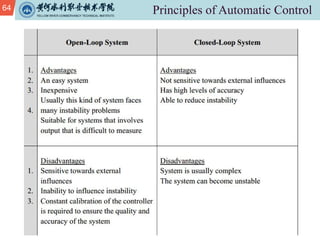
Open-loop control systems
Advantages:
l Simple construction and ease of maintenance.
l Convenient when output is hard to measure or
measuring the output precisely is economically
not feasible. (e.g. washer system)
Disadvantages:
l Disturbances and changes in calibration cause
errors, and the output may be different from what
is desired.
59
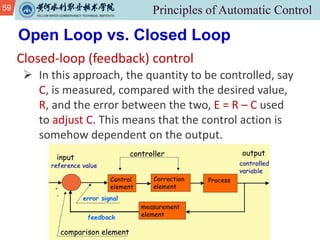
Closed-loop (feedback) control
Open Loop vs. Closed Loop
Ø In this approach, the quantity to be controlled, say
C, is measured, compared with the desired value,
R, and the error between the two, E = R – C used
to adjust C. This means that the control action is
somehow dependent on the output.
60
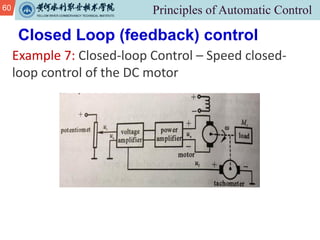
Example 7: Closed-loop Control – Speed closed-
loop control of the DC motor
Closed Loop (feedback) control
61
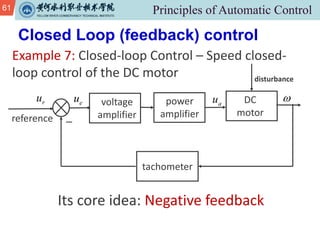
Example 7: Closed-loop Control – Speed closed-
loop control of the DC motor
Closed Loop (feedback) control
voltage
amplifier
power
amplifier
r
u
reference
a
u DC
motor
disturbance

tachometer
_
e
u
Its core idea: Negative feedback
62
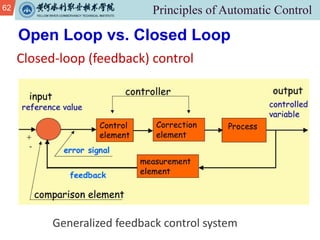
Closed-loop (feedback) control
Open Loop vs. Closed Loop
Generalized feedback control system
63
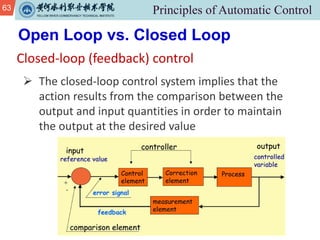
Closed-loop (feedback) control
Open Loop vs. Closed Loop
Ø The closed-loop control system implies that the
action results from the comparison between the
output and input quantities in order to maintain
the output at the desired value
64
65
Exercise
1. Consider an electric oven in a typical modern kitchen.
Identify the objective, plant, controlled variable, and
the disturbances.
2. Imagine you own a backyard swimming pool! Describe
a manual control system to measure pH and to add an
acidic solution to adjust pH. Define the plant,
controlled variable, and the disturbances.
3. Now automate the control of your swimming pool!
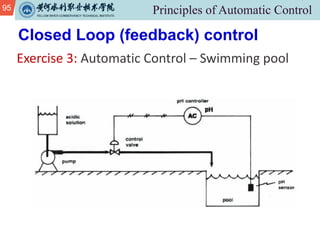
Assume you have a tank of acid solution to pump into
your pool to control pH.
66
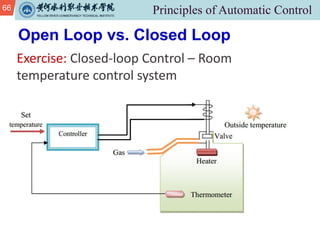
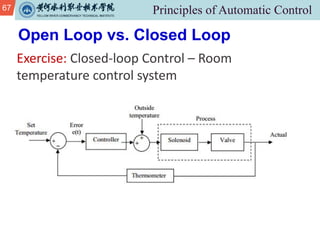
Exercise: Closed-loop Control – Room
temperature control system
Open Loop vs. Closed Loop
67
Exercise: Closed-loop Control – Room
temperature control system
Open Loop vs. Closed Loop
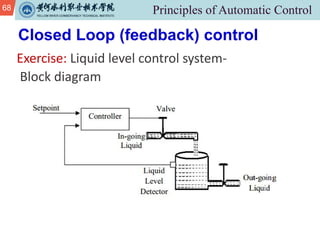
68
Exercise: Liquid level control system-
Block diagram
Closed Loop (feedback) control
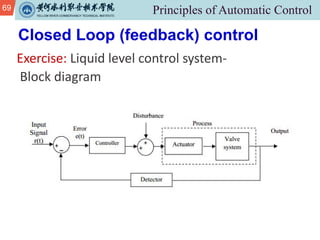
69
Exercise: Liquid level control system-
Block diagram
Closed Loop (feedback) control
70
Principles of Automatic Control
More examples of feedback control
system
71
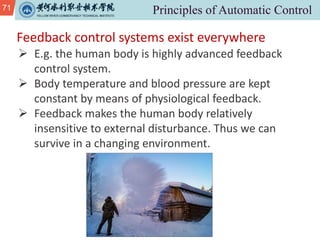
Feedback control systems exist everywhere
Ø E.g. the human body is highly advanced feedback
control system.
Ø Body temperature and blood pressure are kept
constant by means of physiological feedback.
Ø Feedback makes the human body relatively
insensitive to external disturbance. Thus we can
survive in a changing environment.
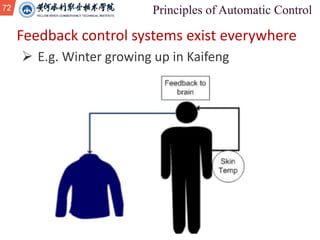
72
Feedback control systems exist everywhere
Ø E.g. Winter growing up in Kaifeng
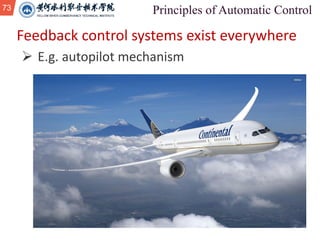
73
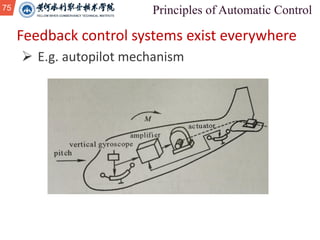
Feedback control systems exist everywhere
Ø E.g. autopilot mechanism
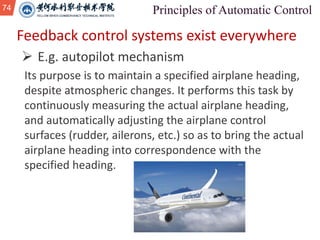
74
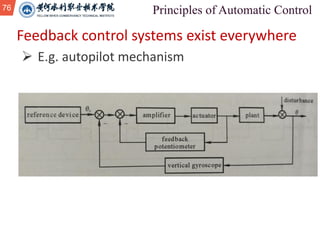
Feedback control systems exist everywhere
Ø E.g. autopilot mechanism
Its purpose is to maintain a specified airplane heading,
despite atmospheric changes. It performs this task by
continuously measuring the actual airplane heading,
and automatically adjusting the airplane control
surfaces (rudder, ailerons, etc.) so as to bring the actual
airplane heading into correspondence with the
specified heading.
75
Feedback control systems exist everywhere
Ø E.g. autopilot mechanism
76
Feedback control systems exist everywhere
Ø E.g. autopilot mechanism
77
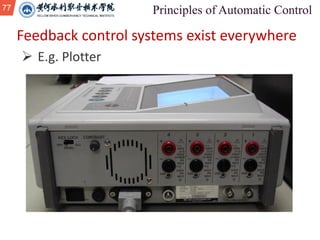
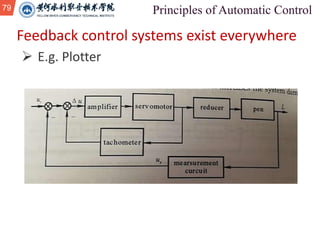
Feedback control systems exist everywhere
Ø E.g. Plotter
78
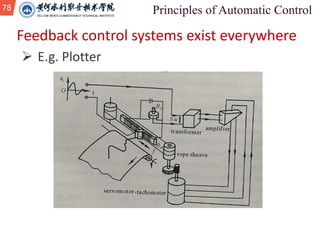
Feedback control systems exist everywhere
Ø E.g. Plotter
79
Feedback control systems exist everywhere
Ø E.g. Plotter
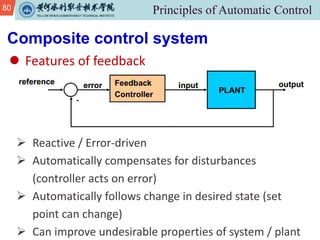
80
l Features of feedback
Composite control system
Ø Reactive / Error-driven
Ø Automatically compensates for disturbances
(controller acts on error)
Ø Automatically follows change in desired state (set
point can change)
Ø Can improve undesirable properties of system / plant
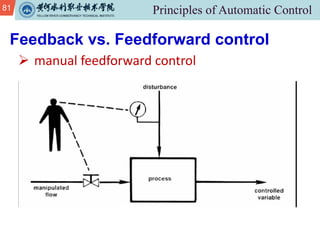
81
Feedback vs. Feedforward control
Ø manual feedforward control
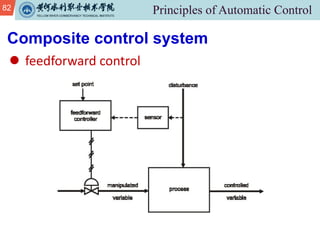
82
l feedforward control
Composite control system
83
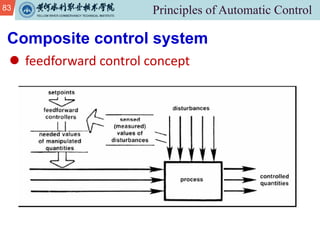
l feedforward control concept
Composite control system
84
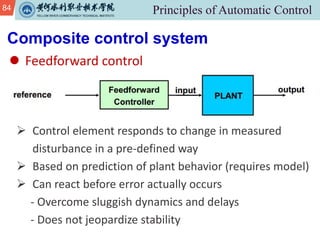
l Feedforward control
Composite control system
Ø Control element responds to change in measured
disturbance in a pre-defined way
Ø Based on prediction of plant behavior (requires model)
Ø Can react before error actually occurs
- Overcome sluggish dynamics and delays
- Does not jeopardize stability
85
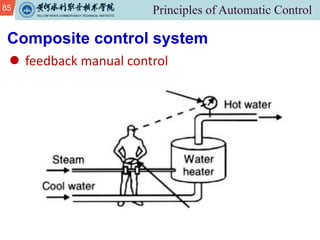
l feedback manual control
Composite control system
86
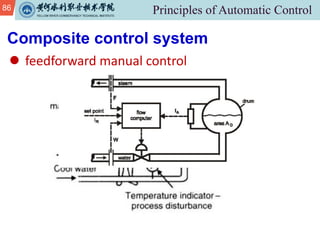
l feedforward manual control
Composite control system
87
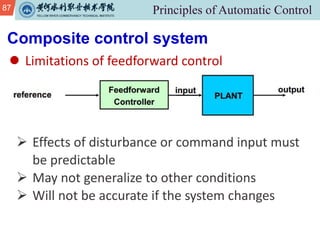
l Limitations of feedforward control
Composite control system
Ø Effects of disturbance or command input must
be predictable
Ø May not generalize to other conditions
Ø Will not be accurate if the system changes
88
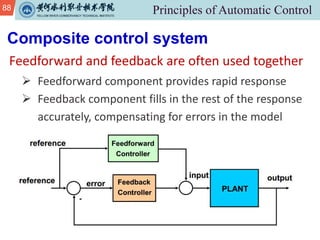
Feedforward and feedback are often used together
Composite control system
Ø Feedforward component provides rapid response
Ø Feedback component fills in the rest of the response
accurately, compensating for errors in the model
89
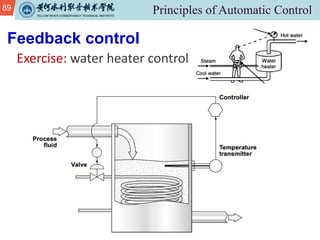
Feedback control
Exercise: water heater control
90
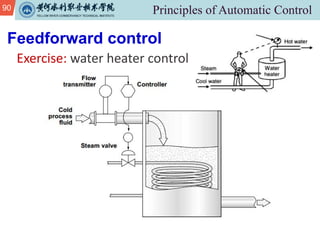
Feedforward control
Exercise: water heater control
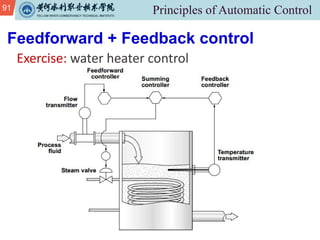
91
Feedforward + Feedback control
Exercise: water heater control
92
Exercise
1. Consider an electric oven in a typical modern kitchen.
Identify the objective, plant, controlled variable, and
the disturbances.
2. Imagine you own a backyard swimming pool! Describe
a manual control system to measure pH and to add an
acidic solution to adjust pH. Define the plant,
controlled variable, and the disturbances.
3. Now automate the control of your swimming pool!
Assume you have a tank of acid solution to pump into
your pool to control pH.
93
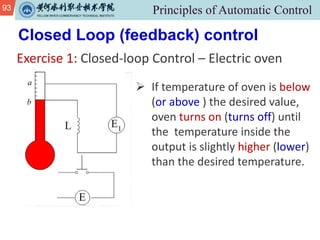
Exercise 1: Closed-loop Control – Electric oven
Closed Loop (feedback) control
Ø If temperature of oven is below
(or above ) the desired value,
oven turns on (turns off) until
the temperature inside the
output is slightly higher (lower)
than the desired temperature.
94
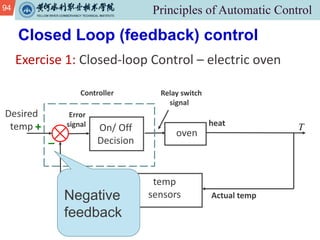
Exercise 1: Closed-loop Control – electric oven
On/ Off
Decision
temp
sensors
Relay switch
signal
Desired
temp
oven
“Measured” temp
Actual temp
+
_
Controller
T
heat
Error
signal
Closed Loop (feedback) control
Negative
feedback
95
Exercise 3: Automatic Control – Swimming pool
Closed Loop (feedback) control
96
Classification of control systems
According to structure
• Open-loop control systems
• Closed-loop control systems
• Composite control systems
97
Open-loop / Closed-loop
98
Classification of control systems
According to type of reference input
• Constant-value control system
(e.g. Water level control, DC motor speed control)
• Servo/tracking control system
(e.g. Aircraft-autopilot, Guided missile)
• Programming control system
(e.g. Numerically controlled machine)
99
Classification of control systems
According to type of reference input
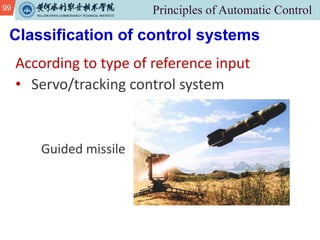
• Servo/tracking control system
Guided missile
100
Classification of control systems
According to type of reference input
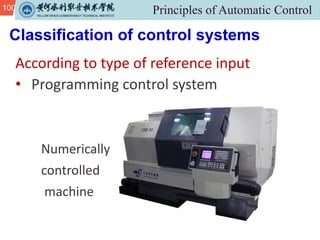
• Programming control system
Numerically
controlled
machine
101
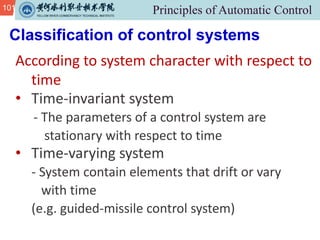
Classification of control systems
According to system character with respect to
time
• Time-invariant system
- The parameters of a control system are
stationary with respect to time
• Time-varying system
- System contain elements that drift or vary
with time
(e.g. guided-missile control system)
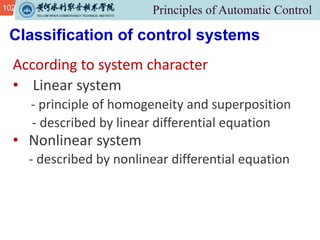
102
Classification of control systems
According to system character
• Linear system
- principle of homogeneity and superposition
- described by linear differential equation
• Nonlinear system
- described by nonlinear differential equation
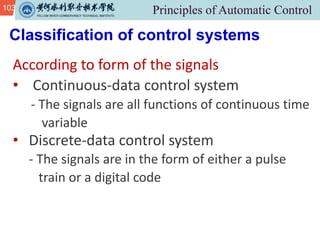
103
Classification of control systems
According to form of the signals
• Continuous-data control system
- The signals are all functions of continuous time
variable
• Discrete-data control system
- The signals are in the form of either a pulse
train or a digital code
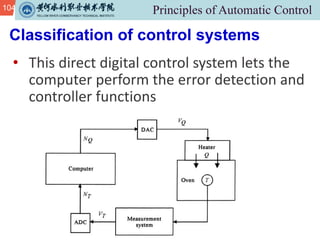
104
Classification of control systems
• This direct digital control system lets the
computer perform the error detection and
controller functions
105
Classification of control systems
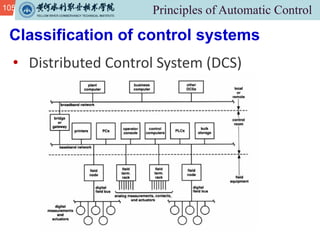
• Distributed Control System (DCS)
106
• The system is expected to be affected Only by
control input, NOT by disturbance.
• Two-fold tasks:
(1) how the system responses to the external
input?
(2) how the system resists disturbances?
Basic requirements for control systems
107
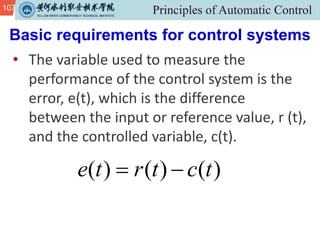
• The variable used to measure the
performance of the control system is the
error, e(t), which is the difference
between the input or reference value, r (t),
and the controlled variable, c(t).
Basic requirements for control systems
( ) ( ) ( )
e t r t c t
 
108
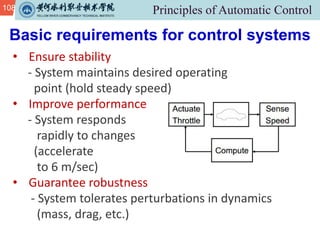
• Ensure stability
- System maintains desired operating
point (hold steady speed)
• Improve performance
- System responds
rapidly to changes
(accelerate
to 6 m/sec)
• Guarantee robustness
- System tolerates perturbations in dynamics
(mass, drag, etc.)
Basic requirements for control systems
109
A suitable control system should have
some of the following properties:
1. Stability
2. Accuracy
3. Swiftness
Basic requirements for control systems
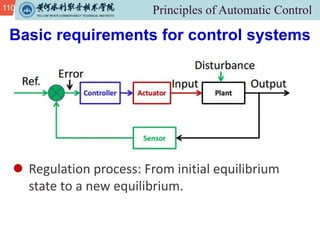
110
l Regulation process: From initial equilibrium
state to a new equilibrium.
Basic requirements for control systems
111
Basic requirements for control systems
l The whole regulation process can be
divided into two stages:
- Transient process in which the controlled
variable goes from the initial state to the final
state.
- steady-state process in which the system
output stay at a new equilibrium state and
maintain at a constant value.
112
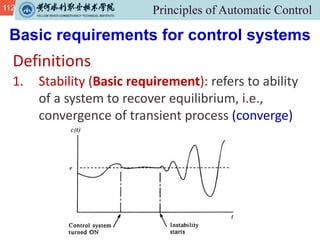
Definitions
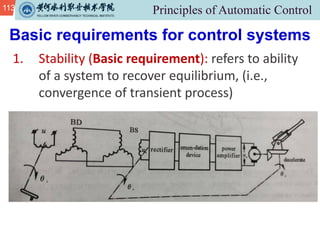
1. Stability (Basic requirement): refers to ability
of a system to recover equilibrium, i.e.,
convergence of transient process (converge)
Basic requirements for control systems
113
1. Stability (Basic requirement): refers to ability
of a system to recover equilibrium, (i.e.,
convergence of transient process)
Basic requirements for control systems
114
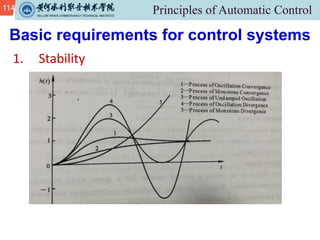
1. Stability
Basic requirements for control systems
115
1. Stability ---(converge)
2. Accuracy : refers to size of a steady-state
error when the transient process ends.
(small)
(Steady-state error = desired output – actual output)
3. Swiftness: refers to duration of transient
process (quick)
Basic requirements for control systems
116
Note
For a control system, the above three
performance indices (stability, accuracy,
swiftness) are sometimes contradictory.
In design of a practical control system, we
always need to make compromise.
Basic requirements for control systems
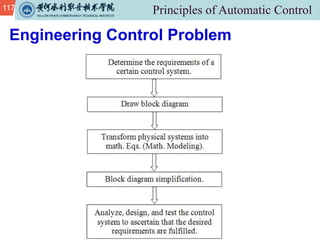
117
Engineering Control Problem
118
Ø Chapter 1:
Control essentiality
Examples of control systems
Open-loop versus closed-loop control
Component block diagram
Ø Next lecture:
Time Response of Linear System
Summary
119
1. Consider an automatic gas-fired, home hot-water
tank. Identify the controlled variable, the
manipulated variable, and the disturbances.
Assignment – Chapter 1
120
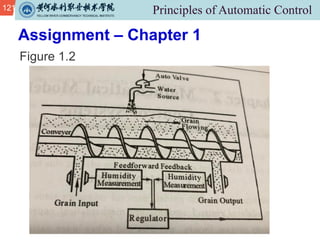
2. Figure 1.2 shows the grain humidity control system.
There is an optimal grinding humidity on which we can
acquire the most flour. So, we need to add some water
to grain to achieve the optimal grain humidity. Grain is
conveyed with a constant flow under an auto valve
which controls the water quantity. In this process, grain
flow, initial grain humidity and water pressure consists
of the disturbance of the grain humidity control system.
In order to get better precision, feed forward control is
adapted. Please draw the block diagram of the system.
Assignment – Chapter 1
121
Figure 1.2
Assignment – Chapter 1

Principles of Automatic Control and .pdf

  • 1.
    1 Principles of Automatic Control QingpuHu (胡青璞) Yellow River Conservancy Technical Institute (YRCTI)
  • 2.
    2 l Instructor: - Chinesename: Qingpu Hu (胡青璞) - English name: Jaden l Office: 5# Training building sy5530 l Email: Jaden_yrcti@163.com l WeChat: qingpupu Welcome to contact me
  • 3.
    3 Ø Lectures: 48hours Ø Grading: - Attendance - Homework - Class participation - Final examination Ø Objectives: - Basic understanding of control systems - Engineering applications Course Description
  • 4.
    4 Ø Slides /Lecture notes Ø References: - 胡寿松主编,《自动控制原理》 - 李俨主编,Principles of Automatic Control - Carlos A. Smith, Principles and Practice of Automatic Process Control - H. Bischoff, Process Control System - Curtis D. Johnson, Process Control Instrumentation Technology Course Materials
  • 5.
    5 Principles of AutomaticControl CHAPTER 1 Introduction to Control Systems
  • 6.
    6 1.1 Introduction 1.2 Developmentof Automatic Control 1.3 Basic Concepts of Automatic Control 1.4 Control System Composition 1.5 Classification of Automatic Control Systems 1.6 General Requirements for Control Systems Outline
  • 7.
    7 Ø Requirements: - Open-loopcontrol vs. Closed-loop control - Feedback control - Block diagram - Components distinguishment, such as, System Input, Output, Controller, Plant, Sensor Introduction to control systems
  • 8.
    8 - What is“Control” ? - Development of “ Control Theory” - Why to study “Automatic Control” ? - What is “ Automatic Control” ? - Feedback control structure - Types of control systems - Basic requirements on control systems Introduction to control systems
  • 9.
    9 Ø ”The philosophershave only interpreted the world, in various ways; the point is, however, to change it.” - in 'Theses on Feuerbach', Karl Marx Ø The capability of effective control is the unique characteristic distinguishing human beings and animals. What is “Control” ?
  • 10.
    10 Ø Control: Actionon the system (machine, plant, process, ...) to modify (improve) its behavior according to desired requirements. Ø A Control system consisting of interconnected components is designed to achieve a desired purpose. Imagine “control” around you! Room temperature control Car driving Voice volume control “Control” (move) the position of the pointer etc. What is “Control” ?
  • 11.
    11 • Energy generationand distribution Control ... everywhere!
  • 12.
  • 13.
  • 14.
  • 15.
  • 16.
  • 17.
  • 18.
  • 19.
    19 Ø Applications ofautomatic control include, but not limited to, aircraft, robots, civil engineering structures, process control,..., etc. Ø Automatic control has played a vital role in the advance of engineering and science.
  • 20.
    20 1. Kindergarten period ØApplied, but not aware or no theories appeared Ø Famous example: A speed control system developed by James Watt in 1769, to maintain the rotating speed of a shaft in a steam engine A VERY short control history
  • 21.
    21 1. Kindergarten period AVERY short control history Watt’s Flyball Governor
  • 22.
    22 2. Period inClassical control theories A VERY short control history Ø Examples - In 1868, “On Regulators”, differential equation description - In 1877, Routh’s Stability Criterion - In 1892, Lyaounov Stability - In 1932, Nyquist Stability Criterion - In 1938, Frequency response method - In 1948, Root Locus method Ø Based on Laplace Transforms and Transfer function in Frequency domain Ø Mainly on SISO Linear Constant Systems
  • 23.
    23 3. Period inModern control theories A VERY short control history Ø Branches - Linear system theories - Adaptive control - Optimal control - Predictive control - Discrete Event Dynamic System (DEDS) - H-infinite theories ØBased on State Space in Time domain ØOn MIMO Nonlinear Time-variable Systems
  • 24.
    24 4. Period inIntelligent control theories A VERY short control history Ø Branches - Neural network control - Fuzzy control - Genetic algorithm - Iterative learning control - Adaptive inverse control - Guidance, Navigation & Control (GNC) integrity system ØBased on diverse mathematical foundations ØImitate methodologies of human or other animals
  • 25.
    25 Current situation andperspectives A VERY short control history
  • 26.
    26 Current situation andperspectives A VERY short control history
  • 27.
    27 Current situation andperspectives A VERY short control history
  • 28.
    28 Other areas ofinterest: l Biomedical devices l Biological systems l Environment l Socio-Economic systems l Financial markets l Management l …… A VERY short control history
  • 29.
    29 Ø why dowe need automatic control? - Convenient (room temperature, laundry machine) Why to study “Automatic Control” ?
  • 30.
    30 Ø why dowe need automatic control? - Dangerous (hot/cold places, space, bomb removal) Why to study “Automatic Control” ?
  • 31.
    31 Ø why dowe need automatic control? - Impossible for human (nanometer scale precision positioning, work inside the small space that human cannot enter, huge antennas control, elevator) Why to study “Automatic Control” ?
  • 32.
    32 Ø why dowe need automatic control? - High effeciency (engine control) Ø Many examples of automatic control around us Why to study “Automatic Control” ?
  • 33.
    33 Example 1: manualcontrol What is “Automatic Control” ?
  • 34.
    34 Ø Objective: Topick up book by hands Ø Outputs: Actual position of hands Ø Inputs: Actual position of book Ø Plants: hands / Arms / Legs What is “Automatic Control” ?
  • 35.
    35 What is “AutomaticControl” ? Typical manual control
  • 36.
    36 Ø Example 2:driving a car implies controlling the vehicle to follow the desired path and arrive safely at a planned destination. Ø If you drive the car yourself, you are performing a manual control of the car. If you design a machine to do it then you build an automatic control system. What is “Automatic Control” ?
  • 37.
    37 Ø Objective: Tocontrol direction and speed of car Ø Outputs: Actual direction and speed of car Ø Inputs: Desired actual direction and speed of car Ø Disturbances: Road surface and obstacles Ø Plants: Car What is “Automatic Control” ?
  • 38.
    38 Example 3: Waterlevel control What is “Automatic Control” ? The objective is to regulate the level of water in the tank
  • 39.
    39 Example 3: Waterlevel control - Manual control What is “Automatic Control” ? A human can regulate the level using a sight tube, S, to compare the level, h, to the objective, H, and adjust a valve to change the level.
  • 40.
    40 Example 3: Waterlevel control - Automatic control What is “Automatic Control” ? An automatic level-control system replaces the human with a controller and uses a sensor to measure the level.
  • 41.
    41 Ø Objective: Levelof water in the bank Ø Outputs: Actual water level or height Ø Inputs: Desired water level Ø Plants: Tank What is “Automatic Control” ?
  • 42.
    42 What is “AutomaticControl” ? Water level manual control Water level automatic control Sense organ: Eye Measurement instrument: Sensor Central decision organ: Brain Decision-making instrument: Controller Effector organ: Hand Actuator: Valve l Not manual!
  • 43.
    43 definitions • SISO (single–inputsingle–output) Control System • MIMO (multi-input multi output) Multivariable Control System •
  • 44.
    44 Block diagram ofautomatic control system
  • 45.
    45 Basic elements ofclosed-loop system Sensor - Measures the output or controlled variable and provide the signal fed back to the comparison element
  • 46.
    46 Basic elements ofclosed-loop system Controller Make the output following the reference in a “satisfactory” manner even under disturbances Actuator Acts on the plant directly to adjust controlled variables
  • 47.
    47 Basic elements ofclosed-loop system Process / Plant - Physical object or system to be controlled
  • 48.
    48 Basic elements ofclosed-loop system
  • 49.
    49 • Open-Loop ControlSystems Utilize a controller or control actuator to obtain the desired response. definitions
  • 50.
    50 Example 5: Open-loopControl Open Loop vs. Closed Loop A laundry machine washes clothes, by setting a program. It does not measure how clean the clothes become.
  • 51.
    51 Example 5: Open-loopControl – Laundry Machine Open Loop vs. Closed Loop
  • 52.
    52 Example 6: Open-loopControl Open Loop vs. Closed Loop Input: Desired room temperature Output: Actual room temperature Plants: heating furnace Home heating control system
  • 53.
    53 Example 6: Open-loopControl Open Loop vs. Closed Loop Heating furnace Desired temperature (Input) Temperature (Output) If the temperature of furnace is not satisfactory, it cannot automatically alter the time.
  • 54.
    54 Example 6: Open-loopControl – DC motor Open Loop vs. Closed Loop Input: reference voltage Output: speed of the shaft Plants: DC motor
  • 55.
    55 Example 6: Open-loopControl – DC motor Open Loop vs. Closed Loop If a variation of the speed from the desired value appears, due to a change of mechanical load on the shaft, it is no way to change the value of input quantity automatically.
  • 56.
    56 Example 6: Open-loopControl – DC motor Open Loop vs. Closed Loop slide rheostat (generates reference voltage) speed suppose 0 ~ 10V 0 ~ 1000r voltage amplifier power amplifier r u reference a u (control device) DC motor disturbance  (controlled variables)
  • 57.
    57 Example 6: OpenLoop Control – DC motor Open-loop control systems l The output is not measured and compared with the input, no feedback l Control without measuring devices (sensors) are called open-loop control l The accuracy of the system depends on calibration l In the presence of disturbance Control device Plant Reference (Input) Control (Input) Controlled variable (Output) disturbance Functional block diagram of a open-loop control system
  • 58.
    58 Open-loop control systems Advantages: lSimple construction and ease of maintenance. l Convenient when output is hard to measure or measuring the output precisely is economically not feasible. (e.g. washer system) Disadvantages: l Disturbances and changes in calibration cause errors, and the output may be different from what is desired.
  • 59.
    59 Closed-loop (feedback) control OpenLoop vs. Closed Loop Ø In this approach, the quantity to be controlled, say C, is measured, compared with the desired value, R, and the error between the two, E = R – C used to adjust C. This means that the control action is somehow dependent on the output.
  • 60.
    60 Example 7: Closed-loopControl – Speed closed- loop control of the DC motor Closed Loop (feedback) control
  • 61.
    61 Example 7: Closed-loopControl – Speed closed- loop control of the DC motor Closed Loop (feedback) control voltage amplifier power amplifier r u reference a u DC motor disturbance  tachometer _ e u Its core idea: Negative feedback
  • 62.
    62 Closed-loop (feedback) control OpenLoop vs. Closed Loop Generalized feedback control system
  • 63.
    63 Closed-loop (feedback) control OpenLoop vs. Closed Loop Ø The closed-loop control system implies that the action results from the comparison between the output and input quantities in order to maintain the output at the desired value
  • 64.
  • 65.
    65 Exercise 1. Consider anelectric oven in a typical modern kitchen. Identify the objective, plant, controlled variable, and the disturbances. 2. Imagine you own a backyard swimming pool! Describe a manual control system to measure pH and to add an acidic solution to adjust pH. Define the plant, controlled variable, and the disturbances. 3. Now automate the control of your swimming pool! Assume you have a tank of acid solution to pump into your pool to control pH.
  • 66.
    66 Exercise: Closed-loop Control– Room temperature control system Open Loop vs. Closed Loop
  • 67.
    67 Exercise: Closed-loop Control– Room temperature control system Open Loop vs. Closed Loop
  • 68.
    68 Exercise: Liquid levelcontrol system- Block diagram Closed Loop (feedback) control
  • 69.
    69 Exercise: Liquid levelcontrol system- Block diagram Closed Loop (feedback) control
  • 70.
    70 Principles of AutomaticControl More examples of feedback control system
  • 71.
    71 Feedback control systemsexist everywhere Ø E.g. the human body is highly advanced feedback control system. Ø Body temperature and blood pressure are kept constant by means of physiological feedback. Ø Feedback makes the human body relatively insensitive to external disturbance. Thus we can survive in a changing environment.
  • 72.
    72 Feedback control systemsexist everywhere Ø E.g. Winter growing up in Kaifeng
  • 73.
    73 Feedback control systemsexist everywhere Ø E.g. autopilot mechanism
  • 74.
    74 Feedback control systemsexist everywhere Ø E.g. autopilot mechanism Its purpose is to maintain a specified airplane heading, despite atmospheric changes. It performs this task by continuously measuring the actual airplane heading, and automatically adjusting the airplane control surfaces (rudder, ailerons, etc.) so as to bring the actual airplane heading into correspondence with the specified heading.
  • 75.
    75 Feedback control systemsexist everywhere Ø E.g. autopilot mechanism
  • 76.
    76 Feedback control systemsexist everywhere Ø E.g. autopilot mechanism
  • 77.
    77 Feedback control systemsexist everywhere Ø E.g. Plotter
  • 78.
    78 Feedback control systemsexist everywhere Ø E.g. Plotter
  • 79.
    79 Feedback control systemsexist everywhere Ø E.g. Plotter
  • 80.
    80 l Features offeedback Composite control system Ø Reactive / Error-driven Ø Automatically compensates for disturbances (controller acts on error) Ø Automatically follows change in desired state (set point can change) Ø Can improve undesirable properties of system / plant
  • 81.
    81 Feedback vs. Feedforwardcontrol Ø manual feedforward control
  • 82.
  • 83.
    83 l feedforward controlconcept Composite control system
  • 84.
    84 l Feedforward control Compositecontrol system Ø Control element responds to change in measured disturbance in a pre-defined way Ø Based on prediction of plant behavior (requires model) Ø Can react before error actually occurs - Overcome sluggish dynamics and delays - Does not jeopardize stability
  • 85.
    85 l feedback manualcontrol Composite control system
  • 86.
    86 l feedforward manualcontrol Composite control system
  • 87.
    87 l Limitations offeedforward control Composite control system Ø Effects of disturbance or command input must be predictable Ø May not generalize to other conditions Ø Will not be accurate if the system changes
  • 88.
    88 Feedforward and feedbackare often used together Composite control system Ø Feedforward component provides rapid response Ø Feedback component fills in the rest of the response accurately, compensating for errors in the model
  • 89.
  • 90.
  • 91.
    91 Feedforward + Feedbackcontrol Exercise: water heater control
  • 92.
    92 Exercise 1. Consider anelectric oven in a typical modern kitchen. Identify the objective, plant, controlled variable, and the disturbances. 2. Imagine you own a backyard swimming pool! Describe a manual control system to measure pH and to add an acidic solution to adjust pH. Define the plant, controlled variable, and the disturbances. 3. Now automate the control of your swimming pool! Assume you have a tank of acid solution to pump into your pool to control pH.
  • 93.
    93 Exercise 1: Closed-loopControl – Electric oven Closed Loop (feedback) control Ø If temperature of oven is below (or above ) the desired value, oven turns on (turns off) until the temperature inside the output is slightly higher (lower) than the desired temperature.
  • 94.
    94 Exercise 1: Closed-loopControl – electric oven On/ Off Decision temp sensors Relay switch signal Desired temp oven “Measured” temp Actual temp + _ Controller T heat Error signal Closed Loop (feedback) control Negative feedback
  • 95.
    95 Exercise 3: AutomaticControl – Swimming pool Closed Loop (feedback) control
  • 96.
    96 Classification of controlsystems According to structure • Open-loop control systems • Closed-loop control systems • Composite control systems
  • 97.
  • 98.
    98 Classification of controlsystems According to type of reference input • Constant-value control system (e.g. Water level control, DC motor speed control) • Servo/tracking control system (e.g. Aircraft-autopilot, Guided missile) • Programming control system (e.g. Numerically controlled machine)
  • 99.
    99 Classification of controlsystems According to type of reference input • Servo/tracking control system Guided missile
  • 100.
    100 Classification of controlsystems According to type of reference input • Programming control system Numerically controlled machine
  • 101.
    101 Classification of controlsystems According to system character with respect to time • Time-invariant system - The parameters of a control system are stationary with respect to time • Time-varying system - System contain elements that drift or vary with time (e.g. guided-missile control system)
  • 102.
    102 Classification of controlsystems According to system character • Linear system - principle of homogeneity and superposition - described by linear differential equation • Nonlinear system - described by nonlinear differential equation
  • 103.
    103 Classification of controlsystems According to form of the signals • Continuous-data control system - The signals are all functions of continuous time variable • Discrete-data control system - The signals are in the form of either a pulse train or a digital code
  • 104.
    104 Classification of controlsystems • This direct digital control system lets the computer perform the error detection and controller functions
  • 105.
    105 Classification of controlsystems • Distributed Control System (DCS)
  • 106.
    106 • The systemis expected to be affected Only by control input, NOT by disturbance. • Two-fold tasks: (1) how the system responses to the external input? (2) how the system resists disturbances? Basic requirements for control systems
  • 107.
    107 • The variableused to measure the performance of the control system is the error, e(t), which is the difference between the input or reference value, r (t), and the controlled variable, c(t). Basic requirements for control systems ( ) ( ) ( ) e t r t c t  
  • 108.
    108 • Ensure stability -System maintains desired operating point (hold steady speed) • Improve performance - System responds rapidly to changes (accelerate to 6 m/sec) • Guarantee robustness - System tolerates perturbations in dynamics (mass, drag, etc.) Basic requirements for control systems
  • 109.
    109 A suitable controlsystem should have some of the following properties: 1. Stability 2. Accuracy 3. Swiftness Basic requirements for control systems
  • 110.
    110 l Regulation process:From initial equilibrium state to a new equilibrium. Basic requirements for control systems
  • 111.
    111 Basic requirements forcontrol systems l The whole regulation process can be divided into two stages: - Transient process in which the controlled variable goes from the initial state to the final state. - steady-state process in which the system output stay at a new equilibrium state and maintain at a constant value.
  • 112.
    112 Definitions 1. Stability (Basicrequirement): refers to ability of a system to recover equilibrium, i.e., convergence of transient process (converge) Basic requirements for control systems
  • 113.
    113 1. Stability (Basicrequirement): refers to ability of a system to recover equilibrium, (i.e., convergence of transient process) Basic requirements for control systems
  • 114.
  • 115.
    115 1. Stability ---(converge) 2.Accuracy : refers to size of a steady-state error when the transient process ends. (small) (Steady-state error = desired output – actual output) 3. Swiftness: refers to duration of transient process (quick) Basic requirements for control systems
  • 116.
    116 Note For a controlsystem, the above three performance indices (stability, accuracy, swiftness) are sometimes contradictory. In design of a practical control system, we always need to make compromise. Basic requirements for control systems
  • 117.
  • 118.
    118 Ø Chapter 1: Controlessentiality Examples of control systems Open-loop versus closed-loop control Component block diagram Ø Next lecture: Time Response of Linear System Summary
  • 119.
    119 1. Consider anautomatic gas-fired, home hot-water tank. Identify the controlled variable, the manipulated variable, and the disturbances. Assignment – Chapter 1
  • 120.
    120 2. Figure 1.2shows the grain humidity control system. There is an optimal grinding humidity on which we can acquire the most flour. So, we need to add some water to grain to achieve the optimal grain humidity. Grain is conveyed with a constant flow under an auto valve which controls the water quantity. In this process, grain flow, initial grain humidity and water pressure consists of the disturbance of the grain humidity control system. In order to get better precision, feed forward control is adapted. Please draw the block diagram of the system. Assignment – Chapter 1
  • 121.