Ouanaminthe Social Impact and Innovation Consortium (OSIIC)


            Core Launch Team
                         2012

       Community Enterprise Solutions
  Association for Self-Financed Communities
                Ashoka Youth Venture
                    M.I.T. D-Lab
                                                          1
Community Solutions: employment and technology access
About Greg van Kirk’s Innovation

A self-sustaining model in which local women entrepreneurs generate income by selling
affordable goods and services that improve health and economic welfare:
 Micro-consignment model providing training and health-related products to local
entrepreneurs for promoting and selling them to underserved communities
 Products are selected based on impact on physical health and economic welfare
 They must be portable, affordable and operable with minimum amount of training
 Products include eyeglasses, wood-burning stoves, water filtration systems, seeds,
sustainable gardening techniques, and energy-efficient light bulbs
 Local entrepreneurs selling eyeglasses are also taught how to give simple eye exams to
fit consumers with the appropriate lens prescription.

Successes

 Since 2004 over 300 women entrepreneurs in Guatemala, Ecuador and Nicaragua
 Over $250,000 in net earnings for entrepreneurs and local leadership
 Over 3,000 village outreach and sales visits
 Over 80,000 solutions sales including 7,800+ solar panels/lamps, 2,100+ improved
cook stoves, 26,000+ pairs of glasses, 1,100 water purification buckets, 6,300+ packets
of vegetable seeds and 5,400+ energy efficient light bulbs
 Over $2.75 million in net economic benefit
Community Solutions: employment and technology access
How Community Solutions Works

Community Solutions is a company that provides health-related
products to the local communities

Self-Sufficiency
 Entrepreneurs keep a percentage of their monthly revenues while
the rest goes to cover inventory and operating costs of the company
 Community Solutions is run and owned by the local entrepreneurs

Community Development
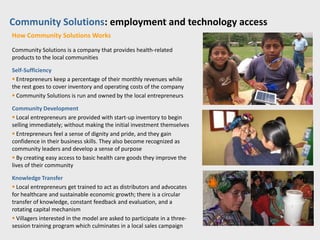
 Local entrepreneurs are provided with start-up inventory to begin
selling immediately; without making the initial investment themselves
 Entrepreneurs feel a sense of dignity and pride, and they gain
confidence in their business skills. They also become recognized as
community leaders and develop a sense of purpose
 By creating easy access to basic health care goods they improve the
lives of their community

Knowledge Transfer
 Local entrepreneurs get trained to act as distributors and advocates
for healthcare and sustainable economic growth; there is a circular
transfer of knowledge, constant feedback and evaluation, and a
rotating capital mechanism
 Villagers interested in the model are asked to participate in a three-
session training program which culminates in a local sales campaign
Association for Self-Financed Communities (ACAF): financing
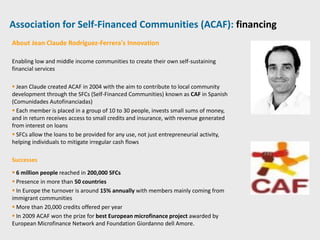
About Jean Claude Rodríguez-Ferrera’s Innovation

Enabling low and middle income communities to create their own self-sustaining
financial services

 Jean Claude created ACAF in 2004 with the aim to contribute to local community
development through the SFCs (Self-Financed Communities) known as CAF in Spanish
(Comunidades Autofinanciadas)
 Each member is placed in a group of 10 to 30 people, invests small sums of money,
and in return receives access to small credits and insurance, with revenue generated
from interest on loans
 SFCs allow the loans to be provided for any use, not just entrepreneurial activity,
helping individuals to mitigate irregular cash flows

Successes

 6 million people reached in 200,000 SFCs
 Presence in more than 50 countries
 In Europe the turnover is around 15% annually with members mainly coming from
immigrant communities
 More than 20,000 credits offered per year
 In 2009 ACAF won the prize for best European microfinance project awarded by
European Microfinance Network and Foundation Giordanno dell Amore.
Association for Self-Financed Communities (ACAF): financing
How the Association for Self-Financed Communities (ACAF) works
Self-Sufficiency
 Jean Claude is working with Ashoka Fellow Salomón Raydan to create banks
that pool community resources to provide for local financing needs
 The SFC approach, based on IT, brings costs and helps establish
independent, self-generated SFCs without the intermediation of an external
entity
 ACAF is closing the gap between traditional banks and micro-financing
 From 2006 to 2010, ACAF’s loan portfolios grew from € 81,000 to € 132,000
with over 500 members and 3,500 indirect beneficiaries

Community Development
 The SFC (Self-Financing Communities) model allows low income – and even
middle income – people to access small credits and small insurances while
building stronger communities
 This methodology has proven that poor people are bankable

Knowledge Transfer
 Jean Claude’s plan is to reach 200,000 people in Europe and 20 million
people around the world in the next 3 years
 The main strategy is to build the Winkomun Platform that includes “Do It
Yourself”, an e-learning tool that allows any community to build their own SFC
Ashoka Youth Venture
About Youth Venture Innovation

Instill entrepreneurship in young people, by educating young people on
social entrepreneurship and providing them with know-how and seed
capital to start their own entrepreneurial project.

Youth Venture seeks to create impact by transforming:
       The youth participant, through the enabling experience of
      starting a social venture
       The youth team, as they learn important life skills and realize that
      they can create change
       The community, as growing numbers of Youth Venture teams
      “tip” the local culture toward greater youth leadership
       Society at large, by fundamentally redefining the role of young
      people as leaders of social change


Successes
 Youth Venture currently operates in 19 countries including the US,
Mexico, Argentina, Brazil, India, South Africa, Thailand, France, Germany,
and Spain
 In the past 15 years, Youth Venture has trained nearly 5,000 teams
 100,000 young people launched and lead sustainable social ventures
The M.I.T. D-Lab
About the D-lab
D-Lab is a program of Massachusetts Institute of
Technology (MIT) created to improve the quality of life
of low-income households through the creation and
implementation of low cost technologies.

How D-Lab works?
 D-Lab brings appropriate technologies designed to
suit the needs of the community;
 It is intended for environmentally responsible and
spreading productive employment opportunities.

What type of technologies?
 Community water testing and treatment;
 Clean-burning cooking fuels, post-harvest processing
pedal, and human power production;
 Medical devices for global health, mobility aids, and
physical rehabilitation.

D-lab addresses poverty through building the local
creative capacity, promoting local innovation, valuing
indigenous     knowledge,    fostering   participatory
development and co-creation, and building sustainable
organizations and partnerships.
Ouanaminthe Social Impact and Innovation Consortium (OSCIIC)


             Strategic Partners

        Community Enterprise Solutions
   Association for Self-Financed Communities
                 Ashoka Youth Venture
                     M.I.T. D-Lab

                                                           8
GRUPEDSAC: water, food, energy
About Margarita Barney’s Innovation
Community skills training in eco-technologies to meet basic needs:

 Pure water: rainwater harvesting and water purification plants
 Healthy food: solar dehydrator for preserving food, eco-friendly ovens and stoves
 Sustainable energy: wind generator, electricity-generator bicycle, solar-powered
electricity generator, and solar-powered water heaters
 Sustainable agriculture: organic farming, earthen dams, swales for water infiltration,
and bio-intensive agriculture
 Sustainable housing: ecological construction using local materials
 Other eco-products and services such as prickly pear natural paint and
waterproofing resin, agro-tourism

Successes
 20 years of experience
 Two learning centers, training 12,000 people/year
 More than 30 technologies
 30 learning centers have been started across the region by other groups
 Won the Tech Awards 2009 Intel Environment Award
 Won the 2006 UBS Visionaris Award
GRUPEDSAC: water, food, energy
How GRUPEDSAC Works
GRUPEDSAC (the Group to Promote Education and Sustainable
Development) provides an integrated, socially inclusive training
program in eco-technologies that focuses on:

Self-Sufficiency
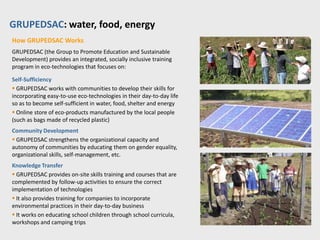
 GRUPEDSAC works with communities to develop their skills for
incorporating easy-to-use eco-technologies in their day-to-day life
so as to become self-sufficient in water, food, shelter and energy
 Online store of eco-products manufactured by the local people
(such as bags made of recycled plastic)
Community Development
 GRUPEDSAC strengthens the organizational capacity and
autonomy of communities by educating them on gender equality,
organizational skills, self-management, etc.
Knowledge Transfer
 GRUPEDSAC provides on-site skills training and courses that are
complemented by follow-up activities to ensure the correct
implementation of technologies
 It also provides training for companies to incorporate
environmental practices in their day-to-day business
 It works on educating school children through school curricula,
workshops and camping trips
AMUCSS: financial education and financial products
 About Isabel Cruz’s Innovation
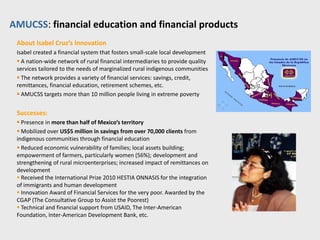
 Isabel created a financial system that fosters small-scale local development
  A nation-wide network of rural financial intermediaries to provide quality
 services tailored to the needs of marginalized rural indigenous communities
  The network provides a variety of financial services: savings, credit,
 remittances, financial education, retirement schemes, etc.
  AMUCSS targets more than 10 million people living in extreme poverty


 Successes:
  Presence in more than half of Mexico’s territory
  Mobilized over US$5 million in savings from over 70,000 clients from
 indigenous communities through financial education
  Reduced economic vulnerability of families; local assets building;
 empowerment of farmers, particularly women (56%); development and
 strengthening of rural microenterprises; increased impact of remittances on
 development
  Received the International Prize 2010 HESTIA ONNASIS for the integration
 of immigrants and human development
  Innovation Award of Financial Services for the very poor. Awarded by the
 CGAP (The Consultative Group to Assist the Poorest)
  Technical and financial support from USAID, The Inter-American
 Foundation, Inter-American Development Bank, etc.
AMUCSS: financial education and financial products
  How AMUCSS Works
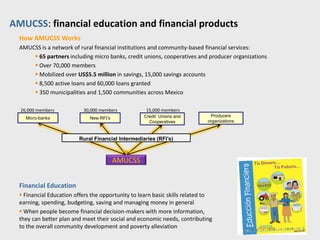
  AMUCSS is a network of rural financial institutions and community-based financial services:
       65 partners including micro banks, credit unions, cooperatives and producer organizations
       Over 70,000 members
       Mobilized over US$5.5 million in savings, 15,000 savings accounts
       8,500 active loans and 60,000 loans granted
       350 municipalities and 1,500 communities across Mexico

  26,000 members           30,000 members           15,000 members
                                                   Credit Unions and          Producers
    Micro-banks               New RFI’s
                                                     Cooperatives            organizations


                         Rural Financial Intermediaries (RFI’s)


                                          AMUCSS


  Financial Education
   Financial Education offers the opportunity to learn basic skills related to
  earning, spending, budgeting, saving and managing money in general
   When people become financial decision-makers with more information,
  they can better plan and meet their social and economic needs, contributing
  to the overall community development and poverty alleviation
Echale: housing and related products
About Francesco Piazzesi’s Innovation
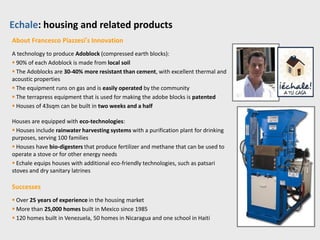
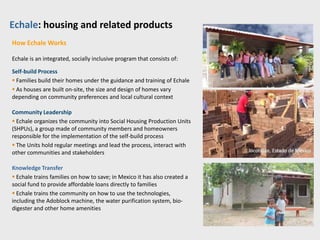
A technology to produce Adoblock (compressed earth blocks):
 90% of each Adoblock is made from local soil
 The Adoblocks are 30-40% more resistant than cement, with excellent thermal and
acoustic properties
 The equipment runs on gas and is easily operated by the community
 The terrapress equipment that is used for making the adobe blocks is patented
 Houses of 43sqm can be built in two weeks and a half

Houses are equipped with eco-technologies:
 Houses include rainwater harvesting systems with a purification plant for drinking
purposes, serving 100 families
 Houses have bio-digesters that produce fertilizer and methane that can be used to
operate a stove or for other energy needs
 Echale equips houses with additional eco-friendly technologies, such as patsari
stoves and dry sanitary latrines

Successes
 Over 25 years of experience in the housing market
 More than 25,000 homes built in Mexico since 1985
 120 homes built in Venezuela, 50 homes in Nicaragua and one school in Haiti
Echale: housing and related products
How Echale Works

Echale is an integrated, socially inclusive program that consists of:

Self-build Process
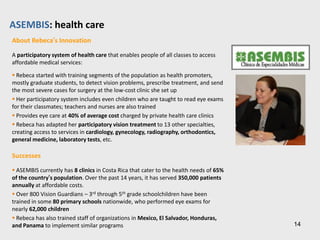
 Families build their homes under the guidance and training of Echale
 As houses are built on-site, the size and design of homes vary
depending on community preferences and local cultural context

Community Leadership
 Echale organizes the community into Social Housing Production Units
(SHPUs), a group made of community members and homeowners
responsible for the implementation of the self-build process
 The Units hold regular meetings and lead the process, interact with
other communities and stakeholders

Knowledge Transfer
 Echale trains families on how to save; in Mexico it has also created a
social fund to provide affordable loans directly to families
 Echale trains the community on how to use the technologies,
including the Adoblock machine, the water purification system, bio-
digester and other home amenities
ASEMBIS: health care
About Rebeca’s Innovation

A participatory system of health care that enables people of all classes to access
affordable medical services:

 Rebeca started with training segments of the population as health promoters,
mostly graduate students, to detect vision problems, prescribe treatment, and send
the most severe cases for surgery at the low-cost clinic she set up
 Her participatory system includes even children who are taught to read eye exams
for their classmates; teachers and nurses are also trained
 Provides eye care at 40% of average cost charged by private health care clinics
 Rebeca has adapted her participatory vision treatment to 13 other specialties,
creating access to services in cardiology, gynecology, radiography, orthodontics,
general medicine, laboratory tests, etc.

Successes

 ASEMBIS currently has 8 clinics in Costa Rica that cater to the health needs of 65%
of the country’s population. Over the past 14 years, it has served 350,000 patients
annually at affordable costs.
 Over 800 Vision Guardians – 3rd through 5th grade schoolchildren have been
trained in some 80 primary schools nationwide, who performed eye exams for
nearly 62,000 children
 Rebeca has also trained staff of organizations in Mexico, El Salvador, Honduras,
and Panama to implement similar programs                                                15
ASEMBIS: health care
How ASEMBIS Works

ASEMBIS (Association of Medical Services for the Common Good) is a
participatory treatment system that brings affordable high-tech health care
to all segments of the populations

Self-Sufficiency
 ASEMBIS leverages unconventional channels and different segments of
the population (nurses, students, children, etc.) by training them in order to
provide basic health care services at affordable rates

Community Development
 By providing low cost eye care to marginalized areas, ASEMBIS is bringing
back people to their jobs and improving the performance of children in
schools

Knowledge Transfer
 Training is at the very core of ASEMBIS’ participatory system
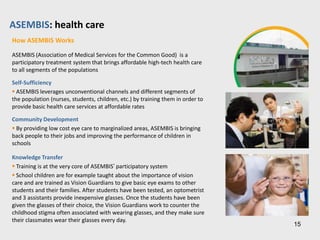
 School children are for example taught about the importance of vision
care and are trained as Vision Guardians to give basic eye exams to other
students and their families. After students have been tested, an optometrist
and 3 assistants provide inexpensive glasses. Once the students have been
given the glasses of their choice, the Vision Guardians work to counter the
childhood stigma often associated with wearing glasses, and they make sure
their classmates wear their glasses every day.
                                                                                 16
SANUT: nutrition and health
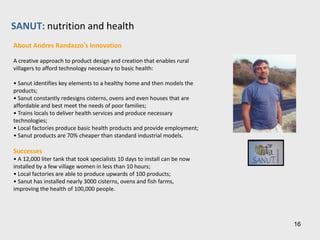
About Andres Randazzo’s Innovation

A creative approach to product design and creation that enables rural
villagers to afford technology necessary to basic health:

• Sanut identifies key elements to a healthy home and then models the
products;
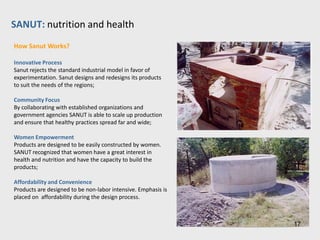
• Sanut constantly redesigns cisterns, ovens and even houses that are
affordable and best meet the needs of poor families;
• Trains locals to deliver health services and produce necessary
technologies;
• Local factories produce basic health products and provide employment;
• Sanut products are 70% cheaper than standard industrial models.

Successes
• A 12,000 liter tank that took specialists 10 days to install can be now
installed by a few village women in less than 10 hours;
• Local factories are able to produce upwards of 100 products;
• Sanut has installed nearly 3000 cisterns, ovens and fish farms,
improving the health of 100,000 people.


                                                                            17
SANUT: nutrition and health
How Sanut Works?

Innovative Process
Sanut rejects the standard industrial model in favor of
experimentation. Sanut designs and redesigns its products
to suit the needs of the regions;

Community Focus
By collaborating with established organizations and
government agencies SANUT is able to scale up production
and ensure that healthy practices spread far and wide;

Women Empowerment
Products are designed to be easily constructed by women.
SANUT recognized that women have a great interest in
health and nutrition and have the capacity to build the
products;

Affordability and Convenience
Products are designed to be non-labor intensive. Emphasis is
placed on affordability during the design process.


                                                               18

Profiles

  • 1.
    Ouanaminthe Social Impactand Innovation Consortium (OSIIC) Core Launch Team 2012 Community Enterprise Solutions Association for Self-Financed Communities Ashoka Youth Venture M.I.T. D-Lab 1
  • 2.
    Community Solutions: employmentand technology access About Greg van Kirk’s Innovation A self-sustaining model in which local women entrepreneurs generate income by selling affordable goods and services that improve health and economic welfare:  Micro-consignment model providing training and health-related products to local entrepreneurs for promoting and selling them to underserved communities  Products are selected based on impact on physical health and economic welfare  They must be portable, affordable and operable with minimum amount of training  Products include eyeglasses, wood-burning stoves, water filtration systems, seeds, sustainable gardening techniques, and energy-efficient light bulbs  Local entrepreneurs selling eyeglasses are also taught how to give simple eye exams to fit consumers with the appropriate lens prescription. Successes  Since 2004 over 300 women entrepreneurs in Guatemala, Ecuador and Nicaragua  Over $250,000 in net earnings for entrepreneurs and local leadership  Over 3,000 village outreach and sales visits  Over 80,000 solutions sales including 7,800+ solar panels/lamps, 2,100+ improved cook stoves, 26,000+ pairs of glasses, 1,100 water purification buckets, 6,300+ packets of vegetable seeds and 5,400+ energy efficient light bulbs  Over $2.75 million in net economic benefit
  • 3.
    Community Solutions: employmentand technology access How Community Solutions Works Community Solutions is a company that provides health-related products to the local communities Self-Sufficiency  Entrepreneurs keep a percentage of their monthly revenues while the rest goes to cover inventory and operating costs of the company  Community Solutions is run and owned by the local entrepreneurs Community Development  Local entrepreneurs are provided with start-up inventory to begin selling immediately; without making the initial investment themselves  Entrepreneurs feel a sense of dignity and pride, and they gain confidence in their business skills. They also become recognized as community leaders and develop a sense of purpose  By creating easy access to basic health care goods they improve the lives of their community Knowledge Transfer  Local entrepreneurs get trained to act as distributors and advocates for healthcare and sustainable economic growth; there is a circular transfer of knowledge, constant feedback and evaluation, and a rotating capital mechanism  Villagers interested in the model are asked to participate in a three- session training program which culminates in a local sales campaign
  • 4.
    Association for Self-FinancedCommunities (ACAF): financing About Jean Claude Rodríguez-Ferrera’s Innovation Enabling low and middle income communities to create their own self-sustaining financial services  Jean Claude created ACAF in 2004 with the aim to contribute to local community development through the SFCs (Self-Financed Communities) known as CAF in Spanish (Comunidades Autofinanciadas)  Each member is placed in a group of 10 to 30 people, invests small sums of money, and in return receives access to small credits and insurance, with revenue generated from interest on loans  SFCs allow the loans to be provided for any use, not just entrepreneurial activity, helping individuals to mitigate irregular cash flows Successes  6 million people reached in 200,000 SFCs  Presence in more than 50 countries  In Europe the turnover is around 15% annually with members mainly coming from immigrant communities  More than 20,000 credits offered per year  In 2009 ACAF won the prize for best European microfinance project awarded by European Microfinance Network and Foundation Giordanno dell Amore.
  • 5.
    Association for Self-FinancedCommunities (ACAF): financing How the Association for Self-Financed Communities (ACAF) works Self-Sufficiency  Jean Claude is working with Ashoka Fellow Salomón Raydan to create banks that pool community resources to provide for local financing needs  The SFC approach, based on IT, brings costs and helps establish independent, self-generated SFCs without the intermediation of an external entity  ACAF is closing the gap between traditional banks and micro-financing  From 2006 to 2010, ACAF’s loan portfolios grew from € 81,000 to € 132,000 with over 500 members and 3,500 indirect beneficiaries Community Development  The SFC (Self-Financing Communities) model allows low income – and even middle income – people to access small credits and small insurances while building stronger communities  This methodology has proven that poor people are bankable Knowledge Transfer  Jean Claude’s plan is to reach 200,000 people in Europe and 20 million people around the world in the next 3 years  The main strategy is to build the Winkomun Platform that includes “Do It Yourself”, an e-learning tool that allows any community to build their own SFC
  • 6.
    Ashoka Youth Venture AboutYouth Venture Innovation Instill entrepreneurship in young people, by educating young people on social entrepreneurship and providing them with know-how and seed capital to start their own entrepreneurial project. Youth Venture seeks to create impact by transforming:  The youth participant, through the enabling experience of starting a social venture  The youth team, as they learn important life skills and realize that they can create change  The community, as growing numbers of Youth Venture teams “tip” the local culture toward greater youth leadership  Society at large, by fundamentally redefining the role of young people as leaders of social change Successes  Youth Venture currently operates in 19 countries including the US, Mexico, Argentina, Brazil, India, South Africa, Thailand, France, Germany, and Spain  In the past 15 years, Youth Venture has trained nearly 5,000 teams  100,000 young people launched and lead sustainable social ventures
  • 7.
    The M.I.T. D-Lab Aboutthe D-lab D-Lab is a program of Massachusetts Institute of Technology (MIT) created to improve the quality of life of low-income households through the creation and implementation of low cost technologies. How D-Lab works?  D-Lab brings appropriate technologies designed to suit the needs of the community;  It is intended for environmentally responsible and spreading productive employment opportunities. What type of technologies?  Community water testing and treatment;  Clean-burning cooking fuels, post-harvest processing pedal, and human power production;  Medical devices for global health, mobility aids, and physical rehabilitation. D-lab addresses poverty through building the local creative capacity, promoting local innovation, valuing indigenous knowledge, fostering participatory development and co-creation, and building sustainable organizations and partnerships.
  • 8.
    Ouanaminthe Social Impactand Innovation Consortium (OSCIIC) Strategic Partners Community Enterprise Solutions Association for Self-Financed Communities Ashoka Youth Venture M.I.T. D-Lab 8
  • 9.
    GRUPEDSAC: water, food,energy About Margarita Barney’s Innovation Community skills training in eco-technologies to meet basic needs:  Pure water: rainwater harvesting and water purification plants  Healthy food: solar dehydrator for preserving food, eco-friendly ovens and stoves  Sustainable energy: wind generator, electricity-generator bicycle, solar-powered electricity generator, and solar-powered water heaters  Sustainable agriculture: organic farming, earthen dams, swales for water infiltration, and bio-intensive agriculture  Sustainable housing: ecological construction using local materials  Other eco-products and services such as prickly pear natural paint and waterproofing resin, agro-tourism Successes  20 years of experience  Two learning centers, training 12,000 people/year  More than 30 technologies  30 learning centers have been started across the region by other groups  Won the Tech Awards 2009 Intel Environment Award  Won the 2006 UBS Visionaris Award
  • 10.
    GRUPEDSAC: water, food,energy How GRUPEDSAC Works GRUPEDSAC (the Group to Promote Education and Sustainable Development) provides an integrated, socially inclusive training program in eco-technologies that focuses on: Self-Sufficiency  GRUPEDSAC works with communities to develop their skills for incorporating easy-to-use eco-technologies in their day-to-day life so as to become self-sufficient in water, food, shelter and energy  Online store of eco-products manufactured by the local people (such as bags made of recycled plastic) Community Development  GRUPEDSAC strengthens the organizational capacity and autonomy of communities by educating them on gender equality, organizational skills, self-management, etc. Knowledge Transfer  GRUPEDSAC provides on-site skills training and courses that are complemented by follow-up activities to ensure the correct implementation of technologies  It also provides training for companies to incorporate environmental practices in their day-to-day business  It works on educating school children through school curricula, workshops and camping trips
  • 11.
    AMUCSS: financial educationand financial products About Isabel Cruz’s Innovation Isabel created a financial system that fosters small-scale local development  A nation-wide network of rural financial intermediaries to provide quality services tailored to the needs of marginalized rural indigenous communities  The network provides a variety of financial services: savings, credit, remittances, financial education, retirement schemes, etc.  AMUCSS targets more than 10 million people living in extreme poverty Successes:  Presence in more than half of Mexico’s territory  Mobilized over US$5 million in savings from over 70,000 clients from indigenous communities through financial education  Reduced economic vulnerability of families; local assets building; empowerment of farmers, particularly women (56%); development and strengthening of rural microenterprises; increased impact of remittances on development  Received the International Prize 2010 HESTIA ONNASIS for the integration of immigrants and human development  Innovation Award of Financial Services for the very poor. Awarded by the CGAP (The Consultative Group to Assist the Poorest)  Technical and financial support from USAID, The Inter-American Foundation, Inter-American Development Bank, etc.
  • 12.
    AMUCSS: financial educationand financial products How AMUCSS Works AMUCSS is a network of rural financial institutions and community-based financial services:  65 partners including micro banks, credit unions, cooperatives and producer organizations  Over 70,000 members  Mobilized over US$5.5 million in savings, 15,000 savings accounts  8,500 active loans and 60,000 loans granted  350 municipalities and 1,500 communities across Mexico 26,000 members 30,000 members 15,000 members Credit Unions and Producers Micro-banks New RFI’s Cooperatives organizations Rural Financial Intermediaries (RFI’s) AMUCSS Financial Education  Financial Education offers the opportunity to learn basic skills related to earning, spending, budgeting, saving and managing money in general  When people become financial decision-makers with more information, they can better plan and meet their social and economic needs, contributing to the overall community development and poverty alleviation
  • 13.
    Echale: housing andrelated products About Francesco Piazzesi’s Innovation A technology to produce Adoblock (compressed earth blocks):  90% of each Adoblock is made from local soil  The Adoblocks are 30-40% more resistant than cement, with excellent thermal and acoustic properties  The equipment runs on gas and is easily operated by the community  The terrapress equipment that is used for making the adobe blocks is patented  Houses of 43sqm can be built in two weeks and a half Houses are equipped with eco-technologies:  Houses include rainwater harvesting systems with a purification plant for drinking purposes, serving 100 families  Houses have bio-digesters that produce fertilizer and methane that can be used to operate a stove or for other energy needs  Echale equips houses with additional eco-friendly technologies, such as patsari stoves and dry sanitary latrines Successes  Over 25 years of experience in the housing market  More than 25,000 homes built in Mexico since 1985  120 homes built in Venezuela, 50 homes in Nicaragua and one school in Haiti
  • 14.
    Echale: housing andrelated products How Echale Works Echale is an integrated, socially inclusive program that consists of: Self-build Process  Families build their homes under the guidance and training of Echale  As houses are built on-site, the size and design of homes vary depending on community preferences and local cultural context Community Leadership  Echale organizes the community into Social Housing Production Units (SHPUs), a group made of community members and homeowners responsible for the implementation of the self-build process  The Units hold regular meetings and lead the process, interact with other communities and stakeholders Knowledge Transfer  Echale trains families on how to save; in Mexico it has also created a social fund to provide affordable loans directly to families  Echale trains the community on how to use the technologies, including the Adoblock machine, the water purification system, bio- digester and other home amenities
  • 15.
    ASEMBIS: health care AboutRebeca’s Innovation A participatory system of health care that enables people of all classes to access affordable medical services:  Rebeca started with training segments of the population as health promoters, mostly graduate students, to detect vision problems, prescribe treatment, and send the most severe cases for surgery at the low-cost clinic she set up  Her participatory system includes even children who are taught to read eye exams for their classmates; teachers and nurses are also trained  Provides eye care at 40% of average cost charged by private health care clinics  Rebeca has adapted her participatory vision treatment to 13 other specialties, creating access to services in cardiology, gynecology, radiography, orthodontics, general medicine, laboratory tests, etc. Successes  ASEMBIS currently has 8 clinics in Costa Rica that cater to the health needs of 65% of the country’s population. Over the past 14 years, it has served 350,000 patients annually at affordable costs.  Over 800 Vision Guardians – 3rd through 5th grade schoolchildren have been trained in some 80 primary schools nationwide, who performed eye exams for nearly 62,000 children  Rebeca has also trained staff of organizations in Mexico, El Salvador, Honduras, and Panama to implement similar programs 15
  • 16.
    ASEMBIS: health care HowASEMBIS Works ASEMBIS (Association of Medical Services for the Common Good) is a participatory treatment system that brings affordable high-tech health care to all segments of the populations Self-Sufficiency  ASEMBIS leverages unconventional channels and different segments of the population (nurses, students, children, etc.) by training them in order to provide basic health care services at affordable rates Community Development  By providing low cost eye care to marginalized areas, ASEMBIS is bringing back people to their jobs and improving the performance of children in schools Knowledge Transfer  Training is at the very core of ASEMBIS’ participatory system  School children are for example taught about the importance of vision care and are trained as Vision Guardians to give basic eye exams to other students and their families. After students have been tested, an optometrist and 3 assistants provide inexpensive glasses. Once the students have been given the glasses of their choice, the Vision Guardians work to counter the childhood stigma often associated with wearing glasses, and they make sure their classmates wear their glasses every day. 16
  • 17.
    SANUT: nutrition andhealth About Andres Randazzo’s Innovation A creative approach to product design and creation that enables rural villagers to afford technology necessary to basic health: • Sanut identifies key elements to a healthy home and then models the products; • Sanut constantly redesigns cisterns, ovens and even houses that are affordable and best meet the needs of poor families; • Trains locals to deliver health services and produce necessary technologies; • Local factories produce basic health products and provide employment; • Sanut products are 70% cheaper than standard industrial models. Successes • A 12,000 liter tank that took specialists 10 days to install can be now installed by a few village women in less than 10 hours; • Local factories are able to produce upwards of 100 products; • Sanut has installed nearly 3000 cisterns, ovens and fish farms, improving the health of 100,000 people. 17
  • 18.
    SANUT: nutrition andhealth How Sanut Works? Innovative Process Sanut rejects the standard industrial model in favor of experimentation. Sanut designs and redesigns its products to suit the needs of the regions; Community Focus By collaborating with established organizations and government agencies SANUT is able to scale up production and ensure that healthy practices spread far and wide; Women Empowerment Products are designed to be easily constructed by women. SANUT recognized that women have a great interest in health and nutrition and have the capacity to build the products; Affordability and Convenience Products are designed to be non-labor intensive. Emphasis is placed on affordability during the design process. 18