FEATURE WRITING
RACHEL COKER
BINGHAMTON UNIVERSITY
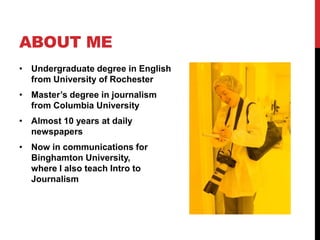
ABOUT ME
• Undergraduate degree in English
from University of Rochester
• Master’s degree in journalism
from Columbia University
• Almost 10 years at daily
newspapers
• Now in communications for
Binghamton University,
where I also teach Intro to
Journalism
FIRST THINGS FIRST
• Review your notes.
• Make an outline.
• Identify your best quotes.
• Check for gaps.
• E-mail or call the interviewee for missing information.
• You’re ready to write!
SPELLING COUNTS!
Profiles are different than
other kinds of writing
assignments … in some
regards. You still need to
apply what you’ve learned
about grammar, transitions,
accuracy, attribution and so
on.
FIRST FIVE GRAPHS
The news
• Capture the key elements
• Tell readers why they should care
• Emphasize who is most affected
• Include a “nut graph”
• Use simple language
• Try to tell the story through the experiences of those
most affected
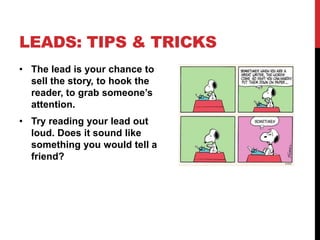
LEADS: TIPS & TRICKS
• The lead is your chance to
sell the story, to hook the
reader, to grab someone’s
attention.
• Try reading your lead out
loud. Does it sound like
something you would tell a
friend?
LEADS: DOS AND DON’TS
Do:
• Try to hit on some of
the 5 Ws.
• Be concise.
• Identify the central
part of the story.
• Think of the lead as
the billboard for your
story.
• Use strong, active
verbs.
Don’t:
• Start with a quote!
• Use names that
people don’t know.
• Rely on the passive
voice.
• Let your opinion
invade the lead.
• Try to wedge in too
much.
A FEW WORDS ABOUT QUOTES
• Quotes represent the direct words of your source.
• Fabricating a quote is unethical and can lead to your
firing if you are a staff reporter.
• (Likewise, making up a source is a serious mistake.)
• Most stories need quotes. They enliven the copy and
let the reader feel as though they know the “voice”
of your sources.
• Do not use quotes around statements you can write
better.
QUOTES
Here’s how to punctuate a quote:
“I think Valentine’s Day is a total scam,” she said. “If
you really love someone, you should show it 365 days
a year.”
“I think Valentine’s Day is a total scam,” said Smith,
who is married. “If you really love someone, you should
show it 365 days a year.”
INGREDIENTS FOR SUCCESS
• Read at least a few examples of good profiles. Try to
see what makes them work. Does your story capture
something about what makes this person special?
Will readers feel they’ve met this person after they
read your story?
• Read your story out loud. Listen for places where the
language is rough, and then fix them.
• Revise. Good writing is rewriting.
ONE OF RACHEL’S FAVORITES
In our candy-colored digital world, there’s no time for rust.
Gadgets from five years ago are worthless to a “new-every-two”
culture. And a man working long hours alone in a garage is
presumed to harbor grand ambitions of becoming a start-up
millionaire.
But on Robinson Street in Binghamton, you can pick up a
distinctly analog signal. It emanates from the cramped studio of
sculptor Ronald Gonzalez, a Binghamton University faculty
member who transforms the detritus of the last century into
burned and blackened figures that speak to the 21st century’s
values, politics and ideas of beauty.
ANOTHER FROM RACHEL’S FILES
The phone is so old-fashioned. So, for that matter, are e-mail and
even Facebook. Aleksandar Vukasinovic envisions living in a world
of seamless communication. In that world, sensors will gather
information about how we’re feeling. That data will inform the music
we hear, the way rooms are lit and more.
Vukasinovic, a Binghamton University junior, recently took a
semester off to address some health concerns. When he recovered
more quickly than expected, he did what many young scientists and
engineers dream of doing: He created his own company.
Now he’s CEO of a start-up called Emozia with 10 employees,
many of them also Binghamton students. “Entrepreneurship is a
quintessential aspect of our education,” Vukasinovic says. “I’m 21. I
haven’t even had a real job. And suddenly you’re thrown into a
whirlwind.”
GOOD
WRITING IS
REWRITING.

Profile Writing

  • 1.
  • 2.
    ABOUT ME • Undergraduatedegree in English from University of Rochester • Master’s degree in journalism from Columbia University • Almost 10 years at daily newspapers • Now in communications for Binghamton University, where I also teach Intro to Journalism
  • 3.
    FIRST THINGS FIRST •Review your notes. • Make an outline. • Identify your best quotes. • Check for gaps. • E-mail or call the interviewee for missing information. • You’re ready to write!
  • 4.
    SPELLING COUNTS! Profiles aredifferent than other kinds of writing assignments … in some regards. You still need to apply what you’ve learned about grammar, transitions, accuracy, attribution and so on.
  • 5.
    FIRST FIVE GRAPHS Thenews • Capture the key elements • Tell readers why they should care • Emphasize who is most affected • Include a “nut graph” • Use simple language • Try to tell the story through the experiences of those most affected
  • 6.
    LEADS: TIPS &TRICKS • The lead is your chance to sell the story, to hook the reader, to grab someone’s attention. • Try reading your lead out loud. Does it sound like something you would tell a friend?
  • 7.
    LEADS: DOS ANDDON’TS Do: • Try to hit on some of the 5 Ws. • Be concise. • Identify the central part of the story. • Think of the lead as the billboard for your story. • Use strong, active verbs. Don’t: • Start with a quote! • Use names that people don’t know. • Rely on the passive voice. • Let your opinion invade the lead. • Try to wedge in too much.
  • 8.
    A FEW WORDSABOUT QUOTES • Quotes represent the direct words of your source. • Fabricating a quote is unethical and can lead to your firing if you are a staff reporter. • (Likewise, making up a source is a serious mistake.) • Most stories need quotes. They enliven the copy and let the reader feel as though they know the “voice” of your sources. • Do not use quotes around statements you can write better.
  • 9.
    QUOTES Here’s how topunctuate a quote: “I think Valentine’s Day is a total scam,” she said. “If you really love someone, you should show it 365 days a year.” “I think Valentine’s Day is a total scam,” said Smith, who is married. “If you really love someone, you should show it 365 days a year.”
  • 10.
    INGREDIENTS FOR SUCCESS •Read at least a few examples of good profiles. Try to see what makes them work. Does your story capture something about what makes this person special? Will readers feel they’ve met this person after they read your story? • Read your story out loud. Listen for places where the language is rough, and then fix them. • Revise. Good writing is rewriting.
  • 11.
    ONE OF RACHEL’SFAVORITES In our candy-colored digital world, there’s no time for rust. Gadgets from five years ago are worthless to a “new-every-two” culture. And a man working long hours alone in a garage is presumed to harbor grand ambitions of becoming a start-up millionaire. But on Robinson Street in Binghamton, you can pick up a distinctly analog signal. It emanates from the cramped studio of sculptor Ronald Gonzalez, a Binghamton University faculty member who transforms the detritus of the last century into burned and blackened figures that speak to the 21st century’s values, politics and ideas of beauty.
  • 12.
    ANOTHER FROM RACHEL’SFILES The phone is so old-fashioned. So, for that matter, are e-mail and even Facebook. Aleksandar Vukasinovic envisions living in a world of seamless communication. In that world, sensors will gather information about how we’re feeling. That data will inform the music we hear, the way rooms are lit and more. Vukasinovic, a Binghamton University junior, recently took a semester off to address some health concerns. When he recovered more quickly than expected, he did what many young scientists and engineers dream of doing: He created his own company. Now he’s CEO of a start-up called Emozia with 10 employees, many of them also Binghamton students. “Entrepreneurship is a quintessential aspect of our education,” Vukasinovic says. “I’m 21. I haven’t even had a real job. And suddenly you’re thrown into a whirlwind.”
  • 13.