
August 2010
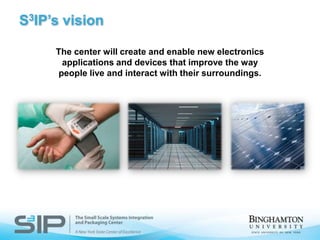
S3IP’s visionThe center will create and enable new electronics applications and devices that improve the way people live and interact with their surroundings. Flexible Solar
S3IP’s missionThe center, in partnership with industry, addresses challenges in small scale systems research and development, including:Systems IntegrationElectronics PackagingElectronics ManufacturingNew Materials for Electronic SystemsThe center also develops global partnerships with academic institutions, federal and state governments, national labs and industry to promote high-technology growth opportunities in small scale systems.S3IP has generated more than $700 million in economic impact for New York State alone since 1996.
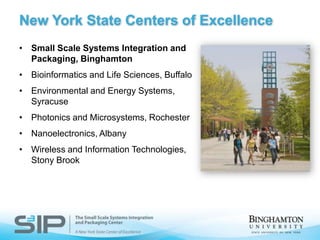
New York State Centers of ExcellenceSmall Scale Systems Integration and Packaging, BinghamtonBioinformatics and Life Sciences, BuffaloEnvironmental and Energy Systems, SyracusePhotonics and Microsystems, RochesterNanoelectronics, AlbanyWireless and Information Technologies, Stony Brook
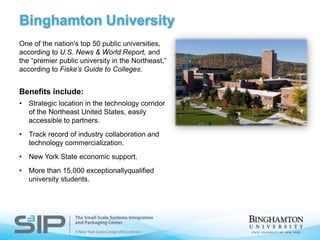
Binghamton UniversityOne of the nation's top 50 public universities, according to U.S. News & World Report, and the “premier public university in the Northeast,” according to Fiske’s Guide to Colleges.Benefits include:Strategic location in the technology corridor of the Northeast United States, easily accessible to partners.Track record of industry collaboration and technology commercialization.New York State economic support.More than 15,000 exceptionallyqualified university students.
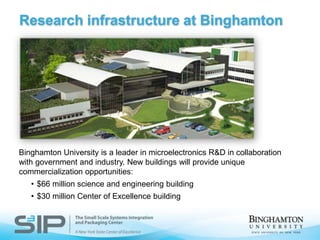
Research infrastructure at BinghamtonBinghamton University is a leader in microelectronics R&D in collaboration with government and industry. New buildings will provide unique commercialization opportunities:$66 million science and engineering building$30 million Center of Excellence building
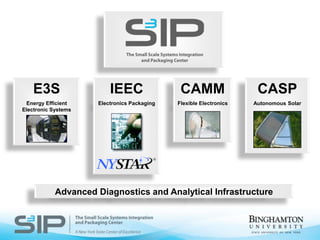
E3SEnergy Efficient  Electronic SystemsCAMMFlexible Electronics CASPAutonomous SolarIEECElectronics PackagingAdvanced Diagnostics and Analytical Infrastructure
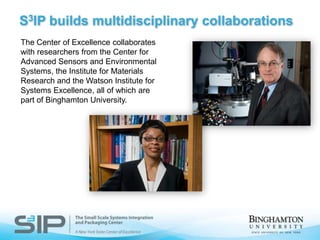
S3IP builds multidisciplinary collaborationsThe Center of Excellence collaborates with researchers from the Center for Advanced Sensors and Environmental Systems, the Institute for Materials Research and the Watson Institute for Systems Excellence, all of which are part of Binghamton University.
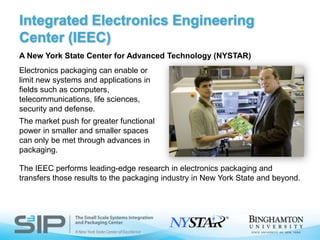
Integrated Electronics Engineering Center (IEEC)A New York State Center for Advanced Technology (NYSTAR)Electronics packaging can enable or limit new systems and applications in fields such as computers, telecommunications, life sciences, security and defense. The market push for greater functional power in smaller and smaller spaces can only be met through advances in packaging.The IEEC performs leading-edge research in electronics packaging and transfers those results to the packaging industry in New York State and beyond.
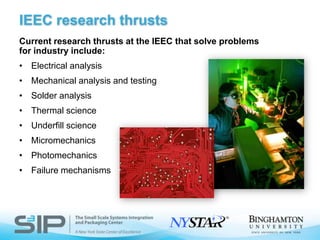
IEEC research thrustsCurrent research thrusts at the IEEC that solve problems for industry include:Electrical analysisMechanical analysis and testingSolder analysis Thermal scienceUnderfill scienceMicromechanicsPhotomechanics Failure mechanisms
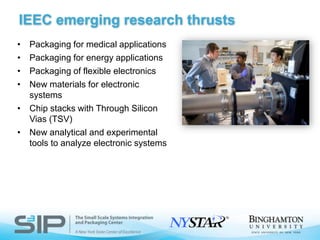
IEEC emerging research thrustsPackaging for medical applications
Packaging for energy applications
Packaging of flexible electronics
New materials for electronic systems
Chip stacks with Through Silicon Vias (TSV)
New analytical and experimental tools to analyze electronic systems Center for Advanced Microelectronics Manufacturing (CAMM)The Center for Advanced Microelectronics Manufacturing was established as an R&D center with an award from the Flex Tech Alliance to a team from Binghamton University, Endicott Interconnect and Cornell University.The CAMM:Demonstrates the feasibility of roll-to-roll (R2R) electronics manufacturing by acquiring prototype tools and establishing processes to produce low-volume, test bed products in partnership with industry.Addresses R2R fundamental enabling technologies and sciences.Develops flexible components for medical applications, military and homeland security, displays, electronics, energy and telecommunications.
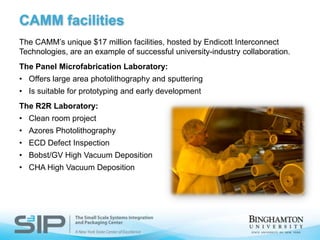
CAMM facilitiesThe CAMM’s unique $17 million facilities, hosted by Endicott Interconnect Technologies, are an example of successful university-industry collaboration.The Panel Microfabrication Laboratory:Offers large area photolithography and sputteringIs suitable for prototyping and early developmentThe R2R Laboratory:Clean room project Azores Photolithography ECD Defect InspectionBobst/GV High Vacuum Deposition CHA High Vacuum Deposition
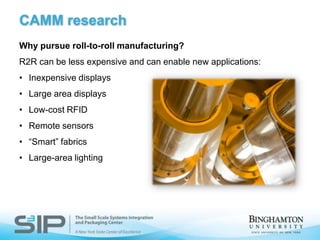
CAMM researchWhy pursue roll-to-roll manufacturing? R2R can be less expensive and can enable new applications:Inexpensive displaysLarge area displaysLow-cost RFIDRemote sensors“Smart” fabricsLarge-area lighting
Center for Autonomous Solar Power (CASP)The Center for Autonomous Solar Power aims to capitalize on the sun’s energy as a flexible, large-area and low-cost power source.CASP, which has received millions of dollars in federal funding:Develops flexible, low-cost solar cells.Creates integrated energy-storage and low-cost installation solutions.Fosters university-industry relationships.Provides leading-edge technology for the defense, aerospace, consumer and industrial markets.
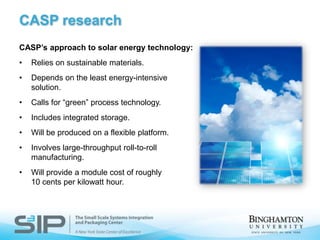
CASP researchCASP’s approach to solar energy technology:Relies on sustainable materials.Depends on the least energy-intensive solution.Calls for “green” process technology.Includes integrated storage.Will be produced on a flexible platform.Involves large-throughput roll-to-roll manufacturing.Will provide a module cost of roughly10 cents per kilowatt hour.
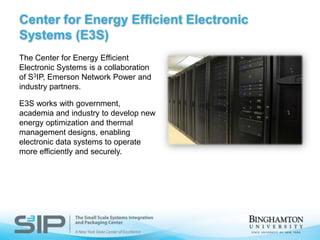
Center for Energy Efficient Electronic Systems (E3S)The Center for Energy Efficient Electronic Systems is a collaboration of S3IP, Emerson Network Power and industry partners. E3S works with government, academia and industry to develop new energy optimization and thermal management designs, enabling electronic data systems to operate more efficiently and securely.
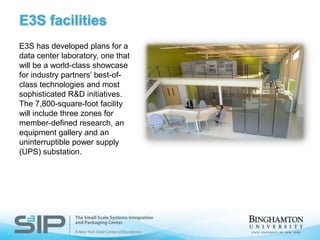
E3S facilitiesE3S has developed plans for a data center laboratory, one that will be a world-class showcase for industry partners’ best-of-class technologies and most sophisticated R&D initiatives. The 7,800-square-foot facility will include three zones for member-defined research, an equipment gallery and an uninterruptible power supply (UPS) substation.
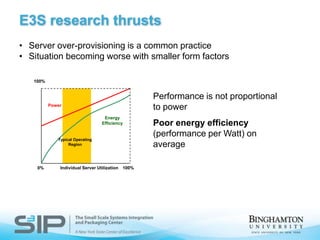
E3S research thrusts Server over-provisioning is a common practice
Situation becoming worse with smaller form factorsPerformance is not proportional to powerPoor energy efficiency (performance per Watt) on average100%PowerEnergyEfficiencyTypical Operating RegionIndividual Server Utilization0%100%

An introduction to S3IP

  • 1.
  • 2.
    S3IP’s visionThe centerwill create and enable new electronics applications and devices that improve the way people live and interact with their surroundings. Flexible Solar
  • 3.
    S3IP’s missionThe center,in partnership with industry, addresses challenges in small scale systems research and development, including:Systems IntegrationElectronics PackagingElectronics ManufacturingNew Materials for Electronic SystemsThe center also develops global partnerships with academic institutions, federal and state governments, national labs and industry to promote high-technology growth opportunities in small scale systems.S3IP has generated more than $700 million in economic impact for New York State alone since 1996.
  • 4.
    New York StateCenters of ExcellenceSmall Scale Systems Integration and Packaging, BinghamtonBioinformatics and Life Sciences, BuffaloEnvironmental and Energy Systems, SyracusePhotonics and Microsystems, RochesterNanoelectronics, AlbanyWireless and Information Technologies, Stony Brook
  • 5.
    Binghamton UniversityOne ofthe nation's top 50 public universities, according to U.S. News & World Report, and the “premier public university in the Northeast,” according to Fiske’s Guide to Colleges.Benefits include:Strategic location in the technology corridor of the Northeast United States, easily accessible to partners.Track record of industry collaboration and technology commercialization.New York State economic support.More than 15,000 exceptionallyqualified university students.
  • 6.
    Research infrastructure atBinghamtonBinghamton University is a leader in microelectronics R&D in collaboration with government and industry. New buildings will provide unique commercialization opportunities:$66 million science and engineering building$30 million Center of Excellence building
  • 7.
    E3SEnergy Efficient Electronic SystemsCAMMFlexible Electronics CASPAutonomous SolarIEECElectronics PackagingAdvanced Diagnostics and Analytical Infrastructure
  • 8.
    S3IP builds multidisciplinarycollaborationsThe Center of Excellence collaborates with researchers from the Center for Advanced Sensors and Environmental Systems, the Institute for Materials Research and the Watson Institute for Systems Excellence, all of which are part of Binghamton University.
  • 9.
    Integrated Electronics EngineeringCenter (IEEC)A New York State Center for Advanced Technology (NYSTAR)Electronics packaging can enable or limit new systems and applications in fields such as computers, telecommunications, life sciences, security and defense. The market push for greater functional power in smaller and smaller spaces can only be met through advances in packaging.The IEEC performs leading-edge research in electronics packaging and transfers those results to the packaging industry in New York State and beyond.
  • 10.
    IEEC research thrustsCurrentresearch thrusts at the IEEC that solve problems for industry include:Electrical analysisMechanical analysis and testingSolder analysis Thermal scienceUnderfill scienceMicromechanicsPhotomechanics Failure mechanisms
  • 11.
    IEEC emerging researchthrustsPackaging for medical applications
  • 12.
  • 13.
  • 14.
    New materials forelectronic systems
  • 15.
    Chip stacks withThrough Silicon Vias (TSV)
  • 16.
    New analytical andexperimental tools to analyze electronic systems Center for Advanced Microelectronics Manufacturing (CAMM)The Center for Advanced Microelectronics Manufacturing was established as an R&D center with an award from the Flex Tech Alliance to a team from Binghamton University, Endicott Interconnect and Cornell University.The CAMM:Demonstrates the feasibility of roll-to-roll (R2R) electronics manufacturing by acquiring prototype tools and establishing processes to produce low-volume, test bed products in partnership with industry.Addresses R2R fundamental enabling technologies and sciences.Develops flexible components for medical applications, military and homeland security, displays, electronics, energy and telecommunications.
  • 17.
    CAMM facilitiesThe CAMM’sunique $17 million facilities, hosted by Endicott Interconnect Technologies, are an example of successful university-industry collaboration.The Panel Microfabrication Laboratory:Offers large area photolithography and sputteringIs suitable for prototyping and early developmentThe R2R Laboratory:Clean room project Azores Photolithography ECD Defect InspectionBobst/GV High Vacuum Deposition CHA High Vacuum Deposition
  • 18.
    CAMM researchWhy pursueroll-to-roll manufacturing? R2R can be less expensive and can enable new applications:Inexpensive displaysLarge area displaysLow-cost RFIDRemote sensors“Smart” fabricsLarge-area lighting
  • 19.
    Center for AutonomousSolar Power (CASP)The Center for Autonomous Solar Power aims to capitalize on the sun’s energy as a flexible, large-area and low-cost power source.CASP, which has received millions of dollars in federal funding:Develops flexible, low-cost solar cells.Creates integrated energy-storage and low-cost installation solutions.Fosters university-industry relationships.Provides leading-edge technology for the defense, aerospace, consumer and industrial markets.
  • 20.
    CASP researchCASP’s approachto solar energy technology:Relies on sustainable materials.Depends on the least energy-intensive solution.Calls for “green” process technology.Includes integrated storage.Will be produced on a flexible platform.Involves large-throughput roll-to-roll manufacturing.Will provide a module cost of roughly10 cents per kilowatt hour.
  • 21.
    Center for EnergyEfficient Electronic Systems (E3S)The Center for Energy Efficient Electronic Systems is a collaboration of S3IP, Emerson Network Power and industry partners. E3S works with government, academia and industry to develop new energy optimization and thermal management designs, enabling electronic data systems to operate more efficiently and securely.
  • 22.
    E3S facilitiesE3S hasdeveloped plans for a data center laboratory, one that will be a world-class showcase for industry partners’ best-of-class technologies and most sophisticated R&D initiatives. The 7,800-square-foot facility will include three zones for member-defined research, an equipment gallery and an uninterruptible power supply (UPS) substation.
  • 23.
    E3S research thrustsServer over-provisioning is a common practice
  • 24.
    Situation becoming worsewith smaller form factorsPerformance is not proportional to powerPoor energy efficiency (performance per Watt) on average100%PowerEnergyEfficiencyTypical Operating RegionIndividual Server Utilization0%100%