1
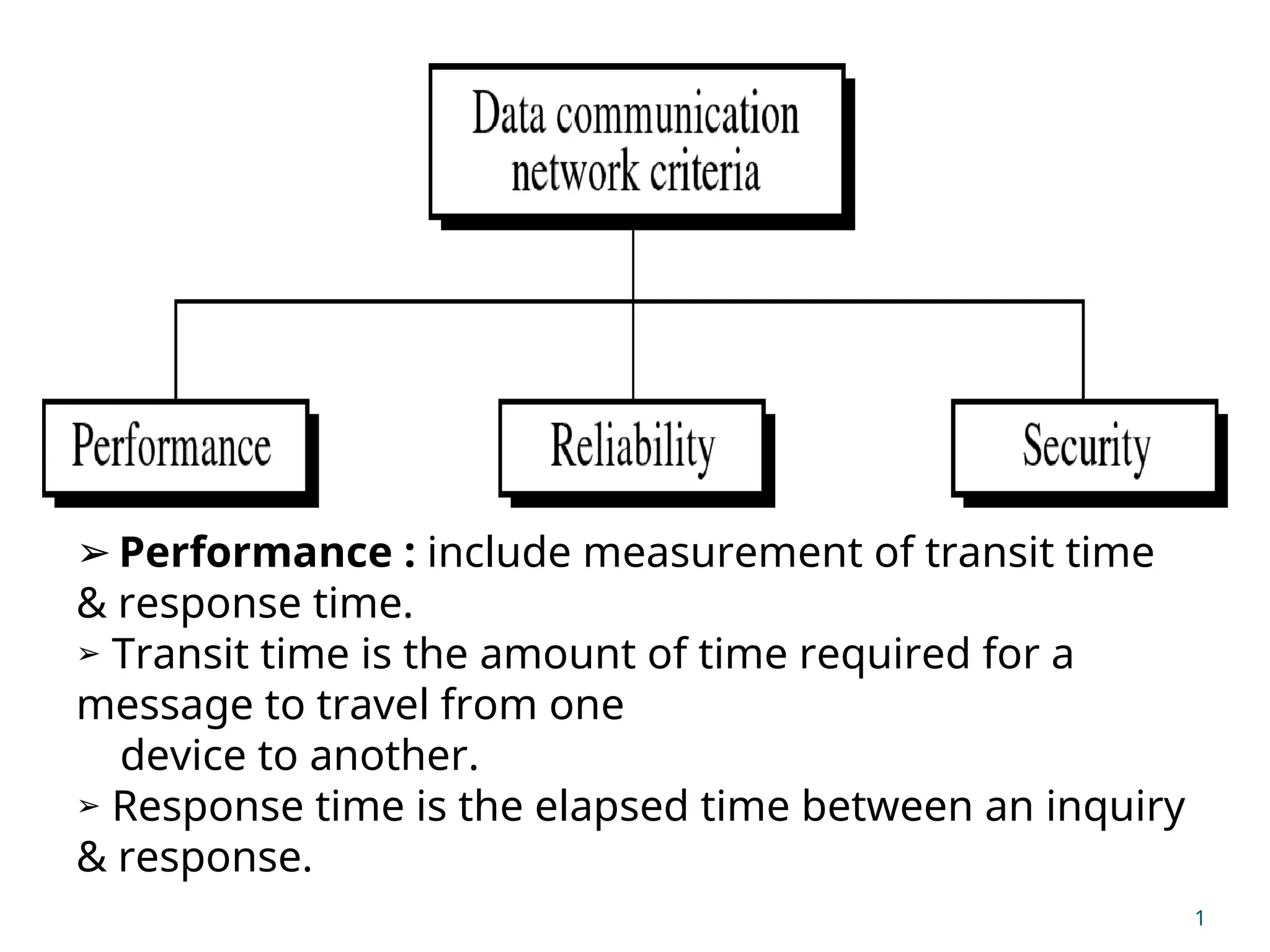
➢ Performance :include measurement of transit time
& response time.
➢ Transit time is the amount of time required for a
message to travel from one
device to another.
➢ Response time is the elapsed time between an inquiry
& response.
2.
2
➢ Performance ofa n/w depends on :
- no. of users
- type of transmission medium
-capabilities of the connected h/w
- efficiency of the s/w
➢ Performance evaluated by two networking
metrics: throughput & delay.
➢ Reliability: measured by the frequency of failure,
the time it takes a link to recover from a failure, &
the n/w’s robustness in a catastrophe.
➢Security: N/w security issues include protecting
data from unauthorized access, protecting data
from damage & development, & implementing
policies and procedures.
3.
Definition of ComputerNetwork
●A computer network is an interconnected
collection of autonomous computers.
●Two computer are interconnected if they are able to
exchange information
●Two computer are autonomous if they are capable
of operating independently, that is, neither is
capable of forcibly starting, stopping, or controlling
the other
●Computer n/ws are created by different entities.
Standards are needed so that these heterogeneous
networks can communicate with one another.
3
4.
Network Model
●Local AreaNetworks (LANs) : The computers
are geographically close together (that is, in the
same building).
●Metropolitan Area Network (MAN) : The
Computer network designed for a town or city.
●Wide Area Networks (WANs) : The computers
are farther apart and are connected by telephone
lines or radio waves. (Across Countries)
4
5.
characteristics
●Topology : Thegeometric arrangement of a
computer system. Common topologies include a
bus, star, and ring.
●Architecture : Networks can be broadly classified
as using either a peer-to-peer or client/server
architecture
5
6.
Local Area Network(LAN)
6
•A LAN is usually privately owned & links the devices in a single office,
building, or campus.
•Depending on the needs of an organization & the type of technology
used, a LAN can be simple as two PCs & a printer in someone’s home
office; or it can be extended throughout a company & include audio &
video peripherals
7.
LAN
confined to:
●a singlebuilding or group of building
●Home, Office Building, Or School, Or University
●Either Wired or wireless media.
LAN size is limited to a few kilometers.
●Allow resources to be shared between personal
computers or workstations.(include h/w, s/w, or data)
●LANs are distinguished from other types of networks
by their transmission media & topology
●data rates: earlier 4 to 16 Mbps
now 100 or 1000 Mbps
7
Metropolitan Area Network(MAN)
●For a town or city
●Consists of multiple LANs
●larger than local-area networks (LANs)
●but smaller than wide-area networks (WANs)
●characterized by very high-speed connections using
fiber optical cable or other digital media.
●Examples: part of telephone company n/w that can
provide a high speed DSL line to the customer.
●Cable TV n/w that originally was designed for cable
TV, but today can also be used for high-speed data
connection to the Internet.
9
10.
Wide Area Network(WAN)
●Covers a large Geographical area (Kilometers)
●Consists of two or more LANs
●The INTERNET (the largest WAN)
10
11.
●Provides long-distance transmissionof data, image,
audio, & video information over large geographic areas
that may comprise a country, a continent, or even the
whole world.
●A WAN can be as complex as the backbone that
connect the Internet or as simple as a dial-up line that
connects a home computer to the Internet
11
PAN:
●Personal devices ofone individual:
●His/her PC, laptop, cell phone, PDA
●To allow devices to communicate and work together.
●To permit devices to become smarter: spontaneously,
network and work together.
●PANs feasibility growing with improvement of
wireless technology:
●Bluetooth enabling devices to communicate
automatically and wirelessly when they are in range.
●PANs can keep portable devices synchronized with a
desktop PC.
●E-clothing products (Jacket) equipped with a battery
pack and devices.
13
15
Types of connection
Ina n/w devices are connected through links.
Link → communication pathway → transfers data from one device to another.
Two types of connections: point-to-point & multipoint.
➢ Point-to-Point connection provides dedicated link b/w 2 devices.
→ entire capacity of the link is reserved for transmission b/w those 2
devices.
➢ Multipoint connection is one in which more than two specific devices share
a single link