Scrum | XP | Lean | Kanban
What’s What?
Brief intro to Agile practices
“We do Agile”X
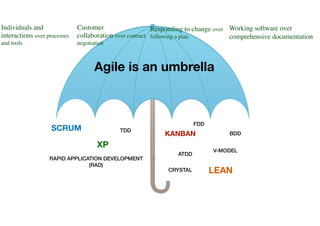
Agile is an umbrella
SCRUM
XP
LEAN
KANBAN
FDD
BDD
TDD
RAPID APPLICATION DEVELOPMENT
(RAD)
V-MODEL
ATDD
CRYSTAL
Individuals and
interactions over processes
and tools
Working software over
comprehensive documentation
Customer
collaboration over contract
negotiation
Responding to change over
following a plan
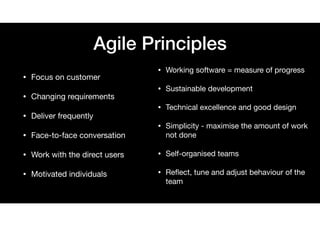
Agile Principles
• Focus on customer

• Changing requirements

• Deliver frequently

• Face-to-face conversation

• Work with the direct users

• Motivated individuals
• Working software = measure of progress

• Sustainable development

• Technical excellence and good design

• Simplicity - maximise the amount of work
not done

• Self-organised teams

• Reflect, tune and adjust behaviour of the
team
Scrum | XP | Lean | Kanban
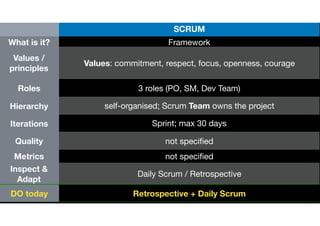
SCRUM
What is it? Framework
Values /
principles
Values: commitment, respect, focus, openness, courage
Roles 3 roles (PO, SM, Dev Team)
Hierarchy self-organised; Scrum Team owns the project
Iterations Sprint; max 30 days
Quality not specified
Metrics not specified
Inspect &
Adapt
Daily Scrum / Retrospective
DO today Retrospective + Daily Scrum
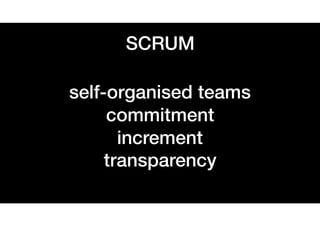
SCRUM
self-organised teams
commitment
increment
transparency
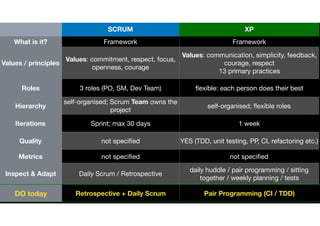
SCRUM XP
What is it? Framework Framework
Values / principles
Values: commitment, respect, focus,
openness, courage
Values: communication, simplicity, feedback,
courage, respect 

13 primary practices
Roles 3 roles (PO, SM, Dev Team) flexible: each person does their best
Hierarchy
self-organised; Scrum Team owns the
project
self-organised; flexible roles
Iterations Sprint; max 30 days 1 week
Quality not specified YES (TDD, unit testing, PP, CI, refactoring etc.)
Metrics not specified not specified
Inspect & Adapt Daily Scrum / Retrospective
daily huddle / pair programming / sitting
together / weekly planning / tests
DO today Retrospective + Daily Scrum Pair Programming (CI / TDD)
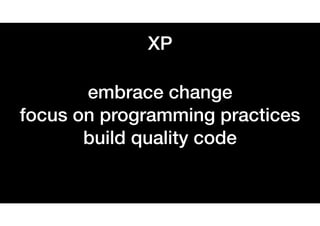
XP
embrace change
focus on programming practices
build quality code
XP Practices
• Programming:

• TDD

• Pair Programming

• Integration:

• 10-minutes build

• Continuous integration
• Planning:

• weekly cycles

• user stories

• quarterly cycle

• slack

• Team:

• sit together

• informative workspace
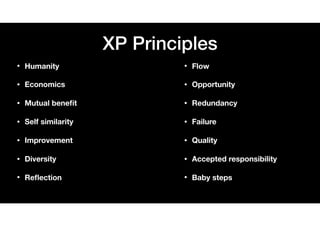
XP Principles
• Humanity
• Economics
• Mutual benefit
• Self similarity
• Improvement
• Diversity
• Reflection
• Flow
• Opportunity
• Redundancy
• Failure
• Quality
• Accepted responsibility
• Baby steps
Scrum vs XP
• Scrum is all about making sure that your customers know what you can
produce and what you can’t
• XP is about making it possible for you to make changes quickly and as
defect-free as possible
SCRUM XP Lean (Thinking)
What is it? Framework Framework Mindset
Values /
principles
Values: commitment, respect,
focus, openness, courage
Values: communication, simplicity,
feedback, courage, respect 

13 primary practices
Values: eliminate waste, amplify learning,
decide as late as possible, deliver as fast as
possible, empower the team, build integrity
in, see the whole 

Principles
Roles 3 roles (PO, SM, Dev Team)
flexible: each person does their
best
use existing roles
Hierarchy
self-organised; Scrum Team
owns the project
self-organised; flexible roles use existing roles
Iterations Sprint; max 30 days 1 week sprints up to 6 weeks
Quality not specified
YES (TDD, unit testing, PP, CI,
refactoring etc.)
YES
Metrics not specified not specified YES
Inspect &
Adapt
Daily Scrum / Retrospective
daily huddle / pair programming /
sitting together / weekly planning /
tests
amplify learning sessions
DO today
Retrospective + Daily
Scrum
Pair Programming / CI / TDD Look for waste in your project
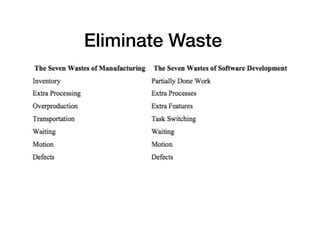
Eliminate Waste
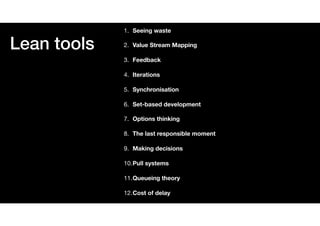
Lean tools
1. Seeing waste
2. Value Stream Mapping
3. Feedback
4. Iterations
5. Synchronisation
6. Set-based development
7. Options thinking
8. The last responsible moment
9. Making decisions
10.Pull systems
11.Queueing theory
12.Cost of delay
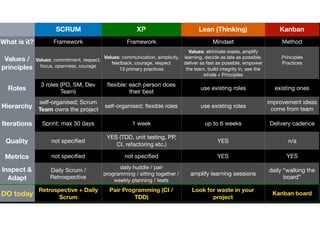
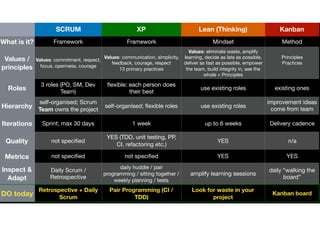
SCRUM XP Lean (Thinking) Kanban
What is it? Framework Framework Mindset Method
Values /
principles
Values: commitment, respect,
focus, openness, courage
Values: communication, simplicity,
feedback, courage, respect 

13 primary practices
Values: eliminate waste, amplify
learning, decide as late as possible,
deliver as fast as possible, empower
the team, build integrity in, see the
whole + Principles
Principles

Practices

Roles
3 roles (PO, SM, Dev
Team)
flexible: each person does
their best
use existing roles existing ones
Hierarchy
self-organised; Scrum
Team owns the project
self-organised; flexible roles use existing roles
improvement ideas
come from team
Iterations Sprint; max 30 days 1 week up to 6 weeks Delivery cadence
Quality not specified
YES (TDD, unit testing, PP,
CI, refactoring etc.)
YES n/a
Metrics not specified not specified YES YES
Inspect &
Adapt
Daily Scrum /
Retrospective
daily huddle / pair
programming / sitting together /
weekly planning / tests
amplify learning sessions
daily “walking the
board”
DO today
Retrospective + Daily
Scrum
Pair Programming (CI /
TDD)
Look for waste in your
project
Kanban board
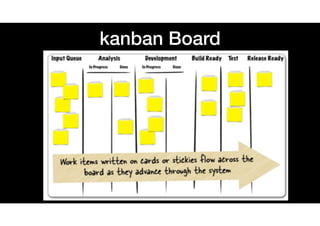
kanban Board
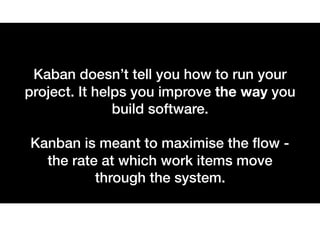
Kaban doesn’t tell you how to run your
project. It helps you improve the way you
build software.
Kanban is meant to maximise the flow -
the rate at which work items move
through the system.
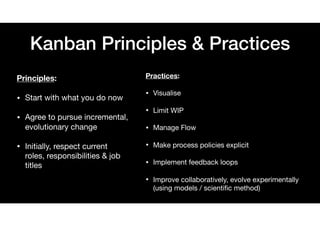
Kanban Principles & Practices
Principles:
• Start with what you do now

• Agree to pursue incremental,
evolutionary change

• Initially, respect current
roles, responsibilities & job
titles
Practices:
• Visualise

• Limit WIP

• Manage Flow

• Make process policies explicit

• Implement feedback loops

• Improve collaboratively, evolve experimentally
(using models / scientific method)
SCRUM XP Lean (Thinking) Kanban
What is it? Framework Framework Mindset Method
Values /
principles
Values: commitment, respect,
focus, openness, courage
Values: communication, simplicity,
feedback, courage, respect 

13 primary practices
Values: eliminate waste, amplify
learning, decide as late as possible,
deliver as fast as possible, empower
the team, build integrity in, see the
whole + Principles
Principles

Practices

Roles
3 roles (PO, SM, Dev
Team)
flexible: each person does
their best
use existing roles existing ones
Hierarchy
self-organised; Scrum
Team owns the project
self-organised; flexible roles use existing roles
improvement ideas
come from team
Iterations Sprint; max 30 days 1 week up to 6 weeks Delivery cadence
Quality not specified
YES (TDD, unit testing, PP,
CI, refactoring etc.)
YES n/a
Metrics not specified not specified YES YES
Inspect &
Adapt
Daily Scrum /
Retrospective
daily huddle / pair
programming / sitting together /
weekly planning / tests
amplify learning sessions
daily “walking the
board”
DO today
Retrospective + Daily
Scrum
Pair Programming (CI /
TDD)
Look for waste in your
project
Kanban board
What to do next?
SCRUM
XP
Lean &
Kanban

Scrum. XP. Lean. Kanban - Be Agile

  • 1.
    Scrum | XP| Lean | Kanban What’s What? Brief intro to Agile practices
  • 2.
  • 3.
    Agile is anumbrella SCRUM XP LEAN KANBAN FDD BDD TDD RAPID APPLICATION DEVELOPMENT (RAD) V-MODEL ATDD CRYSTAL Individuals and interactions over processes and tools Working software over comprehensive documentation Customer collaboration over contract negotiation Responding to change over following a plan
  • 4.
    Agile Principles • Focuson customer • Changing requirements • Deliver frequently • Face-to-face conversation • Work with the direct users • Motivated individuals • Working software = measure of progress • Sustainable development • Technical excellence and good design • Simplicity - maximise the amount of work not done • Self-organised teams • Reflect, tune and adjust behaviour of the team
  • 5.
    Scrum | XP| Lean | Kanban
  • 6.
    SCRUM What is it?Framework Values / principles Values: commitment, respect, focus, openness, courage Roles 3 roles (PO, SM, Dev Team) Hierarchy self-organised; Scrum Team owns the project Iterations Sprint; max 30 days Quality not specified Metrics not specified Inspect & Adapt Daily Scrum / Retrospective DO today Retrospective + Daily Scrum
  • 8.
  • 9.
    SCRUM XP What isit? Framework Framework Values / principles Values: commitment, respect, focus, openness, courage Values: communication, simplicity, feedback, courage, respect 13 primary practices Roles 3 roles (PO, SM, Dev Team) flexible: each person does their best Hierarchy self-organised; Scrum Team owns the project self-organised; flexible roles Iterations Sprint; max 30 days 1 week Quality not specified YES (TDD, unit testing, PP, CI, refactoring etc.) Metrics not specified not specified Inspect & Adapt Daily Scrum / Retrospective daily huddle / pair programming / sitting together / weekly planning / tests DO today Retrospective + Daily Scrum Pair Programming (CI / TDD)
  • 10.
    XP embrace change focus onprogramming practices build quality code
  • 11.
    XP Practices • Programming: •TDD • Pair Programming • Integration: • 10-minutes build • Continuous integration • Planning: • weekly cycles • user stories • quarterly cycle • slack • Team: • sit together • informative workspace
  • 12.
    XP Principles • Humanity •Economics • Mutual benefit • Self similarity • Improvement • Diversity • Reflection • Flow • Opportunity • Redundancy • Failure • Quality • Accepted responsibility • Baby steps
  • 13.
    Scrum vs XP •Scrum is all about making sure that your customers know what you can produce and what you can’t • XP is about making it possible for you to make changes quickly and as defect-free as possible
  • 14.
    SCRUM XP Lean(Thinking) What is it? Framework Framework Mindset Values / principles Values: commitment, respect, focus, openness, courage Values: communication, simplicity, feedback, courage, respect 13 primary practices Values: eliminate waste, amplify learning, decide as late as possible, deliver as fast as possible, empower the team, build integrity in, see the whole Principles Roles 3 roles (PO, SM, Dev Team) flexible: each person does their best use existing roles Hierarchy self-organised; Scrum Team owns the project self-organised; flexible roles use existing roles Iterations Sprint; max 30 days 1 week sprints up to 6 weeks Quality not specified YES (TDD, unit testing, PP, CI, refactoring etc.) YES Metrics not specified not specified YES Inspect & Adapt Daily Scrum / Retrospective daily huddle / pair programming / sitting together / weekly planning / tests amplify learning sessions DO today Retrospective + Daily Scrum Pair Programming / CI / TDD Look for waste in your project
  • 15.
  • 16.
    Lean tools 1. Seeingwaste 2. Value Stream Mapping 3. Feedback 4. Iterations 5. Synchronisation 6. Set-based development 7. Options thinking 8. The last responsible moment 9. Making decisions 10.Pull systems 11.Queueing theory 12.Cost of delay
  • 17.
    SCRUM XP Lean(Thinking) Kanban What is it? Framework Framework Mindset Method Values / principles Values: commitment, respect, focus, openness, courage Values: communication, simplicity, feedback, courage, respect 13 primary practices Values: eliminate waste, amplify learning, decide as late as possible, deliver as fast as possible, empower the team, build integrity in, see the whole + Principles Principles Practices Roles 3 roles (PO, SM, Dev Team) flexible: each person does their best use existing roles existing ones Hierarchy self-organised; Scrum Team owns the project self-organised; flexible roles use existing roles improvement ideas come from team Iterations Sprint; max 30 days 1 week up to 6 weeks Delivery cadence Quality not specified YES (TDD, unit testing, PP, CI, refactoring etc.) YES n/a Metrics not specified not specified YES YES Inspect & Adapt Daily Scrum / Retrospective daily huddle / pair programming / sitting together / weekly planning / tests amplify learning sessions daily “walking the board” DO today Retrospective + Daily Scrum Pair Programming (CI / TDD) Look for waste in your project Kanban board
  • 18.
  • 19.
    Kaban doesn’t tellyou how to run your project. It helps you improve the way you build software. Kanban is meant to maximise the flow - the rate at which work items move through the system.
  • 20.
    Kanban Principles &Practices Principles: • Start with what you do now • Agree to pursue incremental, evolutionary change • Initially, respect current roles, responsibilities & job titles Practices: • Visualise • Limit WIP • Manage Flow • Make process policies explicit • Implement feedback loops • Improve collaboratively, evolve experimentally (using models / scientific method)
  • 21.
    SCRUM XP Lean(Thinking) Kanban What is it? Framework Framework Mindset Method Values / principles Values: commitment, respect, focus, openness, courage Values: communication, simplicity, feedback, courage, respect 13 primary practices Values: eliminate waste, amplify learning, decide as late as possible, deliver as fast as possible, empower the team, build integrity in, see the whole + Principles Principles Practices Roles 3 roles (PO, SM, Dev Team) flexible: each person does their best use existing roles existing ones Hierarchy self-organised; Scrum Team owns the project self-organised; flexible roles use existing roles improvement ideas come from team Iterations Sprint; max 30 days 1 week up to 6 weeks Delivery cadence Quality not specified YES (TDD, unit testing, PP, CI, refactoring etc.) YES n/a Metrics not specified not specified YES YES Inspect & Adapt Daily Scrum / Retrospective daily huddle / pair programming / sitting together / weekly planning / tests amplify learning sessions daily “walking the board” DO today Retrospective + Daily Scrum Pair Programming (CI / TDD) Look for waste in your project Kanban board
  • 22.
  • 23.
  • 24.
  • 25.