Prof. Ed 6 Facilitating Learner-Centered Teaching
MELANY Altea- MANRIZA - INSTRUCTOR
FACILITATING
LEARNER-CENTERED
TEACHING
Prof. Ed 6 Facilitating Learner-Centered Teaching
MELANY A. MANRIZA - INSTRUCTOR
COURSE DESCRIPTION:
This course is designed to explore and equip pre-service teachers
with the fundamental principles, processes, and practices anchored
on learner-centeredness and other educational psychologies
supportive of learning environments as these apply to facilitate
various teaching- learning delivery modes to enhance learning. It
also includes the demonstration of knowledge and understanding
of differentiated teaching to suit the learners’ gender, needs,
strengths, interests and experiences. Further, pre-service teachers
will be trained to implement teaching strategies that are
responsive to learners’ linguistic, cultural, socio-economic and
religious backgrounds.
Prof. Ed 6 Facilitating Learner-Centered Teaching
MELANY A. MANRIZA - INSTRUCTOR
Unit 1 Learner-centered teaching: Foundations and characteristics
A. Learner-centered teaching
1. Definition
2. Description/Characteristics
B. Paradigm shift: From teacher- centered to learner-centered teaching
1. Philosophical perspectives
Teacher-centered philosophies
Essentialism
Perennialism
Learner-centered philosophies
Progressivism
Humanism
Constructivism
2. Supporting research
3. Resistance to change: Managing the shift
Prof. Ed 6 Facilitating Learner-Centered Teaching
MELANY A. MANRIZA - INSTRUCTOR
C. Dimensions of learner-centered
teaching
1. The function of content
2. The role of the instructor
3. The responsibility for learning
4. The purposes and processes of
assessment
5. The balance of power
Prof. Ed 6 Facilitating Learner-Centered Teaching
MELANY A. MANRIZA - INSTRUCTOR
Prof. Ed 6 Facilitating Learner-Centered Teaching
MELANY A. MANRIZA - INSTRUCTOR
Prof. Ed 6 Facilitating Learner-Centered Teaching
MELANY A. MANRIZA - INSTRUCTOR
Unit 3 – Organization and Management of Learner-Centered Classrooms
A. Forms of learner-centered classroom organization, procedures and
physical structure
1. Room structuring
- For individualized learning
- For group learning
- Activity-oriented classroom
2. Classroom routines and procedures
3. The social environment: Fairness, respect, care and
encouraging learning
4. Creating motivating learning environment
Prof. Ed 6 Facilitating Learner-Centered Teaching
MELANY A. MANRIZA - INSTRUCTOR
B. Learner-centered classroom: Roles and
responsibilities
1.Of teachers
2. Of learners
C. The role of discipline in learner- centered classrooms
1. Collaborative class norms
2. Logical consequences
3. Consistent application
4. Student-specific
5. Time for resolution
6. Calm spaces
Prof. Ed 6 Facilitating Learner-Centered Teaching
MELANY A. MANRIZA - INSTRUCTOR
Unit 4 –Learner-centered Pedagogy
A. Delivery Modalities
1. Face-to-face
2. Blended learning
3. Technology-based, Online/ e-
Learning
4. Distance learning
Prof. Ed 6 Facilitating Learner-Centered Teaching
MELANY A. MANRIZA - INSTRUCTOR
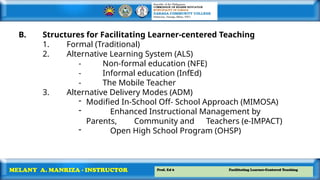
B. Structures for Facilitating Learner-centered Teaching
1. Formal (Traditional)
2. Alternative Learning System (ALS)
- Non-formal education (NFE)
- Informal education (InfEd)
- The Mobile Teacher
3. Alternative Delivery Modes (ADM)
- Modified In-School Off- School Approach (MIMOSA)
- Enhanced Instructional Management by
Parents, Community and Teachers (e-IMPACT)
- Open High School Program (OHSP)
Prof. Ed 6 Facilitating Learner-Centered Teaching
MELANY A. MANRIZA - INSTRUCTOR
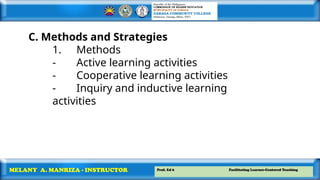
C. Methods and Strategies
1. Methods
- Active learning activities
- Cooperative learning activities
- Inquiry and inductive learning
activities
Prof. Ed 6 Facilitating Learner-Centered Teaching
MELANY A. MANRIZA - INSTRUCTOR
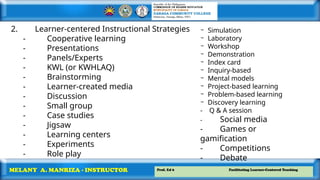
2. Learner-centered Instructional Strategies
- Cooperative learning
- Presentations
- Panels/Experts
- KWL (or KWHLAQ)
- Brainstorming
- Learner-created media
- Discussion
- Small group
- Case studies
- Jigsaw
- Learning centers
- Experiments
- Role play
- Simulation
- Laboratory
- Workshop
- Demonstration
- Index card
- Inquiry-based
- Mental models
- Project-based learning
- Problem-based learning
- Discovery learning
- Q & A session
- Social media
- Games or
gamification
- Competitions
- Debate
Prof. Ed 6 Facilitating Learner-Centered Teaching
MELANY A. MANRIZA - INSTRUCTOR
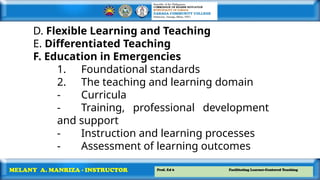
D. Flexible Learning and Teaching
E. Differentiated Teaching
F. Education in Emergencies
1. Foundational standards
2. The teaching and learning domain
- Curricula
- Training, professional development
and support
- Instruction and learning processes
- Assessment of learning outcomes
Prof. Ed 6 Facilitating Learner-Centered Teaching
MELANY A. MANRIZA - INSTRUCTOR
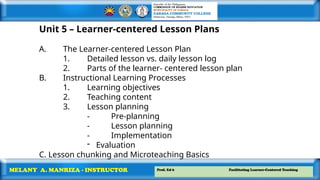
Unit 5 – Learner-centered Lesson Plans
A. The Learner-centered Lesson Plan
1. Detailed lesson vs. daily lesson log
2. Parts of the learner- centered lesson plan
B. Instructional Learning Processes
1. Learning objectives
2. Teaching content
3. Lesson planning
- Pre-planning
- Lesson planning
- Implementation
- Evaluation
C. Lesson chunking and Microteaching Basics
Prof. Ed 6 Facilitating Learner-Centered Teaching
MELANY A. MANRIZA - INSTRUCTOR
We think that learner-centered teaching focus
on_______________________________________________________
_____________________________________________
LEARNER-CENTERED TEACHING means subjecting
every teaching activity (method, assignment, or
assessment) to the test of a single question: ‘‘Given
the context of my students, course, and classroom, will
this teaching action optimize my students’ opportunity
to learn?’’
Prof. Ed 6 Facilitating Learner-Centered Teaching
MELANY A. MANRIZA - INSTRUCTOR
A learner-centered environment is different. It
requires students to take on new learning roles
and responsibilities that go far beyond taking
notes and passing tests. It is an environment that
allows students to take some real control over
their educational experience and encourages
them to make important choices about what and
how they will learn. In learner-centered
classrooms, collaboration is the norm, not an
occasional class activity.
Prof. Ed 6 Facilitating Learner-Centered Teaching
MELANY A. MANRIZA - INSTRUCTOR
Four specific aspects of learner-centered
practice that are crucial to achieving this
optimization.
1. Involving Students in Firsthand Learning
When students engage in firsthand learning experiences,
they learn to figure things out for themselves, to believe in
the analytical abilities of their minds, to connect with the
world around them directly, and to learn to use their innate
curiosity to discover the power of their learning abilities
(First Hand Learning Inc., 2007). However, this powerful
process is one with which students have limited familiarity,
and they will need our help to learn how to be successful
firsthand learners.
Prof. Ed 6 Facilitating Learner-Centered Teaching
MELANY A. MANRIZA - INSTRUCTOR
2. Giving Students Choices About and Control of Their Learning
The second aspect, which goes to the heart of the learner-
centered practice, is to share more control over students’
learning with them. Sometimes we in education forget that it is
indeed the students’ learning we are trying to facilitate—it is, in
fact, all about them.
3. Teaching Students Lifelong Learning Skills
The third aspect of a learner-centered practice goes
hand-in-hand with teaching for long-term memory. As an
integrated part of teaching our course content, we need
to teach the lifelong learning skills that our students will
need to live successfully in an ever-expanding global
economy.
Prof. Ed 6 Facilitating Learner-Centered Teaching
MELANY A. MANRIZA - INSTRUCTOR
4. Promoting the Relevance of Learner-Centered Teaching
The fourth aspect of successfully implementing a learner-
centered practice is to be able to explain to students why you
want them to change their roles and responsibilities, and how
these changes will produce deeper and long-lasting learning.
Example: One fascinating finding in the TV program Sesame Street was that the
children lost interest not because the colors were not bright enough or the
characters attractive, but when they did not understand what was going on. We
should take this lesson from Sesame Street to heart. Students might lose interest in
what we are trying to teach because they do not understand why the information is
important or relevant to their lives or to the learning goals of the class.
Prof. Ed 6 Facilitating Learner-Centered Teaching
MELANY A. MANRIZA - INSTRUCTOR
Paradigm Shift: From Teacher-centered to
Learner-Centered Teaching
Lesson no.1 Essentialism
Introduction
An essentialist account of human nature could, at first sight,
seem to be something that a dedicated feminist philosopher
should oppose. Essentialism is often associated with old-
fashioned, conservative, and even patriarchal thinking. Thus,
it is understood as something entirely inappropriate for the
adequate justification of the ideals crucial to feminist
philosophy.
Prof. Ed 6 Facilitating Learner-Centered Teaching
MELANY A. MANRIZA - INSTRUCTOR
Take the challenge!
Name the things that are necessary to you as a person.
(Get a partner to come up with a tally sheet).
Analysis.
Answer the following.
1. In what things are you and your classmates the same?
2. In what things are you and your classmate different?
3. Are you glad that you have similarities? Differences? Explain your answer.
4. How can the teacher utilize these similarities and differences in teaching
you?
Prof. Ed 6 Facilitating Learner-Centered Teaching
MELANY A. MANRIZA - INSTRUCTOR
WHAT IS ESSENTIALISM?
• is the view that every entity has a set of
necessary attributes to its identity and
function. In early Western thought, Plato's
idealism held that all things have such an
"essence"—an "idea" or "form". The
contrary view—nonessentialism—denies
the need to posit such an "essence.”
• is the view that certain categories (e.g.,
women, racial groups, dinosaurs, original
Picasso artwork) have an underlying
reality or true nature that one cannot
observe directly.
Prof. Ed 6 Facilitating Learner-Centered Teaching
MELANY A. MANRIZA - INSTRUCTOR
PRINCIPLES OF ESSENTIALISM
Essentialists argue that classrooms should be teacher-oriented.
An example of essentialism would be lecture-based introduction
classes taught at universities. Students sit and take notes in a
classroom that holds over one hundred students. They take
introductory-level courses to introduce them to the content.
Essentialism is a relatively conservative stance to education that
strives to teach students the knowledge of a society and
civilization through a core curriculum. This core curriculum
involves such areas that include the study of the surrounding
environment, basic natural laws, and the disciplines that promote
a happier, more educated living.
Prof. Ed 6 Facilitating Learner-Centered Teaching
MELANY A. MANRIZA - INSTRUCTOR
Essentialism is a teacher-centered philosophy. The role of the
teacher as the leader of the classroom is a fundamental tenet of
Educational essentialism. The teacher is the center of the
classroom, so they should be rigid and disciplinary. Establishing
order in the classroom is crucial for student learning; effective
teaching cannot occur in a loud and disorganized environment.
Essentialists believe that teachers should try to embed
traditional moral values and virtues such as respect for
authority, perseverance, fidelity to duty, consideration for
others, and practicality and intellectual knowledge that students
need to become model citizens.
Prof. Ed 6 Facilitating Learner-Centered Teaching
MELANY A. MANRIZA - INSTRUCTOR
Application
Describe/present the concept of individual needs by
means of the following:
Group 1. Song
Group 2. Poem
Group 3. Jingle
Group 4. Slide presentation
Prof. Ed 6 Facilitating Learner-Centered Teaching
MELANY A. MANRIZA - INSTRUCTOR
Prof. Ed 6 Facilitating Learner-Centered Teaching
MELANY A. MANRIZA - INSTRUCTOR
The Process and Purposes of Assessment in Learner-
Centered Teaching
Learner-centered teaching is an approach that shifts
the focus from the teacher as the primary source of
knowledge to the students as active participants in
their own learning. In this framework, assessment
plays a crucial role in guiding learning, evaluating
progress, and ensuring that the teaching methods
align with the needs of the learners.
Prof. Ed 6 Facilitating Learner-Centered Teaching
MELANY A. MANRIZA - INSTRUCTOR
Process of Assessment in Learner-Centered Teaching
1.Formative Assessments
1.Ongoing Feedback: Formative assessments are carried
out regularly throughout the learning process. They
provide feedback to both learners and instructors, helping
to identify strengths and areas for improvement. Examples
include quizzes, reflective journals, in-class discussions, or
concept maps.
2.Adjustments to Learning: Based on formative
assessment results, teachers can adjust their instruction to
meet the needs of individual learners, while learners can
adjust their study strategies.
Prof. Ed 6 Facilitating Learner-Centered Teaching
MELANY A. MANRIZA - INSTRUCTOR
2. Summative Assessments
•Evaluating Mastery: Summative assessments occur
at the end of a learning unit or course. These are
typically used to evaluate whether students have
achieved the intended learning outcomes. Examples
include final exams, projects, presentations, or papers.
•Demonstrating Learning Outcomes: In learner-
centered teaching, summative assessments often
emphasize the application of knowledge, problem-
solving, and critical thinking, rather than rote
memorization.
Prof. Ed 6 Facilitating Learner-Centered Teaching
MELANY A. MANRIZA - INSTRUCTOR
3. Self-Assessment
•Encouraging Reflection: In a learner-
centered approach, students are encouraged
to assess their own learning progress. They
reflect on their understanding of the material
and identify areas where they need more work,
promoting autonomy and responsibility in
learning.
Prof. Ed 6 Facilitating Learner-Centered Teaching
MELANY A. MANRIZA - INSTRUCTOR
4.Peer Assessment
Collaborative Learning: Peer assessments
allow students to evaluate each other's
work. This fosters collaboration, critical
thinking, and deeper understanding by
engaging with different perspectives and
offering constructive feedback.
Prof. Ed 6 Facilitating Learner-Centered Teaching
MELANY A. MANRIZA - INSTRUCTOR
5. Authentic Assessments
•Real-World Applications: Authentic
assessments ask students to apply their
knowledge to real-world problems or
situations. For example, a project-based
task might require students to solve a
community issue, demonstrating the
practical application of their learning.
Prof. Ed 6 Facilitating Learner-Centered Teaching
MELANY A. MANRIZA - INSTRUCTOR
Prof. Ed 6 Facilitating Learner-Centered Teaching
MELANY A. MANRIZA - INSTRUCTOR
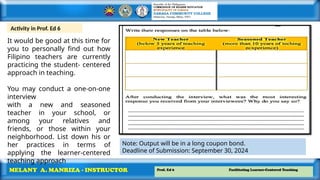
It would be good at this time for
you to personally find out how
Filipino teachers are currently
practicing the student- centered
approach in teaching.
You may conduct a one-on-one
interview
with a new and seasoned
teacher in your school, or
among your relatives and
friends, or those within your
neighborhood. List down his or
her practices in terms of
applying the learner-centered
teaching approach
Activity in Prof. Ed 6
Note: Output will be in a long coupon bond.
Deadline of Submission: September 30, 2024
Prof. Ed 6 Facilitating Learner-Centered Teaching
MELANY A. MANRIZA - INSTRUCTOR

Professional Education Subject for BEED3

  • 1.
    Prof. Ed 6Facilitating Learner-Centered Teaching MELANY Altea- MANRIZA - INSTRUCTOR FACILITATING LEARNER-CENTERED TEACHING
  • 2.
    Prof. Ed 6Facilitating Learner-Centered Teaching MELANY A. MANRIZA - INSTRUCTOR COURSE DESCRIPTION: This course is designed to explore and equip pre-service teachers with the fundamental principles, processes, and practices anchored on learner-centeredness and other educational psychologies supportive of learning environments as these apply to facilitate various teaching- learning delivery modes to enhance learning. It also includes the demonstration of knowledge and understanding of differentiated teaching to suit the learners’ gender, needs, strengths, interests and experiences. Further, pre-service teachers will be trained to implement teaching strategies that are responsive to learners’ linguistic, cultural, socio-economic and religious backgrounds.
  • 3.
    Prof. Ed 6Facilitating Learner-Centered Teaching MELANY A. MANRIZA - INSTRUCTOR Unit 1 Learner-centered teaching: Foundations and characteristics A. Learner-centered teaching 1. Definition 2. Description/Characteristics B. Paradigm shift: From teacher- centered to learner-centered teaching 1. Philosophical perspectives Teacher-centered philosophies Essentialism Perennialism Learner-centered philosophies Progressivism Humanism Constructivism 2. Supporting research 3. Resistance to change: Managing the shift
  • 4.
    Prof. Ed 6Facilitating Learner-Centered Teaching MELANY A. MANRIZA - INSTRUCTOR C. Dimensions of learner-centered teaching 1. The function of content 2. The role of the instructor 3. The responsibility for learning 4. The purposes and processes of assessment 5. The balance of power
  • 5.
    Prof. Ed 6Facilitating Learner-Centered Teaching MELANY A. MANRIZA - INSTRUCTOR
  • 6.
    Prof. Ed 6Facilitating Learner-Centered Teaching MELANY A. MANRIZA - INSTRUCTOR
  • 7.
    Prof. Ed 6Facilitating Learner-Centered Teaching MELANY A. MANRIZA - INSTRUCTOR Unit 3 – Organization and Management of Learner-Centered Classrooms A. Forms of learner-centered classroom organization, procedures and physical structure 1. Room structuring - For individualized learning - For group learning - Activity-oriented classroom 2. Classroom routines and procedures 3. The social environment: Fairness, respect, care and encouraging learning 4. Creating motivating learning environment
  • 8.
    Prof. Ed 6Facilitating Learner-Centered Teaching MELANY A. MANRIZA - INSTRUCTOR B. Learner-centered classroom: Roles and responsibilities 1.Of teachers 2. Of learners C. The role of discipline in learner- centered classrooms 1. Collaborative class norms 2. Logical consequences 3. Consistent application 4. Student-specific 5. Time for resolution 6. Calm spaces
  • 9.
    Prof. Ed 6Facilitating Learner-Centered Teaching MELANY A. MANRIZA - INSTRUCTOR Unit 4 –Learner-centered Pedagogy A. Delivery Modalities 1. Face-to-face 2. Blended learning 3. Technology-based, Online/ e- Learning 4. Distance learning
  • 10.
    Prof. Ed 6Facilitating Learner-Centered Teaching MELANY A. MANRIZA - INSTRUCTOR B. Structures for Facilitating Learner-centered Teaching 1. Formal (Traditional) 2. Alternative Learning System (ALS) - Non-formal education (NFE) - Informal education (InfEd) - The Mobile Teacher 3. Alternative Delivery Modes (ADM) - Modified In-School Off- School Approach (MIMOSA) - Enhanced Instructional Management by Parents, Community and Teachers (e-IMPACT) - Open High School Program (OHSP)
  • 11.
    Prof. Ed 6Facilitating Learner-Centered Teaching MELANY A. MANRIZA - INSTRUCTOR C. Methods and Strategies 1. Methods - Active learning activities - Cooperative learning activities - Inquiry and inductive learning activities
  • 12.
    Prof. Ed 6Facilitating Learner-Centered Teaching MELANY A. MANRIZA - INSTRUCTOR 2. Learner-centered Instructional Strategies - Cooperative learning - Presentations - Panels/Experts - KWL (or KWHLAQ) - Brainstorming - Learner-created media - Discussion - Small group - Case studies - Jigsaw - Learning centers - Experiments - Role play - Simulation - Laboratory - Workshop - Demonstration - Index card - Inquiry-based - Mental models - Project-based learning - Problem-based learning - Discovery learning - Q & A session - Social media - Games or gamification - Competitions - Debate
  • 13.
    Prof. Ed 6Facilitating Learner-Centered Teaching MELANY A. MANRIZA - INSTRUCTOR D. Flexible Learning and Teaching E. Differentiated Teaching F. Education in Emergencies 1. Foundational standards 2. The teaching and learning domain - Curricula - Training, professional development and support - Instruction and learning processes - Assessment of learning outcomes
  • 14.
    Prof. Ed 6Facilitating Learner-Centered Teaching MELANY A. MANRIZA - INSTRUCTOR Unit 5 – Learner-centered Lesson Plans A. The Learner-centered Lesson Plan 1. Detailed lesson vs. daily lesson log 2. Parts of the learner- centered lesson plan B. Instructional Learning Processes 1. Learning objectives 2. Teaching content 3. Lesson planning - Pre-planning - Lesson planning - Implementation - Evaluation C. Lesson chunking and Microteaching Basics
  • 15.
    Prof. Ed 6Facilitating Learner-Centered Teaching MELANY A. MANRIZA - INSTRUCTOR We think that learner-centered teaching focus on_______________________________________________________ _____________________________________________ LEARNER-CENTERED TEACHING means subjecting every teaching activity (method, assignment, or assessment) to the test of a single question: ‘‘Given the context of my students, course, and classroom, will this teaching action optimize my students’ opportunity to learn?’’
  • 16.
    Prof. Ed 6Facilitating Learner-Centered Teaching MELANY A. MANRIZA - INSTRUCTOR A learner-centered environment is different. It requires students to take on new learning roles and responsibilities that go far beyond taking notes and passing tests. It is an environment that allows students to take some real control over their educational experience and encourages them to make important choices about what and how they will learn. In learner-centered classrooms, collaboration is the norm, not an occasional class activity.
  • 17.
    Prof. Ed 6Facilitating Learner-Centered Teaching MELANY A. MANRIZA - INSTRUCTOR Four specific aspects of learner-centered practice that are crucial to achieving this optimization. 1. Involving Students in Firsthand Learning When students engage in firsthand learning experiences, they learn to figure things out for themselves, to believe in the analytical abilities of their minds, to connect with the world around them directly, and to learn to use their innate curiosity to discover the power of their learning abilities (First Hand Learning Inc., 2007). However, this powerful process is one with which students have limited familiarity, and they will need our help to learn how to be successful firsthand learners.
  • 18.
    Prof. Ed 6Facilitating Learner-Centered Teaching MELANY A. MANRIZA - INSTRUCTOR 2. Giving Students Choices About and Control of Their Learning The second aspect, which goes to the heart of the learner- centered practice, is to share more control over students’ learning with them. Sometimes we in education forget that it is indeed the students’ learning we are trying to facilitate—it is, in fact, all about them. 3. Teaching Students Lifelong Learning Skills The third aspect of a learner-centered practice goes hand-in-hand with teaching for long-term memory. As an integrated part of teaching our course content, we need to teach the lifelong learning skills that our students will need to live successfully in an ever-expanding global economy.
  • 19.
    Prof. Ed 6Facilitating Learner-Centered Teaching MELANY A. MANRIZA - INSTRUCTOR 4. Promoting the Relevance of Learner-Centered Teaching The fourth aspect of successfully implementing a learner- centered practice is to be able to explain to students why you want them to change their roles and responsibilities, and how these changes will produce deeper and long-lasting learning. Example: One fascinating finding in the TV program Sesame Street was that the children lost interest not because the colors were not bright enough or the characters attractive, but when they did not understand what was going on. We should take this lesson from Sesame Street to heart. Students might lose interest in what we are trying to teach because they do not understand why the information is important or relevant to their lives or to the learning goals of the class.
  • 20.
    Prof. Ed 6Facilitating Learner-Centered Teaching MELANY A. MANRIZA - INSTRUCTOR Paradigm Shift: From Teacher-centered to Learner-Centered Teaching Lesson no.1 Essentialism Introduction An essentialist account of human nature could, at first sight, seem to be something that a dedicated feminist philosopher should oppose. Essentialism is often associated with old- fashioned, conservative, and even patriarchal thinking. Thus, it is understood as something entirely inappropriate for the adequate justification of the ideals crucial to feminist philosophy.
  • 21.
    Prof. Ed 6Facilitating Learner-Centered Teaching MELANY A. MANRIZA - INSTRUCTOR Take the challenge! Name the things that are necessary to you as a person. (Get a partner to come up with a tally sheet). Analysis. Answer the following. 1. In what things are you and your classmates the same? 2. In what things are you and your classmate different? 3. Are you glad that you have similarities? Differences? Explain your answer. 4. How can the teacher utilize these similarities and differences in teaching you?
  • 22.
    Prof. Ed 6Facilitating Learner-Centered Teaching MELANY A. MANRIZA - INSTRUCTOR WHAT IS ESSENTIALISM? • is the view that every entity has a set of necessary attributes to its identity and function. In early Western thought, Plato's idealism held that all things have such an "essence"—an "idea" or "form". The contrary view—nonessentialism—denies the need to posit such an "essence.” • is the view that certain categories (e.g., women, racial groups, dinosaurs, original Picasso artwork) have an underlying reality or true nature that one cannot observe directly.
  • 23.
    Prof. Ed 6Facilitating Learner-Centered Teaching MELANY A. MANRIZA - INSTRUCTOR PRINCIPLES OF ESSENTIALISM Essentialists argue that classrooms should be teacher-oriented. An example of essentialism would be lecture-based introduction classes taught at universities. Students sit and take notes in a classroom that holds over one hundred students. They take introductory-level courses to introduce them to the content. Essentialism is a relatively conservative stance to education that strives to teach students the knowledge of a society and civilization through a core curriculum. This core curriculum involves such areas that include the study of the surrounding environment, basic natural laws, and the disciplines that promote a happier, more educated living.
  • 24.
    Prof. Ed 6Facilitating Learner-Centered Teaching MELANY A. MANRIZA - INSTRUCTOR Essentialism is a teacher-centered philosophy. The role of the teacher as the leader of the classroom is a fundamental tenet of Educational essentialism. The teacher is the center of the classroom, so they should be rigid and disciplinary. Establishing order in the classroom is crucial for student learning; effective teaching cannot occur in a loud and disorganized environment. Essentialists believe that teachers should try to embed traditional moral values and virtues such as respect for authority, perseverance, fidelity to duty, consideration for others, and practicality and intellectual knowledge that students need to become model citizens.
  • 25.
    Prof. Ed 6Facilitating Learner-Centered Teaching MELANY A. MANRIZA - INSTRUCTOR Application Describe/present the concept of individual needs by means of the following: Group 1. Song Group 2. Poem Group 3. Jingle Group 4. Slide presentation
  • 26.
    Prof. Ed 6Facilitating Learner-Centered Teaching MELANY A. MANRIZA - INSTRUCTOR
  • 27.
    Prof. Ed 6Facilitating Learner-Centered Teaching MELANY A. MANRIZA - INSTRUCTOR The Process and Purposes of Assessment in Learner- Centered Teaching Learner-centered teaching is an approach that shifts the focus from the teacher as the primary source of knowledge to the students as active participants in their own learning. In this framework, assessment plays a crucial role in guiding learning, evaluating progress, and ensuring that the teaching methods align with the needs of the learners.
  • 28.
    Prof. Ed 6Facilitating Learner-Centered Teaching MELANY A. MANRIZA - INSTRUCTOR Process of Assessment in Learner-Centered Teaching 1.Formative Assessments 1.Ongoing Feedback: Formative assessments are carried out regularly throughout the learning process. They provide feedback to both learners and instructors, helping to identify strengths and areas for improvement. Examples include quizzes, reflective journals, in-class discussions, or concept maps. 2.Adjustments to Learning: Based on formative assessment results, teachers can adjust their instruction to meet the needs of individual learners, while learners can adjust their study strategies.
  • 29.
    Prof. Ed 6Facilitating Learner-Centered Teaching MELANY A. MANRIZA - INSTRUCTOR 2. Summative Assessments •Evaluating Mastery: Summative assessments occur at the end of a learning unit or course. These are typically used to evaluate whether students have achieved the intended learning outcomes. Examples include final exams, projects, presentations, or papers. •Demonstrating Learning Outcomes: In learner- centered teaching, summative assessments often emphasize the application of knowledge, problem- solving, and critical thinking, rather than rote memorization.
  • 30.
    Prof. Ed 6Facilitating Learner-Centered Teaching MELANY A. MANRIZA - INSTRUCTOR 3. Self-Assessment •Encouraging Reflection: In a learner- centered approach, students are encouraged to assess their own learning progress. They reflect on their understanding of the material and identify areas where they need more work, promoting autonomy and responsibility in learning.
  • 31.
    Prof. Ed 6Facilitating Learner-Centered Teaching MELANY A. MANRIZA - INSTRUCTOR 4.Peer Assessment Collaborative Learning: Peer assessments allow students to evaluate each other's work. This fosters collaboration, critical thinking, and deeper understanding by engaging with different perspectives and offering constructive feedback.
  • 32.
    Prof. Ed 6Facilitating Learner-Centered Teaching MELANY A. MANRIZA - INSTRUCTOR 5. Authentic Assessments •Real-World Applications: Authentic assessments ask students to apply their knowledge to real-world problems or situations. For example, a project-based task might require students to solve a community issue, demonstrating the practical application of their learning.
  • 33.
    Prof. Ed 6Facilitating Learner-Centered Teaching MELANY A. MANRIZA - INSTRUCTOR
  • 34.
    Prof. Ed 6Facilitating Learner-Centered Teaching MELANY A. MANRIZA - INSTRUCTOR It would be good at this time for you to personally find out how Filipino teachers are currently practicing the student- centered approach in teaching. You may conduct a one-on-one interview with a new and seasoned teacher in your school, or among your relatives and friends, or those within your neighborhood. List down his or her practices in terms of applying the learner-centered teaching approach Activity in Prof. Ed 6 Note: Output will be in a long coupon bond. Deadline of Submission: September 30, 2024
  • 35.
    Prof. Ed 6Facilitating Learner-Centered Teaching MELANY A. MANRIZA - INSTRUCTOR