www.iss.nus.edu.sg
Professional Conversion
Programme Sharing Session
Virtual Learning Festival
13th August 2020
For Digital Product Management
Daniel Boey
© 2020 National University of Singapore. All Rights Reserved
Daniel Boey
Chief, Products & Platforms Practice
MBA, NUS BSc(Hons) (Comp Sc & Info Sys) NUS,
PMP, CITPM (Senior), CSM, P3O
Daniel currently heads the Products & Platforms practice in ISS, NUS.
He teaches and consults in product and project management and works
closely with many organizations in developing customised training
programs for their staff development.
Currently teaching the following courses
• NICF- Managing Digital Products (SF)
• NICF- Digital Product Strategy (SF)
• NICF- Managing Business Analytics Projects (SF)
© 2020 National University of Singapore. All Rights Reserved
linkedin.com/in/daniel-
sk-boey-6a920541
© 2020 National University of Singapore. All Rights Reserved
What is Professional Conversion Programme (PCP)
A career conversion programme for :
 Professionals, Managers, Executives and Technicians (PMETs), including mid-career
switchers,
 to undergo skills conversion and
 move into new occupations or sectors with better prospects and opportunities for
progression.
 Place-and-Train Programme where PMET is hired by a participating employer
before undergoing training to take on new job role
Data Analytics Software
Development
Business Analytics Artificial
Intelligence
Digital Product
Management
Digital
Transformation© 2020 National University of Singapore. All Rights Reserved
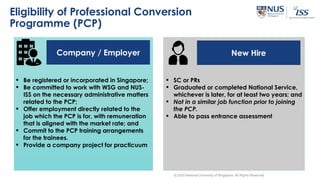
Eligibility of Professional Conversion
Programme (PCP)
New HireCompany / Employer
 Be registered or incorporated in Singapore;
 Be committed to work with WSG and NUS-
ISS on the necessary administrative matters
related to the PCP;
 Offer employment directly related to the
job which the PCP is for, with remuneration
that is aligned with the market rate; and
 Commit to the PCP training arrangements
for the trainees.
 Provide a company project for practicuum
 SC or PRs
 Graduated or completed National Service,
whichever is later, for at least two years; and
 Not in a similar job function prior to joining
the PCP.
 Able to pass entrance assessment
© 2020 National University of Singapore. All Rights Reserved
Professional Conversion Programmes (PCP)
Phase 1: Training Course
Phase 2: Proj Practicuum
(4 months)
Grants and Salary SupportInterview and Hire
Interview, Select
and Hire
Submit Details
+ Project Plan
Full-time training
(14.7 days)
Employee back in
office + Company
provides mentorship
and guidance
Get rewarded
for building and
growing talents
Skills Level Up! Productivity Up!
© 2020 National University of Singapore. All Rights Reserved
Structure and Duration of NUS-ISS PCP
Phase 1
(Classroom Training)
Phase 2
(Project Practicuum)
 14.7 training days
spread over 2-3 months
of classroom training plus
assessment
 Require at least 75%
attendance
 Able to pass all
classroom assessment
 4 months of OJT with
the sponsoring company.
 To complete the
company sponsored
project within OJT
period.
 Require to make at least
3 progressive project
presentation over the
period to NUS-ISS
assigned project
supervisor.
Completion of
Programme
Professional
Diploma
Certification
from NUS-ISS
Duration : 5 to 6 months
Entrance
Assessment
© 2020 National University of Singapore. All Rights Reserved
What are the PCP Programmes in NUS-ISS
Digital Product
Management
Digital product,
marketing,
e-commerce,
Management
 Gain customer insights for products
 Find solutions towards market problem and new product
opportunities;
 Define product strategy and manage Product lifecycle
 Design a platform business
SmartHealth
Transformation
Analyst
Digital Transformation
Analyst
 Establish organisation’s program management framework
 Design & develop program plans/ Transformation Initiatives;
 Facilitate change management/ oversee program implementation;
 Manage people and organisation/ transformation programmes.
Solutions Architect
IT Solutions Architect
 Implement platform architecture strategy
 Identify requirements and develop platform architecture
 Support platform feature development
 Manage solutions architecture projects
Applicable to SGUS and PCP Applicable to PCP onlyLegend: © 2020 National University of Singapore. All Rights Reserved
What are the Jobs that this program supports?
• Digital transformation is the integration of digital technology into
all areas of a business, fundamentally changing how you operate
and deliver value to customers.
• Those involved in the strategy, management and development of
digital products such as mobile apps, web sites, e-commerce, digital
platforms and omni-channels or even a game
• A traditional product (e.g. gadget, apparels or Tupperware) that could
benefit from digital channels, digital marketing and a digital strategy
© 2020 National University of Singapore. All Rights Reserved
What are the Jobs that this program supports?
BUT ALSO…
• Those managing projects that builds new systems, e.g. recommender system
based on data, loyalty program that interacts with customers digitally, social
selling, digital promotions and campaigns, digital customer service
…projects in a connected, online world where brands and organizations
interact directly with customers.
• These are best manage by a Product Management Framework rather than a
Project Management Framework. Why?
• Product Managers, Product Market Managers, Marketing Managers,
Programme Managers, Customer Programmes,
• Suitable for those with some team management experience and previously
project managers, business analysts or traditional product managers or sales
managers, marketing managers
© 2020 National University of Singapore. All Rights Reserved
PCP Pathway for Digital Product Manager
© 2020 National University of Singapore. All Rights Reserved
Digital Product Manager
4 months
Company’s Project
The project scope covers aspects of digital product management.
Where the project could cover discovery of a product/platform idea,
to working through product requirements, a product road map ,
creation of a product strategy , a launch plan or other parts of a
product life cycle.
14.7 days
(elapsed time 2-3
months)
Skills Training
• Service Design
• Managing Digital Products
• Digital Product Strategy
• Architecting Platform as a Business
www.iss.nus.edu.sg
Training
Details
© 2020 National University of Singapore. All Rights Reserved
PCP for Digital Product Management
Understand and apply the central
concepts of design thinking to innovation
projects and products
Service Design
Apply fundamental product management
methods and techniques to manage
products and services in the digital world
Digital Product Strategy
Architecting Platforms
as a Business
Practice Module
Demonstrate competency of your newly acquired skills in a team-based mini-capstone and an individual assessment.
♦ Ideate and research to solve a real world problem or to capture an opportunity ♦ demonstrate clear value propositions
♦ justify your business case and investment plan♦ strategize your roadmap ♦ deliver a prototype or establish a MVP
Develop a strategy from vision, monetisation,
go-to-market, to growth acceleration and exit,
through intensive hands-on iterations.
Design a business platform
and its supporting technical
architecture
Tailored for adult learners,
with hands on interactive
learning, industry
practitioners’ experience
sharing ,use of case studies
and in-depth discussions
Carefully curated set of
four modules that address
key knowledge and skills
for digital product
management and platform
design
Suitable for job roles like
Product Manager, Platform
Designers,
Product/platform Owners,
Business Architects, Digital
Product Strategists.
https://www.iss.nus.edu.sg/stackable-certificate-programmes/software-engineering/graduate-certificate-in-designing-and-managing-products-and-platforms
Managing Digital Products
ProductManagement,theLevertoDigitalTransformation
www.iss.nus.edu.sg
NICF -
Service
Design (SF)
Module 1 - SID
© 2020 National University of Singapore. All Rights Reserved
SID Course Learning Outcomes
• Upon completion of the course, participants will be able to:
• Understand and apply the central concepts of Design Thinking to innovation projects
• Approach service innovation from an outside-in perspective and understand the process
for evolving a fuzzy idea into a fully envisioned service concept.
• Understand how to conduct user research and synthesize data from multiple sources in
order to discover unmet needs and develop ideas.
• Understand and use tools such as personas, customer journey mapping, service
blueprinting and storytelling to realize service innovation.
• Illustrate a new service innovation concept and explain its value proposition and the
outcome intended for the customer.
• Carry out low fidelity prototyping of a proposed innovation concept to evaluate, adapt
and refine the idea.
© 2020 National University of Singapore. All Rights Reserved
https://www.iss.nus.edu.sg/executive-education/course/detail/nicf--service-design-
(sf)/digital-innovation-design
Human-Centered
Research
Creative IdeationPrototype
Measure Value
Iterative
Process
? Define Challenge?
© 2020 National University of Singapore. All Rights Reserved
Design Thinking Process
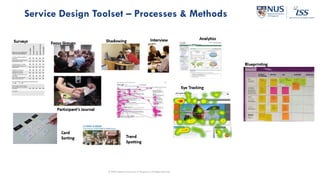
Service Design Toolset – Processes & Methods
© 2020 National University of Singapore. All Rights Reserved
Different Research Methods
• Focus Groups
• Face-to-Face Interviews
• Eye Tracking
• Diary Studies
• Analytics
• Ethnography & Observations
• Ethnographic Interviews
© 2020 National University of Singapore. All Rights Reserved
Prototyping & Testing
© 2020 National University of Singapore. All Rights Reserved
Implementation Tools
• Service Blueprinting
• How-How Diagrams
• Stakeholder Mapping
© 2020 National University of Singapore. All Rights Reserved
www.iss.nus.edu.sg
NICF –
Managing
Digital
Products(SF)
Module 2 - MDP
© 2020 National University of Singapore. All Rights Reserved
Course Overview
• This course presents participants with a practical and interactive learning
experience to pick up skills and tools to successfully manage new and existing
products in the digital world. It will cover:
• the fundamentals of managing products with a focus on the digital world.
• the use of modern product management methods and techniques,
leveraging on data, agility, user experience design, and experimentation.
© 2020 National University of Singapore. All Rights Reserved
https://www.iss.nus.edu.sg/executive-education/course/detail/nicf---managing-digital-
products-(sf)/digital-products-platforms
MDP Course Learning Outcomes
Upon completion of the course, participants will be able to:
• effectively execute the digital product manager’s crucial role in driving
digital business success by orchestrating all relevant stakeholders to manage
a continually evolving digital product through its lifecycle.
• develop mastery over building customer-centric products, and leveraging on
data to make product decisions within an agile product life cycle and
integrated partner ecosystems.
© 2020 National University of Singapore. All Rights Reserved
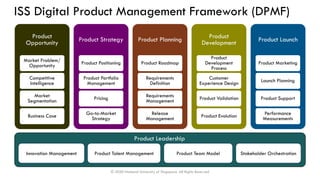
ISS Digital Product Management Framework (DPMF)
© 2020 National University of Singapore. All Rights Reserved
Product
Opportunity
Market Problem/
Opportunity
Competitive
Intelligence
Market
Segmentation
Business Case
Product Strategy
Product Positioning
Product Portfolio
Management
Pricing
Go-to-Market
Strategy
Product Planning
Product Roadmap
Requirements
Definition
Requirements
Management
Release
Management
Product
Development
Product
Development
Process
Customer
Experience Design
Product Validation
Product Evolution
Product Launch
Product Marketing
Launch Planning
Product Support
Performance
Measurements
Innovation Management Product Talent Management
Product Leadership
Product Team Model Stakeholder Orchestration
www.iss.nus.edu.sg
NICF –
Digital
Product
Strategy (SF)
Module 3 - DPS
© 2020 National University of Singapore. All Rights Reserved
DPS Course Overview
• https://www.iss.nus.edu.sg/executive-education/course/detail/nicf--digital-
product-strategy-(sf)/digital-products-platforms
• 3.7 days over 4 weeks
• transition product professionals to (digital) product strategist roles
• practice oriented course, facilitated by industry & ISS practitioners
• acquire skills through pre-readings, lectures, case discussions and working in
teams to develop digital product strategies to launch and sustain their digital
products
• present DPS to an industry panel for assessment & feedback and learning
• “flipped classroom”: participants are to do pre-readings and prepare case
discussions before class session
© 2020 National University of Singapore. All Rights Reserved
DPS Course Learning Outcomes
Upon completion of the course, participants are expected to be able to:
• understand the challenges of the digital product eco-system that the
product manager operates in
• acquire key skills to develop a strategy for the entire digital product
lifecycle - from strategy to development, launch, growth and exit
• demonstrate these understanding and skills acquisition by working in
team to develop and present their digital product strategy to a
panel of industry product leaders for assessment
© 2020 National University of Singapore. All Rights Reserved
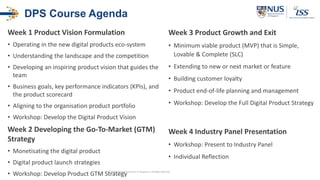
DPS Course Agenda
Week 1 Product Vision Formulation
• Operating in the new digital products eco-system
• Understanding the landscape and the competition
• Developing an inspiring product vision that guides the
team
• Business goals, key performance indicators (KPIs), and
the product scorecard
• Aligning to the organisation product portfolio
• Workshop: Develop the Digital Product Vision
Week 2 Developing the Go-To-Market (GTM)
Strategy
• Monetisating the digital product
• Digital product launch strategies
• Workshop: Develop Product GTM Strategy
Week 3 Product Growth and Exit
• Minimum viable product (MVP) that is Simple,
Lovable & Complete (SLC)
• Extending to new or next market or feature
• Building customer loyalty
• Product end-of-life planning and management
• Workshop: Develop the Full Digital Product Strategy
Week 4 Industry Panel Presentation
• Workshop: Present to Industry Panel
• Individual Reflection
© 2020 National University of Singapore. All Rights Reserved
www.iss.nus.edu.sg
Architecting
Platforms As
a Business
Module 4 - APAB
© 2020 National University of Singapore. All Rights Reserved
APAB Course Overview
• https://www.iss.nus.edu.sg/executive-education/course/detail/architecting-platforms-as-a-business/digital-
products-platforms
• 4 days over 4 weeks
• Team based hands on platform modelling, built on established principles
and building blocks
• Appropriate for those targeting roles in platform design and management
• Classes and workshops delivered by a mix of ISS and industry practioner
• Pre-reading and tools familiarization to prepare for class
© 2020 National University of Singapore. All Rights Reserved
APAB Course Learning Outcomes
Upon completion of the course, participants are expected to be able to:
• Understand the role of platforms and challenges of using a platform
model for business
• Acquire key skills in designing a business platform
• Define the technical architecture to support the business platform
• Define key enablers for the platform like Governance, Trust, Brand
• Demonstrate understanding and skills acquired through the design of
a platform for business and to present to a panel for assessment
© 2020 National University of Singapore. All Rights Reserved
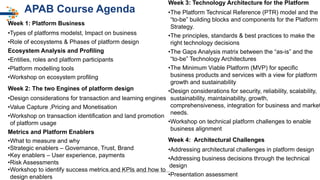
APAB Course Agenda
Week 1: Platform Business
•Types of platforms modelst, Impact on business
•Role of ecosystems & Phases of platform design
Ecosystem Analysis and Profiling
•Entities, roles and platform participants
•Platform modelling tools
•Workshop on ecosystem profiling
Week 2: The two Engines of platform design
•Design considerations for transaction and learning engines
•Value Capture ,Pricing and Monetisation
•Workshop on transaction identification and land promotion
of platform usage
Metrics and Platform Enablers
•What to measure and why
•Strategic enablers – Governance, Trust, Brand
•Key enablers – User experience, payments
•Risk Assessments
•Workshop to identify success metrics and KPIs and how to
design enablers
Week 3: Technology Architecture for the Platform
•The Platform Technical Reference (PTR) model and the
“to-be” building blocks and components for the Platform
Strategy.
•The principles, standards & best practices to make the
right technology decisions
•The Gaps Analysis matrix between the “as-is” and the
“to-be” Technology Architectures
•The Minimum Viable Platform (MVP) for specific
business products and services with a view for platform
growth and sustainability
•Design considerations for security, reliability, scalability,
sustainability, maintainability, growth,
comprehensiveness, integration for business and market
needs.
•Workshop on technical platform challenges to enable
business alignment
Week 4: Architectural Challenges
•Addressing architectural challenges in platform design
•Addressing business decisions through the technical
design
•Presentation assessment
© 2020 National University of Singapore. All Rights Reserved
PCP Course Fees ($)
Data
Analytics
Full Stack
Developer
BAPA AI Engineer Digital Product
Management
Smarthealth
Digital
Transformati
on
Solution
Architect
Gross Fees 23,660 17,000 17,860 17,800 19,900 18,960 21,400
Net Fees* 7,594.86 5,457 5,733.06 5,713.80 6,387.90 6,086.16 6,869.40
Mid-career
Enhanced
Subsidies/
SME Grant*
2,862.86 2,057 2,161.06 2,153.80 2,407.90 2,294.16 2,589.40
Salary
Support
(for PnT
only)
 70% of monthly salary capped at S$4,000 per month for Singaporeans and
Singapore PRs below 40 years.
 90% of monthly salary capped at S$6,000 per month for Singaporeans 40
years and above OR at least 6 months unemployed.
* Including GST
© 2020 National University of Singapore. All Rights Reserved
PCP Intake Dates
The following Professional Conversion Programmes targeted to build tech talents in accordance to
industries demands.
• PCP for Digital Product Manager NEW! (planned intake 31 Aug, 1 Dec)
• PCP for Business Analytics Programme Analyst NEW! (next intake TBD)
• PCP for Data Analyst (next intake 7 Sep)
• PCP for SmartHealth Transformation Analyst NEW! (planned intake Sep)
• PCP for Artificial Intelligence Engineer NEW! (planned intake Sep)
• PCP for Full Stack Developer (next intake 26 Oct)
• PCP for Solution Architect NEW! (planned intake Nov)
NOTE:
Candidate is subjected to NUS ISS screening and assessment test before they are onboarded for the PCP.
© 2020 National University of Singapore. All Rights Reserved
ANY QUESTIONS?
© 2020 National University of Singapore. All Rights Reserved
FAQs
No FAQ Response
1 Who is the PCP for? The PCP is a Place-and-Train programme either for new hire. A candidate
must be newly hired (not more than 3 months at the start of the PCP) by an
employer before the employer enrols the candidate into the PCP to undergo
training to take on the new job role. The candidate must be a Singapore
citizen or Permanent Resident of 21 years or older, and must be a graduate
with minimum of 2 years full-time working experience and national service
completion for males.
2 How much is the cost
of the PCP as I am
interested to attend
and pay for the
courses on my own.
The PCP is only for candidates that are newly hired by an employer. The
employer will enrol the candidate into the PCP and candidates need not pay
for the course fees. Candidates have to be hired by an employer before
joining the PCP.
3 Can I pay and attend
the courses under the
PCP if I do not have
an employer?
The PCP is for candidates hired by an employer to undergo skills conversion.
ISS has parallel program Graduate Certificate in Designing and Managing
Products and Platforms (DPMM).
© 2020 National University of Singapore. All Rights Reserved
FAQs
No FAQ Response
4 How do I find an
employer to hire and
enrol me into the
PCP?
Candidates can deposit their resume with Workforce Singapore’s Professional
Conversion Programme Portal for job matching with potential employers by
depositing their resumes and particulars.
By depositing their resume, candidates agree that their personal information
will be shared with potential employers without requiring additional consent.
ISS and/or the potential employer will contact candidates if they are
shortlisted. Candidates may also look for potential employers who are willing
to hire and sponsor them for the programme.
5 What is the selection
criteria for
candidates?
Selection criteria is subjected to employer’s requirements and due
recruitment process. In some programmes, candidates are also required to
complete some pre-requisite learning and to pass an entry assessment in
order to be enrolled into the programme.
6 Should I resign from
my job if I intend to
make a career switch?
This is strongly discouraged. It is generally known that candidates face a
tougher time to be hired again the longer they stay unemployed. Candidates
are advised to seek other options to upskills or upgrade themselves by
enrolling through other related programmes.
© 2020 National University of Singapore. All Rights Reserved
FAQs
No FAQ Response
7 Does ISS have a list of
employers interested in
hiring under the PCP?
Employers approach NUS-ISS when they have talent requirements.
Applicants are shortlisted based on profile fit with employer’s hiring
requirements. Only shortlisted applicants will be contacted.
8 What is the estimated
salary of candidates hired
by employers under the
PCP?
The salary will depend on the candidate’s skill and experience and based
on the employer’s remuneration policy amongst other factors.
9 What will happen to my
pay with my employer
after the end of the PCP
funding?
As the candidate is hired as a full time staff, the pay will remain the same
after the end of the PCP funding.
10 What sort of qualification
do I get on completion of
the programme?
On completion of the PCP programme, the candidate will be awarded a
Professional Diploma qualification.
© 2020 National University of Singapore. All Rights Reserved
FAQs
No FAQ Response
11 What if I quit from
the programme
midway. Am I
required to pay back
to company.
Candidates are highly encouraged to complete the entire programme or they
will not be able to earn the Professional Diploma qualification.
12 How often does ISS
run PCP programmes?
The course run frequency is dependent on availability of demand-and-supply
for the respective programme.
13 If I have already taken
a module before;
would I be able to
have exemption?
Exemptions will have to be considered on a case-by-case basis depending on
when the last module was taken and the its programme details/ pre-
requisite.
14 What is expected on
the 4 months
practicum project?
The project must be a company-sponsored project that is reviewed and
approved by NUS-ISS project supervisors. Within the 4 months OJT period,
the candidates must progressively update the project progression with their
assigned supervisor to demonstrate application of their skills during the
period.© 2020 National University of Singapore. All Rights Reserved
www.iss.nus.edu.sg
Questions?
© 2020 National University of Singapore. All Rights Reserved
Give Us Your Feedback
© 2020 National University of Singapore. All Rights Reserved
Day 3 Programme

Professional Conversion Programme (PCP) for Digital Product Managers (for Individuals)

  • 1.
    www.iss.nus.edu.sg Professional Conversion Programme SharingSession Virtual Learning Festival 13th August 2020 For Digital Product Management Daniel Boey © 2020 National University of Singapore. All Rights Reserved
  • 2.
    Daniel Boey Chief, Products& Platforms Practice MBA, NUS BSc(Hons) (Comp Sc & Info Sys) NUS, PMP, CITPM (Senior), CSM, P3O Daniel currently heads the Products & Platforms practice in ISS, NUS. He teaches and consults in product and project management and works closely with many organizations in developing customised training programs for their staff development. Currently teaching the following courses • NICF- Managing Digital Products (SF) • NICF- Digital Product Strategy (SF) • NICF- Managing Business Analytics Projects (SF) © 2020 National University of Singapore. All Rights Reserved linkedin.com/in/daniel- sk-boey-6a920541
  • 3.
    © 2020 NationalUniversity of Singapore. All Rights Reserved
  • 4.
    What is ProfessionalConversion Programme (PCP) A career conversion programme for :  Professionals, Managers, Executives and Technicians (PMETs), including mid-career switchers,  to undergo skills conversion and  move into new occupations or sectors with better prospects and opportunities for progression.  Place-and-Train Programme where PMET is hired by a participating employer before undergoing training to take on new job role Data Analytics Software Development Business Analytics Artificial Intelligence Digital Product Management Digital Transformation© 2020 National University of Singapore. All Rights Reserved
  • 5.
    Eligibility of ProfessionalConversion Programme (PCP) New HireCompany / Employer  Be registered or incorporated in Singapore;  Be committed to work with WSG and NUS- ISS on the necessary administrative matters related to the PCP;  Offer employment directly related to the job which the PCP is for, with remuneration that is aligned with the market rate; and  Commit to the PCP training arrangements for the trainees.  Provide a company project for practicuum  SC or PRs  Graduated or completed National Service, whichever is later, for at least two years; and  Not in a similar job function prior to joining the PCP.  Able to pass entrance assessment © 2020 National University of Singapore. All Rights Reserved
  • 6.
    Professional Conversion Programmes(PCP) Phase 1: Training Course Phase 2: Proj Practicuum (4 months) Grants and Salary SupportInterview and Hire Interview, Select and Hire Submit Details + Project Plan Full-time training (14.7 days) Employee back in office + Company provides mentorship and guidance Get rewarded for building and growing talents Skills Level Up! Productivity Up! © 2020 National University of Singapore. All Rights Reserved
  • 7.
    Structure and Durationof NUS-ISS PCP Phase 1 (Classroom Training) Phase 2 (Project Practicuum)  14.7 training days spread over 2-3 months of classroom training plus assessment  Require at least 75% attendance  Able to pass all classroom assessment  4 months of OJT with the sponsoring company.  To complete the company sponsored project within OJT period.  Require to make at least 3 progressive project presentation over the period to NUS-ISS assigned project supervisor. Completion of Programme Professional Diploma Certification from NUS-ISS Duration : 5 to 6 months Entrance Assessment © 2020 National University of Singapore. All Rights Reserved
  • 8.
    What are thePCP Programmes in NUS-ISS Digital Product Management Digital product, marketing, e-commerce, Management  Gain customer insights for products  Find solutions towards market problem and new product opportunities;  Define product strategy and manage Product lifecycle  Design a platform business SmartHealth Transformation Analyst Digital Transformation Analyst  Establish organisation’s program management framework  Design & develop program plans/ Transformation Initiatives;  Facilitate change management/ oversee program implementation;  Manage people and organisation/ transformation programmes. Solutions Architect IT Solutions Architect  Implement platform architecture strategy  Identify requirements and develop platform architecture  Support platform feature development  Manage solutions architecture projects Applicable to SGUS and PCP Applicable to PCP onlyLegend: © 2020 National University of Singapore. All Rights Reserved
  • 9.
    What are theJobs that this program supports? • Digital transformation is the integration of digital technology into all areas of a business, fundamentally changing how you operate and deliver value to customers. • Those involved in the strategy, management and development of digital products such as mobile apps, web sites, e-commerce, digital platforms and omni-channels or even a game • A traditional product (e.g. gadget, apparels or Tupperware) that could benefit from digital channels, digital marketing and a digital strategy © 2020 National University of Singapore. All Rights Reserved
  • 10.
    What are theJobs that this program supports? BUT ALSO… • Those managing projects that builds new systems, e.g. recommender system based on data, loyalty program that interacts with customers digitally, social selling, digital promotions and campaigns, digital customer service …projects in a connected, online world where brands and organizations interact directly with customers. • These are best manage by a Product Management Framework rather than a Project Management Framework. Why? • Product Managers, Product Market Managers, Marketing Managers, Programme Managers, Customer Programmes, • Suitable for those with some team management experience and previously project managers, business analysts or traditional product managers or sales managers, marketing managers © 2020 National University of Singapore. All Rights Reserved
  • 11.
    PCP Pathway forDigital Product Manager © 2020 National University of Singapore. All Rights Reserved Digital Product Manager 4 months Company’s Project The project scope covers aspects of digital product management. Where the project could cover discovery of a product/platform idea, to working through product requirements, a product road map , creation of a product strategy , a launch plan or other parts of a product life cycle. 14.7 days (elapsed time 2-3 months) Skills Training • Service Design • Managing Digital Products • Digital Product Strategy • Architecting Platform as a Business
  • 12.
    www.iss.nus.edu.sg Training Details © 2020 NationalUniversity of Singapore. All Rights Reserved
  • 13.
    PCP for DigitalProduct Management Understand and apply the central concepts of design thinking to innovation projects and products Service Design Apply fundamental product management methods and techniques to manage products and services in the digital world Digital Product Strategy Architecting Platforms as a Business Practice Module Demonstrate competency of your newly acquired skills in a team-based mini-capstone and an individual assessment. ♦ Ideate and research to solve a real world problem or to capture an opportunity ♦ demonstrate clear value propositions ♦ justify your business case and investment plan♦ strategize your roadmap ♦ deliver a prototype or establish a MVP Develop a strategy from vision, monetisation, go-to-market, to growth acceleration and exit, through intensive hands-on iterations. Design a business platform and its supporting technical architecture Tailored for adult learners, with hands on interactive learning, industry practitioners’ experience sharing ,use of case studies and in-depth discussions Carefully curated set of four modules that address key knowledge and skills for digital product management and platform design Suitable for job roles like Product Manager, Platform Designers, Product/platform Owners, Business Architects, Digital Product Strategists. https://www.iss.nus.edu.sg/stackable-certificate-programmes/software-engineering/graduate-certificate-in-designing-and-managing-products-and-platforms Managing Digital Products ProductManagement,theLevertoDigitalTransformation
  • 14.
    www.iss.nus.edu.sg NICF - Service Design (SF) Module1 - SID © 2020 National University of Singapore. All Rights Reserved
  • 15.
    SID Course LearningOutcomes • Upon completion of the course, participants will be able to: • Understand and apply the central concepts of Design Thinking to innovation projects • Approach service innovation from an outside-in perspective and understand the process for evolving a fuzzy idea into a fully envisioned service concept. • Understand how to conduct user research and synthesize data from multiple sources in order to discover unmet needs and develop ideas. • Understand and use tools such as personas, customer journey mapping, service blueprinting and storytelling to realize service innovation. • Illustrate a new service innovation concept and explain its value proposition and the outcome intended for the customer. • Carry out low fidelity prototyping of a proposed innovation concept to evaluate, adapt and refine the idea. © 2020 National University of Singapore. All Rights Reserved https://www.iss.nus.edu.sg/executive-education/course/detail/nicf--service-design- (sf)/digital-innovation-design
  • 16.
    Human-Centered Research Creative IdeationPrototype Measure Value Iterative Process ?Define Challenge? © 2020 National University of Singapore. All Rights Reserved Design Thinking Process
  • 17.
    Service Design Toolset– Processes & Methods © 2020 National University of Singapore. All Rights Reserved
  • 18.
    Different Research Methods •Focus Groups • Face-to-Face Interviews • Eye Tracking • Diary Studies • Analytics • Ethnography & Observations • Ethnographic Interviews © 2020 National University of Singapore. All Rights Reserved
  • 19.
    Prototyping & Testing ©2020 National University of Singapore. All Rights Reserved
  • 20.
    Implementation Tools • ServiceBlueprinting • How-How Diagrams • Stakeholder Mapping © 2020 National University of Singapore. All Rights Reserved
  • 21.
    www.iss.nus.edu.sg NICF – Managing Digital Products(SF) Module 2- MDP © 2020 National University of Singapore. All Rights Reserved
  • 22.
    Course Overview • Thiscourse presents participants with a practical and interactive learning experience to pick up skills and tools to successfully manage new and existing products in the digital world. It will cover: • the fundamentals of managing products with a focus on the digital world. • the use of modern product management methods and techniques, leveraging on data, agility, user experience design, and experimentation. © 2020 National University of Singapore. All Rights Reserved https://www.iss.nus.edu.sg/executive-education/course/detail/nicf---managing-digital- products-(sf)/digital-products-platforms
  • 23.
    MDP Course LearningOutcomes Upon completion of the course, participants will be able to: • effectively execute the digital product manager’s crucial role in driving digital business success by orchestrating all relevant stakeholders to manage a continually evolving digital product through its lifecycle. • develop mastery over building customer-centric products, and leveraging on data to make product decisions within an agile product life cycle and integrated partner ecosystems. © 2020 National University of Singapore. All Rights Reserved
  • 24.
    ISS Digital ProductManagement Framework (DPMF) © 2020 National University of Singapore. All Rights Reserved Product Opportunity Market Problem/ Opportunity Competitive Intelligence Market Segmentation Business Case Product Strategy Product Positioning Product Portfolio Management Pricing Go-to-Market Strategy Product Planning Product Roadmap Requirements Definition Requirements Management Release Management Product Development Product Development Process Customer Experience Design Product Validation Product Evolution Product Launch Product Marketing Launch Planning Product Support Performance Measurements Innovation Management Product Talent Management Product Leadership Product Team Model Stakeholder Orchestration
  • 25.
    www.iss.nus.edu.sg NICF – Digital Product Strategy (SF) Module3 - DPS © 2020 National University of Singapore. All Rights Reserved
  • 26.
    DPS Course Overview •https://www.iss.nus.edu.sg/executive-education/course/detail/nicf--digital- product-strategy-(sf)/digital-products-platforms • 3.7 days over 4 weeks • transition product professionals to (digital) product strategist roles • practice oriented course, facilitated by industry & ISS practitioners • acquire skills through pre-readings, lectures, case discussions and working in teams to develop digital product strategies to launch and sustain their digital products • present DPS to an industry panel for assessment & feedback and learning • “flipped classroom”: participants are to do pre-readings and prepare case discussions before class session © 2020 National University of Singapore. All Rights Reserved
  • 27.
    DPS Course LearningOutcomes Upon completion of the course, participants are expected to be able to: • understand the challenges of the digital product eco-system that the product manager operates in • acquire key skills to develop a strategy for the entire digital product lifecycle - from strategy to development, launch, growth and exit • demonstrate these understanding and skills acquisition by working in team to develop and present their digital product strategy to a panel of industry product leaders for assessment © 2020 National University of Singapore. All Rights Reserved
  • 28.
    DPS Course Agenda Week1 Product Vision Formulation • Operating in the new digital products eco-system • Understanding the landscape and the competition • Developing an inspiring product vision that guides the team • Business goals, key performance indicators (KPIs), and the product scorecard • Aligning to the organisation product portfolio • Workshop: Develop the Digital Product Vision Week 2 Developing the Go-To-Market (GTM) Strategy • Monetisating the digital product • Digital product launch strategies • Workshop: Develop Product GTM Strategy Week 3 Product Growth and Exit • Minimum viable product (MVP) that is Simple, Lovable & Complete (SLC) • Extending to new or next market or feature • Building customer loyalty • Product end-of-life planning and management • Workshop: Develop the Full Digital Product Strategy Week 4 Industry Panel Presentation • Workshop: Present to Industry Panel • Individual Reflection © 2020 National University of Singapore. All Rights Reserved
  • 29.
    www.iss.nus.edu.sg Architecting Platforms As a Business Module4 - APAB © 2020 National University of Singapore. All Rights Reserved
  • 30.
    APAB Course Overview •https://www.iss.nus.edu.sg/executive-education/course/detail/architecting-platforms-as-a-business/digital- products-platforms • 4 days over 4 weeks • Team based hands on platform modelling, built on established principles and building blocks • Appropriate for those targeting roles in platform design and management • Classes and workshops delivered by a mix of ISS and industry practioner • Pre-reading and tools familiarization to prepare for class © 2020 National University of Singapore. All Rights Reserved
  • 31.
    APAB Course LearningOutcomes Upon completion of the course, participants are expected to be able to: • Understand the role of platforms and challenges of using a platform model for business • Acquire key skills in designing a business platform • Define the technical architecture to support the business platform • Define key enablers for the platform like Governance, Trust, Brand • Demonstrate understanding and skills acquired through the design of a platform for business and to present to a panel for assessment © 2020 National University of Singapore. All Rights Reserved
  • 32.
    APAB Course Agenda Week1: Platform Business •Types of platforms modelst, Impact on business •Role of ecosystems & Phases of platform design Ecosystem Analysis and Profiling •Entities, roles and platform participants •Platform modelling tools •Workshop on ecosystem profiling Week 2: The two Engines of platform design •Design considerations for transaction and learning engines •Value Capture ,Pricing and Monetisation •Workshop on transaction identification and land promotion of platform usage Metrics and Platform Enablers •What to measure and why •Strategic enablers – Governance, Trust, Brand •Key enablers – User experience, payments •Risk Assessments •Workshop to identify success metrics and KPIs and how to design enablers Week 3: Technology Architecture for the Platform •The Platform Technical Reference (PTR) model and the “to-be” building blocks and components for the Platform Strategy. •The principles, standards & best practices to make the right technology decisions •The Gaps Analysis matrix between the “as-is” and the “to-be” Technology Architectures •The Minimum Viable Platform (MVP) for specific business products and services with a view for platform growth and sustainability •Design considerations for security, reliability, scalability, sustainability, maintainability, growth, comprehensiveness, integration for business and market needs. •Workshop on technical platform challenges to enable business alignment Week 4: Architectural Challenges •Addressing architectural challenges in platform design •Addressing business decisions through the technical design •Presentation assessment © 2020 National University of Singapore. All Rights Reserved
  • 33.
    PCP Course Fees($) Data Analytics Full Stack Developer BAPA AI Engineer Digital Product Management Smarthealth Digital Transformati on Solution Architect Gross Fees 23,660 17,000 17,860 17,800 19,900 18,960 21,400 Net Fees* 7,594.86 5,457 5,733.06 5,713.80 6,387.90 6,086.16 6,869.40 Mid-career Enhanced Subsidies/ SME Grant* 2,862.86 2,057 2,161.06 2,153.80 2,407.90 2,294.16 2,589.40 Salary Support (for PnT only)  70% of monthly salary capped at S$4,000 per month for Singaporeans and Singapore PRs below 40 years.  90% of monthly salary capped at S$6,000 per month for Singaporeans 40 years and above OR at least 6 months unemployed. * Including GST © 2020 National University of Singapore. All Rights Reserved
  • 34.
    PCP Intake Dates Thefollowing Professional Conversion Programmes targeted to build tech talents in accordance to industries demands. • PCP for Digital Product Manager NEW! (planned intake 31 Aug, 1 Dec) • PCP for Business Analytics Programme Analyst NEW! (next intake TBD) • PCP for Data Analyst (next intake 7 Sep) • PCP for SmartHealth Transformation Analyst NEW! (planned intake Sep) • PCP for Artificial Intelligence Engineer NEW! (planned intake Sep) • PCP for Full Stack Developer (next intake 26 Oct) • PCP for Solution Architect NEW! (planned intake Nov) NOTE: Candidate is subjected to NUS ISS screening and assessment test before they are onboarded for the PCP. © 2020 National University of Singapore. All Rights Reserved
  • 35.
    ANY QUESTIONS? © 2020National University of Singapore. All Rights Reserved
  • 36.
    FAQs No FAQ Response 1Who is the PCP for? The PCP is a Place-and-Train programme either for new hire. A candidate must be newly hired (not more than 3 months at the start of the PCP) by an employer before the employer enrols the candidate into the PCP to undergo training to take on the new job role. The candidate must be a Singapore citizen or Permanent Resident of 21 years or older, and must be a graduate with minimum of 2 years full-time working experience and national service completion for males. 2 How much is the cost of the PCP as I am interested to attend and pay for the courses on my own. The PCP is only for candidates that are newly hired by an employer. The employer will enrol the candidate into the PCP and candidates need not pay for the course fees. Candidates have to be hired by an employer before joining the PCP. 3 Can I pay and attend the courses under the PCP if I do not have an employer? The PCP is for candidates hired by an employer to undergo skills conversion. ISS has parallel program Graduate Certificate in Designing and Managing Products and Platforms (DPMM). © 2020 National University of Singapore. All Rights Reserved
  • 37.
    FAQs No FAQ Response 4How do I find an employer to hire and enrol me into the PCP? Candidates can deposit their resume with Workforce Singapore’s Professional Conversion Programme Portal for job matching with potential employers by depositing their resumes and particulars. By depositing their resume, candidates agree that their personal information will be shared with potential employers without requiring additional consent. ISS and/or the potential employer will contact candidates if they are shortlisted. Candidates may also look for potential employers who are willing to hire and sponsor them for the programme. 5 What is the selection criteria for candidates? Selection criteria is subjected to employer’s requirements and due recruitment process. In some programmes, candidates are also required to complete some pre-requisite learning and to pass an entry assessment in order to be enrolled into the programme. 6 Should I resign from my job if I intend to make a career switch? This is strongly discouraged. It is generally known that candidates face a tougher time to be hired again the longer they stay unemployed. Candidates are advised to seek other options to upskills or upgrade themselves by enrolling through other related programmes. © 2020 National University of Singapore. All Rights Reserved
  • 38.
    FAQs No FAQ Response 7Does ISS have a list of employers interested in hiring under the PCP? Employers approach NUS-ISS when they have talent requirements. Applicants are shortlisted based on profile fit with employer’s hiring requirements. Only shortlisted applicants will be contacted. 8 What is the estimated salary of candidates hired by employers under the PCP? The salary will depend on the candidate’s skill and experience and based on the employer’s remuneration policy amongst other factors. 9 What will happen to my pay with my employer after the end of the PCP funding? As the candidate is hired as a full time staff, the pay will remain the same after the end of the PCP funding. 10 What sort of qualification do I get on completion of the programme? On completion of the PCP programme, the candidate will be awarded a Professional Diploma qualification. © 2020 National University of Singapore. All Rights Reserved
  • 39.
    FAQs No FAQ Response 11What if I quit from the programme midway. Am I required to pay back to company. Candidates are highly encouraged to complete the entire programme or they will not be able to earn the Professional Diploma qualification. 12 How often does ISS run PCP programmes? The course run frequency is dependent on availability of demand-and-supply for the respective programme. 13 If I have already taken a module before; would I be able to have exemption? Exemptions will have to be considered on a case-by-case basis depending on when the last module was taken and the its programme details/ pre- requisite. 14 What is expected on the 4 months practicum project? The project must be a company-sponsored project that is reviewed and approved by NUS-ISS project supervisors. Within the 4 months OJT period, the candidates must progressively update the project progression with their assigned supervisor to demonstrate application of their skills during the period.© 2020 National University of Singapore. All Rights Reserved
  • 40.
    www.iss.nus.edu.sg Questions? © 2020 NationalUniversity of Singapore. All Rights Reserved
  • 41.
    Give Us YourFeedback © 2020 National University of Singapore. All Rights Reserved Day 3 Programme