FACILITATING LEARNING
Mercè Bernaus mbernaus@uab.es
January 18, February 01, 08, 2014
Teaching vs. Facilitating
Mercè Bernaus mbernaus@uab.es
Teaching vs. Facilitating
Mercè Bernaus mbernaus@uab.es
• A process whereby a
teacher leads a
group of students in
acquiring new skills,
knowledge, or
understanding.
• Helping/making it easy
for students to learn
together in a group, or
to achieve something
together as a group.
Teaching vs. Facilitating
Mercè Bernaus mbernaus@uab.es
• Most subject area
teaching involves
telling and teaching
the students.
Measurable outcome
at the end.
• Involves helping
the students to
discover by
themselves.
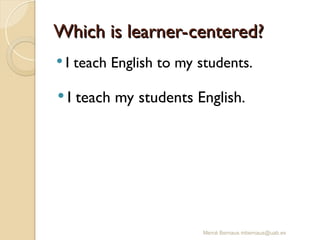
Which is learner-centered?
 I teach English to my students.
Mercè Bernaus mbernaus@uab.es
 I teach my students English.
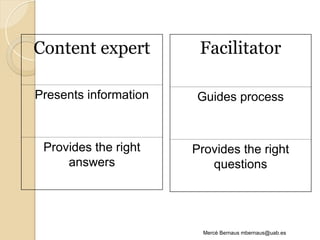
Content expert
Presents information
Provides the right
answers
Facilitator
Guides process
Provides the right
questions
Mercè Bernaus mbernaus@uab.es
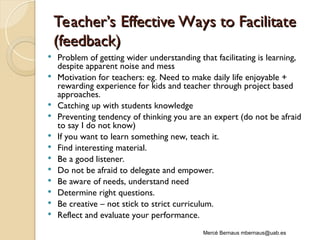
Teacher’s Effective Ways to Facilitat
Teacher’s Effective Ways to Facilitate
e
(feedback)
(feedback)
 Problem of getting wider understanding that facilitating is learning,
despite apparent noise and mess
 Motivation for teachers: eg. Need to make daily life enjoyable +
rewarding experience for kids and teacher through project based
approaches.
 Catching up with students knowledge
 Preventing tendency of thinking you are an expert (do not be afraid
to say I do not know)
 If you want to learn something new, teach it.
 Find interesting material.
 Be a good listener.
 Do not be afraid to delegate and empower.
 Be aware of needs, understand need
 Determine right questions.
 Be creative – not stick to strict curriculum.
 Reflect and evaluate your performance.
Mercè Bernaus mbernaus@uab.es
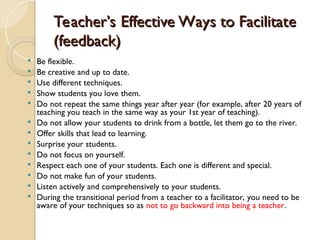
Teacher’s Effective Ways to Facilitat
Teacher’s Effective Ways to Facilitate
e
(feedback)
(feedback)
 Be flexible.
 Be creative and up to date.
 Use different techniques.
 Show students you love them.
 Do not repeat the same things year after year (for example, after 20 years of
teaching you teach in the same way as your 1st year of teaching).
 Do not allow your students to drink from a bottle, let them go to the river.
 Offer skills that lead to learning.
 Surprise your students.
 Do not focus on yourself.
 Respect each one of your students. Each one is different and special.
 Do not make fun of your students.
 Listen actively and comprehensively to your students.
 During the transitional period from a teacher to a facilitator, you need to be
aware of your techniques so as not to go backward into being a teacher.
Unforgettable Teachers facilitate…
 Value of Learning & Knowledge
◦ Teachers should be enthusiastic about their subject. However,
they give more than knowledge. They show how learning
enhances creativity. Sparks interest, and uncover talents.
 Value of Respect
◦ Teachers treat students with honor. They explain how kind
words can prevent hurtful confrontations and turn enemies into
friends.
 Value of Integrity
◦ They demonstrate empathy. Their ethics inspires students to
live with courage, honesty, dignity, and self-worth.
Mercè Bernaus mbernaus@uab.es
Unforgettable Teachers facilitate…
 Value of Responsibility
◦ Teachers teach that individuals must be accountable
for his/her actions.
 Value of Perseverance
◦ Teachers teach that education continues until our last
breath. They tell stories about hard times they had faced,
and how God had often turned difficulties into blessings.
Mercè Bernaus mbernaus@uab.es
You will be divided into two groups.
Each group will choose a classroom
scenario and will present ways of
how learning could be best
facilitated.
facilitated.
Mercè Bernaus mbernaus@uab.es
Learning
Learning
 LEARNING is a mental ability by means of
which knowledge, skills, habits, attitudes, and
ideals are acquired, retained, and utilized,
resulting in the progressive adaptation and
modification of conduct and behavior.
 It is any change in the behavior of organism.
 It is a continuous process.
Mercè Bernaus mbernaus@uab.es
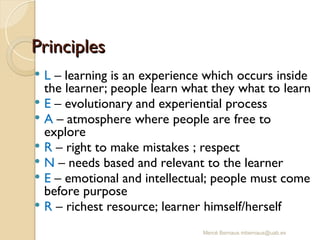
Principles
Principles
 L – learning is an experience which occurs inside
the learner; people learn what they what to learn
 E – evolutionary and experiential process
 A – atmosphere where people are free to
explore
 R – right to make mistakes ; respect
 N – needs based and relevant to the learner
 E – emotional and intellectual; people must come
before purpose
 R – richest resource; learner himself/herself
Mercè Bernaus mbernaus@uab.es
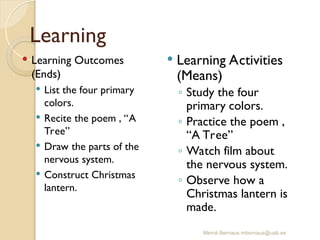
Learning
 Learning Outcomes
(Ends)
 List the four primary
colors.
 Recite the poem , “A
Tree”
 Draw the parts of the
nervous system.
 Construct Christmas
lantern.
 Learning Activities
(Means)
◦ Study the four
primary colors.
◦ Practice the poem ,
“A Tree”
◦ Watch film about
the nervous system.
◦ Observe how a
Christmas lantern is
made.
Mercè Bernaus mbernaus@uab.es
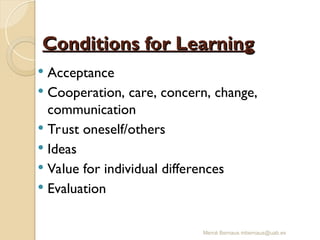
Conditions for Learning
 Acceptance
 Cooperation, care, concern, change,
communication
 Trust oneself/others
 Ideas
 Value for individual differences
 Evaluation
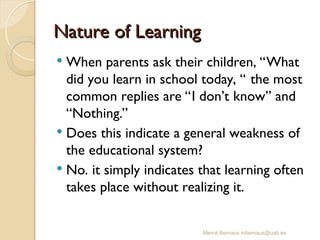
Nature of Learning
Nature of Learning
 When parents ask their children, “What
did you learn in school today, “ the most
common replies are “I don’t know” and
“Nothing.”
 Does this indicate a general weakness of
the educational system?
 No. it simply indicates that learning often
takes place without realizing it.
Mercè Bernaus mbernaus@uab.es
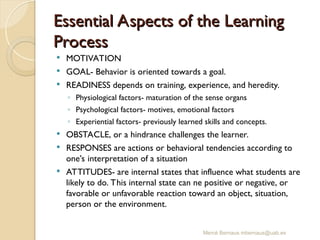
Essential Aspects of the Learning
Process
Process
 MOTIVATION
 GOAL- Behavior is oriented towards a goal.
 READINESS depends on training, experience, and heredity.
◦ Physiological factors- maturation of the sense organs
◦ Psychological factors- motives, emotional factors
◦ Experiential factors- previously learned skills and concepts.
 OBSTACLE, or a hindrance challenges the learner.
 RESPONSES are actions or behavioral tendencies according to
one’s interpretation of a situation
 ATTITUDES- are internal states that influence what students are
likely to do. This internal state can ne positive or negative, or
favorable or unfavorable reaction toward an object, situation,
person or the environment.
Mercè Bernaus mbernaus@uab.es
What is your attitude toward…
◦ Learning
◦ School
◦ Math, science, English, and other Subjects
◦ Homework
◦ Classroom rules
◦ Teachers
◦ Examination
◦ Taking responsibility for one’s acts
◦ Relationships
◦ Boys/Girls
◦ Family
◦ Fashion
◦ Love
◦ Money
◦ Sex
Types of Learning
Types of Learning
 Cognitive Learning
◦ It is concerned with the development of
ideas.
 Affective Learning
◦ Involves assimilation of values, emotional
reactions and acquisition of attitudes.
 Psychomotor Learning
◦ Understanding of the external world through
the senses and muscles.
Mercè Bernaus mbernaus@uab.es
Goals of the learning process
 The successful learner, over time and
with support and instructional guidance,
can create meaningful, coherent
representations of knowledge.
◦ To construct useful representations of
knowledge and to acquire the thinking and
learning strategies necessary for continued
learning success across the life span,
students must generate and pursue
personally relevant goals.
Context of Learning
Context of Learning
 Learning is influenced by environmental
factors, including culture, technology, and
instructional practices.
◦ Learning does not occur in a vacuum. Teachers
play a major interactive role with both the
learner and the learning environment
◦ Technologies and instructional practices must
be appropriate for the learner’s level of prior
knowledge, cognitive abilities, and their learning
and thinking strategies.
◦ The classroom environment has also an impact
on student learning.
Motivational and Emotional
Influences on Learning
 What and how much is learned is influenced by
the learner’s motivation. Motivation to learn, in
turn, is influenced by the individual’s emotional
states, beliefs, interests and goals, and habits of
thinking.
◦ Positive emotions such as curiosity, generally
enhance motivation and facilitate learning and
performance.
◦ Intense negative emotions such as anxiety, rage,
insecurity, and related thoughts like fearing
punishment, worrying about competence generally
detract from motivation, interfere with learning,
and contribute to low performance.
Mercè Bernaus mbernaus@uab.es
Intrinsic Motivation to Learn
 The learner’s creativity, higher order
thinking, and natural curiosity all contribute
to motivation to learn. Intrinsic motivation
is stimulated by tasks of optimal novelty and
difficulty, relevant to personal interests, and
providing for personal interests, and
providing for personal choice and control.
◦ Curiosity, flexible and insightful thinking, and
creativity are major indicators of the learner’s
intrinsic motivation to learn.
Mercè Bernaus mbernaus@uab.es
Effects of Motivation on Effort
 Acquisition of complex knowledge and
skills requires extended learner effort
and guided practice. Without learner’s
motivation to learn, the willingness to
exert this effort is unlikely without
coercion.
◦ Effort is another major indicator of
motivation to learn.
Mercè Bernaus mbernaus@uab.es
Developmental Influences on
Learning
Learning
 As individuals develop, there are
different opportunities and constraints
for learning. Learning is most effective
when differential development within
and across physical, intellectual,
emotional, and social domains is taken
into account.
◦ Individuals learn best when material is
appropriate to their developmental level
and is presented in an enjoyable and
interesting way.
Mercè Bernaus mbernaus@uab.es
Social Influences on Learning
 Learning is influenced by social
interactions, interpersonal relations, and
communication with others.
◦ Learning can be enhanced when the learner has
an opportunity to interact and to collaborate
with others on instructional tasks.
◦ Quality personal relationships that provide
stability, trust, and caring can increase learner’s
sense of belonging, self-respect and self
acceptance, and provide a positive climate for
learning.
Mercè Bernaus mbernaus@uab.es
Individual Differences in Learning
 Learners have different strategies,
approaches, and capabilities for learning
that are a function of prior experience
and heredity.
◦ Individuals are born with and develop their
own capabilities and talents
Mercè Bernaus mbernaus@uab.es
Learning and Diversity
 Learning is most effective when
differences in learner’s linguistic,
cultural, and social backgrounds are
taken into account.
◦ When learners perceive that their individual
differences in abilities, backgrounds,
cultures, and experiences are valued,
respected, and accommodated in learning
tasks and contexts, levels of motivation and
achievement are enhanced.
When I have free time I like to
__________.
__________.
Mercè Bernaus mbernaus@uab.es
I think Mathematics is
__________.
__________.
Mercè Bernaus mbernaus@uab.es
The subject I like most is
__________.
__________.
Mercè Bernaus mbernaus@uab.es
What I like most about school is
__________.
__________.
Mercè Bernaus mbernaus@uab.es
What I like least about school is
__________.
__________.
Mercè Bernaus mbernaus@uab.es
Today, I don’t want to see
__________.
__________.
Mercè Bernaus mbernaus@uab.es
I think I am __________.
Mercè Bernaus mbernaus@uab.es
I believe __________.
Mercè Bernaus mbernaus@uab.es
The LEARNING THEORIES
Mercè Bernaus mbernaus@uab.es
Dr. Howard
Gardner’s Theory of
Multiple Intelligences
Mercè Bernaus mbernaus@uab.es
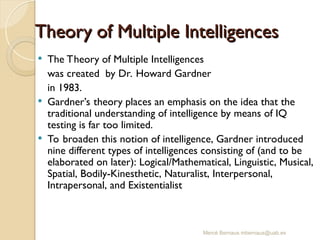
 The Theory of Multiple Intelligences
was created by Dr. Howard Gardner
in 1983.
 Gardner’s theory places an emphasis on the idea that the
traditional understanding of intelligence by means of IQ
testing is far too limited.
 To broaden this notion of intelligence, Gardner introduced
nine different types of intelligences consisting of (and to be
elaborated on later): Logical/Mathematical, Linguistic, Musical,
Spatial, Bodily-Kinesthetic, Naturalist, Interpersonal,
Intrapersonal, and Existentialist
Theory of Multiple Intelligences
Mercè Bernaus mbernaus@uab.es
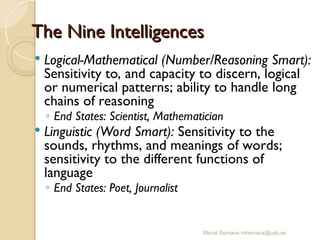
 Logical-Mathematical (Number/Reasoning Smart):
Sensitivity to, and capacity to discern, logical
or numerical patterns; ability to handle long
chains of reasoning
◦ End States: Scientist, Mathematician
 Linguistic (Word Smart): Sensitivity to the
sounds, rhythms, and meanings of words;
sensitivity to the different functions of
language
◦ End States: Poet, Journalist
The Nine Intelligences
Mercè Bernaus mbernaus@uab.es
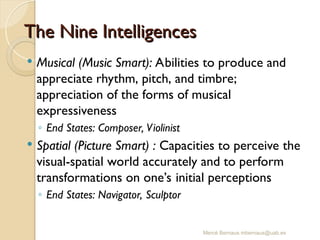
 Musical (Music Smart): Abilities to produce and
appreciate rhythm, pitch, and timbre;
appreciation of the forms of musical
expressiveness
◦ End States: Composer, Violinist
 Spatial (Picture Smart) : Capacities to perceive the
visual-spatial world accurately and to perform
transformations on one’s initial perceptions
◦ End States: Navigator, Sculptor
The Nine Intelligences
Mercè Bernaus mbernaus@uab.es
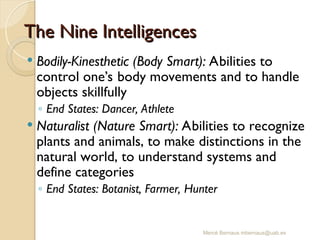
 Bodily-Kinesthetic (Body Smart): Abilities to
control one’s body movements and to handle
objects skillfully
◦ End States: Dancer, Athlete
 Naturalist (Nature Smart): Abilities to recognize
plants and animals, to make distinctions in the
natural world, to understand systems and
define categories
◦ End States: Botanist, Farmer, Hunter
The Nine Intelligences
Mercè Bernaus mbernaus@uab.es
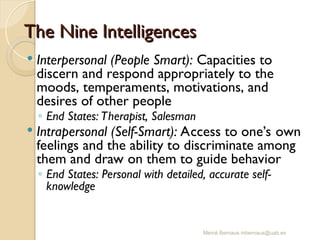
 Interpersonal (People Smart): Capacities to
discern and respond appropriately to the
moods, temperaments, motivations, and
desires of other people
◦ End States: Therapist, Salesman
 Intrapersonal (Self-Smart): Access to one’s own
feelings and the ability to discriminate among
them and draw on them to guide behavior
◦ End States: Personal with detailed, accurate self-
knowledge
The Nine Intelligences
Mercè Bernaus mbernaus@uab.es
 Existentialist Intelligence (Role Smart)
The Nine Intelligences
Mercè Bernaus mbernaus@uab.es
 Dr. Gardner says that our schools and culture focus most of
their attention on linguistic and logical-mathematical
intelligence, where some unique ways of thinking aren’t
addressed.
 This often leads to kids being labeled as “learning disabled” or
“hyperactive” when they may not be.
 The theory of multiple intelligences proposes a major
transformation in the way our schools are run. It suggests
that teachers be trained to present their lessons in a wide
variety of ways using music, cooperative learning, art
activities, role play, multimedia, field trips, inner reflection,
and much more
Applications
Applications
Mercè Bernaus mbernaus@uab.es
 An awareness of Gardner’s multiple-intelligence theory has
provided teachers with the knowledge necessary to satisfy
the educational needs of many more students.
 With an understanding of Gardner's theory of multiple
intelligences, teachers, school administrators, and parents can
better understand the different possibilities of each students’
learning preference. The application of of multiple
intelligences in the classroom can stimulate a student’s
learning in new ways.
Conclusion
Conclusion
Mercè Bernaus mbernaus@uab.es

What motivates my
students?
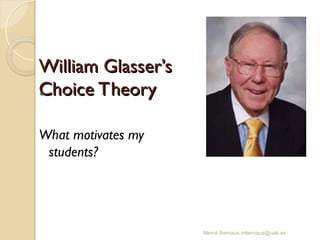
William Glasser’s
William Glasser’s
Choice Theory
Choice Theory
Mercè Bernaus mbernaus@uab.es
The Brain Seeks Two Things:
 Emotion
This is the “hook” to get
students’ attention
and peak interest.
 Meaning
This how the brain can
make sense of the
information coming
in…and anchor it to
something it already
knows.
Mercè Bernaus mbernaus@uab.es
 Information stays in short-term memory only
briefly. It moves from short-term to long-term
memory only if there a compelling reason to
remember the information—a WHY.
 More than ninety percent of our reasons for
taking action and remembering –the “whys” –
occur in the unconscious mind.
 The part of the brain that determines what we
remember resides in the same area as emotions.
Therefore, if the “why” to remember something is
linked to emotions, it is more likely to be retained
longer than if it is not. ALL LEARNING IS LINKED
TO EMOTIONS.
Mercè Bernaus mbernaus@uab.es
 Students come to school with their own
“whys”—emotional reasons for being there.
These “whys” are basic needs to survive, to
belong and love, to gain power, to be free, and
to have fun.
 Students possessing negative attitudes toward
learning are limited in their ability to transfer
their knowledge to new learning situations.
 Teachers can aid students’ desire to learn,
affecting their emotions and attitudes, by
addressing students’ basic needs through what
they say and what they do in the classroom.
Mercè Bernaus mbernaus@uab.es
We all make choices according to
basic needs that come from
within ourselves. The needs
drive our choices and influence
how we behave in those choices.
Mercè Bernaus mbernaus@uab.es
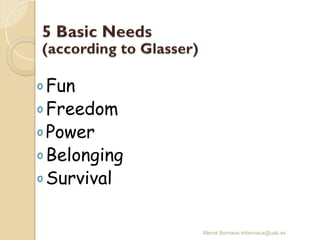
o Fun
o Freedom
o Power
o Belonging
o Survival
Mercè Bernaus mbernaus@uab.es
 The need for pleasure
 To play
 To laugh
 Naturally motivating
 No one has to bribe you to do these things
Try to imagine life without fun…
Mercè Bernaus mbernaus@uab.es
 The need for independence
 For autonomy
 For control over one’s own life
 For choice
Some students have had little experience with
choice…
Mercè Bernaus mbernaus@uab.es
 Empowerment
 The need to achieve
 To be recognized for achievement/skills
 To have a sense of self-worth
 To contribute
What makes your students feel valued?
Mercè Bernaus mbernaus@uab.es
 The need for love
 For relationships
 Social connection
 Part of a group
In schools, we must work to make students
(parents, teachers) feel they belong…
Mercè Bernaus mbernaus@uab.es
 Physiological
 The need for food, shelter, safety
 Safe from bullying
Schools should be a safe environment from bodily
harm, mental or physical intimidation, abuse.
Mercè Bernaus mbernaus@uab.es
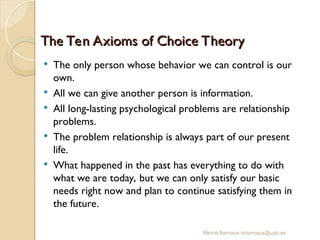
The Ten Axioms of Choice Theory
 The only person whose behavior we can control is our
own.
 All we can give another person is information.
 All long-lasting psychological problems are relationship
problems.
 The problem relationship is always part of our present
life.
 What happened in the past has everything to do with
what we are today, but we can only satisfy our basic
needs right now and plan to continue satisfying them in
the future.
Mercè Bernaus mbernaus@uab.es
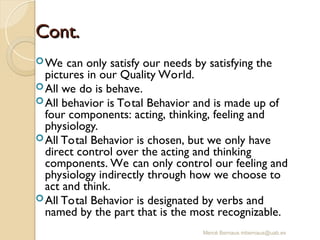
Cont.
Cont.
We can only satisfy our needs by satisfying the
pictures in our Quality World.
All we do is behave.
All behavior is Total Behavior and is made up of
four components: acting, thinking, feeling and
physiology.
All Total Behavior is chosen, but we only have
direct control over the acting and thinking
components. We can only control our feeling and
physiology indirectly through how we choose to
act and think.
All Total Behavior is designated by verbs and
named by the part that is the most recognizable.
Mercè Bernaus mbernaus@uab.es
Quality world
Quality world
The pictures in our head that we want to
experience in our life. Three clusters
1.People that are important to us
2.Experiences – places, activities, things that we
want
3.Beliefs and values – what we believe in
If something is not in our quality world it is not
and will not be important to us.
Mercè Bernaus mbernaus@uab.es
Car analogy
Car analogy
 Wheels – front wheels (acting, thinking – more
control), back wheels (feeling, physiology - less
direct control)
 Steering wheel – quality world
 Engine – needs (drive behaviour)
 Rear view mirror, fuel, passengers,
Mercè Bernaus mbernaus@uab.es
Applying It to the Classroom
 There are two types of teachers, Boss teachers and Lead
Teachers
 Boss Teachers are those who dwell heavily on rules and
consequences. They use rewards and punishment to
recognize good and bad before. Children are to be
motivated by rewards and avoiding punishment.
 Lead Teachers are those who align lessons and
assignments with students’ basic need as the main focus.
A grading system is in place but is only used as a
temporary indicator. They hope students will be engaged,
deeply motivated learners, instead of sitting around and
doing busy work to meet predetermined assignments.
Mercè Bernaus mbernaus@uab.es
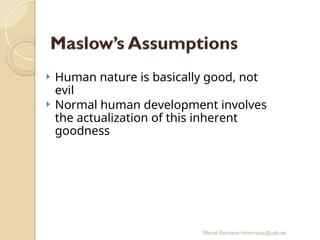
 Human nature is basically good, not
evil
 Normal human development involves
the actualization of this inherent
goodness
Mercè Bernaus mbernaus@uab.es
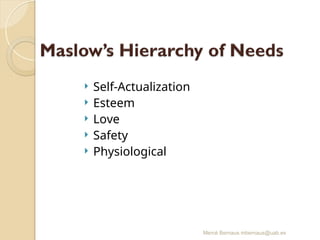
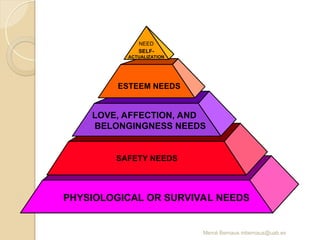
 Self-Actualization
 Esteem
 Love
 Safety
 Physiological
Mercè Bernaus mbernaus@uab.es
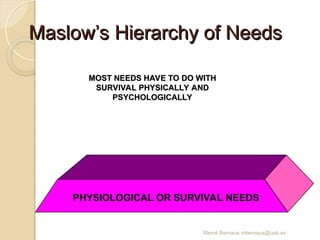
Maslow’s Hierarchy of Needs
MOST NEEDS HAVE TO DO WITH
SURVIVAL PHYSICALLY AND
PSYCHOLOGICALLY
PSYCHOLOGICALLY
PHYSIOLOGICAL OR SURVIVAL NEEDS
Mercè Bernaus mbernaus@uab.es
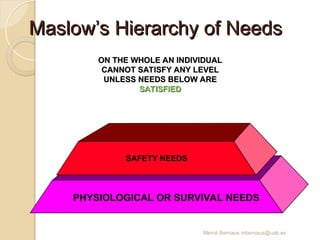
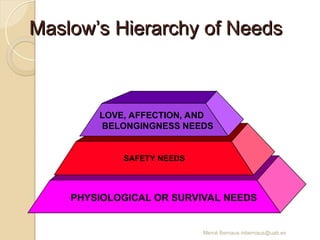
Maslow’s Hierarchy of Needs
PHYSIOLOGICAL OR SURVIVAL NEEDS
SAFETY NEEDS
ON THE WHOLE AN INDIVIDUAL
CANNOT SATISFY ANY LEVEL
UNLESS NEEDS BELOW ARE
SATISFIED
SATISFIED
Mercè Bernaus mbernaus@uab.es
Maslow’s Hierarchy of Needs
PHYSIOLOGICAL OR SURVIVAL NEEDS
SAFETY NEEDS
LOVE, AFFECTION, AND
BELONGINGNESS NEEDS
Mercè Bernaus mbernaus@uab.es
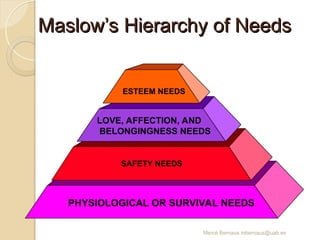
Maslow’s Hierarchy of Needs
PHYSIOLOGICAL OR SURVIVAL NEEDS
SAFETY NEEDS
LOVE, AFFECTION, AND
BELONGINGNESS NEEDS
ESTEEM NEEDS
Mercè Bernaus mbernaus@uab.es
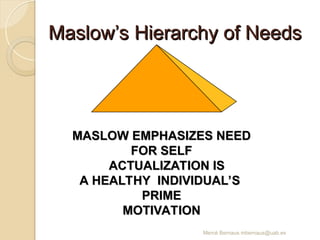
Maslow’s Hierarchy of Needs
MASLOW EMPHASIZES NEED
FOR SELF
FOR SELF
ACTUALIZATION IS
ACTUALIZATION IS
A HEALTHY INDIVIDUAL’S
PRIME
PRIME
MOTIVATION
MOTIVATION
Mercè Bernaus mbernaus@uab.es
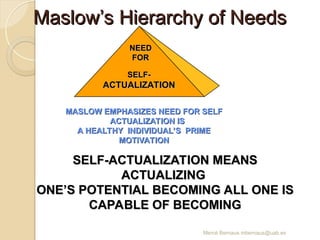
Maslow’s Hierarchy of Needs
SELF-
SELF-
ACTUALIZATION
ACTUALIZATION
NEED
NEED
FOR
FOR
MASLOW EMPHASIZES NEED FOR SELF
ACTUALIZATION IS
ACTUALIZATION IS
A HEALTHY INDIVIDUAL’S PRIME
MOTIVATION
MOTIVATION
SELF-ACTUALIZATION MEANS
ACTUALIZING
ACTUALIZING
ONE’S POTENTIAL BECOMING ALL ONE IS
CAPABLE OF BECOMING
CAPABLE OF BECOMING
Mercè Bernaus mbernaus@uab.es
PHYSIOLOGICAL OR SURVIVAL NEEDS
SAFETY NEEDS
LOVE, AFFECTION, AND
BELONGINGNESS NEEDS
ESTEEM NEEDS
SELF-
ACTUALIZATION
NEED
Mercè Bernaus mbernaus@uab.es
but we can nearly all do
more than we think we
can
can
Nobody can do everything,
Mercè Bernaus mbernaus@uab.es
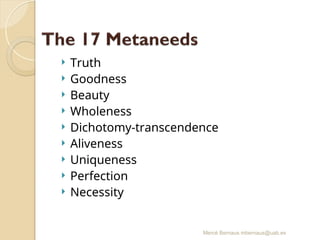
 Truth
 Goodness
 Beauty
 Wholeness
 Dichotomy-transcendence
 Aliveness
 Uniqueness
 Perfection
 Necessity
Mercè Bernaus mbernaus@uab.es
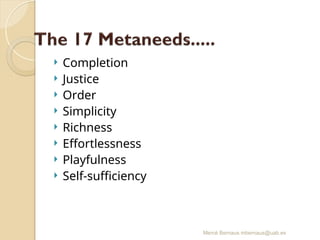
 Completion
 Justice
 Order
 Simplicity
 Richness
 Effortlessness
 Playfulness
 Self-sufficiency
Mercè Bernaus mbernaus@uab.es
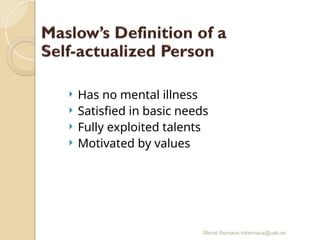
 Has no mental illness
 Satisfied in basic needs
 Fully exploited talents
 Motivated by values
Mercè Bernaus mbernaus@uab.es
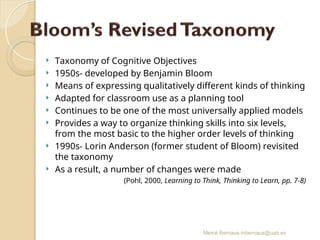
 Taxonomy of Cognitive Objectives
 1950s- developed by Benjamin Bloom
 Means of expressing qualitatively different kinds of thinking
 Adapted for classroom use as a planning tool
 Continues to be one of the most universally applied models
 Provides a way to organize thinking skills into six levels,
from the most basic to the higher order levels of thinking
 1990s- Lorin Anderson (former student of Bloom) revisited
the taxonomy
 As a result, a number of changes were made
(Pohl, 2000, Learning to Think, Thinking to Learn, pp. 7-8)
Mercè Bernaus mbernaus@uab.es
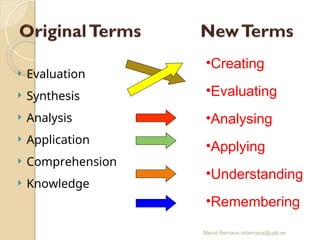
 Evaluation
 Synthesis
 Analysis
 Application
 Comprehension
 Knowledge
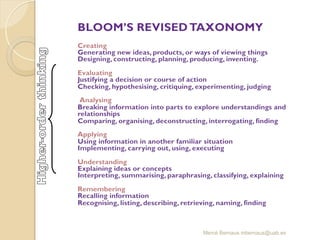
•Creating
•Evaluating
•Analysing
•Applying
•Understanding
•Remembering
Mercè Bernaus mbernaus@uab.es
COGNITIVE DOMAIN
COGNITIVE DOMAIN
 The cognitive domain (Bloom, 1956) involves
knowledge and the development of
intellectual skills. This includes the recall or
recognition of specific facts, procedural
patterns, and concepts that serve in the
development of intellectual abilities and skills.
Mercè Bernaus mbernaus@uab.es
Six Major Categories
 Knowledge-Recall data or information.
 Comprehension-Understand the meaning,
translation, interpolation, and interpretation of
instructions and problems. State a problem in one's
own words.
 Application -Use a concept in a new situation or
unprompted use of an abstraction. Applies what was
learned in the classroom into novel situations in the
work place.
Mercè Bernaus mbernaus@uab.es
 Analysis -Separates material or concepts into
component parts so that its organizational
structure may be understood. Distinguishes
between facts and inferences.
 Synthesis -Builds a structure or pattern from
diverse elements. Put parts together to form
a whole, with emphasis on creating a new
meaning or structure.
 Evaluation -Make judgments about the value
of ideas or materials.
Mercè Bernaus mbernaus@uab.es
Knowledge
Knowledge
 Examples or Activity:
multiple-choice test, recount facts or
statistics, recall a process, rules, definitions;
quote law or procedure
 Keywords:
arrange, define, describe, label, list,
memorize, recognize, relate, reproduce,
select, state
Mercè Bernaus mbernaus@uab.es
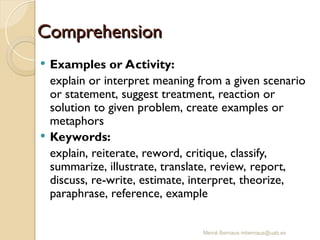
Comprehension
Comprehension
 Examples or Activity:
explain or interpret meaning from a given scenario
or statement, suggest treatment, reaction or
solution to given problem, create examples or
metaphors
 Keywords:
explain, reiterate, reword, critique, classify,
summarize, illustrate, translate, review, report,
discuss, re-write, estimate, interpret, theorize,
paraphrase, reference, example
Mercè Bernaus mbernaus@uab.es
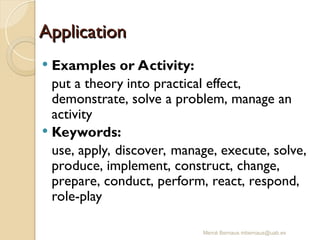
Application
Application
 Examples or Activity:
put a theory into practical effect,
demonstrate, solve a problem, manage an
activity
 Keywords:
use, apply, discover, manage, execute, solve,
produce, implement, construct, change,
prepare, conduct, perform, react, respond,
role-play
Mercè Bernaus mbernaus@uab.es
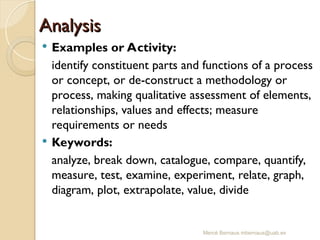
Analysis
Analysis
 Examples or Activity:
identify constituent parts and functions of a process
or concept, or de-construct a methodology or
process, making qualitative assessment of elements,
relationships, values and effects; measure
requirements or needs
 Keywords:
analyze, break down, catalogue, compare, quantify,
measure, test, examine, experiment, relate, graph,
diagram, plot, extrapolate, value, divide
Mercè Bernaus mbernaus@uab.es
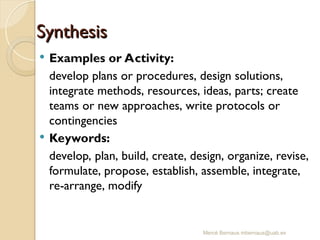
Synthesis
Synthesis
 Examples or Activity:
develop plans or procedures, design solutions,
integrate methods, resources, ideas, parts; create
teams or new approaches, write protocols or
contingencies
 Keywords:
develop, plan, build, create, design, organize, revise,
formulate, propose, establish, assemble, integrate,
re-arrange, modify
Mercè Bernaus mbernaus@uab.es
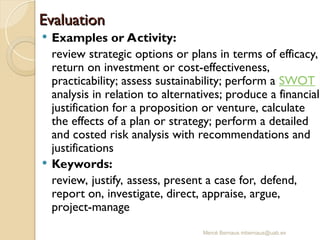
Evaluation
Evaluation
 Examples or Activity:
review strategic options or plans in terms of efficacy,
return on investment or cost-effectiveness,
practicability; assess sustainability; perform a SWOT
analysis in relation to alternatives; produce a financial
justification for a proposition or venture, calculate
the effects of a plan or strategy; perform a detailed
and costed risk analysis with recommendations and
justifications
 Keywords:
review, justify, assess, present a case for, defend,
report on, investigate, direct, appraise, argue,
project-manage
Mercè Bernaus mbernaus@uab.es
AFFECTIVE DOMAIN
AFFECTIVE DOMAIN
 includes the manner in which we deal
with things emotionally, such as feelings,
values, appreciation, enthusiasms,
motivations, and attitudes.
Mercè Bernaus mbernaus@uab.es
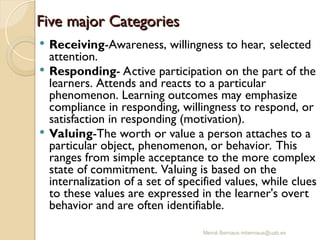
Five major Categories
 Receiving-Awareness, willingness to hear, selected
attention.
 Responding- Active participation on the part of the
learners. Attends and reacts to a particular
phenomenon. Learning outcomes may emphasize
compliance in responding, willingness to respond, or
satisfaction in responding (motivation).
 Valuing-The worth or value a person attaches to a
particular object, phenomenon, or behavior. This
ranges from simple acceptance to the more complex
state of commitment. Valuing is based on the
internalization of a set of specified values, while clues
to these values are expressed in the learner's overt
behavior and are often identifiable.
Mercè Bernaus mbernaus@uab.es
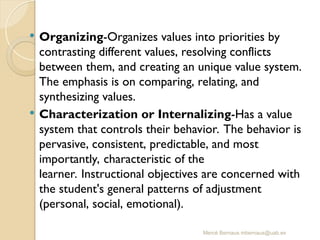
 Organizing-Organizes values into priorities by
contrasting different values, resolving conflicts
between them, and creating an unique value system.
The emphasis is on comparing, relating, and
synthesizing values.
 Characterization or Internalizing-Has a value
system that controls their behavior. The behavior is
pervasive, consistent, predictable, and most
importantly, characteristic of the
learner. Instructional objectives are concerned with
the student's general patterns of adjustment
(personal, social, emotional).
Mercè Bernaus mbernaus@uab.es
Receiving
Receiving
Examples: Listen to others with respect.
Listen for and remember the name of newly
introduced people.
Key Words: asks, chooses, describes, follows,
gives, holds, identifies, locates, names, points
to, selects, sits, erects, replies, uses.
Mercè Bernaus mbernaus@uab.es
Responding
Responding
 Examples: Participates in class discussions. Gives a
presentation. Questions new ideals, concepts,
models, etc. in order to fully understand them.
Know the safety rules and practices them.
 Key Words: answers, assists, aids, complies,
conforms, discusses, greets, helps, labels, performs,
practices, presents, reads, recites, reports, selects,
tells, writes.
Mercè Bernaus mbernaus@uab.es
Valuing
Valuing
Examples: Demonstrates belief in the democratic
process. Is sensitive towards individual and cultural
differences (value diversity). Shows the ability to
solve problems. Proposes a plan to social
improvement and follows through with commitment.
Informs management on matters that one feels
strongly about.
Key Words: completes, demonstrates, differentiates,
explains, follows, forms, initiates, invites, joins,
justifies, proposes, reads, reports, selects, shares,
studies, works.
Mercè Bernaus mbernaus@uab.es
Organizing
Organizing
 Examples: Recognizes the need for balance between freedom
and responsible behavior. Accepts responsibility for one's
behavior. Explains the role of systematic planning in solving
problems. Accepts professional ethical standards. Creates a
life plan in harmony with abilities, interests, and beliefs.
Prioritizes time effectively to meet the needs of the
organization, family, and self.
 Key Words: adheres, alters, arranges, combines, compares,
completes, defends, explains, formulates, generalizes,
identifies, integrates, modifies, orders, organizes, prepares,
relates, synthesizes.
Mercè Bernaus mbernaus@uab.es
Internalizing
Internalizing
 Examples: Shows self-reliance when working
independently. Cooperates in group
activities (displays teamwork). Uses an objective
approach in problem solving. Displays a professional
commitment to ethical practice on a daily basis.
Revises judgments and changes behavior in light of
new evidence. Values people for what they are, not
how they look.
 Key Words: acts, discriminates, displays, influences,
listens, modifies, performs, practices, proposes,
qualifies, questions, revises, serves, solves, verifies.
Mercè Bernaus mbernaus@uab.es
PSYCHOMOTOR DOMAIN
PSYCHOMOTOR DOMAIN
 includes physical movement, coordination,
and use of the motor-skill areas. Development
of these skills requires practice and is
measured in terms of speed, precision,
distance, procedures, or techniques in
execution.
Mercè Bernaus mbernaus@uab.es
Reflex movements
Reflex movements
 are actions elicited without learning in
response to some stimuli.
 Examples include: flexion, extension, stretch,
postural adjustments
Mercè Bernaus mbernaus@uab.es
Perceptual
Perceptual
 refers to interpretation of various stimuli that
enable one to make adjustments to the
environment. Visual, auditory, kinesthetic, or
tactile discrimination. Suggests cognitive as
well as psychomotor behavior.
 Examples include: coordinated movements
such as jumping rope, punting, or catching.
Mercè Bernaus mbernaus@uab.es
Physical activities
Physical activities
 require endurance, strength, vigor, and agility
which produces a sound, efficiently
functioning body.
 Examples are: all activities which require a)
strenuous effort for long periods of time; b)
muscular exertion; c) a quick, wide range of
motion at the hip joints; and d) quick, precise
movements.
Mercè Bernaus mbernaus@uab.es
Skilled movements
Skilled movements
 are the result of the acquisition of a degree
of efficiency when performing a complex task.
 Examples are: all skilled activities obvious in
sports, recreation, and dance.
Mercè Bernaus mbernaus@uab.es
Non-discursive communication
 is communication through bodily movements
ranging from facial expressions through
sophisticated choreographics.
 Examples include: body postures, gestures,
and facial expressions efficiently executed in
skilled dance movement and choreographics.
Mercè Bernaus mbernaus@uab.es
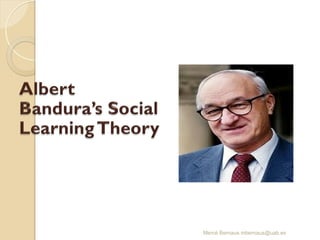
 Albert Bandura’s (1960s +) Social Learning
Theory
◦ aka Social Cognitive Theory
 Put the “person” back into personality
Mercè Bernaus mbernaus@uab.es
 Use strategies to gain the students’ attention.
 Ensure that the observation is not too complex.
 Link new skills to the student’s prior knowledge
 Use practice to ensure long-term retention
 Ensure a positive attitude toward a new skill so
that the students will be motivated to reproduce
or use new behavior
Principles of Social Learning
Mercè Bernaus mbernaus@uab.es
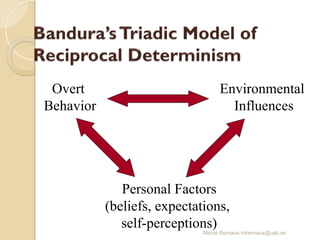
Environmental
Influences
Personal Factors
(beliefs, expectations,
self-perceptions)
Overt
Behavior
Mercè Bernaus mbernaus@uab.es
 Bandura’s biggest contribution to learning
theory:
◦ New patterns of behavior can be acquired in the
absence of external reinforcement
◦ We can pay attention to what others do, and
repeat their actions
 i.e., We learn through observation, rather than
through direct reinforcement
Mercè Bernaus mbernaus@uab.es
 We can exercise control over our behavior
through self-regulation
◦ We are not slaves to environmental influences
◦ We have free will
 Cognition allows us to use previous
experiences, rather than trial-and-error, to
foresee probable consequences of our acts,
and behave accordingly
 Self-regulation allows us to choose behaviors
that help us to avoid punishments and move
towards long-term goals
Mercè Bernaus mbernaus@uab.es
 We learn much of what we do through
observing and speaking with others
(“models”), rather than through personal
experience
 We form a cognitive image of how to
perform certain behaviors through
modeling, and use this image as a guide for
later behaviors
Mercè Bernaus mbernaus@uab.es
Observational learning is
also known as imitation or
modeling. In this process,
learning occurs when
individuals observes and
imitate others’ behavior.
Mercè Bernaus mbernaus@uab.es
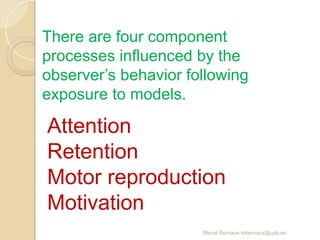
Attention
Retention
Motor reproduction
Motivation
There are four component
processes influenced by the
observer’s behavior following
exposure to models.
Mercè Bernaus mbernaus@uab.es
Attention is the first component of
observational learning. Individuals
cannot learn much by observation
unless they perceive and attend
to the significant features of the
modeled behavior.
Mercè Bernaus mbernaus@uab.es
Retention is the next
component. In order to
reproduce the modeled
behavior, the individuals must
code the information into long-
term memory.
Mercè Bernaus mbernaus@uab.es
Motor reproduction is another
process in observational
learning. The observer must be
able to reproduce the model’s
behavior. The observer must
learn and posses the physical
capabilities of the modeled
behavior.
Mercè Bernaus mbernaus@uab.es
Motivation or
Reinforcements In this
process, the observer
expects to receive positive
reinforcements for the
modeled behavior.
Mercè Bernaus mbernaus@uab.es
Environmental experience is a
second influence of the social
learning of violence in children.
Albert Bandura reported that
individuals that live in high crime
rates areas are more likely to act
violently than those who dwell in
low-crime areas.
Mercè Bernaus mbernaus@uab.es
Albert Bandura believed
television was a source of
behavior modeling.
Since aggression is a prominent feature of
many shows, children who have a high
degree of exposure to the media may
exhibit a relatively high incidence of
hostility themselves in imitation of the
aggression they have witnessed.
Mercè Bernaus mbernaus@uab.es
For example,
David Phillips reported homicide rates
increase tremendously after a heavy
weight championship fight . There
have been a number of deaths linked
to violence on television.
Mercè Bernaus mbernaus@uab.es
 We acquire, maintain, and modify
behaviors that we see others perform
 We decide which behaviors to keep, and
when to use them, by using:
◦ symbolic thought
◦ emotion
◦ self-regulation (“I really want to stab my prof,
but I need an A, so…”)
 Bandura and other Social Learning
Theorists put the “person” back into
personality by stressing the interplay of
personal factors, environmental factors,
and behavior
Words of Wisdom
Words of Wisdom
A person without a goal,
happenstance is his
destination.
Mercè Bernaus mbernaus@uab.es
FAST TALK
FAST TALK
Mercè Bernaus mbernaus@uab.es
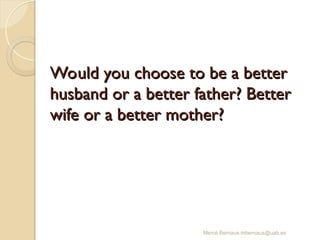
Would you choose to be a better
husband or a better father? Better
wife or a better mother?
Mercè Bernaus mbernaus@uab.es
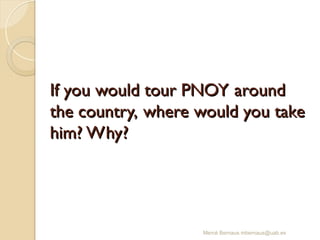
If you would tour PNOY around
the country, where would you take
him? Why?
him? Why?
Mercè Bernaus mbernaus@uab.es
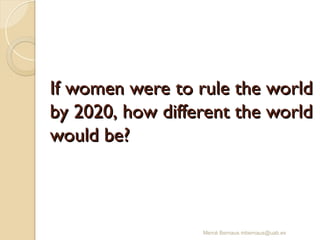
If women were to rule the world
by 2020, how different the world
would be?
would be?
Mercè Bernaus mbernaus@uab.es
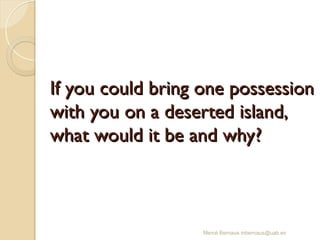
If you could bring one possession
with you on a deserted island,
what would it be and why?
Mercè Bernaus mbernaus@uab.es
If you could be very famous, in
what way would you choose?
Mercè Bernaus mbernaus@uab.es
What childhood play do you miss
most? Why?
most? Why?
Mercè Bernaus mbernaus@uab.es
How do you consider teaching
profession- a masculine course
or feminine course?
or feminine course?
Mercè Bernaus mbernaus@uab.es
Does crying make a man less of a
woman? Why?
woman? Why?
Mercè Bernaus mbernaus@uab.es
If you were to be transported to
live in a new planet, who will be
the three persons you would
want to be with you and why?
Mercè Bernaus mbernaus@uab.es
What are the three things you
would never do to the person
you love?
you love?
Mercè Bernaus mbernaus@uab.es
Motivational Factors in Learning
 MOTIVATION refers to the initiation, direction,
intensity, and persistence of human behavior.
 REWARD vs REINFORCEMENT
 A reward often has the intent of encouraging the
behavior to happen again. It can be external or
internal.
 A reinforcement is intended to create a
measured increase in the rate of a desirable
behavior following the addition of something to
the environment.
Mercè Bernaus mbernaus@uab.es
Other Factors
Other Factors
 COERCION- a form of motivation where
the avoidance of pain or other negative
consequences has an immediate effect.
 SELF-CONTROL is increasingly
understood as a subset of emotional
intelligence; a person maybe highly
intelligent, yet unmotivated to dedicate
this intelligence to certain tasks.
Mercè Bernaus mbernaus@uab.es
How do the following motivate
you?
you?
 ACHIEVEMENT
 GOAL
 LOVE
 FAMILY
 FRIENDS
 MONEY
 RELATIONSHIPS/AFFILIATIONS
 WORKPLACE
 NEEDS
Mercè Bernaus mbernaus@uab.es
Students and the Need for
Differentiated Environments
1. When students see that Effort = Success, they
become eager and effective learners
2. When students believe success is due to innate
ability, they are afraid to make mistakes
3. When tasks are too easy or too hard, students learn
to get by or give up
4. When task is appropriate for student readiness, task
becomes satisfying
Mercè Bernaus mbernaus@uab.es
Students and the Need for Differentiated Environments
5. When task is too difficult, brain goes into escape (fight or
flight) mode
6. When task is too easy, brain goes into relaxation (sleep-
like) mode
7. Students function best when the task is slightly difficult for
them
8. Matching difficulty level of task to student readiness leads
to feelings of student competence – students select more
challenging tasks in the future
Mercè Bernaus mbernaus@uab.es
When a teacher tries to teach
something to the entire class at
the same time, “chances are, one-
third of the kids already know it;
one-third will get it; and the
remaining third won’t. So two-
thirds of the children are wasting
their time.”
Lilian Katz
What if you are demotivated?
Mercè Bernaus mbernaus@uab.es
See JOHN GARDNER’s PERSONAL
RENEWAL
Motivational Theories
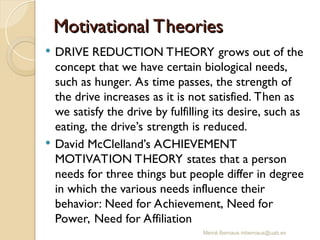
 DRIVE REDUCTION THEORY grows out of the
concept that we have certain biological needs,
such as hunger. As time passes, the strength of
the drive increases as it is not satisfied. Then as
we satisfy the drive by fulfilling its desire, such as
eating, the drive’s strength is reduced.
 David McClelland’s ACHIEVEMENT
MOTIVATION THEORY states that a person
needs for three things but people differ in degree
in which the various needs influence their
behavior: Need for Achievement, Need for
Power, Need for Affiliation
Mercè Bernaus mbernaus@uab.es
Motivational Theories
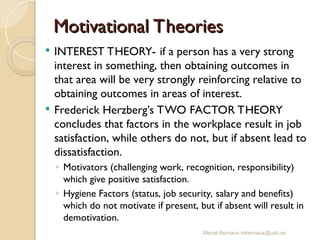
 INTEREST THEORY- if a person has a very strong
interest in something, then obtaining outcomes in
that area will be very strongly reinforcing relative to
obtaining outcomes in areas of interest.
 Frederick Herzberg’s TWO FACTOR THEORY
concludes that factors in the workplace result in job
satisfaction, while others do not, but if absent lead to
dissatisfaction.
◦ Motivators (challenging work, recognition, responsibility)
which give positive satisfaction.
◦ Hygiene Factors (status, job security, salary and benefits)
which do not motivate if present, but if absent will result in
demotivation.
Mercè Bernaus mbernaus@uab.es
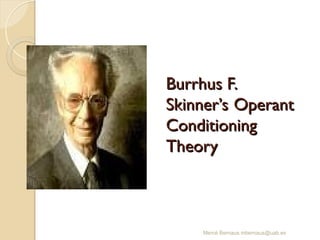
Burrhus F.
Burrhus F.
Skinner’s Operant
Skinner’s Operant
Conditioning
Conditioning
Theory
Theory
Mercè Bernaus mbernaus@uab.es
 This theory developed by
Burrhus Skinner (1968) refers to
learning facilitated through
reinforcement and learning that is
based upon a pleasure –pain view
of human behavior.
Operant Conditioning Theory
Mercè Bernaus mbernaus@uab.es
 B. F. Skinner made the law of effect the
cornerstone for his influential theory of
learning, called operant conditioning.
◦ According to Skinner, the organism’s behavior is
“operating” on the environment to achieve some desired
goal.
 Operant conditioning: learning in which
behavior is strengthened if followed by
reinforcement and weakened if followed by
punishment
Mercè Bernaus mbernaus@uab.es
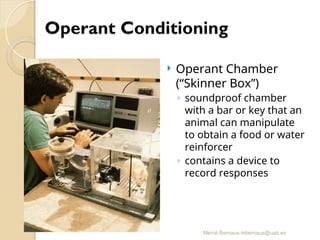
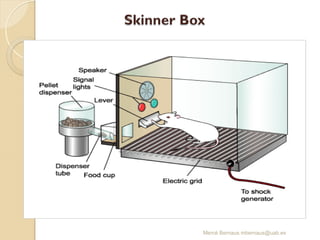
 Operant Chamber
(“Skinner Box”)
◦ soundproof chamber
with a bar or key that an
animal can manipulate
to obtain a food or water
reinforcer
◦ contains a device to
record responses
Mercè Bernaus mbernaus@uab.es
 The fundamental principle of behaviorism is
that rewarded behavior is likely to be
repeated.
 This is known as reinforcement in operant
conditioning.
 It also states the positive side of Thorndike’s
Law of Effect.
Mercè Bernaus mbernaus@uab.es
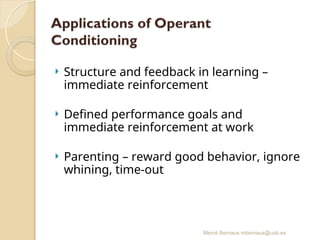
 Structure and feedback in learning –
immediate reinforcement
 Defined performance goals and
immediate reinforcement at work
 Parenting – reward good behavior, ignore
whining, time-out
Mercè Bernaus mbernaus@uab.es
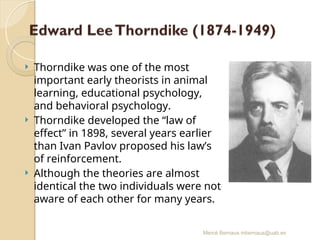
 Thorndike was one of the most
important early theorists in animal
learning, educational psychology,
and behavioral psychology.
 Thorndike developed the “law of
effect” in 1898, several years earlier
than Ivan Pavlov proposed his law’s
of reinforcement.
 Although the theories are almost
identical the two individuals were not
aware of each other for many years.
Mercè Bernaus mbernaus@uab.es
 two main foci in education were 1) the
improvement of classroom instruction
and 2) the measurement of the learner
and the products of learning.
 wrote three books for his own use that
became classics in educational psychology 1)
Educational Psychology (1903), 2) The Theory
of Mental and Social Measurement (1904), and
a three volume Educational Psychology (1913).
Mercè Bernaus mbernaus@uab.es
 referred to his approach to learning as connectionism,
hypothesized that an organism learned about
connections between situations and types of responses.
 one of the first to hypothesize that “if all of these
(responses & situational variables) could be analyzed”
man could be told what would and would not satisfy him
and annoy him in every conceivable situation.
 The law of effect refers to “stamping in or stamping out”
a response tendency by attaching favorable or
unfavorable consequences.
 the law of effect states “any act which in a given
situation produces satisfaction becomes associated with
that situation, and when the situation reoccurs the act is
more likely to reoccur than before”.
Mercè Bernaus mbernaus@uab.es
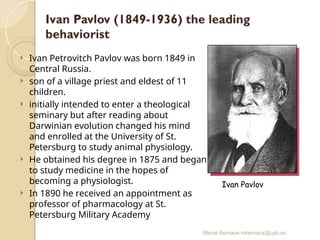
 Ivan Petrovitch Pavlov was born 1849 in
Central Russia.
 son of a village priest and eldest of 11
children.
 initially intended to enter a theological
seminary but after reading about
Darwinian evolution changed his mind
and enrolled at the University of St.
Petersburg to study animal physiology.
 He obtained his degree in 1875 and began
to study medicine in the hopes of
becoming a physiologist.
 In 1890 he received an appointment as
professor of pharmacology at St.
Petersburg Military Academy
Ivan Pavlov
Mercè Bernaus mbernaus@uab.es
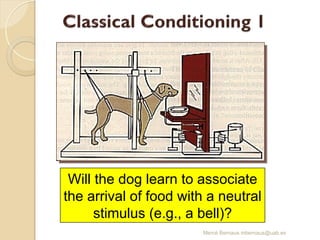
Will the dog learn to associate
the arrival of food with a neutral
stimulus (e.g., a bell)?
Mercè Bernaus mbernaus@uab.es
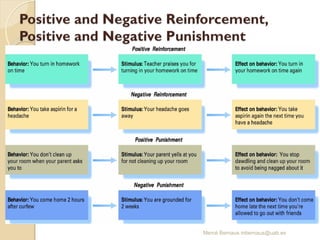
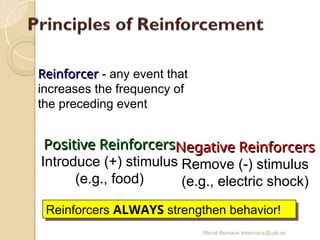
Reinforcer
Reinforcer - any event that
increases the frequency of
the preceding event
Positive Reinforcers
Introduce (+) stimulus
(e.g., food)
Negative Reinforcers
Remove (-) stimulus
(e.g., electric shock)
Reinforcers ALWAYS strengthen behavior!
Mercè Bernaus mbernaus@uab.es
 Locke’s reflection on knowing starts with the
problem of theories
◦ Given two explanations the one that is most likely
to be true is the simplest
◦ Is it possible to construct an explanation of
knowledge without using the notion of innate
ideas
 According to Locke, “yes”, is one starts with a
simple concept (model) of the mind
Mercè Bernaus mbernaus@uab.es
 Imagine the mind like a blank slate on which
nothing is written (without any innate ideas)
◦ “Let us suppose the mind to be, as we say, white
paper, void of all characters, without any ideas:
How comes it to be furnished? To this I answer in
one word, from EXPERIENCE.” (John Locke, EHU)
The mind is like a blank slate
informed only by sense
experience and acts of reflection
Mercè Bernaus mbernaus@uab.es
 Children show no evidence of innate ideas.
They appear to learn their ideas
◦ Copy from adults
◦ Education
◦ Personal experience
 If a child were kept in a room with no color
would have no idea of color
 So by “degrees” their minds are furnished
with ideas
Mercè Bernaus mbernaus@uab.es
 The senses play a role in knowing by providing
data from an “external world” - the “to be known.”
 The ‘external world’ (reality) imposes itself on
consciousness. However, what is ‘imposed’
(impressed on the mind) are ideas.
◦ As we have noted there is no means to verify the
correspondence of idea and reality the idea
represents.
 The mind actively relates the data together.
◦ So the mind is ACTIVE in acts of knowing.
Mercè Bernaus mbernaus@uab.es
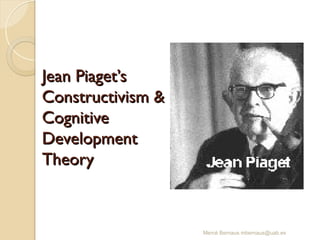
Jean Piaget’s
Jean Piaget’s
Constructivism &
Constructivism &
Cognitive
Cognitive
Development
Development
Theory
Theory
Mercè Bernaus mbernaus@uab.es
 In order to understand something,
we MUST be able to relate it to
something else
 If at all possible, APPLY this
knowledge during the lesson to
foster concrete connections
 Differs from traditional view; the
mind is a blank tablet
Mercè Bernaus mbernaus@uab.es
 1. Sensory motor stage (birth-2 yrs)
-through physical interaction with
environment, child develops set of
concepts about reality & how it works
-stage where child is unaware that if an
object is not seen it still exists (object
permanence)
Mercè Bernaus mbernaus@uab.es
 Child needs concrete physical
situations and is unable to
conceptualize in the abstract
-needs to see, hear, feel in order
to understand something
Mercè Bernaus mbernaus@uab.es
 Child begins to conceptualize based on
physical experiences
-creates logical structures to explain his/her
environment
-abstract problem solving possible
Example: math with #’s, not objects
Mercè Bernaus mbernaus@uab.es
 Cognitive structures are like an adult and
include conceptual reasoning
-Piaget classified as a “cognitive constructivist”
focusing on processes of the mind and its
effects on learning
Mercè Bernaus mbernaus@uab.es
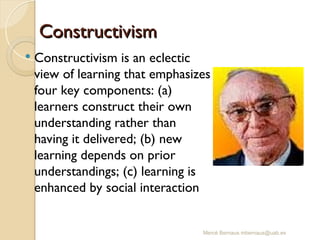
 Constructivism is an eclectic
view of learning that emphasizes
four key components: (a)
learners construct their own
understanding rather than
having it delivered; (b) new
learning depends on prior
understandings; (c) learning is
enhanced by social interaction
Constructivism
Constructivism
Mercè Bernaus mbernaus@uab.es
 An educational
theory that places
emphasis on the
learner
 Teacher’s role: Act as
a facilitator
 Based on the idea
that All knowledge
is CONSTRUCTED
based on previous
experiences
Mercè Bernaus mbernaus@uab.es
Two Views of
Constructivism
Mercè Bernaus mbernaus@uab.es
•Individual
Contructivism – it
emphasizes
individual, internal
construction of
knowledge.
Mercè Bernaus mbernaus@uab.es
•Social
Constructivism – it
emphasizes that
“knowledge exists in
a social context and
is initially shared
with others instead
of being represented
solely in the mind of
an individual.”
Mercè Bernaus mbernaus@uab.es
Characteristics
of
Constructivism
Mercè Bernaus mbernaus@uab.es
•Learners construct
understanding.
•New learning depends on
current understanding.
•Learning is facilitated by social
interaction.
•Meaningful learning occurs
within authentic learning tasks.
Mercè Bernaus mbernaus@uab.es
Bruner’s Main
Concepts
Mercè Bernaus mbernaus@uab.es
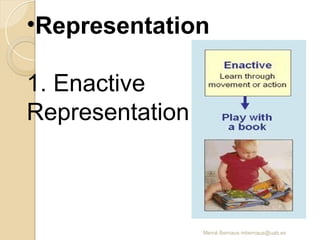
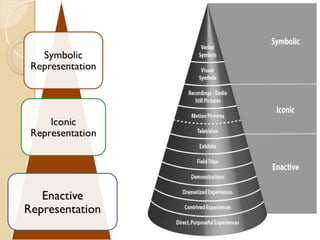
•Representation
1. Enactive
Representation
Mercè Bernaus mbernaus@uab.es
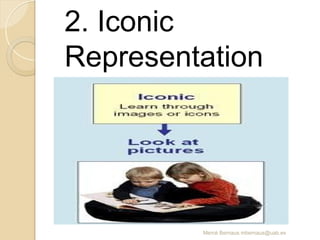
2. Iconic
Representation
Mercè Bernaus mbernaus@uab.es
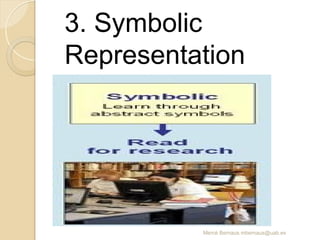
3. Symbolic
Representation
Mercè Bernaus mbernaus@uab.es
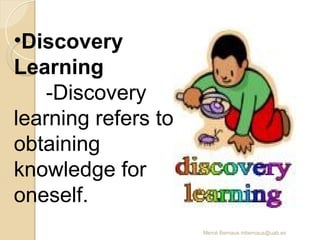
•Discovery
Learning
-Discovery
learning refers to
obtaining
knowledge for
oneself.
Mercè Bernaus mbernaus@uab.es
The five E’s:
 Engage- do this! Engage the students and get
them interested in learning
Ex: ask a question, define a problem, surprise
them, use problematic situations
Mercè Bernaus mbernaus@uab.es
 Get the students directly involved in
the material
 Have them work in teams
 Act as a facilitator
 Use their inquiry to drive the
process
Mercè Bernaus mbernaus@uab.es
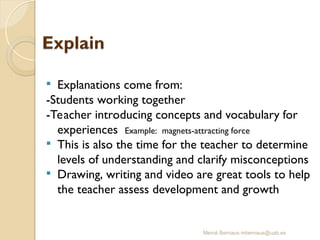
 Explanations come from:
-Students working together
-Teacher introducing concepts and vocabulary for
experiences Example: magnets-attracting force
 This is also the time for the teacher to determine
levels of understanding and clarify misconceptions
 Drawing, writing and video are great tools to help
the teacher assess development and growth
Mercè Bernaus mbernaus@uab.es
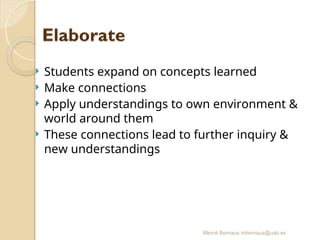
 Students expand on concepts learned
 Make connections
 Apply understandings to own environment &
world around them
 These connections lead to further inquiry &
new understandings
Mercè Bernaus mbernaus@uab.es
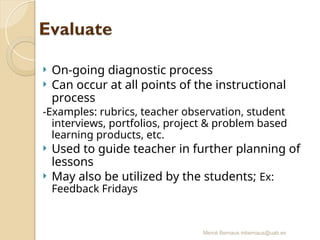
 On-going diagnostic process
 Can occur at all points of the instructional
process
-Examples: rubrics, teacher observation, student
interviews, portfolios, project & problem based
learning products, etc.
 Used to guide teacher in further planning of
lessons
 May also be utilized by the students; Ex:
Feedback Fridays
Mercè Bernaus mbernaus@uab.es
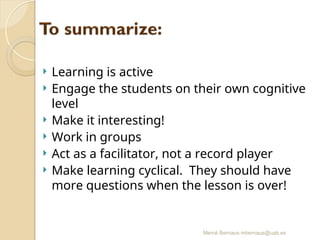
 Learning is active
 Engage the students on their own cognitive
level
 Make it interesting!
 Work in groups
 Act as a facilitator, not a record player
 Make learning cyclical. They should have
more questions when the lesson is over!
Mercè Bernaus mbernaus@uab.es
 Learning experiences should be as pleasant and satisfying as
possible.
 Whenever possible, lessons should take into account the
interests and students of students.
 The attention of learners can be gained and held longer by
using different sensory channels and movement.
 Learners can attend for only so long, and they differ in their
ability to attend.
 Distractions interfere with attention
 Learners can attend only to so much info at any one time.
Cognitivist Guiding Principles to Gain and
Hold Learning
Hold Learning
Mercè Bernaus mbernaus@uab.es
 Psychosocial development theory is based on
eight stages of development
 Erikson’s theory is based on the idea that
development through life is a series of stages
which are each defined by a crisis or challenge
 The early stages provide the foundations for later
stages so Erikson says that if a child does not
resolve a crisis in a particular stage, they will have
problems in later stages
 For example, if an adolescent does not establish
his own identity, he will have difficulty in
relationships as an adult
Mercè Bernaus mbernaus@uab.es
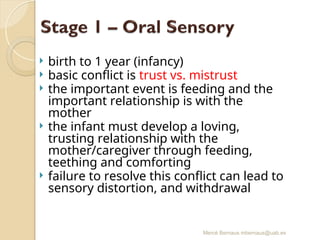
 Stage 1 – Oral Sensory
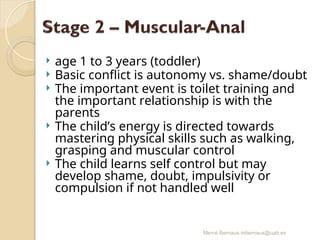
 Stage 2 – Muscular-Anal
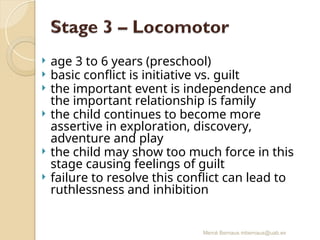
 Stage 3 – Locomotor
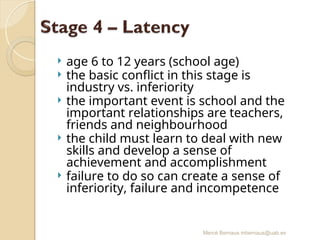
 Stage 4 – Latency
 Stage 5 – Adolescence
 Stage 6 – Young Adulthood
 Stage 7 – Middle Adulthood
 Stage 8 – Maturity
Mercè Bernaus mbernaus@uab.es
 birth to 1 year (infancy)
 basic conflict is trust vs. mistrust
 the important event is feeding and the
important relationship is with the
mother
 the infant must develop a loving,
trusting relationship with the
mother/caregiver through feeding,
teething and comforting
 failure to resolve this conflict can lead to
sensory distortion, and withdrawal
Mercè Bernaus mbernaus@uab.es
 age 1 to 3 years (toddler)
 Basic conflict is autonomy vs. shame/doubt
 The important event is toilet training and
the important relationship is with the
parents
 The child’s energy is directed towards
mastering physical skills such as walking,
grasping and muscular control
 The child learns self control but may
develop shame, doubt, impulsivity or
compulsion if not handled well
Mercè Bernaus mbernaus@uab.es
 age 3 to 6 years (preschool)
 basic conflict is initiative vs. guilt
 the important event is independence and
the important relationship is family
 the child continues to become more
assertive in exploration, discovery,
adventure and play
 the child may show too much force in this
stage causing feelings of guilt
 failure to resolve this conflict can lead to
ruthlessness and inhibition
Mercè Bernaus mbernaus@uab.es
 age 6 to 12 years (school age)
 the basic conflict in this stage is
industry vs. inferiority
 the important event is school and the
important relationships are teachers,
friends and neighbourhood
 the child must learn to deal with new
skills and develop a sense of
achievement and accomplishment
 failure to do so can create a sense of
inferiority, failure and incompetence
Mercè Bernaus mbernaus@uab.es
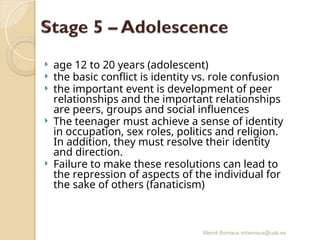
 age 12 to 20 years (adolescent)
 the basic conflict is identity vs. role confusion
 the important event is development of peer
relationships and the important relationships
are peers, groups and social influences
 The teenager must achieve a sense of identity
in occupation, sex roles, politics and religion.
In addition, they must resolve their identity
and direction.
 Failure to make these resolutions can lead to
the repression of aspects of the individual for
the sake of others (fanaticism)
Mercè Bernaus mbernaus@uab.es
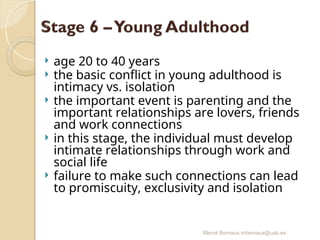
 age 20 to 40 years
 the basic conflict in young adulthood is
intimacy vs. isolation
 the important event is parenting and the
important relationships are lovers, friends
and work connections
 in this stage, the individual must develop
intimate relationships through work and
social life
 failure to make such connections can lead
to promiscuity, exclusivity and isolation
Mercè Bernaus mbernaus@uab.es
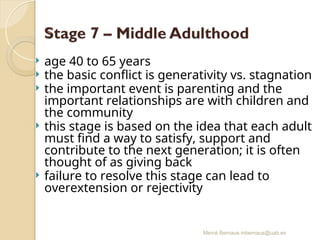
 age 40 to 65 years
 the basic conflict is generativity vs. stagnation
 the important event is parenting and the
important relationships are with children and
the community
 this stage is based on the idea that each adult
must find a way to satisfy, support and
contribute to the next generation; it is often
thought of as giving back
 failure to resolve this stage can lead to
overextension or rejectivity
Mercè Bernaus mbernaus@uab.es
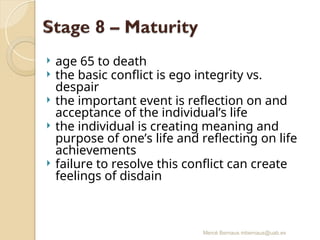
 age 65 to death
 the basic conflict is ego integrity vs.
despair
 the important event is reflection on and
acceptance of the individual’s life
 the individual is creating meaning and
purpose of one’s life and reflecting on life
achievements
 failure to resolve this conflict can create
feelings of disdain
Mercè Bernaus mbernaus@uab.es
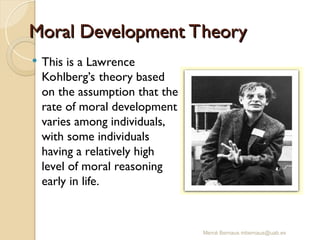
 This is a Lawrence
Kohlberg’s theory based
on the assumption that the
rate of moral development
varies among individuals,
with some individuals
having a relatively high
level of moral reasoning
early in life.
Moral Development Theory
Mercè Bernaus mbernaus@uab.es
 Assessed moral reasoning by posing hypothetical
moral dilemmas and examining the reasoning
behind people’s answers
 Proposed three distinct levels of moral reasoning:
preconventional, conventional, and postconventional
 Each level is based on the degree to which a person
conforms to conventional standards of society
 Each level has two stages that represent different
degrees of sophistication in moral reasoning.
Mercè Bernaus mbernaus@uab.es
 Preconventional—moral reasoning is
based on external rewards and
punishments
 Conventional—laws and rules are
upheld simply because they are laws and
rules
 Postconventional—reasoning based on
personal moral standards
Mercè Bernaus mbernaus@uab.es
 Characterized by the desire to
avoid punishment or gain
reward
 Typically children under the age
of 10
Mercè Bernaus mbernaus@uab.es
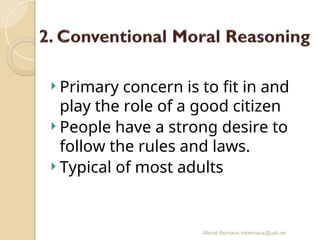
 Primary concern is to fit in and
play the role of a good citizen
 People have a strong desire to
follow the rules and laws.
 Typical of most adults
Mercè Bernaus mbernaus@uab.es
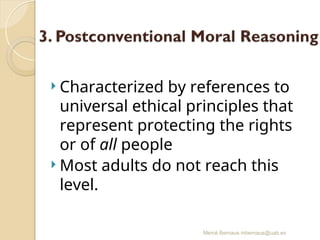
 Characterized by references to
universal ethical principles that
represent protecting the rights
or of all people
 Most adults do not reach this
level.
Mercè Bernaus mbernaus@uab.es
 Stages 1 & 2
Mercè Bernaus mbernaus@uab.es
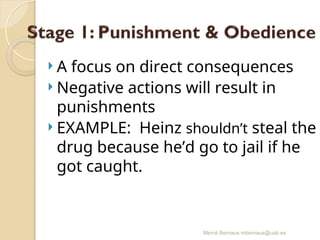
 A focus on direct consequences
 Negative actions will result in
punishments
 EXAMPLE: Heinz shouldn’t steal the
drug because he’d go to jail if he
got caught.
Mercè Bernaus mbernaus@uab.es
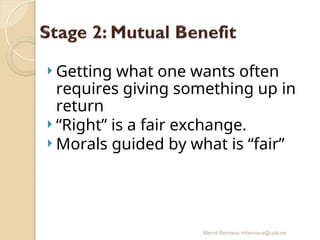
 Getting what one wants often
requires giving something up in
return
 “Right” is a fair exchange.
 Morals guided by what is “fair”
Mercè Bernaus mbernaus@uab.es
 Stages 3 & 4
Mercè Bernaus mbernaus@uab.es
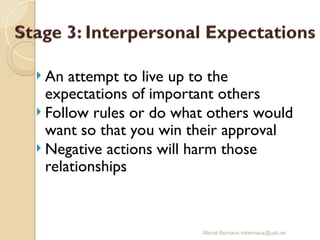
 An attempt to live up to the
expectations of important others
 Follow rules or do what others would
want so that you win their approval
 Negative actions will harm those
relationships
Mercè Bernaus mbernaus@uab.es
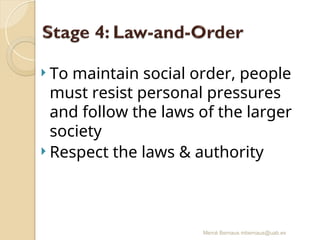
 To maintain social order, people
must resist personal pressures
and follow the laws of the larger
society
 Respect the laws & authority
Mercè Bernaus mbernaus@uab.es
 Stages 5 & 6
Mercè Bernaus mbernaus@uab.es
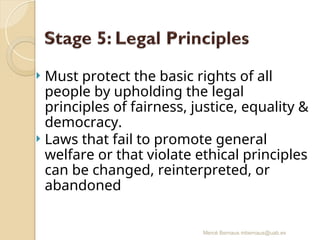
 Must protect the basic rights of all
people by upholding the legal
principles of fairness, justice, equality &
democracy.
 Laws that fail to promote general
welfare or that violate ethical principles
can be changed, reinterpreted, or
abandoned
Mercè Bernaus mbernaus@uab.es
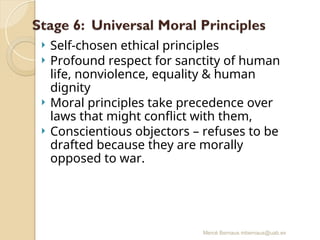
 Self-chosen ethical principles
 Profound respect for sanctity of human
life, nonviolence, equality & human
dignity
 Moral principles take precedence over
laws that might conflict with them,
 Conscientious objectors – refuses to be
drafted because they are morally
opposed to war.
Mercè Bernaus mbernaus@uab.es
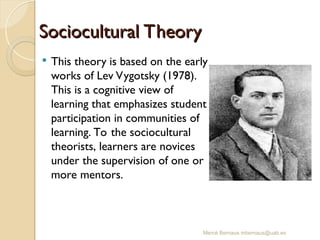
 This theory is based on the early
works of Lev Vygotsky (1978).
This is a cognitive view of
learning that emphasizes student
participation in communities of
learning. To the sociocultural
theorists, learners are novices
under the supervision of one or
more mentors.
Sociocultural Theory
Mercè Bernaus mbernaus@uab.es
 Russian psychologist & philosopher in
1930’s usually associated with Social
Constructivism
 Social Constructivism emphasized the
effects of one’s environment (family,
friends, culture & background) have on
learning
 Today, Co-Constructivism Seems to
prevail, incorporating Cognitive and
Social aspects
Mercè Bernaus mbernaus@uab.es
 This is a cognitive view of knowledge elucidating that that
the information people store in memory consists of a
network of organized and interconnected ideas.
According to this theory, the organized structured and
abstract bodies or info or schemata that a learner brings
to fore in learning new content determine how the
learning tasks are interpreted and what the learner
understands from the study. This theory expounds that
each subset of knowledge is stored in a schema, an
outline or organized network of knowledge about a
single concept or subject.
Schema Theory
Schema Theory
Mercè Bernaus mbernaus@uab.es
David Ausubel’s Meaningful
Verbal Learning/Subsumption
Theory
Theory
Mercè Bernaus mbernaus@uab.es
Ausubel, instead of criticizing the
manner of teaching, proposed ways
of improving it. He suggested the
use of advance organizers.
Mercè Bernaus mbernaus@uab.es
 The most important factor influencing learning
is the quantity, clarity, and organization of the
learner’s present knowledge which consists of
facts, concepts, propositions, theories, etc.
 The way to strengthen the student’s cognitive
structure is by using advance organizers that
allow students to already have a bird’s eye view
or to see the big picture of the topic to be
learned even before going to the details.
Focus of Ausubel’s Theory
Mercè Bernaus mbernaus@uab.es
Ausubel’s theory is concerned with how individuals
learn large amounts of meaningful material from
verbal/ textual (lecture/ books) presentations in a
school setting as opposed to theories developed
based on experimental settings.
Therefore, learning is based upon the kinds of
superordinate, representational, and combinatorial
processes that occur during the presentation of
information.
Mercè Bernaus mbernaus@uab.es
FORCE FIELD
FORCE FIELD
THEORY & Change
THEORY & Change
ThEORY
ThEORY
Kurt Lewin
Mercè Bernaus mbernaus@uab.es
Kurt Lewin (1890-1947)
◦was a famous, charismatic psychologist
who is now viewed as the father of
social psychology. Born in Germany.
◦was well known for his terms “life
space” and “field theory”.
◦A Gestalt psychologist
Kurt Lewin’s Change theory
 Unfreeze – “ready to change”
 When a structure has been in place for a while, habits and routine have
naturally settled in. The organization as a whole is going in the right
direction, but – as shown on the illustration – people or processes may
have strayed off course. For example, tasks that are not relevant or
useful anymore are still being performed by force of habit, without
anyone questioning their legitimacy. Similarly, people might have learned
to do things one way, without considering other, more efficient
methods. Unfreezing means getting people to gain perspective on their
day-to-day activities, unlearn their bad habits, and open up to new ways
of reaching their objectives. Basically, the current practices and
processes have to be reassessed in order for the wheels of change to be
set in motion.
Mercè Bernaus mbernaus@uab.es
Kurt Lewin’s Change theory
 Change – “implementation”
 Once team members have opened up their minds, change
can start. The change process can be a very dynamic one
and, if it is to be effective, it will probably take some time
and involve a transition period. In order to gain efficiency,
people will have to take on new tasks and responsibilities,
which entails a learning curve that will at first slow the
organization down. A change process has to be viewed as an
investment, both in terms of time and the allocation of
resources: after the new organization and processes have
been rolled out, a certain chaos might ensue, but that is the
price to pay in order to attain enhanced effectiveness within
the structure.
Mercè Bernaus mbernaus@uab.es
Kurt Lewin’s Change theory
 Freeze (sometimes called refreeze)- “making
it stick”
 Change will only reach its full effect if it’s made permanent.
Once the organizational changes have been made and the
structure has regained its effectiveness, every effort must be
made to cement them and make sure the new organization
becomes the standard. Further changes will be made down
the line, but once the structure has found a way to improve
the way it conducts its operations, “re-freezing” will give the
people the opportunity to thrive in the new organization and
take full advantage of the change. Many quote the model as
saying the third step of this approach is to re-freeze, when in
Lewins original work it was “freeze”.
Mercè Bernaus mbernaus@uab.es
Field Theory
◦is a psychological theory which
examines patterns of
interaction between the
individual and the total field,
or environment.
Mercè Bernaus mbernaus@uab.es
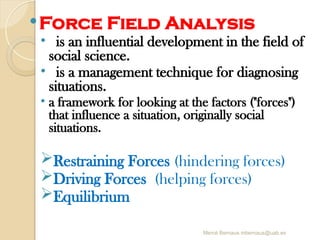
Force Field Analysis
• is an influential development in the field of
social science.
• is a management technique for diagnosing
situations.
• a framework for looking at the factors ("forces")
that influence a situation, originally social
situations.
Restraining Forces (hindering forces)
Driving Forces (helping forces)
Equilibrium
Mercè Bernaus mbernaus@uab.es
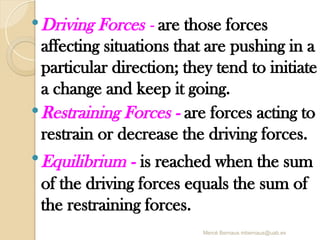
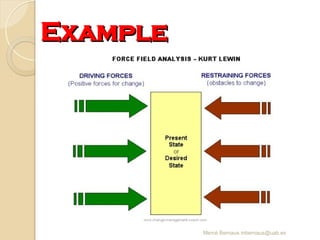
Driving Forces - are those forces
affecting situations that are pushing in a
particular direction; they tend to initiate
a change and keep it going.
Restraining Forces - are forces acting to
restrain or decrease the driving forces.
Equilibrium - is reached when the sum
of the driving forces equals the sum of
the restraining forces.
Mercè Bernaus mbernaus@uab.es
Example
Example
Mercè Bernaus mbernaus@uab.es
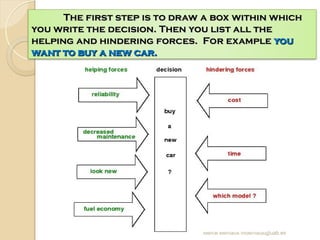
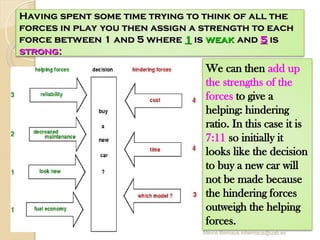
The first step is to draw a box within which
you write the decision. Then you list all the
helping and hindering forces. For example
helping and hindering forces. For example you
you
want to buy a new car.
Mercè Bernaus mbernaus@uab.es
Having spent some time trying to think of all the
forces in play you then assign a strength to each
force between 1 and 5 where
force between 1 and 5 where 1
1 is
is weak
weak and
and 5
5 is
is
strong:
strong:
We can then add up
the strengths of the
forces to give a
helping: hindering
ratio. In this case it is
7:11 so initially it
looks like the decision
to buy a new car will
not be made because
the hindering forces
outweigh the helping
forces.
Mercè Bernaus mbernaus@uab.es
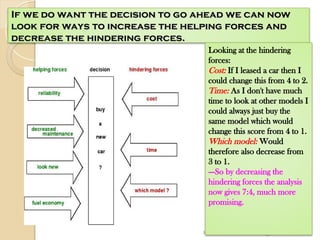
If we do want the decision to go ahead we can now
look for ways to increase the helping forces and
decrease the hindering forces.
Looking at the hindering
forces:
Cost: If I leased a car then I
could change this from 4 to 2.
Time: As I don't have much
time to look at other models I
could always just buy the
same model which would
change this score from 4 to 1.
Which model: Would
therefore also decrease from
3 to 1.
---So by decreasing the
hindering forces the analysis
now gives 7:4, much more
promising.

PROF ED 6 Facilitating-Learner- centered

  • 1.
    FACILITATING LEARNING FACILITATING LEARNING MercèBernaus mbernaus@uab.es January 18, February 01, 08, 2014
  • 2.
    Teaching vs. Facilitating Teachingvs. Facilitating Mercè Bernaus mbernaus@uab.es
  • 3.
    Teaching vs. Facilitating Teachingvs. Facilitating Mercè Bernaus mbernaus@uab.es • A process whereby a teacher leads a group of students in acquiring new skills, knowledge, or understanding. • Helping/making it easy for students to learn together in a group, or to achieve something together as a group.
  • 4.
    Teaching vs. Facilitating Teachingvs. Facilitating Mercè Bernaus mbernaus@uab.es • Most subject area teaching involves telling and teaching the students. Measurable outcome at the end. • Involves helping the students to discover by themselves.
  • 5.
    Which is learner-centered? Whichis learner-centered?  I teach English to my students. Mercè Bernaus mbernaus@uab.es  I teach my students English.
  • 6.
    Content expert Presents information Providesthe right answers Facilitator Guides process Provides the right questions Mercè Bernaus mbernaus@uab.es
  • 7.
    Teacher’s Effective Waysto Facilitat Teacher’s Effective Ways to Facilitate e (feedback) (feedback)  Problem of getting wider understanding that facilitating is learning, despite apparent noise and mess  Motivation for teachers: eg. Need to make daily life enjoyable + rewarding experience for kids and teacher through project based approaches.  Catching up with students knowledge  Preventing tendency of thinking you are an expert (do not be afraid to say I do not know)  If you want to learn something new, teach it.  Find interesting material.  Be a good listener.  Do not be afraid to delegate and empower.  Be aware of needs, understand need  Determine right questions.  Be creative – not stick to strict curriculum.  Reflect and evaluate your performance. Mercè Bernaus mbernaus@uab.es
  • 8.
    Teacher’s Effective Waysto Facilitat Teacher’s Effective Ways to Facilitate e (feedback) (feedback)  Be flexible.  Be creative and up to date.  Use different techniques.  Show students you love them.  Do not repeat the same things year after year (for example, after 20 years of teaching you teach in the same way as your 1st year of teaching).  Do not allow your students to drink from a bottle, let them go to the river.  Offer skills that lead to learning.  Surprise your students.  Do not focus on yourself.  Respect each one of your students. Each one is different and special.  Do not make fun of your students.  Listen actively and comprehensively to your students.  During the transitional period from a teacher to a facilitator, you need to be aware of your techniques so as not to go backward into being a teacher.
  • 9.
    Unforgettable Teachers facilitate… UnforgettableTeachers facilitate…  Value of Learning & Knowledge ◦ Teachers should be enthusiastic about their subject. However, they give more than knowledge. They show how learning enhances creativity. Sparks interest, and uncover talents.  Value of Respect ◦ Teachers treat students with honor. They explain how kind words can prevent hurtful confrontations and turn enemies into friends.  Value of Integrity ◦ They demonstrate empathy. Their ethics inspires students to live with courage, honesty, dignity, and self-worth. Mercè Bernaus mbernaus@uab.es
  • 10.
    Unforgettable Teachers facilitate… UnforgettableTeachers facilitate…  Value of Responsibility ◦ Teachers teach that individuals must be accountable for his/her actions.  Value of Perseverance ◦ Teachers teach that education continues until our last breath. They tell stories about hard times they had faced, and how God had often turned difficulties into blessings. Mercè Bernaus mbernaus@uab.es
  • 11.
    You will bedivided into two groups. You will be divided into two groups. Each group will choose a classroom Each group will choose a classroom scenario and will present ways of scenario and will present ways of how learning could be best how learning could be best facilitated. facilitated. Mercè Bernaus mbernaus@uab.es
  • 12.
    Mercè Bernaus mbernaus@uab.es Learning Learning LEARNING is a mental ability by means of which knowledge, skills, habits, attitudes, and ideals are acquired, retained, and utilized, resulting in the progressive adaptation and modification of conduct and behavior.  It is any change in the behavior of organism.  It is a continuous process.
  • 13.
    Mercè Bernaus mbernaus@uab.es Principles Principles L – learning is an experience which occurs inside the learner; people learn what they what to learn  E – evolutionary and experiential process  A – atmosphere where people are free to explore  R – right to make mistakes ; respect  N – needs based and relevant to the learner  E – emotional and intellectual; people must come before purpose  R – richest resource; learner himself/herself
  • 14.
    Mercè Bernaus mbernaus@uab.es Learning Learning Outcomes (Ends)  List the four primary colors.  Recite the poem , “A Tree”  Draw the parts of the nervous system.  Construct Christmas lantern.  Learning Activities (Means) ◦ Study the four primary colors. ◦ Practice the poem , “A Tree” ◦ Watch film about the nervous system. ◦ Observe how a Christmas lantern is made.
  • 15.
    Mercè Bernaus mbernaus@uab.es Conditionsfor Learning Conditions for Learning  Acceptance  Cooperation, care, concern, change, communication  Trust oneself/others  Ideas  Value for individual differences  Evaluation
  • 16.
    Nature of Learning Natureof Learning  When parents ask their children, “What did you learn in school today, “ the most common replies are “I don’t know” and “Nothing.”  Does this indicate a general weakness of the educational system?  No. it simply indicates that learning often takes place without realizing it. Mercè Bernaus mbernaus@uab.es
  • 17.
    Essential Aspects ofthe Learning Essential Aspects of the Learning Process Process  MOTIVATION  GOAL- Behavior is oriented towards a goal.  READINESS depends on training, experience, and heredity. ◦ Physiological factors- maturation of the sense organs ◦ Psychological factors- motives, emotional factors ◦ Experiential factors- previously learned skills and concepts.  OBSTACLE, or a hindrance challenges the learner.  RESPONSES are actions or behavioral tendencies according to one’s interpretation of a situation  ATTITUDES- are internal states that influence what students are likely to do. This internal state can ne positive or negative, or favorable or unfavorable reaction toward an object, situation, person or the environment. Mercè Bernaus mbernaus@uab.es
  • 18.
    Mercè Bernaus mbernaus@uab.es Whatis your attitude toward… What is your attitude toward… ◦ Learning ◦ School ◦ Math, science, English, and other Subjects ◦ Homework ◦ Classroom rules ◦ Teachers ◦ Examination ◦ Taking responsibility for one’s acts ◦ Relationships ◦ Boys/Girls ◦ Family ◦ Fashion ◦ Love ◦ Money ◦ Sex
  • 19.
    Types of Learning Typesof Learning  Cognitive Learning ◦ It is concerned with the development of ideas.  Affective Learning ◦ Involves assimilation of values, emotional reactions and acquisition of attitudes.  Psychomotor Learning ◦ Understanding of the external world through the senses and muscles. Mercè Bernaus mbernaus@uab.es
  • 20.
    Mercè Bernaus mbernaus@uab.es Goalsof the learning process Goals of the learning process  The successful learner, over time and with support and instructional guidance, can create meaningful, coherent representations of knowledge. ◦ To construct useful representations of knowledge and to acquire the thinking and learning strategies necessary for continued learning success across the life span, students must generate and pursue personally relevant goals.
  • 21.
    Context of Learning Contextof Learning  Learning is influenced by environmental factors, including culture, technology, and instructional practices. ◦ Learning does not occur in a vacuum. Teachers play a major interactive role with both the learner and the learning environment ◦ Technologies and instructional practices must be appropriate for the learner’s level of prior knowledge, cognitive abilities, and their learning and thinking strategies. ◦ The classroom environment has also an impact on student learning.
  • 22.
    Motivational and Emotional Motivationaland Emotional Influences on Learning Influences on Learning  What and how much is learned is influenced by the learner’s motivation. Motivation to learn, in turn, is influenced by the individual’s emotional states, beliefs, interests and goals, and habits of thinking. ◦ Positive emotions such as curiosity, generally enhance motivation and facilitate learning and performance. ◦ Intense negative emotions such as anxiety, rage, insecurity, and related thoughts like fearing punishment, worrying about competence generally detract from motivation, interfere with learning, and contribute to low performance.
  • 23.
    Mercè Bernaus mbernaus@uab.es IntrinsicMotivation to Learn Intrinsic Motivation to Learn  The learner’s creativity, higher order thinking, and natural curiosity all contribute to motivation to learn. Intrinsic motivation is stimulated by tasks of optimal novelty and difficulty, relevant to personal interests, and providing for personal interests, and providing for personal choice and control. ◦ Curiosity, flexible and insightful thinking, and creativity are major indicators of the learner’s intrinsic motivation to learn.
  • 24.
    Mercè Bernaus mbernaus@uab.es Effectsof Motivation on Effort Effects of Motivation on Effort  Acquisition of complex knowledge and skills requires extended learner effort and guided practice. Without learner’s motivation to learn, the willingness to exert this effort is unlikely without coercion. ◦ Effort is another major indicator of motivation to learn.
  • 25.
    Mercè Bernaus mbernaus@uab.es DevelopmentalInfluences on Developmental Influences on Learning Learning  As individuals develop, there are different opportunities and constraints for learning. Learning is most effective when differential development within and across physical, intellectual, emotional, and social domains is taken into account. ◦ Individuals learn best when material is appropriate to their developmental level and is presented in an enjoyable and interesting way.
  • 26.
    Mercè Bernaus mbernaus@uab.es SocialInfluences on Learning Social Influences on Learning  Learning is influenced by social interactions, interpersonal relations, and communication with others. ◦ Learning can be enhanced when the learner has an opportunity to interact and to collaborate with others on instructional tasks. ◦ Quality personal relationships that provide stability, trust, and caring can increase learner’s sense of belonging, self-respect and self acceptance, and provide a positive climate for learning.
  • 27.
    Mercè Bernaus mbernaus@uab.es IndividualDifferences in Learning Individual Differences in Learning  Learners have different strategies, approaches, and capabilities for learning that are a function of prior experience and heredity. ◦ Individuals are born with and develop their own capabilities and talents

  • 28.
    Mercè Bernaus mbernaus@uab.es Learningand Diversity Learning and Diversity  Learning is most effective when differences in learner’s linguistic, cultural, and social backgrounds are taken into account. ◦ When learners perceive that their individual differences in abilities, backgrounds, cultures, and experiences are valued, respected, and accommodated in learning tasks and contexts, levels of motivation and achievement are enhanced.
  • 29.
    When I havefree time I like to When I have free time I like to __________. __________. Mercè Bernaus mbernaus@uab.es
  • 30.
    I think Mathematicsis I think Mathematics is __________. __________. Mercè Bernaus mbernaus@uab.es
  • 31.
    The subject Ilike most is The subject I like most is __________. __________. Mercè Bernaus mbernaus@uab.es
  • 32.
    What I likemost about school is What I like most about school is __________. __________. Mercè Bernaus mbernaus@uab.es
  • 33.
    What I likeleast about school is What I like least about school is __________. __________. Mercè Bernaus mbernaus@uab.es
  • 34.
    Today, I don’twant to see Today, I don’t want to see __________. __________. Mercè Bernaus mbernaus@uab.es
  • 35.
    I think Iam __________. I think I am __________. Mercè Bernaus mbernaus@uab.es
  • 36.
    I believe __________. Ibelieve __________. Mercè Bernaus mbernaus@uab.es
  • 37.
    The LEARNING THEORIES TheLEARNING THEORIES Mercè Bernaus mbernaus@uab.es
  • 38.
    Mercè Bernaus mbernaus@uab.es Dr.Howard Gardner’s Theory of Multiple Intelligences
  • 39.
    Mercè Bernaus mbernaus@uab.es The Theory of Multiple Intelligences was created by Dr. Howard Gardner in 1983.  Gardner’s theory places an emphasis on the idea that the traditional understanding of intelligence by means of IQ testing is far too limited.  To broaden this notion of intelligence, Gardner introduced nine different types of intelligences consisting of (and to be elaborated on later): Logical/Mathematical, Linguistic, Musical, Spatial, Bodily-Kinesthetic, Naturalist, Interpersonal, Intrapersonal, and Existentialist Theory of Multiple Intelligences Theory of Multiple Intelligences
  • 40.
    Mercè Bernaus mbernaus@uab.es Logical-Mathematical (Number/Reasoning Smart): Sensitivity to, and capacity to discern, logical or numerical patterns; ability to handle long chains of reasoning ◦ End States: Scientist, Mathematician  Linguistic (Word Smart): Sensitivity to the sounds, rhythms, and meanings of words; sensitivity to the different functions of language ◦ End States: Poet, Journalist The Nine Intelligences The Nine Intelligences
  • 41.
    Mercè Bernaus mbernaus@uab.es Musical (Music Smart): Abilities to produce and appreciate rhythm, pitch, and timbre; appreciation of the forms of musical expressiveness ◦ End States: Composer, Violinist  Spatial (Picture Smart) : Capacities to perceive the visual-spatial world accurately and to perform transformations on one’s initial perceptions ◦ End States: Navigator, Sculptor The Nine Intelligences The Nine Intelligences
  • 42.
    Mercè Bernaus mbernaus@uab.es Bodily-Kinesthetic (Body Smart): Abilities to control one’s body movements and to handle objects skillfully ◦ End States: Dancer, Athlete  Naturalist (Nature Smart): Abilities to recognize plants and animals, to make distinctions in the natural world, to understand systems and define categories ◦ End States: Botanist, Farmer, Hunter The Nine Intelligences The Nine Intelligences
  • 43.
    Mercè Bernaus mbernaus@uab.es Interpersonal (People Smart): Capacities to discern and respond appropriately to the moods, temperaments, motivations, and desires of other people ◦ End States: Therapist, Salesman  Intrapersonal (Self-Smart): Access to one’s own feelings and the ability to discriminate among them and draw on them to guide behavior ◦ End States: Personal with detailed, accurate self- knowledge The Nine Intelligences The Nine Intelligences
  • 44.
    Mercè Bernaus mbernaus@uab.es Existentialist Intelligence (Role Smart) The Nine Intelligences The Nine Intelligences
  • 45.
    Mercè Bernaus mbernaus@uab.es Dr. Gardner says that our schools and culture focus most of their attention on linguistic and logical-mathematical intelligence, where some unique ways of thinking aren’t addressed.  This often leads to kids being labeled as “learning disabled” or “hyperactive” when they may not be.  The theory of multiple intelligences proposes a major transformation in the way our schools are run. It suggests that teachers be trained to present their lessons in a wide variety of ways using music, cooperative learning, art activities, role play, multimedia, field trips, inner reflection, and much more Applications Applications
  • 46.
    Mercè Bernaus mbernaus@uab.es An awareness of Gardner’s multiple-intelligence theory has provided teachers with the knowledge necessary to satisfy the educational needs of many more students.  With an understanding of Gardner's theory of multiple intelligences, teachers, school administrators, and parents can better understand the different possibilities of each students’ learning preference. The application of of multiple intelligences in the classroom can stimulate a student’s learning in new ways. Conclusion Conclusion
  • 47.
    Mercè Bernaus mbernaus@uab.es  Whatmotivates my students? William Glasser’s William Glasser’s Choice Theory Choice Theory
  • 48.
    Mercè Bernaus mbernaus@uab.es TheBrain Seeks Two Things: The Brain Seeks Two Things:  Emotion This is the “hook” to get students’ attention and peak interest.  Meaning This how the brain can make sense of the information coming in…and anchor it to something it already knows.
  • 49.
    Mercè Bernaus mbernaus@uab.es Information stays in short-term memory only briefly. It moves from short-term to long-term memory only if there a compelling reason to remember the information—a WHY.  More than ninety percent of our reasons for taking action and remembering –the “whys” – occur in the unconscious mind.  The part of the brain that determines what we remember resides in the same area as emotions. Therefore, if the “why” to remember something is linked to emotions, it is more likely to be retained longer than if it is not. ALL LEARNING IS LINKED TO EMOTIONS.
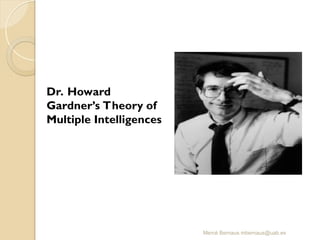
  • 50.
    Mercè Bernaus mbernaus@uab.es Students come to school with their own “whys”—emotional reasons for being there. These “whys” are basic needs to survive, to belong and love, to gain power, to be free, and to have fun.  Students possessing negative attitudes toward learning are limited in their ability to transfer their knowledge to new learning situations.  Teachers can aid students’ desire to learn, affecting their emotions and attitudes, by addressing students’ basic needs through what they say and what they do in the classroom.
  • 51.
    Mercè Bernaus mbernaus@uab.es Weall make choices according to basic needs that come from within ourselves. The needs drive our choices and influence how we behave in those choices.
  • 52.
    Mercè Bernaus mbernaus@uab.es oFun o Freedom o Power o Belonging o Survival
  • 53.
    Mercè Bernaus mbernaus@uab.es The need for pleasure  To play  To laugh  Naturally motivating  No one has to bribe you to do these things Try to imagine life without fun…
  • 54.
    Mercè Bernaus mbernaus@uab.es The need for independence  For autonomy  For control over one’s own life  For choice Some students have had little experience with choice…
  • 55.
    Mercè Bernaus mbernaus@uab.es Empowerment  The need to achieve  To be recognized for achievement/skills  To have a sense of self-worth  To contribute What makes your students feel valued?
  • 56.
    Mercè Bernaus mbernaus@uab.es The need for love  For relationships  Social connection  Part of a group In schools, we must work to make students (parents, teachers) feel they belong…
  • 57.
    Mercè Bernaus mbernaus@uab.es Physiological  The need for food, shelter, safety  Safe from bullying Schools should be a safe environment from bodily harm, mental or physical intimidation, abuse.
  • 58.
    Mercè Bernaus mbernaus@uab.es TheTen Axioms of Choice Theory The Ten Axioms of Choice Theory  The only person whose behavior we can control is our own.  All we can give another person is information.  All long-lasting psychological problems are relationship problems.  The problem relationship is always part of our present life.  What happened in the past has everything to do with what we are today, but we can only satisfy our basic needs right now and plan to continue satisfying them in the future.
  • 59.
    Mercè Bernaus mbernaus@uab.es Cont. Cont. Wecan only satisfy our needs by satisfying the pictures in our Quality World. All we do is behave. All behavior is Total Behavior and is made up of four components: acting, thinking, feeling and physiology. All Total Behavior is chosen, but we only have direct control over the acting and thinking components. We can only control our feeling and physiology indirectly through how we choose to act and think. All Total Behavior is designated by verbs and named by the part that is the most recognizable.
  • 60.
    Mercè Bernaus mbernaus@uab.es Qualityworld Quality world The pictures in our head that we want to experience in our life. Three clusters 1.People that are important to us 2.Experiences – places, activities, things that we want 3.Beliefs and values – what we believe in If something is not in our quality world it is not and will not be important to us.
  • 61.
    Mercè Bernaus mbernaus@uab.es Caranalogy Car analogy  Wheels – front wheels (acting, thinking – more control), back wheels (feeling, physiology - less direct control)  Steering wheel – quality world  Engine – needs (drive behaviour)  Rear view mirror, fuel, passengers,
  • 62.
    Mercè Bernaus mbernaus@uab.es ApplyingIt to the Classroom Applying It to the Classroom  There are two types of teachers, Boss teachers and Lead Teachers  Boss Teachers are those who dwell heavily on rules and consequences. They use rewards and punishment to recognize good and bad before. Children are to be motivated by rewards and avoiding punishment.  Lead Teachers are those who align lessons and assignments with students’ basic need as the main focus. A grading system is in place but is only used as a temporary indicator. They hope students will be engaged, deeply motivated learners, instead of sitting around and doing busy work to meet predetermined assignments.
  • 63.
  • 64.
    Mercè Bernaus mbernaus@uab.es Human nature is basically good, not evil  Normal human development involves the actualization of this inherent goodness
  • 65.
    Mercè Bernaus mbernaus@uab.es Self-Actualization  Esteem  Love  Safety  Physiological
  • 66.
    Mercè Bernaus mbernaus@uab.es Maslow’sHierarchy of Needs Maslow’s Hierarchy of Needs MOST NEEDS HAVE TO DO WITH MOST NEEDS HAVE TO DO WITH SURVIVAL PHYSICALLY AND SURVIVAL PHYSICALLY AND PSYCHOLOGICALLY PSYCHOLOGICALLY PHYSIOLOGICAL OR SURVIVAL NEEDS
  • 67.
    Mercè Bernaus mbernaus@uab.es Maslow’sHierarchy of Needs Maslow’s Hierarchy of Needs PHYSIOLOGICAL OR SURVIVAL NEEDS SAFETY NEEDS ON THE WHOLE AN INDIVIDUAL ON THE WHOLE AN INDIVIDUAL CANNOT SATISFY ANY LEVEL CANNOT SATISFY ANY LEVEL UNLESS NEEDS BELOW ARE UNLESS NEEDS BELOW ARE SATISFIED SATISFIED
  • 68.
    Mercè Bernaus mbernaus@uab.es Maslow’sHierarchy of Needs Maslow’s Hierarchy of Needs PHYSIOLOGICAL OR SURVIVAL NEEDS SAFETY NEEDS LOVE, AFFECTION, AND BELONGINGNESS NEEDS
  • 69.
    Mercè Bernaus mbernaus@uab.es Maslow’sHierarchy of Needs Maslow’s Hierarchy of Needs PHYSIOLOGICAL OR SURVIVAL NEEDS SAFETY NEEDS LOVE, AFFECTION, AND BELONGINGNESS NEEDS ESTEEM NEEDS
  • 70.
    Mercè Bernaus mbernaus@uab.es Maslow’sHierarchy of Needs Maslow’s Hierarchy of Needs MASLOW EMPHASIZES NEED MASLOW EMPHASIZES NEED FOR SELF FOR SELF ACTUALIZATION IS ACTUALIZATION IS A HEALTHY INDIVIDUAL’S A HEALTHY INDIVIDUAL’S PRIME PRIME MOTIVATION MOTIVATION
  • 71.
    Mercè Bernaus mbernaus@uab.es Maslow’sHierarchy of Needs Maslow’s Hierarchy of Needs SELF- SELF- ACTUALIZATION ACTUALIZATION NEED NEED FOR FOR MASLOW EMPHASIZES NEED FOR SELF MASLOW EMPHASIZES NEED FOR SELF ACTUALIZATION IS ACTUALIZATION IS A HEALTHY INDIVIDUAL’S PRIME A HEALTHY INDIVIDUAL’S PRIME MOTIVATION MOTIVATION SELF-ACTUALIZATION MEANS SELF-ACTUALIZATION MEANS ACTUALIZING ACTUALIZING ONE’S POTENTIAL BECOMING ALL ONE IS ONE’S POTENTIAL BECOMING ALL ONE IS CAPABLE OF BECOMING CAPABLE OF BECOMING
  • 72.
    Mercè Bernaus mbernaus@uab.es PHYSIOLOGICALOR SURVIVAL NEEDS SAFETY NEEDS LOVE, AFFECTION, AND BELONGINGNESS NEEDS ESTEEM NEEDS SELF- ACTUALIZATION NEED
  • 73.
    Mercè Bernaus mbernaus@uab.es butwe can nearly all do but we can nearly all do more than we think we more than we think we can can Nobody can do everything, Nobody can do everything,
  • 74.
    Mercè Bernaus mbernaus@uab.es Truth  Goodness  Beauty  Wholeness  Dichotomy-transcendence  Aliveness  Uniqueness  Perfection  Necessity
  • 75.
    Mercè Bernaus mbernaus@uab.es Completion  Justice  Order  Simplicity  Richness  Effortlessness  Playfulness  Self-sufficiency
  • 76.
    Mercè Bernaus mbernaus@uab.es Has no mental illness  Satisfied in basic needs  Fully exploited talents  Motivated by values
  • 77.
  • 78.
    Mercè Bernaus mbernaus@uab.es Taxonomy of Cognitive Objectives  1950s- developed by Benjamin Bloom  Means of expressing qualitatively different kinds of thinking  Adapted for classroom use as a planning tool  Continues to be one of the most universally applied models  Provides a way to organize thinking skills into six levels, from the most basic to the higher order levels of thinking  1990s- Lorin Anderson (former student of Bloom) revisited the taxonomy  As a result, a number of changes were made (Pohl, 2000, Learning to Think, Thinking to Learn, pp. 7-8)
  • 79.
    Mercè Bernaus mbernaus@uab.es Evaluation  Synthesis  Analysis  Application  Comprehension  Knowledge •Creating •Evaluating •Analysing •Applying •Understanding •Remembering
  • 80.
  • 81.
    Mercè Bernaus mbernaus@uab.es COGNITIVEDOMAIN COGNITIVE DOMAIN  The cognitive domain (Bloom, 1956) involves knowledge and the development of intellectual skills. This includes the recall or recognition of specific facts, procedural patterns, and concepts that serve in the development of intellectual abilities and skills.
  • 82.
    Mercè Bernaus mbernaus@uab.es SixMajor Categories Six Major Categories  Knowledge-Recall data or information.  Comprehension-Understand the meaning, translation, interpolation, and interpretation of instructions and problems. State a problem in one's own words.  Application -Use a concept in a new situation or unprompted use of an abstraction. Applies what was learned in the classroom into novel situations in the work place.
  • 83.
    Mercè Bernaus mbernaus@uab.es Analysis -Separates material or concepts into component parts so that its organizational structure may be understood. Distinguishes between facts and inferences.  Synthesis -Builds a structure or pattern from diverse elements. Put parts together to form a whole, with emphasis on creating a new meaning or structure.  Evaluation -Make judgments about the value of ideas or materials.
  • 84.
    Mercè Bernaus mbernaus@uab.es Knowledge Knowledge Examples or Activity: multiple-choice test, recount facts or statistics, recall a process, rules, definitions; quote law or procedure  Keywords: arrange, define, describe, label, list, memorize, recognize, relate, reproduce, select, state
  • 85.
    Mercè Bernaus mbernaus@uab.es Comprehension Comprehension Examples or Activity: explain or interpret meaning from a given scenario or statement, suggest treatment, reaction or solution to given problem, create examples or metaphors  Keywords: explain, reiterate, reword, critique, classify, summarize, illustrate, translate, review, report, discuss, re-write, estimate, interpret, theorize, paraphrase, reference, example
  • 86.
    Mercè Bernaus mbernaus@uab.es Application Application Examples or Activity: put a theory into practical effect, demonstrate, solve a problem, manage an activity  Keywords: use, apply, discover, manage, execute, solve, produce, implement, construct, change, prepare, conduct, perform, react, respond, role-play
  • 87.
    Mercè Bernaus mbernaus@uab.es Analysis Analysis Examples or Activity: identify constituent parts and functions of a process or concept, or de-construct a methodology or process, making qualitative assessment of elements, relationships, values and effects; measure requirements or needs  Keywords: analyze, break down, catalogue, compare, quantify, measure, test, examine, experiment, relate, graph, diagram, plot, extrapolate, value, divide
  • 88.
    Mercè Bernaus mbernaus@uab.es Synthesis Synthesis Examples or Activity: develop plans or procedures, design solutions, integrate methods, resources, ideas, parts; create teams or new approaches, write protocols or contingencies  Keywords: develop, plan, build, create, design, organize, revise, formulate, propose, establish, assemble, integrate, re-arrange, modify
  • 89.
    Mercè Bernaus mbernaus@uab.es Evaluation Evaluation Examples or Activity: review strategic options or plans in terms of efficacy, return on investment or cost-effectiveness, practicability; assess sustainability; perform a SWOT analysis in relation to alternatives; produce a financial justification for a proposition or venture, calculate the effects of a plan or strategy; perform a detailed and costed risk analysis with recommendations and justifications  Keywords: review, justify, assess, present a case for, defend, report on, investigate, direct, appraise, argue, project-manage
  • 90.
    Mercè Bernaus mbernaus@uab.es AFFECTIVEDOMAIN AFFECTIVE DOMAIN  includes the manner in which we deal with things emotionally, such as feelings, values, appreciation, enthusiasms, motivations, and attitudes.
  • 91.
    Mercè Bernaus mbernaus@uab.es Fivemajor Categories Five major Categories  Receiving-Awareness, willingness to hear, selected attention.  Responding- Active participation on the part of the learners. Attends and reacts to a particular phenomenon. Learning outcomes may emphasize compliance in responding, willingness to respond, or satisfaction in responding (motivation).  Valuing-The worth or value a person attaches to a particular object, phenomenon, or behavior. This ranges from simple acceptance to the more complex state of commitment. Valuing is based on the internalization of a set of specified values, while clues to these values are expressed in the learner's overt behavior and are often identifiable.
  • 92.
    Mercè Bernaus mbernaus@uab.es Organizing-Organizes values into priorities by contrasting different values, resolving conflicts between them, and creating an unique value system. The emphasis is on comparing, relating, and synthesizing values.  Characterization or Internalizing-Has a value system that controls their behavior. The behavior is pervasive, consistent, predictable, and most importantly, characteristic of the learner. Instructional objectives are concerned with the student's general patterns of adjustment (personal, social, emotional).
  • 93.
    Mercè Bernaus mbernaus@uab.es Receiving Receiving Examples:Listen to others with respect. Listen for and remember the name of newly introduced people. Key Words: asks, chooses, describes, follows, gives, holds, identifies, locates, names, points to, selects, sits, erects, replies, uses.
  • 94.
    Mercè Bernaus mbernaus@uab.es Responding Responding Examples: Participates in class discussions. Gives a presentation. Questions new ideals, concepts, models, etc. in order to fully understand them. Know the safety rules and practices them.  Key Words: answers, assists, aids, complies, conforms, discusses, greets, helps, labels, performs, practices, presents, reads, recites, reports, selects, tells, writes.
  • 95.
    Mercè Bernaus mbernaus@uab.es Valuing Valuing Examples:Demonstrates belief in the democratic process. Is sensitive towards individual and cultural differences (value diversity). Shows the ability to solve problems. Proposes a plan to social improvement and follows through with commitment. Informs management on matters that one feels strongly about. Key Words: completes, demonstrates, differentiates, explains, follows, forms, initiates, invites, joins, justifies, proposes, reads, reports, selects, shares, studies, works.
  • 96.
    Mercè Bernaus mbernaus@uab.es Organizing Organizing Examples: Recognizes the need for balance between freedom and responsible behavior. Accepts responsibility for one's behavior. Explains the role of systematic planning in solving problems. Accepts professional ethical standards. Creates a life plan in harmony with abilities, interests, and beliefs. Prioritizes time effectively to meet the needs of the organization, family, and self.  Key Words: adheres, alters, arranges, combines, compares, completes, defends, explains, formulates, generalizes, identifies, integrates, modifies, orders, organizes, prepares, relates, synthesizes.
  • 97.
    Mercè Bernaus mbernaus@uab.es Internalizing Internalizing Examples: Shows self-reliance when working independently. Cooperates in group activities (displays teamwork). Uses an objective approach in problem solving. Displays a professional commitment to ethical practice on a daily basis. Revises judgments and changes behavior in light of new evidence. Values people for what they are, not how they look.  Key Words: acts, discriminates, displays, influences, listens, modifies, performs, practices, proposes, qualifies, questions, revises, serves, solves, verifies.
  • 98.
    Mercè Bernaus mbernaus@uab.es PSYCHOMOTORDOMAIN PSYCHOMOTOR DOMAIN  includes physical movement, coordination, and use of the motor-skill areas. Development of these skills requires practice and is measured in terms of speed, precision, distance, procedures, or techniques in execution.
  • 99.
    Mercè Bernaus mbernaus@uab.es Reflexmovements Reflex movements  are actions elicited without learning in response to some stimuli.  Examples include: flexion, extension, stretch, postural adjustments
  • 100.
    Mercè Bernaus mbernaus@uab.es Perceptual Perceptual refers to interpretation of various stimuli that enable one to make adjustments to the environment. Visual, auditory, kinesthetic, or tactile discrimination. Suggests cognitive as well as psychomotor behavior.  Examples include: coordinated movements such as jumping rope, punting, or catching.
  • 101.
    Mercè Bernaus mbernaus@uab.es Physicalactivities Physical activities  require endurance, strength, vigor, and agility which produces a sound, efficiently functioning body.  Examples are: all activities which require a) strenuous effort for long periods of time; b) muscular exertion; c) a quick, wide range of motion at the hip joints; and d) quick, precise movements.
  • 102.
    Mercè Bernaus mbernaus@uab.es Skilledmovements Skilled movements  are the result of the acquisition of a degree of efficiency when performing a complex task.  Examples are: all skilled activities obvious in sports, recreation, and dance.
  • 103.
    Mercè Bernaus mbernaus@uab.es Non-discursivecommunication Non-discursive communication  is communication through bodily movements ranging from facial expressions through sophisticated choreographics.  Examples include: body postures, gestures, and facial expressions efficiently executed in skilled dance movement and choreographics.
  • 104.
  • 105.
    Mercè Bernaus mbernaus@uab.es Albert Bandura’s (1960s +) Social Learning Theory ◦ aka Social Cognitive Theory  Put the “person” back into personality
  • 106.
    Mercè Bernaus mbernaus@uab.es Use strategies to gain the students’ attention.  Ensure that the observation is not too complex.  Link new skills to the student’s prior knowledge  Use practice to ensure long-term retention  Ensure a positive attitude toward a new skill so that the students will be motivated to reproduce or use new behavior Principles of Social Learning Principles of Social Learning
  • 107.
    Mercè Bernaus mbernaus@uab.es Environmental Influences PersonalFactors (beliefs, expectations, self-perceptions) Overt Behavior
  • 108.
    Mercè Bernaus mbernaus@uab.es Bandura’s biggest contribution to learning theory: ◦ New patterns of behavior can be acquired in the absence of external reinforcement ◦ We can pay attention to what others do, and repeat their actions  i.e., We learn through observation, rather than through direct reinforcement
  • 109.
    Mercè Bernaus mbernaus@uab.es We can exercise control over our behavior through self-regulation ◦ We are not slaves to environmental influences ◦ We have free will  Cognition allows us to use previous experiences, rather than trial-and-error, to foresee probable consequences of our acts, and behave accordingly  Self-regulation allows us to choose behaviors that help us to avoid punishments and move towards long-term goals
  • 110.
    Mercè Bernaus mbernaus@uab.es We learn much of what we do through observing and speaking with others (“models”), rather than through personal experience  We form a cognitive image of how to perform certain behaviors through modeling, and use this image as a guide for later behaviors
  • 111.
    Mercè Bernaus mbernaus@uab.es Observationallearning is also known as imitation or modeling. In this process, learning occurs when individuals observes and imitate others’ behavior.
  • 112.
    Mercè Bernaus mbernaus@uab.es Attention Retention Motorreproduction Motivation There are four component processes influenced by the observer’s behavior following exposure to models.
  • 113.
    Mercè Bernaus mbernaus@uab.es Attentionis the first component of observational learning. Individuals cannot learn much by observation unless they perceive and attend to the significant features of the modeled behavior.
  • 114.
    Mercè Bernaus mbernaus@uab.es Retentionis the next component. In order to reproduce the modeled behavior, the individuals must code the information into long- term memory.
  • 115.
    Mercè Bernaus mbernaus@uab.es Motorreproduction is another process in observational learning. The observer must be able to reproduce the model’s behavior. The observer must learn and posses the physical capabilities of the modeled behavior.
  • 116.
    Mercè Bernaus mbernaus@uab.es Motivationor Reinforcements In this process, the observer expects to receive positive reinforcements for the modeled behavior.
  • 117.
    Mercè Bernaus mbernaus@uab.es Environmentalexperience is a second influence of the social learning of violence in children. Albert Bandura reported that individuals that live in high crime rates areas are more likely to act violently than those who dwell in low-crime areas.
  • 118.
    Mercè Bernaus mbernaus@uab.es AlbertBandura believed television was a source of behavior modeling. Since aggression is a prominent feature of many shows, children who have a high degree of exposure to the media may exhibit a relatively high incidence of hostility themselves in imitation of the aggression they have witnessed.
  • 119.
    Mercè Bernaus mbernaus@uab.es Forexample, David Phillips reported homicide rates increase tremendously after a heavy weight championship fight . There have been a number of deaths linked to violence on television.
  • 120.
    Mercè Bernaus mbernaus@uab.es We acquire, maintain, and modify behaviors that we see others perform  We decide which behaviors to keep, and when to use them, by using: ◦ symbolic thought ◦ emotion ◦ self-regulation (“I really want to stab my prof, but I need an A, so…”)  Bandura and other Social Learning Theorists put the “person” back into personality by stressing the interplay of personal factors, environmental factors, and behavior
  • 121.
    Words of Wisdom Wordsof Wisdom A person without a goal, happenstance is his destination. Mercè Bernaus mbernaus@uab.es
  • 122.
    FAST TALK FAST TALK MercèBernaus mbernaus@uab.es
  • 123.
    Would you chooseto be a better Would you choose to be a better husband or a better father? Better husband or a better father? Better wife or a better mother? wife or a better mother? Mercè Bernaus mbernaus@uab.es
  • 124.
    If you wouldtour PNOY around If you would tour PNOY around the country, where would you take the country, where would you take him? Why? him? Why? Mercè Bernaus mbernaus@uab.es
  • 125.
    If women wereto rule the world If women were to rule the world by 2020, how different the world by 2020, how different the world would be? would be? Mercè Bernaus mbernaus@uab.es
  • 126.
    If you couldbring one possession If you could bring one possession with you on a deserted island, with you on a deserted island, what would it be and why? what would it be and why? Mercè Bernaus mbernaus@uab.es
  • 127.
    If you couldbe very famous, in If you could be very famous, in what way would you choose? what way would you choose? Mercè Bernaus mbernaus@uab.es
  • 128.
    What childhood playdo you miss What childhood play do you miss most? Why? most? Why? Mercè Bernaus mbernaus@uab.es
  • 129.
    How do youconsider teaching How do you consider teaching profession- a masculine course profession- a masculine course or feminine course? or feminine course? Mercè Bernaus mbernaus@uab.es
  • 130.
    Does crying makea man less of a Does crying make a man less of a woman? Why? woman? Why? Mercè Bernaus mbernaus@uab.es
  • 131.
    If you wereto be transported to If you were to be transported to live in a new planet, who will be live in a new planet, who will be the three persons you would the three persons you would want to be with you and why? want to be with you and why? Mercè Bernaus mbernaus@uab.es
  • 132.
    What are thethree things you What are the three things you would never do to the person would never do to the person you love? you love? Mercè Bernaus mbernaus@uab.es
  • 133.
  • 134.
    Motivational Factors inLearning Motivational Factors in Learning  MOTIVATION refers to the initiation, direction, intensity, and persistence of human behavior.  REWARD vs REINFORCEMENT  A reward often has the intent of encouraging the behavior to happen again. It can be external or internal.  A reinforcement is intended to create a measured increase in the rate of a desirable behavior following the addition of something to the environment. Mercè Bernaus mbernaus@uab.es
  • 135.
    Other Factors Other Factors COERCION- a form of motivation where the avoidance of pain or other negative consequences has an immediate effect.  SELF-CONTROL is increasingly understood as a subset of emotional intelligence; a person maybe highly intelligent, yet unmotivated to dedicate this intelligence to certain tasks. Mercè Bernaus mbernaus@uab.es
  • 136.
    How do thefollowing motivate How do the following motivate you? you?  ACHIEVEMENT  GOAL  LOVE  FAMILY  FRIENDS  MONEY  RELATIONSHIPS/AFFILIATIONS  WORKPLACE  NEEDS Mercè Bernaus mbernaus@uab.es
  • 137.
    Mercè Bernaus mbernaus@uab.es Studentsand the Need for Differentiated Environments 1. When students see that Effort = Success, they become eager and effective learners 2. When students believe success is due to innate ability, they are afraid to make mistakes 3. When tasks are too easy or too hard, students learn to get by or give up 4. When task is appropriate for student readiness, task becomes satisfying
  • 138.
    Mercè Bernaus mbernaus@uab.es Studentsand the Need for Differentiated Environments Students and the Need for Differentiated Environments 5. When task is too difficult, brain goes into escape (fight or flight) mode 6. When task is too easy, brain goes into relaxation (sleep- like) mode 7. Students function best when the task is slightly difficult for them 8. Matching difficulty level of task to student readiness leads to feelings of student competence – students select more challenging tasks in the future
  • 139.
    Mercè Bernaus mbernaus@uab.es Whena teacher tries to teach something to the entire class at the same time, “chances are, one- third of the kids already know it; one-third will get it; and the remaining third won’t. So two- thirds of the children are wasting their time.” Lilian Katz
  • 140.
    What if youare demotivated? What if you are demotivated? Mercè Bernaus mbernaus@uab.es See JOHN GARDNER’s PERSONAL RENEWAL
  • 141.
    Motivational Theories Motivational Theories DRIVE REDUCTION THEORY grows out of the concept that we have certain biological needs, such as hunger. As time passes, the strength of the drive increases as it is not satisfied. Then as we satisfy the drive by fulfilling its desire, such as eating, the drive’s strength is reduced.  David McClelland’s ACHIEVEMENT MOTIVATION THEORY states that a person needs for three things but people differ in degree in which the various needs influence their behavior: Need for Achievement, Need for Power, Need for Affiliation Mercè Bernaus mbernaus@uab.es
  • 142.
    Motivational Theories Motivational Theories INTEREST THEORY- if a person has a very strong interest in something, then obtaining outcomes in that area will be very strongly reinforcing relative to obtaining outcomes in areas of interest.  Frederick Herzberg’s TWO FACTOR THEORY concludes that factors in the workplace result in job satisfaction, while others do not, but if absent lead to dissatisfaction. ◦ Motivators (challenging work, recognition, responsibility) which give positive satisfaction. ◦ Hygiene Factors (status, job security, salary and benefits) which do not motivate if present, but if absent will result in demotivation. Mercè Bernaus mbernaus@uab.es
  • 143.
  • 144.
    Mercè Bernaus mbernaus@uab.es BurrhusF. Burrhus F. Skinner’s Operant Skinner’s Operant Conditioning Conditioning Theory Theory
  • 145.
    Mercè Bernaus mbernaus@uab.es This theory developed by Burrhus Skinner (1968) refers to learning facilitated through reinforcement and learning that is based upon a pleasure –pain view of human behavior. Operant Conditioning Theory Operant Conditioning Theory
  • 146.
    Mercè Bernaus mbernaus@uab.es B. F. Skinner made the law of effect the cornerstone for his influential theory of learning, called operant conditioning. ◦ According to Skinner, the organism’s behavior is “operating” on the environment to achieve some desired goal.  Operant conditioning: learning in which behavior is strengthened if followed by reinforcement and weakened if followed by punishment
  • 147.
    Mercè Bernaus mbernaus@uab.es Operant Chamber (“Skinner Box”) ◦ soundproof chamber with a bar or key that an animal can manipulate to obtain a food or water reinforcer ◦ contains a device to record responses
  • 148.
  • 149.
    Mercè Bernaus mbernaus@uab.es The fundamental principle of behaviorism is that rewarded behavior is likely to be repeated.  This is known as reinforcement in operant conditioning.  It also states the positive side of Thorndike’s Law of Effect.
  • 150.
  • 151.
    Mercè Bernaus mbernaus@uab.es Structure and feedback in learning – immediate reinforcement  Defined performance goals and immediate reinforcement at work  Parenting – reward good behavior, ignore whining, time-out
  • 152.
    Mercè Bernaus mbernaus@uab.es Thorndike was one of the most important early theorists in animal learning, educational psychology, and behavioral psychology.  Thorndike developed the “law of effect” in 1898, several years earlier than Ivan Pavlov proposed his law’s of reinforcement.  Although the theories are almost identical the two individuals were not aware of each other for many years.
  • 153.
    Mercè Bernaus mbernaus@uab.es two main foci in education were 1) the improvement of classroom instruction and 2) the measurement of the learner and the products of learning.  wrote three books for his own use that became classics in educational psychology 1) Educational Psychology (1903), 2) The Theory of Mental and Social Measurement (1904), and a three volume Educational Psychology (1913).
  • 154.
    Mercè Bernaus mbernaus@uab.es referred to his approach to learning as connectionism, hypothesized that an organism learned about connections between situations and types of responses.  one of the first to hypothesize that “if all of these (responses & situational variables) could be analyzed” man could be told what would and would not satisfy him and annoy him in every conceivable situation.  The law of effect refers to “stamping in or stamping out” a response tendency by attaching favorable or unfavorable consequences.  the law of effect states “any act which in a given situation produces satisfaction becomes associated with that situation, and when the situation reoccurs the act is more likely to reoccur than before”.
  • 155.
    Mercè Bernaus mbernaus@uab.es Ivan Petrovitch Pavlov was born 1849 in Central Russia.  son of a village priest and eldest of 11 children.  initially intended to enter a theological seminary but after reading about Darwinian evolution changed his mind and enrolled at the University of St. Petersburg to study animal physiology.  He obtained his degree in 1875 and began to study medicine in the hopes of becoming a physiologist.  In 1890 he received an appointment as professor of pharmacology at St. Petersburg Military Academy Ivan Pavlov
  • 156.
    Mercè Bernaus mbernaus@uab.es Willthe dog learn to associate the arrival of food with a neutral stimulus (e.g., a bell)?
  • 157.
    Mercè Bernaus mbernaus@uab.es Reinforcer Reinforcer- any event that increases the frequency of the preceding event Positive Reinforcers Positive Reinforcers Introduce (+) stimulus (e.g., food) Negative Reinforcers Negative Reinforcers Remove (-) stimulus (e.g., electric shock) Reinforcers ALWAYS strengthen behavior!
  • 158.
  • 159.
    Mercè Bernaus mbernaus@uab.es Locke’s reflection on knowing starts with the problem of theories ◦ Given two explanations the one that is most likely to be true is the simplest ◦ Is it possible to construct an explanation of knowledge without using the notion of innate ideas  According to Locke, “yes”, is one starts with a simple concept (model) of the mind
  • 160.
    Mercè Bernaus mbernaus@uab.es Imagine the mind like a blank slate on which nothing is written (without any innate ideas) ◦ “Let us suppose the mind to be, as we say, white paper, void of all characters, without any ideas: How comes it to be furnished? To this I answer in one word, from EXPERIENCE.” (John Locke, EHU) The mind is like a blank slate informed only by sense experience and acts of reflection
  • 161.
    Mercè Bernaus mbernaus@uab.es Children show no evidence of innate ideas. They appear to learn their ideas ◦ Copy from adults ◦ Education ◦ Personal experience  If a child were kept in a room with no color would have no idea of color  So by “degrees” their minds are furnished with ideas
  • 162.
    Mercè Bernaus mbernaus@uab.es The senses play a role in knowing by providing data from an “external world” - the “to be known.”  The ‘external world’ (reality) imposes itself on consciousness. However, what is ‘imposed’ (impressed on the mind) are ideas. ◦ As we have noted there is no means to verify the correspondence of idea and reality the idea represents.  The mind actively relates the data together. ◦ So the mind is ACTIVE in acts of knowing.
  • 163.
    Mercè Bernaus mbernaus@uab.es JeanPiaget’s Jean Piaget’s Constructivism & Constructivism & Cognitive Cognitive Development Development Theory Theory
  • 164.
    Mercè Bernaus mbernaus@uab.es In order to understand something, we MUST be able to relate it to something else  If at all possible, APPLY this knowledge during the lesson to foster concrete connections  Differs from traditional view; the mind is a blank tablet
  • 165.
    Mercè Bernaus mbernaus@uab.es 1. Sensory motor stage (birth-2 yrs) -through physical interaction with environment, child develops set of concepts about reality & how it works -stage where child is unaware that if an object is not seen it still exists (object permanence)
  • 166.
    Mercè Bernaus mbernaus@uab.es Child needs concrete physical situations and is unable to conceptualize in the abstract -needs to see, hear, feel in order to understand something
  • 167.
    Mercè Bernaus mbernaus@uab.es Child begins to conceptualize based on physical experiences -creates logical structures to explain his/her environment -abstract problem solving possible Example: math with #’s, not objects
  • 168.
    Mercè Bernaus mbernaus@uab.es Cognitive structures are like an adult and include conceptual reasoning -Piaget classified as a “cognitive constructivist” focusing on processes of the mind and its effects on learning
  • 169.
    Mercè Bernaus mbernaus@uab.es Constructivism is an eclectic view of learning that emphasizes four key components: (a) learners construct their own understanding rather than having it delivered; (b) new learning depends on prior understandings; (c) learning is enhanced by social interaction Constructivism Constructivism
  • 170.
    Mercè Bernaus mbernaus@uab.es An educational theory that places emphasis on the learner  Teacher’s role: Act as a facilitator  Based on the idea that All knowledge is CONSTRUCTED based on previous experiences
  • 171.
    Mercè Bernaus mbernaus@uab.es TwoViews of Constructivism
  • 172.
    Mercè Bernaus mbernaus@uab.es •Individual Contructivism– it emphasizes individual, internal construction of knowledge.
  • 173.
    Mercè Bernaus mbernaus@uab.es •Social Constructivism– it emphasizes that “knowledge exists in a social context and is initially shared with others instead of being represented solely in the mind of an individual.”
  • 174.
  • 175.
    Mercè Bernaus mbernaus@uab.es •Learnersconstruct understanding. •New learning depends on current understanding. •Learning is facilitated by social interaction. •Meaningful learning occurs within authentic learning tasks.
  • 176.
  • 177.
  • 178.
    Mercè Bernaus mbernaus@uab.es 2.Iconic Representation
  • 179.
    Mercè Bernaus mbernaus@uab.es 3.Symbolic Representation
  • 180.
  • 181.
  • 182.
    Mercè Bernaus mbernaus@uab.es Thefive E’s:  Engage- do this! Engage the students and get them interested in learning Ex: ask a question, define a problem, surprise them, use problematic situations
  • 183.
    Mercè Bernaus mbernaus@uab.es Get the students directly involved in the material  Have them work in teams  Act as a facilitator  Use their inquiry to drive the process
  • 184.
    Mercè Bernaus mbernaus@uab.es Explanations come from: -Students working together -Teacher introducing concepts and vocabulary for experiences Example: magnets-attracting force  This is also the time for the teacher to determine levels of understanding and clarify misconceptions  Drawing, writing and video are great tools to help the teacher assess development and growth
  • 185.
    Mercè Bernaus mbernaus@uab.es Students expand on concepts learned  Make connections  Apply understandings to own environment & world around them  These connections lead to further inquiry & new understandings
  • 186.
    Mercè Bernaus mbernaus@uab.es On-going diagnostic process  Can occur at all points of the instructional process -Examples: rubrics, teacher observation, student interviews, portfolios, project & problem based learning products, etc.  Used to guide teacher in further planning of lessons  May also be utilized by the students; Ex: Feedback Fridays
  • 187.
    Mercè Bernaus mbernaus@uab.es Learning is active  Engage the students on their own cognitive level  Make it interesting!  Work in groups  Act as a facilitator, not a record player  Make learning cyclical. They should have more questions when the lesson is over!
  • 188.
    Mercè Bernaus mbernaus@uab.es Learning experiences should be as pleasant and satisfying as possible.  Whenever possible, lessons should take into account the interests and students of students.  The attention of learners can be gained and held longer by using different sensory channels and movement.  Learners can attend for only so long, and they differ in their ability to attend.  Distractions interfere with attention  Learners can attend only to so much info at any one time. Cognitivist Guiding Principles to Gain and Cognitivist Guiding Principles to Gain and Hold Learning Hold Learning
  • 189.
  • 190.
    Mercè Bernaus mbernaus@uab.es Psychosocial development theory is based on eight stages of development  Erikson’s theory is based on the idea that development through life is a series of stages which are each defined by a crisis or challenge  The early stages provide the foundations for later stages so Erikson says that if a child does not resolve a crisis in a particular stage, they will have problems in later stages  For example, if an adolescent does not establish his own identity, he will have difficulty in relationships as an adult
  • 191.
    Mercè Bernaus mbernaus@uab.es Stage 1 – Oral Sensory  Stage 2 – Muscular-Anal  Stage 3 – Locomotor  Stage 4 – Latency  Stage 5 – Adolescence  Stage 6 – Young Adulthood  Stage 7 – Middle Adulthood  Stage 8 – Maturity
  • 192.
    Mercè Bernaus mbernaus@uab.es birth to 1 year (infancy)  basic conflict is trust vs. mistrust  the important event is feeding and the important relationship is with the mother  the infant must develop a loving, trusting relationship with the mother/caregiver through feeding, teething and comforting  failure to resolve this conflict can lead to sensory distortion, and withdrawal
  • 193.
    Mercè Bernaus mbernaus@uab.es age 1 to 3 years (toddler)  Basic conflict is autonomy vs. shame/doubt  The important event is toilet training and the important relationship is with the parents  The child’s energy is directed towards mastering physical skills such as walking, grasping and muscular control  The child learns self control but may develop shame, doubt, impulsivity or compulsion if not handled well
  • 194.
    Mercè Bernaus mbernaus@uab.es age 3 to 6 years (preschool)  basic conflict is initiative vs. guilt  the important event is independence and the important relationship is family  the child continues to become more assertive in exploration, discovery, adventure and play  the child may show too much force in this stage causing feelings of guilt  failure to resolve this conflict can lead to ruthlessness and inhibition
  • 195.
    Mercè Bernaus mbernaus@uab.es age 6 to 12 years (school age)  the basic conflict in this stage is industry vs. inferiority  the important event is school and the important relationships are teachers, friends and neighbourhood  the child must learn to deal with new skills and develop a sense of achievement and accomplishment  failure to do so can create a sense of inferiority, failure and incompetence
  • 196.
    Mercè Bernaus mbernaus@uab.es age 12 to 20 years (adolescent)  the basic conflict is identity vs. role confusion  the important event is development of peer relationships and the important relationships are peers, groups and social influences  The teenager must achieve a sense of identity in occupation, sex roles, politics and religion. In addition, they must resolve their identity and direction.  Failure to make these resolutions can lead to the repression of aspects of the individual for the sake of others (fanaticism)
  • 197.
    Mercè Bernaus mbernaus@uab.es age 20 to 40 years  the basic conflict in young adulthood is intimacy vs. isolation  the important event is parenting and the important relationships are lovers, friends and work connections  in this stage, the individual must develop intimate relationships through work and social life  failure to make such connections can lead to promiscuity, exclusivity and isolation
  • 198.
    Mercè Bernaus mbernaus@uab.es age 40 to 65 years  the basic conflict is generativity vs. stagnation  the important event is parenting and the important relationships are with children and the community  this stage is based on the idea that each adult must find a way to satisfy, support and contribute to the next generation; it is often thought of as giving back  failure to resolve this stage can lead to overextension or rejectivity
  • 199.
    Mercè Bernaus mbernaus@uab.es age 65 to death  the basic conflict is ego integrity vs. despair  the important event is reflection on and acceptance of the individual’s life  the individual is creating meaning and purpose of one’s life and reflecting on life achievements  failure to resolve this conflict can create feelings of disdain
  • 200.
    Mercè Bernaus mbernaus@uab.es This is a Lawrence Kohlberg’s theory based on the assumption that the rate of moral development varies among individuals, with some individuals having a relatively high level of moral reasoning early in life. Moral Development Theory Moral Development Theory
  • 201.
    Mercè Bernaus mbernaus@uab.es Assessed moral reasoning by posing hypothetical moral dilemmas and examining the reasoning behind people’s answers  Proposed three distinct levels of moral reasoning: preconventional, conventional, and postconventional  Each level is based on the degree to which a person conforms to conventional standards of society  Each level has two stages that represent different degrees of sophistication in moral reasoning.
  • 202.
    Mercè Bernaus mbernaus@uab.es Preconventional—moral reasoning is based on external rewards and punishments  Conventional—laws and rules are upheld simply because they are laws and rules  Postconventional—reasoning based on personal moral standards
  • 203.
    Mercè Bernaus mbernaus@uab.es Characterized by the desire to avoid punishment or gain reward  Typically children under the age of 10
  • 204.
    Mercè Bernaus mbernaus@uab.es Primary concern is to fit in and play the role of a good citizen  People have a strong desire to follow the rules and laws.  Typical of most adults
  • 205.
    Mercè Bernaus mbernaus@uab.es Characterized by references to universal ethical principles that represent protecting the rights or of all people  Most adults do not reach this level.
  • 206.
  • 207.
    Mercè Bernaus mbernaus@uab.es A focus on direct consequences  Negative actions will result in punishments  EXAMPLE: Heinz shouldn’t steal the drug because he’d go to jail if he got caught.
  • 208.
    Mercè Bernaus mbernaus@uab.es Getting what one wants often requires giving something up in return  “Right” is a fair exchange.  Morals guided by what is “fair”
  • 209.
  • 210.
    Mercè Bernaus mbernaus@uab.es An attempt to live up to the expectations of important others  Follow rules or do what others would want so that you win their approval  Negative actions will harm those relationships
  • 211.
    Mercè Bernaus mbernaus@uab.es To maintain social order, people must resist personal pressures and follow the laws of the larger society  Respect the laws & authority
  • 212.
  • 213.
    Mercè Bernaus mbernaus@uab.es Must protect the basic rights of all people by upholding the legal principles of fairness, justice, equality & democracy.  Laws that fail to promote general welfare or that violate ethical principles can be changed, reinterpreted, or abandoned
  • 214.
    Mercè Bernaus mbernaus@uab.es Self-chosen ethical principles  Profound respect for sanctity of human life, nonviolence, equality & human dignity  Moral principles take precedence over laws that might conflict with them,  Conscientious objectors – refuses to be drafted because they are morally opposed to war.
  • 215.
    Mercè Bernaus mbernaus@uab.es This theory is based on the early works of Lev Vygotsky (1978). This is a cognitive view of learning that emphasizes student participation in communities of learning. To the sociocultural theorists, learners are novices under the supervision of one or more mentors. Sociocultural Theory Sociocultural Theory
  • 216.
    Mercè Bernaus mbernaus@uab.es Russian psychologist & philosopher in 1930’s usually associated with Social Constructivism  Social Constructivism emphasized the effects of one’s environment (family, friends, culture & background) have on learning  Today, Co-Constructivism Seems to prevail, incorporating Cognitive and Social aspects
  • 217.
    Mercè Bernaus mbernaus@uab.es This is a cognitive view of knowledge elucidating that that the information people store in memory consists of a network of organized and interconnected ideas. According to this theory, the organized structured and abstract bodies or info or schemata that a learner brings to fore in learning new content determine how the learning tasks are interpreted and what the learner understands from the study. This theory expounds that each subset of knowledge is stored in a schema, an outline or organized network of knowledge about a single concept or subject. Schema Theory Schema Theory
  • 218.
    Mercè Bernaus mbernaus@uab.es DavidAusubel’s Meaningful David Ausubel’s Meaningful Verbal Learning/Subsumption Verbal Learning/Subsumption Theory Theory
  • 219.
    Mercè Bernaus mbernaus@uab.es Ausubel,instead of criticizing the Ausubel, instead of criticizing the manner of teaching, proposed ways manner of teaching, proposed ways of improving it. He suggested the of improving it. He suggested the use of advance organizers. use of advance organizers.
  • 220.
    Mercè Bernaus mbernaus@uab.es The most important factor influencing learning is the quantity, clarity, and organization of the learner’s present knowledge which consists of facts, concepts, propositions, theories, etc.  The way to strengthen the student’s cognitive structure is by using advance organizers that allow students to already have a bird’s eye view or to see the big picture of the topic to be learned even before going to the details. Focus of Ausubel’s Theory Focus of Ausubel’s Theory
  • 221.
    Mercè Bernaus mbernaus@uab.es Ausubel’stheory is concerned with how individuals learn large amounts of meaningful material from verbal/ textual (lecture/ books) presentations in a school setting as opposed to theories developed based on experimental settings. Therefore, learning is based upon the kinds of superordinate, representational, and combinatorial processes that occur during the presentation of information.
  • 222.
    Mercè Bernaus mbernaus@uab.es FORCEFIELD FORCE FIELD THEORY & Change THEORY & Change ThEORY ThEORY Kurt Lewin
  • 223.
    Mercè Bernaus mbernaus@uab.es KurtLewin (1890-1947) ◦was a famous, charismatic psychologist who is now viewed as the father of social psychology. Born in Germany. ◦was well known for his terms “life space” and “field theory”. ◦A Gestalt psychologist
  • 224.
    Kurt Lewin’s Changetheory  Unfreeze – “ready to change”  When a structure has been in place for a while, habits and routine have naturally settled in. The organization as a whole is going in the right direction, but – as shown on the illustration – people or processes may have strayed off course. For example, tasks that are not relevant or useful anymore are still being performed by force of habit, without anyone questioning their legitimacy. Similarly, people might have learned to do things one way, without considering other, more efficient methods. Unfreezing means getting people to gain perspective on their day-to-day activities, unlearn their bad habits, and open up to new ways of reaching their objectives. Basically, the current practices and processes have to be reassessed in order for the wheels of change to be set in motion. Mercè Bernaus mbernaus@uab.es
  • 225.
    Kurt Lewin’s Changetheory  Change – “implementation”  Once team members have opened up their minds, change can start. The change process can be a very dynamic one and, if it is to be effective, it will probably take some time and involve a transition period. In order to gain efficiency, people will have to take on new tasks and responsibilities, which entails a learning curve that will at first slow the organization down. A change process has to be viewed as an investment, both in terms of time and the allocation of resources: after the new organization and processes have been rolled out, a certain chaos might ensue, but that is the price to pay in order to attain enhanced effectiveness within the structure. Mercè Bernaus mbernaus@uab.es
  • 226.
    Kurt Lewin’s Changetheory  Freeze (sometimes called refreeze)- “making it stick”  Change will only reach its full effect if it’s made permanent. Once the organizational changes have been made and the structure has regained its effectiveness, every effort must be made to cement them and make sure the new organization becomes the standard. Further changes will be made down the line, but once the structure has found a way to improve the way it conducts its operations, “re-freezing” will give the people the opportunity to thrive in the new organization and take full advantage of the change. Many quote the model as saying the third step of this approach is to re-freeze, when in Lewins original work it was “freeze”. Mercè Bernaus mbernaus@uab.es
  • 227.
    Mercè Bernaus mbernaus@uab.es FieldTheory ◦is a psychological theory which examines patterns of interaction between the individual and the total field, or environment.
  • 228.
    Mercè Bernaus mbernaus@uab.es ForceField Analysis • is an influential development in the field of social science. • is a management technique for diagnosing situations. • a framework for looking at the factors ("forces") that influence a situation, originally social situations. Restraining Forces (hindering forces) Driving Forces (helping forces) Equilibrium
  • 229.
    Mercè Bernaus mbernaus@uab.es DrivingForces - are those forces affecting situations that are pushing in a particular direction; they tend to initiate a change and keep it going. Restraining Forces - are forces acting to restrain or decrease the driving forces. Equilibrium - is reached when the sum of the driving forces equals the sum of the restraining forces.
  • 230.
  • 231.
    Mercè Bernaus mbernaus@uab.es Thefirst step is to draw a box within which The first step is to draw a box within which you write the decision. Then you list all the you write the decision. Then you list all the helping and hindering forces. For example helping and hindering forces. For example you you want to buy a new car. want to buy a new car.
  • 232.
    Mercè Bernaus mbernaus@uab.es Havingspent some time trying to think of all the Having spent some time trying to think of all the forces in play you then assign a strength to each forces in play you then assign a strength to each force between 1 and 5 where force between 1 and 5 where 1 1 is is weak weak and and 5 5 is is strong: strong: We can then add up the strengths of the forces to give a helping: hindering ratio. In this case it is 7:11 so initially it looks like the decision to buy a new car will not be made because the hindering forces outweigh the helping forces.
  • 233.
    Mercè Bernaus mbernaus@uab.es Ifwe do want the decision to go ahead we can now If we do want the decision to go ahead we can now look for ways to increase the helping forces and look for ways to increase the helping forces and decrease the hindering forces. decrease the hindering forces. Looking at the hindering forces: Cost: If I leased a car then I could change this from 4 to 2. Time: As I don't have much time to look at other models I could always just buy the same model which would change this score from 4 to 1. Which model: Would therefore also decrease from 3 to 1. ---So by decreasing the hindering forces the analysis now gives 7:4, much more promising.