Facilitating
Learner-Centered
Teaching
Precious Jessica Z. Calipjo
How do you feel
about taking the
LET?
• Use an emoji and a #hashtag, and a
short explanation for your answer.
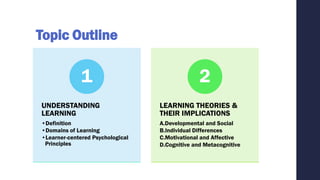
Topic Outline
UNDERSTANDING
LEARNING
•Definition
•Domains of Learning
•Learner-centered Psychological
Principles
1
LEARNING THEORIES &
THEIR IMPLICATIONS
A.Developmental and Social
B.Individual Differences
C.Motivational and Affective
D.Cognitive and Metacognitive
2
What do we mean by the term
“learner-centered”?
The Nature of Learning
• LEARNING
• A change in the behavior of the learner
• Change can be
deliberate or unintentional
for better or for worse
correct or incorrect
conscious or unconscious
1
• Learning is a relatively permanent change
in behavior with behavior both including
observable activity and internal
processes. (Burns, 1995)
• Learning occurs when experience causes
a relatively permanent change in an
individual’s knowledge, behavior, or
potential for behavior. (Woolfolk, 2016)
• Learning is a relatively permanent
influence on behavior, knowledge, and
thinking skills that comes about through
experience. It is a long-term change in
mental representations or associations as
a result of experience. (Santrock, 2012)
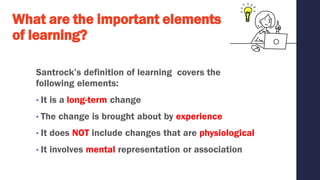
What are the important elements
of learning?
Santrock’s definition of learning covers the
following elements:
• It is a long-term change
• The change is brought about by experience
• It does NOT include changes that are physiological
• It involves mental representation or association
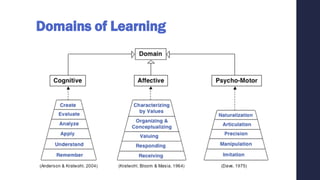
Domains of Learning
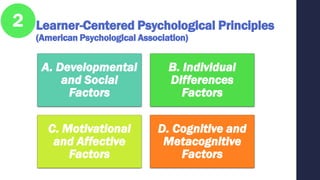
Learner-Centered Psychological Principles
(American Psychological Association)
A. Developmental
and Social
Factors
B. Individual
Differences
Factors
C. Motivational
and Affective
Factors
D. Cognitive and
Metacognitive
Factors
2
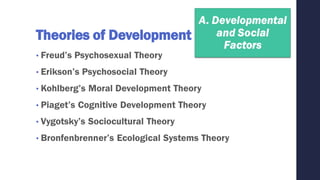
Theories of Development
• Freud’s Psychosexual Theory
• Erikson’s Psychosocial Theory
• Kohlberg’s Moral Development Theory
• Piaget’s Cognitive Development Theory
• Vygotsky’s Sociocultural Theory
• Bronfenbrenner’s Ecological Systems Theory
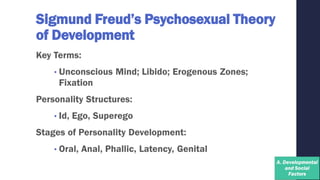
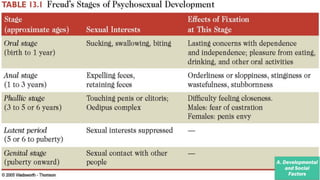
Sigmund Freud’s Psychosexual Theory
of Development
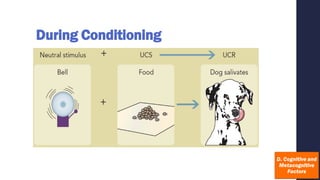
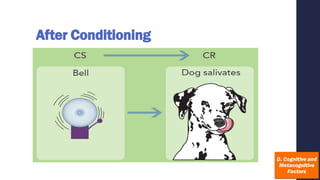
Key Terms:
• Unconscious Mind; Libido; Erogenous Zones;
Fixation
Personality Structures:
• Id, Ego, Superego
Stages of Personality Development:
• Oral, Anal, Phallic, Latency, Genital
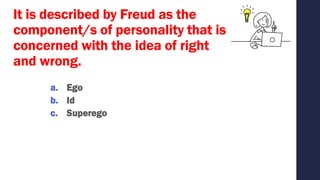
It is described by Freud as the
component/s of personality that is
concerned with the idea of right
and wrong.
a. Ego
b. Id
c. Superego
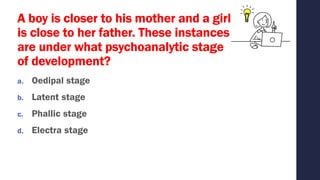
A boy is closer to his mother and a girl
is close to her father. These instances
are under what psychoanalytic stage
of development?
a. Oedipal stage
b. Latent stage
c. Phallic stage
d. Electra stage
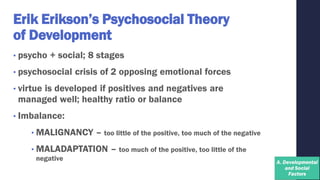
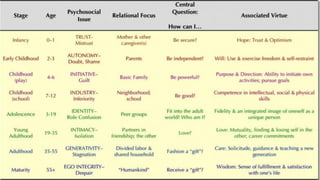
Erik Erikson’s Psychosocial Theory
of Development
• psycho + social; 8 stages
• psychosocial crisis of 2 opposing emotional forces
• virtue is developed if positives and negatives are
managed well; healthy ratio or balance
• Imbalance:
• MALIGNANCY – too little of the positive, too much of the negative
• MALADAPTATION – too much of the positive, too little of the
negative
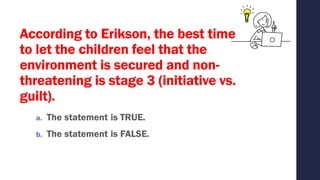
According to Erikson, the best time
to let the children feel that the
environment is secured and non-
threatening is stage 3 (initiative vs.
guilt).
a. The statement is TRUE.
b. The statement is FALSE.
Which stage in Erikson’s theory do
teachers need to provide
teenagers opportunities to develop
a sense of self and individuality?
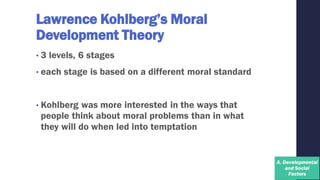
Lawrence Kohlberg’s Moral
Development Theory
• 3 levels, 6 stages
• each stage is based on a different moral standard
• Kohlberg was more interested in the ways that
people think about moral problems than in what
they will do when led into temptation
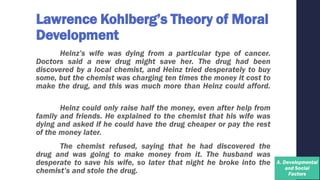
Lawrence Kohlberg’s Theory of Moral
Development
Heinz’s wife was dying from a particular type of cancer.
Doctors said a new drug might save her. The drug had been
discovered by a local chemist, and Heinz tried desperately to buy
some, but the chemist was charging ten times the money it cost to
make the drug, and this was much more than Heinz could afford.
Heinz could only raise half the money, even after help from
family and friends. He explained to the chemist that his wife was
dying and asked if he could have the drug cheaper or pay the rest
of the money later.
The chemist refused, saying that he had discovered the
drug and was going to make money from it. The husband was
desperate to save his wife, so later that night he broke into the
chemist’s and stole the drug.
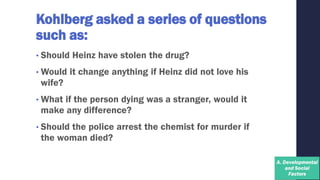
Kohlberg asked a series of questions
such as:
• Should Heinz have stolen the drug?
• Would it change anything if Heinz did not love his
wife?
• What if the person dying was a stranger, would it
make any difference?
• Should the police arrest the chemist for murder if
the woman died?
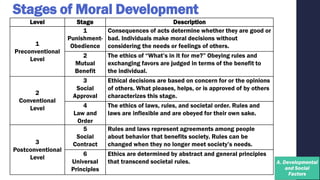
Stages of Moral Development
Level Stage Description
1
Preconventional
Level
1
Punishment-
Obedience
Consequences of acts determine whether they are good or
bad. Individuals make moral decisions without
considering the needs or feelings of others.
2
Mutual
Benefit
The ethics of “What’s in it for me?” Obeying rules and
exchanging favors are judged in terms of the benefit to
the individual.
2
Conventional
Level
3
Social
Approval
Ethical decisions are based on concern for or the opinions
of others. What pleases, helps, or is approved of by others
characterizes this stage.
4
Law and
Order
The ethics of laws, rules, and societal order. Rules and
laws are inflexible and are obeyed for their own sake.
3
Postconventional
Level
5
Social
Contract
Rules and laws represent agreements among people
about behavior that benefits society. Rules can be
changed when they no longer meet society’s needs.
6
Universal
Principles
Ethics are determined by abstract and general principles
that transcend societal rules.
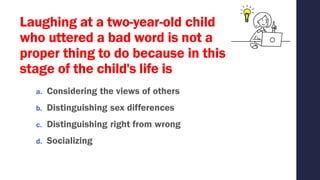
Laughing at a two-year-old child
who uttered a bad word is not a
proper thing to do because in this
stage of the child's life is
a. Considering the views of others
b. Distinguishing sex differences
c. Distinguishing right from wrong
d. Socializing
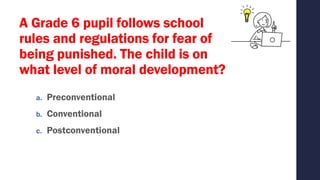
A Grade 6 pupil follows school
rules and regulations for fear of
being punished. The child is on
what level of moral development?
a. Preconventional
b. Conventional
c. Postconventional
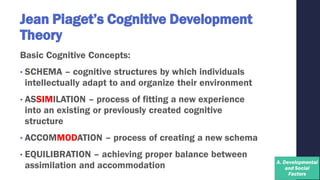
Jean Piaget’s Cognitive Development
Theory
Basic Cognitive Concepts:
• SCHEMA – cognitive structures by which individuals
intellectually adapt to and organize their environment
• ASSIMILATION – process of fitting a new experience
into an existing or previously created cognitive
structure
• ACCOMMODATION – process of creating a new schema
• EQUILIBRATION – achieving proper balance between
assimilation and accommodation
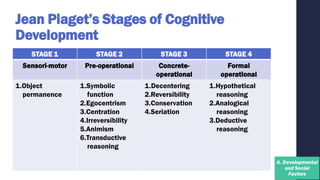
Jean Piaget’s Stages of Cognitive
Development
STAGE 1 STAGE 2 STAGE 3 STAGE 4
Sensori-motor Pre-operational Concrete-
operational
Formal
operational
1.Object
permanence
1.Symbolic
function
2.Egocentrism
3.Centration
4.Irreversibility
5.Animism
6.Transductive
reasoning
1.Decentering
2.Reversibility
3.Conservation
4.Seriation
1.Hypothetical
reasoning
2.Analogical
reasoning
3.Deductive
reasoning
In Piaget’s concrete operational
stage, a teacher should provide
a. activities for evaluation purposes
b. activities for hypothesis formulation
c. stimulating environment with ample objects to
play with
d. activities that involve problems of classification
and order
Lev Vygotsky’s Sociocultural Theory
• Society and culture are important factors for a child to learn
• Language is our main medium for communication (in any
form possible)
• Thought and speech (social, egocentric, inner) are
connected but follows a different path of development
• SCAFFOLDING – appropriate assistance given
• ZONE OF ACTUAL DEVELOPMENT – level of competency
when a child performs alone
• ZONE OF PROXIMAL DEVELOPMENT – difference between
what a child can do alone and what s/he can do with the
help of others
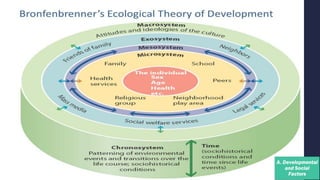
Bronfenbrenner’s Ecological Systems
Theory
• Natural environments are the major source of
influence on developing persons
• Environment/ Context - “a set of nested
structures, each inside the next, like a set of
Russian dolls”
Identify the system emphasized in
the given research findings:
• 1. When peer groups devalue academics, they
often undermine an adolescent’s scholastic
performance, despite the best efforts of parents
and teachers to encourage academic
achievement.
• Steinberg, Dornbusch, & Brown, 1992
• 2. A temperamentally difficult infant can alienate
her parents or even create friction between them
that may be sufficient to damage their marital
relationship.
• Belsky, Rosenberger, & Crnic, 1995
Identify the system emphasized in
the given research findings:
DONE!
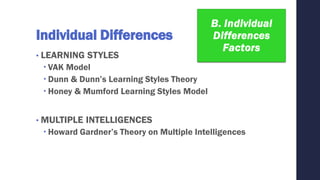
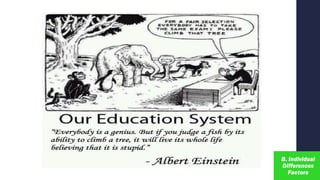
Individual Differences
• LEARNING STYLES
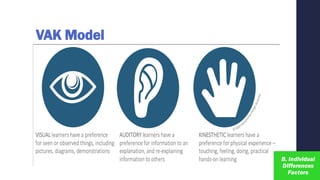
 VAK Model
 Dunn & Dunn’s Learning Styles Theory
 Honey & Mumford Learning Styles Model
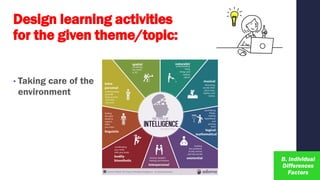
• MULTIPLE INTELLIGENCES
 Howard Gardner’s Theory on Multiple Intelligences
VAK Model
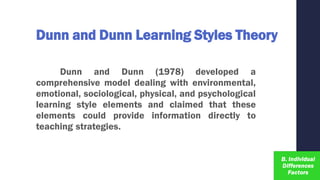
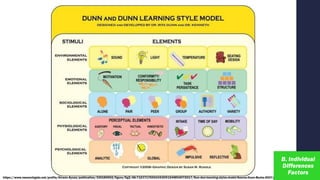
Dunn and Dunn Learning Styles Theory
Dunn and Dunn (1978) developed a
comprehensive model dealing with environmental,
emotional, sociological, physical, and psychological
learning style elements and claimed that these
elements could provide information directly to
teaching strategies.
https://www.researchgate.net/profile/Kivanc-Aycan/publication/330189652/figure/fig2/AS:712371765010432@1546854072017/Dun-dun-learning-styles-model-Source-Dunn-Burke-2007.jpg
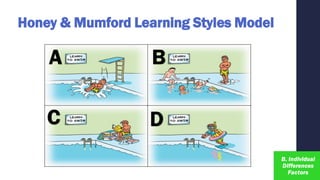
Honey & Mumford Learning Styles Model
A B
C D
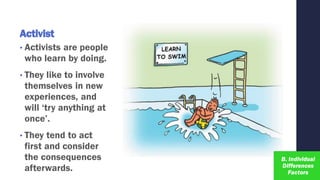
Activist
• Activists are people
who learn by doing.
• They like to involve
themselves in new
experiences, and
will ‘try anything at
once’.
• They tend to act
first and consider
the consequences
afterwards.
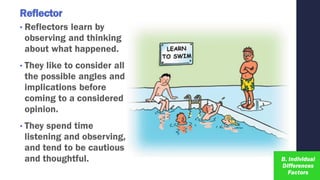
Reflector
• Reflectors learn by
observing and thinking
about what happened.
• They like to consider all
the possible angles and
implications before
coming to a considered
opinion.
• They spend time
listening and observing,
and tend to be cautious
and thoughtful.
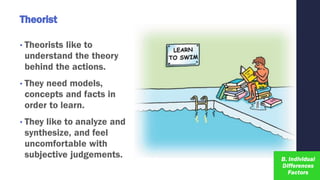
Theorist
• Theorists like to
understand the theory
behind the actions.
• They need models,
concepts and facts in
order to learn.
• They like to analyze and
synthesize, and feel
uncomfortable with
subjective judgements.
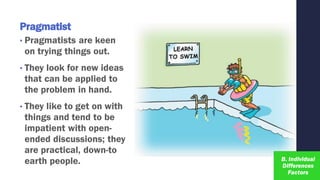
Pragmatist
• Pragmatists are keen
on trying things out.
• They look for new ideas
that can be applied to
the problem in hand.
• They like to get on with
things and tend to be
impatient with open-
ended discussions; they
are practical, down-to
earth people.
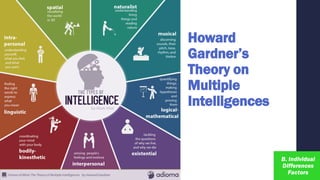
Howard
Gardner’s
Theory on
Multiple
Intelligences
Verbal Linguistic
• enjoy saying, hearing, and seeing words.
• like telling stories.
• motivated by books, records, dramas,
opportunities for writing
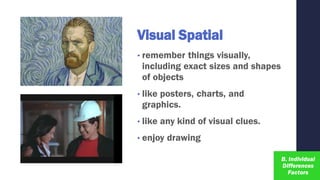
Visual Spatial
• remember things visually,
including exact sizes and shapes
of objects
• like posters, charts, and
graphics.
• like any kind of visual clues.
• enjoy drawing
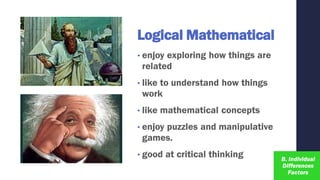
Logical Mathematical
• enjoy exploring how things are
related
• like to understand how things
work
• like mathematical concepts
• enjoy puzzles and manipulative
games.
• good at critical thinking
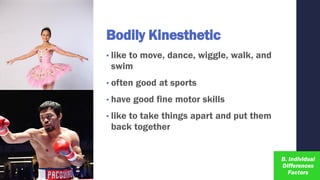
Bodily Kinesthetic
• like to move, dance, wiggle, walk, and
swim
• often good at sports
• have good fine motor skills
• like to take things apart and put them
back together
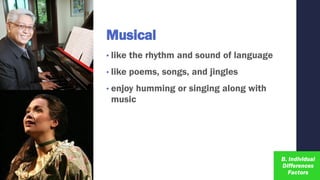
Musical
• like the rhythm and sound of language
• like poems, songs, and jingles
• enjoy humming or singing along with
music
Interpersonal
• like to develop ideas and learn from
other people
• like to talk
• have good social skills
Intrapersonal
• the capacity to understand yourself, who
you are, your limits, wishes, reactions
and interest
• able to hear and understand
himself/herself
• can understand the limits of their own
enthusiasm and they can consider these
limits while directing their own
behaviors
Naturalistic
• enjoy interacting with the outside world
• adept at noticing patterns in nature and
can easily distinguish between different
species of flora and fauna
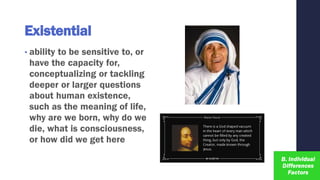
Existential
• ability to be sensitive to, or
have the capacity for,
conceptualizing or tackling
deeper or larger questions
about human existence,
such as the meaning of life,
why are we born, why do we
die, what is consciousness,
or how did we get here
What does this theory on
M.I.s imply?
• Providing students with multiple ways to access
content improves learning (Hattie, 2011).
• Providing students with multiple ways to demonstrate
knowledge and skills increases engagement and
learning, and provides teachers with more accurate
understanding of students' knowledge and skills
(Darling-Hammond, 2010).
• Instruction should be informed as much as possible by
detailed knowledge about students' specific strengths,
needs, and areas for growth (Tomlinson, 2014).
Design learning activities
for the given theme/topic:
• Taking care of the
environment
DONE!
Motivation and Affective
Factors
• Understanding Motivation
• Types of Motivation
• Theories on Motivation
• Maslow’s Hierarchy of Needs
• Attribution Theory
• Self-Efficacy Theory
• Mindset Theory
So ginagawa mo ‘yan because…?
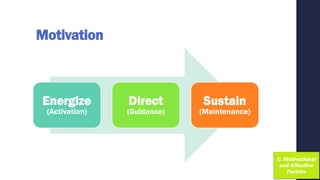
Motivation
Energize
(Activation)
Direct
(Guidance)
Sustain
(Maintenance)
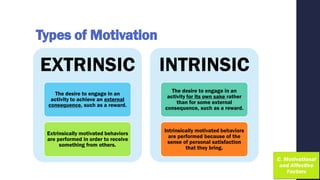
Types of Motivation
EXTRINSIC
The desire to engage in an
activity to achieve an external
consequence, such as a reward.
Extrinsically motivated behaviors
are performed in order to receive
something from others.
INTRINSIC
The desire to engage in an
activity for its own sake rather
than for some external
consequence, such as a reward.
Intrinsically motivated behaviors
are performed because of the
sense of personal satisfaction
that they bring.
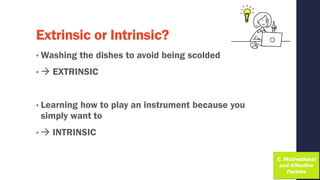
Extrinsic or Intrinsic?
• Washing the dishes to avoid being scolded
• → EXTRINSIC
• Learning how to play an instrument because you
simply want to
• → INTRINSIC
Give other examples of intrinsic or
extrinsic motivation.
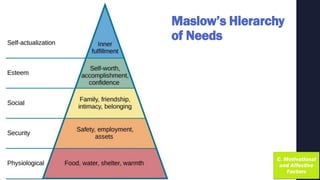
Maslow’s Hierarchy
of Needs
Attribution Theory
WHY DID YOU
SUCCEED?
WHY DID YOU FAIL?
Attribution may or may not reflect the
true state of affairs…
Example:
• Your poor performance on past exams may very well have
been the result of ineffective study strategies; like many
students, you may have tried to learn class material in a
rote, meaningless manner.
• But because you thought of yourself as a smart person
and believed you had studied adequately, perhaps you
instead attributed your low scores to the exceptional
difficulty or “pickiness” of your tests or to arbitrary and
irrational teacher scoring.
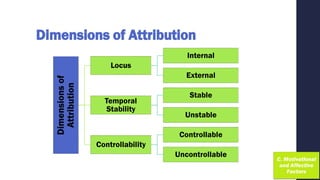
Dimensions of Attribution
Dimensions
of
Attribution
Locus
Internal
External
Temporal
Stability
Stable
Unstable
Controllability
Controllable
Uncontrollable
LOCUS: Internal or External?
• Bumagsak ako sa quiz kasi hindi naman naexplain
nang mabuti ng teacher.
• → EXTERNAL LOCUS
• Bumagsak ako sa quiz kasi di talaga ako nakapag-
review. Naubos ang oras ko sa ML.
• → INTERNAL LOCUS
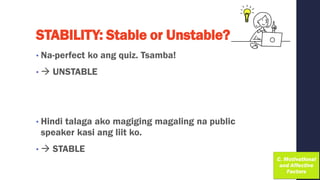
STABILITY: Stable or Unstable?
• Na-perfect ko ang quiz. Tsamba!
• → UNSTABLE
• Hindi talaga ako magiging magaling na public
speaker kasi ang liit ko.
• → STABLE
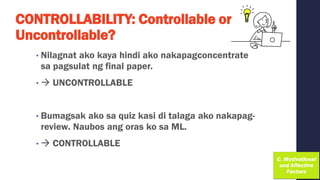
CONTROLLABILITY: Controllable or
Uncontrollable?
• Nilagnat ako kaya hindi ako nakapagconcentrate
sa pagsulat ng final paper.
• → UNCONTROLLABLE
• Bumagsak ako sa quiz kasi di talaga ako nakapag-
review. Naubos ang oras ko sa ML.
• → CONTROLLABLE
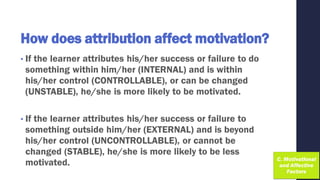
How does attribution affect motivation?
• If the learner attributes his/her success or failure to do
something within him/her (INTERNAL) and is within
his/her control (CONTROLLABLE), or can be changed
(UNSTABLE), he/she is more likely to be motivated.
• If the learner attributes his/her success or failure to
something outside him/her (EXTERNAL) and is beyond
his/her control (UNCONTROLLABLE), or cannot be
changed (STABLE), he/she is more likely to be less
motivated.
Self-Efficacy Theory
• Do you believe that you can do it? Why? Why not?
• The belief that one has the qualities to execute
the courses of action required to manage
prospective situations
• Relates to a person's perception of his ability to
reach a goal while self-esteem relates to person's
sense of self-worth
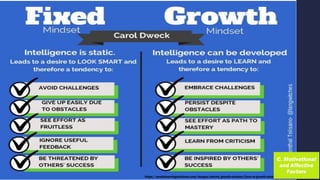
https://austinlearningsolutions.com/images/stories/growth-mindset/fixed-vs-growth-mindset.jpg
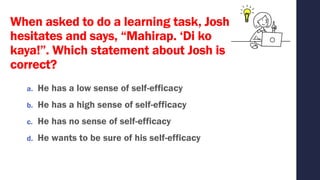
When asked to do a learning task, Josh
hesitates and says, “Mahirap. ‘Di ko
kaya!”. Which statement about Josh is
correct?
a. He has a low sense of self-efficacy
b. He has a high sense of self-efficacy
c. He has no sense of self-efficacy
d. He wants to be sure of his self-efficacy
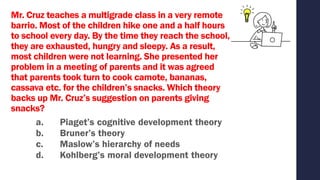
Mr. Cruz teaches a multigrade class in a very remote
barrio. Most of the children hike one and a half hours
to school every day. By the time they reach the school,
they are exhausted, hungry and sleepy. As a result,
most children were not learning. She presented her
problem in a meeting of parents and it was agreed
that parents took turn to cook camote, bananas,
cassava etc. for the children’s snacks. Which theory
backs up Mr. Cruz’s suggestion on parents giving
snacks?
a. Piaget’s cognitive development theory
b. Bruner’s theory
c. Maslow’s hierarchy of needs
d. Kohlberg’s moral development theory
DONE!
• Let’s have a 10-
minute health
break. ☺
Learning Theories
• Behaviorist Theories
• Neobehaviorist Theories
• Cognitive Theories
• Metacognition
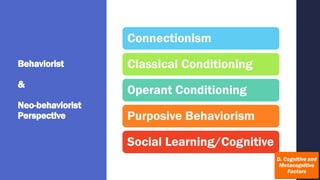
Behaviorist
&
Neo-behaviorist
Perspective
Connectionism
Classical Conditioning
Operant Conditioning
Purposive Behaviorism
Social Learning/Cognitive
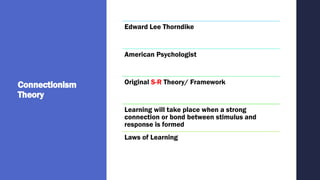
Connectionism
Theory
Edward Lee Thorndike
American Psychologist
Original S-R Theory/ Framework
Learning will take place when a strong
connection or bond between stimulus and
response is formed
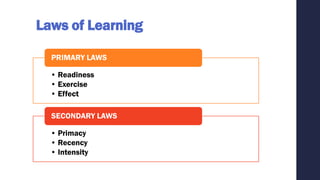
Laws of Learning
Laws of Learning
• Readiness
• Exercise
• Effect
PRIMARY LAWS
• Primacy
• Recency
• Intensity
SECONDARY LAWS
Classical Conditioning Theory
Ivan Pavlov
a type of learning in which an organism learns to
connect, or associate, stimuli so that a neutral
stimulus becomes associated with a meaningful
stimulus and acquires the capacity to elicit a
similar response
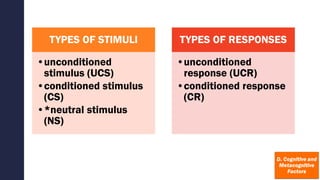
TYPES OF STIMULI
•unconditioned
stimulus (UCS)
•conditioned stimulus
(CS)
•*neutral stimulus
(NS)
TYPES OF RESPONSES
•unconditioned
response (UCR)
•conditioned response
(CR)
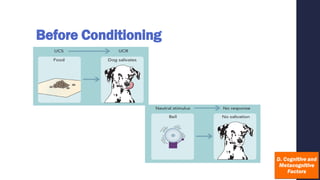
Before Conditioning
During Conditioning
After Conditioning
Other Processes:
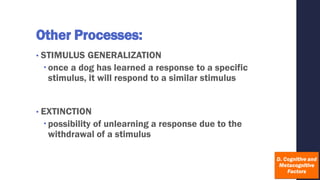
• STIMULUS GENERALIZATION
once a dog has learned a response to a specific
stimulus, it will respond to a similar stimulus
• EXTINCTION
possibility of unlearning a response due to the
withdrawal of a stimulus
Other Processes:
• SPONTANEOUS RECOVERY
possibility of an extinguished response to be
recovered
• DISCRIMINATION
ability to discriminate between similar stimulus
• HIGHER-ORDER CONDITIONING
response to two different stimulus presented
during conditioning
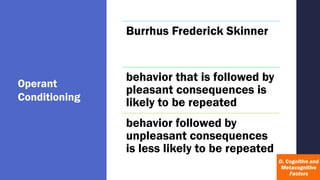
Operant
Conditioning
Burrhus Frederick Skinner
behavior that is followed by
pleasant consequences is
likely to be repeated
behavior followed by
unpleasant consequences
is less likely to be repeated
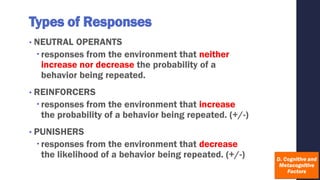
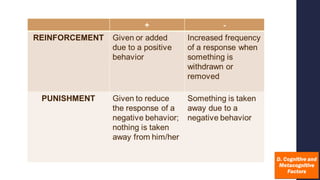
Types of Responses
• NEUTRAL OPERANTS
responses from the environment that neither
increase nor decrease the probability of a
behavior being repeated.
• REINFORCERS
responses from the environment that increase
the probability of a behavior being repeated. (+/-)
• PUNISHERS
responses from the environment that decrease
the likelihood of a behavior being repeated. (+/-)
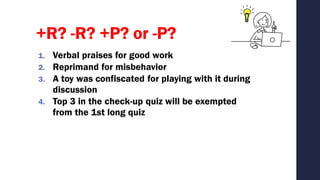
+R? -R? +P? or -P?
1. Verbal praises for good work
2. Reprimand for misbehavior
3. A toy was confiscated for playing with it during
discussion
4. Top 3 in the check-up quiz will be exempted
from the 1st long quiz
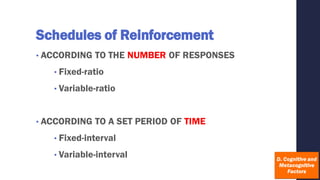
Schedules of Reinforcement
• ACCORDING TO THE NUMBER OF RESPONSES
• Fixed-ratio
• Variable-ratio
• ACCORDING TO A SET PERIOD OF TIME
• Fixed-interval
• Variable-interval
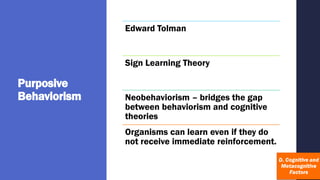
Purposive
Behaviorism
Edward Tolman
Sign Learning Theory
Neobehaviorism – bridges the gap
between behaviorism and cognitive
theories
Organisms can learn even if they do
not receive immediate reinforcement.
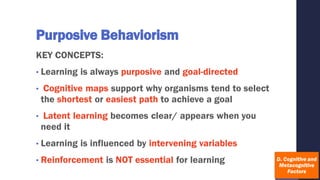
Purposive Behaviorism
KEY CONCEPTS:
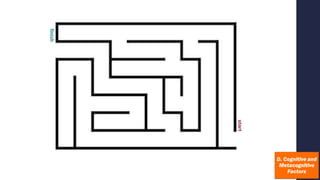
• Learning is always purposive and goal-directed
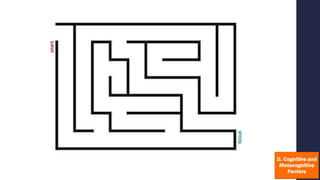
• Cognitive maps support why organisms tend to select
the shortest or easiest path to achieve a goal
• Latent learning becomes clear/ appears when you
need it
• Learning is influenced by intervening variables
• Reinforcement is NOT essential for learning
Social
Learning/
Cognitive
Theory
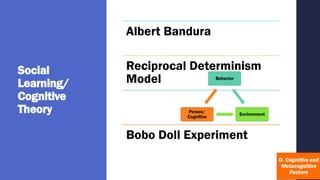
Albert Bandura
Reciprocal Determinism
Model
Bobo Doll Experiment
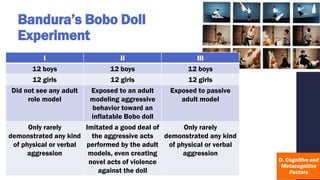
Bandura’s Bobo Doll
Experiment
I II III
12 boys 12 boys 12 boys
12 girls 12 girls 12 girls
Did not see any adult
role model
Exposed to an adult
modeling aggressive
behavior toward an
inflatable Bobo doll
Exposed to passive
adult model
Only rarely
demonstrated any kind
of physical or verbal
aggression
Imitated a good deal of
the aggressive acts
performed by the adult
models, even creating
novel acts of violence
against the doll
Only rarely
demonstrated any kind
of physical or verbal
aggression
OBSERVATIONAL LEARNING
• learning that involves acquiring skills, strategies,
and beliefs by observing others
• involves imitation (but not limited to it)
• modeling
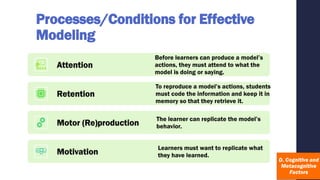
Processes/Conditions for Effective
Modeling
Attention
Before learners can produce a model’s
actions, they must attend to what the
model is doing or saying.
Retention
To reproduce a model’s actions, students
must code the information and keep it in
memory so that they retrieve it.
Motor (Re)production
The learner can replicate the model’s
behavior.
Motivation
Learners must want to replicate what
they have learned.
Strategies for Effectively Using
Observational Learning (Santrock, 2010)
• Think about what type of model you will present to
learners.
• Demonstrate and teach new behaviors.
• Think about ways to use peers as effective models.
• Think about ways that mentors can be used as models.
• Evaluate which classroom guests will provide good
models for students.
• Consider models children observe on television, videos
and computers.
A child treats his friend highly
aggressive. The reason behind this
attitude is his past experiences with his
father who is also highly aggressive.
This demonstrated on what theory?
a. Social learning theory
b. Cognitive developmental theory
c. Operant conditioning
d. Classical conditioning
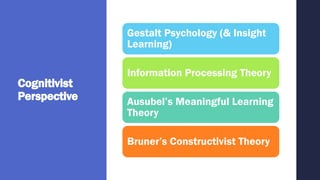
Cognitivist
Perspective
Gestalt Psychology (& Insight
Learning)
Information Processing Theory
Ausubel’s Meaningful Learning
Theory
Bruner’s Constructivist Theory
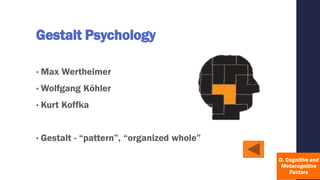
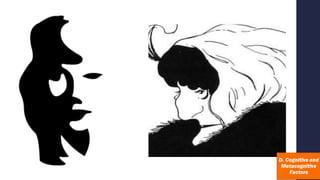
Gestalt Psychology
• Max Wertheimer
• Wolfgang Köhler
• Kurt Koffka
• Gestalt - “pattern”, “organized whole”
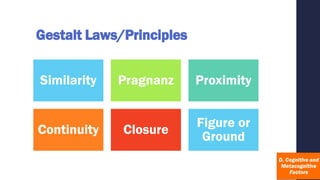
Gestalt Laws/Principles
Similarity Pragnanz Proximity
Continuity Closure
Figure or
Ground
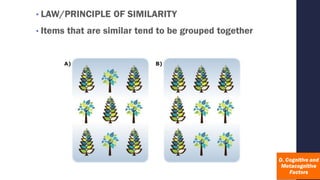
• LAW/PRINCIPLE OF SIMILARITY
• Items that are similar tend to be grouped together
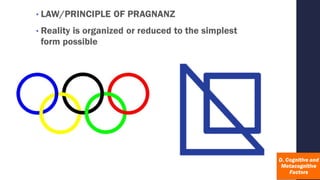
• LAW/PRINCIPLE OF PRAGNANZ
• Reality is organized or reduced to the simplest
form possible
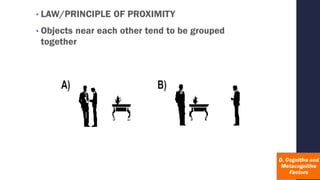
• LAW/PRINCIPLE OF PROXIMITY
• Objects near each other tend to be grouped
together
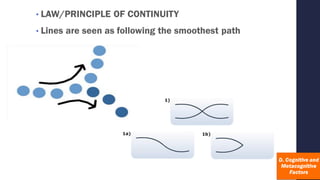
• LAW/PRINCIPLE OF CONTINUITY
• Lines are seen as following the smoothest path
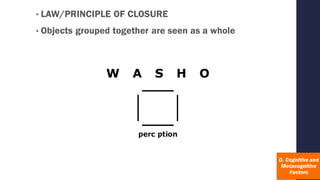
• LAW/PRINCIPLE OF CLOSURE
• Objects grouped together are seen as a whole
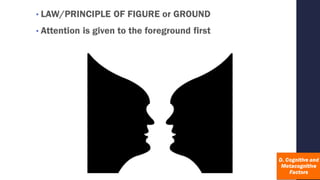
• LAW/PRINCIPLE OF FIGURE or GROUND
• Attention is given to the foreground first
Topics with commonalities are taught next to
each other. What gestalt principle is applied
in this example?
a. Pragnanz
b. Similarity
c. Figure/Ground
d. Closure
a. Closure
b. Similarity
c. Figure/Ground
d. Continuity
The most important words in the paragraph
are written in bolder fonts. What gestalt
principle is applied in this example?
Insight Learning Theory
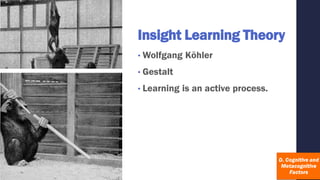
• Wolfgang Köhler
• Gestalt
• Learning is an active process.
• This was a demonstration of Köhler’s dynamic
model of behavior, involving organization within
perception, rather than passive learning through
response to rewards.
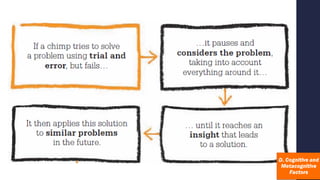
• The pattern (Gestalt) of learning by insight—
failure, pause, perception, insight, and attempt —
is an active one.
Educational Implications of Insight Learning
• We should recognize that people have active minds which
work with the information they receive.
• A rich environment is very important as far as insight
learning is concerned. The environment should be arranged
in a manner that makes insight possible.
• Teachers and guardians should realize that the structure and
organization of the subject matter plays an important part.
• Give problem solving activities. Ask challenging questions.
• Check previous experiences.
• Orient learners with the goal.
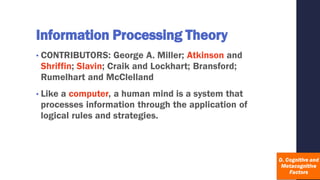
Information Processing Theory
• CONTRIBUTORS: George A. Miller; Atkinson and
Shriffin; Slavin; Craik and Lockhart; Bransford;
Rumelhart and McClelland
• Like a computer, a human mind is a system that
processes information through the application of
logical rules and strategies.
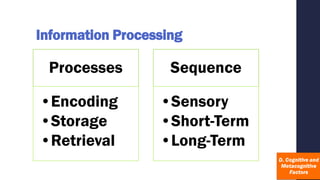
Information Processing
Processes
•Encoding
•Storage
•Retrieval
Sequence
•Sensory
•Short-Term
•Long-Term
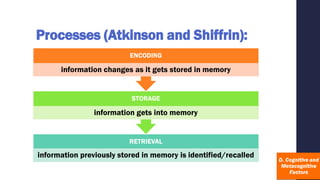
Processes (Atkinson and Shiffrin):
RETRIEVAL
information previously stored in memory is identified/recalled
STORAGE
information gets into memory
ENCODING
information changes as it gets stored in memory
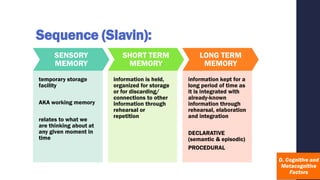
Sequence (Slavin):
SENSORY
MEMORY
temporary storage
facility
AKA working memory
relates to what we
are thinking about at
any given moment in
time
SHORT TERM
MEMORY
information is held,
organized for storage
or for discarding/
connections to other
information through
rehearsal or
repetition
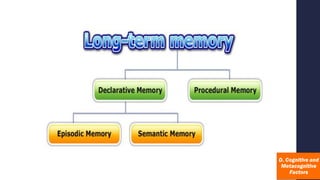
LONG TERM
MEMORY
information kept for a
long period of time as
it is integrated with
already-known
information through
rehearsal, elaboration
and integration
DECLARATIVE
(semantic & episodic)
PROCEDURAL
When you get a new cat, you will note her unique
markings so that you can remember what she looks
like in comparison with other cats in the
neighborhood. What would you call this process of
identifying the distinctive features of your cat?
a. Decoding
b. Storage
c. Encoding
d. Retrieval
To remember the six digits 8, 4, 3, 9, 4, 5, the
Mathematics teacher put them together in twos 84,
39, 45 or in threes 843, 945. This control process of
retaining information is referred to as
a. Rehearsing
b. Inferring
c. Chunking
d. Remembering
Remembering names is usually harder than
remembering facts because names require
___________, while faces require __________.
a. short term memory / long term memory
b. encoding / retrieval
c. declarative memory / procedural memory
d. recall / recognition
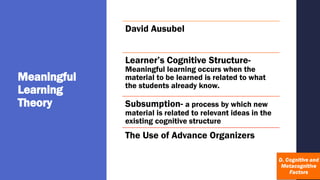
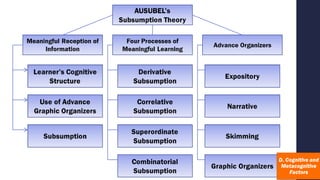
Meaningful
Learning
Theory
David Ausubel
Learner’s Cognitive Structure-
Meaningful learning occurs when the
material to be learned is related to what
the students already know.
Subsumption- a process by which new
material is related to relevant ideas in the
existing cognitive structure
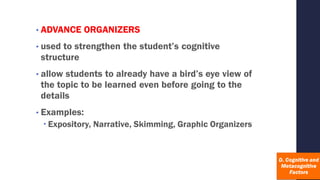
The Use of Advance Organizers
• ADVANCE ORGANIZERS
• used to strengthen the student’s cognitive
structure
• allow students to already have a bird’s eye view of
the topic to be learned even before going to the
details
• Examples:
 Expository, Narrative, Skimming, Graphic Organizers
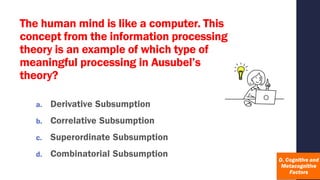
The human mind is like a computer. This
concept from the information processing
theory is an example of which type of
meaningful processing in Ausubel’s
theory?
a. Derivative Subsumption
b. Correlative Subsumption
c. Superordinate Subsumption
d. Combinatorial Subsumption
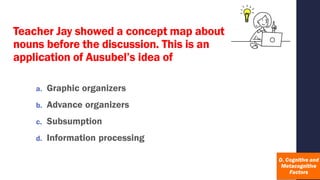
Teacher Jay showed a concept map about
nouns before the discussion. This is an
application of Ausubel’s idea of
a. Graphic organizers
b. Advance organizers
c. Subsumption
d. Information processing
Bruner’s Constructivist Theory
• Levels of Representation
• Enactive
• Iconic
• Symbolic
• Spiral Progression
• Discovery Learning
Transfer of Learning
• The process of applying knowledge or skill previously
learned in one situation to a new different situation
• LATERAL or VERTICAL
• POSITIVE or NEGATIVE
• ZERO
Theories of Transfer
• Formal Discipline
• Identical Elements
• Generalization
• Transposition
Metacognition
• John Flavell (1979, 1987)
• Consists of both metacognitive knowledge and
experiences
• “Thinking about thinking”, “Learning how to learn”
• Three categories
 Person
 Task
 Strategy (meta-attention & meta-memory)
What metacognitive strategies do you
use to:
• … keep your attention focused on studying a
learning material?
• … help you memorize terms/concepts effectively?
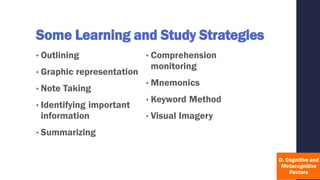
Some Learning and Study Strategies
• Outlining
• Graphic representation
• Note Taking
• Identifying important
information
• Summarizing
• Comprehension
monitoring
• Mnemonics
• Keyword Method
• Visual Imagery
“Creating flash cards to memorize all the
elements in the periodic table helps me a
lot!” The learner who said this
characterizes metacognitive knowledge
on which variable?
a. Person variable
b. Task variable
c. Strategy variable
“I can review my lessons better late at night
and when I am alone.” The learner who said
this characterizes metacognitive knowledge on
which variable?
a. Person variable
b. Task variable
c. Strategy variable
DONE!
Magsipag,
Manalangin,
Manalig!
“The capacity to learn is a gift;
The ability to learn is a skill;
The willingness to learn is a choice.”
-Brian Herbert

513846529-Facilitating-Learner-Centered-Teaching-BASC.pdf

  • 1.
  • 2.
    How do youfeel about taking the LET? • Use an emoji and a #hashtag, and a short explanation for your answer.
  • 3.
    Topic Outline UNDERSTANDING LEARNING •Definition •Domains ofLearning •Learner-centered Psychological Principles 1 LEARNING THEORIES & THEIR IMPLICATIONS A.Developmental and Social B.Individual Differences C.Motivational and Affective D.Cognitive and Metacognitive 2
  • 4.
    What do wemean by the term “learner-centered”?
  • 5.
    The Nature ofLearning • LEARNING • A change in the behavior of the learner • Change can be deliberate or unintentional for better or for worse correct or incorrect conscious or unconscious 1
  • 6.
    • Learning isa relatively permanent change in behavior with behavior both including observable activity and internal processes. (Burns, 1995) • Learning occurs when experience causes a relatively permanent change in an individual’s knowledge, behavior, or potential for behavior. (Woolfolk, 2016) • Learning is a relatively permanent influence on behavior, knowledge, and thinking skills that comes about through experience. It is a long-term change in mental representations or associations as a result of experience. (Santrock, 2012)
  • 7.
    What are theimportant elements of learning? Santrock’s definition of learning covers the following elements: • It is a long-term change • The change is brought about by experience • It does NOT include changes that are physiological • It involves mental representation or association
  • 8.
  • 9.
    Learner-Centered Psychological Principles (AmericanPsychological Association) A. Developmental and Social Factors B. Individual Differences Factors C. Motivational and Affective Factors D. Cognitive and Metacognitive Factors 2
  • 10.
    Theories of Development •Freud’s Psychosexual Theory • Erikson’s Psychosocial Theory • Kohlberg’s Moral Development Theory • Piaget’s Cognitive Development Theory • Vygotsky’s Sociocultural Theory • Bronfenbrenner’s Ecological Systems Theory
  • 11.
    Sigmund Freud’s PsychosexualTheory of Development Key Terms: • Unconscious Mind; Libido; Erogenous Zones; Fixation Personality Structures: • Id, Ego, Superego Stages of Personality Development: • Oral, Anal, Phallic, Latency, Genital
  • 13.
    It is describedby Freud as the component/s of personality that is concerned with the idea of right and wrong. a. Ego b. Id c. Superego
  • 14.
    A boy iscloser to his mother and a girl is close to her father. These instances are under what psychoanalytic stage of development? a. Oedipal stage b. Latent stage c. Phallic stage d. Electra stage
  • 15.
    Erik Erikson’s PsychosocialTheory of Development • psycho + social; 8 stages • psychosocial crisis of 2 opposing emotional forces • virtue is developed if positives and negatives are managed well; healthy ratio or balance • Imbalance: • MALIGNANCY – too little of the positive, too much of the negative • MALADAPTATION – too much of the positive, too little of the negative
  • 17.
    According to Erikson,the best time to let the children feel that the environment is secured and non- threatening is stage 3 (initiative vs. guilt). a. The statement is TRUE. b. The statement is FALSE.
  • 18.
    Which stage inErikson’s theory do teachers need to provide teenagers opportunities to develop a sense of self and individuality?
  • 19.
    Lawrence Kohlberg’s Moral DevelopmentTheory • 3 levels, 6 stages • each stage is based on a different moral standard • Kohlberg was more interested in the ways that people think about moral problems than in what they will do when led into temptation
  • 20.
    Lawrence Kohlberg’s Theoryof Moral Development Heinz’s wife was dying from a particular type of cancer. Doctors said a new drug might save her. The drug had been discovered by a local chemist, and Heinz tried desperately to buy some, but the chemist was charging ten times the money it cost to make the drug, and this was much more than Heinz could afford. Heinz could only raise half the money, even after help from family and friends. He explained to the chemist that his wife was dying and asked if he could have the drug cheaper or pay the rest of the money later. The chemist refused, saying that he had discovered the drug and was going to make money from it. The husband was desperate to save his wife, so later that night he broke into the chemist’s and stole the drug.
  • 21.
    Kohlberg asked aseries of questions such as: • Should Heinz have stolen the drug? • Would it change anything if Heinz did not love his wife? • What if the person dying was a stranger, would it make any difference? • Should the police arrest the chemist for murder if the woman died?
  • 22.
    Stages of MoralDevelopment Level Stage Description 1 Preconventional Level 1 Punishment- Obedience Consequences of acts determine whether they are good or bad. Individuals make moral decisions without considering the needs or feelings of others. 2 Mutual Benefit The ethics of “What’s in it for me?” Obeying rules and exchanging favors are judged in terms of the benefit to the individual. 2 Conventional Level 3 Social Approval Ethical decisions are based on concern for or the opinions of others. What pleases, helps, or is approved of by others characterizes this stage. 4 Law and Order The ethics of laws, rules, and societal order. Rules and laws are inflexible and are obeyed for their own sake. 3 Postconventional Level 5 Social Contract Rules and laws represent agreements among people about behavior that benefits society. Rules can be changed when they no longer meet society’s needs. 6 Universal Principles Ethics are determined by abstract and general principles that transcend societal rules.
  • 23.
    Laughing at atwo-year-old child who uttered a bad word is not a proper thing to do because in this stage of the child's life is a. Considering the views of others b. Distinguishing sex differences c. Distinguishing right from wrong d. Socializing
  • 24.
    A Grade 6pupil follows school rules and regulations for fear of being punished. The child is on what level of moral development? a. Preconventional b. Conventional c. Postconventional
  • 25.
    Jean Piaget’s CognitiveDevelopment Theory Basic Cognitive Concepts: • SCHEMA – cognitive structures by which individuals intellectually adapt to and organize their environment • ASSIMILATION – process of fitting a new experience into an existing or previously created cognitive structure • ACCOMMODATION – process of creating a new schema • EQUILIBRATION – achieving proper balance between assimilation and accommodation
  • 26.
    Jean Piaget’s Stagesof Cognitive Development STAGE 1 STAGE 2 STAGE 3 STAGE 4 Sensori-motor Pre-operational Concrete- operational Formal operational 1.Object permanence 1.Symbolic function 2.Egocentrism 3.Centration 4.Irreversibility 5.Animism 6.Transductive reasoning 1.Decentering 2.Reversibility 3.Conservation 4.Seriation 1.Hypothetical reasoning 2.Analogical reasoning 3.Deductive reasoning
  • 27.
    In Piaget’s concreteoperational stage, a teacher should provide a. activities for evaluation purposes b. activities for hypothesis formulation c. stimulating environment with ample objects to play with d. activities that involve problems of classification and order
  • 28.
    Lev Vygotsky’s SocioculturalTheory • Society and culture are important factors for a child to learn • Language is our main medium for communication (in any form possible) • Thought and speech (social, egocentric, inner) are connected but follows a different path of development • SCAFFOLDING – appropriate assistance given • ZONE OF ACTUAL DEVELOPMENT – level of competency when a child performs alone • ZONE OF PROXIMAL DEVELOPMENT – difference between what a child can do alone and what s/he can do with the help of others
  • 29.
    Bronfenbrenner’s Ecological Systems Theory •Natural environments are the major source of influence on developing persons • Environment/ Context - “a set of nested structures, each inside the next, like a set of Russian dolls”
  • 31.
    Identify the systememphasized in the given research findings: • 1. When peer groups devalue academics, they often undermine an adolescent’s scholastic performance, despite the best efforts of parents and teachers to encourage academic achievement. • Steinberg, Dornbusch, & Brown, 1992
  • 32.
    • 2. Atemperamentally difficult infant can alienate her parents or even create friction between them that may be sufficient to damage their marital relationship. • Belsky, Rosenberger, & Crnic, 1995 Identify the system emphasized in the given research findings:
  • 33.
  • 34.
    Individual Differences • LEARNINGSTYLES  VAK Model  Dunn & Dunn’s Learning Styles Theory  Honey & Mumford Learning Styles Model • MULTIPLE INTELLIGENCES  Howard Gardner’s Theory on Multiple Intelligences
  • 35.
  • 36.
    Dunn and DunnLearning Styles Theory Dunn and Dunn (1978) developed a comprehensive model dealing with environmental, emotional, sociological, physical, and psychological learning style elements and claimed that these elements could provide information directly to teaching strategies.
  • 37.
  • 38.
    Honey & MumfordLearning Styles Model A B C D
  • 39.
    Activist • Activists arepeople who learn by doing. • They like to involve themselves in new experiences, and will ‘try anything at once’. • They tend to act first and consider the consequences afterwards.
  • 40.
    Reflector • Reflectors learnby observing and thinking about what happened. • They like to consider all the possible angles and implications before coming to a considered opinion. • They spend time listening and observing, and tend to be cautious and thoughtful.
  • 41.
    Theorist • Theorists liketo understand the theory behind the actions. • They need models, concepts and facts in order to learn. • They like to analyze and synthesize, and feel uncomfortable with subjective judgements.
  • 42.
    Pragmatist • Pragmatists arekeen on trying things out. • They look for new ideas that can be applied to the problem in hand. • They like to get on with things and tend to be impatient with open- ended discussions; they are practical, down-to earth people.
  • 43.
  • 44.
    Verbal Linguistic • enjoysaying, hearing, and seeing words. • like telling stories. • motivated by books, records, dramas, opportunities for writing
  • 45.
    Visual Spatial • rememberthings visually, including exact sizes and shapes of objects • like posters, charts, and graphics. • like any kind of visual clues. • enjoy drawing
  • 46.
    Logical Mathematical • enjoyexploring how things are related • like to understand how things work • like mathematical concepts • enjoy puzzles and manipulative games. • good at critical thinking
  • 47.
    Bodily Kinesthetic • liketo move, dance, wiggle, walk, and swim • often good at sports • have good fine motor skills • like to take things apart and put them back together
  • 48.
    Musical • like therhythm and sound of language • like poems, songs, and jingles • enjoy humming or singing along with music
  • 49.
    Interpersonal • like todevelop ideas and learn from other people • like to talk • have good social skills
  • 50.
    Intrapersonal • the capacityto understand yourself, who you are, your limits, wishes, reactions and interest • able to hear and understand himself/herself • can understand the limits of their own enthusiasm and they can consider these limits while directing their own behaviors
  • 51.
    Naturalistic • enjoy interactingwith the outside world • adept at noticing patterns in nature and can easily distinguish between different species of flora and fauna
  • 52.
    Existential • ability tobe sensitive to, or have the capacity for, conceptualizing or tackling deeper or larger questions about human existence, such as the meaning of life, why are we born, why do we die, what is consciousness, or how did we get here
  • 53.
    What does thistheory on M.I.s imply? • Providing students with multiple ways to access content improves learning (Hattie, 2011). • Providing students with multiple ways to demonstrate knowledge and skills increases engagement and learning, and provides teachers with more accurate understanding of students' knowledge and skills (Darling-Hammond, 2010). • Instruction should be informed as much as possible by detailed knowledge about students' specific strengths, needs, and areas for growth (Tomlinson, 2014).
  • 54.
    Design learning activities forthe given theme/topic: • Taking care of the environment
  • 56.
  • 57.
    Motivation and Affective Factors •Understanding Motivation • Types of Motivation • Theories on Motivation • Maslow’s Hierarchy of Needs • Attribution Theory • Self-Efficacy Theory • Mindset Theory
  • 58.
    So ginagawa mo‘yan because…?
  • 59.
  • 60.
    Types of Motivation EXTRINSIC Thedesire to engage in an activity to achieve an external consequence, such as a reward. Extrinsically motivated behaviors are performed in order to receive something from others. INTRINSIC The desire to engage in an activity for its own sake rather than for some external consequence, such as a reward. Intrinsically motivated behaviors are performed because of the sense of personal satisfaction that they bring.
  • 61.
    Extrinsic or Intrinsic? •Washing the dishes to avoid being scolded • → EXTRINSIC • Learning how to play an instrument because you simply want to • → INTRINSIC
  • 62.
    Give other examplesof intrinsic or extrinsic motivation.
  • 63.
  • 64.
    Attribution Theory WHY DIDYOU SUCCEED? WHY DID YOU FAIL?
  • 65.
    Attribution may ormay not reflect the true state of affairs… Example: • Your poor performance on past exams may very well have been the result of ineffective study strategies; like many students, you may have tried to learn class material in a rote, meaningless manner. • But because you thought of yourself as a smart person and believed you had studied adequately, perhaps you instead attributed your low scores to the exceptional difficulty or “pickiness” of your tests or to arbitrary and irrational teacher scoring.
  • 66.
  • 67.
    LOCUS: Internal orExternal? • Bumagsak ako sa quiz kasi hindi naman naexplain nang mabuti ng teacher. • → EXTERNAL LOCUS • Bumagsak ako sa quiz kasi di talaga ako nakapag- review. Naubos ang oras ko sa ML. • → INTERNAL LOCUS
  • 68.
    STABILITY: Stable orUnstable? • Na-perfect ko ang quiz. Tsamba! • → UNSTABLE • Hindi talaga ako magiging magaling na public speaker kasi ang liit ko. • → STABLE
  • 69.
    CONTROLLABILITY: Controllable or Uncontrollable? •Nilagnat ako kaya hindi ako nakapagconcentrate sa pagsulat ng final paper. • → UNCONTROLLABLE • Bumagsak ako sa quiz kasi di talaga ako nakapag- review. Naubos ang oras ko sa ML. • → CONTROLLABLE
  • 70.
    How does attributionaffect motivation? • If the learner attributes his/her success or failure to do something within him/her (INTERNAL) and is within his/her control (CONTROLLABLE), or can be changed (UNSTABLE), he/she is more likely to be motivated. • If the learner attributes his/her success or failure to something outside him/her (EXTERNAL) and is beyond his/her control (UNCONTROLLABLE), or cannot be changed (STABLE), he/she is more likely to be less motivated.
  • 71.
    Self-Efficacy Theory • Doyou believe that you can do it? Why? Why not? • The belief that one has the qualities to execute the courses of action required to manage prospective situations • Relates to a person's perception of his ability to reach a goal while self-esteem relates to person's sense of self-worth
  • 73.
  • 74.
    When asked todo a learning task, Josh hesitates and says, “Mahirap. ‘Di ko kaya!”. Which statement about Josh is correct? a. He has a low sense of self-efficacy b. He has a high sense of self-efficacy c. He has no sense of self-efficacy d. He wants to be sure of his self-efficacy
  • 75.
    Mr. Cruz teachesa multigrade class in a very remote barrio. Most of the children hike one and a half hours to school every day. By the time they reach the school, they are exhausted, hungry and sleepy. As a result, most children were not learning. She presented her problem in a meeting of parents and it was agreed that parents took turn to cook camote, bananas, cassava etc. for the children’s snacks. Which theory backs up Mr. Cruz’s suggestion on parents giving snacks? a. Piaget’s cognitive development theory b. Bruner’s theory c. Maslow’s hierarchy of needs d. Kohlberg’s moral development theory
  • 76.
  • 77.
    • Let’s havea 10- minute health break. ☺
  • 78.
    Learning Theories • BehavioristTheories • Neobehaviorist Theories • Cognitive Theories • Metacognition
  • 79.
  • 80.
    Connectionism Theory Edward Lee Thorndike AmericanPsychologist Original S-R Theory/ Framework Learning will take place when a strong connection or bond between stimulus and response is formed Laws of Learning
  • 81.
    Laws of Learning •Readiness • Exercise • Effect PRIMARY LAWS • Primacy • Recency • Intensity SECONDARY LAWS
  • 82.
    Classical Conditioning Theory IvanPavlov a type of learning in which an organism learns to connect, or associate, stimuli so that a neutral stimulus becomes associated with a meaningful stimulus and acquires the capacity to elicit a similar response
  • 83.
    TYPES OF STIMULI •unconditioned stimulus(UCS) •conditioned stimulus (CS) •*neutral stimulus (NS) TYPES OF RESPONSES •unconditioned response (UCR) •conditioned response (CR)
  • 84.
  • 85.
  • 86.
  • 87.
    Other Processes: • STIMULUSGENERALIZATION once a dog has learned a response to a specific stimulus, it will respond to a similar stimulus • EXTINCTION possibility of unlearning a response due to the withdrawal of a stimulus
  • 88.
    Other Processes: • SPONTANEOUSRECOVERY possibility of an extinguished response to be recovered • DISCRIMINATION ability to discriminate between similar stimulus • HIGHER-ORDER CONDITIONING response to two different stimulus presented during conditioning
  • 89.
    Operant Conditioning Burrhus Frederick Skinner behaviorthat is followed by pleasant consequences is likely to be repeated behavior followed by unpleasant consequences is less likely to be repeated
  • 90.
    Types of Responses •NEUTRAL OPERANTS responses from the environment that neither increase nor decrease the probability of a behavior being repeated. • REINFORCERS responses from the environment that increase the probability of a behavior being repeated. (+/-) • PUNISHERS responses from the environment that decrease the likelihood of a behavior being repeated. (+/-)
  • 92.
    +R? -R? +P?or -P? 1. Verbal praises for good work 2. Reprimand for misbehavior 3. A toy was confiscated for playing with it during discussion 4. Top 3 in the check-up quiz will be exempted from the 1st long quiz
  • 93.
    Schedules of Reinforcement •ACCORDING TO THE NUMBER OF RESPONSES • Fixed-ratio • Variable-ratio • ACCORDING TO A SET PERIOD OF TIME • Fixed-interval • Variable-interval
  • 96.
    Purposive Behaviorism Edward Tolman Sign LearningTheory Neobehaviorism – bridges the gap between behaviorism and cognitive theories Organisms can learn even if they do not receive immediate reinforcement.
  • 97.
    Purposive Behaviorism KEY CONCEPTS: •Learning is always purposive and goal-directed • Cognitive maps support why organisms tend to select the shortest or easiest path to achieve a goal • Latent learning becomes clear/ appears when you need it • Learning is influenced by intervening variables • Reinforcement is NOT essential for learning
  • 98.
  • 99.
    Bandura’s Bobo Doll Experiment III III 12 boys 12 boys 12 boys 12 girls 12 girls 12 girls Did not see any adult role model Exposed to an adult modeling aggressive behavior toward an inflatable Bobo doll Exposed to passive adult model Only rarely demonstrated any kind of physical or verbal aggression Imitated a good deal of the aggressive acts performed by the adult models, even creating novel acts of violence against the doll Only rarely demonstrated any kind of physical or verbal aggression
  • 100.
    OBSERVATIONAL LEARNING • learningthat involves acquiring skills, strategies, and beliefs by observing others • involves imitation (but not limited to it) • modeling
  • 101.
    Processes/Conditions for Effective Modeling Attention Beforelearners can produce a model’s actions, they must attend to what the model is doing or saying. Retention To reproduce a model’s actions, students must code the information and keep it in memory so that they retrieve it. Motor (Re)production The learner can replicate the model’s behavior. Motivation Learners must want to replicate what they have learned.
  • 102.
    Strategies for EffectivelyUsing Observational Learning (Santrock, 2010) • Think about what type of model you will present to learners. • Demonstrate and teach new behaviors. • Think about ways to use peers as effective models. • Think about ways that mentors can be used as models. • Evaluate which classroom guests will provide good models for students. • Consider models children observe on television, videos and computers.
  • 103.
    A child treatshis friend highly aggressive. The reason behind this attitude is his past experiences with his father who is also highly aggressive. This demonstrated on what theory? a. Social learning theory b. Cognitive developmental theory c. Operant conditioning d. Classical conditioning
  • 104.
    Cognitivist Perspective Gestalt Psychology (&Insight Learning) Information Processing Theory Ausubel’s Meaningful Learning Theory Bruner’s Constructivist Theory
  • 105.
    Gestalt Psychology • MaxWertheimer • Wolfgang Köhler • Kurt Koffka • Gestalt - “pattern”, “organized whole”
  • 108.
    Gestalt Laws/Principles Similarity PragnanzProximity Continuity Closure Figure or Ground
  • 109.
    • LAW/PRINCIPLE OFSIMILARITY • Items that are similar tend to be grouped together
  • 110.
    • LAW/PRINCIPLE OFPRAGNANZ • Reality is organized or reduced to the simplest form possible
  • 111.
    • LAW/PRINCIPLE OFPROXIMITY • Objects near each other tend to be grouped together
  • 112.
    • LAW/PRINCIPLE OFCONTINUITY • Lines are seen as following the smoothest path
  • 113.
    • LAW/PRINCIPLE OFCLOSURE • Objects grouped together are seen as a whole
  • 114.
    • LAW/PRINCIPLE OFFIGURE or GROUND • Attention is given to the foreground first
  • 116.
    Topics with commonalitiesare taught next to each other. What gestalt principle is applied in this example? a. Pragnanz b. Similarity c. Figure/Ground d. Closure
  • 117.
    a. Closure b. Similarity c.Figure/Ground d. Continuity The most important words in the paragraph are written in bolder fonts. What gestalt principle is applied in this example?
  • 118.
    Insight Learning Theory •Wolfgang Köhler • Gestalt • Learning is an active process.
  • 121.
    • This wasa demonstration of Köhler’s dynamic model of behavior, involving organization within perception, rather than passive learning through response to rewards. • The pattern (Gestalt) of learning by insight— failure, pause, perception, insight, and attempt — is an active one.
  • 122.
    Educational Implications ofInsight Learning • We should recognize that people have active minds which work with the information they receive. • A rich environment is very important as far as insight learning is concerned. The environment should be arranged in a manner that makes insight possible. • Teachers and guardians should realize that the structure and organization of the subject matter plays an important part. • Give problem solving activities. Ask challenging questions. • Check previous experiences. • Orient learners with the goal.
  • 123.
    Information Processing Theory •CONTRIBUTORS: George A. Miller; Atkinson and Shriffin; Slavin; Craik and Lockhart; Bransford; Rumelhart and McClelland • Like a computer, a human mind is a system that processes information through the application of logical rules and strategies.
  • 124.
  • 125.
    Processes (Atkinson andShiffrin): RETRIEVAL information previously stored in memory is identified/recalled STORAGE information gets into memory ENCODING information changes as it gets stored in memory
  • 126.
    Sequence (Slavin): SENSORY MEMORY temporary storage facility AKAworking memory relates to what we are thinking about at any given moment in time SHORT TERM MEMORY information is held, organized for storage or for discarding/ connections to other information through rehearsal or repetition LONG TERM MEMORY information kept for a long period of time as it is integrated with already-known information through rehearsal, elaboration and integration DECLARATIVE (semantic & episodic) PROCEDURAL
  • 128.
    When you geta new cat, you will note her unique markings so that you can remember what she looks like in comparison with other cats in the neighborhood. What would you call this process of identifying the distinctive features of your cat? a. Decoding b. Storage c. Encoding d. Retrieval
  • 129.
    To remember thesix digits 8, 4, 3, 9, 4, 5, the Mathematics teacher put them together in twos 84, 39, 45 or in threes 843, 945. This control process of retaining information is referred to as a. Rehearsing b. Inferring c. Chunking d. Remembering
  • 130.
    Remembering names isusually harder than remembering facts because names require ___________, while faces require __________. a. short term memory / long term memory b. encoding / retrieval c. declarative memory / procedural memory d. recall / recognition
  • 131.
    Meaningful Learning Theory David Ausubel Learner’s CognitiveStructure- Meaningful learning occurs when the material to be learned is related to what the students already know. Subsumption- a process by which new material is related to relevant ideas in the existing cognitive structure The Use of Advance Organizers
  • 133.
    • ADVANCE ORGANIZERS •used to strengthen the student’s cognitive structure • allow students to already have a bird’s eye view of the topic to be learned even before going to the details • Examples:  Expository, Narrative, Skimming, Graphic Organizers
  • 134.
    The human mindis like a computer. This concept from the information processing theory is an example of which type of meaningful processing in Ausubel’s theory? a. Derivative Subsumption b. Correlative Subsumption c. Superordinate Subsumption d. Combinatorial Subsumption
  • 135.
    Teacher Jay showeda concept map about nouns before the discussion. This is an application of Ausubel’s idea of a. Graphic organizers b. Advance organizers c. Subsumption d. Information processing
  • 136.
    Bruner’s Constructivist Theory •Levels of Representation • Enactive • Iconic • Symbolic • Spiral Progression • Discovery Learning
  • 137.
    Transfer of Learning •The process of applying knowledge or skill previously learned in one situation to a new different situation • LATERAL or VERTICAL • POSITIVE or NEGATIVE • ZERO
  • 138.
    Theories of Transfer •Formal Discipline • Identical Elements • Generalization • Transposition
  • 139.
    Metacognition • John Flavell(1979, 1987) • Consists of both metacognitive knowledge and experiences • “Thinking about thinking”, “Learning how to learn” • Three categories  Person  Task  Strategy (meta-attention & meta-memory)
  • 140.
    What metacognitive strategiesdo you use to: • … keep your attention focused on studying a learning material? • … help you memorize terms/concepts effectively?
  • 141.
    Some Learning andStudy Strategies • Outlining • Graphic representation • Note Taking • Identifying important information • Summarizing • Comprehension monitoring • Mnemonics • Keyword Method • Visual Imagery
  • 142.
    “Creating flash cardsto memorize all the elements in the periodic table helps me a lot!” The learner who said this characterizes metacognitive knowledge on which variable? a. Person variable b. Task variable c. Strategy variable
  • 143.
    “I can reviewmy lessons better late at night and when I am alone.” The learner who said this characterizes metacognitive knowledge on which variable? a. Person variable b. Task variable c. Strategy variable
  • 144.
  • 145.
    Magsipag, Manalangin, Manalig! “The capacity tolearn is a gift; The ability to learn is a skill; The willingness to learn is a choice.” -Brian Herbert