Dr. MOHAMMED ABDUL AMEER ALHUMAIRI
UNIVERSITY of MISAN
COLLEGE OF ENGINEERING – PETROLEUM DEPARTMENT
Future IPR
dr.alhumairi@uomisan.edu.iq
INFLOW PERFORMANCE
RELATIONSHIP
FUTURE IPR
Wiggins proposed generalized correlations that are suitable for predicting the IPR
during three-phase flow. His proposed expressions are similar to that of Vogel’s and
are expressed as:
As in Vogel’s method, data from a stabilized flow test on the well must be available in order to determine
(Qo)max.
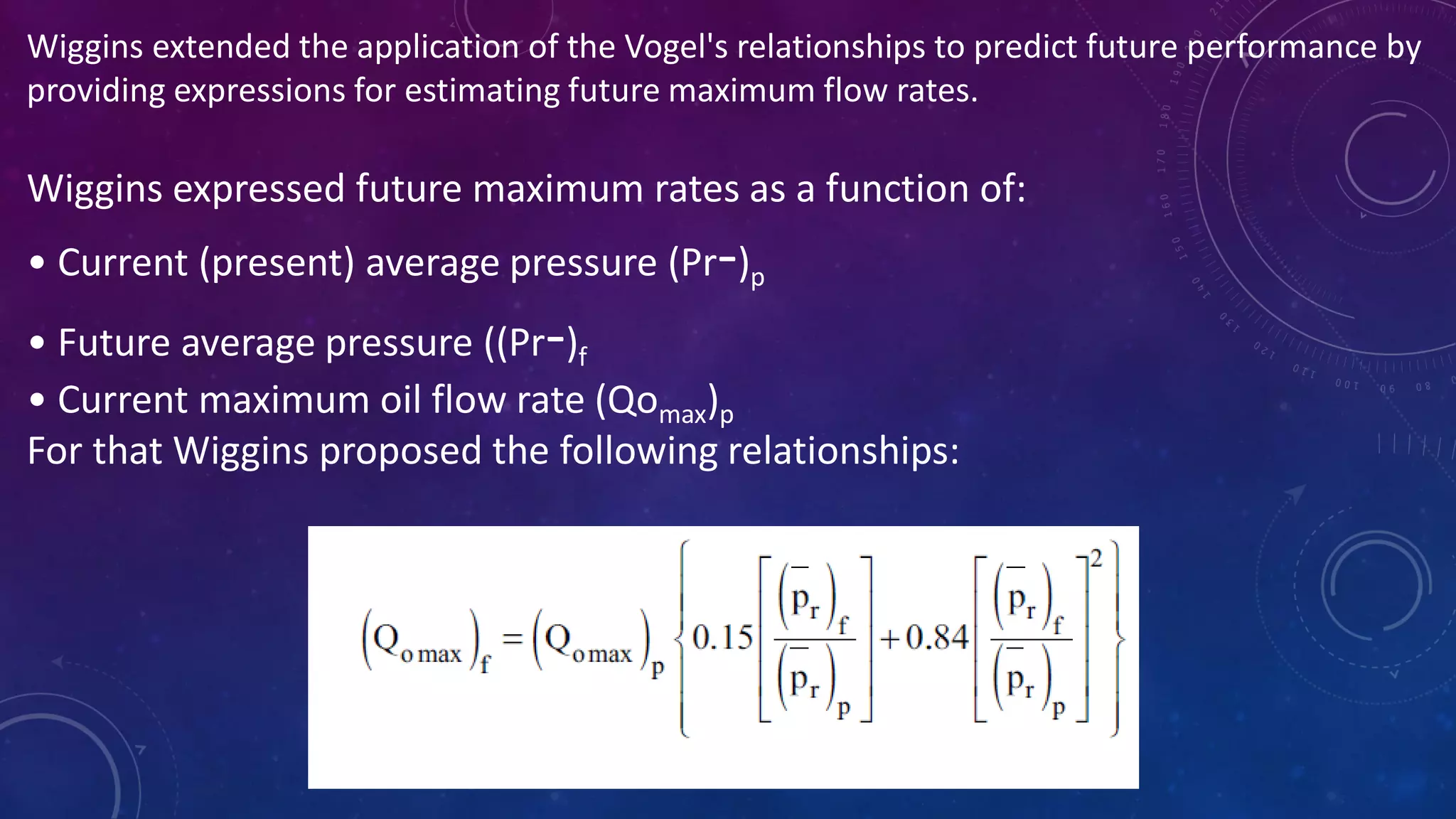
Wiggins extended the application of the Vogel's relationships to predict future performance by
providing expressions for estimating future maximum flow rates.
Wiggins expressed future maximum rates as a function of:
• Current (present) average pressure (Pr-)p
• Future average pressure ((Pr-)f
• Current maximum oil flow rate (Qomax)p
For that Wiggins proposed the following relationships:
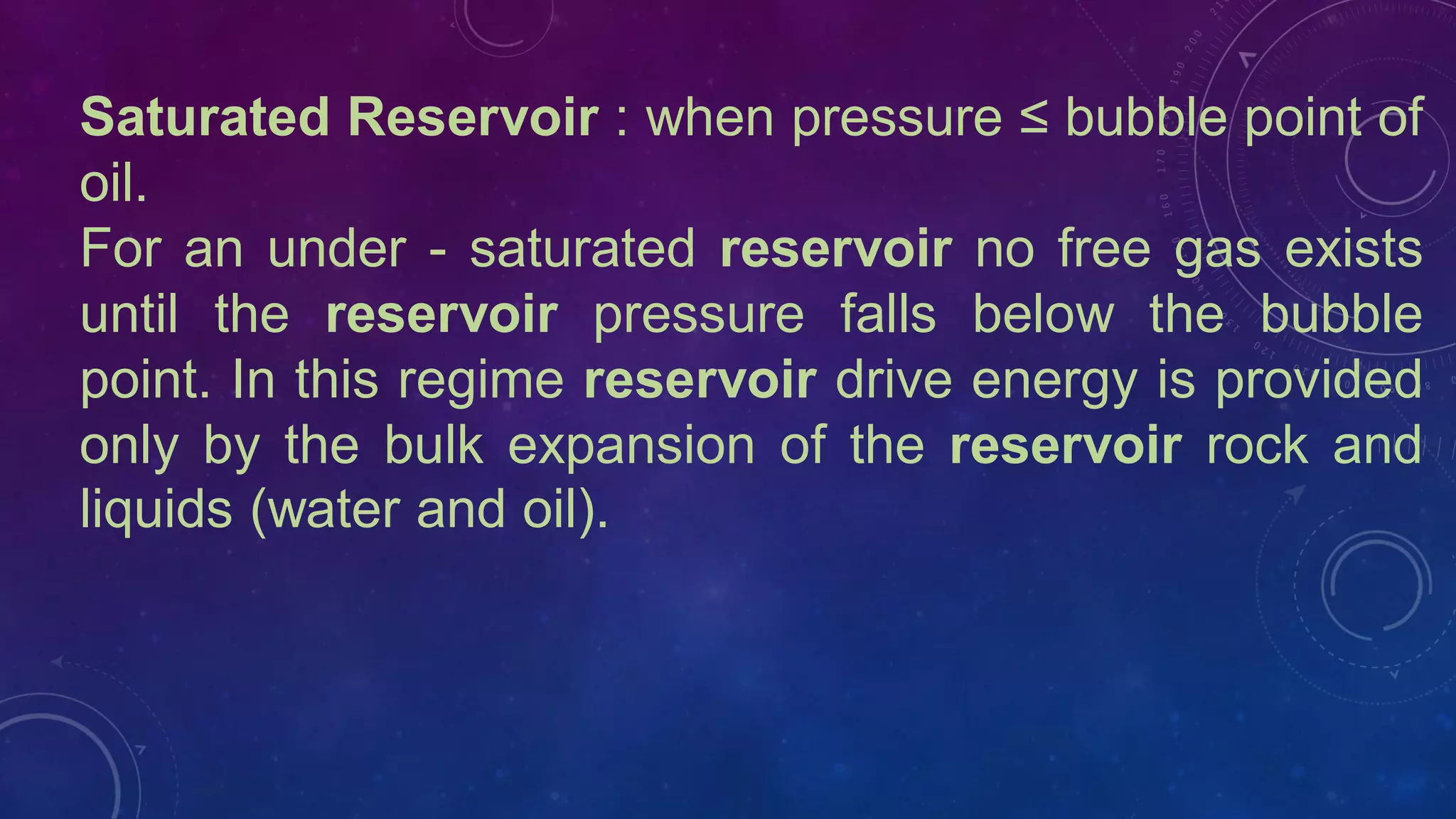
Saturated Reservoir : when pressure ≤ bubble point of
oil.
For an under - saturated reservoir no free gas exists
until the reservoir pressure falls below the bubble
point. In this regime reservoir drive energy is provided
only by the bulk expansion of the reservoir rock and
liquids (water and oil).
Example
A well is producing from a saturated reservoir with an average reservoir pressure of 2,500 psig. Stabilized
production test data indicated that the stabilized rate and wellbore pressure are qo=350 STB/day and Pwf=2,000
psig, respectively.
Generate the current IPR data and predict future IPR when the reservoir pressure declines from 2,500 to 2,000
psig by using Wiggins’ method.
Solution
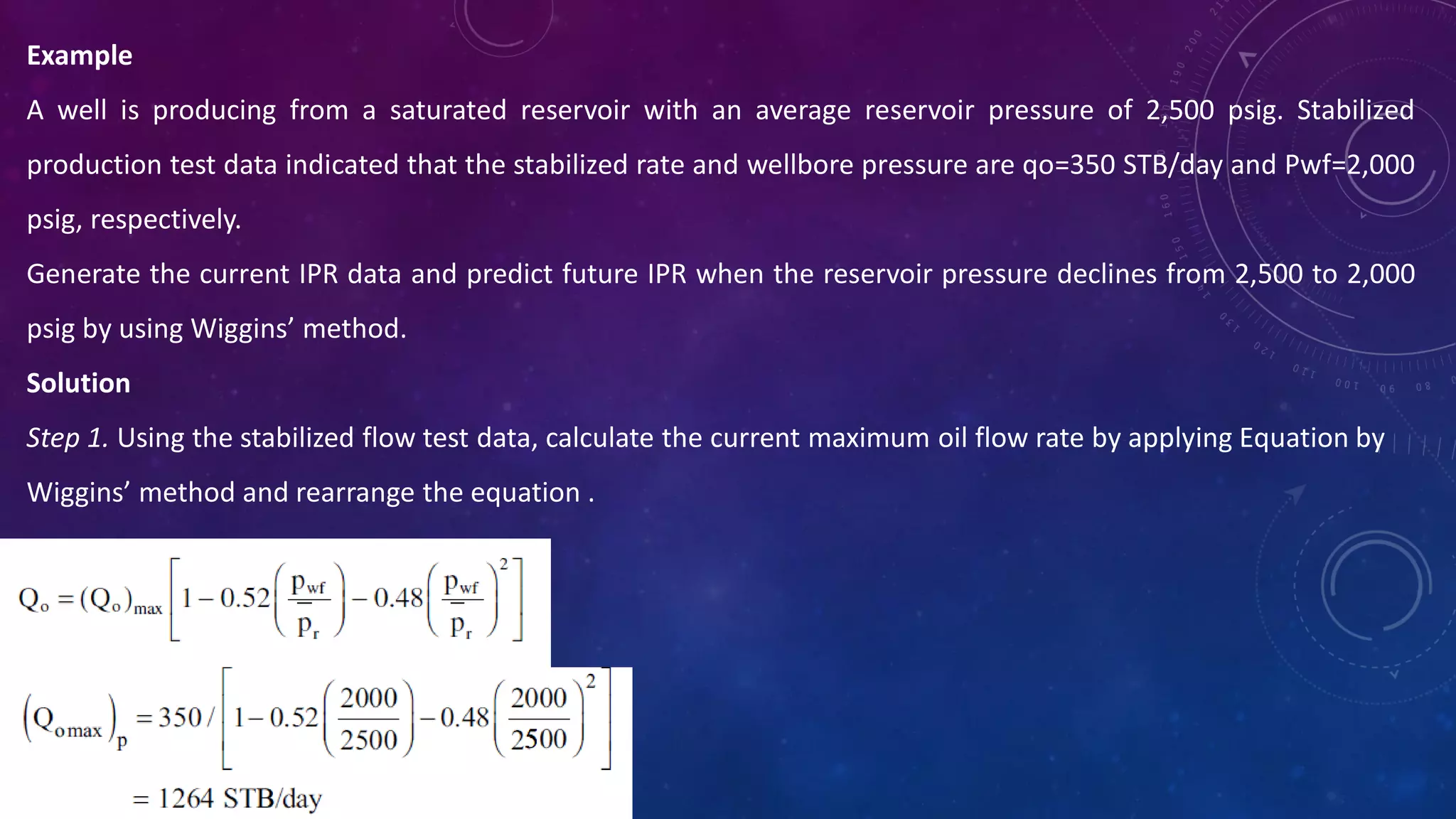
Step 1. Using the stabilized flow test data, calculate the current maximum oil flow rate by applying Equation by
Wiggins’ method and rearrange the equation .
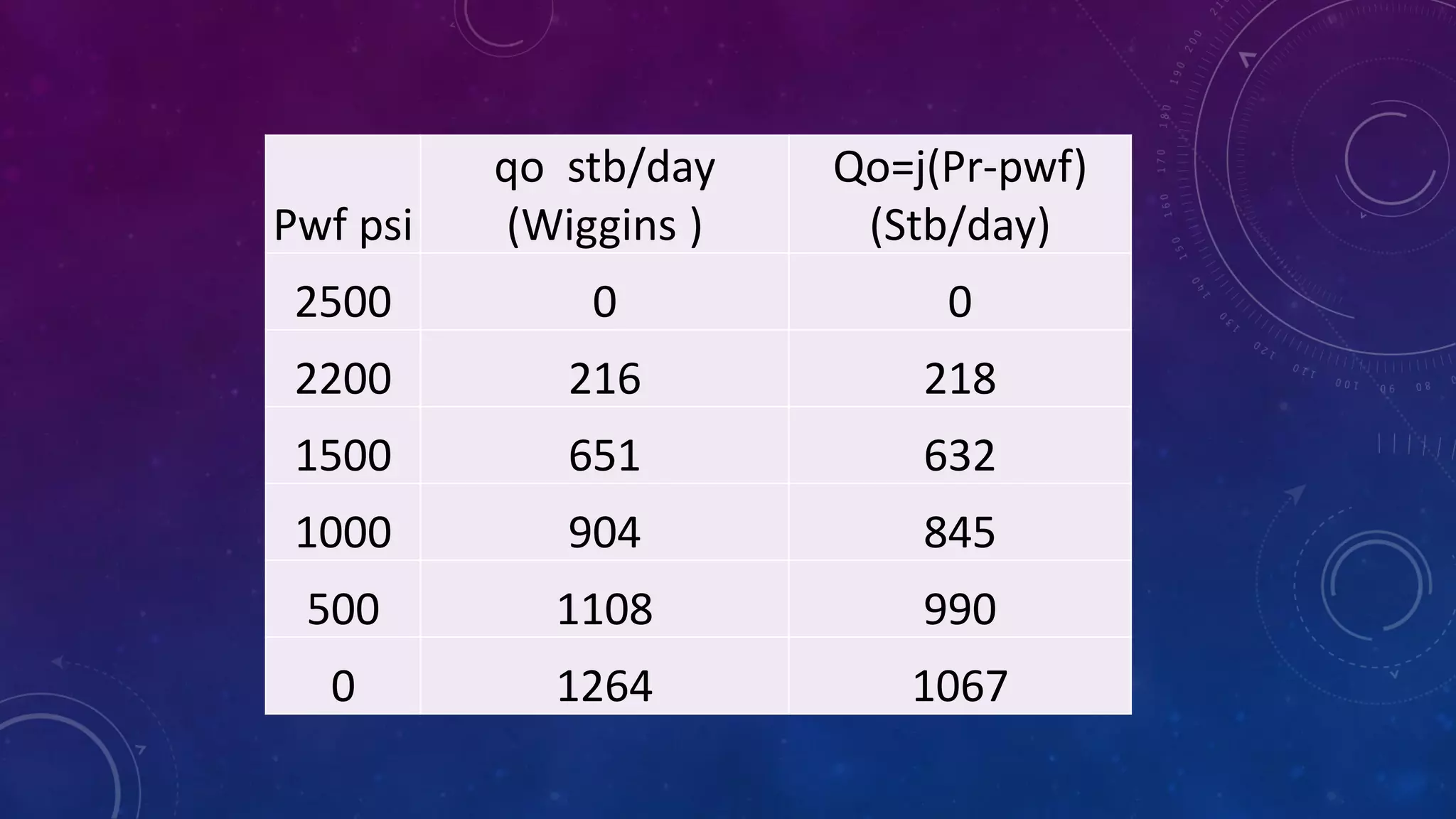
Pwf psi
qo stb/day
(Wiggins )
Qo=j(Pr-pwf)
(Stb/day)
2500 0 0
2200 216 218
1500 651 632
1000 904 845
500 1108 990
0 1264 1067
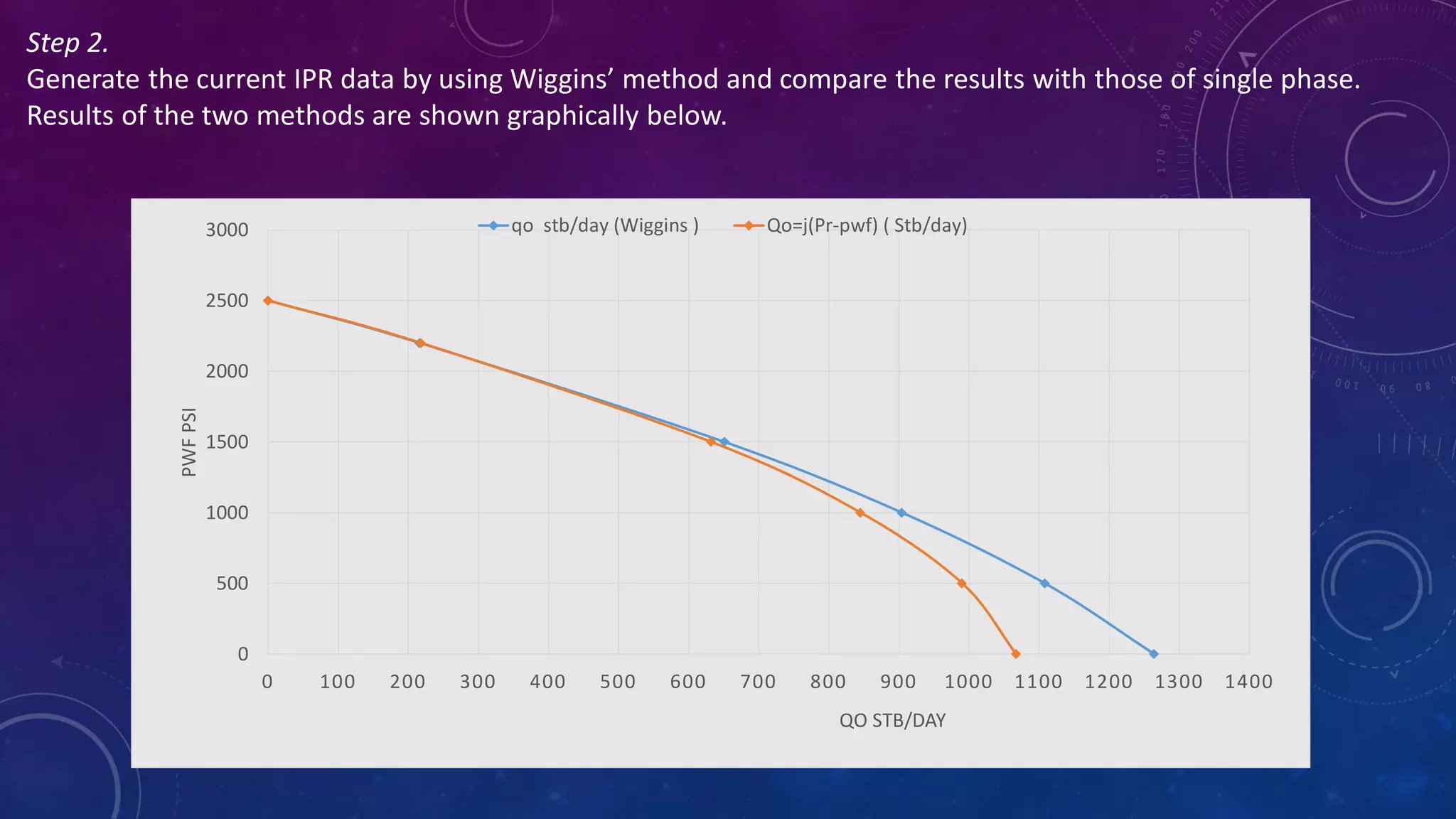
Step 2.
Generate the current IPR data by using Wiggins’ method and compare the results with those of single phase.
Results of the two methods are shown graphically below.
0
500
1000
1500
2000
2500
3000
0 100 200 300 400 500 600 700 800 900 1000 1100 1200 1300 1400
PWF
PSI
QO STB/DAY
qo stb/day (Wiggins ) Qo=j(Pr-pwf) ( Stb/day)
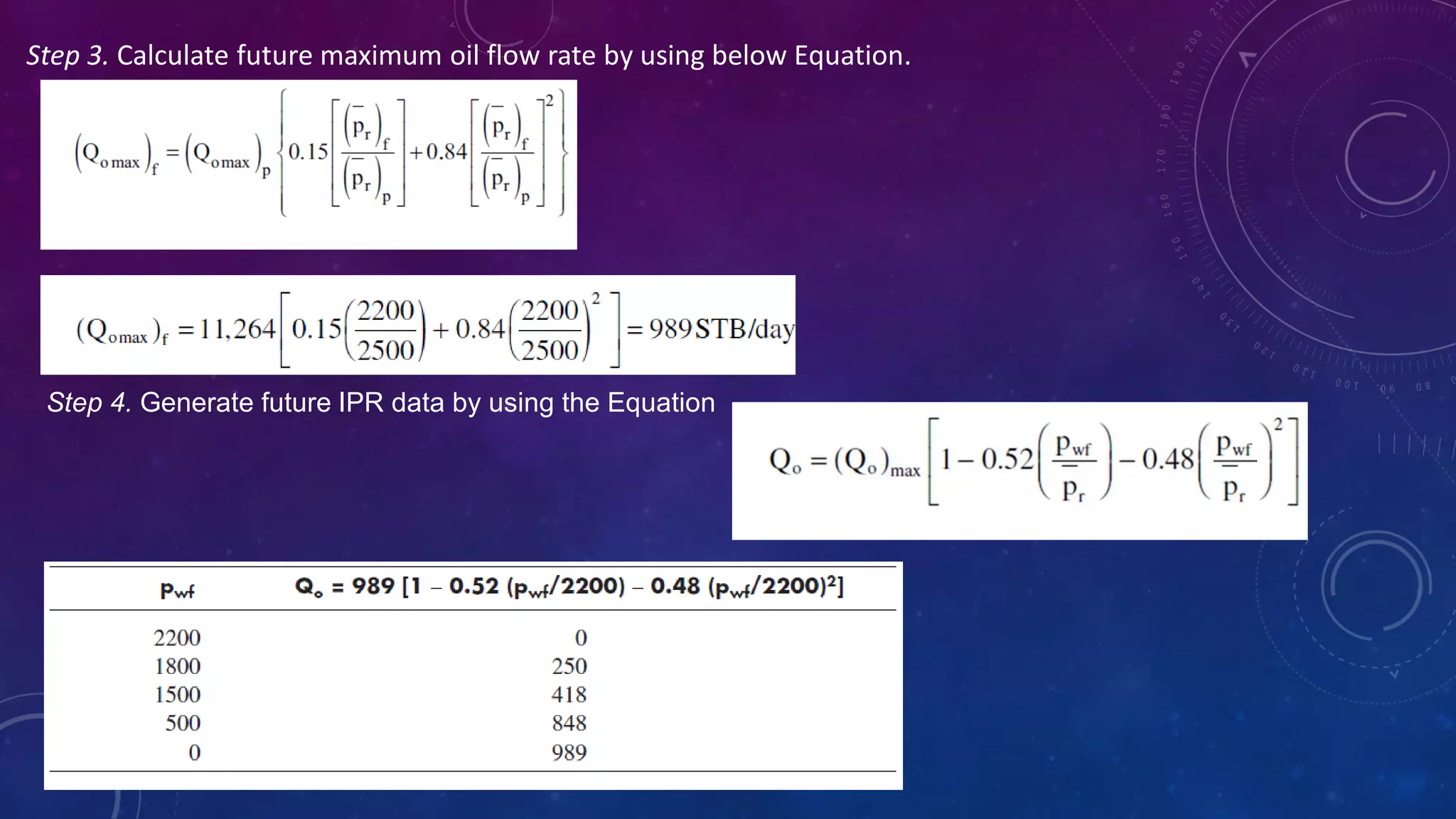
Step 3. Calculate future maximum oil flow rate by using below Equation.
Step 4. Generate future IPR data by using the Equation
0
500
1000
1500
2000
2500
3000
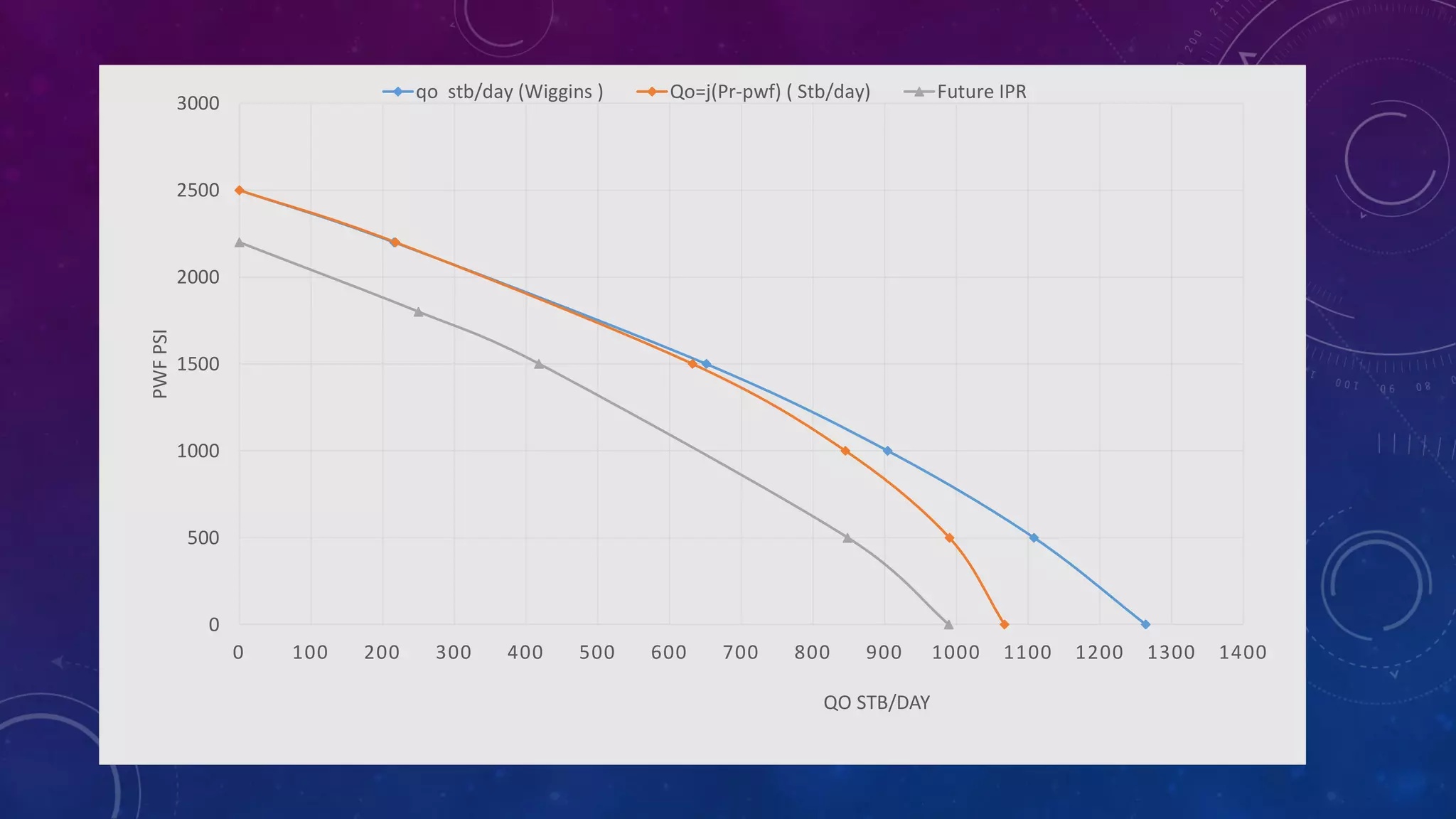
0 100 200 300 400 500 600 700 800 900 1000 1100 1200 1300 1400
PWF
PSI
QO STB/DAY
qo stb/day (Wiggins ) Qo=j(Pr-pwf) ( Stb/day) Future IPR
Standing’s Method
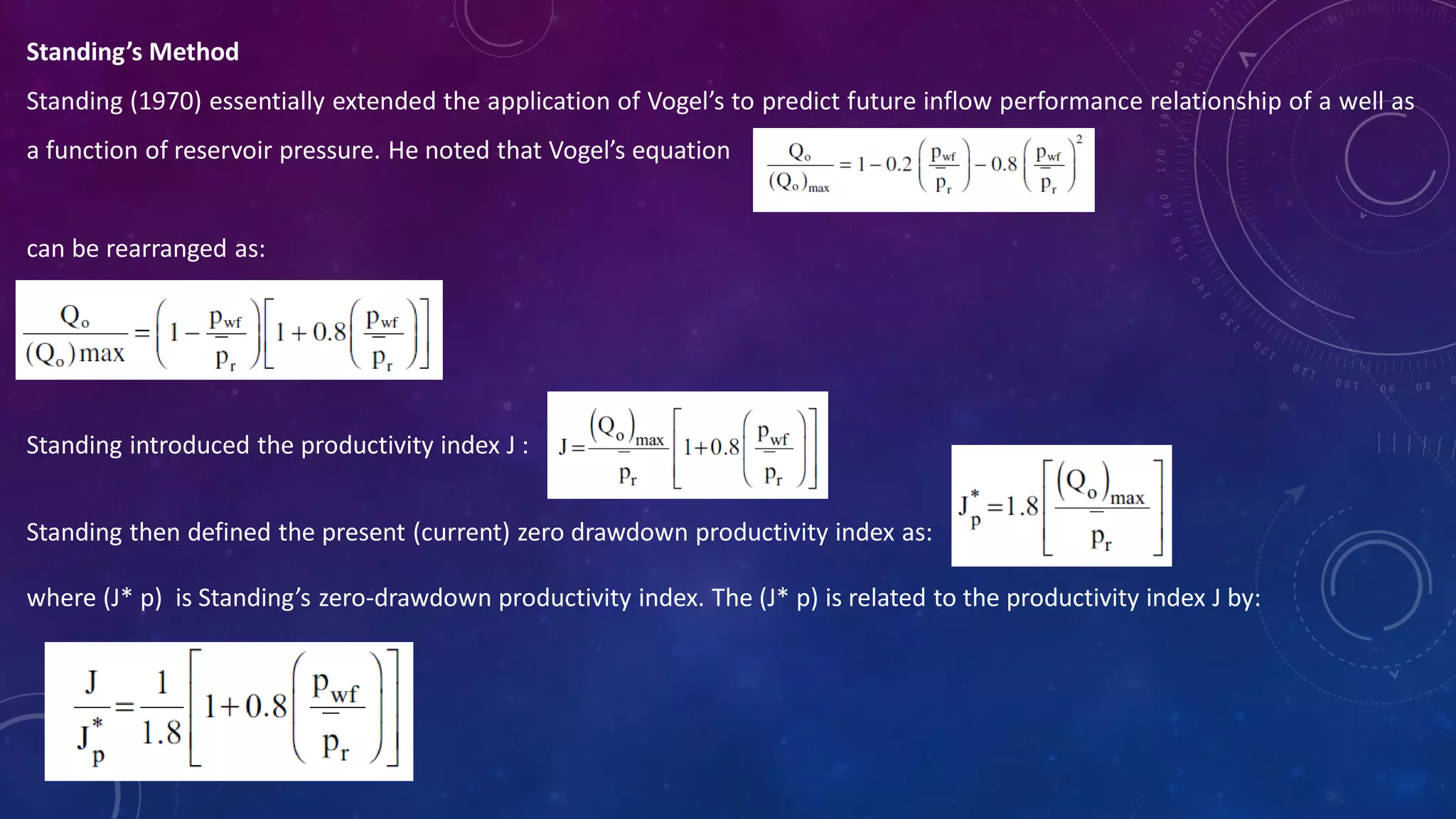
Standing (1970) essentially extended the application of Vogel’s to predict future inflow performance relationship of a well as
a function of reservoir pressure. He noted that Vogel’s equation
can be rearranged as:
Standing introduced the productivity index J :
Standing then defined the present (current) zero drawdown productivity index as:
where (J* p) is Standing’s zero-drawdown productivity index. The (J* p) is related to the productivity index J by:
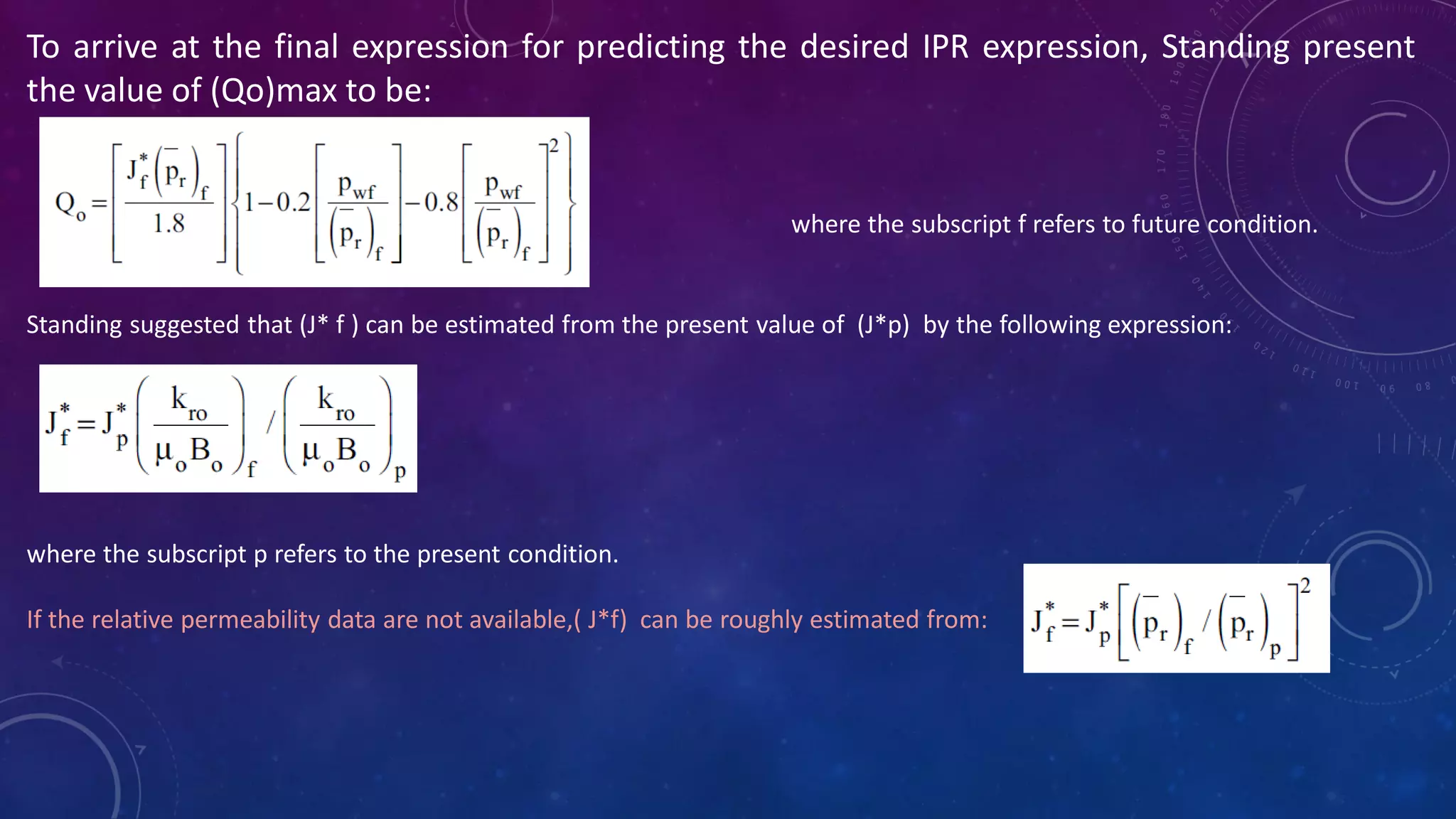
To arrive at the final expression for predicting the desired IPR expression, Standing present
the value of (Qo)max to be:
where the subscript f refers to future condition.
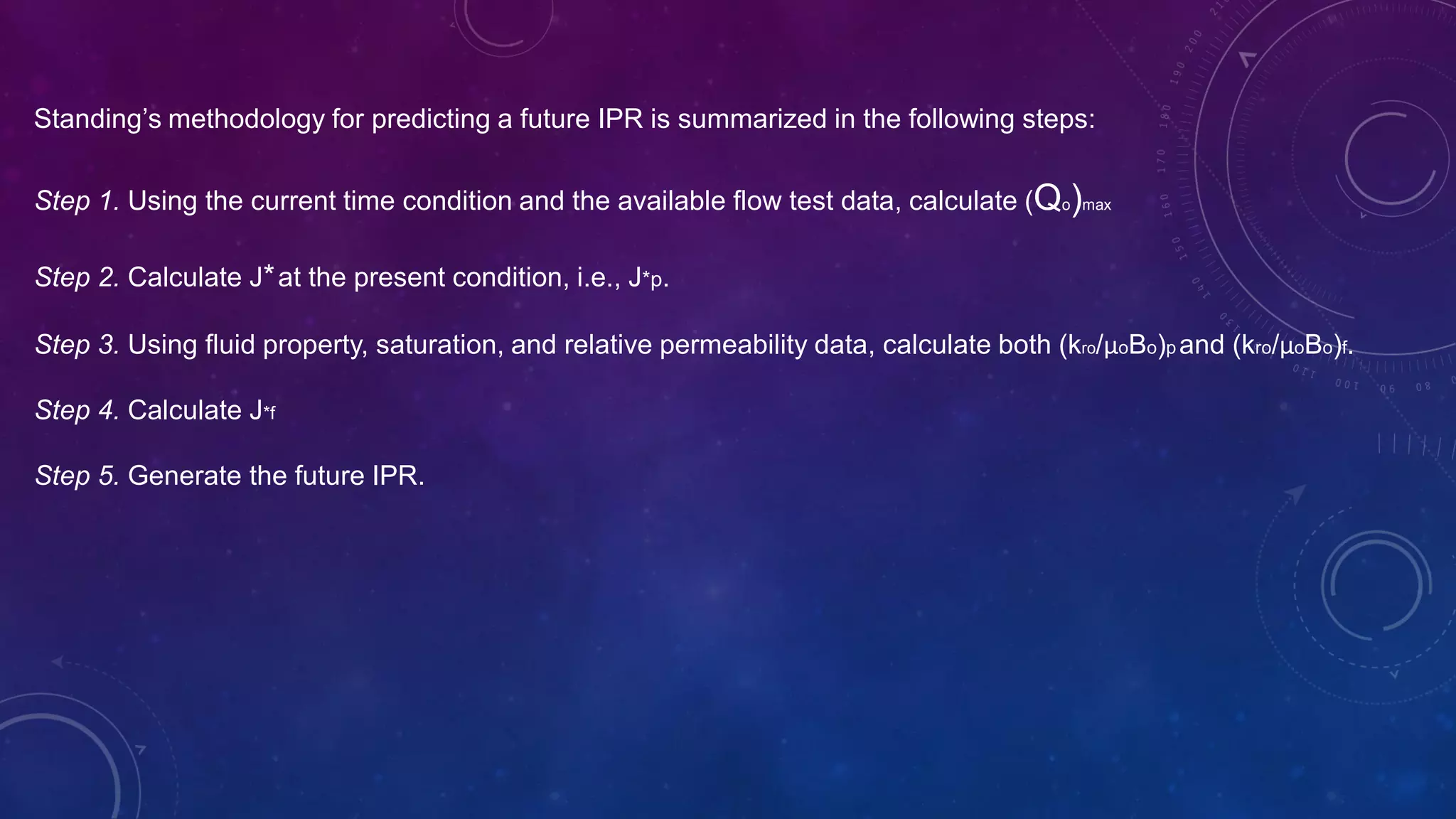
Standing suggested that (J* f ) can be estimated from the present value of (J*p) by the following expression:
where the subscript p refers to the present condition.
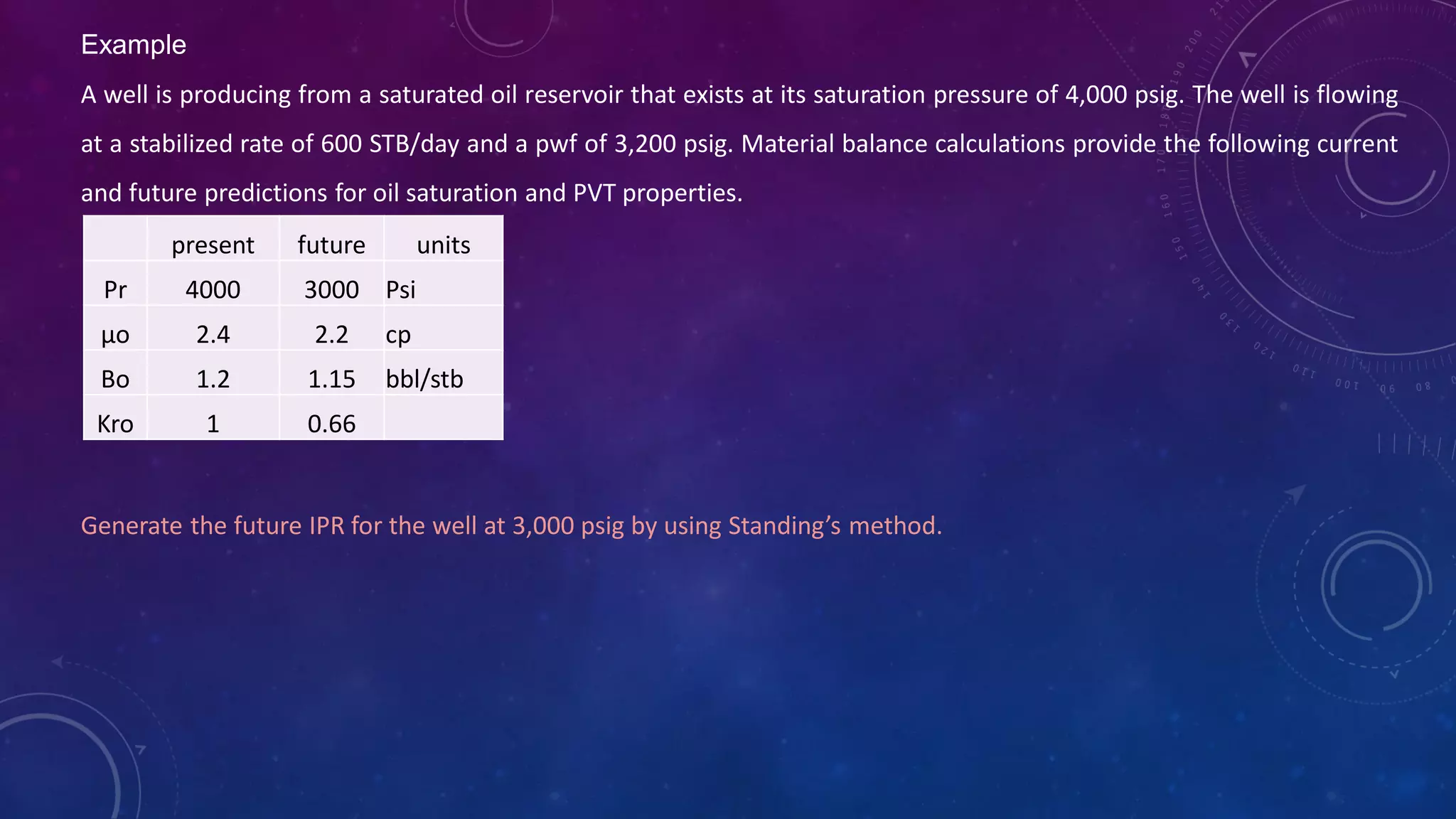
If the relative permeability data are not available,( J*f) can be roughly estimated from:
Standing’s methodology for predicting a future IPR is summarized in the following steps:
Step 1. Using the current time condition and the available flow test data, calculate (Qo)max
Step 2. Calculate J*at the present condition, i.e., J*p.
Step 3. Using fluid property, saturation, and relative permeability data, calculate both (kro/µoBo)p and (kro/µoBo)f.
Step 4. Calculate J*f
Step 5. Generate the future IPR.
Example
A well is producing from a saturated oil reservoir that exists at its saturation pressure of 4,000 psig. The well is flowing
at a stabilized rate of 600 STB/day and a pwf of 3,200 psig. Material balance calculations provide the following current
and future predictions for oil saturation and PVT properties.
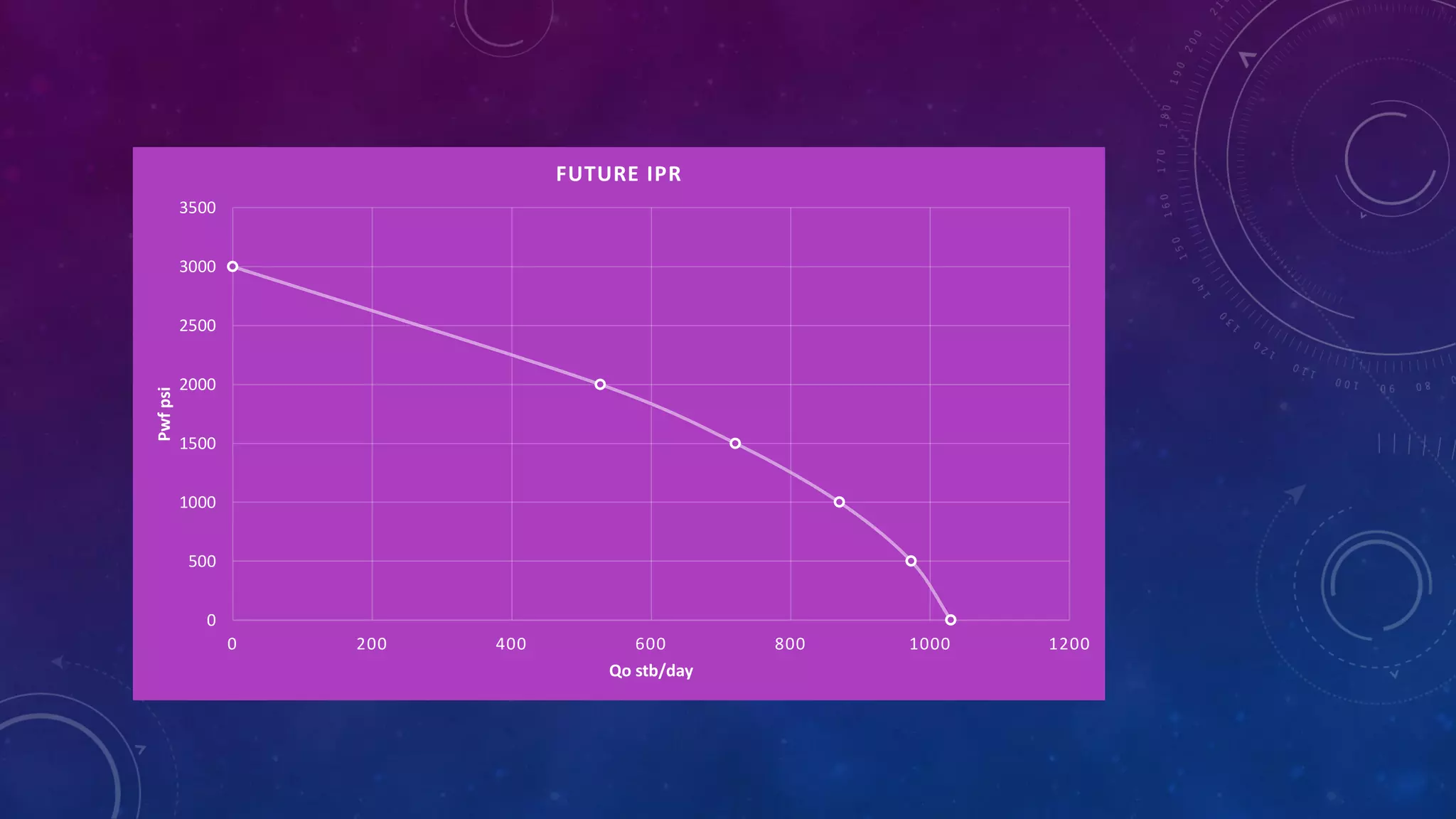
Generate the future IPR for the well at 3,000 psig by using Standing’s method.
present future units
Pr 4000 3000 Psi
µo 2.4 2.2 cp
Bo 1.2 1.15 bbl/stb
Kro 1 0.66
Step 1. calculate the current Qomax from
Step 2. calculate J*
P :
Step 3. calculate the pressure function:
Step 4. calculate J*f by applying
Step 5. generate the IPR assume values for Pwf to find qo by the equation
Pwf psi Qo stb/day
3000 0
2000 527
1500 721
1000 870
500 973
0 1030
0
500
1000
1500
2000
2500
3000
3500
0 200 400 600 800 1000 1200
Pwf
psi
Qo stb/day
FUTURE IPR

future IPR lecture #1.pdf

  • 1.
    Dr. MOHAMMED ABDULAMEER ALHUMAIRI UNIVERSITY of MISAN COLLEGE OF ENGINEERING – PETROLEUM DEPARTMENT Future IPR dr.alhumairi@uomisan.edu.iq
  • 2.
  • 3.
    Wiggins proposed generalizedcorrelations that are suitable for predicting the IPR during three-phase flow. His proposed expressions are similar to that of Vogel’s and are expressed as: As in Vogel’s method, data from a stabilized flow test on the well must be available in order to determine (Qo)max.
  • 4.
    Wiggins extended theapplication of the Vogel's relationships to predict future performance by providing expressions for estimating future maximum flow rates. Wiggins expressed future maximum rates as a function of: • Current (present) average pressure (Pr-)p • Future average pressure ((Pr-)f • Current maximum oil flow rate (Qomax)p For that Wiggins proposed the following relationships:
  • 5.
    Saturated Reservoir :when pressure ≤ bubble point of oil. For an under - saturated reservoir no free gas exists until the reservoir pressure falls below the bubble point. In this regime reservoir drive energy is provided only by the bulk expansion of the reservoir rock and liquids (water and oil).
  • 6.
    Example A well isproducing from a saturated reservoir with an average reservoir pressure of 2,500 psig. Stabilized production test data indicated that the stabilized rate and wellbore pressure are qo=350 STB/day and Pwf=2,000 psig, respectively. Generate the current IPR data and predict future IPR when the reservoir pressure declines from 2,500 to 2,000 psig by using Wiggins’ method. Solution Step 1. Using the stabilized flow test data, calculate the current maximum oil flow rate by applying Equation by Wiggins’ method and rearrange the equation .
  • 7.
    Pwf psi qo stb/day (Wiggins) Qo=j(Pr-pwf) (Stb/day) 2500 0 0 2200 216 218 1500 651 632 1000 904 845 500 1108 990 0 1264 1067
  • 8.
    Step 2. Generate thecurrent IPR data by using Wiggins’ method and compare the results with those of single phase. Results of the two methods are shown graphically below. 0 500 1000 1500 2000 2500 3000 0 100 200 300 400 500 600 700 800 900 1000 1100 1200 1300 1400 PWF PSI QO STB/DAY qo stb/day (Wiggins ) Qo=j(Pr-pwf) ( Stb/day)
  • 9.
    Step 3. Calculatefuture maximum oil flow rate by using below Equation. Step 4. Generate future IPR data by using the Equation
  • 10.
    0 500 1000 1500 2000 2500 3000 0 100 200300 400 500 600 700 800 900 1000 1100 1200 1300 1400 PWF PSI QO STB/DAY qo stb/day (Wiggins ) Qo=j(Pr-pwf) ( Stb/day) Future IPR
  • 11.
    Standing’s Method Standing (1970)essentially extended the application of Vogel’s to predict future inflow performance relationship of a well as a function of reservoir pressure. He noted that Vogel’s equation can be rearranged as: Standing introduced the productivity index J : Standing then defined the present (current) zero drawdown productivity index as: where (J* p) is Standing’s zero-drawdown productivity index. The (J* p) is related to the productivity index J by:
  • 12.
    To arrive atthe final expression for predicting the desired IPR expression, Standing present the value of (Qo)max to be: where the subscript f refers to future condition. Standing suggested that (J* f ) can be estimated from the present value of (J*p) by the following expression: where the subscript p refers to the present condition. If the relative permeability data are not available,( J*f) can be roughly estimated from:
  • 13.
    Standing’s methodology forpredicting a future IPR is summarized in the following steps: Step 1. Using the current time condition and the available flow test data, calculate (Qo)max Step 2. Calculate J*at the present condition, i.e., J*p. Step 3. Using fluid property, saturation, and relative permeability data, calculate both (kro/µoBo)p and (kro/µoBo)f. Step 4. Calculate J*f Step 5. Generate the future IPR.
  • 14.
    Example A well isproducing from a saturated oil reservoir that exists at its saturation pressure of 4,000 psig. The well is flowing at a stabilized rate of 600 STB/day and a pwf of 3,200 psig. Material balance calculations provide the following current and future predictions for oil saturation and PVT properties. Generate the future IPR for the well at 3,000 psig by using Standing’s method. present future units Pr 4000 3000 Psi µo 2.4 2.2 cp Bo 1.2 1.15 bbl/stb Kro 1 0.66
  • 15.
    Step 1. calculatethe current Qomax from Step 2. calculate J* P : Step 3. calculate the pressure function:
  • 16.
    Step 4. calculateJ*f by applying Step 5. generate the IPR assume values for Pwf to find qo by the equation
  • 17.
    Pwf psi Qostb/day 3000 0 2000 527 1500 721 1000 870 500 973 0 1030
  • 18.
    0 500 1000 1500 2000 2500 3000 3500 0 200 400600 800 1000 1200 Pwf psi Qo stb/day FUTURE IPR