


Be Prepared: What You Need to Know to Be Ready
for Your Specialty Pharmacy Accreditation
Heather Bonome, PharmD - Director of Pharmacy, URAC
www.urac.org
Agenda
• About URAC
• The Value of URAC Accreditation
• Overview of URAC’s Specialty Pharmacy Accreditation Program
• Common Challenges
• Tips and Best Practices
• Questions
Founded in 1990 as an independent, third party
validator of the quality in healthcare using best
practices
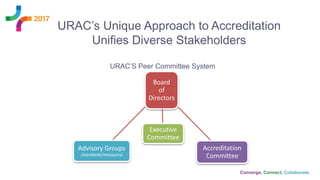
URAC’s Unique Approach to Accreditation
Unifies Diverse Stakeholders
URAC’S Peer Committee System
Board
of
Directors
Executive
Committee
Accreditation
Committee
Advisory Groups
(standards/measures)
Leaders and teams use accreditation to improve
performance and demonstrate value
Accreditation is the most effective way for an organization to demonstrate its
commitment to quality
Accreditation provides:
• Standards framework
• Performance analysis
• Education
Why Accreditation?
URAC accreditation validates the achievement of the industry’s most comprehensive
and rigorous standards
URAC offers:
• Rigorous, evidence-based standards
• Thought leadership
• Independent validation of quality
• Platform for continuous quality improvement
Why URAC Accreditation?
Industry stakeholders have recognized
URAC Specialty Pharmacy accreditation
as a key differentiator and an independent
validation of quality
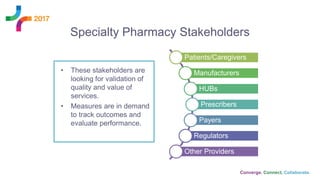
Specialty Pharmacy Stakeholders
• These stakeholders are
looking for validation of
quality and value of
services.
• Measures are in demand
to track outcomes and
evaluate performance.
Patients/Caregivers
Manufacturers
HUBs
Prescribers
Payers
Regulators
Other Providers
Specialty Pharmacies
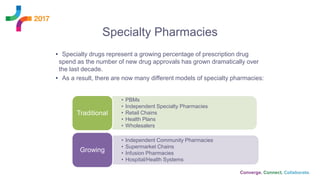
• Specialty drugs represent a growing percentage of prescription drug
spend as the number of new drug approvals has grown dramatically over
the last decade.
• As a result, there are now many different models of specialty pharmacies:
• PBMs
• Independent Specialty Pharmacies
• Retail Chains
• Health Plans
• Wholesalers
Traditional
• Independent Community Pharmacies
• Supermarket Chains
• Infusion Pharmacies
• Hospital/Health Systems
Growing
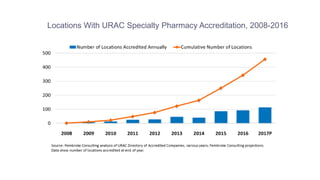
Locations With URAC Specialty Pharmacy Accreditation, 2008-2016
400+ Pharmacy Organizations Have Chosen
URAC to Validate Their Commitment to Quality
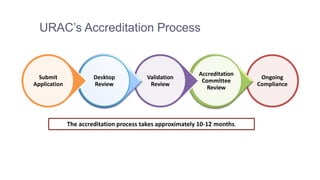
Ongoing
Compliance
Accreditation
Committee
Review
Validation
Review
Desktop
Review
Submit
Application
URAC’s Accreditation Process
The accreditation process takes approximately 10-12 months.
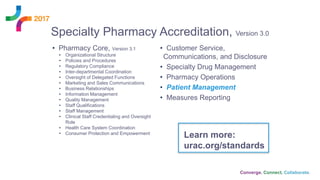
Specialty Pharmacy Accreditation, Version 3.0
• Pharmacy Core, Version 3.1
• Organizational Structure
• Policies and Procedures
• Regulatory Compliance
• Inter-departmental Coordination
• Oversight of Delegated Functions
• Marketing and Sales Communications
• Business Relationships
• Information Management
• Quality Management
• Staff Qualifications
• Staff Management
• Clinical Staff Credentialing and Oversight
Role
• Health Care System Coordination
• Consumer Protection and Empowerment
• Customer Service,
Communications, and Disclosure
• Specialty Drug Management
• Pharmacy Operations
• Patient Management
• Measures Reporting
Learn more:
urac.org/standards
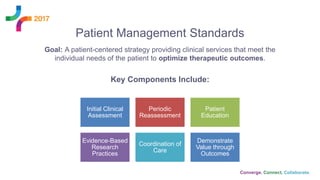
Patient Management Standards
Goal: A patient-centered strategy providing clinical services that meet the
individual needs of the patient to optimize therapeutic outcomes.
Key Components Include:
Initial Clinical
Assessment
Periodic
Reassessment
Patient
Education
Evidence-Based
Research
Practices
Coordination of
Care
Demonstrate
Value through
Outcomes
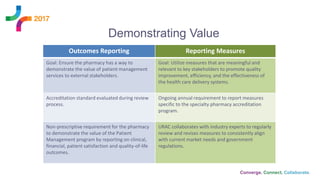
Outcomes Reporting Reporting Measures
Goal: Ensure the pharmacy has a way to
demonstrate the value of patient management
services to external stakeholders.
Goal: Utilize measures that are meaningful and
relevant to key stakeholders to promote quality
improvement, efficiency, and the effectiveness of
the health care delivery systems.
Accreditation standard evaluated during review
process.
Ongoing annual requirement to report measures
specific to the specialty pharmacy accreditation
program.
Non-prescriptive requirement for the pharmacy
to demonstrate the value of the Patient
Management program by reporting on clinical,
financial, patient satisfaction and quality-of-life
outcomes.
URAC collaborates with industry experts to regularly
review and revises measures to consistently align
with current market needs and government
regulations.
Demonstrating Value
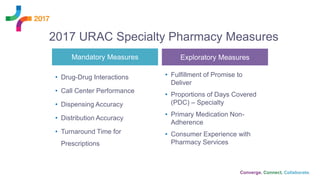
2017 URAC Specialty Pharmacy Measures
• Drug-Drug Interactions
• Call Center Performance
• Dispensing Accuracy
• Distribution Accuracy
• Turnaround Time for
Prescriptions
• Fulfillment of Promise to
Deliver
• Proportions of Days Covered
(PDC) – Specialty
• Primary Medication Non-
Adherence
• Consumer Experience with
Pharmacy Services
Mandatory Measures Exploratory Measures
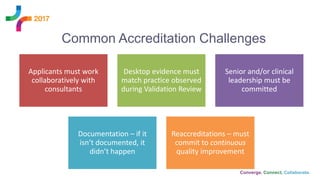
Applicants must work
collaboratively with
consultants
Desktop evidence must
match practice observed
during Validation Review
Senior and/or clinical
leadership must be
committed
Documentation – if it
isn’t documented, it
didn’t happen
Reaccreditations – must
commit to continuous
quality improvement
Common Accreditation Challenges
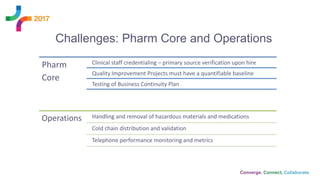
Pharm
Core
Clinical staff credentialing – primary source verification upon hire
Quality Improvement Projects must have a quantifiable baseline
Testing of Business Continuity Plan
Challenges: Pharm Core and Operations
Operations Handling and removal of hazardous materials and medications
Cold chain distribution and validation
Telephone performance monitoring and metrics
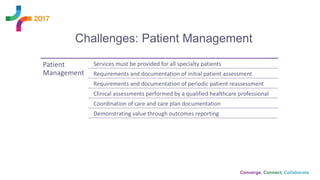
Challenges: Patient Management
Patient
Management
Services must be provided for all specialty patients
Requirements and documentation of initial patient assessment
Requirements and documentation of periodic patient reassessment
Clinical assessments performed by a qualified healthcare professional
Coordination of care and care plan documentation
Demonstrating value through outcomes reporting
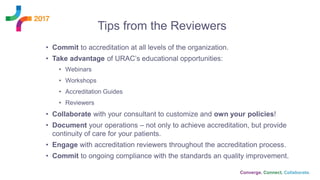
Tips from the Reviewers
• Commit to accreditation at all levels of the organization.
• Take advantage of URAC’s educational opportunities:
• Webinars
• Workshops
• Accreditation Guides
• Reviewers
• Collaborate with your consultant to customize and own your policies!
• Document your operations – not only to achieve accreditation, but provide
continuity of care for your patients.
• Engage with accreditation reviewers throughout the accreditation process.
• Commit to ongoing compliance with the standards an quality improvement.
Best Practices
• New specialty pharmacies can use URAC accreditation standards
as a framework for launching your practice.
• Ask employees for an updated resume with each new
position/promotion to ensure qualifications match position
descriptions.
• Utilize a questionnaire format for Patient Management Initial
Assessments and Reassessments to ensure all required elements
are captured for each patient encounter.
• Leverage your Patient Management outcomes reporting to
demonstrate value and maximize your position for conversations
with payers, manufacturers, and prescribers.
Key Takeaway
URAC accreditation is a big commitment – but when
organizations achieve accreditation, the most frequent
response is:
Thank you
DISCOVER
urac.org/pharmacy
ENGAGE
twitter.com/urac
facebook.com/urac.org
The URAC Report (blog.urac.org)
EXPLORE
202-326-3943 or businessdevelopment@urac.org

Be Ready for Your Specialty Pharmacy Accreditation

  • 1.
    Be Prepared: WhatYou Need to Know to Be Ready for Your Specialty Pharmacy Accreditation Heather Bonome, PharmD - Director of Pharmacy, URAC www.urac.org
  • 2.
    Agenda • About URAC •The Value of URAC Accreditation • Overview of URAC’s Specialty Pharmacy Accreditation Program • Common Challenges • Tips and Best Practices • Questions
  • 3.
    Founded in 1990as an independent, third party validator of the quality in healthcare using best practices
  • 5.
    URAC’s Unique Approachto Accreditation Unifies Diverse Stakeholders URAC’S Peer Committee System Board of Directors Executive Committee Accreditation Committee Advisory Groups (standards/measures)
  • 6.
    Leaders and teamsuse accreditation to improve performance and demonstrate value
  • 7.
    Accreditation is themost effective way for an organization to demonstrate its commitment to quality Accreditation provides: • Standards framework • Performance analysis • Education Why Accreditation?
  • 8.
    URAC accreditation validatesthe achievement of the industry’s most comprehensive and rigorous standards URAC offers: • Rigorous, evidence-based standards • Thought leadership • Independent validation of quality • Platform for continuous quality improvement Why URAC Accreditation?
  • 9.
    Industry stakeholders haverecognized URAC Specialty Pharmacy accreditation as a key differentiator and an independent validation of quality
  • 10.
    Specialty Pharmacy Stakeholders •These stakeholders are looking for validation of quality and value of services. • Measures are in demand to track outcomes and evaluate performance. Patients/Caregivers Manufacturers HUBs Prescribers Payers Regulators Other Providers
  • 11.
    Specialty Pharmacies • Specialtydrugs represent a growing percentage of prescription drug spend as the number of new drug approvals has grown dramatically over the last decade. • As a result, there are now many different models of specialty pharmacies: • PBMs • Independent Specialty Pharmacies • Retail Chains • Health Plans • Wholesalers Traditional • Independent Community Pharmacies • Supermarket Chains • Infusion Pharmacies • Hospital/Health Systems Growing
  • 12.
    Locations With URACSpecialty Pharmacy Accreditation, 2008-2016
  • 13.
    400+ Pharmacy OrganizationsHave Chosen URAC to Validate Their Commitment to Quality
  • 14.
  • 15.
    Specialty Pharmacy Accreditation,Version 3.0 • Pharmacy Core, Version 3.1 • Organizational Structure • Policies and Procedures • Regulatory Compliance • Inter-departmental Coordination • Oversight of Delegated Functions • Marketing and Sales Communications • Business Relationships • Information Management • Quality Management • Staff Qualifications • Staff Management • Clinical Staff Credentialing and Oversight Role • Health Care System Coordination • Consumer Protection and Empowerment • Customer Service, Communications, and Disclosure • Specialty Drug Management • Pharmacy Operations • Patient Management • Measures Reporting Learn more: urac.org/standards
  • 16.
    Patient Management Standards Goal:A patient-centered strategy providing clinical services that meet the individual needs of the patient to optimize therapeutic outcomes. Key Components Include: Initial Clinical Assessment Periodic Reassessment Patient Education Evidence-Based Research Practices Coordination of Care Demonstrate Value through Outcomes
  • 17.
    Outcomes Reporting ReportingMeasures Goal: Ensure the pharmacy has a way to demonstrate the value of patient management services to external stakeholders. Goal: Utilize measures that are meaningful and relevant to key stakeholders to promote quality improvement, efficiency, and the effectiveness of the health care delivery systems. Accreditation standard evaluated during review process. Ongoing annual requirement to report measures specific to the specialty pharmacy accreditation program. Non-prescriptive requirement for the pharmacy to demonstrate the value of the Patient Management program by reporting on clinical, financial, patient satisfaction and quality-of-life outcomes. URAC collaborates with industry experts to regularly review and revises measures to consistently align with current market needs and government regulations. Demonstrating Value
  • 18.
    2017 URAC SpecialtyPharmacy Measures • Drug-Drug Interactions • Call Center Performance • Dispensing Accuracy • Distribution Accuracy • Turnaround Time for Prescriptions • Fulfillment of Promise to Deliver • Proportions of Days Covered (PDC) – Specialty • Primary Medication Non- Adherence • Consumer Experience with Pharmacy Services Mandatory Measures Exploratory Measures
  • 19.
    Applicants must work collaborativelywith consultants Desktop evidence must match practice observed during Validation Review Senior and/or clinical leadership must be committed Documentation – if it isn’t documented, it didn’t happen Reaccreditations – must commit to continuous quality improvement Common Accreditation Challenges
  • 20.
    Pharm Core Clinical staff credentialing– primary source verification upon hire Quality Improvement Projects must have a quantifiable baseline Testing of Business Continuity Plan Challenges: Pharm Core and Operations Operations Handling and removal of hazardous materials and medications Cold chain distribution and validation Telephone performance monitoring and metrics
  • 21.
    Challenges: Patient Management Patient Management Servicesmust be provided for all specialty patients Requirements and documentation of initial patient assessment Requirements and documentation of periodic patient reassessment Clinical assessments performed by a qualified healthcare professional Coordination of care and care plan documentation Demonstrating value through outcomes reporting
  • 22.
    Tips from theReviewers • Commit to accreditation at all levels of the organization. • Take advantage of URAC’s educational opportunities: • Webinars • Workshops • Accreditation Guides • Reviewers • Collaborate with your consultant to customize and own your policies! • Document your operations – not only to achieve accreditation, but provide continuity of care for your patients. • Engage with accreditation reviewers throughout the accreditation process. • Commit to ongoing compliance with the standards an quality improvement.
  • 23.
    Best Practices • Newspecialty pharmacies can use URAC accreditation standards as a framework for launching your practice. • Ask employees for an updated resume with each new position/promotion to ensure qualifications match position descriptions. • Utilize a questionnaire format for Patient Management Initial Assessments and Reassessments to ensure all required elements are captured for each patient encounter. • Leverage your Patient Management outcomes reporting to demonstrate value and maximize your position for conversations with payers, manufacturers, and prescribers.
  • 24.
    Key Takeaway URAC accreditationis a big commitment – but when organizations achieve accreditation, the most frequent response is:
  • 25.
    Thank you DISCOVER urac.org/pharmacy ENGAGE twitter.com/urac facebook.com/urac.org The URACReport (blog.urac.org) EXPLORE 202-326-3943 or businessdevelopment@urac.org

Editor's Notes

  • #5  Over the last quarter century, URAC has developed patient focused national standards in different national market segments. URAC’s accreditation and certification programs are at the intersection of patients, payers, and providers. For example: URAC’s first program, Health Utilization Management, was born out of the public backlash against managed care and the concern that patients were being harmed by unfair and unsafe practices. URAC’s Pharmacy Benefit Management program, launched in 2007, came at a time when public officials were concerned about patient access to prescription drugs. Most recently, URAC launched its telehealth program to set national benchmarks for an emerging market often delivering care directly to patients.
  • #8 Accreditation is the most effective way for an organization to demonstrate its commitment to quality Accreditation provides: Standards framework to build a quality health service organization Performance analysis to identify areas for improvement Educational process to inform priorities and plans for improvement Measurement, reporting, and monitoring to sustain accreditation readiness and continuous quality improvement
  • #9 URAC offers: Rigorous, evidence-based standards and review processes that result in optimal benefit to the consumer of care Thought leadership in key areas of healthcare from experienced URAC leaders and the input of industry experts who are close to health delivery systems and know its unique challenges An independent validation of quality through accreditation programs that act as a key differentiator of performance A systematic approach to quality management to mitigate the human and economic cost of poor quality URAC’s non-prescriptive, educational approach allows organizations of various sizes and models of care achieve accreditation while sharing best practices and opportunities for improvement.
  • #10 Many payers and manufacturers recognize URAC Specialty Pharmacy accreditation as a key differentiator and an independent validation of quality – often including it as a requirement for specialty pharmacies seeking to participate in their network.
  • #12 Briefly address different models….specialty at retail services
  • #13 Still no universal or singular regulatory definition of what an SP pharmacy is…..as such Leave in as a recognition that Drug Channels sees the # of URAC accreditations as a proxy for the significant growth in SP’s.
  • #15 New picture of the 5 phases with support/tools/resources and timing along the bottom URAC provides a dedicated team and tools throughout each phase of accreditation.
  • #20 Documentation – Not just for URAC accreditation – this is for the PATIENT