Production
Scheduling
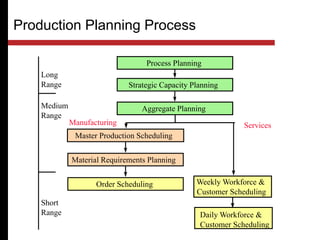
Production Planning Process
Process Planning
Strategic Capacity Planning
Aggregate Planning
Master Production Scheduling
Material Requirements Planning
Order Scheduling Weekly Workforce &
Customer Scheduling
Daily Workforce &
Customer Scheduling
Long
Range
Medium
Range
Short
Range
Manufacturing Services
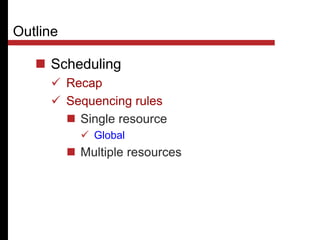
Outline
 Scheduling
 Recap
 Sequencing rules
 Single resource
 Global
 Multiple resources
Scheduling
 Deals with the timing of operations
 Specifies when resources are needed to
produce a product or provide a service
 Helps us decide what order to perform jobs
 All organizations perform scheduling to
some extent…
Sequencing Rules
 Determine the order jobs are processed by
a resource
Types of Sequencing Rules
 Sequencing jobs at a single resource
 Sequencing jobs across multiple resources
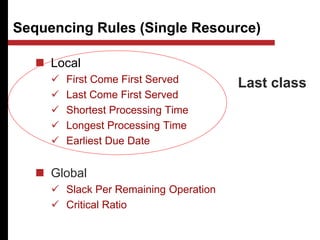
Sequencing Rules (Single Resource)
 Local
 First Come First Served
 Last Come First Served
 Shortest Processing Time
 Longest Processing Time
 Earliest Due Date
 Global
 Slack Per Remaining Operation
 Critical Ratio
Last class
Sequencing Rules (Single Resource)
 Local
 First Come First Served
 Last Come First Served
 Shortest Processing Time
 Longest Processing Time
 Earliest Due Date
 Global
 Slack Per Remaining Operation
 Critical Ratio
Global Rules
 Consider more than current operation
 Look at work at other work centers that needs
to be completed before the job is done
Types of Sequencing Rules
 Sequencing jobs at a single resource
 Sequencing jobs across multiple resources
Scheduling Across Multiple Resources
 Previous rules considered scheduling
(sequencing) jobs at one resource
 How can we schedule jobs across
multiple resources??
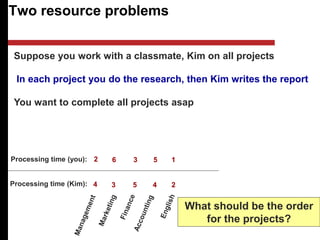
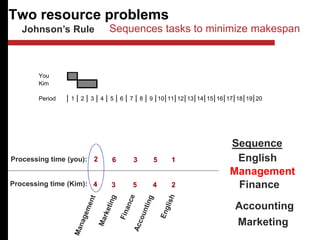
Two resource problems
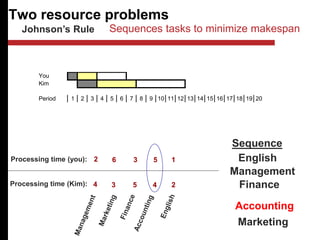
Suppose you work with a classmate, Kim on all projects
4 3 5 4 2
2 6 3 5 1
In each project you do the research, then Kim writes the report
Processing time (you):
Processing time (Kim):
You want to complete all projects asap
What should be the order
for the projects?
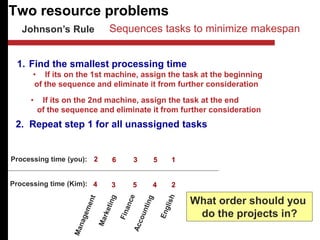
Two resource problems
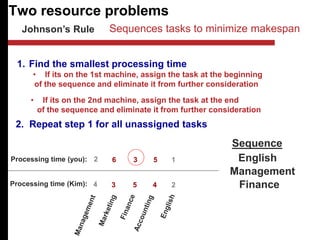
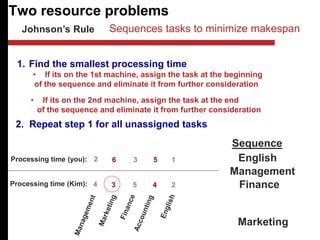
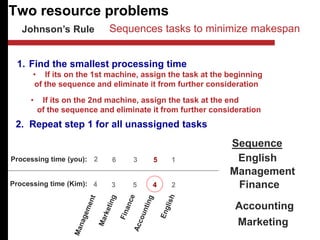
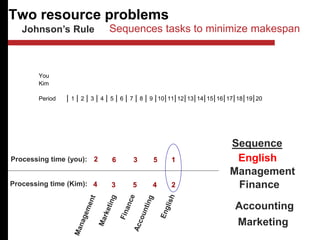
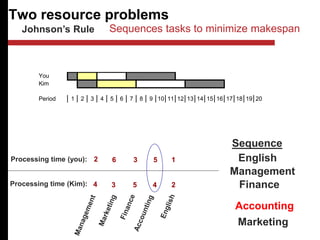
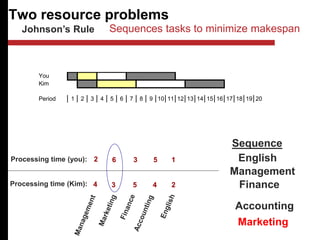
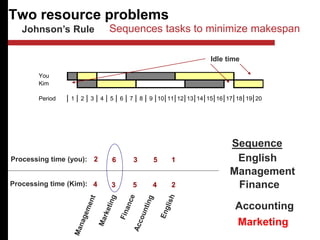
Johnson’s Rule
4 3 5 4 2
2 6 3 5 1
1. Find the smallest processing time
• If its on the 1st machine, assign the task at the beginning
of the sequence and eliminate it from further consideration
Processing time (you):
Processing time (Kim):
What order should you
do the projects in?
• If its on the 2nd machine, assign the task at the end
of the sequence and eliminate it from further consideration
2. Repeat step 1 for all unassigned tasks
Sequences tasks to minimize makespan
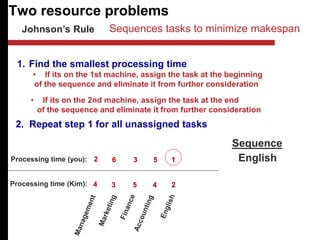
Two resource problems
Johnson’s Rule
4 3 5 4 2
2 6 3 5 1
1. Find the smallest processing time
• If its on the 1st machine, assign the task at the beginning
of the sequence and eliminate it from further consideration
Processing time (you):
Processing time (Kim):
• If its on the 2nd machine, assign the task at the end
of the sequence and eliminate it from further consideration
2. Repeat step 1 for all unassigned tasks
Sequence
English
Sequences tasks to minimize makespan
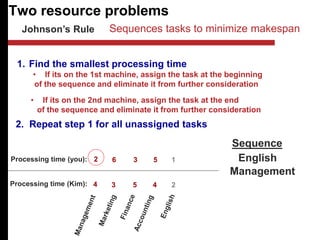
Two resource problems
Johnson’s Rule
4 3 5 4 2
2 6 3 5 1
1. Find the smallest processing time
• If its on the 1st machine, assign the task at the beginning
of the sequence and eliminate it from further consideration
Processing time (you):
Processing time (Kim):
• If its on the 2nd machine, assign the task at the end
of the sequence and eliminate it from further consideration
2. Repeat step 1 for all unassigned tasks
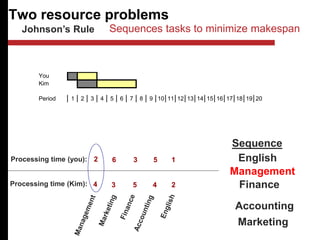
Sequence
English
Management
Sequences tasks to minimize makespan
Two resource problems
Johnson’s Rule
4 3 5 4 2
2 6 3 5 1
1. Find the smallest processing time
• If its on the 1st machine, assign the task at the beginning
of the sequence and eliminate it from further consideration
Processing time (you):
Processing time (Kim):
• If its on the 2nd machine, assign the task at the end
of the sequence and eliminate it from further consideration
2. Repeat step 1 for all unassigned tasks
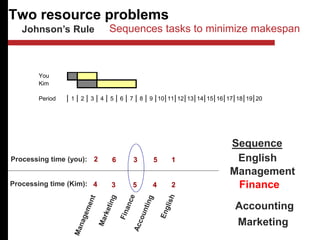
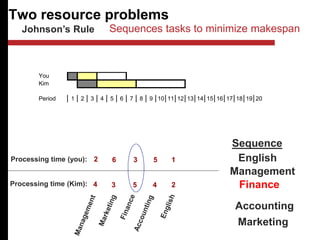
Sequence
English
Management
Finance
Sequences tasks to minimize makespan
Two resource problems
Johnson’s Rule
4 3 5 4 2
2 6 3 5 1
1. Find the smallest processing time
• If its on the 1st machine, assign the task at the beginning
of the sequence and eliminate it from further consideration
Processing time (you):
Processing time (Kim):
• If its on the 2nd machine, assign the task at the end
of the sequence and eliminate it from further consideration
2. Repeat step 1 for all unassigned tasks
Sequence
English
Management
Finance
Marketing
Sequences tasks to minimize makespan
Two resource problems
Johnson’s Rule
4 3 5 4 2
2 6 3 5 1
1. Find the smallest processing time
• If its on the 1st machine, assign the task at the beginning
of the sequence and eliminate it from further consideration
Processing time (you):
Processing time (Kim):
• If its on the 2nd machine, assign the task at the end
of the sequence and eliminate it from further consideration
2. Repeat step 1 for all unassigned tasks
Sequence
English
Management
Finance
Marketing
Accounting
Sequences tasks to minimize makespan
Two resource problems
Johnson’s Rule
4 3 5 4 2
2 6 3 5 1
Processing time (you):
Processing time (Kim):
Sequence
English
Management
Finance
Marketing
Accounting
You
Kim
Period 1 2 3 4 5 6 7 8 9 10 11 12 13 14 15 16 17 18 19 20
Sequences tasks to minimize makespan
Two resource problems
Johnson’s Rule
4 3 5 4 2
2 6 3 5 1
Processing time (you):
Processing time (Kim):
Sequence
English
Management
Finance
Marketing
Accounting
You
Kim
Period 1 2 3 4 5 6 7 8 9 10 11 12 13 14 15 16 17 18 19 20
Sequences tasks to minimize makespan
Two resource problems
Johnson’s Rule
4 3 5 4 2
2 6 3 5 1
Processing time (you):
Processing time (Kim):
Sequence
English
Management
Finance
Marketing
Accounting
You
Kim
Period 1 2 3 4 5 6 7 8 9 10 11 12 13 14 15 16 17 18 19 20
Sequences tasks to minimize makespan
Two resource problems
Johnson’s Rule
4 3 5 4 2
2 6 3 5 1
Processing time (you):
Processing time (Kim):
Sequence
English
Management
Finance
Marketing
Accounting
You
Kim
Period 1 2 3 4 5 6 7 8 9 10 11 12 13 14 15 16 17 18 19 20
Sequences tasks to minimize makespan
Two resource problems
Johnson’s Rule
4 3 5 4 2
2 6 3 5 1
Processing time (you):
Processing time (Kim):
Sequence
English
Management
Finance
Marketing
Accounting
You
Kim
Period 1 2 3 4 5 6 7 8 9 10 11 12 13 14 15 16 17 18 19 20
Sequences tasks to minimize makespan
Two resource problems
Johnson’s Rule
4 3 5 4 2
2 6 3 5 1
Processing time (you):
Processing time (Kim):
Sequence
English
Management
Finance
Marketing
Accounting
You
Kim
Period 1 2 3 4 5 6 7 8 9 10 11 12 13 14 15 16 17 18 19 20
Sequences tasks to minimize makespan
Two resource problems
Johnson’s Rule
4 3 5 4 2
2 6 3 5 1
Processing time (you):
Processing time (Kim):
Sequence
English
Management
Finance
Marketing
Accounting
You
Kim
Period 1 2 3 4 5 6 7 8 9 10 11 12 13 14 15 16 17 18 19 20
Sequences tasks to minimize makespan
Two resource problems
Johnson’s Rule
4 3 5 4 2
2 6 3 5 1
Processing time (you):
Processing time (Kim):
Sequence
English
Management
Finance
Marketing
Accounting
You
Kim
Period 1 2 3 4 5 6 7 8 9 10 11 12 13 14 15 16 17 18 19 20
Sequences tasks to minimize makespan
Two resource problems
Johnson’s Rule
4 3 5 4 2
2 6 3 5 1
Processing time (you):
Processing time (Kim):
Sequence
English
Management
Finance
Marketing
Accounting
You
Kim
Period 1 2 3 4 5 6 7 8 9 10 11 12 13 14 15 16 17 18 19 20
Idle time
Sequences tasks to minimize makespan
More Than 2 Resources
 Optimal methods don’t exist to
minimize makespan
 Heuristics
 CDS Heuristic
Sequencing Rules
 Local
 FCFS
 LCFS
 SPT
 LPT
 EDD
 Global
 SPO
 CR
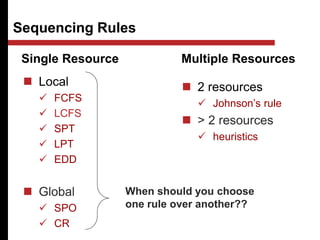
Single Resource Multiple Resources
 2 resources
 Johnson’s rule
 > 2 resources
 heuristics
When should you choose
one rule over another??
Guidelines for Selecting a Sequencing Rule
1. SPT most useful when shop is highly congested
2. Use SPO for periods of normal activity
3. Use EDD when only small tardiness values can be
tolerated
4. Use FCFS when operating at low-capacity levels
Employee Scheduling
 Labor is very flexible resource
 Scheduling workforce is
complicated repetitive task
 Heuristics commonly used
We’ll cover one simple one today…
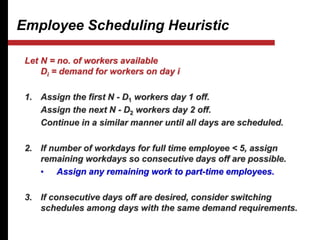
Employee Scheduling Heuristic
Let N = no. of workers available
Di = demand for workers on day i
1. Assign the first N - D1 workers day 1 off.
Assign the next N - D2 workers day 2 off.
Continue in a similar manner until all days are scheduled.
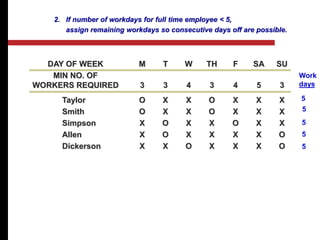
2. If number of workdays for full time employee < 5, assign
remaining workdays so consecutive days off are possible.
• Assign any remaining work to part-time employees.
3. If consecutive days off are desired, consider switching
schedules among days with the same demand requirements.
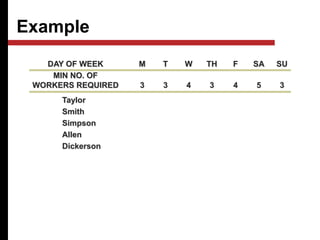
Example
DAY OF WEEK M T W TH F SA SU
MIN NO. OF
WORKERS REQUIRED 3 3 4 3 4 5 3
Taylor
Smith
Simpson
Allen
Dickerson
DAY OF WEEK M T W TH F SA SU
MIN NO. OF
WORKERS REQUIRED 3 3 4 3 4 5 3
Taylor
Smith
Simpson
Allen
Dickerson
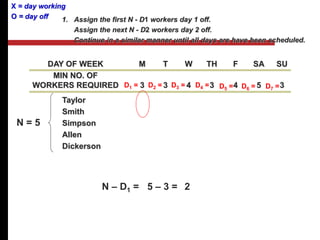
N = 5
D1 = D2 = D3 = D4 = D5 = D6 = D7 =
N – D1 = 5 – 3 = 2
X = day working
O = day off 1. Assign the first N - D1 workers day 1 off.
Assign the next N - D2 workers day 2 off.
Continue in a similar manner until all days are have been scheduled.
DAY OF WEEK M T W TH F SA SU
MIN NO. OF
WORKERS REQUIRED 3 3 4 3 4 5 3
Taylor O X X O X X X
Smith O X X O X X X
Simpson X O X X O X X
Allen X O X X X X O
Dickerson X X O X X X O
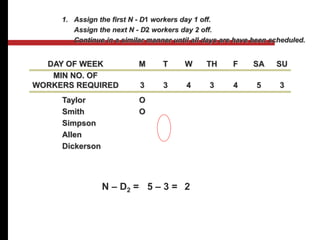
1. Assign the first N - D1 workers day 1 off.
Assign the next N - D2 workers day 2 off.
Continue in a similar manner until all days are have been scheduled.
N – D2 = 5 – 3 = 2
DAY OF WEEK M T W TH F SA SU
MIN NO. OF
WORKERS REQUIRED 3 3 4 3 4 5 3
Taylor O X X O X X X
Smith O X X O X X X
Simpson X O X X O X X
Allen X O X X X X O
Dickerson X X O X X X O
5
5
5
5
5
Work
days
2. If number of workdays for full time employee < 5,
assign remaining workdays so consecutive days off are possible.
DAY OF WEEK M T W TH F SA SU
MIN NO. OF
WORKERS REQUIRED 3 3 4 3 4 5 3
Taylor O X X O X X X
Smith O X X O X X X
Simpson X O X X O X X
Allen X O X X X X O
Dickerson X X O X X X O
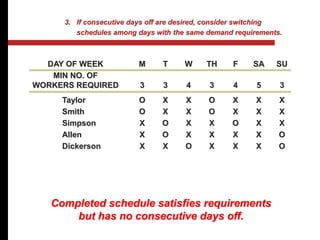
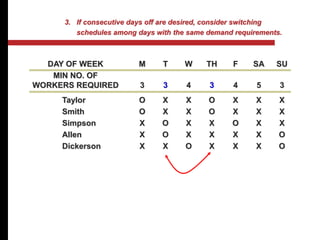
3. If consecutive days off are desired, consider switching
schedules among days with the same demand requirements.
Completed schedule satisfies requirements
but has no consecutive days off.
DAY OF WEEK M T W TH F SA SU
MIN NO. OF
WORKERS REQUIRED 3 3 4 3 4 5 3
Taylor O X X O X X X
Smith O X X O X X X
Simpson X O X X O X X
Allen X O X X X X O
Dickerson X X O X X X O
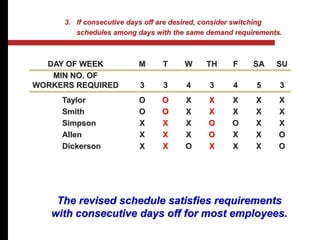
3. If consecutive days off are desired, consider switching
schedules among days with the same demand requirements.
DAY OF WEEK M T W TH F SA SU
MIN NO. OF
WORKERS REQUIRED 3 3 4 3 4 5 3
Taylor O O X X X X X
Smith O O X X X X X
Simpson X X X O O X X
Allen X X X O X X O
Dickerson X X O X X X O
The revised schedule satisfies requirements
with consecutive days off for most employees.
3. If consecutive days off are desired, consider switching
schedules among days with the same demand requirements.

production_scheduling_1.ppt

  • 1.
  • 2.
    Production Planning Process ProcessPlanning Strategic Capacity Planning Aggregate Planning Master Production Scheduling Material Requirements Planning Order Scheduling Weekly Workforce & Customer Scheduling Daily Workforce & Customer Scheduling Long Range Medium Range Short Range Manufacturing Services
  • 3.
    Outline  Scheduling  Recap Sequencing rules  Single resource  Global  Multiple resources
  • 4.
    Scheduling  Deals withthe timing of operations  Specifies when resources are needed to produce a product or provide a service  Helps us decide what order to perform jobs  All organizations perform scheduling to some extent…
  • 5.
    Sequencing Rules  Determinethe order jobs are processed by a resource
  • 6.
    Types of SequencingRules  Sequencing jobs at a single resource  Sequencing jobs across multiple resources
  • 7.
    Sequencing Rules (SingleResource)  Local  First Come First Served  Last Come First Served  Shortest Processing Time  Longest Processing Time  Earliest Due Date  Global  Slack Per Remaining Operation  Critical Ratio Last class
  • 8.
    Sequencing Rules (SingleResource)  Local  First Come First Served  Last Come First Served  Shortest Processing Time  Longest Processing Time  Earliest Due Date  Global  Slack Per Remaining Operation  Critical Ratio
  • 9.
    Global Rules  Considermore than current operation  Look at work at other work centers that needs to be completed before the job is done
  • 10.
    Types of SequencingRules  Sequencing jobs at a single resource  Sequencing jobs across multiple resources
  • 11.
    Scheduling Across MultipleResources  Previous rules considered scheduling (sequencing) jobs at one resource  How can we schedule jobs across multiple resources??
  • 12.
    Two resource problems Supposeyou work with a classmate, Kim on all projects 4 3 5 4 2 2 6 3 5 1 In each project you do the research, then Kim writes the report Processing time (you): Processing time (Kim): You want to complete all projects asap What should be the order for the projects?
  • 13.
    Two resource problems Johnson’sRule 4 3 5 4 2 2 6 3 5 1 1. Find the smallest processing time • If its on the 1st machine, assign the task at the beginning of the sequence and eliminate it from further consideration Processing time (you): Processing time (Kim): What order should you do the projects in? • If its on the 2nd machine, assign the task at the end of the sequence and eliminate it from further consideration 2. Repeat step 1 for all unassigned tasks Sequences tasks to minimize makespan
  • 14.
    Two resource problems Johnson’sRule 4 3 5 4 2 2 6 3 5 1 1. Find the smallest processing time • If its on the 1st machine, assign the task at the beginning of the sequence and eliminate it from further consideration Processing time (you): Processing time (Kim): • If its on the 2nd machine, assign the task at the end of the sequence and eliminate it from further consideration 2. Repeat step 1 for all unassigned tasks Sequence English Sequences tasks to minimize makespan
  • 15.
    Two resource problems Johnson’sRule 4 3 5 4 2 2 6 3 5 1 1. Find the smallest processing time • If its on the 1st machine, assign the task at the beginning of the sequence and eliminate it from further consideration Processing time (you): Processing time (Kim): • If its on the 2nd machine, assign the task at the end of the sequence and eliminate it from further consideration 2. Repeat step 1 for all unassigned tasks Sequence English Management Sequences tasks to minimize makespan
  • 16.
    Two resource problems Johnson’sRule 4 3 5 4 2 2 6 3 5 1 1. Find the smallest processing time • If its on the 1st machine, assign the task at the beginning of the sequence and eliminate it from further consideration Processing time (you): Processing time (Kim): • If its on the 2nd machine, assign the task at the end of the sequence and eliminate it from further consideration 2. Repeat step 1 for all unassigned tasks Sequence English Management Finance Sequences tasks to minimize makespan
  • 17.
    Two resource problems Johnson’sRule 4 3 5 4 2 2 6 3 5 1 1. Find the smallest processing time • If its on the 1st machine, assign the task at the beginning of the sequence and eliminate it from further consideration Processing time (you): Processing time (Kim): • If its on the 2nd machine, assign the task at the end of the sequence and eliminate it from further consideration 2. Repeat step 1 for all unassigned tasks Sequence English Management Finance Marketing Sequences tasks to minimize makespan
  • 18.
    Two resource problems Johnson’sRule 4 3 5 4 2 2 6 3 5 1 1. Find the smallest processing time • If its on the 1st machine, assign the task at the beginning of the sequence and eliminate it from further consideration Processing time (you): Processing time (Kim): • If its on the 2nd machine, assign the task at the end of the sequence and eliminate it from further consideration 2. Repeat step 1 for all unassigned tasks Sequence English Management Finance Marketing Accounting Sequences tasks to minimize makespan
  • 19.
    Two resource problems Johnson’sRule 4 3 5 4 2 2 6 3 5 1 Processing time (you): Processing time (Kim): Sequence English Management Finance Marketing Accounting You Kim Period 1 2 3 4 5 6 7 8 9 10 11 12 13 14 15 16 17 18 19 20 Sequences tasks to minimize makespan
  • 20.
    Two resource problems Johnson’sRule 4 3 5 4 2 2 6 3 5 1 Processing time (you): Processing time (Kim): Sequence English Management Finance Marketing Accounting You Kim Period 1 2 3 4 5 6 7 8 9 10 11 12 13 14 15 16 17 18 19 20 Sequences tasks to minimize makespan
  • 21.
    Two resource problems Johnson’sRule 4 3 5 4 2 2 6 3 5 1 Processing time (you): Processing time (Kim): Sequence English Management Finance Marketing Accounting You Kim Period 1 2 3 4 5 6 7 8 9 10 11 12 13 14 15 16 17 18 19 20 Sequences tasks to minimize makespan
  • 22.
    Two resource problems Johnson’sRule 4 3 5 4 2 2 6 3 5 1 Processing time (you): Processing time (Kim): Sequence English Management Finance Marketing Accounting You Kim Period 1 2 3 4 5 6 7 8 9 10 11 12 13 14 15 16 17 18 19 20 Sequences tasks to minimize makespan
  • 23.
    Two resource problems Johnson’sRule 4 3 5 4 2 2 6 3 5 1 Processing time (you): Processing time (Kim): Sequence English Management Finance Marketing Accounting You Kim Period 1 2 3 4 5 6 7 8 9 10 11 12 13 14 15 16 17 18 19 20 Sequences tasks to minimize makespan
  • 24.
    Two resource problems Johnson’sRule 4 3 5 4 2 2 6 3 5 1 Processing time (you): Processing time (Kim): Sequence English Management Finance Marketing Accounting You Kim Period 1 2 3 4 5 6 7 8 9 10 11 12 13 14 15 16 17 18 19 20 Sequences tasks to minimize makespan
  • 25.
    Two resource problems Johnson’sRule 4 3 5 4 2 2 6 3 5 1 Processing time (you): Processing time (Kim): Sequence English Management Finance Marketing Accounting You Kim Period 1 2 3 4 5 6 7 8 9 10 11 12 13 14 15 16 17 18 19 20 Sequences tasks to minimize makespan
  • 26.
    Two resource problems Johnson’sRule 4 3 5 4 2 2 6 3 5 1 Processing time (you): Processing time (Kim): Sequence English Management Finance Marketing Accounting You Kim Period 1 2 3 4 5 6 7 8 9 10 11 12 13 14 15 16 17 18 19 20 Sequences tasks to minimize makespan
  • 27.
    Two resource problems Johnson’sRule 4 3 5 4 2 2 6 3 5 1 Processing time (you): Processing time (Kim): Sequence English Management Finance Marketing Accounting You Kim Period 1 2 3 4 5 6 7 8 9 10 11 12 13 14 15 16 17 18 19 20 Idle time Sequences tasks to minimize makespan
  • 28.
    More Than 2Resources  Optimal methods don’t exist to minimize makespan  Heuristics  CDS Heuristic
  • 29.
    Sequencing Rules  Local FCFS  LCFS  SPT  LPT  EDD  Global  SPO  CR Single Resource Multiple Resources  2 resources  Johnson’s rule  > 2 resources  heuristics When should you choose one rule over another??
  • 30.
    Guidelines for Selectinga Sequencing Rule 1. SPT most useful when shop is highly congested 2. Use SPO for periods of normal activity 3. Use EDD when only small tardiness values can be tolerated 4. Use FCFS when operating at low-capacity levels
  • 31.
    Employee Scheduling  Laboris very flexible resource  Scheduling workforce is complicated repetitive task  Heuristics commonly used We’ll cover one simple one today…
  • 32.
    Employee Scheduling Heuristic LetN = no. of workers available Di = demand for workers on day i 1. Assign the first N - D1 workers day 1 off. Assign the next N - D2 workers day 2 off. Continue in a similar manner until all days are scheduled. 2. If number of workdays for full time employee < 5, assign remaining workdays so consecutive days off are possible. • Assign any remaining work to part-time employees. 3. If consecutive days off are desired, consider switching schedules among days with the same demand requirements.
  • 33.
    Example DAY OF WEEKM T W TH F SA SU MIN NO. OF WORKERS REQUIRED 3 3 4 3 4 5 3 Taylor Smith Simpson Allen Dickerson
  • 34.
    DAY OF WEEKM T W TH F SA SU MIN NO. OF WORKERS REQUIRED 3 3 4 3 4 5 3 Taylor Smith Simpson Allen Dickerson N = 5 D1 = D2 = D3 = D4 = D5 = D6 = D7 = N – D1 = 5 – 3 = 2 X = day working O = day off 1. Assign the first N - D1 workers day 1 off. Assign the next N - D2 workers day 2 off. Continue in a similar manner until all days are have been scheduled.
  • 35.
    DAY OF WEEKM T W TH F SA SU MIN NO. OF WORKERS REQUIRED 3 3 4 3 4 5 3 Taylor O X X O X X X Smith O X X O X X X Simpson X O X X O X X Allen X O X X X X O Dickerson X X O X X X O 1. Assign the first N - D1 workers day 1 off. Assign the next N - D2 workers day 2 off. Continue in a similar manner until all days are have been scheduled. N – D2 = 5 – 3 = 2
  • 36.
    DAY OF WEEKM T W TH F SA SU MIN NO. OF WORKERS REQUIRED 3 3 4 3 4 5 3 Taylor O X X O X X X Smith O X X O X X X Simpson X O X X O X X Allen X O X X X X O Dickerson X X O X X X O 5 5 5 5 5 Work days 2. If number of workdays for full time employee < 5, assign remaining workdays so consecutive days off are possible.
  • 37.
    DAY OF WEEKM T W TH F SA SU MIN NO. OF WORKERS REQUIRED 3 3 4 3 4 5 3 Taylor O X X O X X X Smith O X X O X X X Simpson X O X X O X X Allen X O X X X X O Dickerson X X O X X X O 3. If consecutive days off are desired, consider switching schedules among days with the same demand requirements. Completed schedule satisfies requirements but has no consecutive days off.
  • 38.
    DAY OF WEEKM T W TH F SA SU MIN NO. OF WORKERS REQUIRED 3 3 4 3 4 5 3 Taylor O X X O X X X Smith O X X O X X X Simpson X O X X O X X Allen X O X X X X O Dickerson X X O X X X O 3. If consecutive days off are desired, consider switching schedules among days with the same demand requirements.
  • 39.
    DAY OF WEEKM T W TH F SA SU MIN NO. OF WORKERS REQUIRED 3 3 4 3 4 5 3 Taylor O O X X X X X Smith O O X X X X X Simpson X X X O O X X Allen X X X O X X O Dickerson X X O X X X O The revised schedule satisfies requirements with consecutive days off for most employees. 3. If consecutive days off are desired, consider switching schedules among days with the same demand requirements.