MERCHANDISE
FINANCIAL
PLANNING
FRAMEWORK
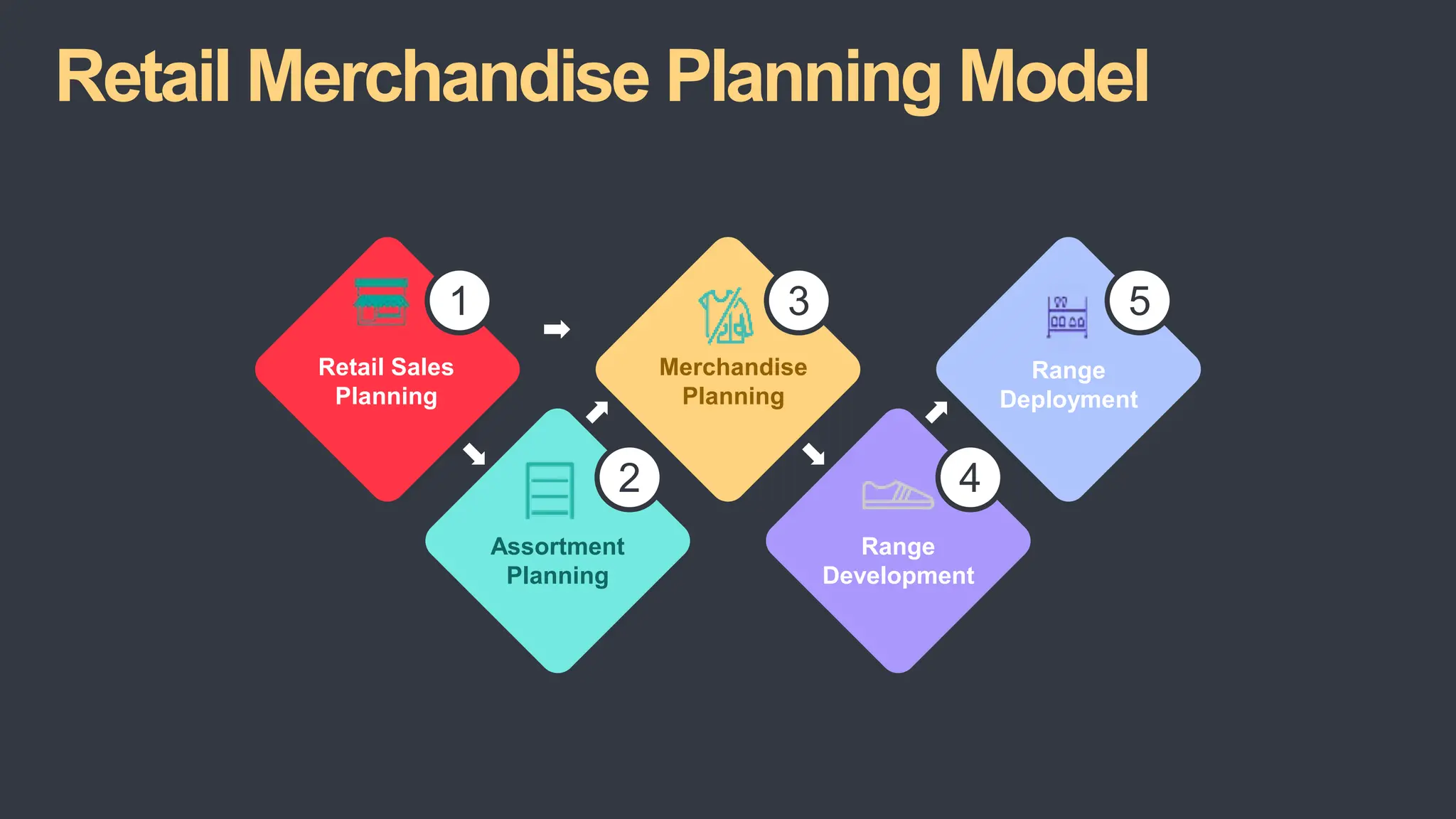
Retail Merchandise Planning Model
1 3 5
2 4
Retail Sales
Planning
Merchandise
Planning
Range
Deployment
Assortment
Planning
Range
Development
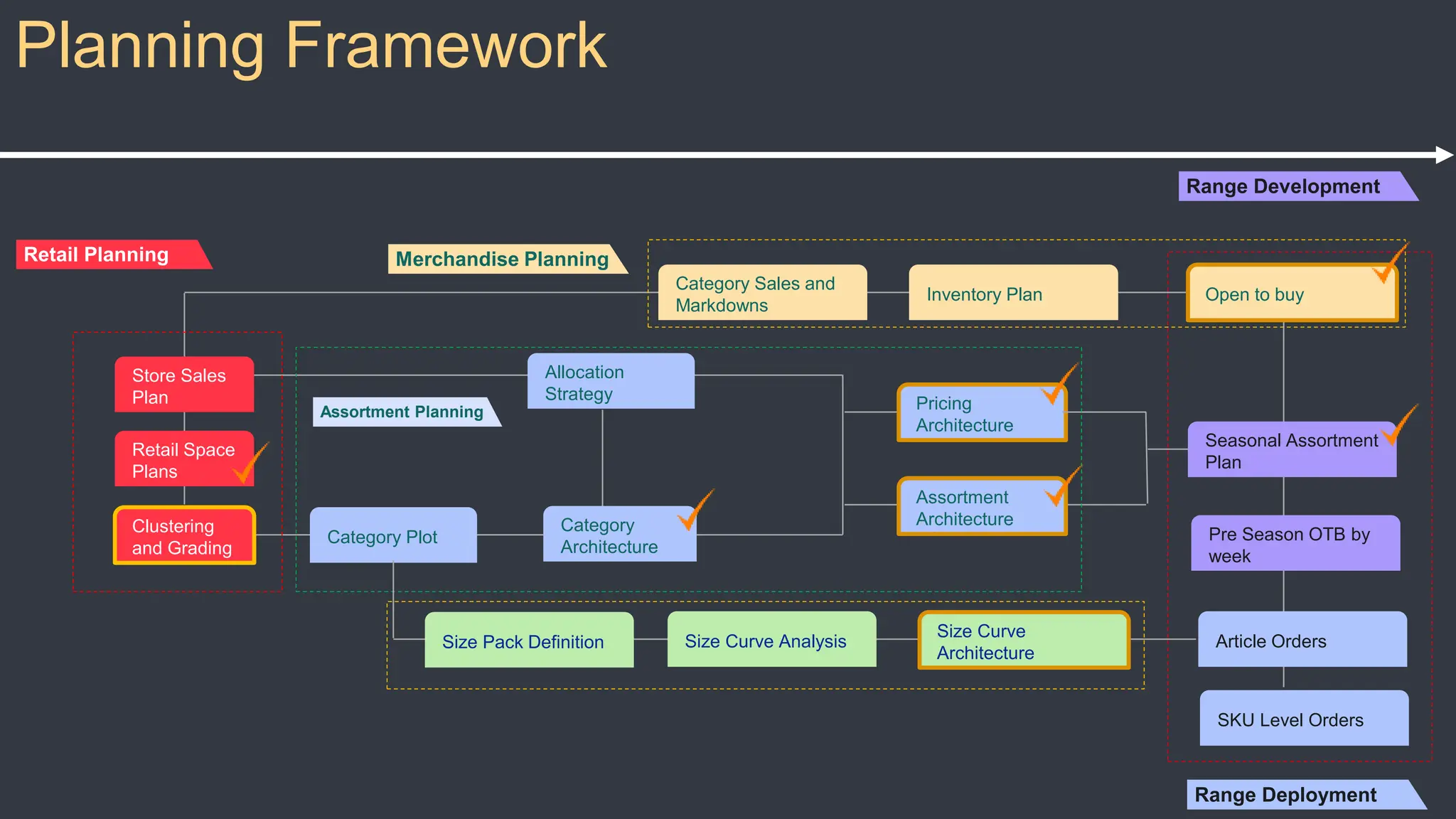
Store Sales
Plan
Retail Space
Plans
Clustering
and Grading
Category Plot
Allocation
Strategy
Category
Architecture
Pricing
Architecture
Seasonal Assortment
Plan
Category Sales and
Markdowns
Inventory Plan Open to buy
Pre Season OTB by
week
Article Orders
Size Curve Analysis
SKU Level Orders
Size Pack Definition
Size Curve
Architecture
Assortment
Architecture
Retail Planning
Assortment Planning
Merchandise Planning
Range Development
Range Deployment
Planning Framework
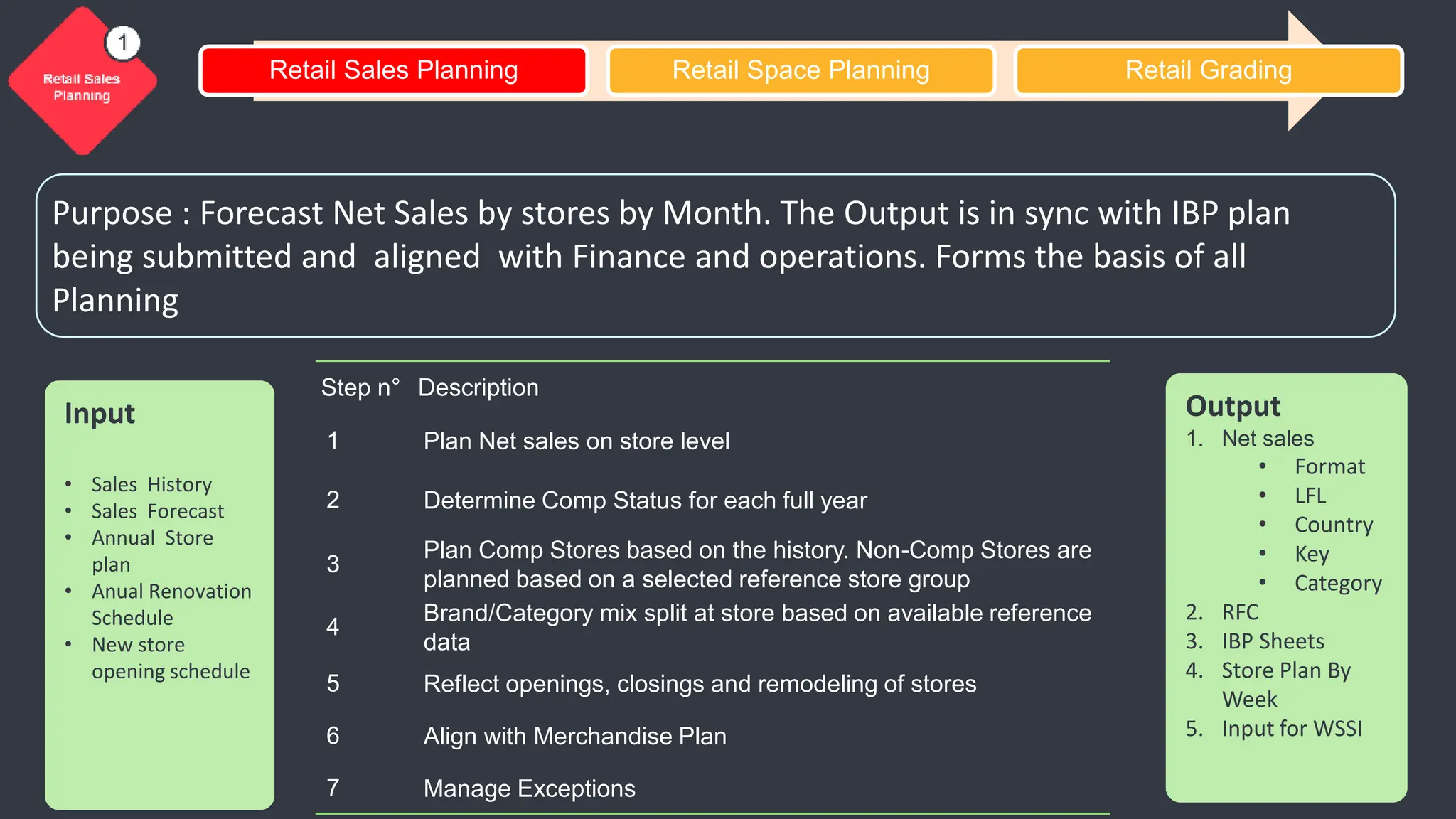
Purpose : Forecast Net Sales by stores by Month. The Output is in sync with IBP plan
being submitted and aligned with Finance and operations. Forms the basis of all
Planning
Input
• Sales History
• Sales Forecast
• Annual Store
plan
• Anual Renovation
Schedule
• New store
opening schedule
Step n° Description
1 Plan Net sales on store level
2 Determine Comp Status for each full year
3
Plan Comp Stores based on the history. Non-Comp Stores are
planned based on a selected reference store group
4
Brand/Category mix split at store based on available reference
data
5 Reflect openings, closings and remodeling of stores
6 Align with Merchandise Plan
7 Manage Exceptions
Output
1. Net sales
• Format
• LFL
• Country
• Key
• Category
2. RFC
3. IBP Sheets
4. Store Plan By
Week
5. Input for WSSI
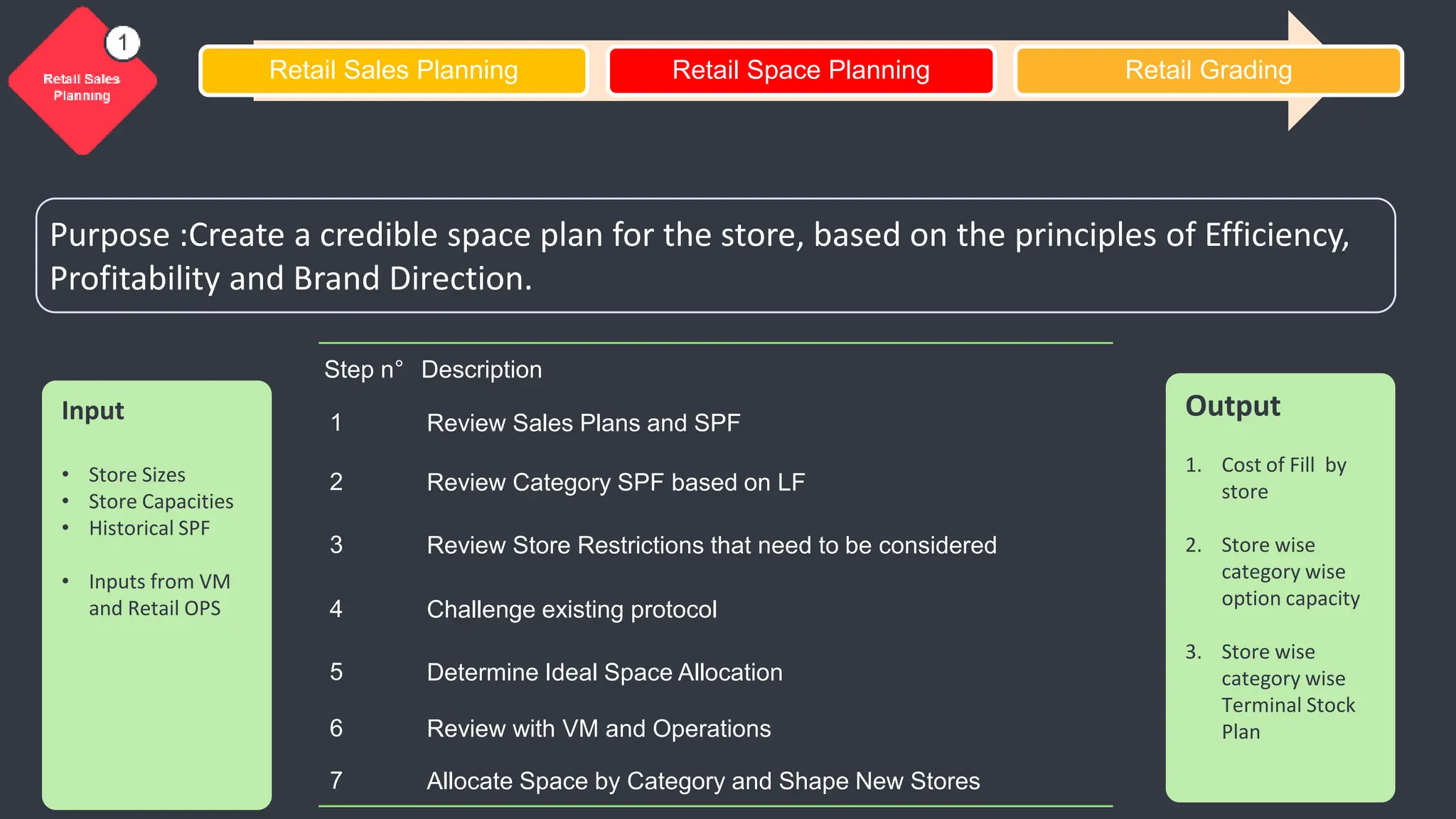
Retail Sales Planning Retail Space Planning Retail Grading
Purpose :Create a credible space plan for the store, based on the principles of Efficiency,
Profitability and Brand Direction.
Input
• Store Sizes
• Store Capacities
• Historical SPF
• Inputs from VM
and Retail OPS
Step n° Description
1 Review Sales Plans and SPF
2 Review Category SPF based on LF
3 Review Store Restrictions that need to be considered
4 Challenge existing protocol
5 Determine Ideal Space Allocation
6 Review with VM and Operations
7 Allocate Space by Category and Shape New Stores
Output
1. Cost of Fill by
store
2. Store wise
category wise
option capacity
3. Store wise
category wise
Terminal Stock
Plan
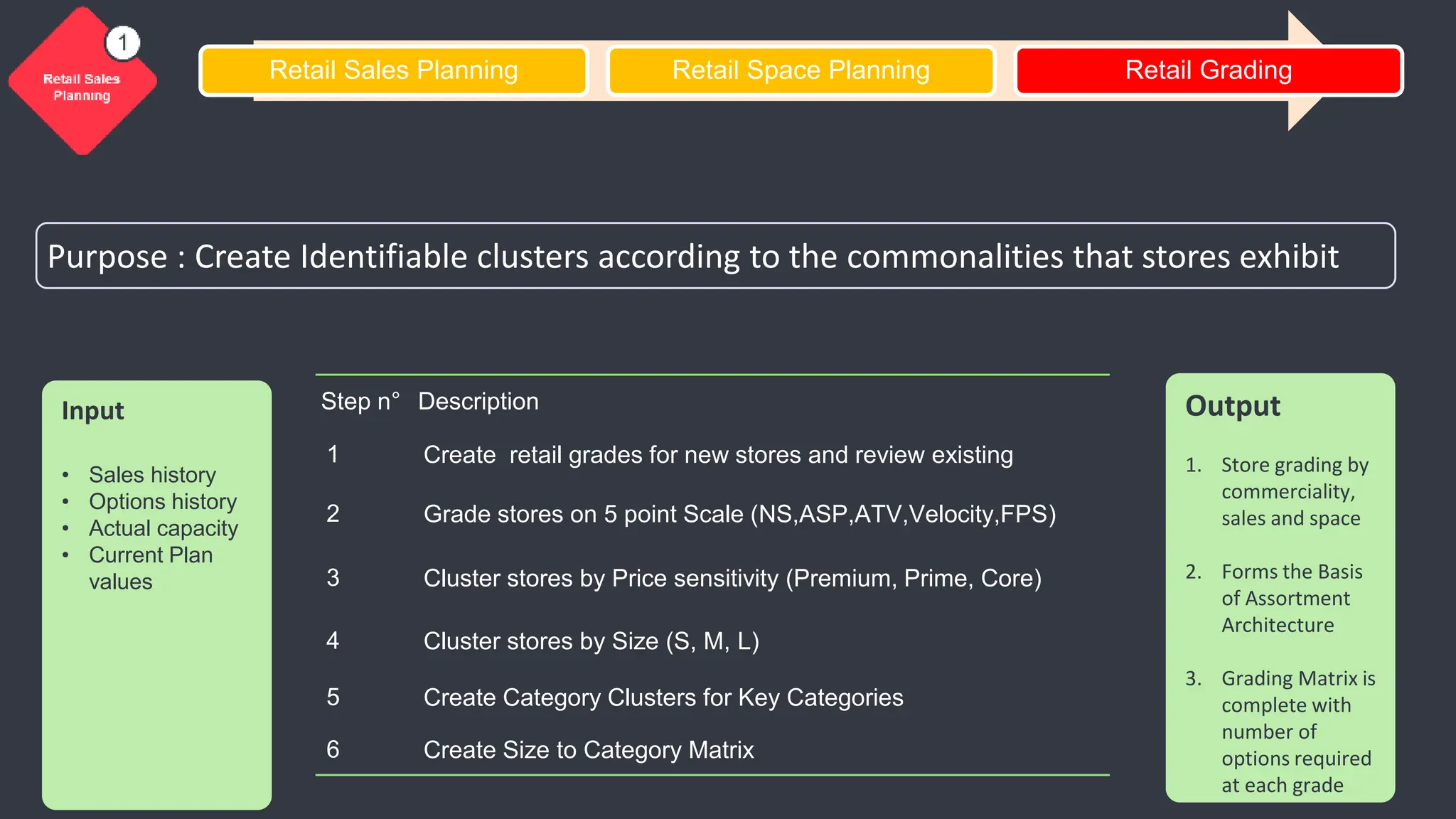
Retail Sales Planning Retail Space Planning Retail Grading
Purpose : Create Identifiable clusters according to the commonalities that stores exhibit
Input
• Sales history
• Options history
• Actual capacity
• Current Plan
values
Step n° Description
1 Create retail grades for new stores and review existing
2 Grade stores on 5 point Scale (NS,ASP,ATV,Velocity,FPS)
3 Cluster stores by Price sensitivity (Premium, Prime, Core)
4 Cluster stores by Size (S, M, L)
5 Create Category Clusters for Key Categories
6 Create Size to Category Matrix
Output
1. Store grading by
commerciality,
sales and space
2. Forms the Basis
of Assortment
Architecture
3. Grading Matrix is
complete with
number of
options required
at each grade
Retail Sales Planning Retail Space Planning Retail Grading
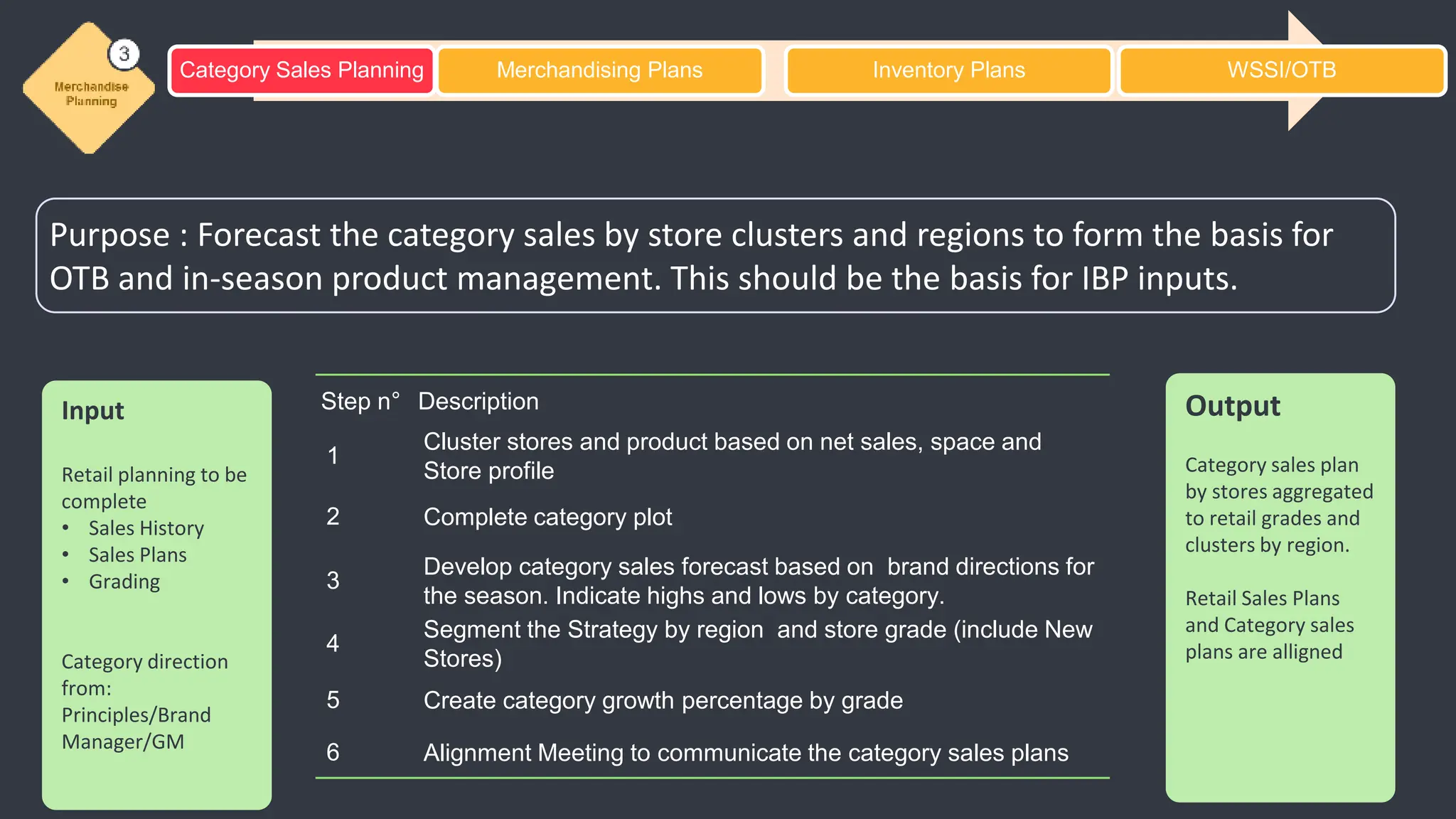
Category Sales Planning Merchandising Plans Inventory Plans WSSI/OTB
Purpose : Forecast the category sales by store clusters and regions to form the basis for
OTB and in-season product management. This should be the basis for IBP inputs.
Input
Retail planning to be
complete
• Sales History
• Sales Plans
• Grading
Category direction
from:
Principles/Brand
Manager/GM
Output
Category sales plan
by stores aggregated
to retail grades and
clusters by region.
Retail Sales Plans
and Category sales
plans are alligned
Step n° Description
1
Cluster stores and product based on net sales, space and
Store profile
2 Complete category plot
3
Develop category sales forecast based on brand directions for
the season. Indicate highs and lows by category.
4
Segment the Strategy by region and store grade (include New
Stores)
5 Create category growth percentage by grade
6 Alignment Meeting to communicate the category sales plans
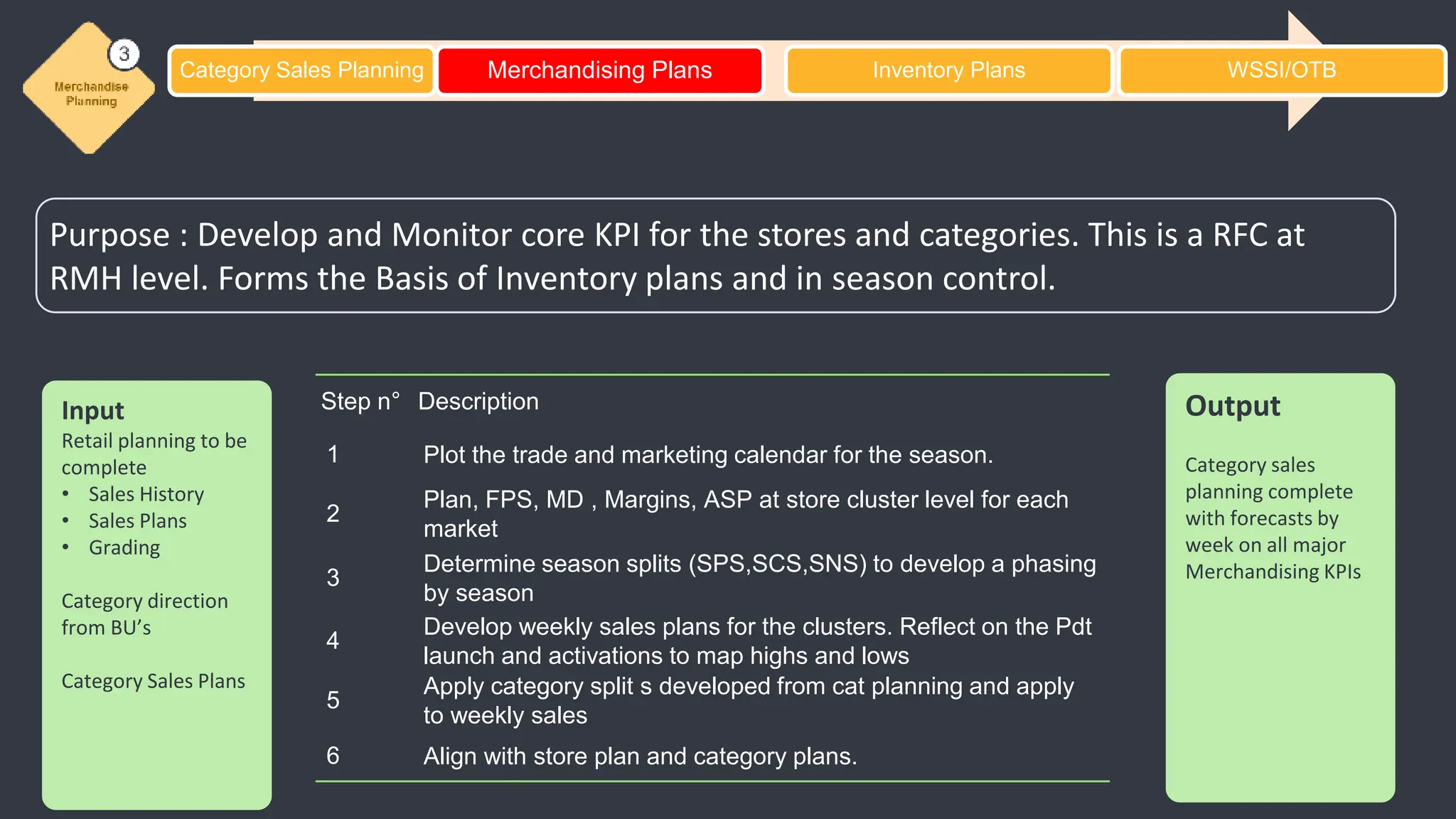
Category Sales Planning Merchandising Plans Inventory Plans WSSI/OTB
Purpose : Develop and Monitor core KPI for the stores and categories. This is a RFC at
RMH level. Forms the Basis of Inventory plans and in season control.
Input
Retail planning to be
complete
• Sales History
• Sales Plans
• Grading
Category direction
from BU’s
Category Sales Plans
Output
Category sales
planning complete
with forecasts by
week on all major
Merchandising KPIs
Step n° Description
1 Plot the trade and marketing calendar for the season.
2
Plan, FPS, MD , Margins, ASP at store cluster level for each
market
3
Determine season splits (SPS,SCS,SNS) to develop a phasing
by season
4
Develop weekly sales plans for the clusters. Reflect on the Pdt
launch and activations to map highs and lows
5
Apply category split s developed from cat planning and apply
to weekly sales
6 Align with store plan and category plans.
Category Sales Planning Merchandising Plans Inventory Plans WSSI/OTB
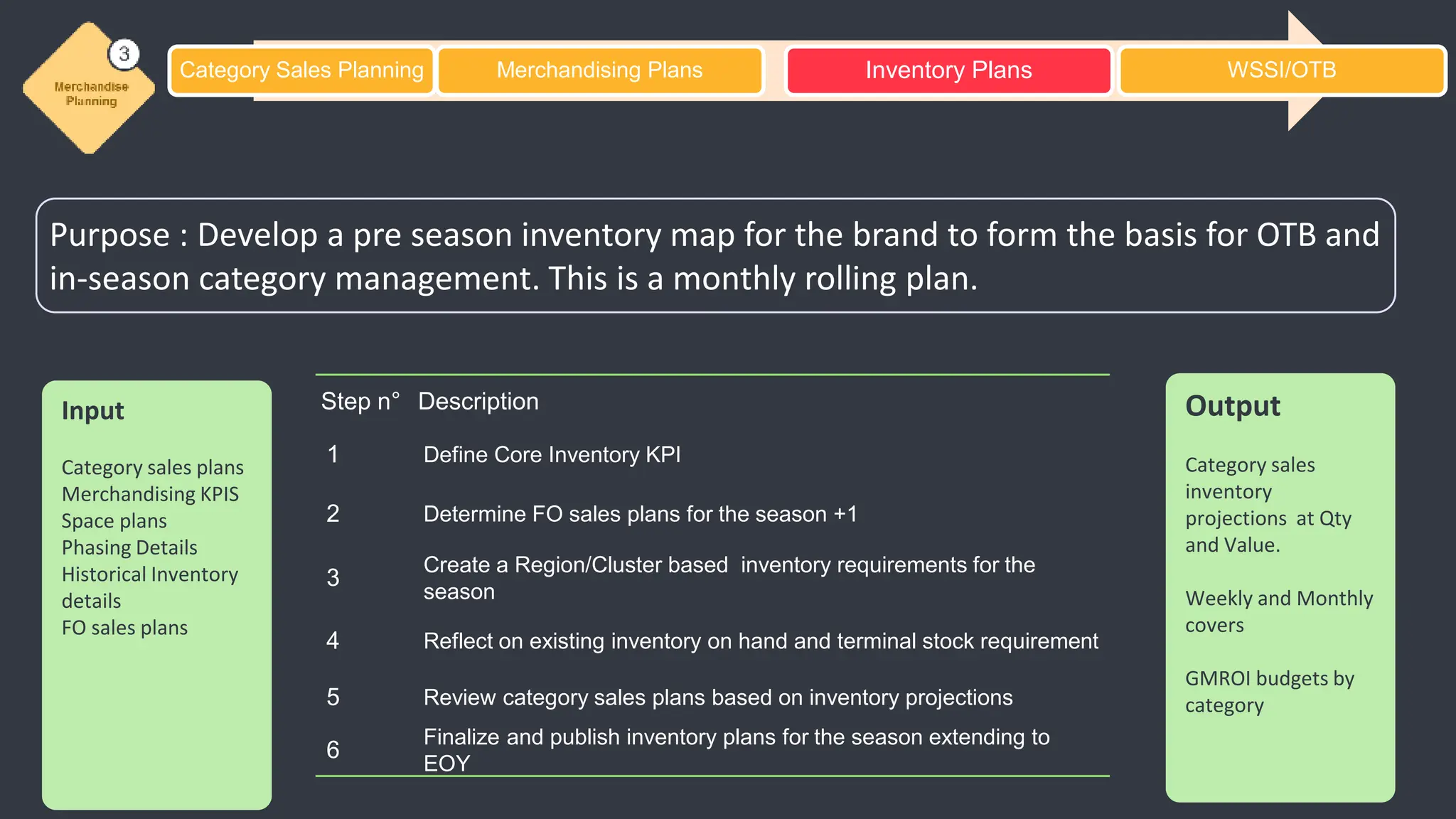
Purpose : Develop a pre season inventory map for the brand to form the basis for OTB and
in-season category management. This is a monthly rolling plan.
Input
Category sales plans
Merchandising KPIS
Space plans
Phasing Details
Historical Inventory
details
FO sales plans
Output
Category sales
inventory
projections at Qty
and Value.
Weekly and Monthly
covers
GMROI budgets by
category
Step n° Description
1 Define Core Inventory KPI
2 Determine FO sales plans for the season +1
3
Create a Region/Cluster based inventory requirements for the
season
4 Reflect on existing inventory on hand and terminal stock requirement
5 Review category sales plans based on inventory projections
6
Finalize and publish inventory plans for the season extending to
EOY
Category Sales Planning Merchandising Plans Inventory Plans WSSI/OTB
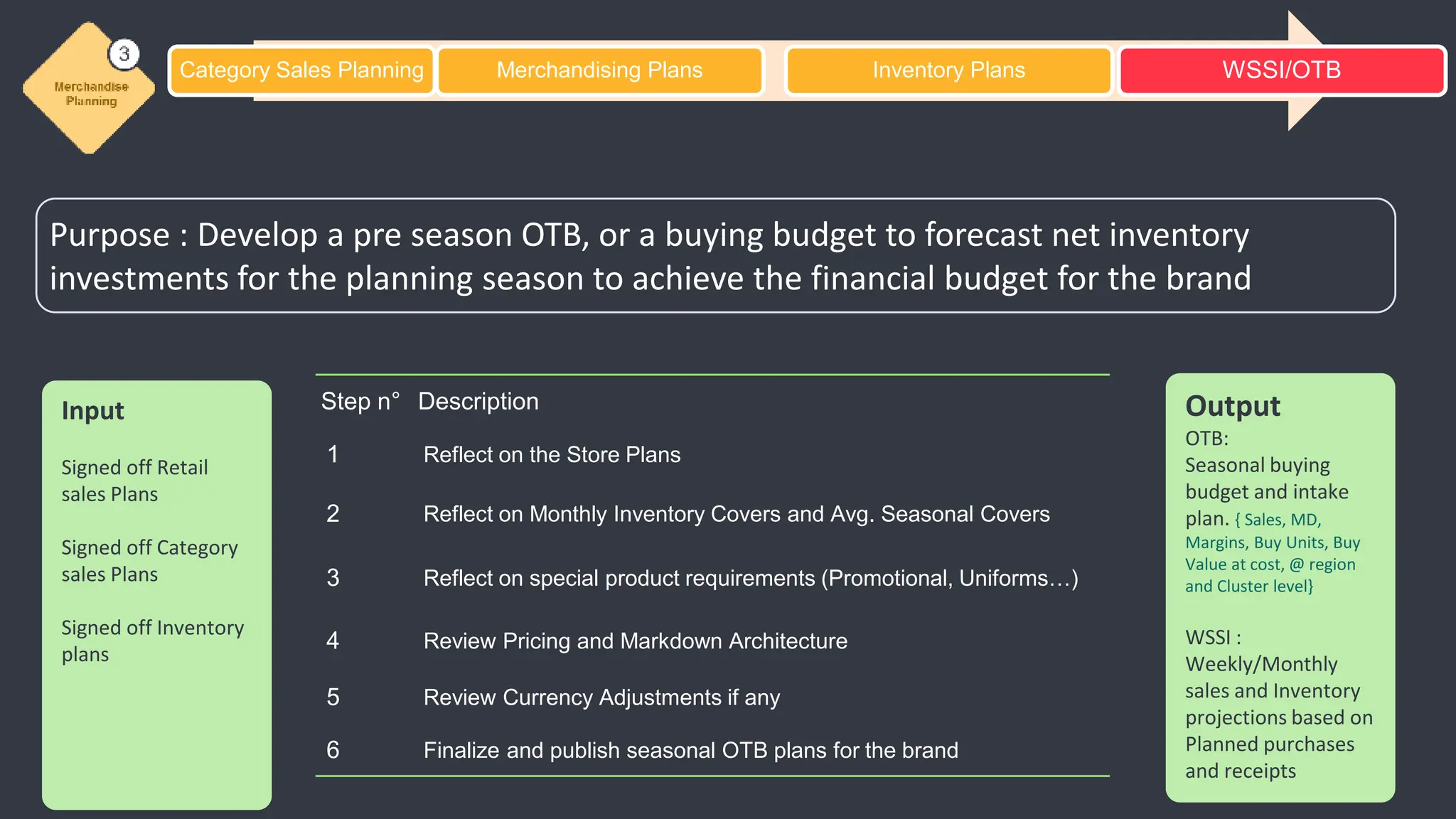
Purpose : Develop a pre season OTB, or a buying budget to forecast net inventory
investments for the planning season to achieve the financial budget for the brand
Input
Signed off Retail
sales Plans
Signed off Category
sales Plans
Signed off Inventory
plans
Output
OTB:
Seasonal buying
budget and intake
plan. { Sales, MD,
Margins, Buy Units, Buy
Value at cost, @ region
and Cluster level}
WSSI :
Weekly/Monthly
sales and Inventory
projections based on
Planned purchases
and receipts
Step n° Description
1 Reflect on the Store Plans
2 Reflect on Monthly Inventory Covers and Avg. Seasonal Covers
3 Reflect on special product requirements (Promotional, Uniforms…)
4 Review Pricing and Markdown Architecture
5 Review Currency Adjustments if any
6 Finalize and publish seasonal OTB plans for the brand

Product Planning Framework -Merchandising

  • 1.
  • 2.
    Retail Merchandise PlanningModel 1 3 5 2 4 Retail Sales Planning Merchandise Planning Range Deployment Assortment Planning Range Development
  • 3.
    Store Sales Plan Retail Space Plans Clustering andGrading Category Plot Allocation Strategy Category Architecture Pricing Architecture Seasonal Assortment Plan Category Sales and Markdowns Inventory Plan Open to buy Pre Season OTB by week Article Orders Size Curve Analysis SKU Level Orders Size Pack Definition Size Curve Architecture Assortment Architecture Retail Planning Assortment Planning Merchandise Planning Range Development Range Deployment Planning Framework
  • 4.
    Purpose : ForecastNet Sales by stores by Month. The Output is in sync with IBP plan being submitted and aligned with Finance and operations. Forms the basis of all Planning Input • Sales History • Sales Forecast • Annual Store plan • Anual Renovation Schedule • New store opening schedule Step n° Description 1 Plan Net sales on store level 2 Determine Comp Status for each full year 3 Plan Comp Stores based on the history. Non-Comp Stores are planned based on a selected reference store group 4 Brand/Category mix split at store based on available reference data 5 Reflect openings, closings and remodeling of stores 6 Align with Merchandise Plan 7 Manage Exceptions Output 1. Net sales • Format • LFL • Country • Key • Category 2. RFC 3. IBP Sheets 4. Store Plan By Week 5. Input for WSSI Retail Sales Planning Retail Space Planning Retail Grading
  • 5.
    Purpose :Create acredible space plan for the store, based on the principles of Efficiency, Profitability and Brand Direction. Input • Store Sizes • Store Capacities • Historical SPF • Inputs from VM and Retail OPS Step n° Description 1 Review Sales Plans and SPF 2 Review Category SPF based on LF 3 Review Store Restrictions that need to be considered 4 Challenge existing protocol 5 Determine Ideal Space Allocation 6 Review with VM and Operations 7 Allocate Space by Category and Shape New Stores Output 1. Cost of Fill by store 2. Store wise category wise option capacity 3. Store wise category wise Terminal Stock Plan Retail Sales Planning Retail Space Planning Retail Grading
  • 6.
    Purpose : CreateIdentifiable clusters according to the commonalities that stores exhibit Input • Sales history • Options history • Actual capacity • Current Plan values Step n° Description 1 Create retail grades for new stores and review existing 2 Grade stores on 5 point Scale (NS,ASP,ATV,Velocity,FPS) 3 Cluster stores by Price sensitivity (Premium, Prime, Core) 4 Cluster stores by Size (S, M, L) 5 Create Category Clusters for Key Categories 6 Create Size to Category Matrix Output 1. Store grading by commerciality, sales and space 2. Forms the Basis of Assortment Architecture 3. Grading Matrix is complete with number of options required at each grade Retail Sales Planning Retail Space Planning Retail Grading
  • 7.
    Category Sales PlanningMerchandising Plans Inventory Plans WSSI/OTB Purpose : Forecast the category sales by store clusters and regions to form the basis for OTB and in-season product management. This should be the basis for IBP inputs. Input Retail planning to be complete • Sales History • Sales Plans • Grading Category direction from: Principles/Brand Manager/GM Output Category sales plan by stores aggregated to retail grades and clusters by region. Retail Sales Plans and Category sales plans are alligned Step n° Description 1 Cluster stores and product based on net sales, space and Store profile 2 Complete category plot 3 Develop category sales forecast based on brand directions for the season. Indicate highs and lows by category. 4 Segment the Strategy by region and store grade (include New Stores) 5 Create category growth percentage by grade 6 Alignment Meeting to communicate the category sales plans
  • 8.
    Category Sales PlanningMerchandising Plans Inventory Plans WSSI/OTB Purpose : Develop and Monitor core KPI for the stores and categories. This is a RFC at RMH level. Forms the Basis of Inventory plans and in season control. Input Retail planning to be complete • Sales History • Sales Plans • Grading Category direction from BU’s Category Sales Plans Output Category sales planning complete with forecasts by week on all major Merchandising KPIs Step n° Description 1 Plot the trade and marketing calendar for the season. 2 Plan, FPS, MD , Margins, ASP at store cluster level for each market 3 Determine season splits (SPS,SCS,SNS) to develop a phasing by season 4 Develop weekly sales plans for the clusters. Reflect on the Pdt launch and activations to map highs and lows 5 Apply category split s developed from cat planning and apply to weekly sales 6 Align with store plan and category plans.
  • 9.
    Category Sales PlanningMerchandising Plans Inventory Plans WSSI/OTB Purpose : Develop a pre season inventory map for the brand to form the basis for OTB and in-season category management. This is a monthly rolling plan. Input Category sales plans Merchandising KPIS Space plans Phasing Details Historical Inventory details FO sales plans Output Category sales inventory projections at Qty and Value. Weekly and Monthly covers GMROI budgets by category Step n° Description 1 Define Core Inventory KPI 2 Determine FO sales plans for the season +1 3 Create a Region/Cluster based inventory requirements for the season 4 Reflect on existing inventory on hand and terminal stock requirement 5 Review category sales plans based on inventory projections 6 Finalize and publish inventory plans for the season extending to EOY
  • 10.
    Category Sales PlanningMerchandising Plans Inventory Plans WSSI/OTB Purpose : Develop a pre season OTB, or a buying budget to forecast net inventory investments for the planning season to achieve the financial budget for the brand Input Signed off Retail sales Plans Signed off Category sales Plans Signed off Inventory plans Output OTB: Seasonal buying budget and intake plan. { Sales, MD, Margins, Buy Units, Buy Value at cost, @ region and Cluster level} WSSI : Weekly/Monthly sales and Inventory projections based on Planned purchases and receipts Step n° Description 1 Reflect on the Store Plans 2 Reflect on Monthly Inventory Covers and Avg. Seasonal Covers 3 Reflect on special product requirements (Promotional, Uniforms…) 4 Review Pricing and Markdown Architecture 5 Review Currency Adjustments if any 6 Finalize and publish seasonal OTB plans for the brand