The senior dev
An opinionated take
Luciano Mammino (@loige)
2022-03-10
Agenda
Discuss what is expected from a senior
software engineer (skills, mindset, duties)
Packed with opinions* (my own and m o re)
For devs to be inspired
For managers to hire, set expectations,
support, and evaluate
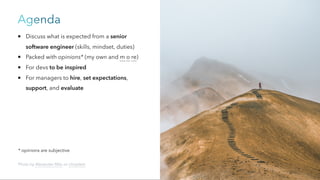
Photo by Alexander Milo on Unsplash
* opinions are subjective
Meta slide
loige.link/senior
These slides are already online if you want to grab them! šŸ‘‡
Hello
šŸ‘‹I'm Luciano
14 years in the industry
Senior Architect at fourTheorem
Co-author of Node.js design Patterns
ā¤ļø
Node.js, AWS & learning Rust šŸ¦€
Let's connect
Blog
Twitter
LinkedIn
GitHub
Twitch
YouTube
nodejsdesignpatterns.com
A senior engineer
The definition changes in every company
There are many levels of seniority: senior,
staff engineer, principal, etc.
My definition: moves projects & people
forward ("Force multiplier")
Team player, not a hero (or rockstar,
superstar, magician, unicorn, etc.)
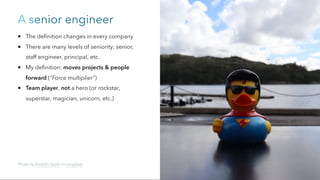
Photo by Rudolfo Spott on Unsplash
It’s not just about time
or age
5 years of experience
At least 28 years old
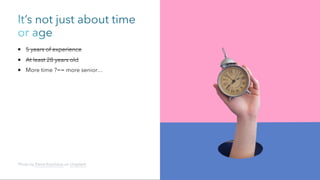
More time ?== more senior…
Photo by Elena Koycheva on Unsplash
Skills
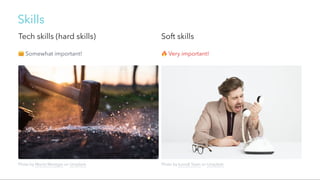
Tech skills (hard skills) Soft skills
šŸ¤—Somewhat important! šŸ”„Very important!
Photo by Moritz Mentges on Unsplash Photo by Icons8 Team on Unsplash
Tech skills
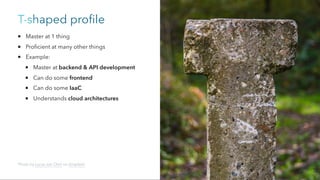
T-shaped profile
Master at 1 thing
Proficient at many other things
Example:
Master at backend & API development
Can do some frontend
Can do some IaaC
Understands cloud architectures
Photo by Lucas van Oort on Unsplash
Broad understanding
Understand the platform
Architecture
Code Structure
Testing
Deployment process
Scalability model
Photo by Jen Theodore on Unsplash
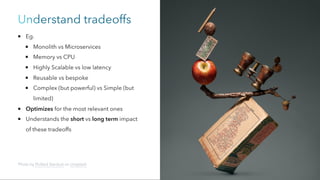
Understand tradeoffs
Eg.
Monolith vs Microservices
Memory vs CPU
Highly Scalable vs low latency
Reusable vs bespoke
Complex (but powerful) vs Simple (but
limited)
Optimizes for the most relevant ones
Understands the short vs long term impact
of these tradeoffs
Photo by Pickled Stardust on Unsplash
Flexible
Comfortable with different programming
languages
…and paradigms:
OOP vs Functional
Declarative vs Imperative
Compiled vs Interpreted
Can solve the same problem in different
ways and with different tools
Photo by Wesley Tingey on Unsplash
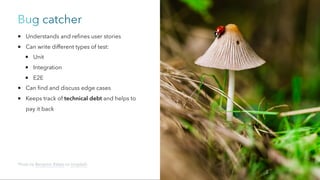
Bug catcher
Understands and refines user stories
Can write different types of test:
Unit
Integration
E2E
Can find and discuss edge cases
Keeps track of technical debt and helps to
pay it back
Photo by Benjamin BalƔzs on Unsplash
Good advisor
Understand patterns and best practices
Can suggest patterns that have good long
term effects
…and avoids other that might lead to
problems
Suggests but does not mandate
Photo by Diego PH on Unsplash
Soft skills
Active lever
Ask hard questions
Takes leadership to find what they don’t
know
Is a bridge between product and
technology
Know when (and how) to say NO
Photo by Florian Olivo on Unsplash
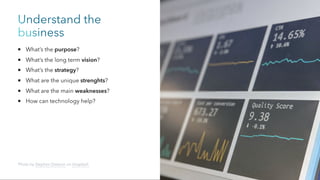
Understand the
business
What’s the purpose?
What’s the long term vision?
What’s the strategy?
What are the unique strenghts?
What are the main weaknesses?
How can technology help?
Photo by Stephen Dawson on Unsplash
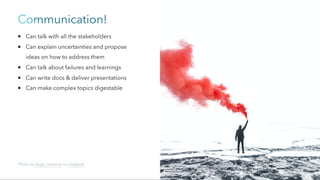
Communication!
Can talk with all the stakeholders
Can explain uncertainties and propose
ideas on how to address them
Can talk about failures and learnings
Can write docs & deliver presentations
Can make complex topics digestable
Photo by Hugo Jehanne on Unsplash
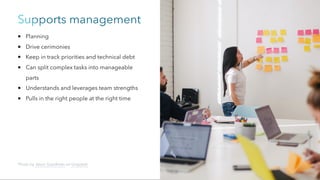
Supports management
Planning
Drive cerimonies
Keep in track priorities and technical debt
Can split complex tasks into manageable
parts
Understands and leverages team strengths
Pulls in the right people at the right time
Photo by Jason Goodman on Unsplash
Autonomy
Can drive projects that require research and
grind
But aware of avoiding silos
Knows how to get unstuck
Ask for help
Research and experiment
Read the docs
Read and understand existing code
Photo by Taelynn Christopher on Unsplash
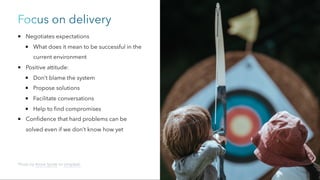
Focus on delivery
Negotiates expectations
What does it mean to be successful in the
current environment
Positive attitude:
Don’t blame the system
Propose solutions
Facilitate conversations
Help to find compromises
Confidence that hard problems can be
solved even if we don’t know how yet
Photo by Annie Spratt on Unsplash
How to grow
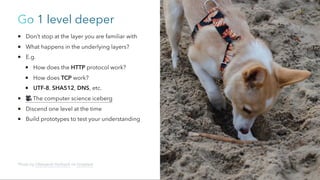
Go 1 level deeper
Don’t stop at the layer you are familiar with
What happens in the underlying layers?
E.g.
How does the HTTP protocol work?
How does TCP work?
UTF-8, SHA512, DNS, etc.
šŸŽ„The computer science iceberg
Discend one level at the time
Build prototypes to test your understanding
Photo by Oleksandr Horbach on Unsplash
Have fun
Learning new stuff can be fun
You can build utilities and side projects
Showcase what you learned to your peers
Can you apply these learnings at work?
Hackaton and free study days are a great
way to spend work time for engineering
growth
Photo by Nathan Dumlao on Unsplash
Pair programming
Try to pair with as many people as possible
within the org
You can probably learn something from
everyone (even from the most junior)
You can probably teach something to
everyone (even to the most senior)
Not everyone loves pair programming, so
try alternatives:
Interactive code reviews
Show and tell sessions
Photo by Geran de Klerk on Unsplash
Create content
Articles, Talks, Videos, Twitter threads, Etc.
You don’t need to be an expert to share
something new you learned
Make it a habit
Creating content will massively improve
your communication skills
āš›ļø
Atomic essays
Photo by Florian Klauer on Unsplash
Keep a positive
attitude
With enough time and money the team can
probably solve everything
With sligthly less money and time you can
find decent compromises šŸ˜…
Don’t be picky about technology or style
Support other people’s ideas (even if you
would have done it differently)
Photo by Nathan Dumlao on Unsplash
Do the hard work
Volunteer for that refactoring that no one
wants to do
Get involved in parts that people generally
avoid because they are hard or messy
Try to make things a little bit better!
Photo by Jess Zoerb on Unsplash
Additional resources
Progression.fyi
Career Ladders
20 Micro-Habits Of High-Impact Software
Engineers
Engineering levels at Carta
Photo by Sharon McCutcheon on Unsplash
We cannot excel at everything
Photo by Marek Szturc on Unsplash
But we should know our strengths and weaknesses
Photo by Marek Szturc on Unsplash
Work with our team to amplify strenghts and compensate
weaknesses
Photo by Marek Szturc on Unsplash
…and strive to get better every day!
Photo by Marek Szturc on Unsplash
Thanks!
Luciano Mammino (@loige)
loige.link/senior
Cover photo by TK on Unsplash

The senior dev

  • 1.
    The senior dev Anopinionated take Luciano Mammino (@loige) 2022-03-10
  • 2.
    Agenda Discuss what isexpected from a senior software engineer (skills, mindset, duties) Packed with opinions* (my own and m o re) For devs to be inspired For managers to hire, set expectations, support, and evaluate Photo by Alexander Milo on Unsplash * opinions are subjective
  • 3.
    Meta slide loige.link/senior These slidesare already online if you want to grab them! šŸ‘‡
  • 4.
    Hello šŸ‘‹I'm Luciano 14 yearsin the industry Senior Architect at fourTheorem Co-author of Node.js design Patterns ā¤ļø Node.js, AWS & learning Rust šŸ¦€ Let's connect Blog Twitter LinkedIn GitHub Twitch YouTube nodejsdesignpatterns.com
  • 5.
    A senior engineer Thedefinition changes in every company There are many levels of seniority: senior, staff engineer, principal, etc. My definition: moves projects & people forward ("Force multiplier") Team player, not a hero (or rockstar, superstar, magician, unicorn, etc.) Photo by Rudolfo Spott on Unsplash
  • 6.
    It’s not justabout time or age 5 years of experience At least 28 years old More time ?== more senior… Photo by Elena Koycheva on Unsplash
  • 7.
    Skills Tech skills (hardskills) Soft skills šŸ¤—Somewhat important! šŸ”„Very important! Photo by Moritz Mentges on Unsplash Photo by Icons8 Team on Unsplash
  • 8.
  • 9.
    T-shaped profile Master at1 thing Proficient at many other things Example: Master at backend & API development Can do some frontend Can do some IaaC Understands cloud architectures Photo by Lucas van Oort on Unsplash
  • 10.
    Broad understanding Understand theplatform Architecture Code Structure Testing Deployment process Scalability model Photo by Jen Theodore on Unsplash
  • 11.
    Understand tradeoffs Eg. Monolith vsMicroservices Memory vs CPU Highly Scalable vs low latency Reusable vs bespoke Complex (but powerful) vs Simple (but limited) Optimizes for the most relevant ones Understands the short vs long term impact of these tradeoffs Photo by Pickled Stardust on Unsplash
  • 12.
    Flexible Comfortable with differentprogramming languages …and paradigms: OOP vs Functional Declarative vs Imperative Compiled vs Interpreted Can solve the same problem in different ways and with different tools Photo by Wesley Tingey on Unsplash
  • 13.
    Bug catcher Understands andrefines user stories Can write different types of test: Unit Integration E2E Can find and discuss edge cases Keeps track of technical debt and helps to pay it back Photo by Benjamin BalƔzs on Unsplash
  • 14.
    Good advisor Understand patternsand best practices Can suggest patterns that have good long term effects …and avoids other that might lead to problems Suggests but does not mandate Photo by Diego PH on Unsplash
  • 15.
  • 16.
    Active lever Ask hardquestions Takes leadership to find what they don’t know Is a bridge between product and technology Know when (and how) to say NO Photo by Florian Olivo on Unsplash
  • 17.
    Understand the business What’s thepurpose? What’s the long term vision? What’s the strategy? What are the unique strenghts? What are the main weaknesses? How can technology help? Photo by Stephen Dawson on Unsplash
  • 18.
    Communication! Can talk withall the stakeholders Can explain uncertainties and propose ideas on how to address them Can talk about failures and learnings Can write docs & deliver presentations Can make complex topics digestable Photo by Hugo Jehanne on Unsplash
  • 19.
    Supports management Planning Drive cerimonies Keepin track priorities and technical debt Can split complex tasks into manageable parts Understands and leverages team strengths Pulls in the right people at the right time Photo by Jason Goodman on Unsplash
  • 20.
    Autonomy Can drive projectsthat require research and grind But aware of avoiding silos Knows how to get unstuck Ask for help Research and experiment Read the docs Read and understand existing code Photo by Taelynn Christopher on Unsplash
  • 21.
    Focus on delivery Negotiatesexpectations What does it mean to be successful in the current environment Positive attitude: Don’t blame the system Propose solutions Facilitate conversations Help to find compromises Confidence that hard problems can be solved even if we don’t know how yet Photo by Annie Spratt on Unsplash
  • 22.
  • 23.
    Go 1 leveldeeper Don’t stop at the layer you are familiar with What happens in the underlying layers? E.g. How does the HTTP protocol work? How does TCP work? UTF-8, SHA512, DNS, etc. šŸŽ„The computer science iceberg Discend one level at the time Build prototypes to test your understanding Photo by Oleksandr Horbach on Unsplash
  • 24.
    Have fun Learning newstuff can be fun You can build utilities and side projects Showcase what you learned to your peers Can you apply these learnings at work? Hackaton and free study days are a great way to spend work time for engineering growth Photo by Nathan Dumlao on Unsplash
  • 25.
    Pair programming Try topair with as many people as possible within the org You can probably learn something from everyone (even from the most junior) You can probably teach something to everyone (even to the most senior) Not everyone loves pair programming, so try alternatives: Interactive code reviews Show and tell sessions Photo by Geran de Klerk on Unsplash
  • 26.
    Create content Articles, Talks,Videos, Twitter threads, Etc. You don’t need to be an expert to share something new you learned Make it a habit Creating content will massively improve your communication skills āš›ļø Atomic essays Photo by Florian Klauer on Unsplash
  • 27.
    Keep a positive attitude Withenough time and money the team can probably solve everything With sligthly less money and time you can find decent compromises šŸ˜… Don’t be picky about technology or style Support other people’s ideas (even if you would have done it differently) Photo by Nathan Dumlao on Unsplash
  • 28.
    Do the hardwork Volunteer for that refactoring that no one wants to do Get involved in parts that people generally avoid because they are hard or messy Try to make things a little bit better! Photo by Jess Zoerb on Unsplash
  • 29.
    Additional resources Progression.fyi Career Ladders 20Micro-Habits Of High-Impact Software Engineers Engineering levels at Carta Photo by Sharon McCutcheon on Unsplash
  • 30.
    We cannot excelat everything Photo by Marek Szturc on Unsplash
  • 31.
    But we shouldknow our strengths and weaknesses Photo by Marek Szturc on Unsplash
  • 32.
    Work with ourteam to amplify strenghts and compensate weaknesses Photo by Marek Szturc on Unsplash
  • 33.
    …and strive toget better every day! Photo by Marek Szturc on Unsplash
  • 34.