Process Wind Tunnel
A Novel Capability for Data-driven Business Process Improvement
Sudhendu Rai
Intelligent Automation Innovation (June 8th-9th, 2021)
PEX (Process Excellence Network)
NOTICE: THE VIEWS AND OPINIONS EXPRESSED IN
THIS PRESENTATION ARE PROVIDED FOR GENERAL
INFORMATIONAL PURPOSES ONLY. SUCH VIEWS AND
OPINIONS ARE THOSE OF THE PRESENTERS AND THE
PRESENTERS ALONE, AND DO NOT NECESSARILY
REPRESENT OR OTHERWISE REFLECT THE VIEWS OR
OPINIONS OF AMERICAN INTERNATIONAL GROUP, INC.
OR ANY OF ITS SUBSIDIARIES OR AFFILIATES.
Improve
Productivity
Improve service
offering
Reduce
Operational
Risk
Leverage Operational and Business Insights
Value Proposition
Address opportunities to reduce operational risk, improve customer service, enhance
quality, and / or increase capacity, through process redesign and automation
3
• Streamline and reduce
complexity
• Optimize cost and
performance by at least
20%
• Automate manual steps
• Reduce cycle time
• Reduce or improve
management of “defects”
• Free up scarce human
capital for higher and
better uses
• Apply metrics to improve
process management
Compute and track
key process metrics
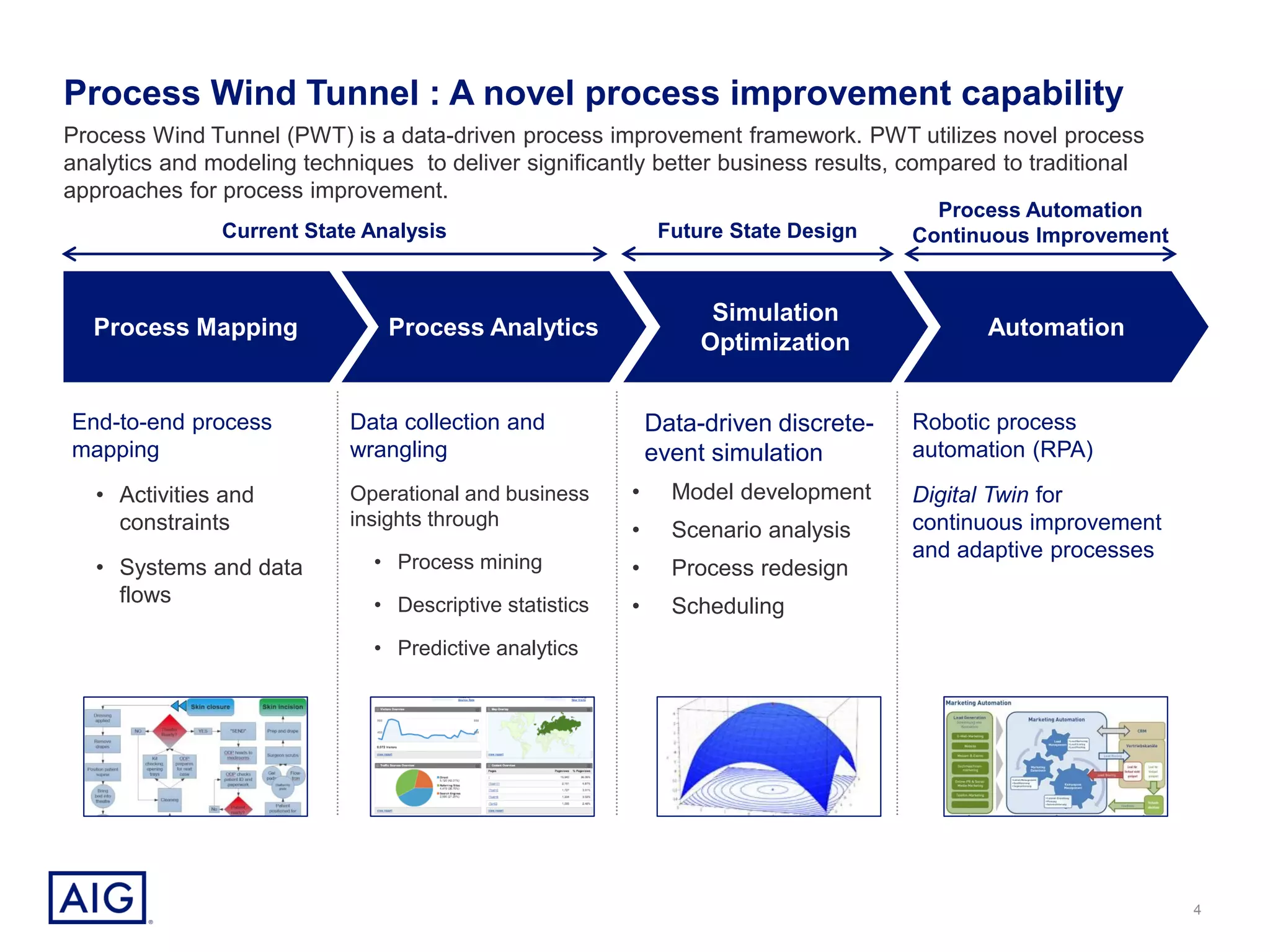
Process Wind Tunnel (PWT) is a data-driven process improvement framework. PWT utilizes novel process
analytics and modeling techniques to deliver significantly better business results, compared to traditional
approaches for process improvement.
Process Wind Tunnel : A novel process improvement capability
Process Mapping
End-to-end process
mapping
• Activities and
constraints
• Systems and data
flows
Process Analytics
Data collection and
wrangling
Operational and business
insights through
• Process mining
• Descriptive statistics
• Predictive analytics
Simulation
Optimization
Data-driven discrete-
event simulation
• Model development
• Scenario analysis
• Process redesign
• Scheduling
Automation
Robotic process
automation (RPA)
Digital Twin for
continuous improvement
and adaptive processes
4
Current State Analysis Future State Design
Process Automation
Continuous Improvement
Other (non-AIG) case studies on Process Optimization
Data-driven process optimization solution has been developed and deployed in other industries and
processes resulting in significant productivity gains. Some examples are listed below.
Link to the Above Presentations: https://www.slideshare.net/SudhenduRai/presentations
Large Transaction Print
Operations Optimization resulting
in 32-46% improvement in
productivity metrics
Deployment of process
optimization solution across 100+
operations resulted in $200M in
incremental profits (Edelman
finalist)
A journal paper describing the
software toolkit and enterprise
solution deployment
Software toolkit development for
data-driven process optimization
Data-driven process optimization
of transaction processing
enterprise resulting in multi-
million dollar cost savings and
performance improvements
Optimization of credit card
operations resulting in 12%
productivity and 31% cycle time
improvement
5
Data Collection
Process data is collected from multiple sources
using different extraction techniques
6
Process
Wind
Tunnel
Data
Relational
databases
Disjointed
spreadsheets
Web-
applications
scraping using
RPA or similar
technologies
Unstructured
documents
using text
mining
API to existing
applications
Manually
logged
process data
in
spreadsheets
and word
documents
Email server
(Outlook)
Process Mapping – Business Function View
Process map developed by the operations team
The original process map developed by the operations team is a high level map to show the connection
among systems and what the process flow is.
7
Other
Databases
Sys
A
Dept
B
Dept
A
DB 1
DB 2
DB 3 DB 4 DB 5
DB 6
Soft-
ware Sys A
Database
Process Mapping– Activity Centric View
Process Map developed by the Process Wind Tunnel team
This version shows more clearly each transitions/handoffs between different teams, and is easier to identify pain
points and bottlenecks. Focuses on activity based view of the process – what activities are performed to
accomplish the business functions within the process.
8
Trade
Settlement
Team
A
Trade
Settlement
Team
B
Team B performs
functions of Team A
when there is overflow
after a certain time
Trade Settlement Process – IT System and Business Application View
The main events and associated IT applications within the business process
This version highlights the business applications utilized in the process
9
Different color arrows do not indicate the same flow, it is simply a measure to avoid confusion where lines cross.
Trade
Executed in System
A
Trade automatically
released to System B
then viewed by Ops
team in System A
Trade Matched
In System B1
Trade Matched
In System B2
Near/Match Platform
To track mismatched
trades
Trading instructions
sent to custodian via
System A/System C
Trading instructions
sent to custodian via
email
Trade matched via
email
Trade settled and
tracked in a daily
report
Failed trades tracked
in System A/System
D
Process Mining
Process mining begins with a sequence of
process activities (event-logs)
10
Case Activity
1 A
2 A
1 B
1 C
3 A
2 C
3 B
2 B
1 D
2 D
2 E
3 C
3 D
1 E
3 D
3 E
11
Case Activity
1 A
2 A
1 B
1 C
3 A
2 C
3 B
2 B
1 D
2 D
2 E
3 C
3 D
1 E
3 D
3 E
A
B
C
D
E
Case 1
Process Mining
12
Case Activity
1 A
2 A
1 B
1 C
3 A
2 C
3 B
2 B
1 D
2 D
2 E
3 C
3 D
1 E
3 D
3 E
A
B
C
D
E
A
C
B
D
E
Case 1 Case 2
Process Mining
13
Case Activity
1 A
2 A
1 B
1 C
3 A
2 C
3 B
2 B
1 D
2 D
2 E
3 C
3 D
1 E
3 D
3 E
A
B
C
D
E
A
C
B
D
E
A
B
C
D
E
D
Case 1 Case 2 Case 3
Process Mining
14
Case Activity
1 A
2 A
1 B
1 C
3 A
2 C
3 B
2 B
1 D
2 D
2 E
3 C
3 D
1 E
3 D
3 E
A
B
C
D
E
A
C
B
D
E
A
B
C
D
E
D
Case 1 Case 2 Case 3
A
B
C
D
E
Process Mining
15
Case Activity
1 A
2 A
1 B
1 C
3 A
2 C
3 B
2 B
1 D
2 D
2 E
3 C
3 D
1 E
3 D
3 E
A
B
C
D
E
A
C
B
D
E
A
B
C
D
E
D
Case 1 Case 2 Case 3
A
B C
D
E
Process Mining
16
Case Activity
1 A
2 A
1 B
1 C
3 A
2 C
3 B
2 B
1 D
2 D
2 E
3 C
3 D
1 E
3 D
3 E
A
B
C
D
E
A
C
B
D
E
A
B
C
D
E
D
Case 1 Case 2 Case 3
A
B C
D
E
Process Mining
Example Process Map Discovered from Event Logs
Real-world example from Claim Setup Process
17
“Receiving Step” “Submit Step”
Receiving Step
Data Entry Step
Submission Step
• TAT distribution
• Product mix analysis
• Demand analysis
• Process cycle efficiency
• Processing rate distribution
• ….
Descriptive and Predictive Analytics is utilized to get critical business and operational
insights into the process
Descriptive Analytics
Predictive analytics techniques
• Decision tree
• Bootstrap forest
• Neural networks …
Some problems where predictive analytics was
utilized
• Claim setup anomaly prediction
• Time to match anomaly prediction
Predictive Analytics
Process Analytics
18
TAT: Turnaound Time
Simulation Modeling
Discrete-event simulation technology is used to develop process models of service operations. Earlier
analysis is utilized as inputs to different simulation blocks (rate distributions, arrival patterns etc.)
19
Applications of Simulation Optimization Methods to
Business Process Operations
Find the optimal number of operators that minimizes the weighted sum of Average TAT and 90th percentile TAT
20
𝑂𝑏𝑗𝑒𝑐𝑡𝑖𝑣𝑒:
𝑚𝑖𝑛𝑖𝑚𝑖𝑧𝑒 𝑤1 × 𝐸 𝑇𝐴𝑇𝐴𝑣𝑔 𝑋, 𝜔 + 𝑤2 × 𝐸[𝑇𝐴𝑇0.90(𝑋, 𝜔)]
𝑐𝑜𝑛𝑠𝑡𝑟𝑎𝑖𝑛𝑡𝑠:
𝐸 𝑇𝐴𝑇𝐴𝑣𝑔 𝑋, 𝜔 ≤ 𝛿1
𝐸[𝑇𝐴𝑇0.90(𝑋, 𝜔)] ≤ 𝛿2
𝐸𝑖 𝑈𝐴𝑣𝑔 𝑋, 𝜔 ≤ 𝜃𝑖 𝑖 = 1. . 𝑛
𝑙𝑖 ≤ 𝑥𝑖 ≤ 𝑢𝑖 𝑖 = 1. . 𝑛
𝑤1 + 𝑤2 = 1
𝑋 = 𝑥𝑖
0 ≤ 𝑤1, 𝑤2 ≤ 1
𝛿1, 𝛿2, 𝜃1 ∈ 𝓡
Where,
X is the vector that represents number of operators in each team/shift
𝑇𝐴𝑇𝐴𝑣𝑔 and 𝑇𝐴𝑇0.90 are the average and 90th percentile turnaround time evaluated through simulation at X.
𝐸𝑖 𝑈𝐴𝑣𝑔 is the average operator utilization of team i evaluated through simulation at X.
𝑙𝑖 and 𝑢𝑖 are the lower and upper limits on number of operators in each team/shift
n is the number of teams/shifts
𝑤1 𝑎𝑛𝑑 𝑤2 are the weights
𝛿1, 𝛿2 are the upper bounds on average turnaround time and 90th percentile turnaround time
𝜃𝑖 is the upper bound on average operator utilization of team i.
𝜔 is the randomness
Operations Site 1
Utilization
Operations Site 2
Utilization
FTE FTE
Process Automation
Based on process analysis and identification of targeted automation opportunities, multiple
automation strategies (VBA, Python, RPA) are utilized
21
RPA: Robotic Process Automation
A framework for delivering (quasi-) real-time process analytics leveraging process wind
tunnel capabilities
Digital Twin
Counterparty End to End Process Overview
Security Product Type Volume Overview
22
Process
mining
Descriptive
Statistics
Process Description Location What was accomplished
Customer Service Operations for a
Life Insurance business
USA • Cycle time by 48% even though
volume went up 30%
• Continuous process tracking using
new KPIs and dashboards
Claims Set-Up Process for a Specific
Insurance Line of Business in a
Commercial Insurance business
USA • Cycle times reduced from 3
business days to 1 business day
• Increased capacity by 21%
Catastrophe Modeling Operation
Center of Excellence for a
Commercial Insurance business
India • 26% Labor savings (257->189)
• Cycle times reduced by over 20%
Commercial Insurance Underwriting
Process for a Specific Line of
Insurance Contracts
Italy • Cycle times for time to quote
reduced from 15d to 5d
• Underwriting capacity to quote
policies increased by over 60%
Post-Trade Settlement Process for
Fixed Income Security Transactions
in an Asset Management business
Ireland • 20% reduction in manual work
• Time to match reduced 54% from
8.3h to 3.8h
Case Studies Using Process Wind Tunnel
The Process Wind Tunnel methodology has been applied to improve several complex
business processes resulting performance and productivity improvements
Opportunities: Mitigate risk and enhance quality, Streamline processes, Improve customer service,
Increase capacity, Reduce expenses
23
Thank you!
24

Process wind tunnel - A novel capability for data-driven business process improvement

  • 1.
    Process Wind Tunnel ANovel Capability for Data-driven Business Process Improvement Sudhendu Rai Intelligent Automation Innovation (June 8th-9th, 2021) PEX (Process Excellence Network)
  • 2.
    NOTICE: THE VIEWSAND OPINIONS EXPRESSED IN THIS PRESENTATION ARE PROVIDED FOR GENERAL INFORMATIONAL PURPOSES ONLY. SUCH VIEWS AND OPINIONS ARE THOSE OF THE PRESENTERS AND THE PRESENTERS ALONE, AND DO NOT NECESSARILY REPRESENT OR OTHERWISE REFLECT THE VIEWS OR OPINIONS OF AMERICAN INTERNATIONAL GROUP, INC. OR ANY OF ITS SUBSIDIARIES OR AFFILIATES.
  • 3.
    Improve Productivity Improve service offering Reduce Operational Risk Leverage Operationaland Business Insights Value Proposition Address opportunities to reduce operational risk, improve customer service, enhance quality, and / or increase capacity, through process redesign and automation 3 • Streamline and reduce complexity • Optimize cost and performance by at least 20% • Automate manual steps • Reduce cycle time • Reduce or improve management of “defects” • Free up scarce human capital for higher and better uses • Apply metrics to improve process management Compute and track key process metrics
  • 4.
    Process Wind Tunnel(PWT) is a data-driven process improvement framework. PWT utilizes novel process analytics and modeling techniques to deliver significantly better business results, compared to traditional approaches for process improvement. Process Wind Tunnel : A novel process improvement capability Process Mapping End-to-end process mapping • Activities and constraints • Systems and data flows Process Analytics Data collection and wrangling Operational and business insights through • Process mining • Descriptive statistics • Predictive analytics Simulation Optimization Data-driven discrete- event simulation • Model development • Scenario analysis • Process redesign • Scheduling Automation Robotic process automation (RPA) Digital Twin for continuous improvement and adaptive processes 4 Current State Analysis Future State Design Process Automation Continuous Improvement
  • 5.
    Other (non-AIG) casestudies on Process Optimization Data-driven process optimization solution has been developed and deployed in other industries and processes resulting in significant productivity gains. Some examples are listed below. Link to the Above Presentations: https://www.slideshare.net/SudhenduRai/presentations Large Transaction Print Operations Optimization resulting in 32-46% improvement in productivity metrics Deployment of process optimization solution across 100+ operations resulted in $200M in incremental profits (Edelman finalist) A journal paper describing the software toolkit and enterprise solution deployment Software toolkit development for data-driven process optimization Data-driven process optimization of transaction processing enterprise resulting in multi- million dollar cost savings and performance improvements Optimization of credit card operations resulting in 12% productivity and 31% cycle time improvement 5
  • 6.
    Data Collection Process datais collected from multiple sources using different extraction techniques 6 Process Wind Tunnel Data Relational databases Disjointed spreadsheets Web- applications scraping using RPA or similar technologies Unstructured documents using text mining API to existing applications Manually logged process data in spreadsheets and word documents Email server (Outlook)
  • 7.
    Process Mapping –Business Function View Process map developed by the operations team The original process map developed by the operations team is a high level map to show the connection among systems and what the process flow is. 7 Other Databases Sys A Dept B Dept A DB 1 DB 2 DB 3 DB 4 DB 5 DB 6 Soft- ware Sys A Database
  • 8.
    Process Mapping– ActivityCentric View Process Map developed by the Process Wind Tunnel team This version shows more clearly each transitions/handoffs between different teams, and is easier to identify pain points and bottlenecks. Focuses on activity based view of the process – what activities are performed to accomplish the business functions within the process. 8 Trade Settlement Team A Trade Settlement Team B Team B performs functions of Team A when there is overflow after a certain time
  • 9.
    Trade Settlement Process– IT System and Business Application View The main events and associated IT applications within the business process This version highlights the business applications utilized in the process 9 Different color arrows do not indicate the same flow, it is simply a measure to avoid confusion where lines cross. Trade Executed in System A Trade automatically released to System B then viewed by Ops team in System A Trade Matched In System B1 Trade Matched In System B2 Near/Match Platform To track mismatched trades Trading instructions sent to custodian via System A/System C Trading instructions sent to custodian via email Trade matched via email Trade settled and tracked in a daily report Failed trades tracked in System A/System D
  • 10.
    Process Mining Process miningbegins with a sequence of process activities (event-logs) 10 Case Activity 1 A 2 A 1 B 1 C 3 A 2 C 3 B 2 B 1 D 2 D 2 E 3 C 3 D 1 E 3 D 3 E
  • 11.
    11 Case Activity 1 A 2A 1 B 1 C 3 A 2 C 3 B 2 B 1 D 2 D 2 E 3 C 3 D 1 E 3 D 3 E A B C D E Case 1 Process Mining
  • 12.
    12 Case Activity 1 A 2A 1 B 1 C 3 A 2 C 3 B 2 B 1 D 2 D 2 E 3 C 3 D 1 E 3 D 3 E A B C D E A C B D E Case 1 Case 2 Process Mining
  • 13.
    13 Case Activity 1 A 2A 1 B 1 C 3 A 2 C 3 B 2 B 1 D 2 D 2 E 3 C 3 D 1 E 3 D 3 E A B C D E A C B D E A B C D E D Case 1 Case 2 Case 3 Process Mining
  • 14.
    14 Case Activity 1 A 2A 1 B 1 C 3 A 2 C 3 B 2 B 1 D 2 D 2 E 3 C 3 D 1 E 3 D 3 E A B C D E A C B D E A B C D E D Case 1 Case 2 Case 3 A B C D E Process Mining
  • 15.
    15 Case Activity 1 A 2A 1 B 1 C 3 A 2 C 3 B 2 B 1 D 2 D 2 E 3 C 3 D 1 E 3 D 3 E A B C D E A C B D E A B C D E D Case 1 Case 2 Case 3 A B C D E Process Mining
  • 16.
    16 Case Activity 1 A 2A 1 B 1 C 3 A 2 C 3 B 2 B 1 D 2 D 2 E 3 C 3 D 1 E 3 D 3 E A B C D E A C B D E A B C D E D Case 1 Case 2 Case 3 A B C D E Process Mining
  • 17.
    Example Process MapDiscovered from Event Logs Real-world example from Claim Setup Process 17 “Receiving Step” “Submit Step” Receiving Step Data Entry Step Submission Step
  • 18.
    • TAT distribution •Product mix analysis • Demand analysis • Process cycle efficiency • Processing rate distribution • …. Descriptive and Predictive Analytics is utilized to get critical business and operational insights into the process Descriptive Analytics Predictive analytics techniques • Decision tree • Bootstrap forest • Neural networks … Some problems where predictive analytics was utilized • Claim setup anomaly prediction • Time to match anomaly prediction Predictive Analytics Process Analytics 18 TAT: Turnaound Time
  • 19.
    Simulation Modeling Discrete-event simulationtechnology is used to develop process models of service operations. Earlier analysis is utilized as inputs to different simulation blocks (rate distributions, arrival patterns etc.) 19
  • 20.
    Applications of SimulationOptimization Methods to Business Process Operations Find the optimal number of operators that minimizes the weighted sum of Average TAT and 90th percentile TAT 20 𝑂𝑏𝑗𝑒𝑐𝑡𝑖𝑣𝑒: 𝑚𝑖𝑛𝑖𝑚𝑖𝑧𝑒 𝑤1 × 𝐸 𝑇𝐴𝑇𝐴𝑣𝑔 𝑋, 𝜔 + 𝑤2 × 𝐸[𝑇𝐴𝑇0.90(𝑋, 𝜔)] 𝑐𝑜𝑛𝑠𝑡𝑟𝑎𝑖𝑛𝑡𝑠: 𝐸 𝑇𝐴𝑇𝐴𝑣𝑔 𝑋, 𝜔 ≤ 𝛿1 𝐸[𝑇𝐴𝑇0.90(𝑋, 𝜔)] ≤ 𝛿2 𝐸𝑖 𝑈𝐴𝑣𝑔 𝑋, 𝜔 ≤ 𝜃𝑖 𝑖 = 1. . 𝑛 𝑙𝑖 ≤ 𝑥𝑖 ≤ 𝑢𝑖 𝑖 = 1. . 𝑛 𝑤1 + 𝑤2 = 1 𝑋 = 𝑥𝑖 0 ≤ 𝑤1, 𝑤2 ≤ 1 𝛿1, 𝛿2, 𝜃1 ∈ 𝓡 Where, X is the vector that represents number of operators in each team/shift 𝑇𝐴𝑇𝐴𝑣𝑔 and 𝑇𝐴𝑇0.90 are the average and 90th percentile turnaround time evaluated through simulation at X. 𝐸𝑖 𝑈𝐴𝑣𝑔 is the average operator utilization of team i evaluated through simulation at X. 𝑙𝑖 and 𝑢𝑖 are the lower and upper limits on number of operators in each team/shift n is the number of teams/shifts 𝑤1 𝑎𝑛𝑑 𝑤2 are the weights 𝛿1, 𝛿2 are the upper bounds on average turnaround time and 90th percentile turnaround time 𝜃𝑖 is the upper bound on average operator utilization of team i. 𝜔 is the randomness Operations Site 1 Utilization Operations Site 2 Utilization FTE FTE
  • 21.
    Process Automation Based onprocess analysis and identification of targeted automation opportunities, multiple automation strategies (VBA, Python, RPA) are utilized 21 RPA: Robotic Process Automation
  • 22.
    A framework fordelivering (quasi-) real-time process analytics leveraging process wind tunnel capabilities Digital Twin Counterparty End to End Process Overview Security Product Type Volume Overview 22 Process mining Descriptive Statistics
  • 23.
    Process Description LocationWhat was accomplished Customer Service Operations for a Life Insurance business USA • Cycle time by 48% even though volume went up 30% • Continuous process tracking using new KPIs and dashboards Claims Set-Up Process for a Specific Insurance Line of Business in a Commercial Insurance business USA • Cycle times reduced from 3 business days to 1 business day • Increased capacity by 21% Catastrophe Modeling Operation Center of Excellence for a Commercial Insurance business India • 26% Labor savings (257->189) • Cycle times reduced by over 20% Commercial Insurance Underwriting Process for a Specific Line of Insurance Contracts Italy • Cycle times for time to quote reduced from 15d to 5d • Underwriting capacity to quote policies increased by over 60% Post-Trade Settlement Process for Fixed Income Security Transactions in an Asset Management business Ireland • 20% reduction in manual work • Time to match reduced 54% from 8.3h to 3.8h Case Studies Using Process Wind Tunnel The Process Wind Tunnel methodology has been applied to improve several complex business processes resulting performance and productivity improvements Opportunities: Mitigate risk and enhance quality, Streamline processes, Improve customer service, Increase capacity, Reduce expenses 23
  • 24.