LDP Lean Document
Production®: Dramatic
Productivity Improvements
for the Printing Industry
The LDP Team
Sudhendu Rai, Charles B. Duke, Cyndi Quan-Trotter, Vaughn Lowe, Thomas
Scheermesser
Presenters
Sudhendu Rai and William A. Steenburgh
Xerox and Xerox Services
Xerox Services - Providing technical, professional and
managed services delivery to our customers in North
America
•$4 Billion/year business
•15,000 employees
•7,000 providing outsourcing services
National Medal of Technology
Xerox Facts
•$18 Billion/year business
•Leading document management company
•History of technology innovation
LDP - Before and After
BEFORE: Print shops optimization efforts were local and inconsistent
AFTER: By applying Operations Research methodologies to print
shop people, processes and technology, LDP has already generated
over $200M in productivity improvements
Applying OR to the services industry has great potential
for future productivity gains
Innovation
“The goal of innovation is to create
differentiation that leads to customer
preference during buying decisions.”
Geoffrey Moore
Innovation
Three key results from innovation
1. Sustainable competitive advantage (higher returns)
2. Neutralization of competitor’s current advantage
3. Productivity leading to better margins
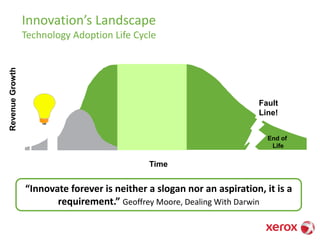
Time
RevenueGrowth
Innovation’s Landscape
Technology Adoption Life Cycle
End of
Life
Fault
Line!
“Innovate forever is neither a slogan nor an aspiration, it is a
requirement.” Geoffrey Moore, Dealing With Darwin
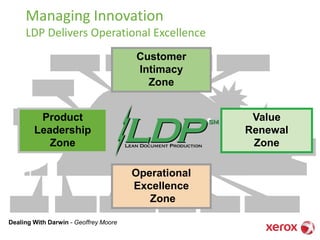
Managing Innovation
LDP Delivers Operational Excellence
Disruptive
Innovation
Application
Innovation
Product
Innovation
Platform
Innovation
Enhancement
Innovation
Integration
Innovation
Experiential
Innovation
Process
Innovation
Marketing
Innovation
Business Model
Innovation
Line Extension
Innovation
Value Engineering
Innovation
Harvest
& Exit
Renewal Innovation
Product
Leadership
Zone
Customer
Intimacy
Zone
Value
Renewal
Zone
Operational
Excellence
Zone
Dealing With Darwin - Geoffrey Moore
The LDP Lean Document
Production® Solution
Sudhendu Rai
Xerox Innovation Group
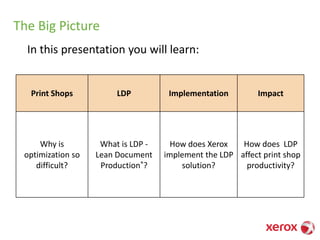
The Big Picture
In this presentation you will learn:
Print Shops LDP Implementation Impact
Why is
optimization so
difficult?
What is LDP -
Lean Document
Production®?
How does Xerox
implement the LDP
solution?
How does LDP
affect print shop
productivity?
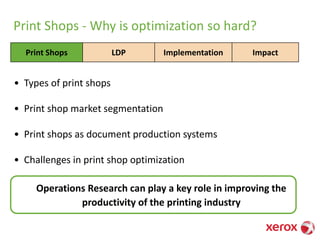
Print Shops - Why is optimization so hard?
• Types of print shops
• Print shop market segmentation
• Print shops as document production systems
• Challenges in print shop optimization
Print Shops LDP Implementation Impact
Operations Research can play a key role in improving the
productivity of the printing industry
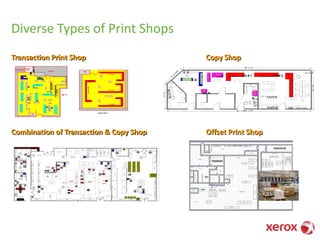
Diverse Types of Print Shops
BellandHowell
Inserter
Inserter
Inserter
PB 8 Series
PB 8 Series
PB 8 Series
Inserter
Cage
Inserter Room
Desk
Desk
Desk
Desk
Desk
Desk
LOADING
Server Room
Mailing
Area
Input
Desk
P
r
i
n
t
e
r
1
Cutter
P
r
i
n
t
e
r
2
P
r
i
n
t
e
r
4
P
r
i
n
t
e
r
3
Desk
SQA
DESK
Moore
Sealer
Desk
Roll System
Printer
Desk
H
I
L
I
T
E
P
R
I
T
E
R
Desk
ShrinkWrapper
Pillar
DeskDesk
Desk
Desk
P
r
i
n
t
e
r
3
Desk
ShrinkWrapper
Roll System
Printer
Transaction Print Shop
55' - 4 1/4"
2' - 4 7/8"
18'-12"
62' - 1 1/8"
12'-0"
PAPER
PAPER
SKRINK
WRAP CUTTER DRILL
DOCUTECH # 2DOCUTECH # 1
D
O
C
U
T
EC
H
#
3
53905
1
0
0
D
O
C
4
0
B
DOC 40 A
DC
265 A
DC
265B
FAX
55' - 4 1/4"
Copy Shop
Combination of Transaction & Copy Shop Offset Print Shop
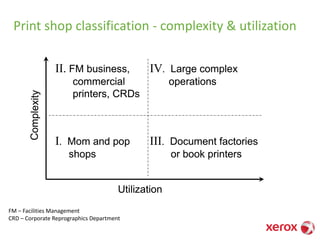
Print shop classification - complexity & utilization
Complexity
Utilization
II. FM business,
commercial
printers, CRDs
IV. Large complex
operations
III. Document factories
or book printers
I. Mom and pop
shops
Complexity
Utilization
II. FM business,
commercial
printers, CRDs
IV. Large complex
operations
III. Document factories
or book printers
I. Mom and pop
shops
FM – Facilities Management
CRD – Corporate Reprographics Department
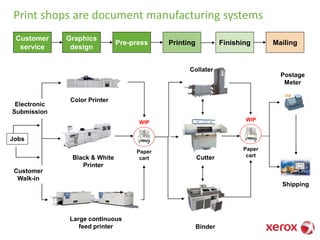
Print shops are document manufacturing systems
Collater
Cutter
Binder
Postage
Meter
Shipping
Electronic
Submission
Color Printer
Black & White
Printer
Large continuous
feed printer
Paper
cart
WIP
Jobs
Finishing Mailing
Graphics
design
Pre-press
Customer
service
Printing
Customer
Walk-in
Paper
cart
WIP
360003000024000180001200060000
Median
Mean
4003002001000
A nderson-Darling Normality Test
V ariance 2034062.0
Skew ness 16.142
Kurtosis 383.015
N 1692
Minimum 1.0
A -Squared
1st Q uartile 6.0
Median 28.0
3rd Q uartile 152.0
Maximum 39802.0
95% C onfidence Interv al for Mean
267.4
425.32
403.4
95% C onfidence Interv al for Median
25.0 33.0
95% C onfidence Interv al for StDev
1379.7 1476.0
P-V alue < 0.005
Mean 335.4
StDev 1426.2
95% Confidence Intervals
Job Size (Page Count) distribution
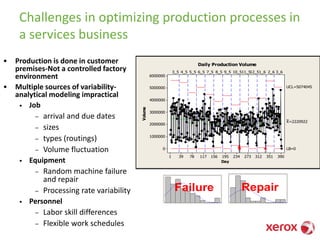
Challenges in optimizing production processes in
a services business
• Production is done in customer
premises-Not a controlled factory
environment
• Multiple sources of variability-
analytical modeling impractical
• Job
– arrival and due dates
– sizes
– types (routings)
– Volume fluctuation
• Equipment
– Random machine failure
and repair
– Processing rate variability
• Personnel
– Labor skill differences
– Flexible work schedules
Day
Volume
39035131227323419515611778391
6000000
5000000
4000000
3000000
2000000
1000000
0
_
X=2220922
UCL=5074045
LB=0
3_5 4_5 5_5 6_5 7_5 8_5 9_5 10_511_512_51_6 2_6 3_6
111
Daily Production Volume
Failure Repair
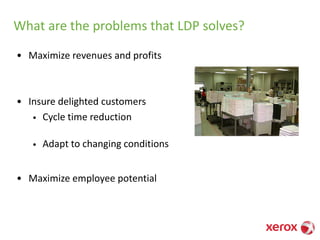
What are the problems that LDP solves?
• Maximize revenues and profits
• Insure delighted customers
• Cycle time reduction
• Adapt to changing conditions
• Maximize employee potential
What is LDP ?
• LDP solutions and architecture
• LDP tools
• Print shop engagement process
• An example: Engagement and tool video
Print Shops LDP Implementation Impact
LDP is an OR-based solution to optimize print shop
productivity
LDP overview
Consists of two elements
• OR techniques and algorithms encapsulated in a PC-
based software toolkit
• A highly structured customer engagement process
• Analysis based on detailed simulations of layout, work flow,
and control policies using historical job data
• Print shops modeled as autonomous cells using a two level
hierarchical scheduling architecture
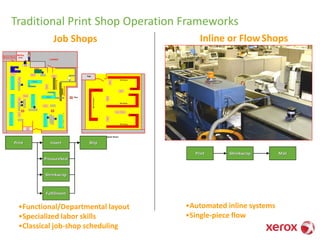
Traditional Print Shop Operation Frameworks
BellandHowell
Inserter
Inserter
Inserter
PB 8 Series
PB 8 Series
PB 8 Series
Inserter
Cage
Inserter Room
Desk
Desk
Desk
Desk
Desk
Desk
LOADING
Server Room
Mailing
Area
Input
Desk
P
r
i
n
t
e
r
1
Cutter
P
r
i
n
t
e
r
2
P
r
i
n
t
e
r
4
P
r
i
n
t
e
r
3
Desk
SQA
DESK
Moore
Sealer
Desk
Roll System
Printer
Desk
H
I
L
I
T
E
P
R
I
T
E
R
Desk
ShrinkWrapper
Pillar
DeskDesk
Desk
Desk
P
r
i
n
t
e
r
3
Desk
ShrinkWrapper
Roll System
Printer
•Functional/Departmental layout
•Specialized labor skills
•Classical job-shop scheduling
Job Shops Inline or FlowShops
Print Shrinkwrap
•Automated inline systems
•Single-piece flow
Print Insert Ship
PressureSeal
Shrinkwrap
Mail
Fulfillment
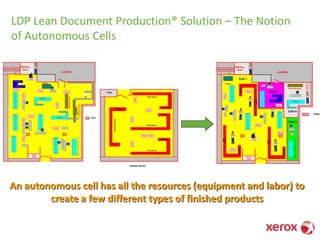
LDP Lean Document Production® Solution – The Notion
of Autonomous Cells
BellandHowell Inserter
Inserter
Inserter
PB 8 Series
PB 8 Series
PB 8 Series
Inserter
Cage
Inserter Room
Desk
Desk
Desk
Desk
Desk
Desk
LOADING
Server Room
Mailing
Area
Input
Desk
P
r
i
n
t
e
r
1
Cutter
P
r
i
n
t
e
r
2
P
r
i
n
t
e
r
4
P
r
i
n
t
e
r
3
Desk
SQA
DESK
Moore
Sealer
Desk
Roll System
Printer
Desk
H
I
L
I
T
E
P
R
I
T
E
R
Desk
ShrinkWrapper
Pillar
DeskDesk
Desk
Desk
P
r
i
n
t
e
r
3
Desk
ShrinkWrapper
Roll System
Printer
LOADING
Server Room
Mailing
Area
Input
Desk
P
r
i
n
t
e
r
1
Cutter
Inserter
PB8
Series
Inserter
PB8
Series
P
r
i
n
t
e
r
2
P
r
i
n
t
e
r
4
P
r
i
n
t
e
r
3
Desk
Desk
Desk
SQA
DESK
Inserter
PB8
Series
Moore
Sealer
Desk
Cell 4
Roll System
Printer
Desk
Desk
Cell 2
H
I
L
I
T
E
P
R
I
T
E
R
Desk
Shrink Wrapper
Pillar
Cell 3
Cell 1
An autonomous cell has all the resources (equipment and labor) to
create a few different types of finished products
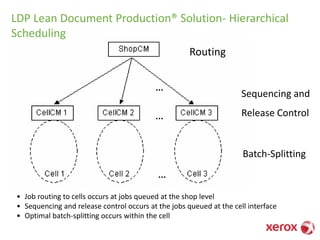
Routing
Sequencing and
Release Control
Batch-Splitting
• Job routing to cells occurs at jobs queued at the shop level
• Sequencing and release control occurs at the jobs queued at the cell interface
• Optimal batch-splitting occurs within the cell
LDP Lean Document Production® Solution- Hierarchical
Scheduling
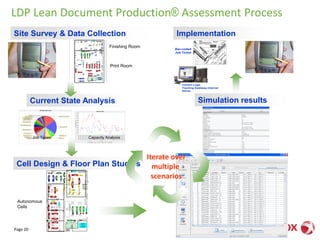
Current State Analysis
Job Types Capacity Analysis
Implementation
Bar-coded
Job Ticket
Control Logic
Tracking Database Internet
Server
Site Survey & Data Collection
Finishing Room
Print Room
Cell Design & Floor Plan Studies
Autonomous
Cells
Simulation results
LDP Lean Document Production® Assessment Process
Iterate over
multiple
scenarios
Page 20
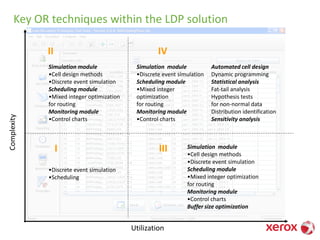
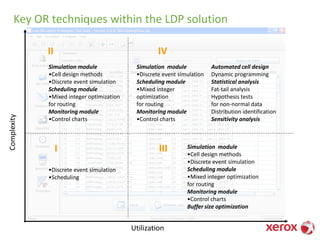
Key OR techniques within the LDP solution
I
Utilization
Complexity
II
III
IV
Simulation module
•Cell design methods
•Discrete event simulation
Scheduling module
•Mixed integer optimization
for routing
Monitoring module
•Control charts
•Discrete event simulation
•Scheduling
Simulation module
•Cell design methods
•Discrete event simulation
Scheduling module
•Mixed integer optimization
for routing
Monitoring module
•Control charts
Buffer size optimization
Simulation module
•Discrete event simulation
Scheduling module
•Mixed integer
optimization
for routing
Monitoring module
•Control charts
Automated cell design
Dynamic programming
Statistical analysis
Fat-tail analysis
Hypothesis tests
for non-normal data
Distribution identification
Sensitivity analysis
Characterizing and analyzing very high variability using
fat-tailed distributions
Let X be a random variable with cdf F(x) = P[X≤ x] and complementary
cdf (ccdf) Fc(x) = P[X>x]. We say here that a distribution F(x) is fat-tailed
if
Fc (x) ~ cx-a 0<a<2 (1)
In the limit of x->∞ (2)
α
dlogx
(x)dLogF
lim
x
c
-=
→
Heavy-tailed distribution determination
-6
-5
-4
-3
-2
-1
0
0 1 2 3 4 5 6 7 8 9 10 11 12 13 14 15
Ln(JobSize)
Ln(CCDF)
Heavy-tailed distribution
determination
Fat-tailed distribution determination
Example: An Application of OR
Quadrant IV Large Shop Optimization in the
Presence of Fat-tailed Job Size Input Distribution
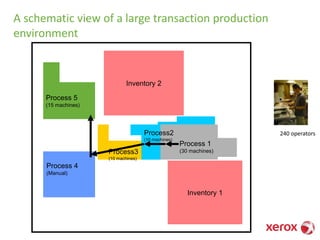
A schematic view of a large transaction production
environment
Inventory 1
Process 1
(30 machines)
Process 4
(Manual)
Process2
(10 machines)
Process3
(10 machines)
Process 5
(15 machines)
Inventory 2
240 operators
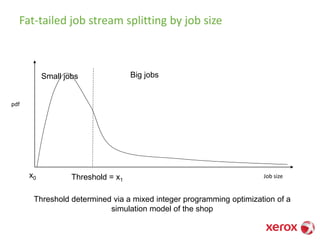
Fat-tailed job stream splitting by job size
x0 Threshold = x1
Small jobs Big jobs
Threshold determined via a mixed integer programming optimization of a
simulation model of the shop
pdf
Job size
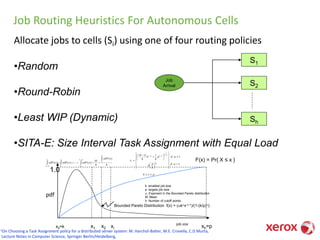
Job Routing Heuristics For Autonomous Cells
Allocate jobs to cells (Si) using one of four routing policies
•Random
•Round-Robin
•Least WIP (Dynamic)
•SITA-E: Size Interval Task Assignment with Equal Load
Job
Arrival
S1
S2
Sh
h
xxdF
h
M
xxdFxxdFxxdF
p
k
px
x
x
x
x
kx
h
h

 =====
=
= -
)(
)(...)()(
1
2
1
1
0
x0=k xh=px1 x2 xi
1.0
F(x) = Pr{ X ≤ x }
1
1
)( 1
1
11
=



























+
-
=
-
--
a
a
a
aa
if
if
k
p
k
p
h
i
k
h
ih
x
h
ii
k: smallest job size
p: largets job size
a: Exponent in the Bounded Pareto distribution
M: Mean
h: Number of cutoff points
Bounded Pareto Distribution f(x) = (akax-a-1)/(1-(k/p)a)
pxk 
pdf
job size
1On Choosing a Task Assignment policy for a distributed server system: M. Harchol-Balter, M.E. Crovella, C.D Murta,
Lecture Notes in Computer Science, Springer Berlin/Heidelberg, ISBN 0302-9743 (2004)
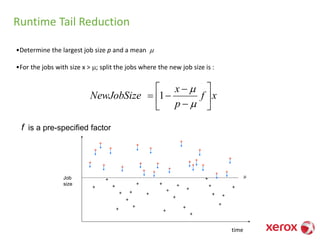
Runtime Tail Reduction
•Determine the largest job size p and a mean m
•For the jobs with size x > m; split the jobs where the new job size is :
f is a pre-specified factor
mJob
size
+
+
+
+
+
+
+
+
+
+
+
+
+
+
+
+
+
+
+
+
+
+
+
+
+
+
+
+
+
+
+
+
+
+
+
+
+
+
+
+
+
+
+
+
+
+
time
xf
p
x
NewJobSize 





-
-
-=
m
m
1
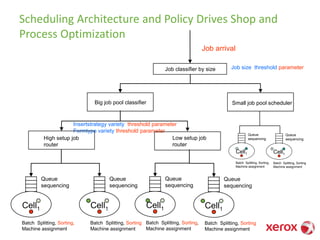
Scheduling Architecture and Policy Drives Shop and
Process Optimization
Job arrival
Job classifier by size
Big job pool classifier Small job pool scheduler
Insertstrategy variety threshold parameter
Formtype variety threshold parameter
High setup job
router
Low setup job
router
Cell1
Queue
sequencing
Batch Splitting, Sorting,
Machine assignment
Cell1
Queue
sequencing
Batch Splitting, Sorting
Machine assignment
Cell1
Queue
sequencing
Batch Splitting, Sorting,
Machine assignment
Cell1
Queue
sequencing
Batch Splitting, Sorting
Machine assignment
Job size threshold parameter
Cell1
Queue
sequencing
Batch Splitting, Sorting,
Machine assignment
Cell1
Queue
sequencing
Batch Splitting, Sorting
Machine assignment
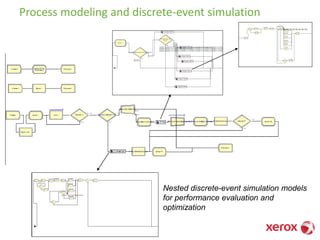
Process modeling and discrete-event simulation
Nested discrete-event simulation models
for performance evaluation and
optimization
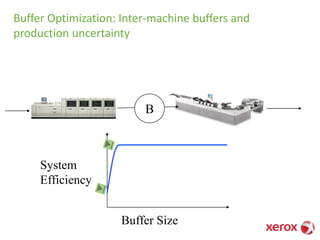
Buffer Optimization: Inter-machine buffers and
production uncertainty
System
Efficiency
Buffer Size
B
Inventory 1
Process 1
(30 machines)
Process 4
(Manual)
Process2
(10 machines)
Process3
(10 machines)
Process 5
(15 machines)
Inventory 2
BEFORE
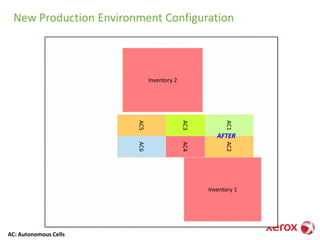
New Production Environment Configuration
AC1AC2
AC3AC4
AC5AC6 AFTER
Inventory 2
Inventory 1
AC: Autonomous Cells
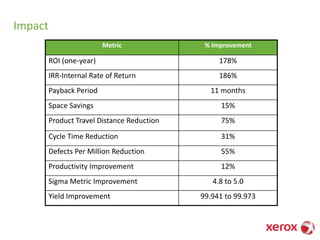
Impact
Metric % Improvement
ROI (one-year) 178%
IRR-Internal Rate of Return 186%
Payback Period 11 months
Space Savings 15%
Product Travel Distance Reduction 75%
Cycle Time Reduction 31%
Defects Per Million Reduction 55%
Productivity Improvement 12%
Sigma Metric Improvement 4.8 to 5.0
Yield Improvement 99.941 to 99.973
Key OR techniques within the LDP solution
I
Utilization
Complexity
II
III
IV
Simulation module
•Cell design methods
•Discrete event simulation
Scheduling module
•Mixed integer optimization
for routing
Monitoring module
•Control charts
•Discrete event simulation
•Scheduling
Simulation module
•Cell design methods
•Discrete event simulation
Scheduling module
•Mixed integer optimization
for routing
Monitoring module
•Control charts
Buffer size optimization
Simulation module
•Discrete event simulation
Scheduling module
•Mixed integer
optimization
for routing
Monitoring module
•Control charts
Automated cell design
Dynamic programming
Statistical analysis
Fat-tail analysis
Hypothesis tests
for non-normal data
Distribution identification
Sensitivity analysis
How Xerox implements the LDP solution
Print Shops LDP Implementation Impact
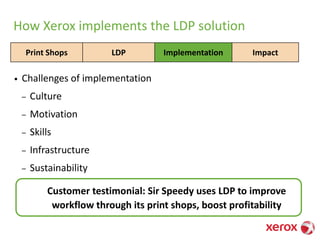
• Challenges of implementation
– Culture
– Motivation
– Skills
– Infrastructure
– Sustainability
Customer testimonial: Sir Speedy uses LDP to improve
workflow through its print shops, boost profitability
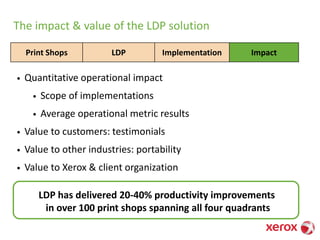
The impact & value of the LDP solution
Print Shops LDP Implementation Impact
• Quantitative operational impact
• Scope of implementations
• Average operational metric results
• Value to customers: testimonials
• Value to other industries: portability
• Value to Xerox & client organization
LDP has delivered 20-40% productivity improvements
in over 100 print shops spanning all four quadrants
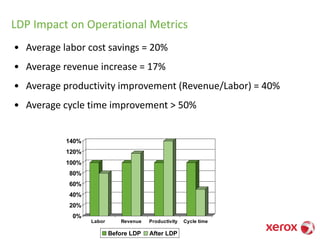
LDP Impact on Operational Metrics
• Average labor cost savings = 20%
• Average revenue increase = 17%
• Average productivity improvement (Revenue/Labor) = 40%
• Average cycle time improvement > 50%
0%
20%
40%
60%
80%
100%
120%
140%
Labor Revenue Productivity Cycle time
Before LDP After LDP
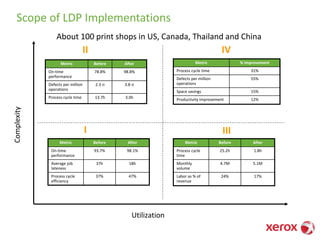
Scope of LDP Implementations
I
Utilization
Complexity
II
III
IV
About 100 print shops in US, Canada, Thailand and China
Metric Before After
On-time
performance
78.8% 98.8%
Defects per million
operations
2.3 s 3.8 s
Process cycle time 13.7h 3.0h
Metric % Improvement
Process cycle time 31%
Defects per million
operations
55%
Space savings 15%
Productivity improvement 12%
Metric Before After
On-time
performance
93.7% 98.1%
Average job
lateness
37h 18h
Process cycle
efficiency
37% 47%
Metric Before After
Process cycle
time
25.2h 1.8h
Monthly
volume
4.7M 5.1M
Labor as % of
revenue
24% 17%
Client Account Manager (Telecom)
◆ Major improvements in scheduling
◆ Increased volume without overtime or additional personnel
◆ Improvement in timely job completion & Quality
of the product
◆ Headcount reduced by 4 head
Sr. Client Account Manager (Health Care)
◆ Reduced overtime to zero
◆ Reduced third shift to one or two days per week
◆ No late jobs in 2 month
Manager of Client Operations (Consumer Industry)
◆ Reduced the staff by more than 1/3 (11 employees)
◆ Increased the production
◆ Recommended shutdown four satellite centers to streamline the
process and increase the equipment utilization
Sr.. Client Account Manager (Banking Application)
◆ Improved efficiency by 40%
◆ Reduced the number of late jobs
◆ Experienced less re-work
◆ Reduced labor costs by performing simultaneous tasks
A mid-sized print shop
◆ Improved Customer Satisfaction through Print Quality & Job
Timeliness
◆ Improved Job Turnaround Time through Effective Equipment
and Manpower Utilization - 99.2% On time Delivery
◆ Effective Resource Utilization - No Incremental Headcount or
Equipment to Support 42.5% Growth
◆ Less rework - Cost of Non-conformance at 1.2% -vs- 3% Industry
Standard
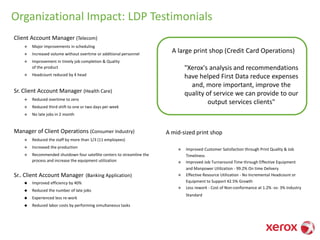
Organizational Impact: LDP Testimonials
A large print shop (Credit Card Operations)
"Xerox's analysis and recommendations
have helped First Data reduce expenses
and, more important, improve the
quality of service we can provide to our
output services clients"
Portability of LDP
• Applicable to other industries with high job diversity and
short production work flow
• Evidence of portability
• Credit card production
• Mail room
• Target work processes
• Digital scanning and imaging
• Apparel
• Healthcare processes
• …
Summary
• First OR-based solution for optimizing print shops
• Based on autonomous cells and hierarchical scheduling
• Supported by analytical toolkit, structured delivery process
• Dramatic productivity improvements across a broad range of
print shops
• Demonstrated value to customers, Xerox and the client
organization
LDP is another example of how Operations Research is
transforming an industry
Closing Remarks
William A. Steenburgh
Sr. Vice President, Xerox Services
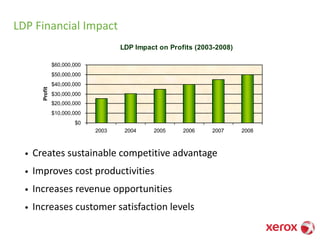
LDP Impact on Profits (2003-2008)
$0
$10,000,000
$20,000,000
$30,000,000
$40,000,000
$50,000,000
$60,000,000
2003 2004 2005 2006 2007 2008
Profit
LDP Financial Impact
• Creates sustainable competitive advantage
• Improves cost productivities
• Increases revenue opportunities
• Increases customer satisfaction levels
0%
10%
20%
30%
40%
50%
60%
70%
80%
90%
100%
1810 1835 1860 1885 1910 1935 1960 1985 2010
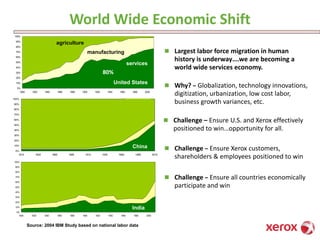
World Wide Economic Shift
China
0%
10%
20%
30%
40%
50%
60%
70%
80%
90%
100%
1800 1820 1840 1860 1880 1900 1920 1940 1960 1980 2000
United States
0%
10%
20%
30%
40%
50%
60%
70%
80%
90%
100%
1800 1820 1840 1860 1880 1900 1920 1940 1960 1980 2000
India
agriculture
manufacturing
services
Source: 2004 IBM Study based on national labor data
◼ Largest labor force migration in human
history is underway….we are becoming a
world wide services economy.
80%
◼ Challenge – Ensure all countries economically
participate and win
◼ Challenge – Ensure U.S. and Xerox effectively
positioned to win…opportunity for all.
◼ Challenge – Ensure Xerox customers,
shareholders & employees positioned to win
◼ Why? – Globalization, technology innovations,
digitization, urbanization, low cost labor,
business growth variances, etc.
In Closing
Question is….What role will Operations Research and innovation play in
leading this economic shift….
Need to get academia, business, government and industry associations all on
the same page on this one!
Where do you….where do we stand in leading this world wide shift to a
services economy?
Xerox is on a journey….a journey to become a services led technology
company and we invite you to join us!
Thanks!

Edelman competition presentation slides

  • 1.
    LDP Lean Document Production®:Dramatic Productivity Improvements for the Printing Industry The LDP Team Sudhendu Rai, Charles B. Duke, Cyndi Quan-Trotter, Vaughn Lowe, Thomas Scheermesser Presenters Sudhendu Rai and William A. Steenburgh
  • 2.
    Xerox and XeroxServices Xerox Services - Providing technical, professional and managed services delivery to our customers in North America •$4 Billion/year business •15,000 employees •7,000 providing outsourcing services National Medal of Technology Xerox Facts •$18 Billion/year business •Leading document management company •History of technology innovation
  • 3.
    LDP - Beforeand After BEFORE: Print shops optimization efforts were local and inconsistent AFTER: By applying Operations Research methodologies to print shop people, processes and technology, LDP has already generated over $200M in productivity improvements Applying OR to the services industry has great potential for future productivity gains
  • 4.
    Innovation “The goal ofinnovation is to create differentiation that leads to customer preference during buying decisions.” Geoffrey Moore Innovation Three key results from innovation 1. Sustainable competitive advantage (higher returns) 2. Neutralization of competitor’s current advantage 3. Productivity leading to better margins
  • 5.
    Time RevenueGrowth Innovation’s Landscape Technology AdoptionLife Cycle End of Life Fault Line! “Innovate forever is neither a slogan nor an aspiration, it is a requirement.” Geoffrey Moore, Dealing With Darwin
  • 6.
    Managing Innovation LDP DeliversOperational Excellence Disruptive Innovation Application Innovation Product Innovation Platform Innovation Enhancement Innovation Integration Innovation Experiential Innovation Process Innovation Marketing Innovation Business Model Innovation Line Extension Innovation Value Engineering Innovation Harvest & Exit Renewal Innovation Product Leadership Zone Customer Intimacy Zone Value Renewal Zone Operational Excellence Zone Dealing With Darwin - Geoffrey Moore
  • 7.
    The LDP LeanDocument Production® Solution Sudhendu Rai Xerox Innovation Group
  • 8.
    The Big Picture Inthis presentation you will learn: Print Shops LDP Implementation Impact Why is optimization so difficult? What is LDP - Lean Document Production®? How does Xerox implement the LDP solution? How does LDP affect print shop productivity?
  • 9.
    Print Shops -Why is optimization so hard? • Types of print shops • Print shop market segmentation • Print shops as document production systems • Challenges in print shop optimization Print Shops LDP Implementation Impact Operations Research can play a key role in improving the productivity of the printing industry
  • 10.
    Diverse Types ofPrint Shops BellandHowell Inserter Inserter Inserter PB 8 Series PB 8 Series PB 8 Series Inserter Cage Inserter Room Desk Desk Desk Desk Desk Desk LOADING Server Room Mailing Area Input Desk P r i n t e r 1 Cutter P r i n t e r 2 P r i n t e r 4 P r i n t e r 3 Desk SQA DESK Moore Sealer Desk Roll System Printer Desk H I L I T E P R I T E R Desk ShrinkWrapper Pillar DeskDesk Desk Desk P r i n t e r 3 Desk ShrinkWrapper Roll System Printer Transaction Print Shop 55' - 4 1/4" 2' - 4 7/8" 18'-12" 62' - 1 1/8" 12'-0" PAPER PAPER SKRINK WRAP CUTTER DRILL DOCUTECH # 2DOCUTECH # 1 D O C U T EC H # 3 53905 1 0 0 D O C 4 0 B DOC 40 A DC 265 A DC 265B FAX 55' - 4 1/4" Copy Shop Combination of Transaction & Copy Shop Offset Print Shop
  • 11.
    Print shop classification- complexity & utilization Complexity Utilization II. FM business, commercial printers, CRDs IV. Large complex operations III. Document factories or book printers I. Mom and pop shops Complexity Utilization II. FM business, commercial printers, CRDs IV. Large complex operations III. Document factories or book printers I. Mom and pop shops FM – Facilities Management CRD – Corporate Reprographics Department
  • 12.
    Print shops aredocument manufacturing systems Collater Cutter Binder Postage Meter Shipping Electronic Submission Color Printer Black & White Printer Large continuous feed printer Paper cart WIP Jobs Finishing Mailing Graphics design Pre-press Customer service Printing Customer Walk-in Paper cart WIP
  • 13.
    360003000024000180001200060000 Median Mean 4003002001000 A nderson-Darling NormalityTest V ariance 2034062.0 Skew ness 16.142 Kurtosis 383.015 N 1692 Minimum 1.0 A -Squared 1st Q uartile 6.0 Median 28.0 3rd Q uartile 152.0 Maximum 39802.0 95% C onfidence Interv al for Mean 267.4 425.32 403.4 95% C onfidence Interv al for Median 25.0 33.0 95% C onfidence Interv al for StDev 1379.7 1476.0 P-V alue < 0.005 Mean 335.4 StDev 1426.2 95% Confidence Intervals Job Size (Page Count) distribution Challenges in optimizing production processes in a services business • Production is done in customer premises-Not a controlled factory environment • Multiple sources of variability- analytical modeling impractical • Job – arrival and due dates – sizes – types (routings) – Volume fluctuation • Equipment – Random machine failure and repair – Processing rate variability • Personnel – Labor skill differences – Flexible work schedules Day Volume 39035131227323419515611778391 6000000 5000000 4000000 3000000 2000000 1000000 0 _ X=2220922 UCL=5074045 LB=0 3_5 4_5 5_5 6_5 7_5 8_5 9_5 10_511_512_51_6 2_6 3_6 111 Daily Production Volume Failure Repair
  • 14.
    What are theproblems that LDP solves? • Maximize revenues and profits • Insure delighted customers • Cycle time reduction • Adapt to changing conditions • Maximize employee potential
  • 15.
    What is LDP? • LDP solutions and architecture • LDP tools • Print shop engagement process • An example: Engagement and tool video Print Shops LDP Implementation Impact LDP is an OR-based solution to optimize print shop productivity
  • 16.
    LDP overview Consists oftwo elements • OR techniques and algorithms encapsulated in a PC- based software toolkit • A highly structured customer engagement process • Analysis based on detailed simulations of layout, work flow, and control policies using historical job data • Print shops modeled as autonomous cells using a two level hierarchical scheduling architecture
  • 17.
    Traditional Print ShopOperation Frameworks BellandHowell Inserter Inserter Inserter PB 8 Series PB 8 Series PB 8 Series Inserter Cage Inserter Room Desk Desk Desk Desk Desk Desk LOADING Server Room Mailing Area Input Desk P r i n t e r 1 Cutter P r i n t e r 2 P r i n t e r 4 P r i n t e r 3 Desk SQA DESK Moore Sealer Desk Roll System Printer Desk H I L I T E P R I T E R Desk ShrinkWrapper Pillar DeskDesk Desk Desk P r i n t e r 3 Desk ShrinkWrapper Roll System Printer •Functional/Departmental layout •Specialized labor skills •Classical job-shop scheduling Job Shops Inline or FlowShops Print Shrinkwrap •Automated inline systems •Single-piece flow Print Insert Ship PressureSeal Shrinkwrap Mail Fulfillment
  • 18.
    LDP Lean DocumentProduction® Solution – The Notion of Autonomous Cells BellandHowell Inserter Inserter Inserter PB 8 Series PB 8 Series PB 8 Series Inserter Cage Inserter Room Desk Desk Desk Desk Desk Desk LOADING Server Room Mailing Area Input Desk P r i n t e r 1 Cutter P r i n t e r 2 P r i n t e r 4 P r i n t e r 3 Desk SQA DESK Moore Sealer Desk Roll System Printer Desk H I L I T E P R I T E R Desk ShrinkWrapper Pillar DeskDesk Desk Desk P r i n t e r 3 Desk ShrinkWrapper Roll System Printer LOADING Server Room Mailing Area Input Desk P r i n t e r 1 Cutter Inserter PB8 Series Inserter PB8 Series P r i n t e r 2 P r i n t e r 4 P r i n t e r 3 Desk Desk Desk SQA DESK Inserter PB8 Series Moore Sealer Desk Cell 4 Roll System Printer Desk Desk Cell 2 H I L I T E P R I T E R Desk Shrink Wrapper Pillar Cell 3 Cell 1 An autonomous cell has all the resources (equipment and labor) to create a few different types of finished products
  • 19.
    Routing Sequencing and Release Control Batch-Splitting •Job routing to cells occurs at jobs queued at the shop level • Sequencing and release control occurs at the jobs queued at the cell interface • Optimal batch-splitting occurs within the cell LDP Lean Document Production® Solution- Hierarchical Scheduling
  • 20.
    Current State Analysis JobTypes Capacity Analysis Implementation Bar-coded Job Ticket Control Logic Tracking Database Internet Server Site Survey & Data Collection Finishing Room Print Room Cell Design & Floor Plan Studies Autonomous Cells Simulation results LDP Lean Document Production® Assessment Process Iterate over multiple scenarios Page 20
  • 22.
    Key OR techniqueswithin the LDP solution I Utilization Complexity II III IV Simulation module •Cell design methods •Discrete event simulation Scheduling module •Mixed integer optimization for routing Monitoring module •Control charts •Discrete event simulation •Scheduling Simulation module •Cell design methods •Discrete event simulation Scheduling module •Mixed integer optimization for routing Monitoring module •Control charts Buffer size optimization Simulation module •Discrete event simulation Scheduling module •Mixed integer optimization for routing Monitoring module •Control charts Automated cell design Dynamic programming Statistical analysis Fat-tail analysis Hypothesis tests for non-normal data Distribution identification Sensitivity analysis
  • 23.
    Characterizing and analyzingvery high variability using fat-tailed distributions Let X be a random variable with cdf F(x) = P[X≤ x] and complementary cdf (ccdf) Fc(x) = P[X>x]. We say here that a distribution F(x) is fat-tailed if Fc (x) ~ cx-a 0<a<2 (1) In the limit of x->∞ (2) α dlogx (x)dLogF lim x c -= → Heavy-tailed distribution determination -6 -5 -4 -3 -2 -1 0 0 1 2 3 4 5 6 7 8 9 10 11 12 13 14 15 Ln(JobSize) Ln(CCDF) Heavy-tailed distribution determination Fat-tailed distribution determination
  • 24.
    Example: An Applicationof OR Quadrant IV Large Shop Optimization in the Presence of Fat-tailed Job Size Input Distribution
  • 25.
    A schematic viewof a large transaction production environment Inventory 1 Process 1 (30 machines) Process 4 (Manual) Process2 (10 machines) Process3 (10 machines) Process 5 (15 machines) Inventory 2 240 operators
  • 26.
    Fat-tailed job streamsplitting by job size x0 Threshold = x1 Small jobs Big jobs Threshold determined via a mixed integer programming optimization of a simulation model of the shop pdf Job size
  • 27.
    Job Routing HeuristicsFor Autonomous Cells Allocate jobs to cells (Si) using one of four routing policies •Random •Round-Robin •Least WIP (Dynamic) •SITA-E: Size Interval Task Assignment with Equal Load Job Arrival S1 S2 Sh h xxdF h M xxdFxxdFxxdF p k px x x x x kx h h   ===== = = - )( )(...)()( 1 2 1 1 0 x0=k xh=px1 x2 xi 1.0 F(x) = Pr{ X ≤ x } 1 1 )( 1 1 11 =                            + - = - -- a a a aa if if k p k p h i k h ih x h ii k: smallest job size p: largets job size a: Exponent in the Bounded Pareto distribution M: Mean h: Number of cutoff points Bounded Pareto Distribution f(x) = (akax-a-1)/(1-(k/p)a) pxk  pdf job size 1On Choosing a Task Assignment policy for a distributed server system: M. Harchol-Balter, M.E. Crovella, C.D Murta, Lecture Notes in Computer Science, Springer Berlin/Heidelberg, ISBN 0302-9743 (2004)
  • 28.
    Runtime Tail Reduction •Determinethe largest job size p and a mean m •For the jobs with size x > m; split the jobs where the new job size is : f is a pre-specified factor mJob size + + + + + + + + + + + + + + + + + + + + + + + + + + + + + + + + + + + + + + + + + + + + + + time xf p x NewJobSize       - - -= m m 1
  • 29.
    Scheduling Architecture andPolicy Drives Shop and Process Optimization Job arrival Job classifier by size Big job pool classifier Small job pool scheduler Insertstrategy variety threshold parameter Formtype variety threshold parameter High setup job router Low setup job router Cell1 Queue sequencing Batch Splitting, Sorting, Machine assignment Cell1 Queue sequencing Batch Splitting, Sorting Machine assignment Cell1 Queue sequencing Batch Splitting, Sorting, Machine assignment Cell1 Queue sequencing Batch Splitting, Sorting Machine assignment Job size threshold parameter Cell1 Queue sequencing Batch Splitting, Sorting, Machine assignment Cell1 Queue sequencing Batch Splitting, Sorting Machine assignment
  • 30.
    Process modeling anddiscrete-event simulation Nested discrete-event simulation models for performance evaluation and optimization
  • 31.
    Buffer Optimization: Inter-machinebuffers and production uncertainty System Efficiency Buffer Size B
  • 32.
    Inventory 1 Process 1 (30machines) Process 4 (Manual) Process2 (10 machines) Process3 (10 machines) Process 5 (15 machines) Inventory 2 BEFORE New Production Environment Configuration AC1AC2 AC3AC4 AC5AC6 AFTER Inventory 2 Inventory 1 AC: Autonomous Cells
  • 33.
    Impact Metric % Improvement ROI(one-year) 178% IRR-Internal Rate of Return 186% Payback Period 11 months Space Savings 15% Product Travel Distance Reduction 75% Cycle Time Reduction 31% Defects Per Million Reduction 55% Productivity Improvement 12% Sigma Metric Improvement 4.8 to 5.0 Yield Improvement 99.941 to 99.973
  • 34.
    Key OR techniqueswithin the LDP solution I Utilization Complexity II III IV Simulation module •Cell design methods •Discrete event simulation Scheduling module •Mixed integer optimization for routing Monitoring module •Control charts •Discrete event simulation •Scheduling Simulation module •Cell design methods •Discrete event simulation Scheduling module •Mixed integer optimization for routing Monitoring module •Control charts Buffer size optimization Simulation module •Discrete event simulation Scheduling module •Mixed integer optimization for routing Monitoring module •Control charts Automated cell design Dynamic programming Statistical analysis Fat-tail analysis Hypothesis tests for non-normal data Distribution identification Sensitivity analysis
  • 35.
    How Xerox implementsthe LDP solution Print Shops LDP Implementation Impact • Challenges of implementation – Culture – Motivation – Skills – Infrastructure – Sustainability Customer testimonial: Sir Speedy uses LDP to improve workflow through its print shops, boost profitability
  • 37.
    The impact &value of the LDP solution Print Shops LDP Implementation Impact • Quantitative operational impact • Scope of implementations • Average operational metric results • Value to customers: testimonials • Value to other industries: portability • Value to Xerox & client organization LDP has delivered 20-40% productivity improvements in over 100 print shops spanning all four quadrants
  • 38.
    LDP Impact onOperational Metrics • Average labor cost savings = 20% • Average revenue increase = 17% • Average productivity improvement (Revenue/Labor) = 40% • Average cycle time improvement > 50% 0% 20% 40% 60% 80% 100% 120% 140% Labor Revenue Productivity Cycle time Before LDP After LDP
  • 39.
    Scope of LDPImplementations I Utilization Complexity II III IV About 100 print shops in US, Canada, Thailand and China Metric Before After On-time performance 78.8% 98.8% Defects per million operations 2.3 s 3.8 s Process cycle time 13.7h 3.0h Metric % Improvement Process cycle time 31% Defects per million operations 55% Space savings 15% Productivity improvement 12% Metric Before After On-time performance 93.7% 98.1% Average job lateness 37h 18h Process cycle efficiency 37% 47% Metric Before After Process cycle time 25.2h 1.8h Monthly volume 4.7M 5.1M Labor as % of revenue 24% 17%
  • 40.
    Client Account Manager(Telecom) ◆ Major improvements in scheduling ◆ Increased volume without overtime or additional personnel ◆ Improvement in timely job completion & Quality of the product ◆ Headcount reduced by 4 head Sr. Client Account Manager (Health Care) ◆ Reduced overtime to zero ◆ Reduced third shift to one or two days per week ◆ No late jobs in 2 month Manager of Client Operations (Consumer Industry) ◆ Reduced the staff by more than 1/3 (11 employees) ◆ Increased the production ◆ Recommended shutdown four satellite centers to streamline the process and increase the equipment utilization Sr.. Client Account Manager (Banking Application) ◆ Improved efficiency by 40% ◆ Reduced the number of late jobs ◆ Experienced less re-work ◆ Reduced labor costs by performing simultaneous tasks A mid-sized print shop ◆ Improved Customer Satisfaction through Print Quality & Job Timeliness ◆ Improved Job Turnaround Time through Effective Equipment and Manpower Utilization - 99.2% On time Delivery ◆ Effective Resource Utilization - No Incremental Headcount or Equipment to Support 42.5% Growth ◆ Less rework - Cost of Non-conformance at 1.2% -vs- 3% Industry Standard Organizational Impact: LDP Testimonials A large print shop (Credit Card Operations) "Xerox's analysis and recommendations have helped First Data reduce expenses and, more important, improve the quality of service we can provide to our output services clients"
  • 41.
    Portability of LDP •Applicable to other industries with high job diversity and short production work flow • Evidence of portability • Credit card production • Mail room • Target work processes • Digital scanning and imaging • Apparel • Healthcare processes • …
  • 42.
    Summary • First OR-basedsolution for optimizing print shops • Based on autonomous cells and hierarchical scheduling • Supported by analytical toolkit, structured delivery process • Dramatic productivity improvements across a broad range of print shops • Demonstrated value to customers, Xerox and the client organization LDP is another example of how Operations Research is transforming an industry
  • 44.
    Closing Remarks William A.Steenburgh Sr. Vice President, Xerox Services
  • 45.
    LDP Impact onProfits (2003-2008) $0 $10,000,000 $20,000,000 $30,000,000 $40,000,000 $50,000,000 $60,000,000 2003 2004 2005 2006 2007 2008 Profit LDP Financial Impact • Creates sustainable competitive advantage • Improves cost productivities • Increases revenue opportunities • Increases customer satisfaction levels
  • 46.
    0% 10% 20% 30% 40% 50% 60% 70% 80% 90% 100% 1810 1835 18601885 1910 1935 1960 1985 2010 World Wide Economic Shift China 0% 10% 20% 30% 40% 50% 60% 70% 80% 90% 100% 1800 1820 1840 1860 1880 1900 1920 1940 1960 1980 2000 United States 0% 10% 20% 30% 40% 50% 60% 70% 80% 90% 100% 1800 1820 1840 1860 1880 1900 1920 1940 1960 1980 2000 India agriculture manufacturing services Source: 2004 IBM Study based on national labor data ◼ Largest labor force migration in human history is underway….we are becoming a world wide services economy. 80% ◼ Challenge – Ensure all countries economically participate and win ◼ Challenge – Ensure U.S. and Xerox effectively positioned to win…opportunity for all. ◼ Challenge – Ensure Xerox customers, shareholders & employees positioned to win ◼ Why? – Globalization, technology innovations, digitization, urbanization, low cost labor, business growth variances, etc.
  • 47.
    In Closing Question is….Whatrole will Operations Research and innovation play in leading this economic shift…. Need to get academia, business, government and industry associations all on the same page on this one! Where do you….where do we stand in leading this world wide shift to a services economy? Xerox is on a journey….a journey to become a services led technology company and we invite you to join us! Thanks!