PROCESS CHART
Presentation by Ashutosh Rath
What is PROCESS CHART
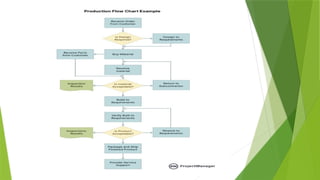
 A process chart, also known as an operation process chart (OPC) or
outline process chart, is a visual representation of the steps involved
in a production process. It's a tool that helps to understand the
process, identify areas for improvement, and track progress
 SO WHAT IS PROCESS ?
 A production process is a series of steps that transform raw materials into
a finished product or service. It involves using economic resources like
labor, land, and capital to create value-adding products for consumers
.
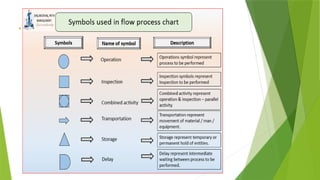
SYMBOLS USED IN PROCESS CHART
Symbols are used in process charts to provide a clear, standardized visual
representation of the different steps or activities in a process
.
TYPES OF PROCESS CHART
 There are mainly two types of process flow charts that
are commonly used in manufacturing for quality
improvement activities/projects.
1. High level Process Flow Chart
2. Detailed Process Flow Chart
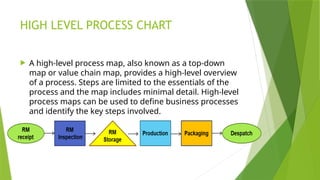
HIGH LEVEL PROCESS CHART
 A high-level process map, also known as a top-down
map or value chain map, provides a high-level overview
of a process. Steps are limited to the essentials of the
process and the map includes minimal detail. High-level
process maps can be used to define business processes
and identify the key steps involved.
DETAILED PROCESS FLOW CHART
 A detailed process flowchart is a step-by-step visual map
that shows how a process works from start to finish. It
includes every action, decision, and step involved in
completing a task, making it easier to understand and
follow.
.
Benefits of Using a Process Flowchart:
•Clarity: Complex processes become easier to understand at a glance.
•Efficiency: Identifies redundancies or unnecessary steps that can be
eliminated.
•Error Reduction: Helps prevent mistakes by outlining the correct steps.
•Improved Communication: Makes it easier to explain processes to different
stakeholders.
•Documentation: Provides a visual reference for procedures, which is useful
for compliance and audits.
.

PROCESS CHARTPRODUCTION AND OPERATION MANAGEMENT

  • 1.
  • 2.
    What is PROCESSCHART  A process chart, also known as an operation process chart (OPC) or outline process chart, is a visual representation of the steps involved in a production process. It's a tool that helps to understand the process, identify areas for improvement, and track progress  SO WHAT IS PROCESS ?  A production process is a series of steps that transform raw materials into a finished product or service. It involves using economic resources like labor, land, and capital to create value-adding products for consumers
  • 3.
  • 4.
    SYMBOLS USED INPROCESS CHART Symbols are used in process charts to provide a clear, standardized visual representation of the different steps or activities in a process
  • 5.
  • 6.
    TYPES OF PROCESSCHART  There are mainly two types of process flow charts that are commonly used in manufacturing for quality improvement activities/projects. 1. High level Process Flow Chart 2. Detailed Process Flow Chart
  • 7.
    HIGH LEVEL PROCESSCHART  A high-level process map, also known as a top-down map or value chain map, provides a high-level overview of a process. Steps are limited to the essentials of the process and the map includes minimal detail. High-level process maps can be used to define business processes and identify the key steps involved.
  • 8.
    DETAILED PROCESS FLOWCHART  A detailed process flowchart is a step-by-step visual map that shows how a process works from start to finish. It includes every action, decision, and step involved in completing a task, making it easier to understand and follow.
  • 9.
  • 10.
    Benefits of Usinga Process Flowchart: •Clarity: Complex processes become easier to understand at a glance. •Efficiency: Identifies redundancies or unnecessary steps that can be eliminated. •Error Reduction: Helps prevent mistakes by outlining the correct steps. •Improved Communication: Makes it easier to explain processes to different stakeholders. •Documentation: Provides a visual reference for procedures, which is useful for compliance and audits.
  • 11.