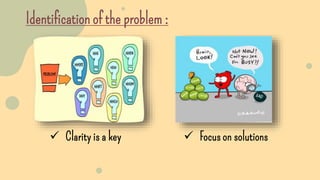
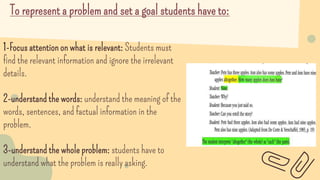
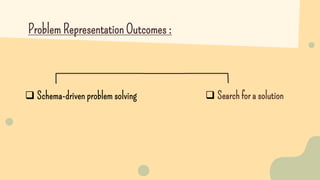
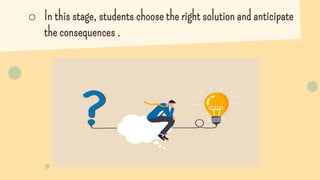
This document outlines a 6-step process for problem solving: 1) identifying the problem, 2) defining goals and representing the problem, 3) identifying possible solution strategies, 4) searching for possible solution strategies, 5) anticipating, acting, and looking back, and 6) factors hindering problem solving. It discusses defining clear goals, understanding the problem, using worked examples and embodied cognition to represent problems, employing strategies like algorithms and heuristics to search for solutions, choosing and testing solutions, and overcoming issues like functional fixedness that hinder the problem-solving process. The presenters aim to encourage students' problem-solving mindsets and inspire unconventional thinking to solve problems.











![Problem based learning[1]](https://cdn.slidesharecdn.com/ss_thumbnails/problembasedlearning1-110324121143-phpapp01-thumbnail.jpg?width=640&height=640&fit=bounds)


