Patty Weiler – Plymouth Ruth Miller – Narragansett New Literacies Teacher Leaders Curriculum Project
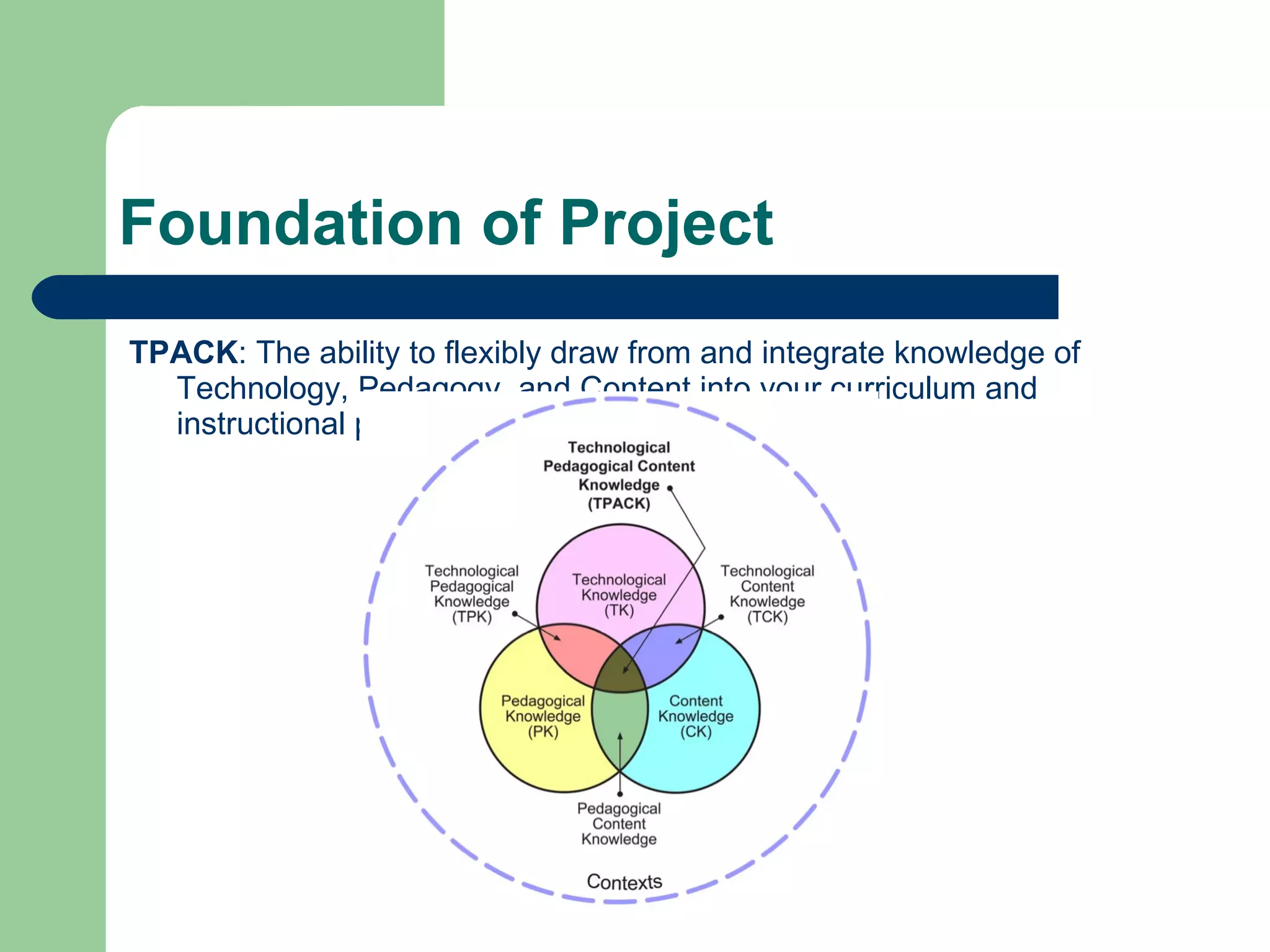
Foundation of Project TPACK : The ability to flexibly draw from and integrate knowledge of Technology, Pedagogy, and Content into your curriculum and instructional practices (Mishra & Koehler, 2006)
Problem Solving Essential Question: What role has problem solving had in the evolution of society?
Massachusetts Standards Technology Literacy Topic: Problem Solving Grade: 6, 7, 8 3.4 Independently use appropriate technology tools ( e.g., graphic organizer) to define problems and propose hypotheses. 3.6 Develop and use guidelines to evaluate the content, organization, design, use of citations, and presentation of technologically enhanced projects. Grade: 9. 10. 11, 12 3.5 Explain and demonstrate how specialized technology tools can be used for problem solving, decision making, and creativity in all subject areas (e.g. simulations software, environmental probes, computer-aided design, geographic information systems, dynamic geometric software, graphing calculators, art and music composition software).
National Standards for Mathematical Practice 1 Make sense of problems and persevere in solving them. Mathematically proficient students start by explaining to themselves the meaning of a problem and looking for entry points to its solution. They analyze givens, constraints, relationships, and goals. They make conjectures about the form and meaning of the solution and plan a solution pathway rather than simply jumping into a solution attempt. They consider analogous problems, and try special cases and simpler forms of the original problem in order to gain insight into its solution. They monitor and evaluate their progress and change course if necessary.
Objectives The students will be able to: Apply the 4 step problem solving process to a simple and complex problem. Demonstrate their understanding of the problem solving process by creating a multimedia presentation
Essential Content Four step problem solving process Understanding the problem What are your trying to find or do? Devising a plan Look for a pattern, make a diagram Carry out the plan Implement the strategy, perform computations Looking Back Does the answer make sense, is it reasonable?
Assessment Creating using multimodal project demonstrating the four step problem solving process.
Resources Voice Thread –  www.voicethread.com Glogster –  www.glogster.com Wiki –  www.wiki.com Xtra Normal – www.Xtranormal.com Math Book Student partners

Problem solving power point

  • 1.
    Patty Weiler –Plymouth Ruth Miller – Narragansett New Literacies Teacher Leaders Curriculum Project
  • 2.
    Foundation of ProjectTPACK : The ability to flexibly draw from and integrate knowledge of Technology, Pedagogy, and Content into your curriculum and instructional practices (Mishra & Koehler, 2006)
  • 3.
    Problem Solving EssentialQuestion: What role has problem solving had in the evolution of society?
  • 4.
    Massachusetts Standards TechnologyLiteracy Topic: Problem Solving Grade: 6, 7, 8 3.4 Independently use appropriate technology tools ( e.g., graphic organizer) to define problems and propose hypotheses. 3.6 Develop and use guidelines to evaluate the content, organization, design, use of citations, and presentation of technologically enhanced projects. Grade: 9. 10. 11, 12 3.5 Explain and demonstrate how specialized technology tools can be used for problem solving, decision making, and creativity in all subject areas (e.g. simulations software, environmental probes, computer-aided design, geographic information systems, dynamic geometric software, graphing calculators, art and music composition software).
  • 5.
    National Standards forMathematical Practice 1 Make sense of problems and persevere in solving them. Mathematically proficient students start by explaining to themselves the meaning of a problem and looking for entry points to its solution. They analyze givens, constraints, relationships, and goals. They make conjectures about the form and meaning of the solution and plan a solution pathway rather than simply jumping into a solution attempt. They consider analogous problems, and try special cases and simpler forms of the original problem in order to gain insight into its solution. They monitor and evaluate their progress and change course if necessary.
  • 6.
    Objectives The studentswill be able to: Apply the 4 step problem solving process to a simple and complex problem. Demonstrate their understanding of the problem solving process by creating a multimedia presentation
  • 7.
    Essential Content Fourstep problem solving process Understanding the problem What are your trying to find or do? Devising a plan Look for a pattern, make a diagram Carry out the plan Implement the strategy, perform computations Looking Back Does the answer make sense, is it reasonable?
  • 8.
    Assessment Creating usingmultimodal project demonstrating the four step problem solving process.
  • 9.
    Resources Voice Thread– www.voicethread.com Glogster – www.glogster.com Wiki – www.wiki.com Xtra Normal – www.Xtranormal.com Math Book Student partners