PROBLEM/SOLUTION ESSAYS

       As a student writer, you’ll encounter different kinds of writing assignments, each
with its own requirements and skills. One common type of essay is the
PROBLEM/SOLUTION ESSAY, in which you will identify and discuss a situation or
problem and then propose and defend one or more solutions.


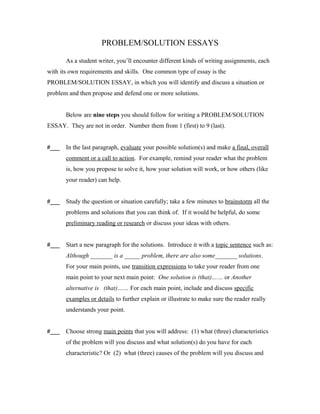
       Below are nine steps you should follow for writing a PROBLEM/SOLUTION
ESSAY. They are not in order. Number them from 1 (first) to 9 (last).


#___   In the last paragraph, evaluate your possible solution(s) and make a final, overall
       comment or a call to action. For example, remind your reader what the problem
       is, how you propose to solve it, how your solution will work, or how others (like
       your reader) can help.


#___   Study the question or situation carefully; take a few minutes to brainstorm all the
       problems and solutions that you can think of. If it would be helpful, do some
       preliminary reading or research or discuss your ideas with others.


#___   Start a new paragraph for the solutions. Introduce it with a topic sentence such as:
       Although _______ is a _____ problem, there are also some_______ solutions.
       For your main points, use transition expressions to take your reader from one
       main point to your next main point: One solution is (that)…… or Another
       alternative is (that)…… For each main point, include and discuss specific
       examples or details to further explain or illustrate to make sure the reader really
       understands your point.


#___   Choose strong main points that you will address: (1) what (three) characteristics
       of the problem will you discuss and what solution(s) do you have for each
       characteristic? Or (2) what (three) causes of the problem will you discuss and
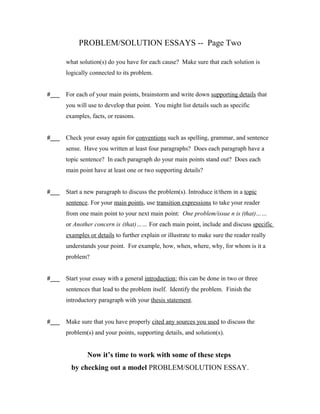
PROBLEM/SOLUTION ESSAYS -- Page Two

       what solution(s) do you have for each cause? Make sure that each solution is
       logically connected to its problem.


#___   For each of your main points, brainstorm and write down supporting details that
       you will use to develop that point. You might list details such as specific
       examples, facts, or reasons.


#___   Check your essay again for conventions such as spelling, grammar, and sentence
       sense. Have you written at least four paragraphs? Does each paragraph have a
       topic sentence? In each paragraph do your main points stand out? Does each
       main point have at least one or two supporting details?


#___   Start a new paragraph to discuss the problem(s). Introduce it/them in a topic
       sentence. For your main points, use transition expressions to take your reader
       from one main point to your next main point: One problem/issue n is (that)……
       or Another concern is (that)…… For each main point, include and discuss specific
       examples or details to further explain or illustrate to make sure the reader really
       understands your point. For example, how, when, where, why, for whom is it a
       problem?


#___   Start your essay with a general introduction; this can be done in two or three
       sentences that lead to the problem itself. Identify the problem. Finish the
       introductory paragraph with your thesis statement.


#___   Make sure that you have properly cited any sources you used to discuss the
       problem(s) and your points, supporting details, and solution(s).


               Now it’s time to work with some of these steps
         by checking out a model PROBLEM/SOLUTION ESSAY.
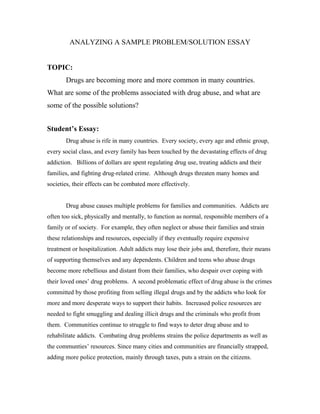
ANALYZING A SAMPLE PROBLEM/SOLUTION ESSAY


TOPIC:
       Drugs are becoming more and more common in many countries.
What are some of the problems associated with drug abuse, and what are
some of the possible solutions?


Student’s Essay:
       Drug abuse is rife in many countries. Every society, every age and ethnic group,
every social class, and every family has been touched by the devastating effects of drug
addiction. Billions of dollars are spent regulating drug use, treating addicts and their
families, and fighting drug-related crime. Although drugs threaten many homes and
societies, their effects can be combated more effectively.


       Drug abuse causes multiple problems for families and communities. Addicts are
often too sick, physically and mentally, to function as normal, responsible members of a
family or of society. For example, they often neglect or abuse their families and strain
these relationships and resources, especially if they eventually require expensive
treatment or hospitalization. Adult addicts may lose their jobs and, therefore, their means
of supporting themselves and any dependents. Children and teens who abuse drugs
become more rebellious and distant from their families, who despair over coping with
their loved ones’ drug problems. A second problematic effect of drug abuse is the crimes
committed by those profiting from selling illegal drugs and by the addicts who look for
more and more desperate ways to support their habits. Increased police resources are
needed to fight smuggling and dealing illicit drugs and the criminals who profit from
them. Communities continue to struggle to find ways to deter drug abuse and to
rehabilitate addicts. Combating drug problems strains the police departments as well as
the communties’ resources. Since many cities and communities are financially strapped,
adding more police protection, mainly through taxes, puts a strain on the citizens.
ANALYZING A SAMPLE PROBLEM/SOLUTION ESSAY
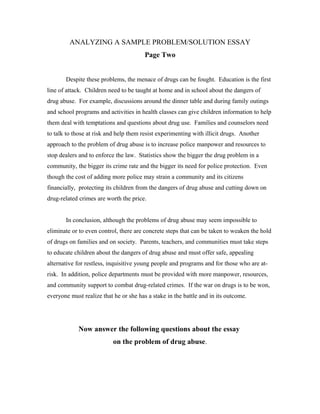
                                        Page Two


       Despite these problems, the menace of drugs can be fought. Education is the first
line of attack. Children need to be taught at home and in school about the dangers of
drug abuse. For example, discussions around the dinner table and during family outings
and school programs and activities in health classes can give children information to help
them deal with temptations and questions about drug use. Families and counselors need
to talk to those at risk and help them resist experimenting with illicit drugs. Another
approach to the problem of drug abuse is to increase police manpower and resources to
stop dealers and to enforce the law. Statistics show the bigger the drug problem in a
community, the bigger its crime rate and the bigger its need for police protection. Even
though the cost of adding more police may strain a community and its citizens
financially, protecting its children from the dangers of drug abuse and cutting down on
drug-related crimes are worth the price.


       In conclusion, although the problems of drug abuse may seem impossible to
eliminate or to even control, there are concrete steps that can be taken to weaken the hold
of drugs on families and on society. Parents, teachers, and communities must take steps
to educate children about the dangers of drug abuse and must offer safe, appealing
alternative for restless, inquisitive young people and programs and for those who are at-
risk. In addition, police departments must be provided with more manpower, resources,
and community support to combat drug-related crimes. If the war on drugs is to be won,
everyone must realize that he or she has a stake in the battle and in its outcome.


            Now answer the following questions about the essay
                           on the problem of drug abuse.
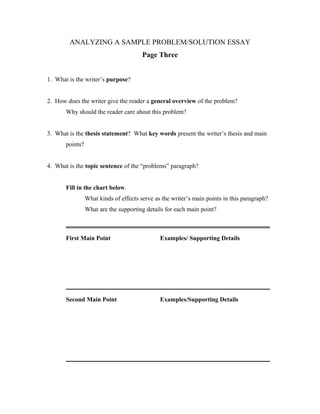
ANALYZING A SAMPLE PROBLEM/SOLUTION ESSAY
                                        Page Three


1. What is the writer’s purpose?


2. How does the writer give the reader a general overview of the problem?
       Why should the reader care about this problem?


3. What is the thesis statement? What key words present the writer’s thesis and main
       points?


4. What is the topic sentence of the “problems” paragraph?


       Fill in the chart below.
                 What kinds of effects serve as the writer’s main points in this paragraph?
                 What are the supporting details for each main point?

       _______________________________________
       First Main Point                        Examples/ Supporting Details


       _______________________________________
       Second Main Point                       Examples/Supporting Details


       _______________________________________
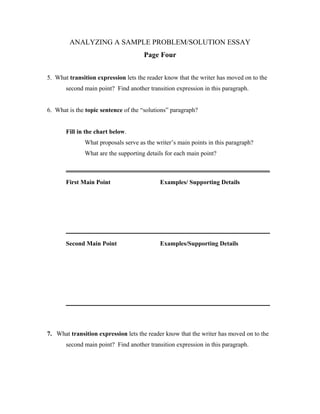
ANALYZING A SAMPLE PROBLEM/SOLUTION ESSAY
                                     Page Four


5. What transition expression lets the reader know that the writer has moved on to the
       second main point? Find another transition expression in this paragraph.


6. What is the topic sentence of the “solutions” paragraph?


       Fill in the chart below.
              What proposals serve as the writer’s main points in this paragraph?
              What are the supporting details for each main point?

       _______________________________________
       First Main Point                     Examples/ Supporting Details


       _______________________________________
       Second Main Point                    Examples/Supporting Details


       _______________________________________


7. What transition expression lets the reader know that the writer has moved on to the
       second main point? Find another transition expression in this paragraph.
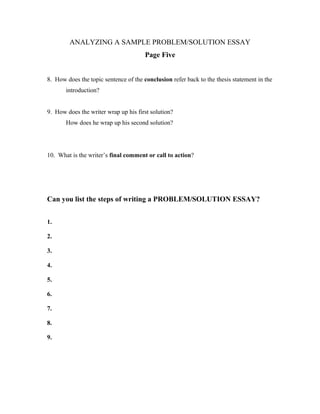
ANALYZING A SAMPLE PROBLEM/SOLUTION ESSAY
                                       Page Five


8. How does the topic sentence of the conclusion refer back to the thesis statement in the
       introduction?


9. How does the writer wrap up his first solution?
       How does he wrap up his second solution?


10. What is the writer’s final comment or call to action?


Can you list the steps of writing a PROBLEM/SOLUTION ESSAY?


1.

2.

3.

4.

5.

6.

7.

8.

9.

Problem solution exercises

  • 1.
    PROBLEM/SOLUTION ESSAYS As a student writer, you’ll encounter different kinds of writing assignments, each with its own requirements and skills. One common type of essay is the PROBLEM/SOLUTION ESSAY, in which you will identify and discuss a situation or problem and then propose and defend one or more solutions. Below are nine steps you should follow for writing a PROBLEM/SOLUTION ESSAY. They are not in order. Number them from 1 (first) to 9 (last). #___ In the last paragraph, evaluate your possible solution(s) and make a final, overall comment or a call to action. For example, remind your reader what the problem is, how you propose to solve it, how your solution will work, or how others (like your reader) can help. #___ Study the question or situation carefully; take a few minutes to brainstorm all the problems and solutions that you can think of. If it would be helpful, do some preliminary reading or research or discuss your ideas with others. #___ Start a new paragraph for the solutions. Introduce it with a topic sentence such as: Although _______ is a _____ problem, there are also some_______ solutions. For your main points, use transition expressions to take your reader from one main point to your next main point: One solution is (that)…… or Another alternative is (that)…… For each main point, include and discuss specific examples or details to further explain or illustrate to make sure the reader really understands your point. #___ Choose strong main points that you will address: (1) what (three) characteristics of the problem will you discuss and what solution(s) do you have for each characteristic? Or (2) what (three) causes of the problem will you discuss and
  • 2.
    PROBLEM/SOLUTION ESSAYS --Page Two what solution(s) do you have for each cause? Make sure that each solution is logically connected to its problem. #___ For each of your main points, brainstorm and write down supporting details that you will use to develop that point. You might list details such as specific examples, facts, or reasons. #___ Check your essay again for conventions such as spelling, grammar, and sentence sense. Have you written at least four paragraphs? Does each paragraph have a topic sentence? In each paragraph do your main points stand out? Does each main point have at least one or two supporting details? #___ Start a new paragraph to discuss the problem(s). Introduce it/them in a topic sentence. For your main points, use transition expressions to take your reader from one main point to your next main point: One problem/issue n is (that)…… or Another concern is (that)…… For each main point, include and discuss specific examples or details to further explain or illustrate to make sure the reader really understands your point. For example, how, when, where, why, for whom is it a problem? #___ Start your essay with a general introduction; this can be done in two or three sentences that lead to the problem itself. Identify the problem. Finish the introductory paragraph with your thesis statement. #___ Make sure that you have properly cited any sources you used to discuss the problem(s) and your points, supporting details, and solution(s). Now it’s time to work with some of these steps by checking out a model PROBLEM/SOLUTION ESSAY.
  • 3.
    ANALYZING A SAMPLEPROBLEM/SOLUTION ESSAY TOPIC: Drugs are becoming more and more common in many countries. What are some of the problems associated with drug abuse, and what are some of the possible solutions? Student’s Essay: Drug abuse is rife in many countries. Every society, every age and ethnic group, every social class, and every family has been touched by the devastating effects of drug addiction. Billions of dollars are spent regulating drug use, treating addicts and their families, and fighting drug-related crime. Although drugs threaten many homes and societies, their effects can be combated more effectively. Drug abuse causes multiple problems for families and communities. Addicts are often too sick, physically and mentally, to function as normal, responsible members of a family or of society. For example, they often neglect or abuse their families and strain these relationships and resources, especially if they eventually require expensive treatment or hospitalization. Adult addicts may lose their jobs and, therefore, their means of supporting themselves and any dependents. Children and teens who abuse drugs become more rebellious and distant from their families, who despair over coping with their loved ones’ drug problems. A second problematic effect of drug abuse is the crimes committed by those profiting from selling illegal drugs and by the addicts who look for more and more desperate ways to support their habits. Increased police resources are needed to fight smuggling and dealing illicit drugs and the criminals who profit from them. Communities continue to struggle to find ways to deter drug abuse and to rehabilitate addicts. Combating drug problems strains the police departments as well as the communties’ resources. Since many cities and communities are financially strapped, adding more police protection, mainly through taxes, puts a strain on the citizens.
  • 4.
    ANALYZING A SAMPLEPROBLEM/SOLUTION ESSAY Page Two Despite these problems, the menace of drugs can be fought. Education is the first line of attack. Children need to be taught at home and in school about the dangers of drug abuse. For example, discussions around the dinner table and during family outings and school programs and activities in health classes can give children information to help them deal with temptations and questions about drug use. Families and counselors need to talk to those at risk and help them resist experimenting with illicit drugs. Another approach to the problem of drug abuse is to increase police manpower and resources to stop dealers and to enforce the law. Statistics show the bigger the drug problem in a community, the bigger its crime rate and the bigger its need for police protection. Even though the cost of adding more police may strain a community and its citizens financially, protecting its children from the dangers of drug abuse and cutting down on drug-related crimes are worth the price. In conclusion, although the problems of drug abuse may seem impossible to eliminate or to even control, there are concrete steps that can be taken to weaken the hold of drugs on families and on society. Parents, teachers, and communities must take steps to educate children about the dangers of drug abuse and must offer safe, appealing alternative for restless, inquisitive young people and programs and for those who are at- risk. In addition, police departments must be provided with more manpower, resources, and community support to combat drug-related crimes. If the war on drugs is to be won, everyone must realize that he or she has a stake in the battle and in its outcome. Now answer the following questions about the essay on the problem of drug abuse.
  • 5.
    ANALYZING A SAMPLEPROBLEM/SOLUTION ESSAY Page Three 1. What is the writer’s purpose? 2. How does the writer give the reader a general overview of the problem? Why should the reader care about this problem? 3. What is the thesis statement? What key words present the writer’s thesis and main points? 4. What is the topic sentence of the “problems” paragraph? Fill in the chart below. What kinds of effects serve as the writer’s main points in this paragraph? What are the supporting details for each main point? _______________________________________ First Main Point Examples/ Supporting Details _______________________________________ Second Main Point Examples/Supporting Details _______________________________________
  • 6.
    ANALYZING A SAMPLEPROBLEM/SOLUTION ESSAY Page Four 5. What transition expression lets the reader know that the writer has moved on to the second main point? Find another transition expression in this paragraph. 6. What is the topic sentence of the “solutions” paragraph? Fill in the chart below. What proposals serve as the writer’s main points in this paragraph? What are the supporting details for each main point? _______________________________________ First Main Point Examples/ Supporting Details _______________________________________ Second Main Point Examples/Supporting Details _______________________________________ 7. What transition expression lets the reader know that the writer has moved on to the second main point? Find another transition expression in this paragraph.
  • 7.
    ANALYZING A SAMPLEPROBLEM/SOLUTION ESSAY Page Five 8. How does the topic sentence of the conclusion refer back to the thesis statement in the introduction? 9. How does the writer wrap up his first solution? How does he wrap up his second solution? 10. What is the writer’s final comment or call to action? Can you list the steps of writing a PROBLEM/SOLUTION ESSAY? 1. 2. 3. 4. 5. 6. 7. 8. 9.