CREM EWRT 1A
Day 15
How do you solve a problem
like your problem?
AGENDA
 -Problem-Solution Essays: Basic Features
 -Patrick O’Malley, “More Testing, More Learning”
 -Essay #4 Review
 -In-Class Writing: Finding a solution
 -Investigate two possible solutions
 -Write two thesis statements
 Participation:
 -Up to 3 points for individual contributions during discussion.
 -Total of 4 points for showing me your two thesis statements
before you leave.
Basic Features
of a Proposal
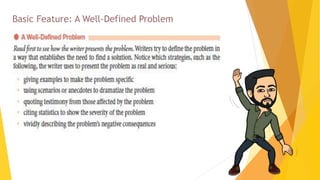
Basic Feature: A Well-Defined Problem
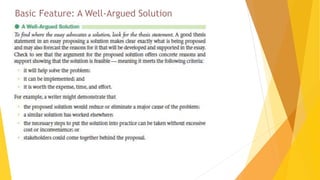
Basic Feature: A Well-Argued Solution
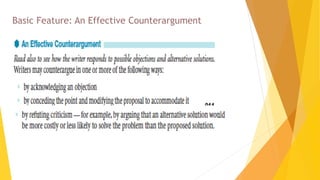
Basic Feature: An Effective Counterargument
An Evaluation of Alternative Solutions
• The writer arguing for a proposal must anticipate objections or
reservations that readers may have about the proposed solution.
• This works in much the same way as a counterargument. Identify
other ways to solve the problem. Then show why or how your
solution is superior.
Basic Feature: An Evaluation of Alternative Solutions
What is the difference between a
COUNTERARGUMENT and an
ALTERNATIVE SOLUTION?
Let’s solve the problem of where I should eat lunch!
Problem: I’m hungry.
Solution: Let’s go to McDonald’s!
Friend 1: “But McDonald’s burgers are
terrible.”
Me: “I agree, but their salads are good
and I want a salad.”
Friend 2: “But McDonald’s exploits its
workers.”
Me: “That’s true. But so does pretty much
any restaurant we could go to.”
Friend 3: “McDonald’s salads aren’t that
good.”
Me: “You’re wrong. They have an
excellent variety and their mixed greens
are really high quality.”
Friend 1: “Let’s go to Jack In The Box!”
Me: “I do like some of the food at Jack In
The Box, but I want a salad. And their
salads are terrible.”
COUNTERARGUMENTS ALTERNATIVE SOLUTION
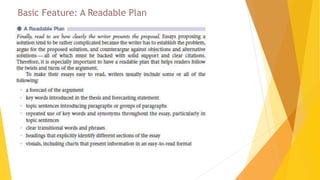
Basic Feature: A Readable Plan
Read Patrick O’Malley’s Essay. Take a few
minutes to look for these basic features in
“More Testing, More Learning.”
 A Well-Defined Problem
 A Clearly Described Solution
 A Convincing Argument
 An Effective Counterargument
 An Evaluation of Alternative Solutions
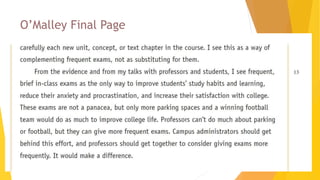
O’Malley Final Page
Now answer these questions:
1. What is this essay about?
2. What is O’Malley’s problem?
3. Where does he tell the reader?
Now let’s go through the basic features
slowly as we look at O’Malley’s essay
A Well-Defined Problem
Although this last-minute anxiety about midterm
and final exams is only too familiar to most college
students, many professors may not realize how such
major, infrequent, high-stakes exams work against
the best interests of students both psychologically
and intellectually.
A Clearly Described Solution:
This is the thesis in a problem/solution essay.
If professors gave additional brief
exams at frequent intervals, students
would be spurred to study more
regularly, learn more, worry less, and
perform better on midterms, finals,
and other papers and projects.
A Convincing Argument:
Support for the Thesis
 A 2006 study reported in Psychological Science journal
concluded that “taking repeated tests on material leads to
better long-term retention than repeated studying,” according
to the study’s coauthors, Henry L. Roediger and Jeff Karpicke.
 A Harvard study notes students’ “strong preference for
frequent evaluation in a course.”
 In a review of a number of studies of student learning,
Frederiksen (1984) reports that students who take weekly
quizzes achieve higher scores on final exams than students who
take only a midterm exam and that testing increases retention
of material tested.
 Researchers at the University of Vermont found a strong
relationship among procrastination, anxiety, and achievement.
An Effective Counterargument:
An Anticipation of Readers’ Objections and Questions
 Some believe that such exams take up too
much of the limited class time available to
cover the material in the course.
 Another objection professors have to
frequent exams is that they take too much
time to read and grade.
An Evaluation of Alternative Solutions
 It is reasonable to consider alternative ways to
achieve the same goals. One alternative solution is to
implement a program that would improve study skills.
 Still another solution might be to provide frequent
study questions for students to answer.
 Another possible solution would be to help students
prepare for midterm and final exams by providing sets
of questions from which the exam questions will be
selected or announcing possible exam topics at the
beginning of the course.
Questions??
If you are not clear
about the basic features
in O’Malley’s essay,
review at home,
beginning with slide 13.
It is critical that you
understand this
material.
 Now that you know the
basic features of the
problem/solution
essay, let’s write one!
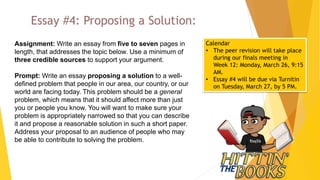
Essay #4: Proposing a Solution:
Assignment: Write an essay from five to seven pages in
length, that addresses the topic below. Use a minimum of
three credible sources to support your argument.
Prompt: Write an essay proposing a solution to a well-
defined problem that people in our area, our country, or our
world are facing today. This problem should be a general
problem, which means that it should affect more than just
you or people you know. You will want to make sure your
problem is appropriately narrowed so that you can describe
it and propose a reasonable solution in such a short paper.
Address your proposal to an audience of people who may
be able to contribute to solving the problem.
Calendar
• The peer revision will take place
during our finals meeting in
Week 12: Monday, March 26, 9:15
AM.
• Essay #4 will be due via Turnitin
on Tuesday, March 27, by 5 PM.
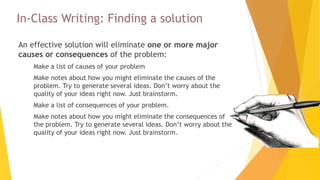
In-Class Writing: Finding a solution
An effective solution will eliminate one or more major
causes or consequences of the problem:
 Make a list of causes of your problem
 Make notes about how you might eliminate the causes of the
problem. Try to generate several ideas. Don’t worry about the
quality of your ideas right now. Just brainstorm.
 Make a list of consequences of your problem.
 Make notes about how you might eliminate the consequences of
the problem. Try to generate several ideas. Don’t worry about the
quality of your ideas right now. Just brainstorm.
Using your brainstorming, make a refined list of possible
solutions to the problem you identified last week.
Try to name at least three ideas. You will use these “alternative
solutions” in your essay after you settle on the single, best
solution.
PAY CAREFUL ATTENTION to how each solution can be implemented.
--You should NOT put the burden of the solution on the victim of the problem.
--Rather, you should think about how people or institutions with POWER could
help to solve this problem.
Example: How to solve bullying?
Solution: Kids who are getting bullied
should fight back.
Solution: Schools should implement
anti-bullying curricula.
Which is a better solution?
Example: How to solve parking at De Anza?
Solution: Students shouldn’t drive to school.
Solution: The school should charge more for parking
permits to discourage driving.
Which solution can be implemented?
Investigate two possible solutions: make notes
about how each one would solve the problem.
 Solution one
 Do something.
 How would this work?
 Solution two
 Do something else.
 How would this work?
NOW: write two thesis potential thesis statements—one for
each of your two possible solutions.
Your thesis statement should state the problem and then state the solution.
Ex.: “The problem is that _____, and the best solution is ________.”
You should show me your two thesis statements before you
leave today.
Homework
 Read: Hope in the Dark, pp. 115-125.
(There will be a quiz.)
 Discussion #23: Post the two thesis
statements you wrote today.
 Then, for each of your two potential
solutions, write a detailed paragraph
explaining why or how your solution
would solve the problem.
 Participation:
 -Up to 3 points for individual
contributions during discussion.
 -Total of 4 points for showing me your
two thesis statements before you leave.

D15-EWRT 1A

  • 1.
    CREM EWRT 1A Day15 How do you solve a problem like your problem?
  • 2.
    AGENDA  -Problem-Solution Essays:Basic Features  -Patrick O’Malley, “More Testing, More Learning”  -Essay #4 Review  -In-Class Writing: Finding a solution  -Investigate two possible solutions  -Write two thesis statements  Participation:  -Up to 3 points for individual contributions during discussion.  -Total of 4 points for showing me your two thesis statements before you leave.
  • 3.
  • 4.
    Basic Feature: AWell-Defined Problem
  • 5.
    Basic Feature: AWell-Argued Solution
  • 6.
    Basic Feature: AnEffective Counterargument
  • 7.
    An Evaluation ofAlternative Solutions • The writer arguing for a proposal must anticipate objections or reservations that readers may have about the proposed solution. • This works in much the same way as a counterargument. Identify other ways to solve the problem. Then show why or how your solution is superior. Basic Feature: An Evaluation of Alternative Solutions
  • 8.
    What is thedifference between a COUNTERARGUMENT and an ALTERNATIVE SOLUTION? Let’s solve the problem of where I should eat lunch!
  • 9.
    Problem: I’m hungry. Solution:Let’s go to McDonald’s! Friend 1: “But McDonald’s burgers are terrible.” Me: “I agree, but their salads are good and I want a salad.” Friend 2: “But McDonald’s exploits its workers.” Me: “That’s true. But so does pretty much any restaurant we could go to.” Friend 3: “McDonald’s salads aren’t that good.” Me: “You’re wrong. They have an excellent variety and their mixed greens are really high quality.” Friend 1: “Let’s go to Jack In The Box!” Me: “I do like some of the food at Jack In The Box, but I want a salad. And their salads are terrible.” COUNTERARGUMENTS ALTERNATIVE SOLUTION
  • 10.
    Basic Feature: AReadable Plan
  • 11.
    Read Patrick O’Malley’sEssay. Take a few minutes to look for these basic features in “More Testing, More Learning.”  A Well-Defined Problem  A Clearly Described Solution  A Convincing Argument  An Effective Counterargument  An Evaluation of Alternative Solutions
  • 12.
  • 13.
    Now answer thesequestions: 1. What is this essay about? 2. What is O’Malley’s problem? 3. Where does he tell the reader?
  • 14.
    Now let’s gothrough the basic features slowly as we look at O’Malley’s essay
  • 15.
    A Well-Defined Problem Althoughthis last-minute anxiety about midterm and final exams is only too familiar to most college students, many professors may not realize how such major, infrequent, high-stakes exams work against the best interests of students both psychologically and intellectually.
  • 16.
    A Clearly DescribedSolution: This is the thesis in a problem/solution essay. If professors gave additional brief exams at frequent intervals, students would be spurred to study more regularly, learn more, worry less, and perform better on midterms, finals, and other papers and projects.
  • 17.
    A Convincing Argument: Supportfor the Thesis  A 2006 study reported in Psychological Science journal concluded that “taking repeated tests on material leads to better long-term retention than repeated studying,” according to the study’s coauthors, Henry L. Roediger and Jeff Karpicke.  A Harvard study notes students’ “strong preference for frequent evaluation in a course.”  In a review of a number of studies of student learning, Frederiksen (1984) reports that students who take weekly quizzes achieve higher scores on final exams than students who take only a midterm exam and that testing increases retention of material tested.  Researchers at the University of Vermont found a strong relationship among procrastination, anxiety, and achievement.
  • 18.
    An Effective Counterargument: AnAnticipation of Readers’ Objections and Questions  Some believe that such exams take up too much of the limited class time available to cover the material in the course.  Another objection professors have to frequent exams is that they take too much time to read and grade.
  • 19.
    An Evaluation ofAlternative Solutions  It is reasonable to consider alternative ways to achieve the same goals. One alternative solution is to implement a program that would improve study skills.  Still another solution might be to provide frequent study questions for students to answer.  Another possible solution would be to help students prepare for midterm and final exams by providing sets of questions from which the exam questions will be selected or announcing possible exam topics at the beginning of the course.
  • 20.
    Questions?? If you arenot clear about the basic features in O’Malley’s essay, review at home, beginning with slide 13. It is critical that you understand this material.
  • 21.
     Now thatyou know the basic features of the problem/solution essay, let’s write one!
  • 22.
    Essay #4: Proposinga Solution: Assignment: Write an essay from five to seven pages in length, that addresses the topic below. Use a minimum of three credible sources to support your argument. Prompt: Write an essay proposing a solution to a well- defined problem that people in our area, our country, or our world are facing today. This problem should be a general problem, which means that it should affect more than just you or people you know. You will want to make sure your problem is appropriately narrowed so that you can describe it and propose a reasonable solution in such a short paper. Address your proposal to an audience of people who may be able to contribute to solving the problem. Calendar • The peer revision will take place during our finals meeting in Week 12: Monday, March 26, 9:15 AM. • Essay #4 will be due via Turnitin on Tuesday, March 27, by 5 PM.
  • 23.
    In-Class Writing: Findinga solution An effective solution will eliminate one or more major causes or consequences of the problem:  Make a list of causes of your problem  Make notes about how you might eliminate the causes of the problem. Try to generate several ideas. Don’t worry about the quality of your ideas right now. Just brainstorm.  Make a list of consequences of your problem.  Make notes about how you might eliminate the consequences of the problem. Try to generate several ideas. Don’t worry about the quality of your ideas right now. Just brainstorm.
  • 24.
    Using your brainstorming,make a refined list of possible solutions to the problem you identified last week. Try to name at least three ideas. You will use these “alternative solutions” in your essay after you settle on the single, best solution. PAY CAREFUL ATTENTION to how each solution can be implemented. --You should NOT put the burden of the solution on the victim of the problem. --Rather, you should think about how people or institutions with POWER could help to solve this problem. Example: How to solve bullying? Solution: Kids who are getting bullied should fight back. Solution: Schools should implement anti-bullying curricula. Which is a better solution? Example: How to solve parking at De Anza? Solution: Students shouldn’t drive to school. Solution: The school should charge more for parking permits to discourage driving. Which solution can be implemented?
  • 25.
    Investigate two possiblesolutions: make notes about how each one would solve the problem.  Solution one  Do something.  How would this work?  Solution two  Do something else.  How would this work? NOW: write two thesis potential thesis statements—one for each of your two possible solutions. Your thesis statement should state the problem and then state the solution. Ex.: “The problem is that _____, and the best solution is ________.” You should show me your two thesis statements before you leave today.
  • 26.
    Homework  Read: Hopein the Dark, pp. 115-125. (There will be a quiz.)  Discussion #23: Post the two thesis statements you wrote today.  Then, for each of your two potential solutions, write a detailed paragraph explaining why or how your solution would solve the problem.  Participation:  -Up to 3 points for individual contributions during discussion.  -Total of 4 points for showing me your two thesis statements before you leave.