1
Chapter 2
Measurements andCalculations
Sections 2.6 to 2.9
In these sections you will learn about:
• Problem Solving and Unit Conversion susing
Dimensional Analysis
• Multistep conversions
• Temperature Conversions
• Density
2.
Problem Solving andDimensional Analysis
• Many calculations, not only in science but in our
daily lives, involve converting one unit of
measurement to another.
• Remember in the United States, in our daily lives, we
still use English Units; Most other countries use Metric
Units; And in scientific labs, it is metric in United
States, and there is also SI units system.
• Therefore, it is very important to learn how to convert
from one unit to the other.
2
3.
Problem Solving andDimensional Analysis
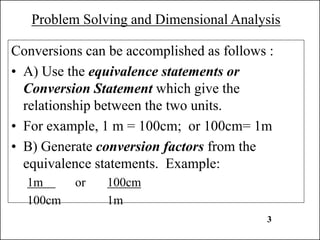
Conversions can be accomplished as follows :
• A) Use the equivalence statements or
Conversion Statement which give the
relationship between the two units.
• For example, 1 m = 100cm; or 100cm= 1m
• B) Generate conversion factors from the
equivalence statements. Example:
1m or 100cm
100cm 1m
3
4.
Problem Solving andDimensional Analysis
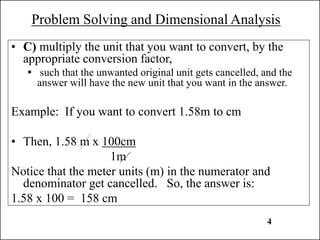
• C) multiply the unit that you want to convert, by the
appropriate conversion factor,
such that the unwanted original unit gets cancelled, and the
answer will have the new unit that you want in the answer.
Example: If you want to convert 1.58m to cm
• Then, 1.58 m x 100cm
1m
Notice that the meter units (m) in the numerator and
denominator get cancelled. So, the answer is:
1.58 x 100 = 158 cm
4
5.
Problem Solving andDimensional Analysis
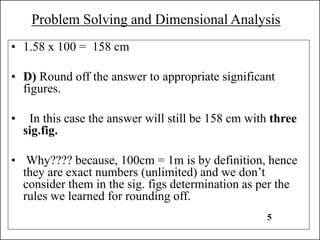
• 1.58 x 100 = 158 cm
• D) Round off the answer to appropriate significant
figures.
• In this case the answer will still be 158 cm with three
sig.fig.
• Why???? because, 100cm = 1m is by definition, hence
they are exact numbers (unlimited) and we don’t
consider them in the sig. figs determination as per the
rules we learned for rounding off.
5
Problem Solving andDimensional Analysis
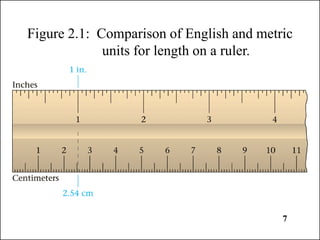
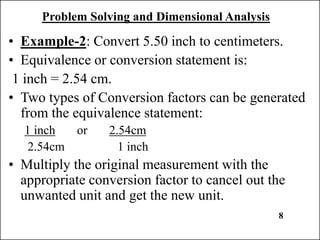
• Example-2: Convert 5.50 inch to centimeters.
• Equivalence or conversion statement is:
1 inch = 2.54 cm.
• Two types of Conversion factors can be generated
from the equivalence statement:
1 inch or 2.54cm
2.54cm 1 inch
• Multiply the original measurement with the
appropriate conversion factor to cancel out the
unwanted unit and get the new unit.
8
9.
Problem Solving andDimensional Analysis
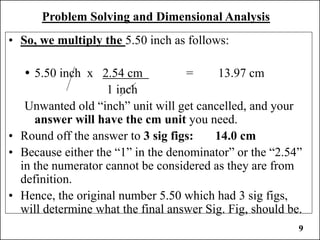
• So, we multiply the 5.50 inch as follows:
5.50 inch x 2.54 cm = 13.97 cm
1 inch
Unwanted old “inch” unit will get cancelled, and your
answer will have the cm unit you need.
• Round off the answer to 3 sig figs: 14.0 cm
• Because either the “1” in the denominator” or the “2.54”
in the numerator cannot be considered as they are from
definition.
• Hence, the original number 5.50 which had 3 sig figs,
will determine what the final answer Sig. Fig, should be.
9
10.
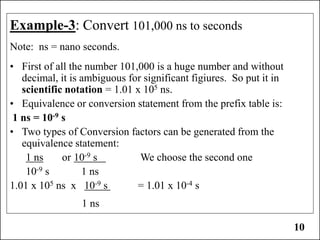
Example-3: Convert 101,000ns to seconds
Note: ns = nano seconds.
• First of all the number 101,000 is a huge number and without
decimal, it is ambiguous for significant figiures. So put it in
scientific notation = 1.01 x 10⁵ ns.
• Equivalence or conversion statement from the prefix table is:
1 ns = 10-9 s
• Two types of Conversion factors can be generated from the
equivalence statement:
1 ns or 10-9 s We choose the second one
10-9 s 1 ns
1.01 x 105 ns x 10-9 s = 1.01 x 10⁻⁴ s
1 ns
10
11.
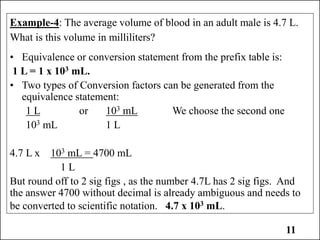
Example-4: The averagevolume of blood in an adult male is 4.7 L.
What is this volume in milliliters?
• Equivalence or conversion statement from the prefix table is:
1 L = 1 x 10³ mL.
• Two types of Conversion factors can be generated from the
equivalence statement:
1 L or 103 mL We choose the second one
103 mL 1 L
4.7 L x 103 mL = 4700 mL
1 L
But round off to 2 sig figs , as the number 4.7L has 2 sig figs. And
the answer 4700 without decimal is already ambiguous and needs to
be converted to scientific notation. 4.7 x 10³ mL.
11
12.
12
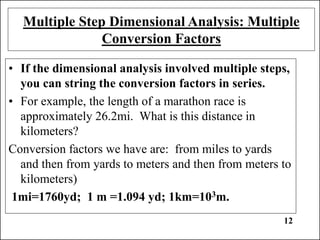
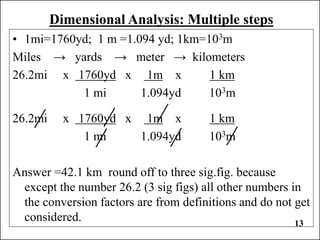
• If thedimensional analysis involved multiple steps,
you can string the conversion factors in series.
• For example, the length of a marathon race is
approximately 26.2mi. What is this distance in
kilometers?
Conversion factors we have are: from miles to yards
and then from yards to meters and then from meters to
kilometers)
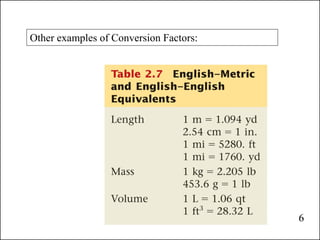
1mi=1760yd; 1 m =1.094 yd; 1km=103m.
Multiple Step Dimensional Analysis: Multiple
Conversion Factors
13.
13
• 1mi=1760yd; 1m =1.094 yd; 1km=103m
Miles → yards → meter → kilometers
26.2mi x 1760yd x 1m x 1 km
1 mi 1.094yd 103m
26.2mi x 1760yd x 1m x 1 km
1 mi 1.094yd 103m
Answer =42.1 km round off to three sig.fig. because
except the number 26.2 (3 sig figs) all other numbers in
the conversion factors are from definitions and do not get
considered.
Dimensional Analysis: Multiple steps
14.
14
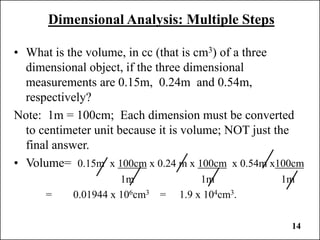
• What isthe volume, in cc (that is cm3) of a three
dimensional object, if the three dimensional
measurements are 0.15m, 0.24m and 0.54m,
respectively?
Note: 1m = 100cm; Each dimension must be converted
to centimeter unit because it is volume; NOT just the
final answer.
• Volume= 0.15m x 100cm x 0.24 m x 100cm x 0.54m x100cm
1m 1m 1m
= 0.01944 x 106cm3 = 1.9 x 104cm3.
Dimensional Analysis: Multiple Steps
15.
15
Summary
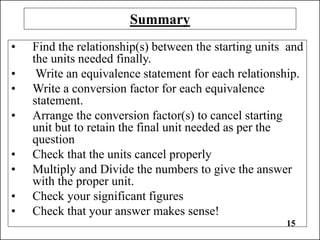
• Find therelationship(s) between the starting units and
the units needed finally.
• Write an equivalence statement for each relationship.
• Write a conversion factor for each equivalence
statement.
• Arrange the conversion factor(s) to cancel starting
unit but to retain the final unit needed as per the
question
• Check that the units cancel properly
• Multiply and Divide the numbers to give the answer
with the proper unit.
• Check your significant figures
• Check that your answer makes sense!
16.
16
When the UnitsRaised to a Power
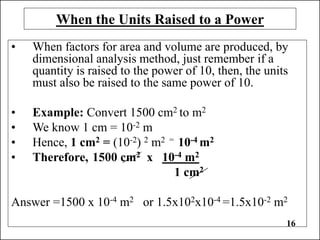
• When factors for area and volume are produced, by
dimensional analysis method, just remember if a
quantity is raised to the power of 10, then, the units
must also be raised to the same power of 10.
• Example: Convert 1500 cm2 to m2
• We know 1 cm = 10-2 m
• Hence, 1 cm2 = (10-2) 2 m2 = 10-4 m2
• Therefore, 1500 cm2 x 10-4 m2
1 cm2
Answer =1500 x 10-4 m2 or 1.5x102x10-4 =1.5x10⁻² m2
17.
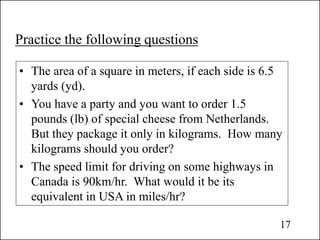
Practice the followingquestions
• The area of a square in meters, if each side is 6.5
yards (yd).
• You have a party and you want to order 1.5
pounds (lb) of special cheese from Netherlands.
But they package it only in kilograms. How many
kilograms should you order?
• The speed limit for driving on some highways in
Canada is 90km/hr. What would it be its
equivalent in USA in miles/hr?
17
18.
Interactive Websites
• Gothe following website and practice the
interactive activities they have under the title
Mass, Length and Volume
• http://www.321know.com/mea.htm
18
19.
19
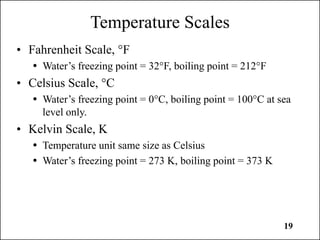
Temperature Scales
• FahrenheitScale, °F
Water’s freezing point = 32°F, boiling point = 212°F
• Celsius Scale, °C
Water’s freezing point = 0°C, boiling point = 100°C at sea
level only.
• Kelvin Scale, K
Temperature unit same size as Celsius
Water’s freezing point = 273 K, boiling point = 373 K
20.
20
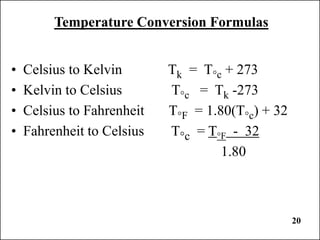
Temperature Conversion Formulas
•Celsius to Kelvin Tk = T°c + 273
• Kelvin to Celsius T°c = Tk -273
• Celsius to Fahrenheit T°F = 1.80(T°c) + 32
• Fahrenheit to Celsius T°c = T°F - 32
1.80
21.
21
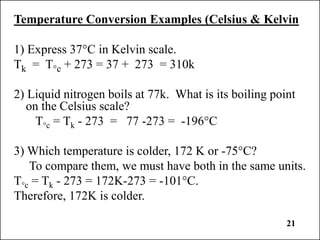
Temperature Conversion Examples(Celsius & Kelvin
1) Express 37°C in Kelvin scale.
Tk = T°c + 273 = 37 + 273 = 310k
2) Liquid nitrogen boils at 77k. What is its boiling point
on the Celsius scale?
T°c = Tk - 273 = 77 -273 = -196°C
3) Which temperature is colder, 172 K or -75°C?
To compare them, we must have both in the same units.
T°c = Tk - 273 = 172K-273 = -101°C.
Therefore, 172K is colder.
22.
22
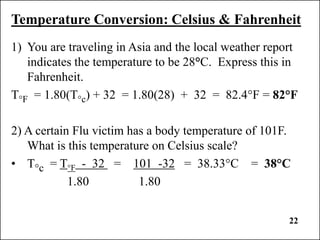
Temperature Conversion: Celsius& Fahrenheit
1) You are traveling in Asia and the local weather report
indicates the temperature to be 28°C. Express this in
Fahrenheit.
T°F = 1.80(T°c) + 32 = 1.80(28) + 32 = 82.4°F = 82°F
2) A certain Flu victim has a body temperature of 101F.
What is this temperature on Celsius scale?
• T°c = T°F - 32 = 101 -32 = 38.33°C = 38°C
1.80 1.80
24
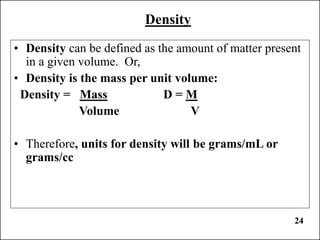
Density
• Density canbe defined as the amount of matter present
in a given volume. Or,
• Density is the mass per unit volume:
Density = Mass D = M
Volume V
• Therefore, units for density will be grams/mL or
grams/cc
25.
25
Density
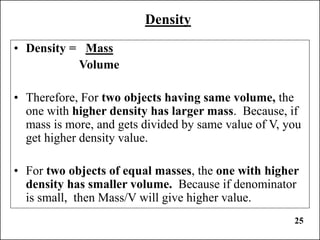
• Density =Mass
Volume
• Therefore, For two objects having same volume, the
one with higher density has larger mass. Because, if
mass is more, and gets divided by same value of V, you
get higher density value.
• For two objects of equal masses, the one with higher
density has smaller volume. Because if denominator
is small, then Mass/V will give higher value.
26.
26
Density
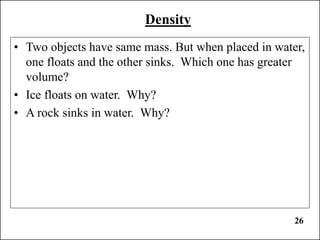
• Two objectshave same mass. But when placed in water,
one floats and the other sinks. Which one has greater
volume?
• Ice floats on water. Why?
• A rock sinks in water. Why?
27.
27
Using Density inCalculations
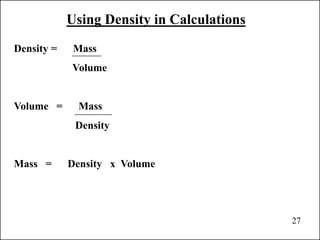
Density = Mass
Volume
Volume = Mass
Density
Mass = Density x Volume
28.
28
Density
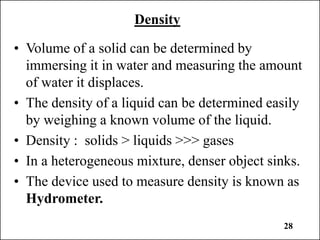
• Volume ofa solid can be determined by
immersing it in water and measuring the amount
of water it displaces.
• The density of a liquid can be determined easily
by weighing a known volume of the liquid.
• Density : solids > liquids >>> gases
• In a heterogeneous mixture, denser object sinks.
• The device used to measure density is known as
Hydrometer.
29.
Calculations
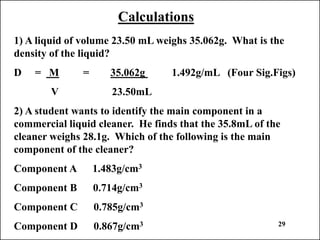
1) A liquidof volume 23.50 mL weighs 35.062g. What is the
density of the liquid?
D = M = 35.062g 1.492g/mL (Four Sig.Figs)
V 23.50mL
2) A student wants to identify the main component in a
commercial liquid cleaner. He finds that the 35.8mL of the
cleaner weighs 28.1g. Which of the following is the main
component of the cleaner?
Component A 1.483g/cm3
Component B 0.714g/cm3
Component C 0.785g/cm3
Component D 0.867g/cm3 29
30.
30
Calculations
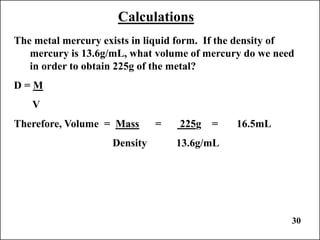
The metal mercuryexists in liquid form. If the density of
mercury is 13.6g/mL, what volume of mercury do we need
in order to obtain 225g of the metal?
D = M
V
Therefore, Volume = Mass = 225g = 16.5mL
Density 13.6g/mL
31.
31
Calculations
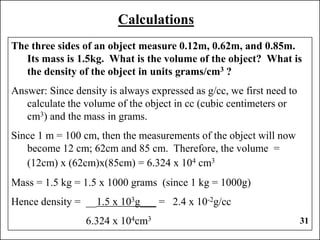
The three sidesof an object measure 0.12m, 0.62m, and 0.85m.
Its mass is 1.5kg. What is the volume of the object? What is
the density of the object in units grams/cm3 ?
Answer: Since density is always expressed as g/cc, we first need to
calculate the volume of the object in cc (cubic centimeters or
cm3) and the mass in grams.
Since 1 m = 100 cm, then the measurements of the object will now
become 12 cm; 62cm and 85 cm. Therefore, the volume =
(12cm) x (62cm)x(85cm) = 6.324 x 104 cm3
Mass = 1.5 kg = 1.5 x 1000 grams (since 1 kg = 1000g)
Hence density = __1.5 x 103g___ = 2.4 x 10⁻²g/cc
6.324 x 104cm3
32.
31
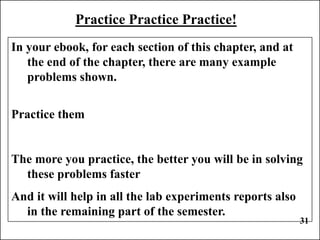
Practice Practice Practice!
Inyour ebook, for each section of this chapter, and at
the end of the chapter, there are many example
problems shown.
Practice them
The more you practice, the better you will be in solving
these problems faster
And it will help in all the lab experiments reports also
in the remaining part of the semester.