Workshop: Problem Definition
Defining the Warehouse, Shelf, and Box
cc: rpongsaj - https://www.flickr.com/photos/15131913@N00
About Me
• Sr. Director Interaction Design
and Research, Active Network
• PhD in Information Science
• Close to 25 years in enterprise
software, 15 in UX
• Authored Agile UX Storytelling
cc: Fefa Guerra - https://www.flickr.com/photos/73573770@N04
About Active Network
• 1,500+ employees (part of Global
Payments with 10,000+ employees)
• 20+ products spanning consumer to
back office software
• Millions of users daily
• 12 interaction designers and
researchers (we’re hiring!)
cc: Fefa Guerra - https://www.flickr.com/photos/73573770@N04
Solutions are FUN!
cc: djwtwo - https://www.flickr.com/photos/40761412@N00
Why Problem Definition?
cc: Alexey Kljatov (ChaoticMind75) - https://www.flickr.com/photos/53601471@N08
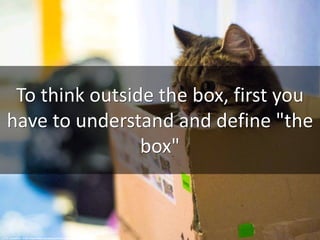
To think outside the box, first you
have to understand and define "the
box"
cc: netzanette - https://www.flickr.com/photos/67212136@N00
Problem Definition
1. Understand and define the
persona, journeys, and workflows.
2. Understand and define the
desired actions, results, and
details.
3. Define the box.
cc: thekellyscope - https://www.flickr.com/photos/38799907@N07
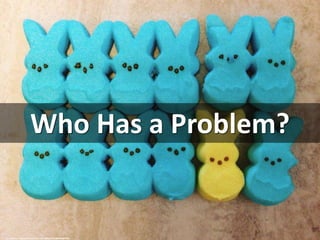
Who Has a Problem?
cc: katerha - https://www.flickr.com/photos/8489692@N03
Where to Look
• Market segments
• Current users
• Current customers
• Employees/Bosses of users
cc: katieb50 - https://www.flickr.com/photos/10233916@N03
What is their Journey?
cc: marfis75 - https://www.flickr.com/photos/45409431@N00
Where to Look
• Support tickets
• Reviews
• Observations
• Adjacencies
• Feature requests (caveat)
• Training videos
• Industry publications
cc: katieb50 - https://www.flickr.com/photos/10233916@N03
A Word about Biases
cc: Wi2_Photography - https://www.flickr.com/photos/41027404@N07
Watch Out For:
• Anchoring/Recency Effect
• Observer-Expectancy
Effect/Wording Bias
• Confirmation Bias
• Social Desirability Bias
• Clustering Illusion/Illusory
Correlation
cc: Michael Mroczek - https://unsplash.com/@michaelmroczek?utm_source=haikudeck&utm_medium=referral&utm_campaign=api-credit
Let's Try It!
cc: Christian Haugen - https://www.flickr.com/photos/34073237@N04
Experience Sharing
1. List everything relevant you know about
your assigned user group - general
demographics, education, environment,
income, etc.
2. List what you want to find out about
regarding experience sharing for your users
and potential sources of information
3. Include expertise in the experience sharing,
but NOT IN A SPECIFIC PRODUCT.
cc: Leonrw - https://www.flickr.com/photos/28435348@N04
Defining Workflows
1. For your user group, describe a workflow
for experience sharing.
2. Describe an experience sharing workflow
that takes too long.
3. Describe how a different products
support/do not support their experience
sharing.
4. Describe what the number one thing they
want to accomplish is.
5. DO NOT CREATE A SOLUTION.
cc: Ian Ruotsala - https://www.flickr.com/photos/46813052@N00
Map Your Journey
• Think about how your workflows
connect (or don't)
• Create a map that shows a typical
day or week or segment for your
user in their experience sharing.
• Include before and after.
cc: marfis75 - https://www.flickr.com/photos/45409431@N00
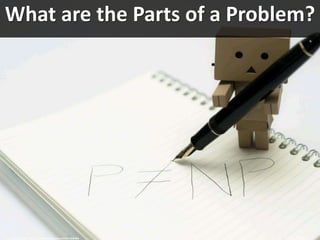
What are the Parts of a Problem?
cc: Takashi(aes256) - https://www.flickr.com/photos/46151146@N04
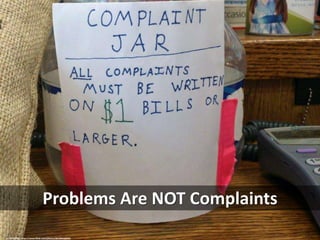
Problems Are NOT Complaints
cc: MTSOfan - https://www.flickr.com/photos/8628862@N05
Aspects of a Problem
• Action/Barriers/Results
• Context
• Motivation/Interest
• Measure/Definition of Success
• Severity/Impact
• Variables/Constants
cc: jah~ - https://www.flickr.com/photos/23019891@N00
Action/Barrier/Results
• What action is the actor trying to do?
• What gets in the way of them doing
this?
• What do they want as a result of this
action?
• DO NOT MENTION THE PRODUCT
cc: JD Hancock - https://www.flickr.com/photos/83346641@N00
Context
• When does this happen?
• Where does this happen?
• What is going on when this
happens?
• What happens before/after this?
cc: ccPixs.com - https://www.flickr.com/photos/86530412@N02
Motivation/Interest
• Why does the actor want to do
this?
• Why?
• Why?
• Why?
• Why?
cc: burrows.nichole28 - https://www.flickr.com/photos/130132803@N07
Measurement of Success
• How will they know that they were
successful?
• How do they measure that today?
• What action do they take based on
that success?
• Is there more than one kind of
success? List them.
cc: johnwiechecki - https://www.flickr.com/photos/97706295@N00
Severity/Impact
• What happens if they are NOT
successful? What is the cost?
• What happens if they are
successful? What is the profit?
cc: Walter-Wilhelm - https://www.flickr.com/photos/38939582@N04
Variables/Constants
• What changes? How much
does it change?
• What stays the same?
cc: SomeDriftwood - https://www.flickr.com/photos/94058312@N00
Let's Try It
cc: Antoine Lang-Cavelier - https://www.flickr.com/photos/41432243@N03
Problem Aspects
1. Write down each aspect on a
different sticky note
2. Stick them to your journey
map. Where do they fit?
cc: Joey Day - https://www.flickr.com/photos/76967796@N00
Assemble the Data
STILL NO SOLUTIONS!!
cc: Dave Dugdale - https://www.flickr.com/photos/37387065@N05
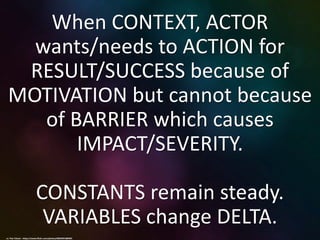
When CONTEXT, ACTOR
wants/needs to ACTION for
RESULT/SUCCESS because of
MOTIVATION but cannot because
of BARRIER which causes
IMPACT/SEVERITY.
CONSTANTS remain steady.
VARIABLES change DELTA.
cc: Poe Tatum - https://www.flickr.com/photos/8064937@N05
Piece It Together
cc: Horia Varlan - https://www.flickr.com/photos/10361931@N06
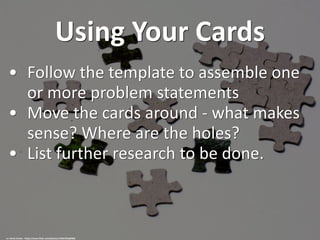
Using Your Cards
• Follow the template to assemble one
or more problem statements
• Move the cards around - what makes
sense? Where are the holes?
• List further research to be done.
cc: Horia Varlan - https://www.flickr.com/photos/10361931@N06
Give It Life
cc: twm1340 - https://www.flickr.com/photos/89093669@N00
Tell Us Your Story!
cc: Daniel McCullough - https://unsplash.com/@d_mccullough?utm_source=haikudeck&utm_medium=referral&utm_campaign=api-credit
Dr. Rebecca Baker
rebecca.baker@activenetwork.com
cc: an untrained eye - https://www.flickr.com/photos/26312642@N00
A Few Resources on Critical Thinking
• Critical Thinking for UX Designers
http://www.slideshare.net/stephenpa/critical-thinking-forux-
designers-workshop
• Become a Better Designer Through Critical
Thinkinghttp://www.vanseodesign.com/web-design/critical-
thinking/
• A Plea for More Critical Thinking in Design, Please
http://www.fastcompany.com/1327667/plea-more-critical-
thinking-design-please
• CriticalThinking.Net http://www.criticalthinking.net/index.html
A Few Resources on Problem Definition
• Rosenhead, J. (1996) What's the problem? An introduction to
problem structuring methods Interfaces 26 (6), 117-131
• Portigal, S. (2016) Doorbells, Danger, and Dead Batteries: User
Research War Stories. Rosenfeld Media.
• Quesenbery, W. and Brooks, K. (2010) Storytelling for User
Experience. Brooklyn, NY: Rosefeld Media, LLC
• Hackos, J. and Redish, J. (1998) User and Task Analysis for Interface
Design. New York, NY: John Wiley & Sons, Inc.
• Spool, J. (2014, Oct 01) Promise, Vision, Scenario and User. [Blog
post] Retrieved from
http://www.uie.com/articles/promise_vision_scenario/
• Inchauste, F. (2010, Jan 29) Better UX with Story Telling. Smashing
Magazine. Retrieved from
http://www.smashingmagazine.com/2010/01/29/better-user-
experience-using-storytelling-part-one/

Problem Definition Workshop

  • 1.
    Workshop: Problem Definition Definingthe Warehouse, Shelf, and Box cc: rpongsaj - https://www.flickr.com/photos/15131913@N00
  • 2.
    About Me • Sr.Director Interaction Design and Research, Active Network • PhD in Information Science • Close to 25 years in enterprise software, 15 in UX • Authored Agile UX Storytelling cc: Fefa Guerra - https://www.flickr.com/photos/73573770@N04
  • 3.
    About Active Network •1,500+ employees (part of Global Payments with 10,000+ employees) • 20+ products spanning consumer to back office software • Millions of users daily • 12 interaction designers and researchers (we’re hiring!) cc: Fefa Guerra - https://www.flickr.com/photos/73573770@N04
  • 4.
    Solutions are FUN! cc:djwtwo - https://www.flickr.com/photos/40761412@N00
  • 5.
    Why Problem Definition? cc:Alexey Kljatov (ChaoticMind75) - https://www.flickr.com/photos/53601471@N08
  • 6.
    To think outsidethe box, first you have to understand and define "the box" cc: netzanette - https://www.flickr.com/photos/67212136@N00
  • 7.
    Problem Definition 1. Understandand define the persona, journeys, and workflows. 2. Understand and define the desired actions, results, and details. 3. Define the box. cc: thekellyscope - https://www.flickr.com/photos/38799907@N07
  • 8.
    Who Has aProblem? cc: katerha - https://www.flickr.com/photos/8489692@N03
  • 9.
    Where to Look •Market segments • Current users • Current customers • Employees/Bosses of users cc: katieb50 - https://www.flickr.com/photos/10233916@N03
  • 10.
    What is theirJourney? cc: marfis75 - https://www.flickr.com/photos/45409431@N00
  • 11.
    Where to Look •Support tickets • Reviews • Observations • Adjacencies • Feature requests (caveat) • Training videos • Industry publications cc: katieb50 - https://www.flickr.com/photos/10233916@N03
  • 12.
    A Word aboutBiases cc: Wi2_Photography - https://www.flickr.com/photos/41027404@N07
  • 13.
    Watch Out For: •Anchoring/Recency Effect • Observer-Expectancy Effect/Wording Bias • Confirmation Bias • Social Desirability Bias • Clustering Illusion/Illusory Correlation cc: Michael Mroczek - https://unsplash.com/@michaelmroczek?utm_source=haikudeck&utm_medium=referral&utm_campaign=api-credit
  • 14.
    Let's Try It! cc:Christian Haugen - https://www.flickr.com/photos/34073237@N04
  • 15.
    Experience Sharing 1. Listeverything relevant you know about your assigned user group - general demographics, education, environment, income, etc. 2. List what you want to find out about regarding experience sharing for your users and potential sources of information 3. Include expertise in the experience sharing, but NOT IN A SPECIFIC PRODUCT. cc: Leonrw - https://www.flickr.com/photos/28435348@N04
  • 16.
    Defining Workflows 1. Foryour user group, describe a workflow for experience sharing. 2. Describe an experience sharing workflow that takes too long. 3. Describe how a different products support/do not support their experience sharing. 4. Describe what the number one thing they want to accomplish is. 5. DO NOT CREATE A SOLUTION. cc: Ian Ruotsala - https://www.flickr.com/photos/46813052@N00
  • 17.
    Map Your Journey •Think about how your workflows connect (or don't) • Create a map that shows a typical day or week or segment for your user in their experience sharing. • Include before and after. cc: marfis75 - https://www.flickr.com/photos/45409431@N00
  • 18.
    What are theParts of a Problem? cc: Takashi(aes256) - https://www.flickr.com/photos/46151146@N04
  • 19.
    Problems Are NOTComplaints cc: MTSOfan - https://www.flickr.com/photos/8628862@N05
  • 20.
    Aspects of aProblem • Action/Barriers/Results • Context • Motivation/Interest • Measure/Definition of Success • Severity/Impact • Variables/Constants cc: jah~ - https://www.flickr.com/photos/23019891@N00
  • 21.
    Action/Barrier/Results • What actionis the actor trying to do? • What gets in the way of them doing this? • What do they want as a result of this action? • DO NOT MENTION THE PRODUCT cc: JD Hancock - https://www.flickr.com/photos/83346641@N00
  • 22.
    Context • When doesthis happen? • Where does this happen? • What is going on when this happens? • What happens before/after this? cc: ccPixs.com - https://www.flickr.com/photos/86530412@N02
  • 23.
    Motivation/Interest • Why doesthe actor want to do this? • Why? • Why? • Why? • Why? cc: burrows.nichole28 - https://www.flickr.com/photos/130132803@N07
  • 24.
    Measurement of Success •How will they know that they were successful? • How do they measure that today? • What action do they take based on that success? • Is there more than one kind of success? List them. cc: johnwiechecki - https://www.flickr.com/photos/97706295@N00
  • 25.
    Severity/Impact • What happensif they are NOT successful? What is the cost? • What happens if they are successful? What is the profit? cc: Walter-Wilhelm - https://www.flickr.com/photos/38939582@N04
  • 26.
    Variables/Constants • What changes?How much does it change? • What stays the same? cc: SomeDriftwood - https://www.flickr.com/photos/94058312@N00
  • 27.
    Let's Try It cc:Antoine Lang-Cavelier - https://www.flickr.com/photos/41432243@N03
  • 28.
    Problem Aspects 1. Writedown each aspect on a different sticky note 2. Stick them to your journey map. Where do they fit? cc: Joey Day - https://www.flickr.com/photos/76967796@N00
  • 29.
    Assemble the Data STILLNO SOLUTIONS!! cc: Dave Dugdale - https://www.flickr.com/photos/37387065@N05
  • 30.
    When CONTEXT, ACTOR wants/needsto ACTION for RESULT/SUCCESS because of MOTIVATION but cannot because of BARRIER which causes IMPACT/SEVERITY. CONSTANTS remain steady. VARIABLES change DELTA. cc: Poe Tatum - https://www.flickr.com/photos/8064937@N05
  • 31.
    Piece It Together cc:Horia Varlan - https://www.flickr.com/photos/10361931@N06
  • 32.
    Using Your Cards •Follow the template to assemble one or more problem statements • Move the cards around - what makes sense? Where are the holes? • List further research to be done. cc: Horia Varlan - https://www.flickr.com/photos/10361931@N06
  • 33.
    Give It Life cc:twm1340 - https://www.flickr.com/photos/89093669@N00
  • 34.
    Tell Us YourStory! cc: Daniel McCullough - https://unsplash.com/@d_mccullough?utm_source=haikudeck&utm_medium=referral&utm_campaign=api-credit
  • 35.
    Dr. Rebecca Baker rebecca.baker@activenetwork.com cc:an untrained eye - https://www.flickr.com/photos/26312642@N00
  • 36.
    A Few Resourceson Critical Thinking • Critical Thinking for UX Designers http://www.slideshare.net/stephenpa/critical-thinking-forux- designers-workshop • Become a Better Designer Through Critical Thinkinghttp://www.vanseodesign.com/web-design/critical- thinking/ • A Plea for More Critical Thinking in Design, Please http://www.fastcompany.com/1327667/plea-more-critical- thinking-design-please • CriticalThinking.Net http://www.criticalthinking.net/index.html
  • 37.
    A Few Resourceson Problem Definition • Rosenhead, J. (1996) What's the problem? An introduction to problem structuring methods Interfaces 26 (6), 117-131 • Portigal, S. (2016) Doorbells, Danger, and Dead Batteries: User Research War Stories. Rosenfeld Media. • Quesenbery, W. and Brooks, K. (2010) Storytelling for User Experience. Brooklyn, NY: Rosefeld Media, LLC • Hackos, J. and Redish, J. (1998) User and Task Analysis for Interface Design. New York, NY: John Wiley & Sons, Inc. • Spool, J. (2014, Oct 01) Promise, Vision, Scenario and User. [Blog post] Retrieved from http://www.uie.com/articles/promise_vision_scenario/ • Inchauste, F. (2010, Jan 29) Better UX with Story Telling. Smashing Magazine. Retrieved from http://www.smashingmagazine.com/2010/01/29/better-user- experience-using-storytelling-part-one/