Probability
Jeanine Blumenau
Classical method
Experiment (eg. Flip of a coin – outcome of H or T)
• Exact outcome is unknown before conducting
experiment
• All possible outcomes of experiment are known
• Each outcome is equally likely
• Experiment can be repeated under uniform
conditions
Together these conditions produce regularities or
patterns in outcomes
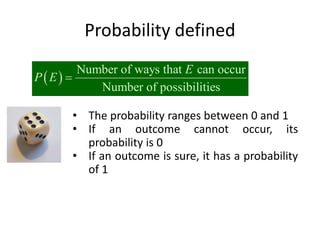
Probability defined
 
Number of ways that can occur
Number of possibilities
E
P E 
• The probability ranges between 0 and 1
• If an outcome cannot occur, its
probability is 0
• If an outcome is sure, it has a probability
of 1
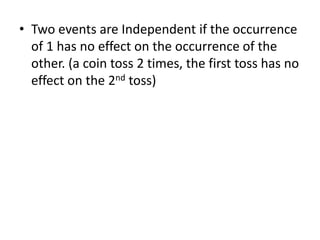
• Two events are Independent if the occurrence
of 1 has no effect on the occurrence of the
other. (a coin toss 2 times, the first toss has no
effect on the 2nd toss)
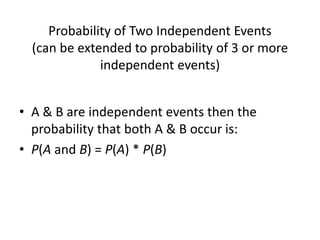
Probability of Two Independent Events
(can be extended to probability of 3 or more
independent events)
• A & B are independent events then the
probability that both A & B occur is:
• P(A and B) = P(A) * P(B)
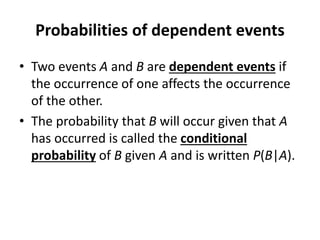
Probabilities of dependent events
• Two events A and B are dependent events if
the occurrence of one affects the occurrence
of the other.
• The probability that B will occur given that A
has occurred is called the conditional
probability of B given A and is written P(B|A).
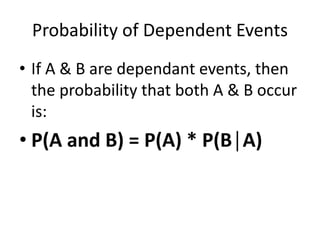
Probability of Dependent Events
• If A & B are dependant events, then
the probability that both A & B occur
is:
• P(A and B) = P(A) * P(B│A)
Comparing Dependent and Independent
Events
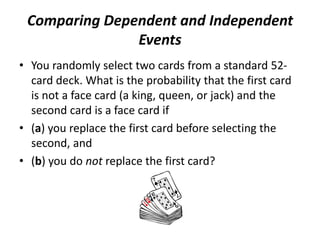
• You randomly select two cards from a standard 52-
card deck. What is the probability that the first card
is not a face card (a king, queen, or jack) and the
second card is a face card if
• (a) you replace the first card before selecting the
second, and
• (b) you do not replace the first card?
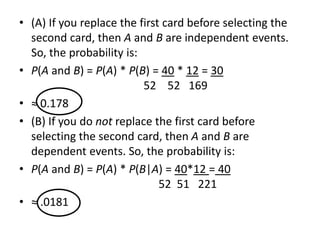
• (A) If you replace the first card before selecting the
second card, then A and B are independent events.
So, the probability is:
• P(A and B) = P(A) * P(B) = 40 * 12 = 30
52 52 169
• ≈ 0.178
• (B) If you do not replace the first card before
selecting the second card, then A and B are
dependent events. So, the probability is:
• P(A and B) = P(A) * P(B|A) = 40*12 = 40
52 51 221
• ≈ .0181
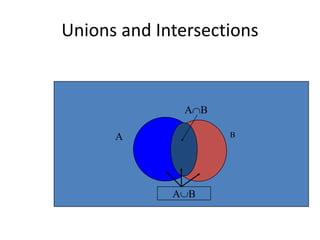
Unions and Intersections
A B
A
A
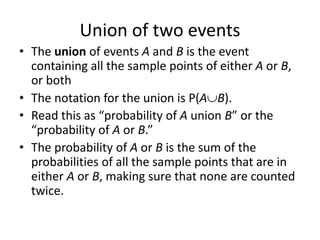
Union of two events
• The union of events A and B is the event
containing all the sample points of either A or B,
or both
• The notation for the union is P(AB).
• Read this as “probability of A union B” or the
“probability of A or B.”
• The probability of A or B is the sum of the
probabilities of all the sample points that are in
either A or B, making sure that none are counted
twice.
Intersection of two events
• The intersection of events A and B is the event
containing only the sample points belonging
to both A and B
• The notation for the intersection is P(AB).
• Read this as “probability of A intersection B”
or the “probability of A and B.”
• The probability of A and B is the sum of the
probabilities of all the sample points common
to both A and B.
Mutually Exclusive Events
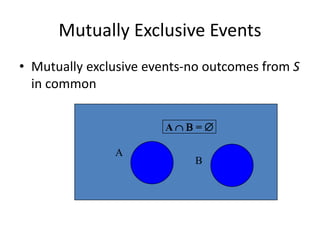
• Mutually exclusive events-no outcomes from S
in common
A
B
A = 
Laws of Probability
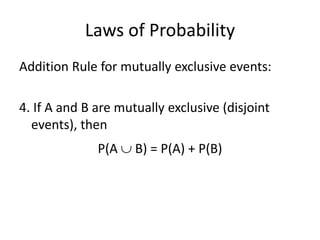
Addition Rule for mutually exclusive events:
4. If A and B are mutually exclusive (disjoint
events), then
P(A  B) = P(A) + P(B)
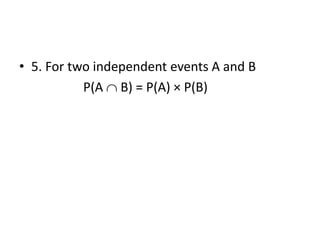
• 5. For two independent events A and B
P(A  B) = P(A) × P(B)
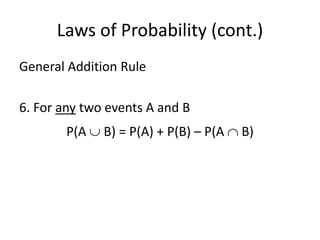
Laws of Probability (cont.)
General Addition Rule
6. For any two events A and B
P(A  B) = P(A) + P(B) – P(A  B)
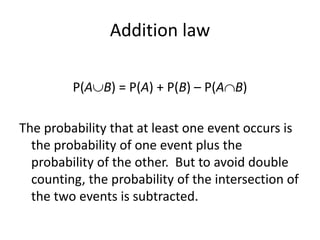
Addition law
P(AB) = P(A) + P(B) – P(AB)
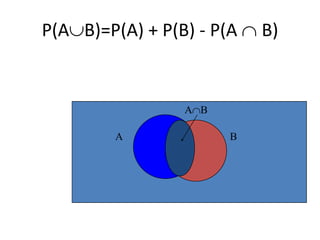
The probability that at least one event occurs is
the probability of one event plus the
probability of the other. But to avoid double
counting, the probability of the intersection of
the two events is subtracted.
P(AB)=P(A) + P(B) - P(A B)
A B
A
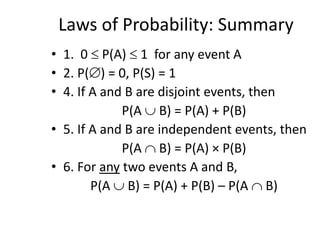
Laws of Probability: Summary
• 1. 0  P(A)  1 for any event A
• 2. P() = 0, P(S) = 1
• 4. If A and B are disjoint events, then
P(A  B) = P(A) + P(B)
• 5. If A and B are independent events, then
P(A  B) = P(A) × P(B)
• 6. For any two events A and B,
P(A  B) = P(A) + P(B) – P(A  B)

Probability revised

  • 1.
  • 2.
    Classical method Experiment (eg.Flip of a coin – outcome of H or T) • Exact outcome is unknown before conducting experiment • All possible outcomes of experiment are known • Each outcome is equally likely • Experiment can be repeated under uniform conditions Together these conditions produce regularities or patterns in outcomes
  • 3.
    Probability defined   Numberof ways that can occur Number of possibilities E P E  • The probability ranges between 0 and 1 • If an outcome cannot occur, its probability is 0 • If an outcome is sure, it has a probability of 1
  • 4.
    • Two eventsare Independent if the occurrence of 1 has no effect on the occurrence of the other. (a coin toss 2 times, the first toss has no effect on the 2nd toss)
  • 5.
    Probability of TwoIndependent Events (can be extended to probability of 3 or more independent events) • A & B are independent events then the probability that both A & B occur is: • P(A and B) = P(A) * P(B)
  • 6.
    Probabilities of dependentevents • Two events A and B are dependent events if the occurrence of one affects the occurrence of the other. • The probability that B will occur given that A has occurred is called the conditional probability of B given A and is written P(B|A).
  • 7.
    Probability of DependentEvents • If A & B are dependant events, then the probability that both A & B occur is: • P(A and B) = P(A) * P(B│A)
  • 8.
    Comparing Dependent andIndependent Events • You randomly select two cards from a standard 52- card deck. What is the probability that the first card is not a face card (a king, queen, or jack) and the second card is a face card if • (a) you replace the first card before selecting the second, and • (b) you do not replace the first card?
  • 9.
    • (A) Ifyou replace the first card before selecting the second card, then A and B are independent events. So, the probability is: • P(A and B) = P(A) * P(B) = 40 * 12 = 30 52 52 169 • ≈ 0.178 • (B) If you do not replace the first card before selecting the second card, then A and B are dependent events. So, the probability is: • P(A and B) = P(A) * P(B|A) = 40*12 = 40 52 51 221 • ≈ .0181
  • 10.
    Unions and Intersections AB A A
  • 11.
    Union of twoevents • The union of events A and B is the event containing all the sample points of either A or B, or both • The notation for the union is P(AB). • Read this as “probability of A union B” or the “probability of A or B.” • The probability of A or B is the sum of the probabilities of all the sample points that are in either A or B, making sure that none are counted twice.
  • 12.
    Intersection of twoevents • The intersection of events A and B is the event containing only the sample points belonging to both A and B • The notation for the intersection is P(AB). • Read this as “probability of A intersection B” or the “probability of A and B.” • The probability of A and B is the sum of the probabilities of all the sample points common to both A and B.
  • 13.
    Mutually Exclusive Events •Mutually exclusive events-no outcomes from S in common A B A = 
  • 14.
    Laws of Probability AdditionRule for mutually exclusive events: 4. If A and B are mutually exclusive (disjoint events), then P(A  B) = P(A) + P(B)
  • 15.
    • 5. Fortwo independent events A and B P(A  B) = P(A) × P(B)
  • 16.
    Laws of Probability(cont.) General Addition Rule 6. For any two events A and B P(A  B) = P(A) + P(B) – P(A  B)
  • 17.
    Addition law P(AB) =P(A) + P(B) – P(AB) The probability that at least one event occurs is the probability of one event plus the probability of the other. But to avoid double counting, the probability of the intersection of the two events is subtracted.
  • 18.
    P(AB)=P(A) + P(B)- P(A B) A B A
  • 19.
    Laws of Probability:Summary • 1. 0  P(A)  1 for any event A • 2. P() = 0, P(S) = 1 • 4. If A and B are disjoint events, then P(A  B) = P(A) + P(B) • 5. If A and B are independent events, then P(A  B) = P(A) × P(B) • 6. For any two events A and B, P(A  B) = P(A) + P(B) – P(A  B)