PROBABILITY AND STATISTICS
5E Note 4
The theory of probability was introduced by two
famous mathematician Blaise and Pierre de Fermat in
1654. They made a study of the gambling problems
to formulate the fundamental principles of
probability theory. After that it was developed by
Laplace, Chebyshev, Markov, Von Mises and
Kolmogorov.
PROBABIILITY
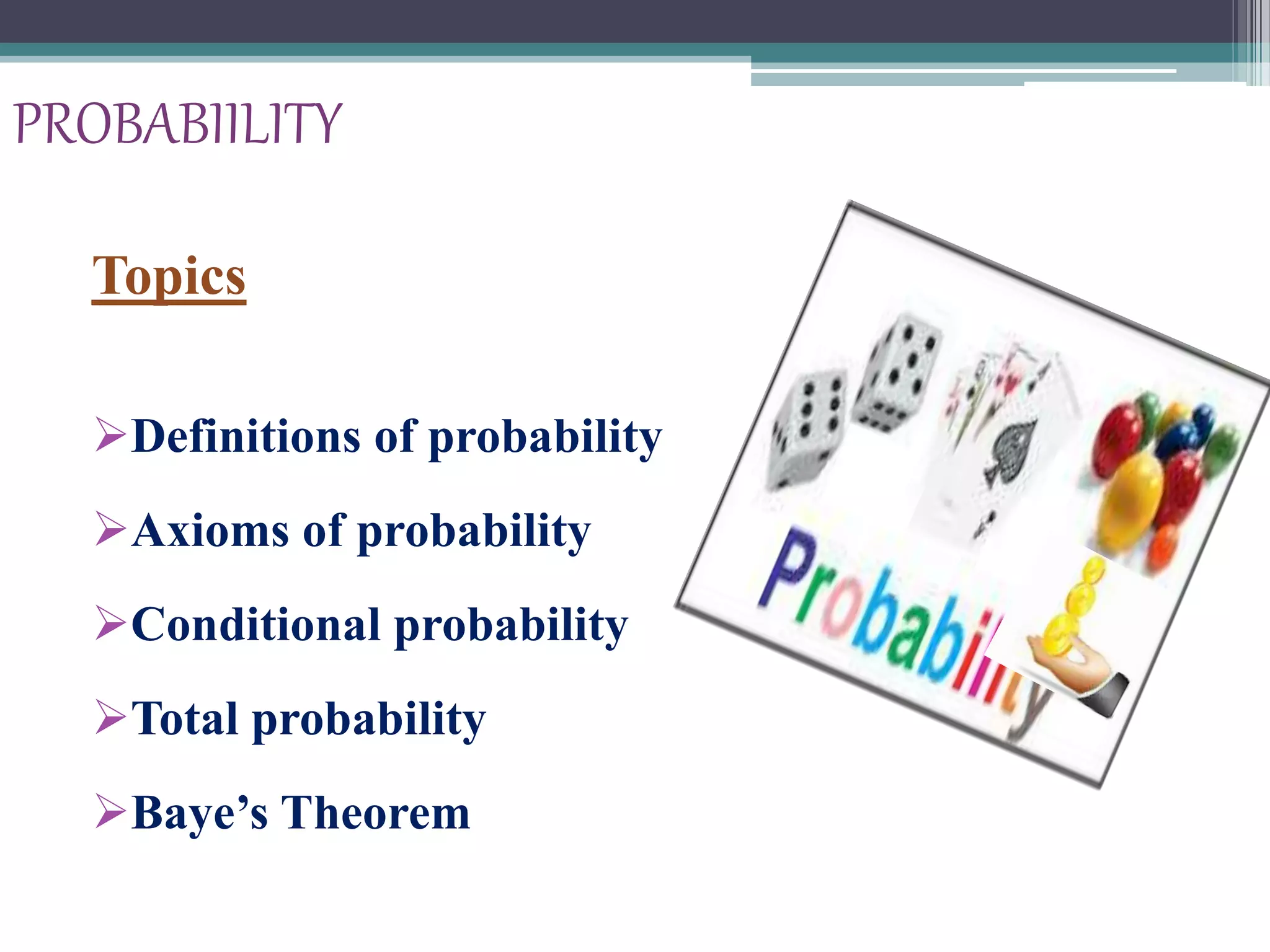
Topics
Definitions of probability
Axioms of probability
Conditional probability
Total probability
Baye’s Theorem
Basic Ideas
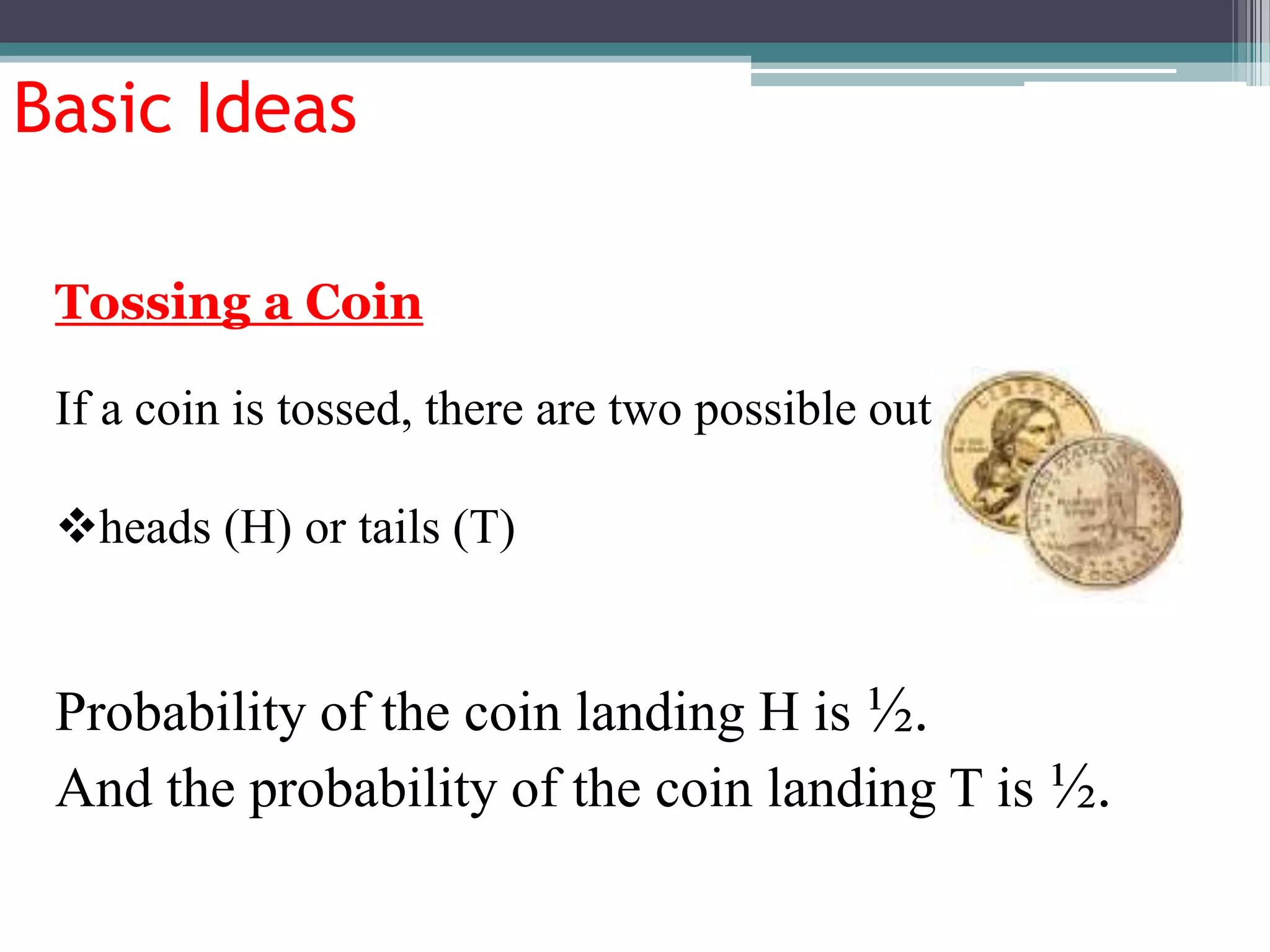
If a coin is tossed, there are two possible outcomes
heads (H) or tails (T)
Probability of the coin landing H is ½.
And the probability of the coin landing T is ½.
Tossing a Coin
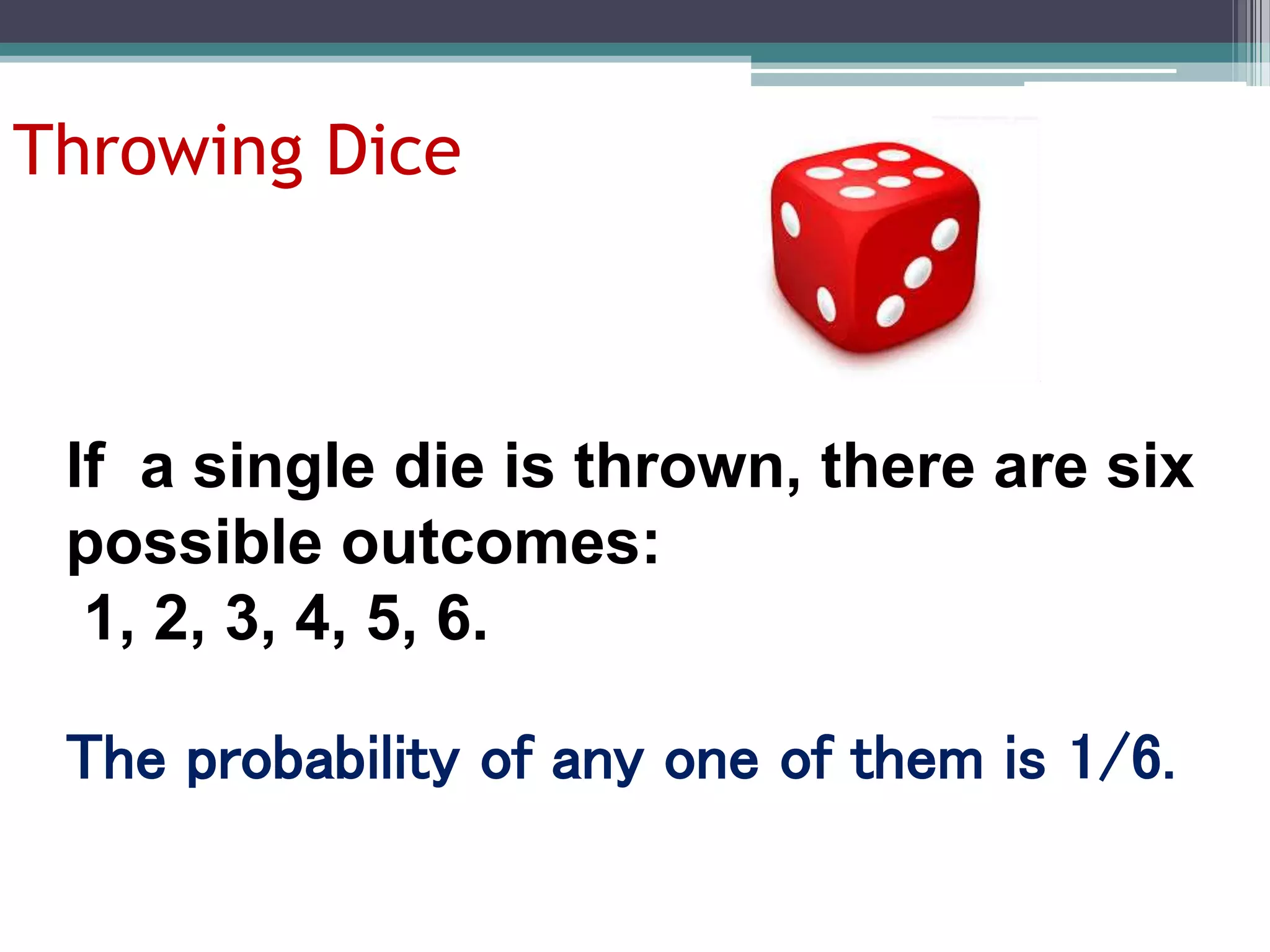
Throwing Dice
If a single die is thrown, there are six
possible outcomes:
1, 2, 3, 4, 5, 6.
The probability of any one of them is 1/6.
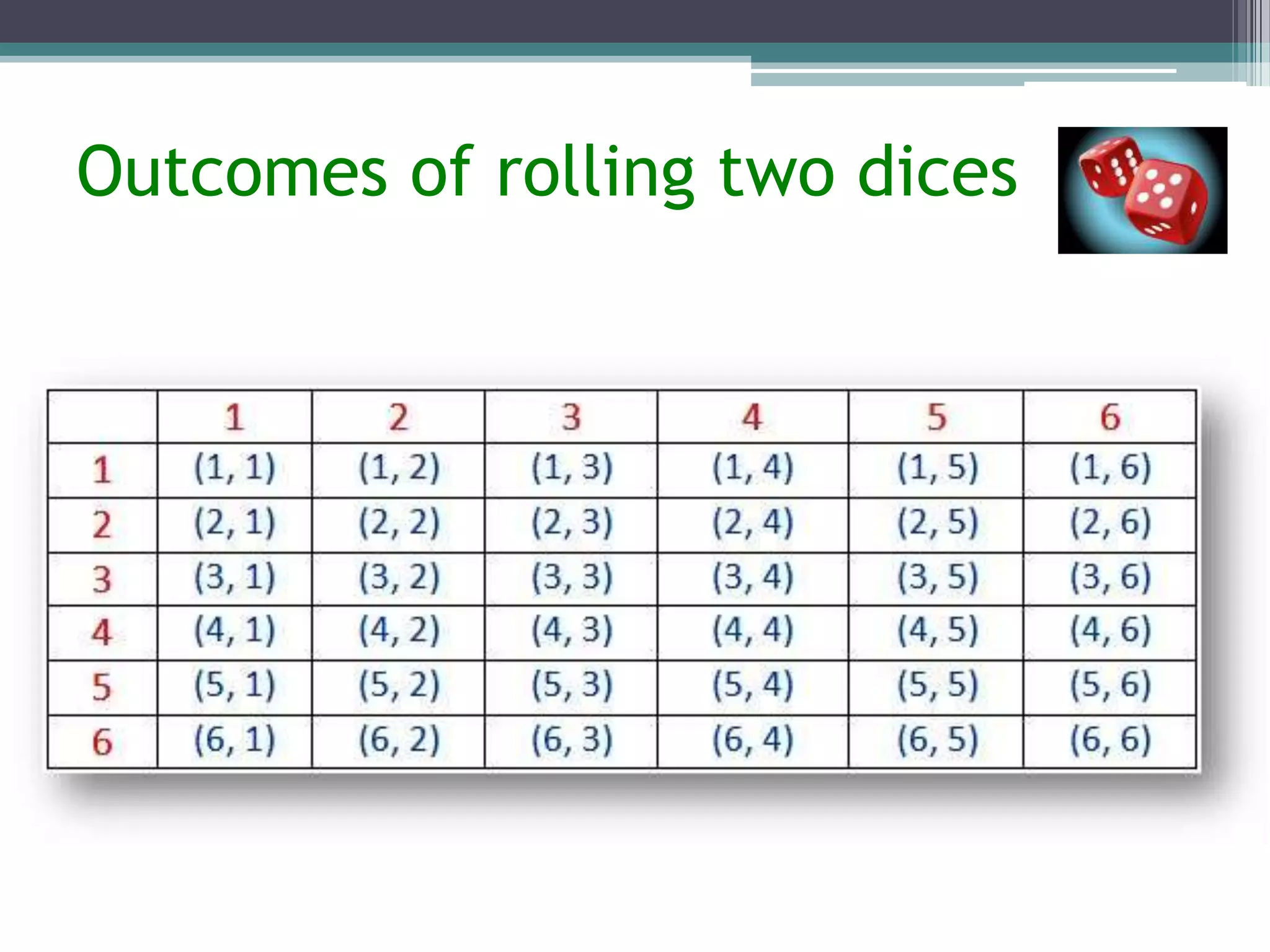
Outcomes of rolling two dices
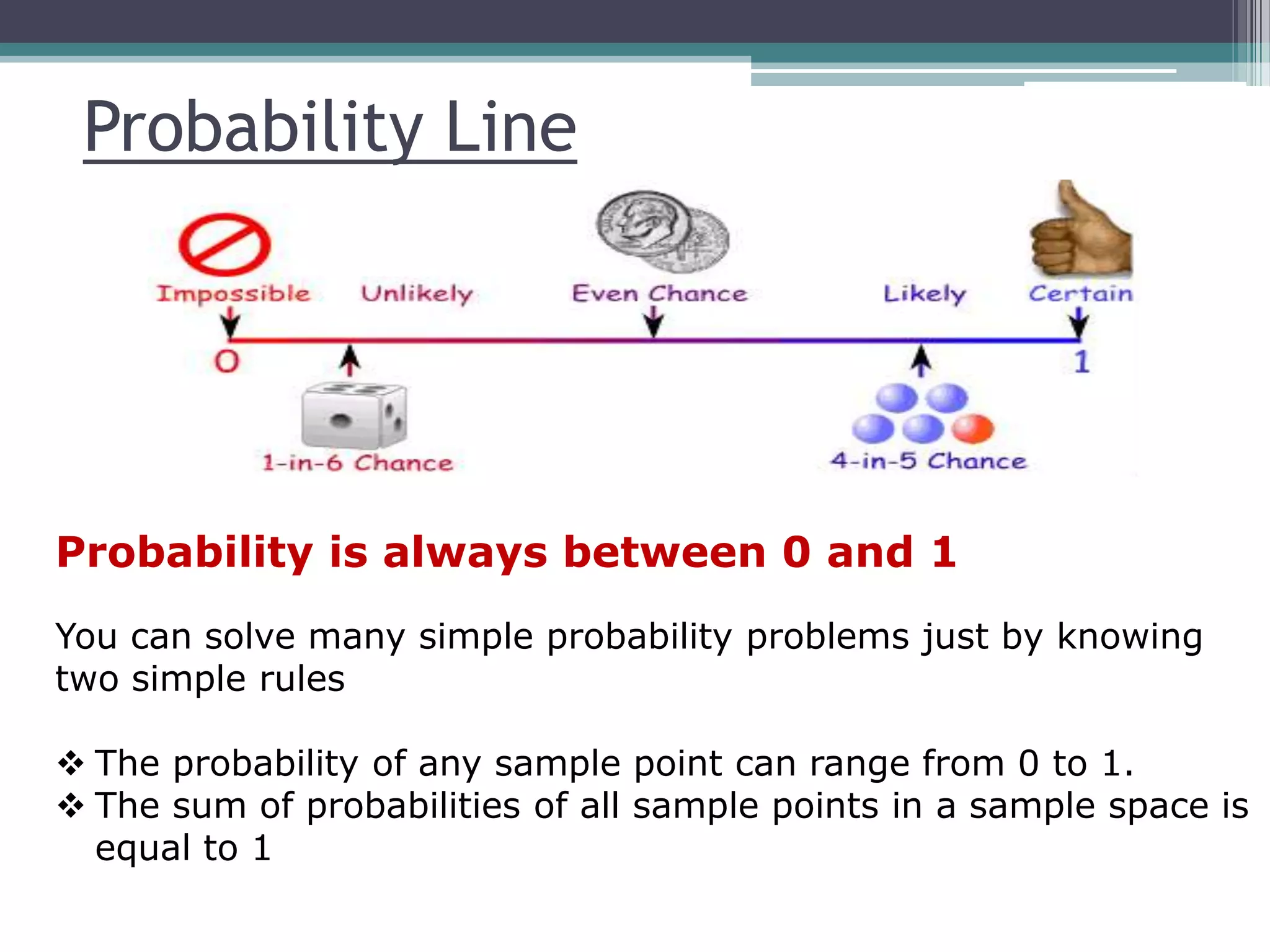
Probability Line
Probability is always between 0 and 1
You can solve many simple probability problems just by knowing
two simple rules
 The probability of any sample point can range from 0 to 1.
 The sum of probabilities of all sample points in a sample space is
equal to 1
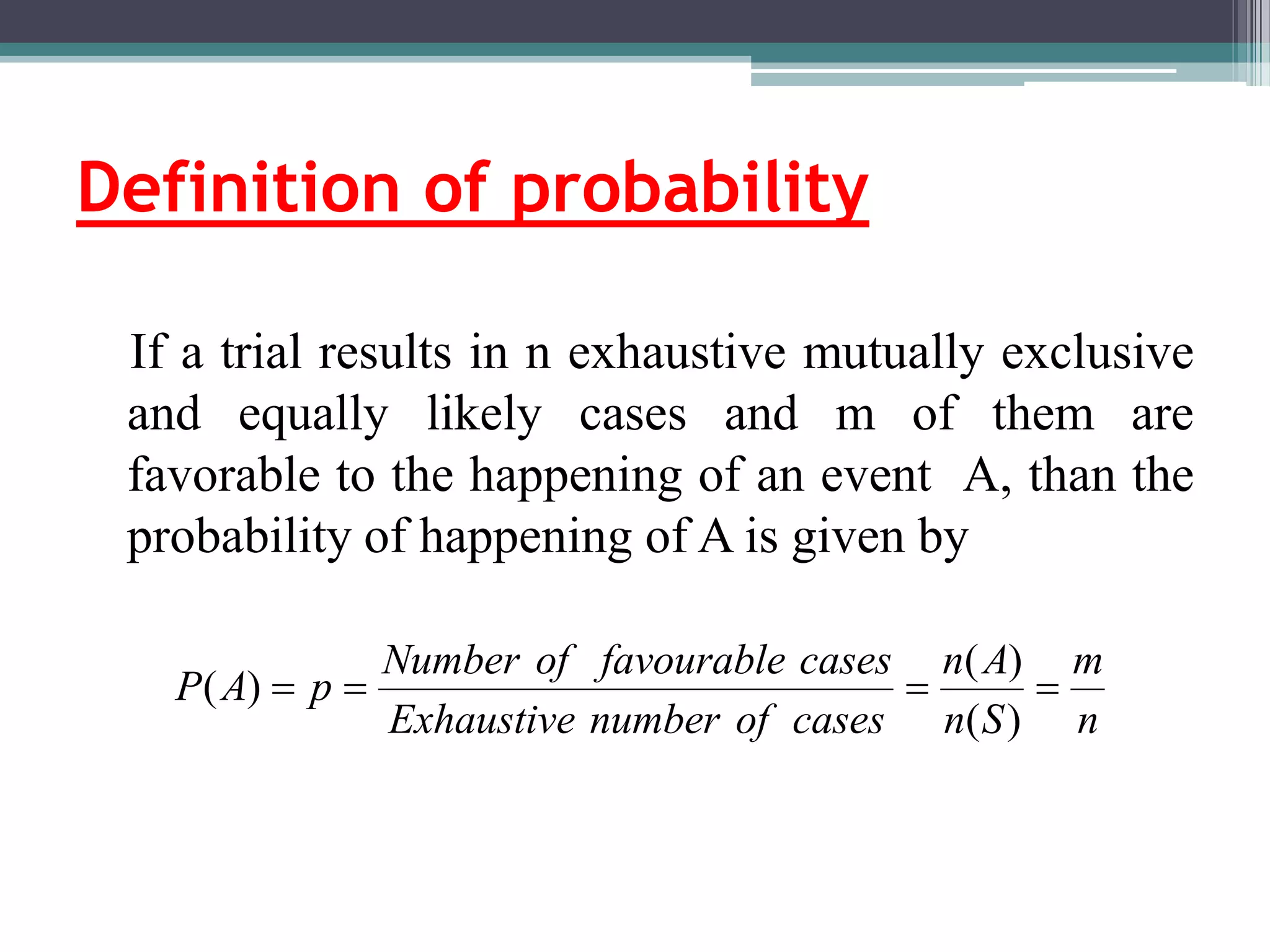
Definition of probability
If a trial results in n exhaustive mutually exclusive
and equally likely cases and m of them are
favorable to the happening of an event A, than the
probability of happening of A is given by
n
m
S
n
A
n
cases
of
number
Exhaustive
cases
favourable
of
Number
p
A
P 



)
(
)
(
)
(
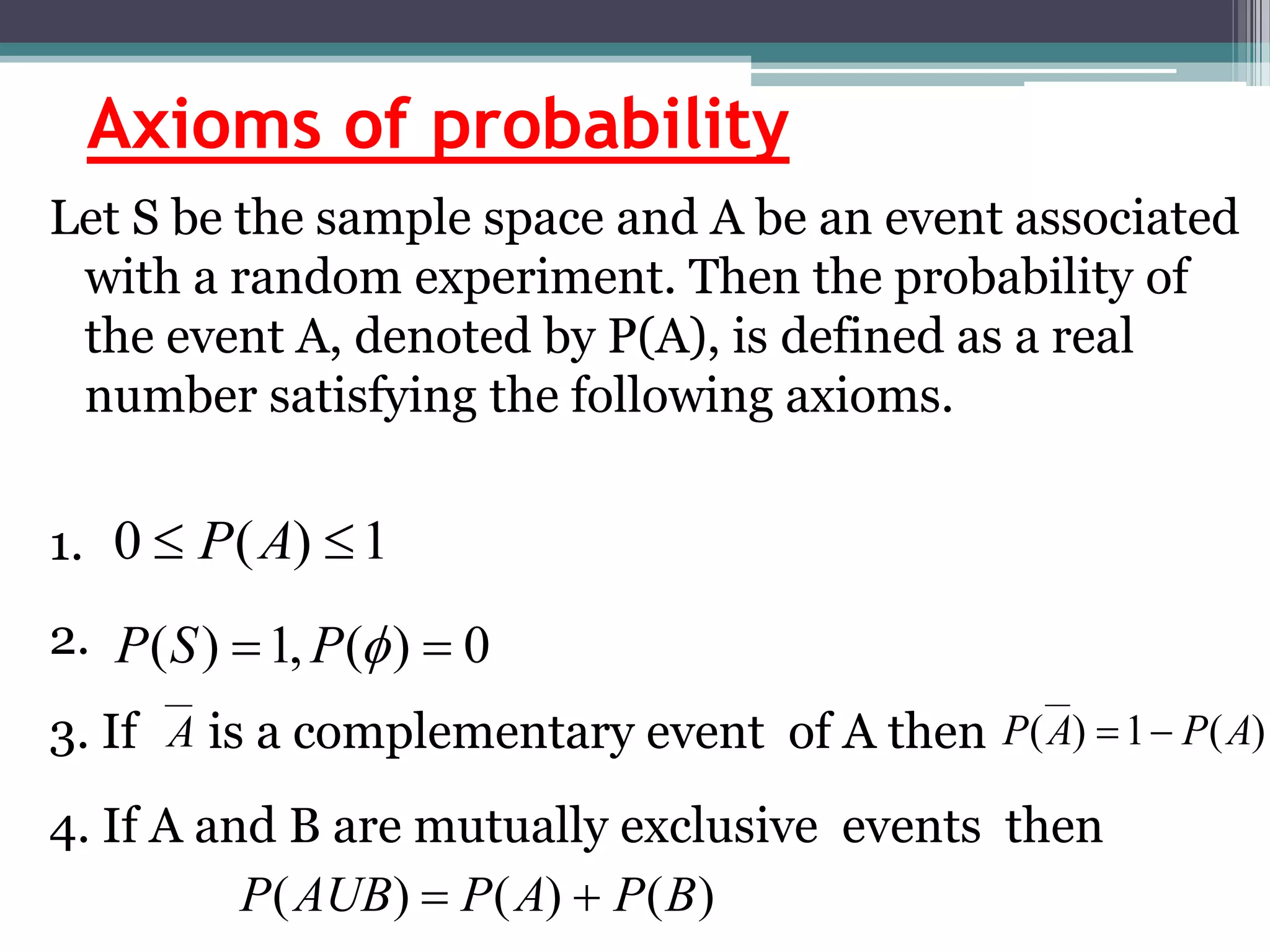
Axioms of probability
Let S be the sample space and A be an event associated
with a random experiment. Then the probability of
the event A, denoted by P(A), is defined as a real
number satisfying the following axioms.
1.
2.
3. If is a complementary event of A then
4. If A and B are mutually exclusive events then
1
)
(
0 
 A
P
0
)
(
,
1
)
( 
 
P
S
P
)
(
1
)
( A
P
A
P 

)
(
)
(
)
( B
P
A
P
AUB
P 

A
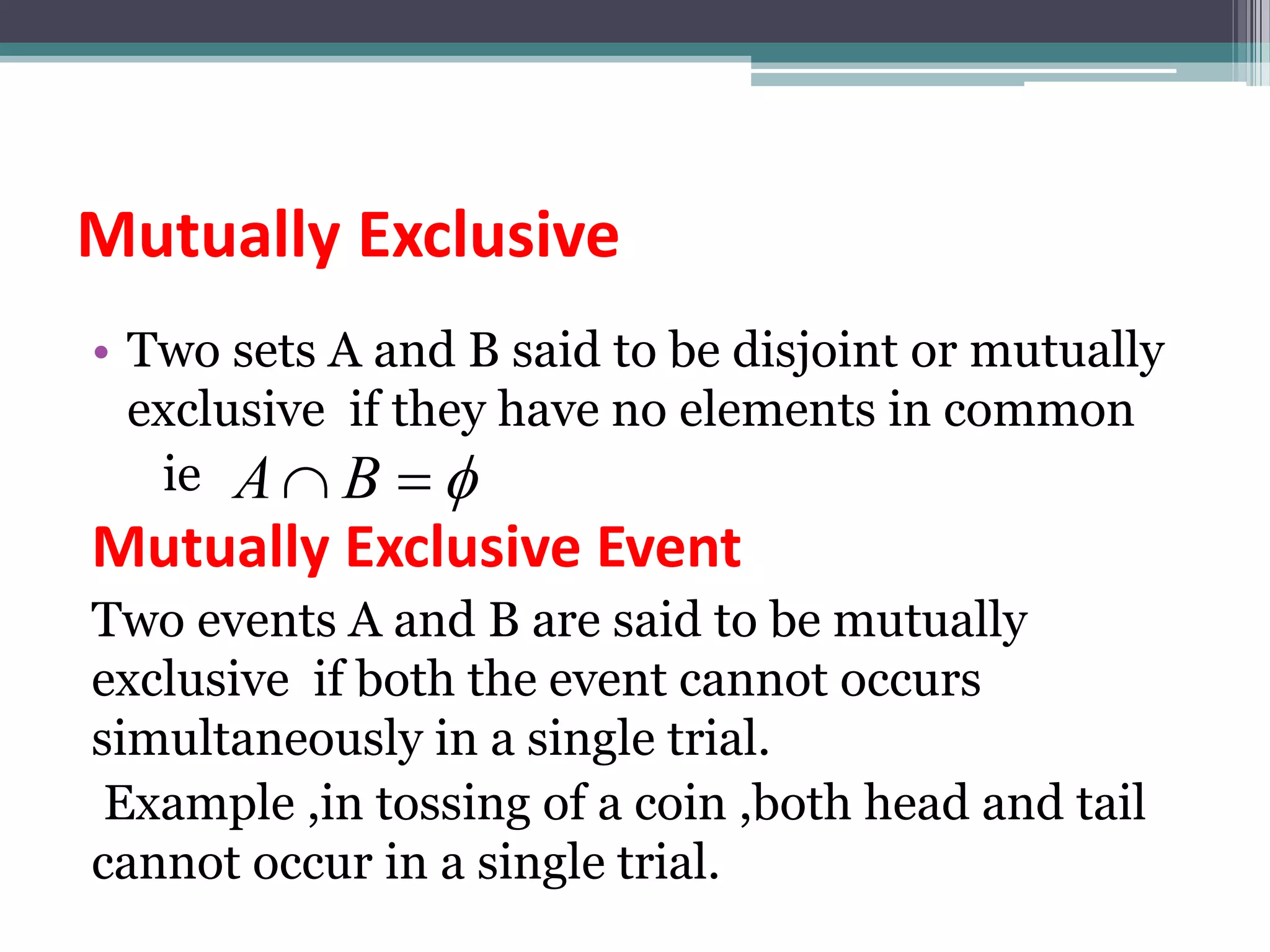
Mutually Exclusive
• Two sets A and B said to be disjoint or mutually
exclusive if they have no elements in common
ie
Mutually Exclusive Event
Two events A and B are said to be mutually
exclusive if both the event cannot occurs
simultaneously in a single trial.
Example ,in tossing of a coin ,both head and tail
cannot occur in a single trial.


 B
A
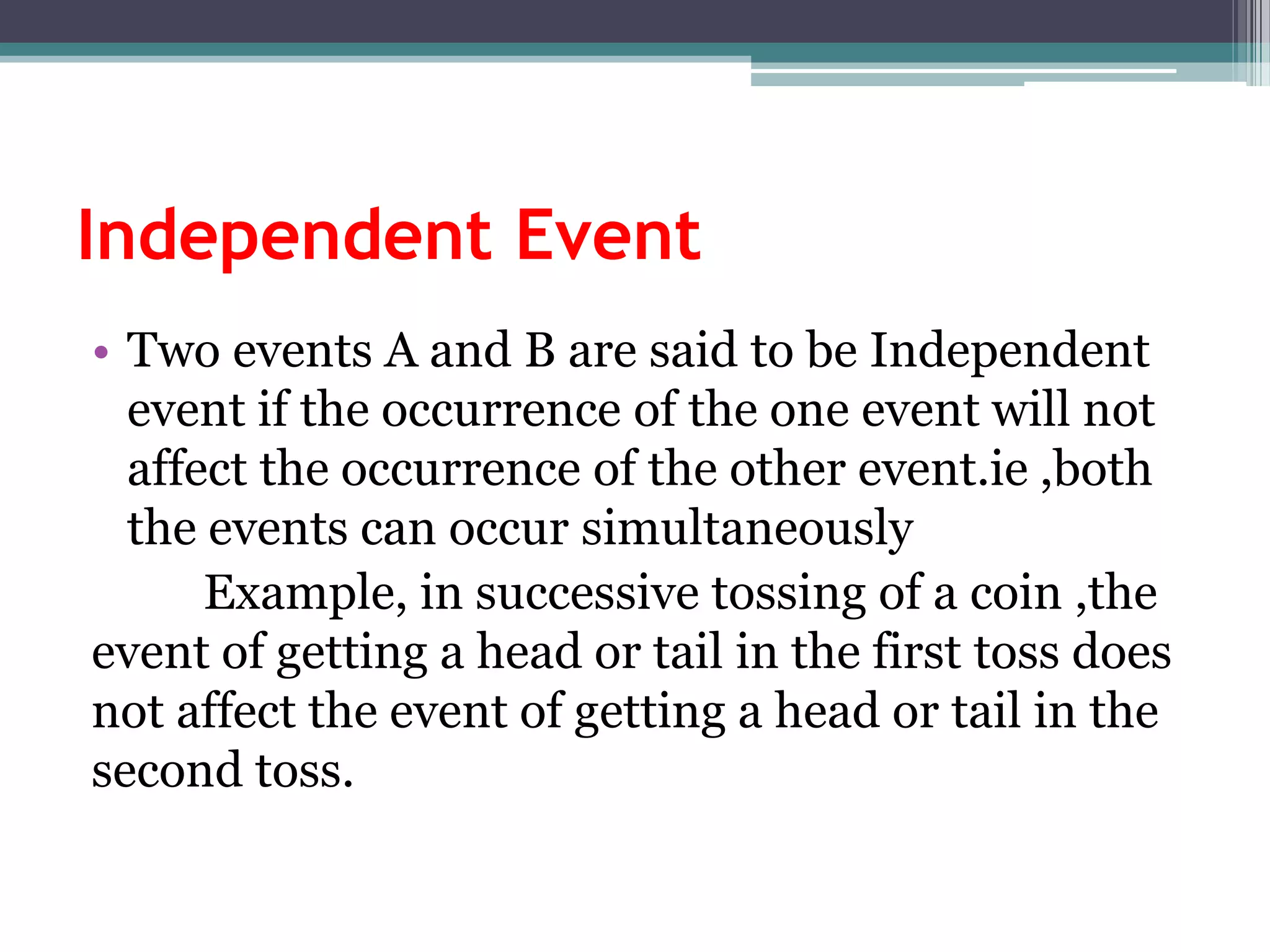
Independent Event
• Two events A and B are said to be Independent
event if the occurrence of the one event will not
affect the occurrence of the other event.ie ,both
the events can occur simultaneously
Example, in successive tossing of a coin ,the
event of getting a head or tail in the first toss does
not affect the event of getting a head or tail in the
second toss.
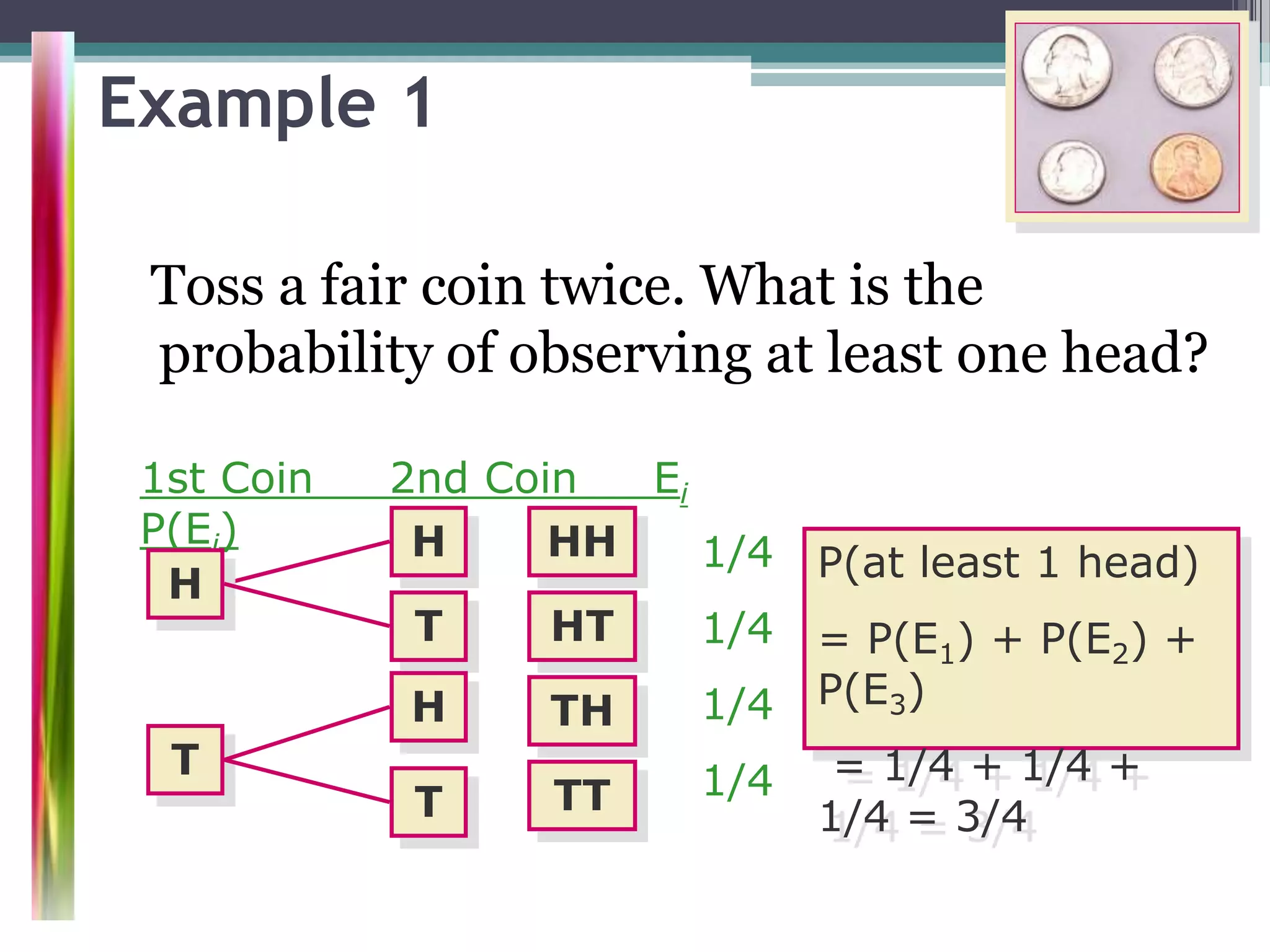
Example 1
Toss a fair coin twice. What is the
probability of observing at least one head?
H
1st Coin 2nd Coin Ei
P(Ei)
H
T
T
H
T
HH
HT
TH
TT
1/4
1/4
1/4
1/4
P(at least 1 head)
= P(E1) + P(E2) +
P(E3)
= 1/4 + 1/4 +
1/4 = 3/4
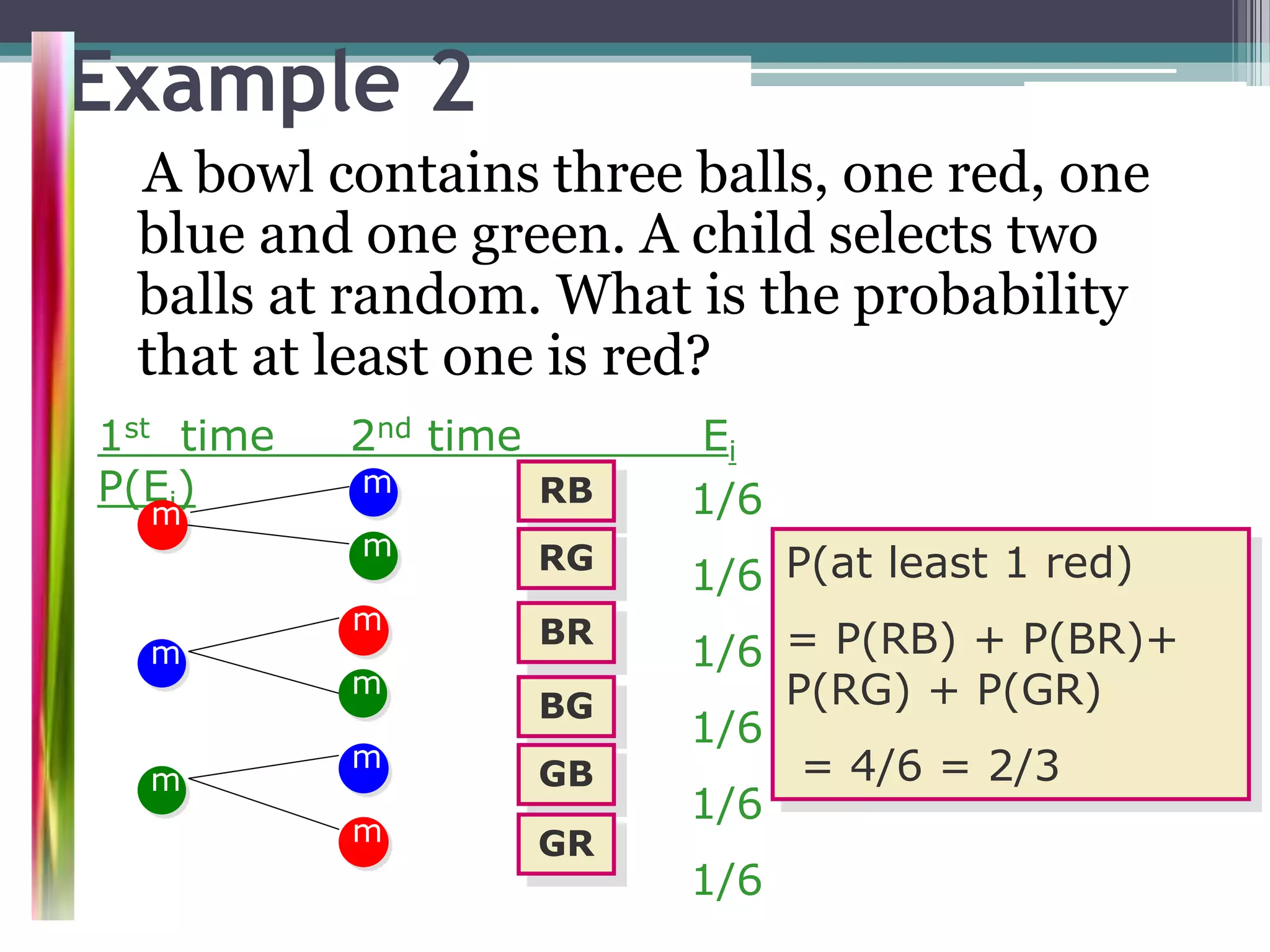
Example 2
A bowl contains three balls, one red, one
blue and one green. A child selects two
balls at random. What is the probability
that at least one is red?
1st time 2nd time Ei
P(Ei) RB
RG
BR
BG
1/6
1/6
1/6
1/6
1/6
1/6
P(at least 1 red)
= P(RB) + P(BR)+
P(RG) + P(GR)
= 4/6 = 2/3
m
m
m
m
m
m
m
m
m
GB
GR
Problems
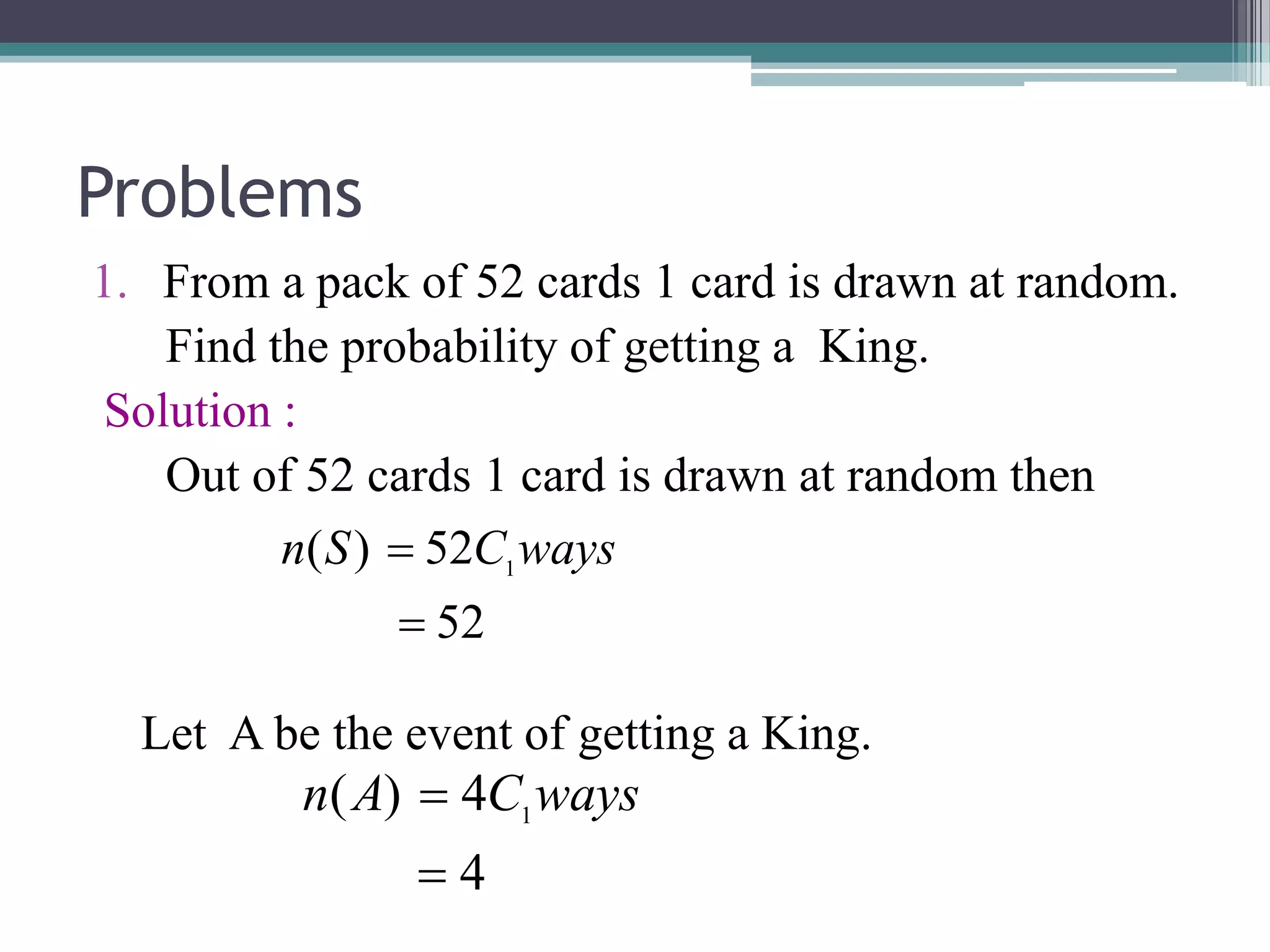
1. From a pack of 52 cards 1 card is drawn at random.
Find the probability of getting a King.
Solution :
Out of 52 cards 1 card is drawn at random then
Let A be the event of getting a King.
52
52
)
( 1

 ways
C
S
n
4
4
)
( 1

 ways
C
A
n
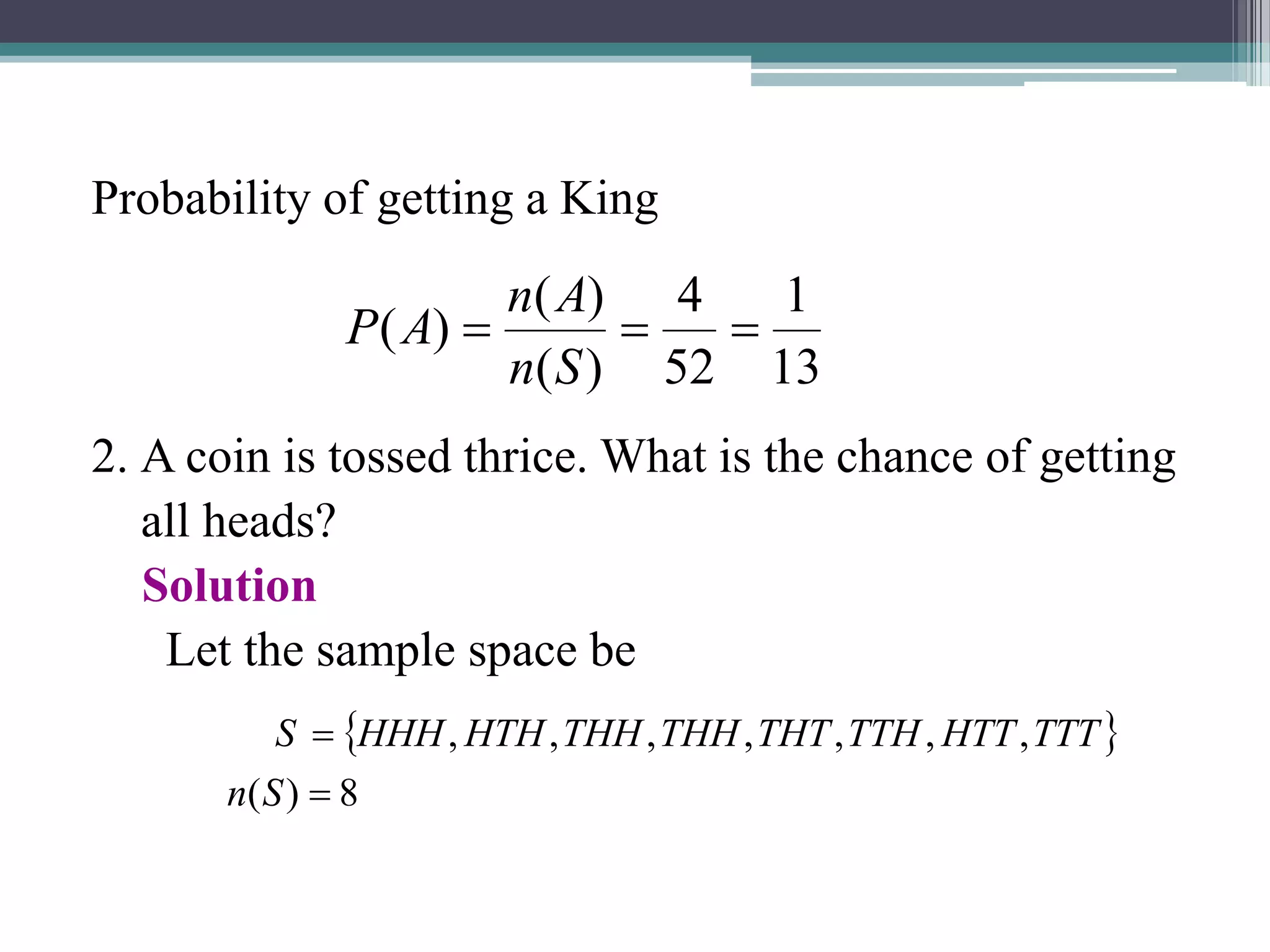
Probability of getting a King
2. A coin is tossed thrice. What is the chance of getting
all heads?
Solution
Let the sample space be
13
1
52
4
)
(
)
(
)
( 


S
n
A
n
A
P
 
8
)
(
,
,
,
,
,
,
,


S
n
TTT
HTT
TTH
THT
THH
THH
HTH
HHH
S
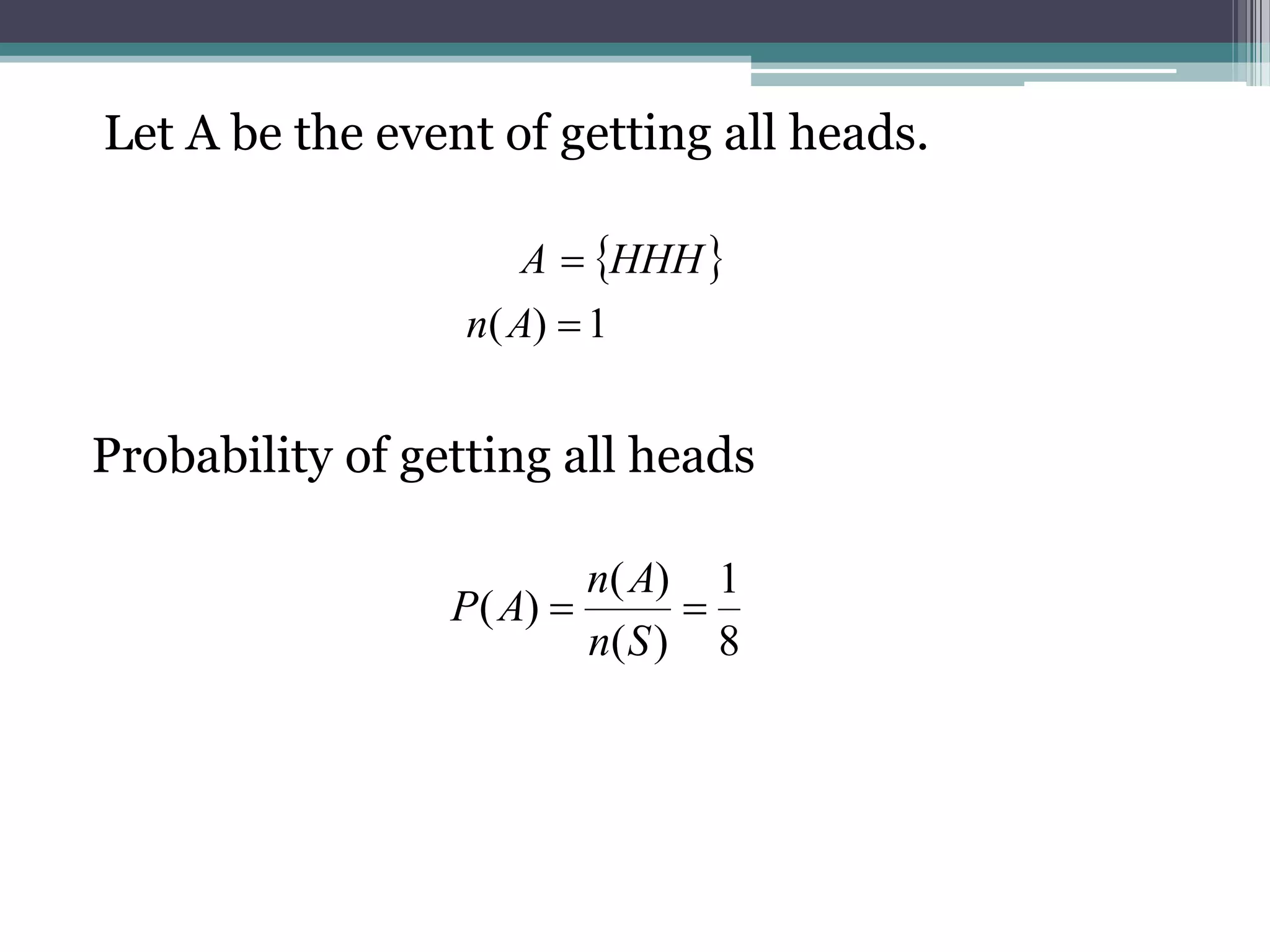
Let A be the event of getting all heads.
Probability of getting all heads
 
1
)
( 

A
n
HHH
A
8
1
)
(
)
(
)
( 

S
n
A
n
A
P
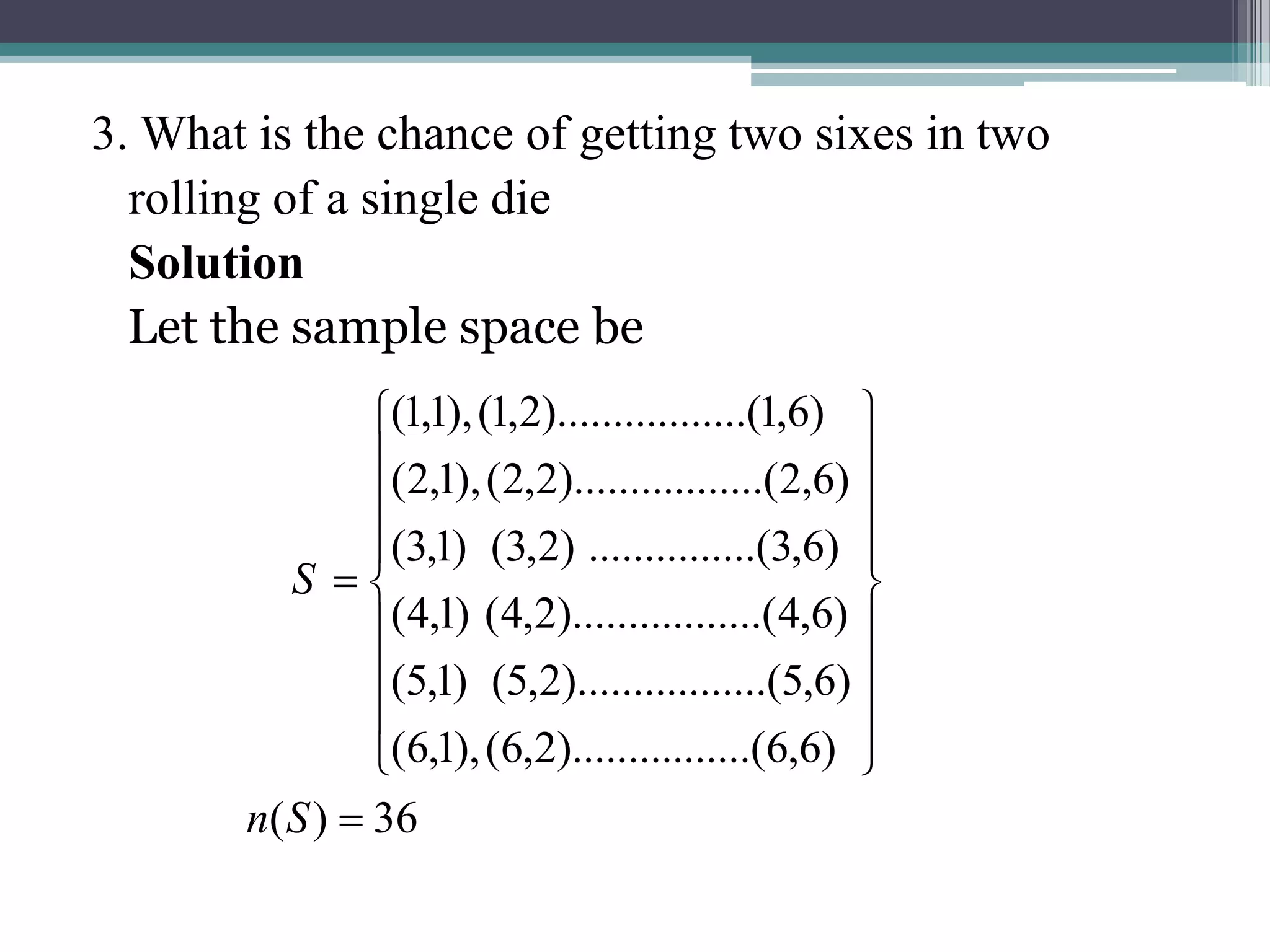
3. What is the chance of getting two sixes in two
rolling of a single die
Solution
Let the sample space be
36
)
(
)
6
,
6
.......(
).........
2
,
6
(
),
1
,
6
(
)
6
,
5
........(
).........
2
,
5
(
)
1
,
5
(
)
6
,
4
........(
).........
2
,
4
(
)
1
,
4
(
)
6
,
3
.....(
..........
)
2
,
3
(
)
1
,
3
(
)
6
,
2
........(
).........
2
,
2
(
),
1
,
2
(
)
6
,
1
........(
).........
2
,
1
(
),
1
,
1
(




















S
n
S
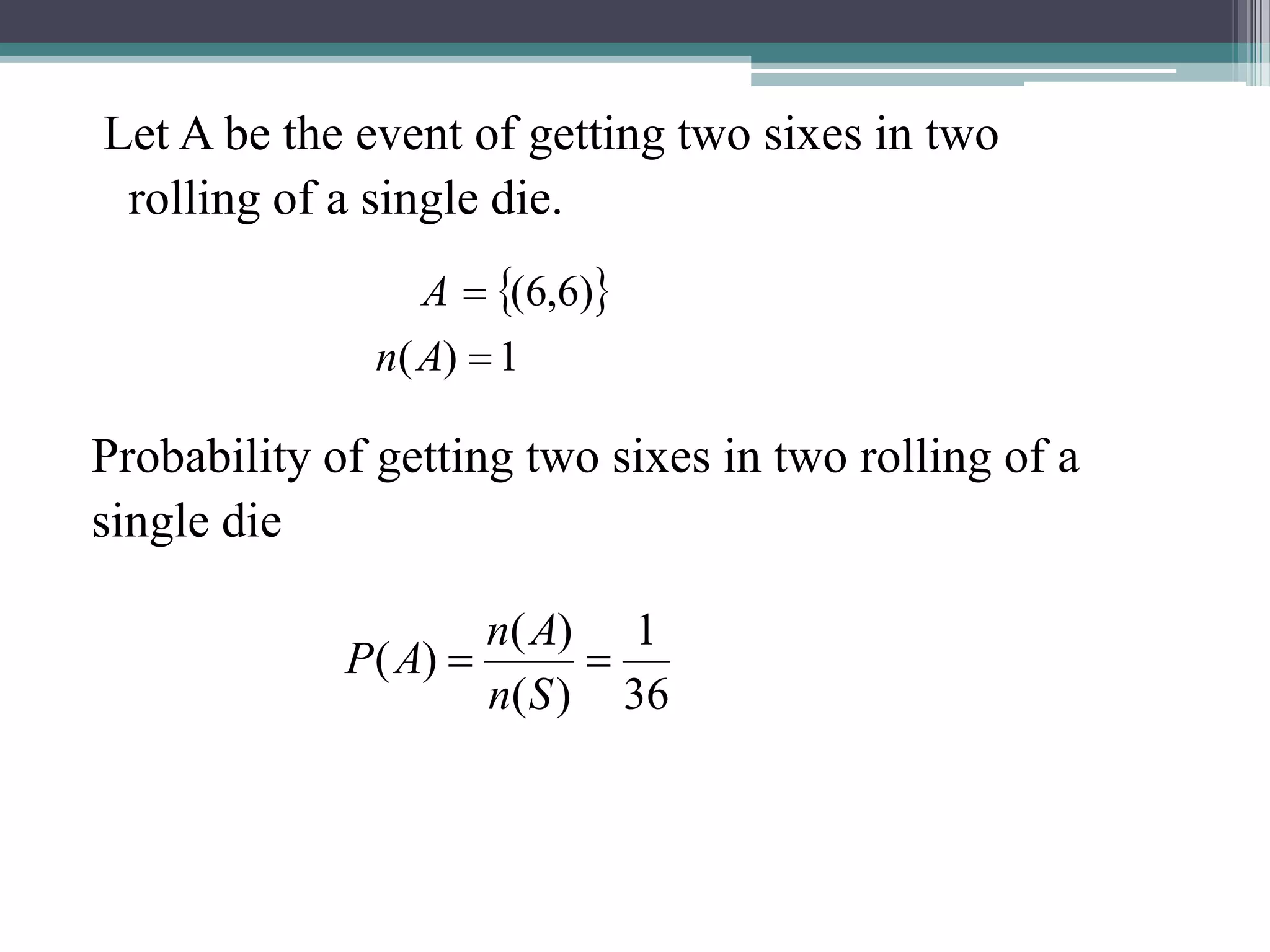
Let A be the event of getting two sixes in two
rolling of a single die.
Probability of getting two sixes in two rolling of a
single die
 
1
)
(
)
6
,
6
(


A
n
A
36
1
)
(
)
(
)
( 

S
n
A
n
A
P
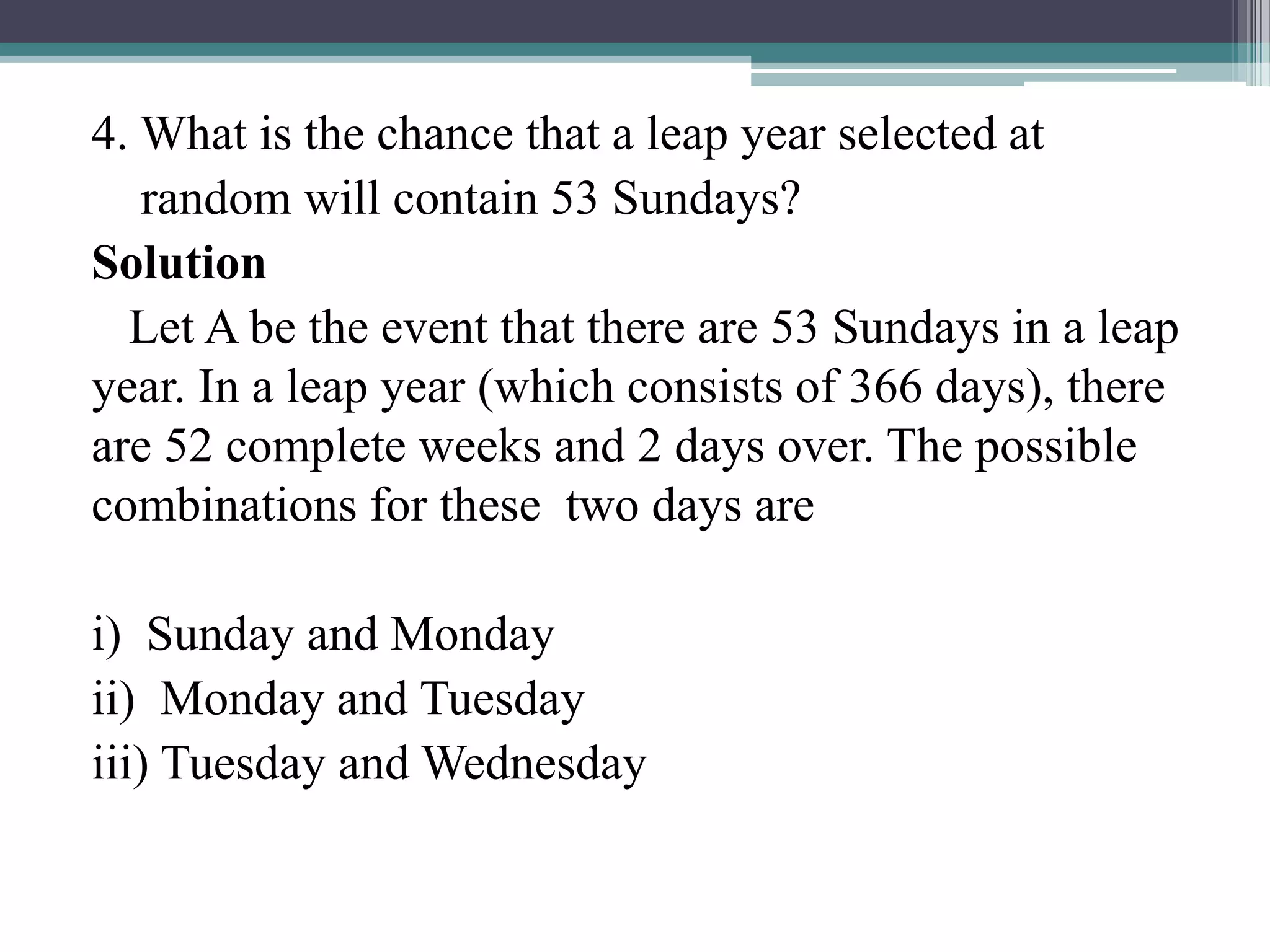
4. What is the chance that a leap year selected at
random will contain 53 Sundays?
Solution
Let A be the event that there are 53 Sundays in a leap
year. In a leap year (which consists of 366 days), there
are 52 complete weeks and 2 days over. The possible
combinations for these two days are
i) Sunday and Monday
ii) Monday and Tuesday
iii) Tuesday and Wednesday
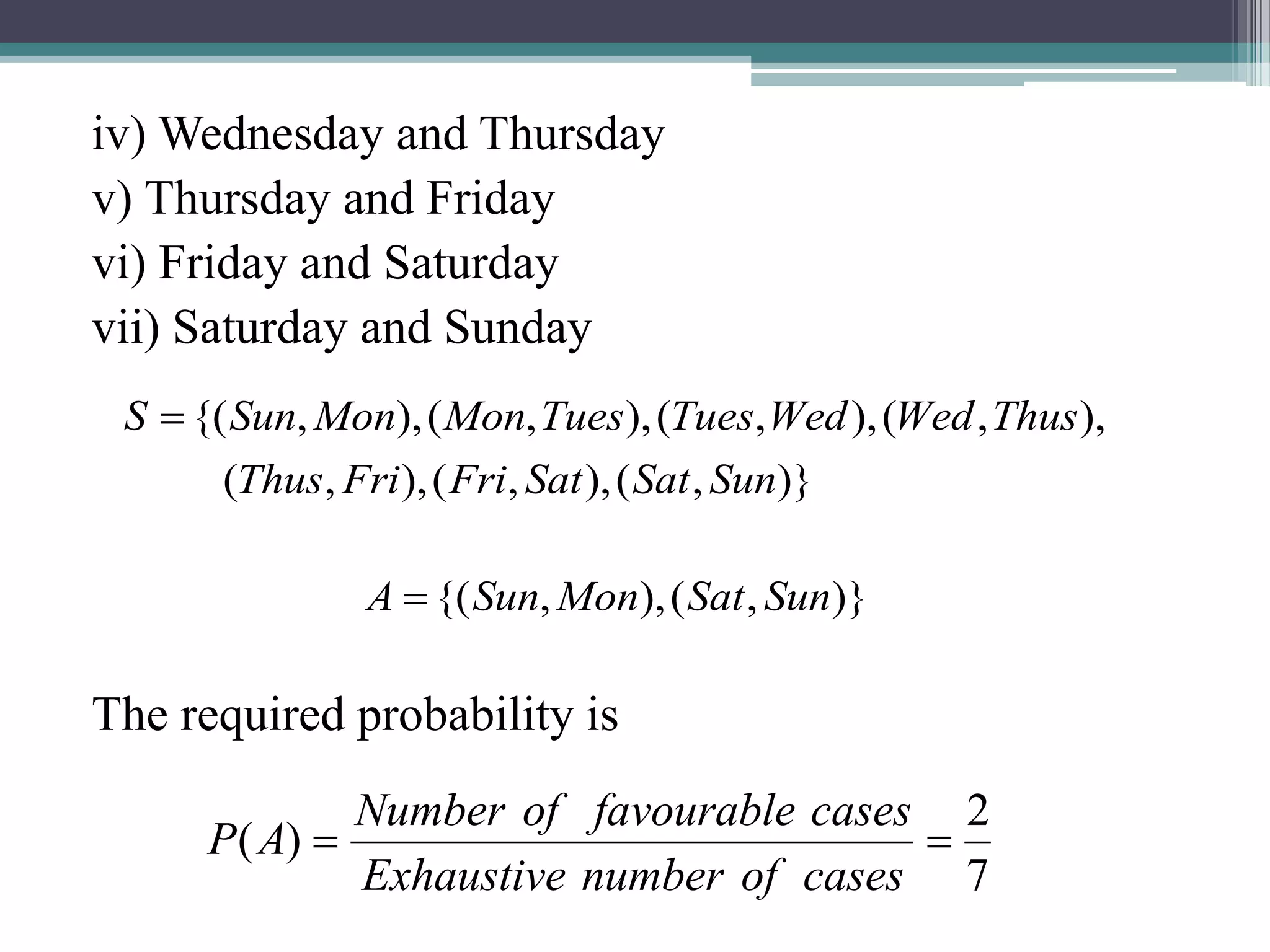
iv) Wednesday and Thursday
v) Thursday and Friday
vi) Friday and Saturday
vii) Saturday and Sunday
The required probability is
7
2
)
( 

cases
of
number
Exhaustive
cases
favourable
of
Number
A
P
)}
,
(
),
,
(
),
,
(
),
,
(
),
,
(
),
,
(
),
,
{(
Sun
Sat
Sat
Fri
Fri
Thus
Thus
Wed
Wed
Tues
Tues
Mon
Mon
Sun
S 
)}
,
(
),
,
{( Sun
Sat
Mon
Sun
A 

Probability

  • 1.
  • 2.
    5E Note 4 Thetheory of probability was introduced by two famous mathematician Blaise and Pierre de Fermat in 1654. They made a study of the gambling problems to formulate the fundamental principles of probability theory. After that it was developed by Laplace, Chebyshev, Markov, Von Mises and Kolmogorov.
  • 3.
    PROBABIILITY Topics Definitions of probability Axiomsof probability Conditional probability Total probability Baye’s Theorem
  • 4.
    Basic Ideas If acoin is tossed, there are two possible outcomes heads (H) or tails (T) Probability of the coin landing H is ½. And the probability of the coin landing T is ½. Tossing a Coin
  • 5.
    Throwing Dice If asingle die is thrown, there are six possible outcomes: 1, 2, 3, 4, 5, 6. The probability of any one of them is 1/6.
  • 6.
  • 7.
    Probability Line Probability isalways between 0 and 1 You can solve many simple probability problems just by knowing two simple rules  The probability of any sample point can range from 0 to 1.  The sum of probabilities of all sample points in a sample space is equal to 1
  • 8.
    Definition of probability Ifa trial results in n exhaustive mutually exclusive and equally likely cases and m of them are favorable to the happening of an event A, than the probability of happening of A is given by n m S n A n cases of number Exhaustive cases favourable of Number p A P     ) ( ) ( ) (
  • 9.
    Axioms of probability LetS be the sample space and A be an event associated with a random experiment. Then the probability of the event A, denoted by P(A), is defined as a real number satisfying the following axioms. 1. 2. 3. If is a complementary event of A then 4. If A and B are mutually exclusive events then 1 ) ( 0   A P 0 ) ( , 1 ) (    P S P ) ( 1 ) ( A P A P   ) ( ) ( ) ( B P A P AUB P   A
  • 10.
    Mutually Exclusive • Twosets A and B said to be disjoint or mutually exclusive if they have no elements in common ie Mutually Exclusive Event Two events A and B are said to be mutually exclusive if both the event cannot occurs simultaneously in a single trial. Example ,in tossing of a coin ,both head and tail cannot occur in a single trial.    B A
  • 11.
    Independent Event • Twoevents A and B are said to be Independent event if the occurrence of the one event will not affect the occurrence of the other event.ie ,both the events can occur simultaneously Example, in successive tossing of a coin ,the event of getting a head or tail in the first toss does not affect the event of getting a head or tail in the second toss.
  • 12.
    Example 1 Toss afair coin twice. What is the probability of observing at least one head? H 1st Coin 2nd Coin Ei P(Ei) H T T H T HH HT TH TT 1/4 1/4 1/4 1/4 P(at least 1 head) = P(E1) + P(E2) + P(E3) = 1/4 + 1/4 + 1/4 = 3/4
  • 13.
    Example 2 A bowlcontains three balls, one red, one blue and one green. A child selects two balls at random. What is the probability that at least one is red? 1st time 2nd time Ei P(Ei) RB RG BR BG 1/6 1/6 1/6 1/6 1/6 1/6 P(at least 1 red) = P(RB) + P(BR)+ P(RG) + P(GR) = 4/6 = 2/3 m m m m m m m m m GB GR
  • 14.
    Problems 1. From apack of 52 cards 1 card is drawn at random. Find the probability of getting a King. Solution : Out of 52 cards 1 card is drawn at random then Let A be the event of getting a King. 52 52 ) ( 1   ways C S n 4 4 ) ( 1   ways C A n
  • 15.
    Probability of gettinga King 2. A coin is tossed thrice. What is the chance of getting all heads? Solution Let the sample space be 13 1 52 4 ) ( ) ( ) (    S n A n A P   8 ) ( , , , , , , ,   S n TTT HTT TTH THT THH THH HTH HHH S
  • 16.
    Let A bethe event of getting all heads. Probability of getting all heads   1 ) (   A n HHH A 8 1 ) ( ) ( ) (   S n A n A P
  • 17.
    3. What isthe chance of getting two sixes in two rolling of a single die Solution Let the sample space be 36 ) ( ) 6 , 6 .......( )......... 2 , 6 ( ), 1 , 6 ( ) 6 , 5 ........( )......... 2 , 5 ( ) 1 , 5 ( ) 6 , 4 ........( )......... 2 , 4 ( ) 1 , 4 ( ) 6 , 3 .....( .......... ) 2 , 3 ( ) 1 , 3 ( ) 6 , 2 ........( )......... 2 , 2 ( ), 1 , 2 ( ) 6 , 1 ........( )......... 2 , 1 ( ), 1 , 1 (                     S n S
  • 18.
    Let A bethe event of getting two sixes in two rolling of a single die. Probability of getting two sixes in two rolling of a single die   1 ) ( ) 6 , 6 (   A n A 36 1 ) ( ) ( ) (   S n A n A P
  • 19.
    4. What isthe chance that a leap year selected at random will contain 53 Sundays? Solution Let A be the event that there are 53 Sundays in a leap year. In a leap year (which consists of 366 days), there are 52 complete weeks and 2 days over. The possible combinations for these two days are i) Sunday and Monday ii) Monday and Tuesday iii) Tuesday and Wednesday
  • 20.
    iv) Wednesday andThursday v) Thursday and Friday vi) Friday and Saturday vii) Saturday and Sunday The required probability is 7 2 ) (   cases of number Exhaustive cases favourable of Number A P )} , ( ), , ( ), , ( ), , ( ), , ( ), , ( ), , {( Sun Sat Sat Fri Fri Thus Thus Wed Wed Tues Tues Mon Mon Sun S  )} , ( ), , {( Sun Sat Mon Sun A 