PROBABILITY
Presented by-
Varun Saxena
MBA (Gen.)
Basic Terms of Probability
 In probability, an experiment is any process that can be repeated in
which the results are uncertain.
 A simple event is any single outcome from a probability experiment.
 Sample space is a list of all possible outcomes of a probability
experiment.
 An event is any collection of outcomes from a probability experiment.
Example
 Experiment : Tossing a coin
 Sample Space: { Head, Tail)
 Event: (Only Head wants) : {Head}
Probability
 The probability of an event, denoted P(E), is the
likelihood of that event occurring.
 The Probability of an event :
P(Event) =
Example
 When a coin is tossed, there are two possible
outcomes: Heads and Tails
P(Heads) = ½
 When a single die is thrown, there are six possible
outcomes: 1, 2, 3, 4, 5, 6.
P(1) = 1/6.
Properties of Probability
 The probability of any event E, P(E), must be between
0 and 1 inclusive. That is, 0 < P(E) < 1.
 If an event is impossible, the probability of the event is
0.
 If an event is a certainty, the probability of the event is
1.
 If S = {e1, e2, …, en}, then P(e1) + P(e2) + … + P(en) = 1.
Three methods for determining Probability
 Classical method
 Empirical method
 Subjective method
Classical Method
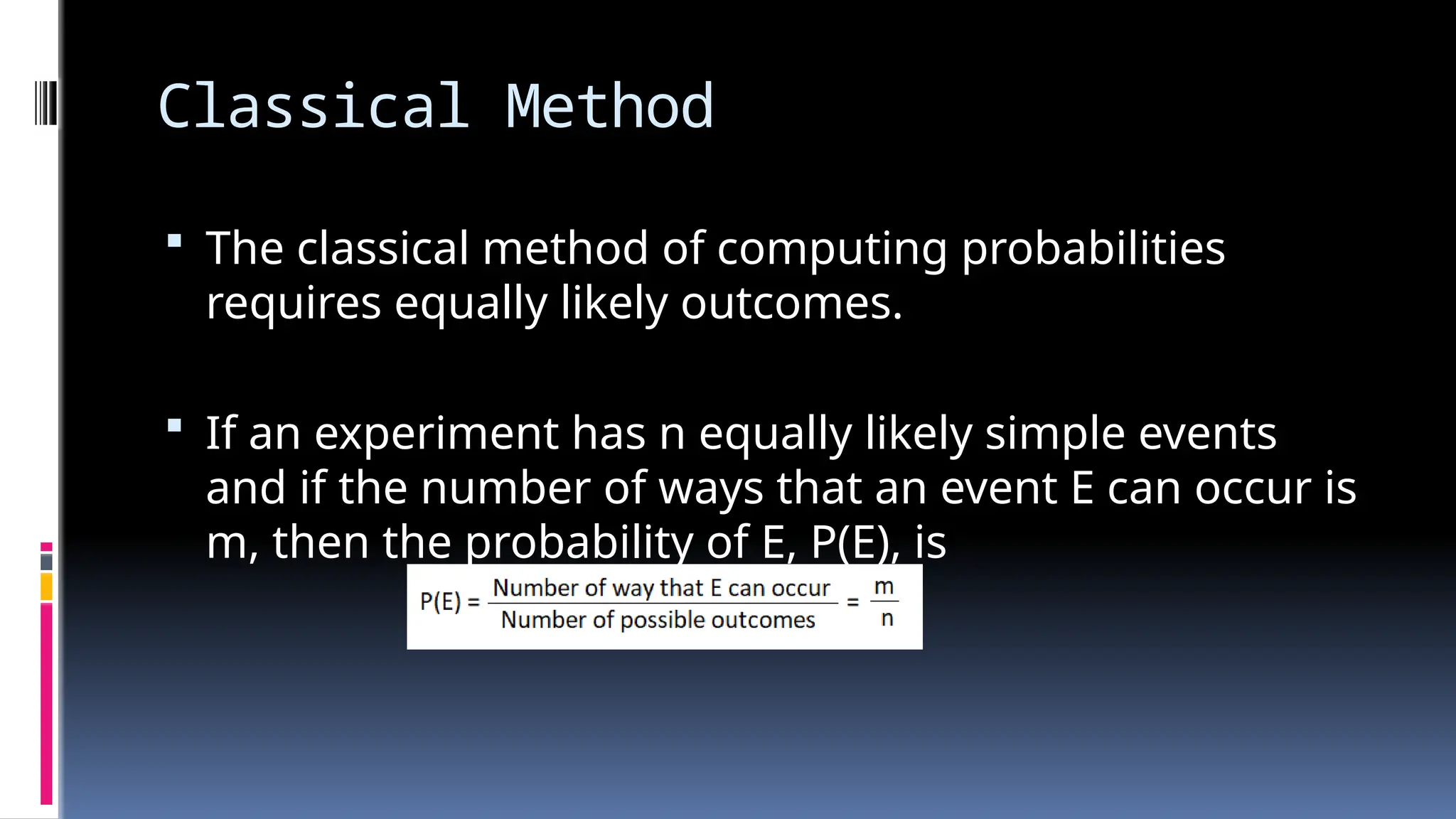
 The classical method of computing probabilities
requires equally likely outcomes.
 If an experiment has n equally likely simple events
and if the number of ways that an event E can occur is
m, then the probability of E, P(E), is
Example for classical method
 Let us suppose a bag of balls contains 6 brown balls,
15 yellow balls, 5 red balls, 20 orange balls, 11 blue
balls, and 4 green balls. Suppose that a ball is
randomly selected.
 What is the probability that it is brown?
 P(Brown) = 6/61
Empirical method
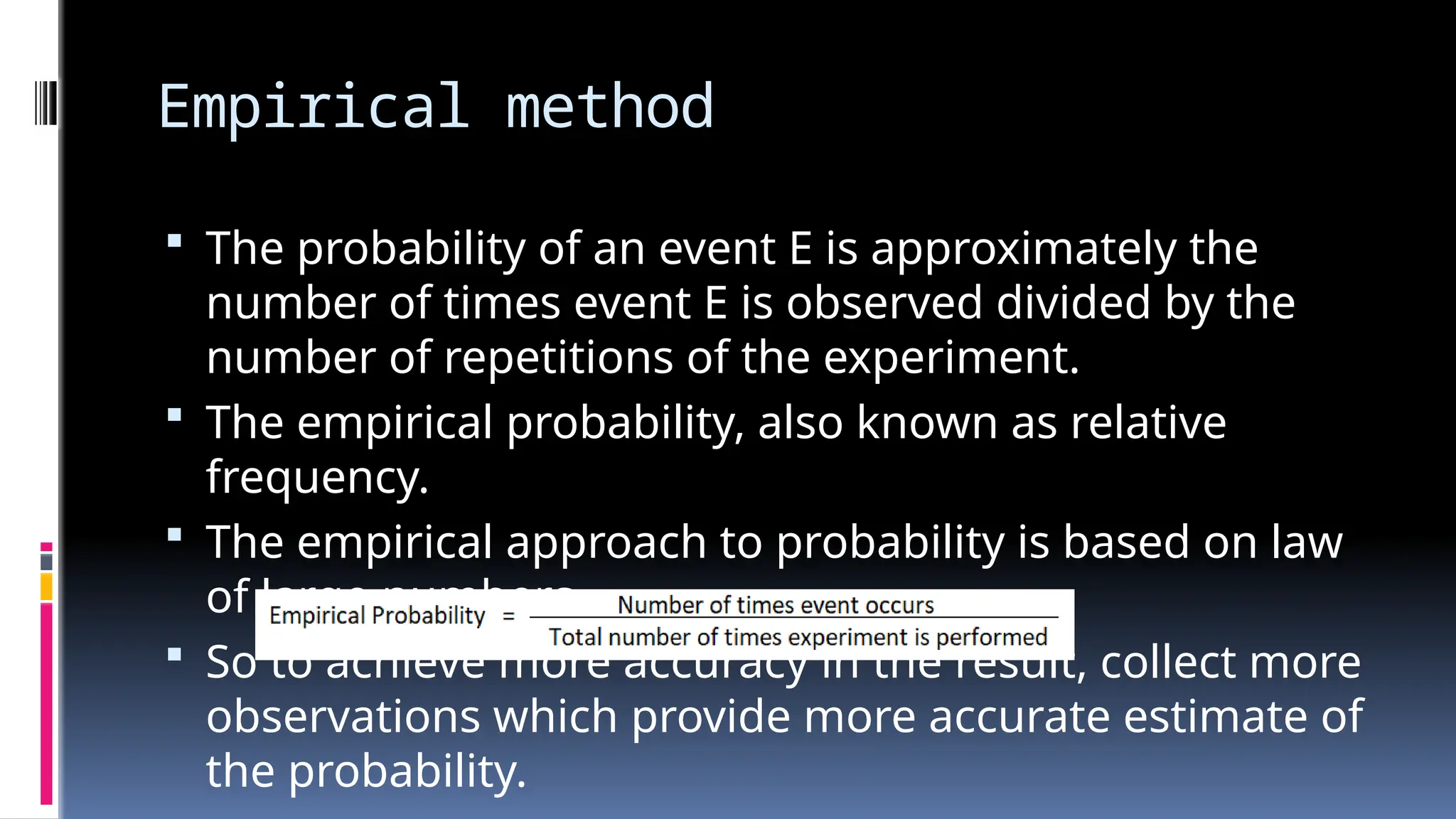
 The probability of an event E is approximately the
number of times event E is observed divided by the
number of repetitions of the experiment.
 The empirical probability, also known as relative
frequency.
 The empirical approach to probability is based on law
of large numbers.
 So to achieve more accuracy in the result, collect more
observations which provide more accurate estimate of
the probability.
Example for Empirical method
 A coin is thrown 100 times out of which head appears
12 times. Find the experimental probability of getting
the head?
The coin is thrown 100 times. So total number of trails
=100
Given head occurs 12 times. So the number of times
the required event occurs = 12
Therefore probability of getting the event of head = =

THANKS

probability-181112173236.pptx BETTER EDU

  • 1.
  • 2.
    Basic Terms ofProbability  In probability, an experiment is any process that can be repeated in which the results are uncertain.  A simple event is any single outcome from a probability experiment.  Sample space is a list of all possible outcomes of a probability experiment.  An event is any collection of outcomes from a probability experiment.
  • 3.
    Example  Experiment :Tossing a coin  Sample Space: { Head, Tail)  Event: (Only Head wants) : {Head}
  • 4.
    Probability  The probabilityof an event, denoted P(E), is the likelihood of that event occurring.  The Probability of an event : P(Event) =
  • 5.
    Example  When acoin is tossed, there are two possible outcomes: Heads and Tails P(Heads) = ½  When a single die is thrown, there are six possible outcomes: 1, 2, 3, 4, 5, 6. P(1) = 1/6.
  • 6.
    Properties of Probability The probability of any event E, P(E), must be between 0 and 1 inclusive. That is, 0 < P(E) < 1.  If an event is impossible, the probability of the event is 0.  If an event is a certainty, the probability of the event is 1.  If S = {e1, e2, …, en}, then P(e1) + P(e2) + … + P(en) = 1.
  • 7.
    Three methods fordetermining Probability  Classical method  Empirical method  Subjective method
  • 8.
    Classical Method  Theclassical method of computing probabilities requires equally likely outcomes.  If an experiment has n equally likely simple events and if the number of ways that an event E can occur is m, then the probability of E, P(E), is
  • 9.
    Example for classicalmethod  Let us suppose a bag of balls contains 6 brown balls, 15 yellow balls, 5 red balls, 20 orange balls, 11 blue balls, and 4 green balls. Suppose that a ball is randomly selected.  What is the probability that it is brown?  P(Brown) = 6/61
  • 10.
    Empirical method  Theprobability of an event E is approximately the number of times event E is observed divided by the number of repetitions of the experiment.  The empirical probability, also known as relative frequency.  The empirical approach to probability is based on law of large numbers.  So to achieve more accuracy in the result, collect more observations which provide more accurate estimate of the probability.
  • 11.
    Example for Empiricalmethod  A coin is thrown 100 times out of which head appears 12 times. Find the experimental probability of getting the head? The coin is thrown 100 times. So total number of trails =100 Given head occurs 12 times. So the number of times the required event occurs = 12 Therefore probability of getting the event of head = =
  • 12.