Introduction to
Project Management
PRM 101
Section 26469
Ron Levi, PMP SCPM
rlevi1@wcccd.edu
Session 1
• Congratulations
• Attendance
• Instructor Introduction
• Technology Check
• Course Overview
• The Triple Constraint
• Description
• Rationale
• Goals
• Course Schedule
• Student Introductions
Break
• The Most Important Skill
• Grading
• Policies and Procedures
• Exercise
• Discussion
Housekeeping
• Bathrooms
• Cafeteria/Vending
• Signup for Emergency Alert
• Activate and Check your
wcccd.edu email often
• Positive Attendance
Instructor
• Ronald Levi Jr, PMP, SCPM
• Certifications
• PMI – Project Management Professional (PMP)
• IBM – Senior Certified Project Manager
• Stanford University – Stanford Certified Project Manager (SCPM)
• Education
• B.A. Wayne State University, Psychology (Minor in Spanish)
• Career
• IBM , 1983-1993, Customer Service, Systems Engineering, Sales
• One Nation Books and Art, Inc., 1993-1997, Entrepreneur
• IBM, 1997-2009, Project Manager, Program Manager
• City of Detroit, 2009-2010, Executive Assistant to the Mayor
• Compuware, 2011-Present, Proposal Manager & Project Manager
4
Exercise
• Smart Phones?
• http://PollEv.com/LeviTech
• Text 20456 “your message” to 37607
• Laptops?
• http://PollEv.com/LeviTech
• Twitter?
• @RonLeviPMP 20456 “your message”
Project Management
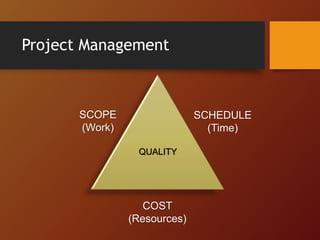
SCOPE
(Work)
SCHEDULE
(Time)
COST
(Resources)
QUALITY
Project Management
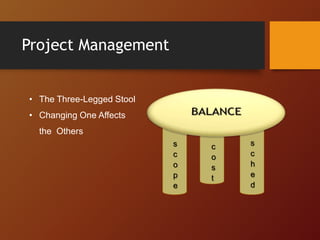
s
c
o
p
e
c
o
s
t
s
c
h
e
d
• The Three-Legged Stool
• Changing One Affects
the Others
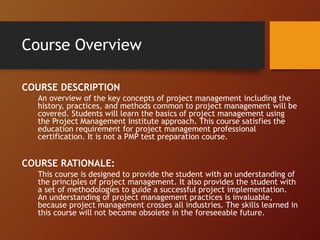
Course Overview
COURSE DESCRIPTION
An overview of the key concepts of project management including the
history, practices, and methods common to project management will be
covered. Students will learn the basics of project management using
the Project Management Institute approach. This course satisfies the
education requirement for project management professional
certification. It is not a PMP test preparation course.
COURSE RATIONALE:
This course is designed to provide the student with an understanding of
the principles of project management. It also provides the student with
a set of methodologies to guide a successful project implementation.
An understanding of project management practices is invaluable,
because project management crosses all industries. The skills learned in
this course will not become obsolete in the foreseeable future.
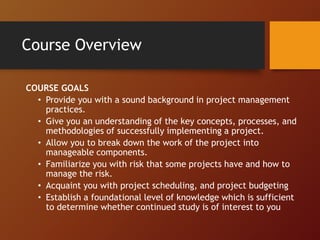
Course Overview
COURSE GOALS
• Provide you with a sound background in project management
practices.
• Give you an understanding of the key concepts, processes, and
methodologies of successfully implementing a project.
• Allow you to break down the work of the project into
manageable components.
• Familiarize you with risk that some projects have and how to
manage the risk.
• Acquaint you with project scheduling, and project budgeting
• Establish a foundational level of knowledge which is sufficient
to determine whether continued study is of interest to you
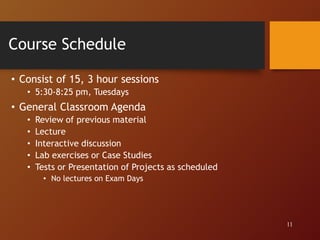
Course Schedule
• Consist of 15, 3 hour sessions
• 5:30-8:25 pm, Tuesdays
• General Classroom Agenda
• Review of previous material
• Lecture
• Interactive discussion
• Lab exercises or Case Studies
• Tests or Presentation of Projects as scheduled
• No lectures on Exam Days
11
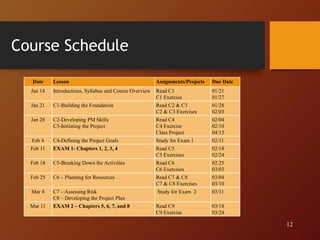
Course Schedule
12
Date Lesson Assignments/Projects Due Date
Jan 14 Introductions, Syllabus and Course Overview Read C1
C1 Exercise
01/21
01/27
Jan 21 C1-Building the Foundation Read C2 & C3
C2 & C3 Exercises
01/28
02/03
Jan 28 C2-Developing PM Skills
C3-Initiating the Project
Read C4
C4 Exercise
Class Project
02/04
02/10
04/15
Feb 4 C4-Defining the Project Goals Study for Exam 1 02/11
Feb 11 EXAM 1- Chapters 1, 2, 3, 4 Read C5
C5 Exercises
02/18
02/24
Feb 18 C5-Breaking Down the Activities Read C6
C6 Exercises
02.25
03/03
Feb 25 C6 – Planning for Resources Read C7 & C8
C7 & C8 Exercises
03/04
03/10
Mar 4 C7 – Assessing Risk
C8 – Developing the Project Plan
Study for Exam 2 03/11
Mar 11 EXAM 2 – Chapters 5, 6, 7, and 8 Read C9
C9 Exercise
03/18
03/24
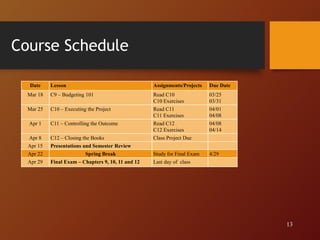
Course Schedule
13
Date Lesson Assignments/Projects Due Date
Mar 18 C9 – Budgeting 101 Read C10
C10 Exercises
03/25
03/31
Mar 25 C10 – Executing the Project Read C11
C11 Exercises
04/01
04/08
Apr 1 C11 – Controlling the Outcome Read C12
C12 Exercises
04/08
04/14
Apr 8 C12 – Closing the Books Class Project Due
Apr 15 Presentations and Semester Review
Apr 22 Spring Break Study for Final Exam 4/29
Apr 29 Final Exam – Chapters 9, 10, 11 and 12 Last day of class
Introductions - Students
• Class introductions
• Name
• Why are you taking this course? What are your expectations?
• Long Term Goal(s)
• Favorite Movie
• Your Theme Song
15
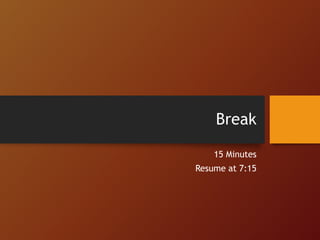
Break
15 Minutes
Resume at 7:15
Communication
• Communication is bi-directional
• Your style may different from someone else’s
• It’s your job to adapt
• Most Important Factor in Successful Projects
• Most Common Failure in Unsuccessful Projects
• Validate Assumptions Early
• Discuss Completion (Success) Criteria
• Revisit Often
Communication
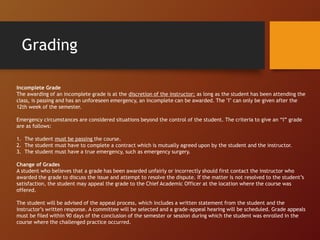
Grading
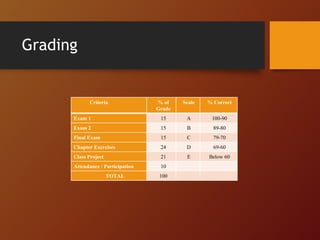
Criteria % of
Grade
Scale % Correct
Exam 1 15 A 100-90
Exam 2 15 B 89-80
Final Exam 15 C 79-70
Chapter Exercises 24 D 69-60
Class Project 21 E Below 60
Attendance / Participation 10
TOTAL 100
Grading
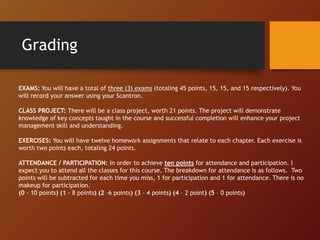
EXAMS: You will have a total of three (3) exams (totaling 45 points, 15, 15, and 15 respectively). You
will record your answer using your Scantron.
CLASS PROJECT: There will be a class project, worth 21 points. The project will demonstrate
knowledge of key concepts taught in the course and successful completion will enhance your project
management skill and understanding.
EXERCISES: You will have twelve homework assignments that relate to each chapter. Each exercise is
worth two points each, totaling 24 points.
ATTENDANCE / PARTICIPATION: In order to achieve ten points for attendance and participation. I
expect you to attend all the classes for this course. The breakdown for attendance is as follows. Two
points will be subtracted for each time you miss, 1 for participation and 1 for attendance. There is no
makeup for participation.
(0 - 10 points) (1 - 8 points) (2 –6 points) (3 – 4 points) (4 – 2 point) (5 – 0 points)
Grading
Incomplete Grade
The awarding of an incomplete grade is at the discretion of the instructor; as long as the student has been attending the
class, is passing and has an unforeseen emergency, an incomplete can be awarded. The "I" can only be given after the
12th week of the semester.
Emergency circumstances are considered situations beyond the control of the student. The criteria to give an “I” grade
are as follows:
1. The student must be passing the course.
2. The student must have to complete a contract which is mutually agreed upon by the student and the instructor.
3. The student must have a true emergency, such as emergency surgery.
Change of Grades
A student who believes that a grade has been awarded unfairly or incorrectly should first contact the instructor who
awarded the grade to discuss the issue and attempt to resolve the dispute. If the matter is not resolved to the student’s
satisfaction, the student may appeal the grade to the Chief Academic Officer at the location where the course was
offered.
The student will be advised of the appeal process, which includes a written statement from the student and the
instructor’s written response. A committee will be selected and a grade-appeal hearing will be scheduled. Grade appeals
must be filed within 90 days of the conclusion of the semester or session during which the student was enrolled in the
course where the challenged practice occurred.
Policies and Procedures
• The instructional delivery systems include, but are not limited to, a
combination of lecture, demonstration, class discussion, and individual
exercises. To meet the minimum objectives of this class successfully, students
are responsible for correctly completing all assigned units of instruction as
outlined by the instructor.
• You are expected to read the assigned material before it is covered in the
lecture. Use the Course Plan as your day-to-day guide throughout the semester.
It is a good idea to write down any questions you may have about the reading
material, for input during class discussion. Student performance will be
assessed by in-class exercises, exams, class discussion, class projects, and
attendance.
• It is important that you DO NOT fall behind in this class, because the
information and concepts in several chapters require an understanding from
the previous chapters.
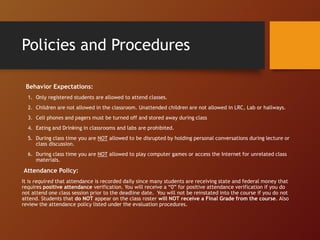
Behavior Expectations:
1. Only registered students are allowed to attend classes.
2. Children are not allowed in the classroom. Unattended children are not allowed in LRC, Lab or hallways.
3. Cell phones and pagers must be turned off and stored away during class
4. Eating and Drinking in classrooms and labs are prohibited.
5. During class time you are NOT allowed to be disrupted by holding personal conversations during lecture or
class discussion.
6. During class time you are NOT allowed to play computer games or access the Internet for unrelated class
materials.
Attendance Policy:
It is required that attendance is recorded daily since many students are receiving state and federal money that
requires positive attendance verification. You will receive a “0” for positive attendance verification if you do
not attend one class session prior to the deadline date. You will not be reinstated into the course if you do not
attend. Students that do NOT appear on the class roster will NOT receive a Final Grade from the course. Also
review the attendance policy listed under the evaluation procedures.
Policies and Procedures
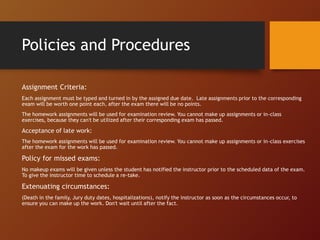
Assignment Criteria:
Each assignment must be typed and turned in by the assigned due date. Late assignments prior to the corresponding
exam will be worth one point each, after the exam there will be no points.
The homework assignments will be used for examination review. You cannot make up assignments or in-class
exercises, because they can't be utilized after their corresponding exam has passed.
Acceptance of late work:
The homework assignments will be used for examination review. You cannot make up assignments or in-class exercises
after the exam for the work has passed.
Policy for missed exams:
No makeup exams will be given unless the student has notified the instructor prior to the scheduled data of the exam.
To give the instructor time to schedule a re-take.
Extenuating circumstances:
(Death in the family, Jury duty dates, hospitalizations), notify the instructor as soon as the circumstances occur, to
ensure you can make up the work. Don't wait until after the fact.
Policies and Procedures
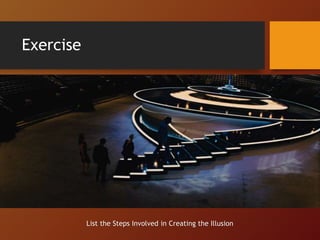
Exercise
List the Steps Involved in Creating the Illusion
Wrap Up
• Project management is
an exciting, dynamic,
rewarding profession
• Project management
skills are invaluable
throughout your
lifetime
• Project management
skills are
interdisciplinary – they
will help you in any
career
28
• This course may be the best investment of time you will ever make
Tip of the Ice Berg
• Agile Project Management
Using Scrum
• Applied Project Management
• Applied Schedule
Optimization Techniques
• Creating the Successful
Project Team
• Decision-Making Tools and
Techniques
• Executive Leadership for
PPM: Strategies
• Executive Leadership for
PPM: Tactics
• Extreme/Agile Project
Management
• Facilitation Skills for Business
Analysts
• Leadership Communication
Skills for Business Analysts
• Lean-Agile Project Management:
Achieving Business Value
• Leveraging the Customer
Relationship
• Managing Global Initiatives
• Managing Projects at Young
Companies
• Managing Projects with Microsoft
Project
• Managing Software Projects
• Managing the Development of New
Products
• Managing Without Authority
• Mastering the Project Portfolio
• PMP Examination Preparation: 35
Hour
• Principles of Business Analysis
• Project Innovation through Design
Thinking
• Project Integration and Risk
Management
• Project Leadership and
Communication
• Project Management Mastery
• Project Management Negotiation
Principles and Techniques
• Project Management Skills for
Business Analysts
• Project Procurement: Outsourcing
and Contract Management
• Project Risk Management
• Role of the Project Manager
• Schedule Optimization Techniques
for Managers
• The Strategic PMO: Projects to
Enterprise

PRM 101 Session 1

  • 1.
    Introduction to Project Management PRM101 Section 26469 Ron Levi, PMP SCPM rlevi1@wcccd.edu
  • 2.
    Session 1 • Congratulations •Attendance • Instructor Introduction • Technology Check • Course Overview • The Triple Constraint • Description • Rationale • Goals • Course Schedule • Student Introductions Break • The Most Important Skill • Grading • Policies and Procedures • Exercise • Discussion
  • 3.
    Housekeeping • Bathrooms • Cafeteria/Vending •Signup for Emergency Alert • Activate and Check your wcccd.edu email often • Positive Attendance
  • 4.
    Instructor • Ronald LeviJr, PMP, SCPM • Certifications • PMI – Project Management Professional (PMP) • IBM – Senior Certified Project Manager • Stanford University – Stanford Certified Project Manager (SCPM) • Education • B.A. Wayne State University, Psychology (Minor in Spanish) • Career • IBM , 1983-1993, Customer Service, Systems Engineering, Sales • One Nation Books and Art, Inc., 1993-1997, Entrepreneur • IBM, 1997-2009, Project Manager, Program Manager • City of Detroit, 2009-2010, Executive Assistant to the Mayor • Compuware, 2011-Present, Proposal Manager & Project Manager 4
  • 5.
    Exercise • Smart Phones? •http://PollEv.com/LeviTech • Text 20456 “your message” to 37607 • Laptops? • http://PollEv.com/LeviTech • Twitter? • @RonLeviPMP 20456 “your message”
  • 7.
  • 8.
    Project Management s c o p e c o s t s c h e d • TheThree-Legged Stool • Changing One Affects the Others
  • 9.
    Course Overview COURSE DESCRIPTION Anoverview of the key concepts of project management including the history, practices, and methods common to project management will be covered. Students will learn the basics of project management using the Project Management Institute approach. This course satisfies the education requirement for project management professional certification. It is not a PMP test preparation course. COURSE RATIONALE: This course is designed to provide the student with an understanding of the principles of project management. It also provides the student with a set of methodologies to guide a successful project implementation. An understanding of project management practices is invaluable, because project management crosses all industries. The skills learned in this course will not become obsolete in the foreseeable future.
  • 10.
    Course Overview COURSE GOALS •Provide you with a sound background in project management practices. • Give you an understanding of the key concepts, processes, and methodologies of successfully implementing a project. • Allow you to break down the work of the project into manageable components. • Familiarize you with risk that some projects have and how to manage the risk. • Acquaint you with project scheduling, and project budgeting • Establish a foundational level of knowledge which is sufficient to determine whether continued study is of interest to you
  • 11.
    Course Schedule • Consistof 15, 3 hour sessions • 5:30-8:25 pm, Tuesdays • General Classroom Agenda • Review of previous material • Lecture • Interactive discussion • Lab exercises or Case Studies • Tests or Presentation of Projects as scheduled • No lectures on Exam Days 11
  • 12.
    Course Schedule 12 Date LessonAssignments/Projects Due Date Jan 14 Introductions, Syllabus and Course Overview Read C1 C1 Exercise 01/21 01/27 Jan 21 C1-Building the Foundation Read C2 & C3 C2 & C3 Exercises 01/28 02/03 Jan 28 C2-Developing PM Skills C3-Initiating the Project Read C4 C4 Exercise Class Project 02/04 02/10 04/15 Feb 4 C4-Defining the Project Goals Study for Exam 1 02/11 Feb 11 EXAM 1- Chapters 1, 2, 3, 4 Read C5 C5 Exercises 02/18 02/24 Feb 18 C5-Breaking Down the Activities Read C6 C6 Exercises 02.25 03/03 Feb 25 C6 – Planning for Resources Read C7 & C8 C7 & C8 Exercises 03/04 03/10 Mar 4 C7 – Assessing Risk C8 – Developing the Project Plan Study for Exam 2 03/11 Mar 11 EXAM 2 – Chapters 5, 6, 7, and 8 Read C9 C9 Exercise 03/18 03/24
  • 13.
    Course Schedule 13 Date LessonAssignments/Projects Due Date Mar 18 C9 – Budgeting 101 Read C10 C10 Exercises 03/25 03/31 Mar 25 C10 – Executing the Project Read C11 C11 Exercises 04/01 04/08 Apr 1 C11 – Controlling the Outcome Read C12 C12 Exercises 04/08 04/14 Apr 8 C12 – Closing the Books Class Project Due Apr 15 Presentations and Semester Review Apr 22 Spring Break Study for Final Exam 4/29 Apr 29 Final Exam – Chapters 9, 10, 11 and 12 Last day of class
  • 15.
    Introductions - Students •Class introductions • Name • Why are you taking this course? What are your expectations? • Long Term Goal(s) • Favorite Movie • Your Theme Song 15
  • 16.
  • 18.
    Communication • Communication isbi-directional • Your style may different from someone else’s • It’s your job to adapt • Most Important Factor in Successful Projects • Most Common Failure in Unsuccessful Projects • Validate Assumptions Early • Discuss Completion (Success) Criteria • Revisit Often
  • 19.
  • 20.
    Grading Criteria % of Grade Scale% Correct Exam 1 15 A 100-90 Exam 2 15 B 89-80 Final Exam 15 C 79-70 Chapter Exercises 24 D 69-60 Class Project 21 E Below 60 Attendance / Participation 10 TOTAL 100
  • 21.
    Grading EXAMS: You willhave a total of three (3) exams (totaling 45 points, 15, 15, and 15 respectively). You will record your answer using your Scantron. CLASS PROJECT: There will be a class project, worth 21 points. The project will demonstrate knowledge of key concepts taught in the course and successful completion will enhance your project management skill and understanding. EXERCISES: You will have twelve homework assignments that relate to each chapter. Each exercise is worth two points each, totaling 24 points. ATTENDANCE / PARTICIPATION: In order to achieve ten points for attendance and participation. I expect you to attend all the classes for this course. The breakdown for attendance is as follows. Two points will be subtracted for each time you miss, 1 for participation and 1 for attendance. There is no makeup for participation. (0 - 10 points) (1 - 8 points) (2 –6 points) (3 – 4 points) (4 – 2 point) (5 – 0 points)
  • 22.
    Grading Incomplete Grade The awardingof an incomplete grade is at the discretion of the instructor; as long as the student has been attending the class, is passing and has an unforeseen emergency, an incomplete can be awarded. The "I" can only be given after the 12th week of the semester. Emergency circumstances are considered situations beyond the control of the student. The criteria to give an “I” grade are as follows: 1. The student must be passing the course. 2. The student must have to complete a contract which is mutually agreed upon by the student and the instructor. 3. The student must have a true emergency, such as emergency surgery. Change of Grades A student who believes that a grade has been awarded unfairly or incorrectly should first contact the instructor who awarded the grade to discuss the issue and attempt to resolve the dispute. If the matter is not resolved to the student’s satisfaction, the student may appeal the grade to the Chief Academic Officer at the location where the course was offered. The student will be advised of the appeal process, which includes a written statement from the student and the instructor’s written response. A committee will be selected and a grade-appeal hearing will be scheduled. Grade appeals must be filed within 90 days of the conclusion of the semester or session during which the student was enrolled in the course where the challenged practice occurred.
  • 23.
    Policies and Procedures •The instructional delivery systems include, but are not limited to, a combination of lecture, demonstration, class discussion, and individual exercises. To meet the minimum objectives of this class successfully, students are responsible for correctly completing all assigned units of instruction as outlined by the instructor. • You are expected to read the assigned material before it is covered in the lecture. Use the Course Plan as your day-to-day guide throughout the semester. It is a good idea to write down any questions you may have about the reading material, for input during class discussion. Student performance will be assessed by in-class exercises, exams, class discussion, class projects, and attendance. • It is important that you DO NOT fall behind in this class, because the information and concepts in several chapters require an understanding from the previous chapters.
  • 24.
    Behavior Expectations: 1. Onlyregistered students are allowed to attend classes. 2. Children are not allowed in the classroom. Unattended children are not allowed in LRC, Lab or hallways. 3. Cell phones and pagers must be turned off and stored away during class 4. Eating and Drinking in classrooms and labs are prohibited. 5. During class time you are NOT allowed to be disrupted by holding personal conversations during lecture or class discussion. 6. During class time you are NOT allowed to play computer games or access the Internet for unrelated class materials. Attendance Policy: It is required that attendance is recorded daily since many students are receiving state and federal money that requires positive attendance verification. You will receive a “0” for positive attendance verification if you do not attend one class session prior to the deadline date. You will not be reinstated into the course if you do not attend. Students that do NOT appear on the class roster will NOT receive a Final Grade from the course. Also review the attendance policy listed under the evaluation procedures. Policies and Procedures
  • 25.
    Assignment Criteria: Each assignmentmust be typed and turned in by the assigned due date. Late assignments prior to the corresponding exam will be worth one point each, after the exam there will be no points. The homework assignments will be used for examination review. You cannot make up assignments or in-class exercises, because they can't be utilized after their corresponding exam has passed. Acceptance of late work: The homework assignments will be used for examination review. You cannot make up assignments or in-class exercises after the exam for the work has passed. Policy for missed exams: No makeup exams will be given unless the student has notified the instructor prior to the scheduled data of the exam. To give the instructor time to schedule a re-take. Extenuating circumstances: (Death in the family, Jury duty dates, hospitalizations), notify the instructor as soon as the circumstances occur, to ensure you can make up the work. Don't wait until after the fact. Policies and Procedures
  • 26.
    Exercise List the StepsInvolved in Creating the Illusion
  • 28.
    Wrap Up • Projectmanagement is an exciting, dynamic, rewarding profession • Project management skills are invaluable throughout your lifetime • Project management skills are interdisciplinary – they will help you in any career 28 • This course may be the best investment of time you will ever make
  • 29.
    Tip of theIce Berg • Agile Project Management Using Scrum • Applied Project Management • Applied Schedule Optimization Techniques • Creating the Successful Project Team • Decision-Making Tools and Techniques • Executive Leadership for PPM: Strategies • Executive Leadership for PPM: Tactics • Extreme/Agile Project Management • Facilitation Skills for Business Analysts • Leadership Communication Skills for Business Analysts • Lean-Agile Project Management: Achieving Business Value • Leveraging the Customer Relationship • Managing Global Initiatives • Managing Projects at Young Companies • Managing Projects with Microsoft Project • Managing Software Projects • Managing the Development of New Products • Managing Without Authority • Mastering the Project Portfolio • PMP Examination Preparation: 35 Hour • Principles of Business Analysis • Project Innovation through Design Thinking • Project Integration and Risk Management • Project Leadership and Communication • Project Management Mastery • Project Management Negotiation Principles and Techniques • Project Management Skills for Business Analysts • Project Procurement: Outsourcing and Contract Management • Project Risk Management • Role of the Project Manager • Schedule Optimization Techniques for Managers • The Strategic PMO: Projects to Enterprise

Editor's Notes

  • #3 Technology Check: This presentation makes use of online polling using smart phones or other internet connected devices. This presentation also embeds several video clips. The technology check is an opportunity to assess the ability of all students to participate. If all students cannot (don’t have smart phone, etc) the course will be modified accordingly.
  • #7  Poll Title: What words come to mind when you hear the phrase "Project Management"? http://www.polleverywhere.com/free_text_polls/5nf1ayqyrrCtNK8
  • #15  Poll Title: In which part of the city do you live? http://www.polleverywhere.com/clickable_images/Jj77E5s2GyxD9Ms
  • #16 After introductions, we’ll take a 15 minute break. When we come back, I’ll give you the number one reason that people and projects fail, and I’ll tell you how to avoid it.
  • #18  Poll Title: Which of the following statements is more true of you personally? http://www.polleverywhere.com/multiple_choice_polls/R5exKGrTYI5KpAY
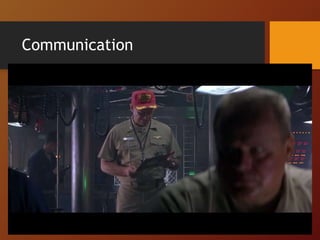
  • #19 Next, we’ll discuss grading and classroom policies and procedures. In my experience, the biggest obstacle to success and the single most common cause of project failure is the lack of effective and appropriate communication. Knowing what is expected, communicating early and often, and always demonstrating respect for one another goes a long way in keep communications open and positive. Getting on the same page and staying there is also one of the hardest things to do in Project Management. Here’s an example….
  • #27 Thaddeus (Morgan Freeman) breaks down the tasks involved in the Bank Heist Illusion. Work Breakdown Structures are created similarly.
  • #28  Poll Title: In the video clip, what are the steps involved in creating the illusion according to Thaddeus? http://www.polleverywhere.com/free_text_polls/ayReWhcP20Xur1e