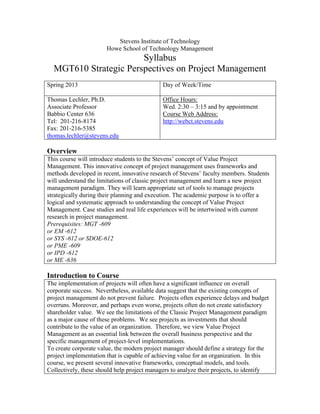
Stevens Institute of Technology
Howe School of Technology Management
Syllabus
MGT610 Strategic Perspectives on Project Management
Spring 2013 Day of Week/Time
Thomas Lechler, Ph.D.
Associate Professor
Babbio Center 636
Tel: 201-216-8174
Fax: 201-216-5385
thomas.lechler@stevens.edu
Office Hours:
Wed. 2:30 – 3:15 and by appointment
Course Web Address:
http://webct.stevens.edu
Overview
This course will introduce students to the Stevens’ concept of Value Project
Management. This innovative concept of project management uses frameworks and
methods developed in recent, innovative research of Stevens’ faculty members. Students
will understand the limitations of classic project management and learn a new project
management paradigm. They will learn appropriate set of tools to manage projects
strategically during their planning and execution. The academic purpose is to offer a
logical and systematic approach to understanding the concept of Value Project
Management. Case studies and real life experiences will be intertwined with current
research in project management.
Prerequisites: MGT -609
or EM -612
or SYS -612 or SDOE-612
or PME -609
or IPD -612
or ME -636
Introduction to Course
The implementation of projects will often have a significant influence on overall
corporate success. Nevertheless, available data suggest that the existing concepts of
project management do not prevent failure. Projects often experience delays and budget
overruns. Moreover, and perhaps even worse, projects often do not create satisfactory
shareholder value. We see the limitations of the Classic Project Management paradigm
as a major cause of these problems. We see projects as investments that should
contribute to the value of an organization. Therefore, we view Value Project
Management as an essential link between the overall business perspective and the
specific management of project-level implementations.
To create corporate value, the modern project manager should define a strategy for the
project implementation that is capable of achieving value for an organization. In this
course, we present several innovative frameworks, conceptual models, and tools.
Collectively, these should help project managers to analyze their projects, to identify
2
critical situations, to create effective solutions, and to develop a successful project
strategy improve their decisions for managing projects.
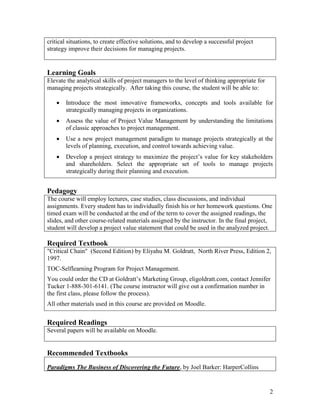
Learning Goals
Elevate the analytical skills of project managers to the level of thinking appropriate for
managing projects strategically. After taking this course, the student will be able to:
 Introduce the most innovative frameworks, concepts and tools available for
strategically managing projects in organizations.
 Assess the value of Project Value Management by understanding the limitations
of classic approaches to project management.
 Use a new project management paradigm to manage projects strategically at the
levels of planning, execution, and control towards achieving value.
 Develop a project strategy to maximize the project’s value for key stakeholders
and shareholders. Select the appropriate set of tools to manage projects
strategically during their planning and execution.
Pedagogy
The course will employ lectures, case studies, class discussions, and individual
assignments. Every student has to individually finish his or her homework questions. One
timed exam will be conducted at the end of the term to cover the assigned readings, the
slides, and other course-related materials assigned by the instructor. In the final project,
student will develop a project value statement that could be used in the analyzed project.
Required Textbook
"Critical Chain" (Second Edition) by Eliyahu M. Goldratt, North River Press, Edition 2,
1997.
TOC-Selflearning Program for Project Management.
You could order the CD at Goldratt’s Marketing Group, eligoldratt.com, contact Jennifer
Tucker 1-888-301-6141. (The course instructor will give out a confirmation number in
the first class, please follow the process).
All other materials used in this course are provided on Moodle.
Required Readings
Several papers will be available on Moodle.
Recommended Textbooks
Paradigms The Business of Discovering the Future, by Joel Barker: HarperCollins
3
Publisher, 1993.
Understanding Variation- The Key to Managing Chaos, D. Wheeler, SPC Press, 1993.
Systematic Innovation – An Introduction to TRIZ by J. Terninko, A. Zusman, B. Zlotin,
St. Lucie Press, 1998.
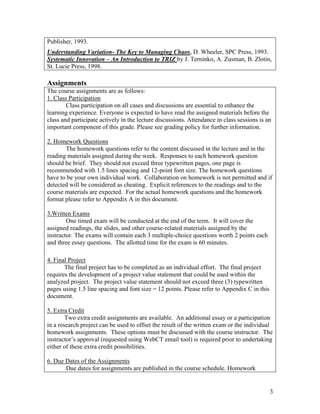
Assignments
The course assignments are as follows:
1. Class Participation
Class participation on all cases and discussions are essential to enhance the
learning experience. Everyone is expected to have read the assigned materials before the
class and participate actively in the lecture discussions. Attendance in class sessions is an
important component of this grade. Please see grading policy for further information.
2. Homework Questions
The homework questions refer to the content discussed in the lecture and in the
reading materials assigned during the week. Responses to each homework question
should be brief. They should not exceed three typewritten pages, one page is
recommended with 1.5 lines spacing and 12-point font size. The homework questions
have to be your own individual work. Collaboration on homework is not permitted and if
detected will be considered as cheating. Explicit references to the readings and to the
course materials are expected. For the actual homework questions and the homework
format please refer to Appendix A in this document.
3.Written Exams
One timed exam will be conducted at the end of the term. It will cover the
assigned readings, the slides, and other course-related materials assigned by the
instructor. The exams will contain each 3 multiple-choice questions worth 2 points each
and three essay questions. The allotted time for the exam is 60 minutes.
4. Final Project
The final project has to be completed as an individual effort. The final project
requires the development of a project value statement that could be used within the
analyzed project. The project value statement should not exceed three (3) typewritten
pages using 1.5 line spacing and font size = 12 points. Please refer to Appendix C in this
document.
5. Extra Credit
Two extra credit assignments are available. An additional essay or a participation
in a research project can be used to offset the result of the written exam or the individual
homework assignments. These options must be discussed with the course instructor. The
instructor’s approval (requested using WebCT email tool) is required prior to undertaking
either of these extra credit possibilities.
6. Due Dates of the Assignments
Due dates for assignments are published in the course schedule. Homework
4
assignments could be resubmitted. The resubmission will only be accepted within ONE
week after grading. In the absence of suitable mitigating circumstances, late submissions,
(homework assignments, final paper etc.) will not be accepted.
Submission of Assignments
All assignments have to be submitted in electronic form to the following email
address: tlechler@stevens.edu. Assignments will be only accepted if they were submitted
within the due date.
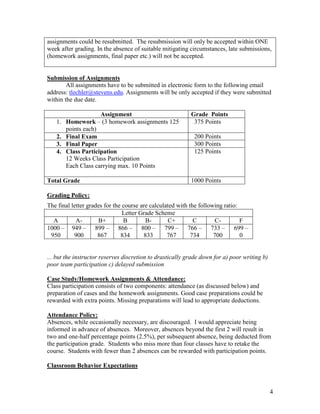
Assignment Grade Points
1. Homework – (3 homework assignments 125
points each)
375 Points
2. Final Exam 200 Points
3. Final Paper 300 Points
4. Class Participation
12 Weeks Class Participation
Each Class carrying max. 10 Points
125 Points
Total Grade 1000 Points
Grading Policy:
The final letter grades for the course are calculated with the following ratio:
Letter Grade Scheme
A A- B+ B B- C+ C C- F
1000 –
950
949 –
900
899 –
867
866 –
834
800 –
833
799 –
767
766 –
734
733 –
700
699 –
0
... but the instructor reserves discretion to drastically grade down for a) poor writing b)
poor team participation c) delayed submission
Case Study/Homework Assignments & Attendance:
Class participation consists of two components: attendance (as discussed below) and
preparation of cases and the homework assignments. Good case preparations could be
rewarded with extra points. Missing preparations will lead to appropriate deductions.
Attendance Policy:
Absences, while occasionally necessary, are discouraged. I would appreciate being
informed in advance of absences. Moreover, absences beyond the first 2 will result in
two and one-half percentage points (2.5%), per subsequent absence, being deducted from
the participation grade. Students who miss more than four classes have to retake the
course. Students with fewer than 2 absences can be rewarded with participation points.
Classroom Behavior Expectations
5
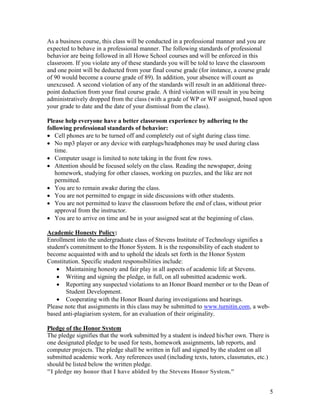
As a business course, this class will be conducted in a professional manner and you are
expected to behave in a professional manner. The following standards of professional
behavior are being followed in all Howe School courses and will be enforced in this
classroom. If you violate any of these standards you will be told to leave the classroom
and one point will be deducted from your final course grade (for instance, a course grade
of 90 would become a course grade of 89). In addition, your absence will count as
unexcused. A second violation of any of the standards will result in an additional three-
point deduction from your final course grade. A third violation will result in you being
administratively dropped from the class (with a grade of WP or WF assigned, based upon
your grade to date and the date of your dismissal from the class).
Please help everyone have a better classroom experience by adhering to the
following professional standards of behavior:
 Cell phones are to be turned off and completely out of sight during class time.
 No mp3 player or any device with earplugs/headphones may be used during class
time.
 Computer usage is limited to note taking in the front few rows.
 Attention should be focused solely on the class. Reading the newspaper, doing
homework, studying for other classes, working on puzzles, and the like are not
permitted.
 You are to remain awake during the class.
 You are not permitted to engage in side discussions with other students.
 You are not permitted to leave the classroom before the end of class, without prior
approval from the instructor.
 You are to arrive on time and be in your assigned seat at the beginning of class.
Academic Honesty Policy:
Enrollment into the undergraduate class of Stevens Institute of Technology signifies a
student's commitment to the Honor System. It is the responsibility of each student to
become acquainted with and to uphold the ideals set forth in the Honor System
Constitution. Specific student responsibilities include:
 Maintaining honesty and fair play in all aspects of academic life at Stevens.
 Writing and signing the pledge, in full, on all submitted academic work.
 Reporting any suspected violations to an Honor Board member or to the Dean of
Student Development.
 Cooperating with the Honor Board during investigations and hearings.
Please note that assignments in this class may be submitted to www.turnitin.com, a web-
based anti-plagiarism system, for an evaluation of their originality.
Pledge of the Honor System
The pledge signifies that the work submitted by a student is indeed his/her own. There is
one designated pledge to be used for tests, homework assignments, lab reports, and
computer projects. The pledge shall be written in full and signed by the student on all
submitted academic work. Any references used (including texts, tutors, classmates, etc.)
should be listed below the written pledge.
"I pledge my honor that I have abided by the Stevens Honor System."
6
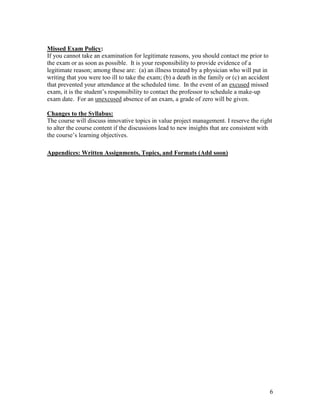
Missed Exam Policy:
If you cannot take an examination for legitimate reasons, you should contact me prior to
the exam or as soon as possible. It is your responsibility to provide evidence of a
legitimate reason; among these are: (a) an illness treated by a physician who will put in
writing that you were too ill to take the exam; (b) a death in the family or (c) an accident
that prevented your attendance at the scheduled time. In the event of an excused missed
exam, it is the student’s responsibility to contact the professor to schedule a make-up
exam date. For an unexcused absence of an exam, a grade of zero will be given.
Changes to the Syllabus:
The course will discuss innovative topics in value project management. I reserve the right
to alter the course content if the discussions lead to new insights that are consistent with
the course’s learning objectives.
Appendices: Written Assignments, Topics, and Formats (Add soon)
7
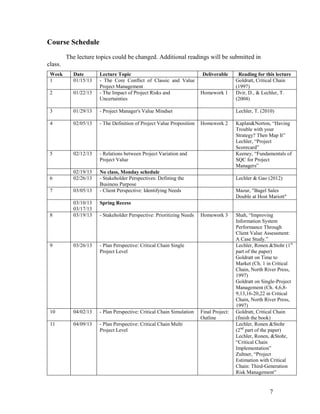
Course Schedule
The lecture topics could be changed. Additional readings will be submitted in
class.
Week Date Lecture Topic Deliverable Reading for this lecture
1 01/15/13 - The Core Conflict of Classic and Value
Project Management
Goldratt, Critical Chain
(1997)
2 01/22/13 - The Impact of Project Risks and
Uncertainties
Homework 1 Dvir, D., & Lechler, T.
(2004)
3 01/29/13 - Project Manager's Value Mindset Lechler, T. (2010)
4 02/05/13 - The Definition of Project Value Proposition Homework 2 Kaplan&Norton, “Having
Trouble with your
Strategy? Then Map It”
Lechler, “Project
Scorecard”
5 02/12/13 - Relations between Project Variation and
Project Value
Keeney, “Fundamentals of
SQC for Project
Managers”
02/19/13 No class, Monday schedule
6 02/26/13 - Stakeholder Perspectives: Defining the
Business Purpose
Lechler & Gao (2012)
7 03/05/13 - Client Perspective: Identifying Needs Mazur, "Bagel Sales
Double at Host Mariott"
03/10/13
03/17/13
Spring Recess
8 03/19/13 - Stakeholder Perspective: Prioritizing Needs Homework 3 Shah, “Improving
Information System
Performance Through
Client Value Assessment:
A Case Study.”
9 03/26/13 - Plan Perspective: Critical Chain Single
Project Level
Lechler, Ronen &Stohr (1st
part of the paper)
Goldratt on Time to
Market (Ch. 1 in Critical
Chain, North River Press,
1997)
Goldratt on Single-Project
Management (Ch. 4,6,8-
9,13,16-20,22 in Critical
Chain, North River Press,
1997)
10 04/02/13 - Plan Perspective: Critical Chain Simulation Final Project:
Outline
Goldratt, Critical Chain
(finish the book)
11 04/09/13 - Plan Perspective: Critical Chain Multi
Project Level
Lechler, Ronen &Stohr
(2nd
part of the paper)
Lechler, Ronen, &Stohr,
“Critical Chain
Implementation”
Zultner, “Project
Estimation with Critical
Chain: Third-Generation
Risk Management”
8
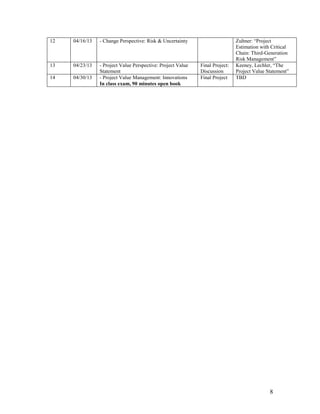
12 04/16/13 - Change Perspective: Risk & Uncertainty Zultner: “Project
Estimation with Critical
Chain: Third-Generation
Risk Management”
13 04/23/13 - Project Value Perspective: Project Value
Statement
Final Project:
Discussion
Keeney, Lechler, “The
Project Value Statement”
14 04/30/13 - Project Value Management: Innovations
In class exam, 90 minutes open book
Final Project TBD

Syllabus mgt610 2013_s

  • 1.
    Stevens Institute ofTechnology Howe School of Technology Management Syllabus MGT610 Strategic Perspectives on Project Management Spring 2013 Day of Week/Time Thomas Lechler, Ph.D. Associate Professor Babbio Center 636 Tel: 201-216-8174 Fax: 201-216-5385 thomas.lechler@stevens.edu Office Hours: Wed. 2:30 – 3:15 and by appointment Course Web Address: http://webct.stevens.edu Overview This course will introduce students to the Stevens’ concept of Value Project Management. This innovative concept of project management uses frameworks and methods developed in recent, innovative research of Stevens’ faculty members. Students will understand the limitations of classic project management and learn a new project management paradigm. They will learn appropriate set of tools to manage projects strategically during their planning and execution. The academic purpose is to offer a logical and systematic approach to understanding the concept of Value Project Management. Case studies and real life experiences will be intertwined with current research in project management. Prerequisites: MGT -609 or EM -612 or SYS -612 or SDOE-612 or PME -609 or IPD -612 or ME -636 Introduction to Course The implementation of projects will often have a significant influence on overall corporate success. Nevertheless, available data suggest that the existing concepts of project management do not prevent failure. Projects often experience delays and budget overruns. Moreover, and perhaps even worse, projects often do not create satisfactory shareholder value. We see the limitations of the Classic Project Management paradigm as a major cause of these problems. We see projects as investments that should contribute to the value of an organization. Therefore, we view Value Project Management as an essential link between the overall business perspective and the specific management of project-level implementations. To create corporate value, the modern project manager should define a strategy for the project implementation that is capable of achieving value for an organization. In this course, we present several innovative frameworks, conceptual models, and tools. Collectively, these should help project managers to analyze their projects, to identify
  • 2.
    2 critical situations, tocreate effective solutions, and to develop a successful project strategy improve their decisions for managing projects. Learning Goals Elevate the analytical skills of project managers to the level of thinking appropriate for managing projects strategically. After taking this course, the student will be able to:  Introduce the most innovative frameworks, concepts and tools available for strategically managing projects in organizations.  Assess the value of Project Value Management by understanding the limitations of classic approaches to project management.  Use a new project management paradigm to manage projects strategically at the levels of planning, execution, and control towards achieving value.  Develop a project strategy to maximize the project’s value for key stakeholders and shareholders. Select the appropriate set of tools to manage projects strategically during their planning and execution. Pedagogy The course will employ lectures, case studies, class discussions, and individual assignments. Every student has to individually finish his or her homework questions. One timed exam will be conducted at the end of the term to cover the assigned readings, the slides, and other course-related materials assigned by the instructor. In the final project, student will develop a project value statement that could be used in the analyzed project. Required Textbook "Critical Chain" (Second Edition) by Eliyahu M. Goldratt, North River Press, Edition 2, 1997. TOC-Selflearning Program for Project Management. You could order the CD at Goldratt’s Marketing Group, eligoldratt.com, contact Jennifer Tucker 1-888-301-6141. (The course instructor will give out a confirmation number in the first class, please follow the process). All other materials used in this course are provided on Moodle. Required Readings Several papers will be available on Moodle. Recommended Textbooks Paradigms The Business of Discovering the Future, by Joel Barker: HarperCollins
  • 3.
    3 Publisher, 1993. Understanding Variation-The Key to Managing Chaos, D. Wheeler, SPC Press, 1993. Systematic Innovation – An Introduction to TRIZ by J. Terninko, A. Zusman, B. Zlotin, St. Lucie Press, 1998. Assignments The course assignments are as follows: 1. Class Participation Class participation on all cases and discussions are essential to enhance the learning experience. Everyone is expected to have read the assigned materials before the class and participate actively in the lecture discussions. Attendance in class sessions is an important component of this grade. Please see grading policy for further information. 2. Homework Questions The homework questions refer to the content discussed in the lecture and in the reading materials assigned during the week. Responses to each homework question should be brief. They should not exceed three typewritten pages, one page is recommended with 1.5 lines spacing and 12-point font size. The homework questions have to be your own individual work. Collaboration on homework is not permitted and if detected will be considered as cheating. Explicit references to the readings and to the course materials are expected. For the actual homework questions and the homework format please refer to Appendix A in this document. 3.Written Exams One timed exam will be conducted at the end of the term. It will cover the assigned readings, the slides, and other course-related materials assigned by the instructor. The exams will contain each 3 multiple-choice questions worth 2 points each and three essay questions. The allotted time for the exam is 60 minutes. 4. Final Project The final project has to be completed as an individual effort. The final project requires the development of a project value statement that could be used within the analyzed project. The project value statement should not exceed three (3) typewritten pages using 1.5 line spacing and font size = 12 points. Please refer to Appendix C in this document. 5. Extra Credit Two extra credit assignments are available. An additional essay or a participation in a research project can be used to offset the result of the written exam or the individual homework assignments. These options must be discussed with the course instructor. The instructor’s approval (requested using WebCT email tool) is required prior to undertaking either of these extra credit possibilities. 6. Due Dates of the Assignments Due dates for assignments are published in the course schedule. Homework
  • 4.
    4 assignments could beresubmitted. The resubmission will only be accepted within ONE week after grading. In the absence of suitable mitigating circumstances, late submissions, (homework assignments, final paper etc.) will not be accepted. Submission of Assignments All assignments have to be submitted in electronic form to the following email address: tlechler@stevens.edu. Assignments will be only accepted if they were submitted within the due date. Assignment Grade Points 1. Homework – (3 homework assignments 125 points each) 375 Points 2. Final Exam 200 Points 3. Final Paper 300 Points 4. Class Participation 12 Weeks Class Participation Each Class carrying max. 10 Points 125 Points Total Grade 1000 Points Grading Policy: The final letter grades for the course are calculated with the following ratio: Letter Grade Scheme A A- B+ B B- C+ C C- F 1000 – 950 949 – 900 899 – 867 866 – 834 800 – 833 799 – 767 766 – 734 733 – 700 699 – 0 ... but the instructor reserves discretion to drastically grade down for a) poor writing b) poor team participation c) delayed submission Case Study/Homework Assignments & Attendance: Class participation consists of two components: attendance (as discussed below) and preparation of cases and the homework assignments. Good case preparations could be rewarded with extra points. Missing preparations will lead to appropriate deductions. Attendance Policy: Absences, while occasionally necessary, are discouraged. I would appreciate being informed in advance of absences. Moreover, absences beyond the first 2 will result in two and one-half percentage points (2.5%), per subsequent absence, being deducted from the participation grade. Students who miss more than four classes have to retake the course. Students with fewer than 2 absences can be rewarded with participation points. Classroom Behavior Expectations
  • 5.
    5 As a businesscourse, this class will be conducted in a professional manner and you are expected to behave in a professional manner. The following standards of professional behavior are being followed in all Howe School courses and will be enforced in this classroom. If you violate any of these standards you will be told to leave the classroom and one point will be deducted from your final course grade (for instance, a course grade of 90 would become a course grade of 89). In addition, your absence will count as unexcused. A second violation of any of the standards will result in an additional three- point deduction from your final course grade. A third violation will result in you being administratively dropped from the class (with a grade of WP or WF assigned, based upon your grade to date and the date of your dismissal from the class). Please help everyone have a better classroom experience by adhering to the following professional standards of behavior:  Cell phones are to be turned off and completely out of sight during class time.  No mp3 player or any device with earplugs/headphones may be used during class time.  Computer usage is limited to note taking in the front few rows.  Attention should be focused solely on the class. Reading the newspaper, doing homework, studying for other classes, working on puzzles, and the like are not permitted.  You are to remain awake during the class.  You are not permitted to engage in side discussions with other students.  You are not permitted to leave the classroom before the end of class, without prior approval from the instructor.  You are to arrive on time and be in your assigned seat at the beginning of class. Academic Honesty Policy: Enrollment into the undergraduate class of Stevens Institute of Technology signifies a student's commitment to the Honor System. It is the responsibility of each student to become acquainted with and to uphold the ideals set forth in the Honor System Constitution. Specific student responsibilities include:  Maintaining honesty and fair play in all aspects of academic life at Stevens.  Writing and signing the pledge, in full, on all submitted academic work.  Reporting any suspected violations to an Honor Board member or to the Dean of Student Development.  Cooperating with the Honor Board during investigations and hearings. Please note that assignments in this class may be submitted to www.turnitin.com, a web- based anti-plagiarism system, for an evaluation of their originality. Pledge of the Honor System The pledge signifies that the work submitted by a student is indeed his/her own. There is one designated pledge to be used for tests, homework assignments, lab reports, and computer projects. The pledge shall be written in full and signed by the student on all submitted academic work. Any references used (including texts, tutors, classmates, etc.) should be listed below the written pledge. "I pledge my honor that I have abided by the Stevens Honor System."
  • 6.
    6 Missed Exam Policy: Ifyou cannot take an examination for legitimate reasons, you should contact me prior to the exam or as soon as possible. It is your responsibility to provide evidence of a legitimate reason; among these are: (a) an illness treated by a physician who will put in writing that you were too ill to take the exam; (b) a death in the family or (c) an accident that prevented your attendance at the scheduled time. In the event of an excused missed exam, it is the student’s responsibility to contact the professor to schedule a make-up exam date. For an unexcused absence of an exam, a grade of zero will be given. Changes to the Syllabus: The course will discuss innovative topics in value project management. I reserve the right to alter the course content if the discussions lead to new insights that are consistent with the course’s learning objectives. Appendices: Written Assignments, Topics, and Formats (Add soon)
  • 7.
    7 Course Schedule The lecturetopics could be changed. Additional readings will be submitted in class. Week Date Lecture Topic Deliverable Reading for this lecture 1 01/15/13 - The Core Conflict of Classic and Value Project Management Goldratt, Critical Chain (1997) 2 01/22/13 - The Impact of Project Risks and Uncertainties Homework 1 Dvir, D., & Lechler, T. (2004) 3 01/29/13 - Project Manager's Value Mindset Lechler, T. (2010) 4 02/05/13 - The Definition of Project Value Proposition Homework 2 Kaplan&Norton, “Having Trouble with your Strategy? Then Map It” Lechler, “Project Scorecard” 5 02/12/13 - Relations between Project Variation and Project Value Keeney, “Fundamentals of SQC for Project Managers” 02/19/13 No class, Monday schedule 6 02/26/13 - Stakeholder Perspectives: Defining the Business Purpose Lechler & Gao (2012) 7 03/05/13 - Client Perspective: Identifying Needs Mazur, "Bagel Sales Double at Host Mariott" 03/10/13 03/17/13 Spring Recess 8 03/19/13 - Stakeholder Perspective: Prioritizing Needs Homework 3 Shah, “Improving Information System Performance Through Client Value Assessment: A Case Study.” 9 03/26/13 - Plan Perspective: Critical Chain Single Project Level Lechler, Ronen &Stohr (1st part of the paper) Goldratt on Time to Market (Ch. 1 in Critical Chain, North River Press, 1997) Goldratt on Single-Project Management (Ch. 4,6,8- 9,13,16-20,22 in Critical Chain, North River Press, 1997) 10 04/02/13 - Plan Perspective: Critical Chain Simulation Final Project: Outline Goldratt, Critical Chain (finish the book) 11 04/09/13 - Plan Perspective: Critical Chain Multi Project Level Lechler, Ronen &Stohr (2nd part of the paper) Lechler, Ronen, &Stohr, “Critical Chain Implementation” Zultner, “Project Estimation with Critical Chain: Third-Generation Risk Management”
  • 8.
    8 12 04/16/13 -Change Perspective: Risk & Uncertainty Zultner: “Project Estimation with Critical Chain: Third-Generation Risk Management” 13 04/23/13 - Project Value Perspective: Project Value Statement Final Project: Discussion Keeney, Lechler, “The Project Value Statement” 14 04/30/13 - Project Value Management: Innovations In class exam, 90 minutes open book Final Project TBD